


- Clean-label claims can support premium pricing in sports drinks, but only when hydration performance, electrolyte balance, taste, and convenience are already strong.
- Buyers are willing to pay more for low-sugar, sugar-free, natural-flavor, organic, plant-based, coconut-water-based, and functional electrolyte sports drinks, but verified public data does not show one universal sports drink clean-label premium.
- The strongest premium opportunity sits in ready-to-drink sports drinks, electrolyte drinks, hydration powders, tablets, endurance hydration, gym-focused products, and everyday active hydration formats.
- Clean label is more valuable in sports drinks when it reduces buyer concerns around high sugar, artificial additives, synthetic colors, unnecessary calories, and unclear functional claims.
- The biggest risk is treating clean label as a marketing claim only. In sports drinks, buyers pay for clean hydration only when the product also delivers performance, taste, convenience, and repeat-use value.
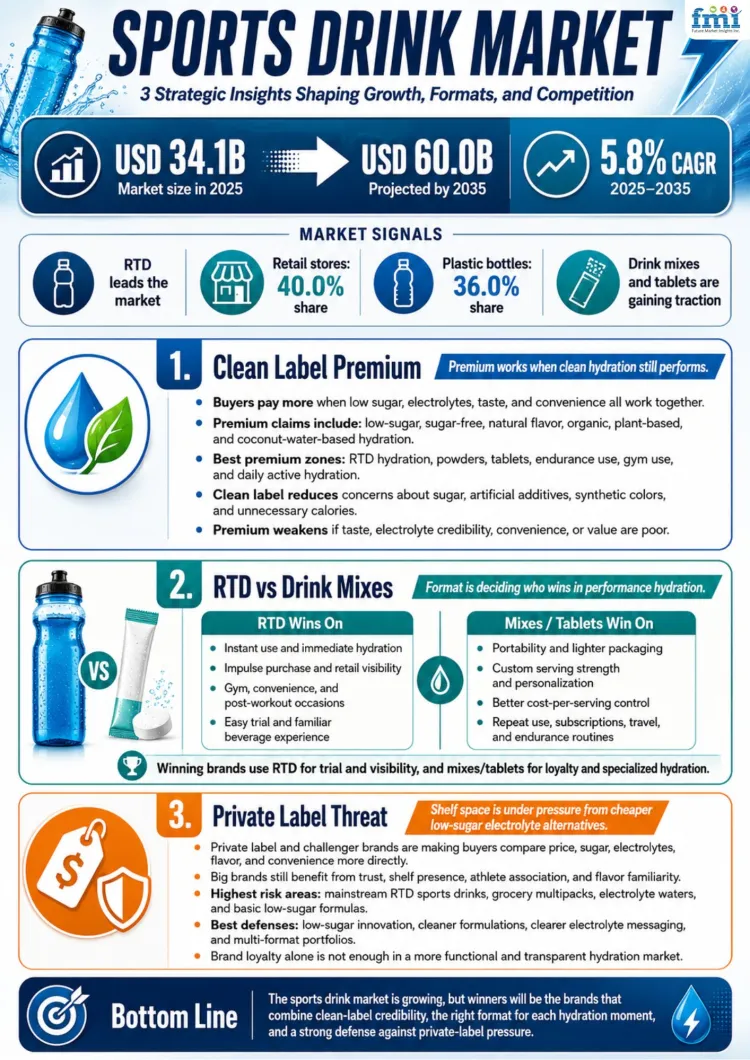
Clean label is becoming a more important premium lever in the sports drink market, but it is not replacing the basic promise of the category. Sports drinks are still purchased for hydration, electrolyte replenishment, energy support, refreshment, and recovery after physical activity. What is changing is the buyer’s definition of a good sports drink. The old formula of sugar, color, flavor, and athlete branding is no longer enough for every consumer. A growing share of buyers now wants hydration that feels cleaner, lighter, lower in sugar, more natural, and suitable for frequent use. Future Market Insights values the global sports drink market at USD 34.1 billion in 2025 and projects it to reach USD 60.0 billion by 2035, growing at a 5.8% CAGR. This growth gives brands room to premiumize, but only when clean-label positioning is linked to clear hydration value.
The clean-label premium in sports drinks is being shaped by a simple question: will the buyer pay more for hydration that feels healthier without losing performance? For athletes, gym users, runners, cyclists, outdoor workers, and active lifestyle consumers, the answer can be yes. However, the premium is not automatic. A low-sugar sports drink can sell at a stronger price only when it still tastes good and delivers credible electrolyte replenishment. A natural-flavor sports drink can gain attention only when the flavor feels enjoyable and not weak. A plant-based or coconut-water-based sports drink can support premium positioning only when the product has a clear functional reason to exist. In this category, clean label helps defend price, but it does not rescue poor taste, thin hydration claims, weak electrolyte levels, or poor availability.
Low sugar is one of the strongest clean-label premium drivers in sports drinks because it responds directly to one of the category’s biggest concerns. Many consumers still associate traditional sports drinks with high sugar, artificial colors, and unnecessary calories. That perception creates space for sugar-free, reduced-sugar, naturally sweetened, and lighter electrolyte drinks. These products can attract consumers who want hydration support during workouts but do not want the calorie load of older sports drink formats. FMI also identifies low-sugar variants as a major route for sports drink brands to widen appeal among health-conscious consumers.
Natural electrolytes are another important part of the clean-label premium. Consumers are not only looking at whether a sports drink contains electrolytes; they are also looking at how the electrolyte story is communicated. Sodium, potassium, magnesium, and calcium are becoming more visible on labels because they help buyers understand the product’s hydration role. The premium becomes stronger when the brand explains why these electrolytes matter and when the formula matches a real use case, such as heavy sweating, endurance activity, gym recovery, daily hydration, or hot-weather consumption. A sports drink that simply says “electrolytes” without a clear formulation story may struggle to justify a higher price.
Ready-to-drink formats remain especially important for clean-label premium sports drinks because the usage occasion is often immediate. Buyers want the product to be available when they are thirsty, tired, overheated, or leaving a workout. FMI notes that plastic bottles are expected to lead packaging with a 36.0% share, while retail stores are projected to account for 40.0% of distribution channel share in 2025. This shows that convenience, shelf visibility, and grab-and-go access remain major purchase factors. A clean-label sports drink may have a better ingredient deck, but it still needs to win in coolers, gyms, retail stores, convenience channels, and online replenishment.
The premium opportunity is also expanding beyond ready-to-drink bottles. Hydration powders, electrolyte tablets, stick packs, and drink mixes are becoming more important because they give consumers control over serving size, sweetness, portability, and usage frequency. The hydration supplement market supports this shift, with FMI projecting the market to expand from USD 41.8 billion in 2026 to USD 89.4 billion by 2036 at a 7.9% CAGR. Electrolyte tablets and powders are expected to dominate product share, while sports nutrition leads the application segment. This matters for sports drink brands because clean-label buyers are often willing to compare formats, ingredient lists, electrolyte levels, and cost per serving before choosing a product.
Plant-based hydration also gives sports drink brands a premium route, especially when the product is positioned around natural ingredients, lighter formulations, and everyday wellness. Coconut water is one of the strongest natural hydration cues because it already has a consumer association with electrolytes and refreshment. However, coconut-water-based sports drinks still need to overcome taste, price, sugar, and performance questions. A coconut-water sports drink can command a premium when it offers a cleaner base, better flavor, and a credible hydration profile. It is weaker when it feels like a wellness claim without enough sports-drink functionality.
Organic and non-GMO claims can support a premium, but they are not the main reason most sports drink buyers purchase. In this market, clean-label certifications are usually secondary to hydration performance, taste, format, and price. A buyer may appreciate organic ingredients, no artificial colors, natural flavors, or non-GMO positioning, but these claims become commercially valuable only when the product still works as a sports drink. The strongest clean-label products will combine functional electrolytes, low or controlled sugar, transparent labeling, good taste, and convenient packaging.
The clean-label premium is also affected by how frequently the product is used. A consumer who drinks a sports drink once in a while may be more price-sensitive and choose a familiar mainstream brand. A consumer who uses hydration products several times a week may care more about sugar, ingredients, artificial additives, and electrolyte strength. This creates a premium opening among repeat users. Clean label is more valuable when the product becomes part of a routine: before workouts, during training, after exercise, during travel, in hot weather, or as a daily hydration aid.
However, the market also carries risk. Sports drinks face competition from electrolyte water, hydration supplements, coconut water, plant-based energy drinks, and private-label alternatives. FMI’s electrolyte drinks market data shows that ready-to-drink electrolyte formats are expected to hold a leading 54.0% share in 2025, which indicates how strongly the hydration message is spreading across adjacent beverage categories. This means sports drink brands cannot depend only on legacy category recognition. They must prove why their clean-label hydration product is better than cheaper, simpler, or more specialized alternatives.
The biggest mistake would be treating clean label as decoration. In sports drinks, clean label cannot be just a front-of-pack phrase. Buyers will look for evidence in the ingredient list, sugar content, electrolyte profile, flavor system, calorie count, and usage occasion. If the drink claims to be clean but contains confusing ingredients, excessive sweetness, weak electrolytes, or unclear benefits, the premium becomes difficult to defend. Clean label works best when it reduces doubt. It tells the buyer that the product is not overloaded with artificial additives, does not carry unnecessary sugar, and can fit better into an active lifestyle.
For large brands, clean label is a way to protect share as the sports drink category becomes more segmented. Established brands can use low-sugar lines, natural flavors, functional electrolyte extensions, and better-for-you sub-brands to retain buyers who are moving toward cleaner hydration. For emerging brands, clean label is a way to enter the market with a sharper promise. A startup does not need to compete with legacy brands on every flavor and channel immediately. It can win by targeting endurance athletes, gym consumers, clean-label shoppers, women’s fitness, youth sports parents, travel hydration, or daily wellness buyers.
The strongest premium zone is likely to sit where clean label and functional specificity overlap. A general clean sports drink may face price resistance. A low-sugar electrolyte drink for heavy sweat recovery, a natural hydration powder for endurance athletes, a plant-based RTD sports drink for everyday active consumers, or a clean-label tablet for travel and gym use can defend a stronger value proposition. The more specific the hydration need, the easier it is to justify a higher price.
Clean label in sports drinks is therefore not one single premium. It is a set of premium conditions. Buyers may pay more when the drink reduces sugar concerns, avoids artificial additives, uses recognizable ingredients, delivers credible electrolytes, tastes good, and is easy to consume. They are less likely to pay more when clean label is the only difference. In the sports drink market, the winning formula is not simply clean ingredients. It is clean hydration that performs.

