


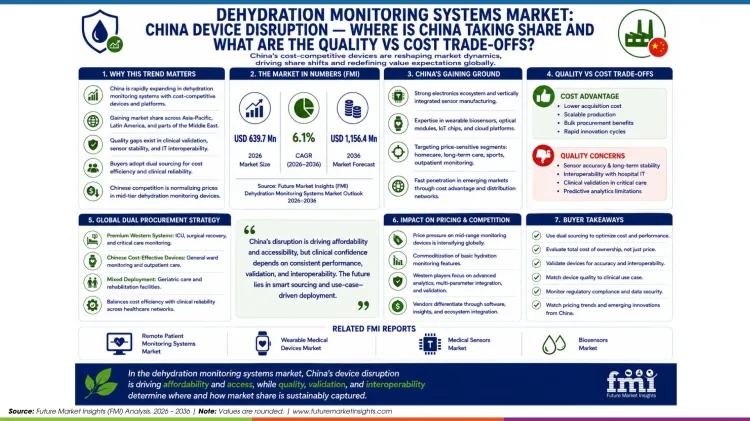
- The dehydration monitoring systems market is projected to reach USD 1,156.4 million by 2036 from USD 639.7 million in 2026, growing at a CAGR of 6.1% during the forecast period 2026-2036 due to increasing adoption of remote patient monitoring and wearable biosensors.
- China is aggressively growing its footprint in dehydration monitoring systems with cost-competitive wearable sensors, biosensor modules, and integrated IoT-based patient monitoring platforms.
- Chinese manufacturers are grabbing market share in the Asia-Pacific, Latin America and parts of the Middle East with low-cost alternatives to premium Western hydration monitoring systems.
- High end hospital procurement has major gaps in clinical validation, long term sensor stability and interoperability with hospital IT systems.
- Global buyers are increasingly going in for dual sourcing, buying premium systems for ICU-grade monitoring and Chinese devices for general and outpatient applications.
- Price normalization is accelerating across mid-tier dehydration monitoring devices, due to competitive pressure from China, impacting the economics of global procurement.
Main Article Body
The dehydration monitoring systems market is experiencing structural changes due to the rapid growth of China's medical device manufacturing capabilities. As global healthcare systems transition to models of continuous patient monitoring and preventative care, China is starting to come up as a critical disruptor in the mid-to-low cost segment of hydration monitoring technologies.
According to Future Market Insights, by 2036 the market is projected to reach USD 1,156.4 million from USD 639.7 million in 2026, growing at a CAGR of 6.1%. This steady growth is indicative of growing integration of hydration tracking in wearable medical devices, remote patient monitoring systems and digital health ecosystems.
But beneath this growth narrative, China’s aggressive expansion in the production of sensors, IoT-enabled healthcare devices and AI-integrated physiological monitoring platforms is remaking the competitive landscape.
China’s Expanding Role in Dehydration Monitoring Supply Chains
China's dominance in the dehydration monitoring systems market is largely attributed to its robust electronics manufacturing ecosystem and vertically integrated sensor manufacturing.
The country has developed considerable expertise in:
- Fabrication of wearable biosensors
- Water detection optical modules
- Energy-efficient IoT health monitoring chip
- Patient monitoring systems connected to the cloud
These capabilities allow Chinese manufacturers to produce dehydration monitoring devices at a fraction of the cost of their Western counterparts.
As a result Chinese companies are aiming at more and more price sensitive segments like:
- Home healthcare monitoring
- Long-term care facilities
- Water consumption monitor for sports and fitness
- Outpatient & post discharge monitoring programs
This has led to quick penetration in emerging healthcare markets in Asia-Pacific, Latin America and parts of Eastern Europe.
Mid-Tier Monitoring Devices Market Share Change
The most obvious disruption China is causing is to mid-tier dehydration monitoring systems. Such devices typically include wearable hydration sensors, patch-based biosensors and mobile-connected monitoring kits.
Why Chinese manufacturers are gaining share in these segments:
- Reduce device acquisition cost
- Quick scaling of production
- Bulk purchasing strategies for hospitals
- Development of distribution networks in underdeveloped regions
However, this cost advantage is also driving the global commoditization of mid-range hydration monitoring devices.
Western manufacturers are under more pressure to differentiate on advanced analytics, multi-parameter integration and clinical validation rather than hardware pricing.
trade-off between quality and cost in clinical adoption
Chinese dehydration monitoring systems have great cost competitiveness, but they are challenged in high acuity clinical environments.
Hospitals and specialty care centers are still focused on:
- High sensor precision for crucial dehydration detection
- long term calibration stability
- Regulatory adherence in FDA- and CE-controlled markets
- Seamless integration with electronic health records (EHR) and ICU monitoring systems
In contrast, lower-cost devices tend to have limitations in:
- Consistency of signal in long-term monitoring
- Interoperability with hospital-grade monitoring infrastructure
- Validation in Critical Care Settings
- Predictive analytics for the risk of severe dehydration
Chinese devices are therefore more widely accepted in non-critical environments with premium systems being the choice for ICU and emergency care applications.
Global Dual Procurement Strategy Emerging
Healthcare providers are adopting hybrid procurement models to meet the dual needs of cost and performance.
Usually this method includes:
- Western premium systems for ICU and surgical recovery and critical care monitoring
- Chinese low-cost devices for general ward monitoring and outpatient care
- Mixed deployment in geriatric care and rehabilitation facilities
This dual structure allows hospitals to optimize on capital expenditure and keep clinical reliability where it matters most.
It also allows for greater deployment of hydration monitoring systems across healthcare networks that previously lacked budget flexibility.
Influence on World Pricing and Competition
Growth in China is putting pressure on mid-range devices in the dehydration monitoring systems market to lower prices. This is especially evident in wearable hydration sensors, where the price competition has grown significantly.
In response, global manufacturers are:
- Moving to subscription-based monitoring platforms
- Hardware combined with cloud analytics services
- Increasing interest in integration of multi-vital signs
- Invest in AI-powered predictive dehydration risk models
This change is slowly moving the market away from hardware-based competition to ecosystem-based differentiation.
Emerging Markets: Hotbeds for Adoption
Chinese Dehydration Monitoring System Market Emerging economies are the biggest drivers of growth. Healthcare systems in these areas are challenged by:
- Limited advanced monitoring support reimbursement
- Budget constraints of public hospitals
- High patient volume, low healthcare expenditure per capita
These conditions make Chinese low cost systems very attractive for rapid deployment.
But as healthcare infrastructure gets more sophisticated, demand should slowly shift toward more accurate integrated monitoring platforms.
This provides a window of opportunity for transition, with China continuing to gain share before premium systems reclaim dominance in high-acuity care settings.
Long-term strategic thinking
China’s disruption is not wiping out premium players, but reshaping the competitive hierarchy of the dehydration monitoring systems market.
The market is moving into three levels of market:
- Western manufacturers leading premium clinical-grade systems
- Mid-tier wearable monitoring devices - China-led disruption, well-contested
- China-dominated, volume-driven low-cost basic monitoring solutions segment
Further convergence between hardware, software and analytics platforms is anticipated to continue this segmentation during the forecast period
Bottom Line
China’s rise in the dehydration monitoring systems market is fundamentally reshaping the global competitive landscape as it accelerates cost compression in mid-tier devices and strengthens premium differentiation in the critical care space. With the market continuing to grow at a steady CAGR of 6.1% through 2036, competitive advantage is increasingly based on ecosystem integration rather than standalone device performance.

