

- Market Size (2026)
- USD 568.0 Mn
- Forecast (2036)
- USD 1382.2 Mn
- CAGR (2026 to 2036)
- 9.3%
How big is Lactation Nutrition Products Market in 2026?
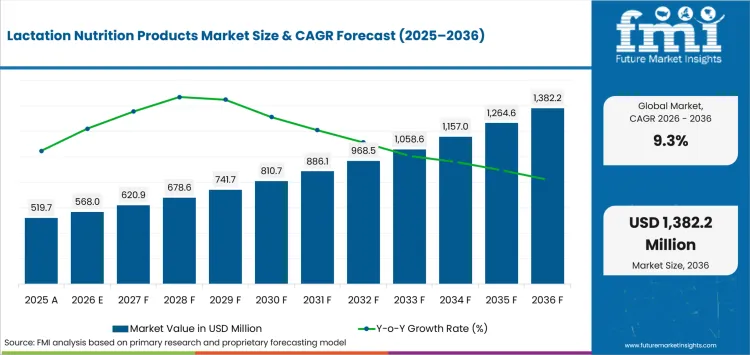
USD 568.0 Million in 2026 and USD 1382.2 Million by 2036 at a 9.3% CAGR.
The lactation nutrition products market is forecast to reach USD 1382.2 Million in 2036. Starting from USD 568.0 Million in 2026, this represents a 9.3% CAGR . The market was worth USD 519.7 Million in 2025. Postpartum hunger, limited time and concerns about milk supply can prompt product purchases. CDC data published in 2026 show breastfeeding participation declining between birth and six months. Snacks, drink mixes and supplements are sold into that period, but they serve different nutritional and practical needs. Labels should explain ingredients, allergens and benefit limits, with products remaining optional support alongside appropriate lactation care.
USA buyers can find lactation products through mass retail and direct websites. South Korean postpartum-care centers offer another point of discovery. UK pharmacy and midwifery advice can influence decisions about herbal ingredients, while Japanese distribution needs local-language education and careful claims. Convenient delivery matters, but a product page should also make it easy to find safety information and understand when professional support is needed.
Key Takeaways of Lactation Nutrition Products Market
- Lactation Supplements (Galactagogues) account for 37.3% of product revenue in 2026. Their compact format fits a repeat routine, although product classification does not establish effectiveness for an individual mother.
- The Oats & Brewer's Yeast category represents 43.5% of ingredient revenue in 2026. These ingredients appear in food and powder formats that are easy to incorporate into ordinary meals or snacks.
- Snacks & Bakery holds 49.4% of form revenue in 2026. Convenient portions can be eaten during feeding or pumping without preparing another meal.
- First-Time Mothers account for 48.7% of buyer revenue in 2026. Questions about feeding and perceived supply can increase interest in advice and product information.
- Online / DTC represents 44.6% of sales in 2026. Home delivery and easy reordering suit households with limited time for shopping.
- Opportunity: Transparent low-sugar formats and professional referral pathways can convert cautious trial into sustained use.
- Companies include Munchkin (Milkmakers), Boobie Superfoods, Oat Mama, UpSpring, Legendairy Milk, Pink Stork, Traditional Medicinals.
Analyst Perspective
"Convenient nutrition can support a demanding postpartum routine. Brands need to explain the ingredients and limits of the product without presenting it as a substitute for skilled lactation care."
- Anurag Sharma, Principal Consultant, Future Market Insights
How is the Lactation Nutrition Products Market segmented?
The market is assessed by Product Type, Key Ingredient, Form, Buyer, Sales Channel, and Region.
By Product Type: Lactation Supplements (Galactagogues), Lactation Cookies & Bars, Lactation Teas & Drinks, Lactation Protein Powders, Others; By Key Ingredient: Oats & Brewer's Yeast, Fenugreek, Moringa, Shatavari & Botanicals, Others; By Form: Snacks & Bakery, Powders, Capsules, Beverages; By Buyer: First-Time Mothers, Experienced Mothers, Gifting; By Sales Channel: Online / DTC, Retail Pharmacy, Supermarkets & Hypermarkets, Specialty & Health Stores, Others.
Why do lactation supplements (galactagogues) lead demand within the product type category?
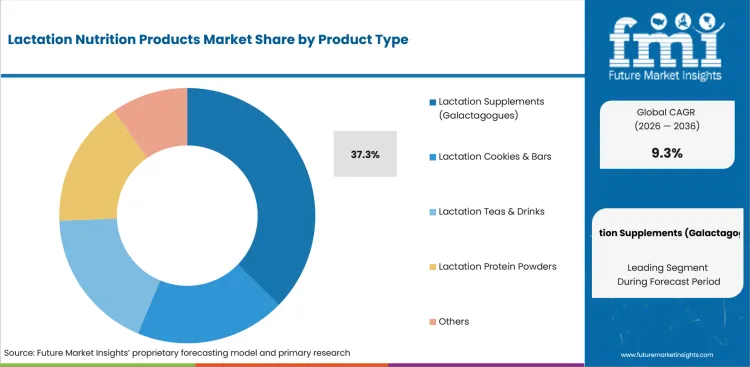
Supplements concentrate the purchase decision into an ingredient-led daily routine. Capsules are portable and easy to store. Drink mixes can be used during a pump session. Powdered blends allow adjustable serving patterns. This structure appeals to mothers seeking a defined intervention after noticing a supply concern. It also gives brands room to differentiate by fenugreek-free formulas, botanical combinations, or targeted cautions. The format carries a higher evidence burden than an ordinary snack because consumers may interpret measured servings as stronger efficacy. Suppliers that pair transparent labels with restrained claims can preserve the convenience advantage without implying that a supplement replaces latch correction or adequate milk removal. Lactation-positioned dietary supplements require clear ingredient information and appropriately supported claims.
- Lactation Supplements (Galactagogues) account for 37.3% of Product Type revenue in 2026. Their compact and doseable format supports repeat routines.
- Legendairy Milk announced on April 27, 2026 that it was expanding its product line in Target stores and on Target.com, with Brewer's Yeast moving from limited distribution to full-chain availability alongside new women's wellness products covering hydration, mood, and hair health.
Why do oats & brewer's yeast lead demand within the key ingredient category?
Oats and brewer's yeast bridge maternal nutrition with lactation positioning. Both ingredients fit cookies and bars. They also work in powders and home baking. Their food familiarity lowers the psychological barrier faced by consumers who are cautious about a concentrated herbal capsule. Oats also support texture and satiety in a snack. Brewer's yeast gives brands a recognizable lactation cue without requiring a tea ritual. This combination makes the ingredient pair useful across trial, gifting, and replenishment. It does not remove the need for evidence or careful claims. Its commercial strength rests on familiarity and format flexibility rather than a guaranteed effect on milk output. The ingredient choice also distinguishes snack formulations from herbal tea products used in a separate preparation routine.
- Oats & Brewer's Yeast represent 43.5% of Key Ingredient revenue in 2026. They support broad use across food and powder formats.
- Target reported in March 2025 that it added Oat Mama lactation oat bars and supplements to its expanded postpartum assortment.
Why do snacks & bakery lead demand within the form category?
Snacks and bakery products solve two jobs in one purchase. They provide portable food while presenting ingredients associated with lactation support. A bar or cookie can be eaten one-handed beside a pump bag or night-feeding station. It is also easier to gift than a capsule regimen. These features expand trial among shoppers who do not identify as supplement users. Repeat purchase still depends on acceptable taste and texture. Sugar profile and allergen disclosure also influence trust. Eating quality must justify the premium as clearly as the lactation message. Snacks share convenience-led demand with breastfeeding protein beverages, although formulations and claims differ.
- Snacks & Bakery hold 49.4% of Form revenue in 2026. Convenience and food value make the format compatible with frequent postpartum use.
- Munchkin announced in August 2016 that its acquisition of Milkmakers brought lactation cookies and teas into the company's infant-feeding portfolio.
Why do first-time mothers lead demand within the buyer category?
First-time mothers face a larger information gap around normal feeding patterns, perceived supply, and the signs that an infant is receiving enough milk. That uncertainty increases search activity and makes peer reviews or professional recommendations commercially influential. The buyer may also be learning to distinguish a temporary supply concern from a latch problem or an ineffective pumping routine. Simple instructions and visible cautions help buyers understand appropriate use. Brands must avoid exploiting anxiety. Strong positioning explains the product's nutritional role and the circumstances that require a lactation professional or clinician. This approach supports trust beyond the first purchase and reduces disappointment caused by unrealistic expectations. First-time mothers encounter these products within a broader postnatal nutrition and recovery routine.
- First-Time Mothers account for 48.7% of Buyer revenue in 2026. Their greater need for reassurance increases discovery and guided trial.
- Japan's Ministry of Health, Labour and Welfare reported in August 2016 that 40.7% of mothers in its 2015 survey were unsure whether breast milk was sufficient.
Why does online / DTC lead demand within the sales channel category?
Online and direct-to-consumer channels match the timing of postpartum demand. Mothers can shop outside store hours and compare a wide assortment without leaving home. Brand sites also carry ingredient explanations and usage guidance. Reviews, bundles, and subscriptions are harder to fit on a retail shelf. This education layer is especially useful for niche botanicals or allergen-aware formats. The channel can also amplify weak claims and unverified testimonials. Credible operators separate traditional use from demonstrated benefit. They disclose serving limits and direct persistent supply concerns toward skilled care. Prompt delivery and dependable replenishment support continued use when the product is useful to the buyer. Online product information should explain maternal nutrition ingredients without implying that every ingredient improves lactation.
- Online / DTC captures 44.6% of Sales Channel revenue in 2026. Wide assortment and replenishment access fit time-constrained postpartum households.
- UpSpring published a lactation-support explainer in November 2024 that paired consumer education with its Milkflow drink-mix proposition.
What are the drivers, restraints and opportunities in the Lactation Nutrition Products Market?
High breastfeeding participation and supply uncertainty support demand, while variable efficacy and botanical safety questions restrain conversion, and clearer adjunct positioning opens the next growth path.
- Driver: Breastfeeding continuation challenges create demand for convenient food, beverage, and supplement support.
- Restraint: Uneven evidence and ingredient-safety concerns weaken clinician recommendation and repeat purchase.
- Opportunity: Transparent low-sugar formats and professional referral pathways can convert cautious trial into sustained use.
The difficulties of continuing breastfeeding create interest in convenient food, drinks and supplements. CDC data updated in July 2026 show that 86.1% of USA children born in 2023 were ever breastfed, compared with 62.8% at six months. Pumping schedules, fatigue and perceived supply changes can prompt mothers to look for support. Bars provide an easy snack, while capsules and drink mixes fit other routines. These products remain adjuncts to a feeding plan, not evidence that milk production will increase.
Evidence uncertainty appears at the point of recommendation and repeat purchase. A 2023 randomized controlled trial published in The American Journal of Clinical Nutrition found no evidence that the tested lactation cookies increased human milk production among parents with overall adequate perceived supply. FDA guidance also states that dietary supplements are not reviewed or approved for safety before sale. These findings make accurate claims and ingredient disclosure central to trust. Retailers and pharmacists are more likely to support products that state traditional use accurately, avoid guaranteed outcomes, and include a clear escalation path for persistent low supply.
Transparent labels and practical food formats can help buyers make an informed choice. Third-party testing, complete allergen information and lower-sugar options address specific concerns, while instructions should explain when professional advice is needed. Target’s March 2025 addition of Oat Mama bars and supplements to its postpartum assortment places these products beside related purchases. Convenience can sustain demand when the product’s limitations are as clear as its intended use.
Which country CAGRs are profiled in the Lactation Nutrition Products Market?
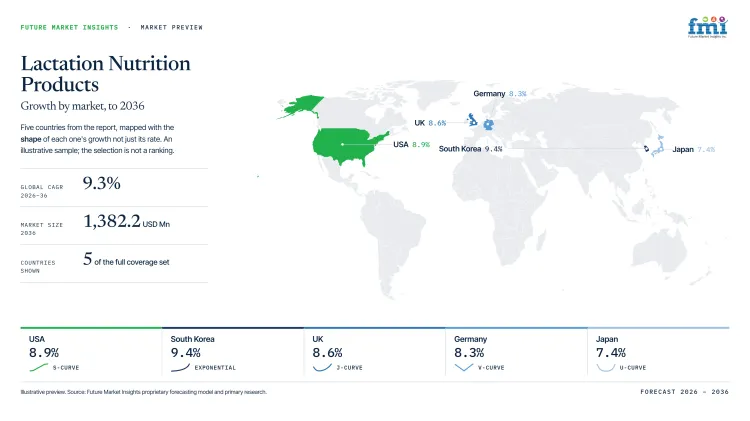
| Country | CAGR (2026 to 2036) |
|---|---|
| USA | 8.9% |
| UK | 8.6% |
| Germany | 8.3% |
| Japan | 7.4% |
| South Korea | 9.4% |
How do country-level CAGRs compare in the lactation nutrition products market?
South Korea’s 9.4% CAGR is the highest forecast, followed by the USA at 8.9%, the UK at 8.6% and Germany at 8.3%. Japan’s 7.4% gives a 2.0 percentage-point range over 2026 to 2036. Postpartum care arrangements influence where products are discovered and who advises the buyer. The growth rates help plan expansion, but current market scale, claim rules and willingness to pay still affect local sales.
- CDC’s July 2026 breastfeeding figures show participation declining between birth and six months. Products sold during this period need clear ingredients and restrained claims, with persistent supply concerns referred for skilled lactation support.
- The July 2026 Infant Feeding Survey reported different six-month breastfeeding rates for first-time and experienced mothers. Ingredient and interaction questions make pharmacy and midwifery advice relevant to product choice.
- The 2021 National Strategy for the Promotion of Breastfeeding places support within a wider counseling framework. Nutrition products need transparent information and should not be presented as a replacement for feeding assessment.
- MHLW’s 2015 survey, published in 2016, documented uncertainty about milk sufficiency among mothers. That older finding gives context for education, while current product claims must respect the applicable food classification.
- The Health and Welfare Ministry’s February 2025 maternal survey identified insufficient milk as a reported reason for not breastfeeding. Postpartum professionals can help distinguish perceived low supply from a problem requiring clinical attention.
Regional coverage includes North America, Latin America, Western Europe, Eastern Europe, East Asia, South Asia and Pacific, and Middle East and Africa.
Country-wise Analysis
- Demand for Lactation Nutrition Products in the USA is forecast to rise at 8.9% CAGR from 2026 to 2036. CDC data published in 2026 show that 85.7% of children born in 2022 were ever breastfed and 62.1% were breastfed at six months. Much of this demand is self-paid, with truthful labeling important under post-market supplement oversight. Retail and subscription information must explain ingredients and maintain the product’s role as an adjunct to care.
- Sales of Lactation Nutrition Products in the UK are forecast to expand at 8.6% CAGR from 2026 to 2036. The Infant Feeding Survey published in July 2026 found six-month breastfeeding prevalence of 56% for first-time mothers and 60% for mothers with other children. Questions about herbal ingredients and interactions can limit recommendation. Pharmacists need ingredient records and restrained claims, with unresolved supply concerns referred for professional assessment.
- Adoption of Lactation Nutrition Products in Germany is forecast to rise at 8.3% CAGR from 2026 to 2036. The Max Rubner-Institut published the National Strategy for the Promotion of Breastfeeding in May 2021 after a national evidence review. German-language safety information and transparent sourcing need to fit a support system centered on counseling and feeding management. Food-quality documentation supports that review. Claims must position the product as optional nutrition support rather than a clinical solution.
- Sales in Japan are expected to grow at 7.4% CAGR during the forecast period. The Ministry of Health, Labour and Welfare reported in August 2016 that 40.7% of mothers in its 2015 survey were unsure whether breast milk was sufficient. Japan also requires authorization when food is marketed under the defined special-use regime for lactating women. Product education and claim classification both require attention. Familiar foods and low-caffeine beverage options still need precise labeling before wider distribution.
- Sales of Lactation Nutrition Products in South Korea are forecast to rise at 9.4% CAGR from 2026 to 2036. The Ministry of Health and Welfare reported in February 2025 that 90.2% of surveyed mothers breastfed. Insufficient milk was the most common reason for not breastfeeding at 28.7%. Perceived supply concerns need to be distinguished from problems requiring skilled care. Korean-language information and advice from postpartum professionals can support informed use through reputable retailers.
Who are the notable companies in the Lactation Nutrition Products Market?
Munchkin (Milkmakers), Boobie Superfoods, Oat Mama, UpSpring, Legendairy Milk, Pink Stork, Traditional Medicinals.
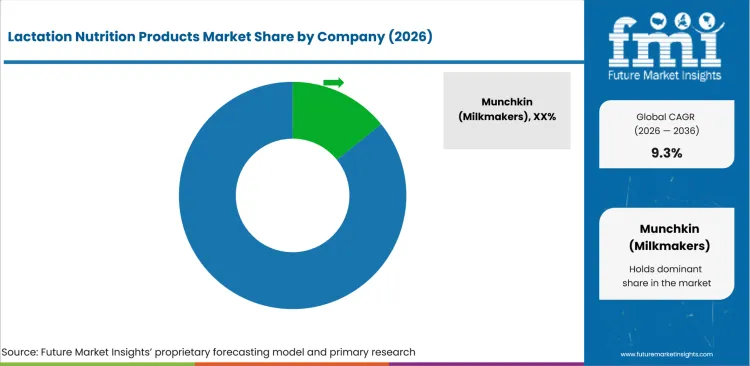
Lactation-positioned products span snacks, supplements and herbal teas, with different reasons for purchase and different evidence for their claims. Food convenience and maternal reassurance can support demand, but neither establishes that a product increases milk supply.
- Snack and food formats: Munchkin (Milkmakers), Boobie Superfoods and Oat Mama address convenient maternal nutrition through cookies, bars, powders or drink formats.
- Supplement and botanical formats: UpSpring, Legendairy Milk and Pink Stork organize products around ingredients and repeat routines.
- Herbal tea: Traditional Medicinals provides a familiar preparation format with broad retail access.
Competitive Benchmarking: Lactation Nutrition Products Market
| Company | Maternal product range | Format choices | Purchase and product information | Geographic reach |
|---|---|---|---|---|
| Munchkin (Milkmakers) | Medium | Medium | High | USA-led retail and online distribution |
| Boobie Superfoods | High | High | High | USA-led retail and direct sales |
| Oat Mama | High | High | High | USA-led direct and retail sales |
| UpSpring | High | High | High | USA-led maternal-health retail |
| Legendairy Milk | High | High | High | USA with international distribution |
| Pink Stork | High | High | High | USA-led retail and direct sales |
| Traditional Medicinals | Medium | Medium | High | North America and international tea distribution |
Scoring basis: High for Maternal product range spans several products for pregnancy, postpartum or breastfeeding routines; Medium marks a focused line. High for Format choices covers several food, drink or supplement forms; Medium describes one main form or a narrower pair. High for Purchase and product information combines accessible sales with clear ingredients and directions; Medium marks a more limited route. Unscored indicates that no current product is available to assess. Ratings do not measure milk-production efficacy, clinical strength or safety for an individual mother.
Legendairy Milk offers botanical supplements and drink mixes, while food-oriented brands compete through snacks and powders. Traditional Medicinals concentrates on tea. Product claims and ingredient suitability require separate assessment from assortment breadth or ease of purchase.
Key Developments in the Lactation Nutrition Products Market
- In March 2025, Target added Oat Mama lactation oat bars and supplements to its expanded baby and postpartum assortment. The range placed snack and supplement formats beside other maternal recovery products. This made the products easier to find for shoppers who prefer a physical retail point rather than a specialist DTC site.
Key Players in the Lactation Nutrition Products Market
Food-First Snacks and Maternal Nutrition
- Munchkin (Milkmakers)
- Boobie Superfoods
- Oat Mama
Botanical and Multi-Format Supplement Specialists
- UpSpring
- Legendairy Milk
- Pink Stork
Herbal Tea Specialist
- Traditional Medicinals
Lactation Nutrition Products Market - Report Scope
| Coverage field | Report scope |
|---|---|
| Market breakdown | Product Type, Key Ingredient, Form, Buyer, Sales Channel, and Region |
| Quantitative Units | Revenue in USD Million and CAGR in %. |
| Market Definition | Revenue includes packaged foods, beverages, protein powders, herbal teas, capsules, and other supplements specifically formulated and marketed for lactating or breastfeeding mothers. It excludes infant formula, infant foods, breast pumps, nursing accessories, clinical lactation services, ordinary foods without lactation positioning, and downstream finished-product revenue. |
| Regions Covered | North America, Latin America, Western Europe, Eastern Europe, East Asia, South Asia and Pacific, and Middle East and Africa |
| Countries Covered | USA, UK, Germany, Japan, South Korea |
| Key Companies Profiled | Munchkin (Milkmakers), Boobie Superfoods, Oat Mama, UpSpring, Legendairy Milk, Pink Stork, Traditional Medicinals |
| Forecast Period | 2026 to 2036 |
| Approach | FMI applies a hybrid bottom-up and top-down approach that reconciles product-format, channel, ingredient, buyer, and country demand signals. |
Lactation Nutrition Products Market - Research Methodology
| Method | Approach |
|---|---|
| Primary Research | FMI interviews manufacturers, brand operators, distributors, retailers, pharmacists, lactation professionals, and end users. Discussions address product scope, purchase triggers, channel economics, ingredient acceptance, repeat behavior, and country-specific constraints. |
| Desk Research | FMI reviews official breastfeeding statistics, public health guidance, supplement regulation, food-labeling rules, peer-reviewed literature, company product documentation, corporate announcements, and retail assortment evidence. |
| Market Sizing and Forecasting | The model reconciles packaged-product revenue by Product Type, Key Ingredient, Form, Buyer, Sales Channel, and country. Forecast assumptions consider breastfeeding continuation, birth trends, postpartum support, retail expansion, online replenishment, price realization, and claim-related constraints. |
| Data Validation | Findings are cross-checked across authoritative public sources and first-party company evidence. The process excludes double counting, downstream finished-product revenue, ordinary foods without lactation positioning, infant formula, breast pumps, and adjacent clinical services. |
Lactation Nutrition Products Market by Segments
Lactation Nutrition Products Market segmented by Product Type:
- Lactation Supplements (Galactagogues)
- Lactation Cookies & Bars
- Lactation Teas & Drinks
- Lactation Protein Powders
- Others
Lactation Nutrition Products Market segmented by Key Ingredient:
- Oats & Brewer's Yeast
- Fenugreek
- Moringa
- Shatavari & Botanicals
- Others
Lactation Nutrition Products Market segmented by Form:
- Snacks & Bakery
- Powders
- Capsules
- Beverages
Lactation Nutrition Products Market segmented by Buyer:
- First-Time Mothers
- Experienced Mothers
- Gifting
Lactation Nutrition Products Market segmented by Sales Channel:
- Online / DTC
- Retail Pharmacy
- Supermarkets & Hypermarkets
- Specialty & Health Stores
- Others
Lactation Nutrition Products Market by Region:
- North America
- United States
- Canada
- Latin America
- Brazil
- Mexico
- Argentina
- Chile
- Western Europe
- Germany
- France
- United Kingdom
- Italy
- Spain
- Benelux
- Nordics
- Eastern Europe
- Poland
- Czech Republic
- Romania
- Hungary
- East Asia
- China
- Japan
- South Korea
- South Asia and Pacific
- India
- ASEAN
- Australia and New Zealand
- Middle East and Africa
- GCC Countries
- South Africa
- Türkiye
- Israel
Research Sources and Bibliography
- Centers for Disease Control and Prevention (2026, July 31). National and State Breastfeeding Rates: Data Results.
- Palacios, A. M., et al. (2023). Effectiveness of lactation cookies on human milk production rates: A randomized controlled trial. The American Journal of Clinical Nutrition.
- USA Food and Drug Administration (2019, May 29). Dietary Supplements: Tips for Women.
- Department of Health and Social Care (2026, July 21). Infant Feeding Survey 2024: Summary of Main Findings.
- NHS Specialist Pharmacy Service (2025, December 1). Managing Complementary Products and Conventional Medicines.
- Max Rubner-Institut (2021, May 17). National Strategy for the Promotion of Breastfeeding: Results of the Becoming Breastfeeding Friendly Project.
- Ministry of Health, Labour and Welfare, Japan (2016, August 24). Overview of the 2015 Infant and Young Child Nutrition Survey Results.
- Consumer Affairs Agency, Japan (n.d.; accessed 2026, August 27). Foods for Special Dietary Uses.
- Ministry of Health and Welfare, Republic of Korea (2025, February 5). Results of the 2024 Postpartum Care Survey.
- Target Corporation (2025, March 20). Target's Baby Boom: Thousands of New Items for Your Little Bundle of Joy.
- UpSpring (2024, November 8). Supporting Your Milk Supply: Exploring Choices for Breastfeeding Moms.
- Traditional Medicinals (2024, July 23). A Peek Inside Mother's Milk Tea.
- Legendairy Milk (n.d.; accessed September 9, 2026). Lactation Supplements collection and Main Products FAQ.
This bibliography is provided for reader reference and is not exhaustive. The full report contains the complete reference list and detailed citations.
This Report Answers
- Which breastfeeding and postpartum pressures support demand for lactation-specific nutrition products?
- Why do Lactation Supplements (Galactagogues) hold the leading Product Type position?
- How do Oats & Brewer's Yeast influence product development and downstream format demand?
- Why do Snacks & Bakery hold the leading Form position?
- How do growth rates differ across USA, UK, Germany, Japan, and South Korea?
- Which companies have direct products and market-relevant capabilities in this market?
- How do evidence limitations and botanical safety concerns restrict adoption and repeat purchase?
- What should retail category managers evaluate before listing lactation nutrition products?
Frequently Asked Questions
How big is the Lactation Nutrition Products Market in 2026?
The market is estimated at USD 568.0 Million in 2026 and is projected to reach USD 1382.2 Million by 2036.
What is the CAGR of the Lactation Nutrition Products Market from 2026 to 2036?
The market is forecast to expand at a 9.3% CAGR from 2026 to 2036.
Which segment leads the product type category?
Lactation Supplements (Galactagogues) are expected to lead with a 37.3% share in 2026.
How much value is the Lactation Nutrition Products Market expected to add by 2036?
The projected increase between 2026 and 2036 is USD 814.2 Million.
Which companies participate in the Lactation Nutrition Products Market?
Munchkin (Milkmakers), Boobie Superfoods, Oat Mama, UpSpring, Legendairy Milk, Pink Stork, Traditional Medicinals.
What notable restraint affects the Lactation Nutrition Products Market?
Uneven efficacy findings and safety questions around concentrated botanicals and potential interactions constrain adoption. This uncertainty can reduce clinician recommendations, raise retailer scrutiny and weaken repeat demand when a product promise exceeds the user’s observed result.
Preview the report firsthand - request a free sample
Get SampleGet the brochure for pricing and purchase details.
Get PDFTable of Content
- Key Takeaways
- Market Size and CAGR
- Top Growth Driver
- Fastest Growing Segment
- Leading Region
- Key Companies
- Emerging Opportunities
- Executive Summary
- Global Market Outlook
- Demand-side Trends
- Supply-side Trends
- Technology Roadmap Analysis
- Analysis and Recommendations
- Analyst Perspective (What is happening? Why now? What should investors know?)
- Key Questions Answered
- How large is the market?
- What is the CAGR?
- What are key trends?
- Which region dominates?
- Who are the leaders?
- Market Overview
- Market Coverage / Taxonomy
- Market Definition / Scope / Limitations
- Research Methodology
- Chapter Orientation
- Analytical Lens and Working Hypotheses
- Market Structure, Signals, and Trend Drivers
- Benchmarking and Cross-market Comparability
- Market Sizing, Forecasting, and Opportunity Mapping
- Research Design and Evidence Framework
- Desk Research Programme (Secondary Evidence)
- Expert Input and Fieldwork (Primary Evidence)
- Tooling, Models, and Reference Databases
- Data Engineering and Model Build
- Quality Assurance and Audit Trail
- Market Background
- Market Dynamics (Drivers, Restraints, Opportunity, Trends)
- Scenario Forecast (Optimistic, Likely, Conservative)
- Impact Analysis
- AI Impact
- Sustainability Impact
- Regulatory Impact
- Technology Impact
- Consumer / Buyer Analysis
- Purchase Drivers
- Adoption Barriers
- Buyer Journey
- Opportunity Map Analysis
- Product Life Cycle Analysis
- Supply Chain Analysis
- Investment Feasibility Matrix
- Value Chain Analysis
- PESTLE and Porter's Analysis
- Regulatory Landscape
- Regional Parent Market Outlook
- Production and Consumption Statistics
- Import and Export Statistics
- Global Market Analysis and Forecast, 2021 to 2036
- Historical Market Size Value (USD Million) Analysis, 2021 to 2025
- Current and Future Market Size Value (USD Million) Projections, 2026 to 2036
- Y-o-Y Growth Trend Analysis
- Absolute $ Opportunity Analysis
- Global Market Pricing Analysis, 2021 to 2036
- Global Market Analysis and Forecast, By Product Type, 2021 to 2036
- Introduction / Key Findings
- Historical Market Size Value (USD Million) Analysis By Product Type, 2021 to 2025
- Current and Future Market Size Value (USD Million) Analysis and Forecast By Product Type, 2026 to 2036
- Lactation Supplements (Galactagogues)
- Lactation Cookies & Bars
- Lactation Teas & Drinks
- Lactation Protein Powders
- Others
- Lactation Supplements (Galactagogues)
- Y-o-Y Growth Trend Analysis By Product Type, 2021 to 2025
- Absolute $ Opportunity Analysis By Product Type, 2026 to 2036
- Global Market Analysis and Forecast, By Key Ingredient, 2021 to 2036
- Introduction / Key Findings
- Historical Market Size Value (USD Million) Analysis By Key Ingredient, 2021 to 2025
- Current and Future Market Size Value (USD Million) Analysis and Forecast By Key Ingredient, 2026 to 2036
- Oats & Brewer's Yeast
- Fenugreek
- Moringa
- Shatavari & Botanicals
- Others
- Oats & Brewer's Yeast
- Y-o-Y Growth Trend Analysis By Key Ingredient, 2021 to 2025
- Absolute $ Opportunity Analysis By Key Ingredient, 2026 to 2036
- Global Market Analysis and Forecast, By Form, 2021 to 2036
- Introduction / Key Findings
- Historical Market Size Value (USD Million) Analysis By Form, 2021 to 2025
- Current and Future Market Size Value (USD Million) Analysis and Forecast By Form, 2026 to 2036
- Snacks & Bakery
- Powders
- Capsules
- Beverages
- Snacks & Bakery
- Y-o-Y Growth Trend Analysis By Form, 2021 to 2025
- Absolute $ Opportunity Analysis By Form, 2026 to 2036
- Global Market Analysis and Forecast, By Buyer, 2021 to 2036
- Introduction / Key Findings
- Historical Market Size Value (USD Million) Analysis By Buyer, 2021 to 2025
- Current and Future Market Size Value (USD Million) Analysis and Forecast By Buyer, 2026 to 2036
- First-Time Mothers
- Experienced Mothers
- Gifting
- First-Time Mothers
- Y-o-Y Growth Trend Analysis By Buyer, 2021 to 2025
- Absolute $ Opportunity Analysis By Buyer, 2026 to 2036
- Global Market Analysis and Forecast, By Sales Channel, 2021 to 2036
- Introduction / Key Findings
- Historical Market Size Value (USD Million) Analysis By Sales Channel, 2021 to 2025
- Current and Future Market Size Value (USD Million) Analysis and Forecast By Sales Channel, 2026 to 2036
- Online / DTC
- Retail Pharmacy
- Supermarkets & Hypermarkets
- Specialty & Health Stores
- Others
- Online / DTC
- Y-o-Y Growth Trend Analysis By Sales Channel, 2021 to 2025
- Absolute $ Opportunity Analysis By Sales Channel, 2026 to 2036
- Global Market Analysis and Forecast, By Region, 2021 to 2036
- Introduction
- Historical Market Size Value (USD Million) Analysis By Region, 2021 to 2025
- Current Market Size Value (USD Million) Analysis and Forecast By Region, 2026 to 2036
- North America
- Latin America
- Western Europe
- Eastern Europe
- East Asia
- South Asia and Pacific
- Middle East & Africa
- Market Attractiveness Analysis By Region
- North America Market Analysis and Forecast, By Country, 2021 to 2036
- Historical Market Size Value (USD Million) Trend Analysis By Market Taxonomy, 2021 to 2025
- Market Size Value (USD Million) Forecast By Market Taxonomy, 2026 to 2036
- By Country
- USA
- Canada
- By Product Type
- By Key Ingredient
- By Form
- By Buyer
- By Sales Channel
- By Country
- Market Attractiveness Analysis
- By Country
- By Product Type
- By Key Ingredient
- By Form
- By Buyer
- By Sales Channel
- Key Takeaways
- Latin America Market Analysis and Forecast, By Country
- Historical Market Size Value (USD Million) Trend Analysis By Market Taxonomy, 2021 to 2025
- Market Size Value (USD Million) Forecast By Market Taxonomy, 2026 to 2036
- By Country
- Brazil
- Mexico
- Chile
- Rest of Latin America
- By Product Type
- By Key Ingredient
- By Form
- By Buyer
- By Sales Channel
- By Country
- Market Attractiveness Analysis
- By Country
- By Product Type
- By Key Ingredient
- By Form
- By Buyer
- By Sales Channel
- Key Takeaways
- Western Europe Market Analysis and Forecast, By Country
- Historical Market Size Value (USD Million) Trend Analysis By Market Taxonomy, 2021 to 2025
- Market Size Value (USD Million) Forecast By Market Taxonomy, 2026 to 2036
- By Country
- Germany
- UK
- Italy
- Spain
- France
- Nordic
- BENELUX
- Rest of Western Europe
- By Product Type
- By Key Ingredient
- By Form
- By Buyer
- By Sales Channel
- By Country
- Market Attractiveness Analysis
- By Country
- By Product Type
- By Key Ingredient
- By Form
- By Buyer
- By Sales Channel
- Key Takeaways
- Eastern Europe Market Analysis and Forecast, By Country
- Historical Market Size Value (USD Million) Trend Analysis By Market Taxonomy, 2021 to 2025
- Market Size Value (USD Million) Forecast By Market Taxonomy, 2026 to 2036
- By Country
- Russia
- Poland
- Hungary
- Balkan & Baltic
- Rest of Eastern Europe
- By Product Type
- By Key Ingredient
- By Form
- By Buyer
- By Sales Channel
- By Country
- Market Attractiveness Analysis
- By Country
- By Product Type
- By Key Ingredient
- By Form
- By Buyer
- By Sales Channel
- Key Takeaways
- East Asia Market Analysis and Forecast, By Country
- Historical Market Size Value (USD Million) Trend Analysis By Market Taxonomy, 2021 to 2025
- Market Size Value (USD Million) Forecast By Market Taxonomy, 2026 to 2036
- By Country
- China
- Japan
- South Korea
- By Product Type
- By Key Ingredient
- By Form
- By Buyer
- By Sales Channel
- By Country
- Market Attractiveness Analysis
- By Country
- By Product Type
- By Key Ingredient
- By Form
- By Buyer
- By Sales Channel
- Key Takeaways
- South Asia and Pacific Market Analysis and Forecast, By Country
- Historical Market Size Value (USD Million) Trend Analysis By Market Taxonomy, 2021 to 2025
- Market Size Value (USD Million) Forecast By Market Taxonomy, 2026 to 2036
- By Country
- India
- ASEAN
- Australia & New Zealand
- Rest of South Asia and Pacific
- By Product Type
- By Key Ingredient
- By Form
- By Buyer
- By Sales Channel
- By Country
- Market Attractiveness Analysis
- By Country
- By Product Type
- By Key Ingredient
- By Form
- By Buyer
- By Sales Channel
- Key Takeaways
- Middle East & Africa Market Analysis and Forecast, By Country
- Historical Market Size Value (USD Million) Trend Analysis By Market Taxonomy, 2021 to 2025
- Market Size Value (USD Million) Forecast By Market Taxonomy, 2026 to 2036
- By Country
- Kingdom of Saudi Arabia
- Other GCC Countries
- Türkiye
- South Africa
- Other African Union
- Rest of Middle East & Africa
- By Product Type
- By Key Ingredient
- By Form
- By Buyer
- By Sales Channel
- By Country
- Market Attractiveness Analysis
- By Country
- By Product Type
- By Key Ingredient
- By Form
- By Buyer
- By Sales Channel
- Key Takeaways
- Key Countries Market Analysis
- USA
- Pricing Analysis
- Market Share Analysis, 2025
- By Product Type
- By Key Ingredient
- By Form
- By Buyer
- By Sales Channel
- Canada
- Pricing Analysis
- Market Share Analysis, 2025
- By Product Type
- By Key Ingredient
- By Form
- By Buyer
- By Sales Channel
- Mexico
- Pricing Analysis
- Market Share Analysis, 2025
- By Product Type
- By Key Ingredient
- By Form
- By Buyer
- By Sales Channel
- Brazil
- Pricing Analysis
- Market Share Analysis, 2025
- By Product Type
- By Key Ingredient
- By Form
- By Buyer
- By Sales Channel
- Chile
- Pricing Analysis
- Market Share Analysis, 2025
- By Product Type
- By Key Ingredient
- By Form
- By Buyer
- By Sales Channel
- Germany
- Pricing Analysis
- Market Share Analysis, 2025
- By Product Type
- By Key Ingredient
- By Form
- By Buyer
- By Sales Channel
- UK
- Pricing Analysis
- Market Share Analysis, 2025
- By Product Type
- By Key Ingredient
- By Form
- By Buyer
- By Sales Channel
- Italy
- Pricing Analysis
- Market Share Analysis, 2025
- By Product Type
- By Key Ingredient
- By Form
- By Buyer
- By Sales Channel
- Spain
- Pricing Analysis
- Market Share Analysis, 2025
- By Product Type
- By Key Ingredient
- By Form
- By Buyer
- By Sales Channel
- France
- Pricing Analysis
- Market Share Analysis, 2025
- By Product Type
- By Key Ingredient
- By Form
- By Buyer
- By Sales Channel
- India
- Pricing Analysis
- Market Share Analysis, 2025
- By Product Type
- By Key Ingredient
- By Form
- By Buyer
- By Sales Channel
- ASEAN
- Pricing Analysis
- Market Share Analysis, 2025
- By Product Type
- By Key Ingredient
- By Form
- By Buyer
- By Sales Channel
- Australia & New Zealand
- Pricing Analysis
- Market Share Analysis, 2025
- By Product Type
- By Key Ingredient
- By Form
- By Buyer
- By Sales Channel
- China
- Pricing Analysis
- Market Share Analysis, 2025
- By Product Type
- By Key Ingredient
- By Form
- By Buyer
- By Sales Channel
- Japan
- Pricing Analysis
- Market Share Analysis, 2025
- By Product Type
- By Key Ingredient
- By Form
- By Buyer
- By Sales Channel
- South Korea
- Pricing Analysis
- Market Share Analysis, 2025
- By Product Type
- By Key Ingredient
- By Form
- By Buyer
- By Sales Channel
- Russia
- Pricing Analysis
- Market Share Analysis, 2025
- By Product Type
- By Key Ingredient
- By Form
- By Buyer
- By Sales Channel
- Poland
- Pricing Analysis
- Market Share Analysis, 2025
- By Product Type
- By Key Ingredient
- By Form
- By Buyer
- By Sales Channel
- Hungary
- Pricing Analysis
- Market Share Analysis, 2025
- By Product Type
- By Key Ingredient
- By Form
- By Buyer
- By Sales Channel
- Kingdom of Saudi Arabia
- Pricing Analysis
- Market Share Analysis, 2025
- By Product Type
- By Key Ingredient
- By Form
- By Buyer
- By Sales Channel
- Türkiye
- Pricing Analysis
- Market Share Analysis, 2025
- By Product Type
- By Key Ingredient
- By Form
- By Buyer
- By Sales Channel
- South Africa
- Pricing Analysis
- Market Share Analysis, 2025
- By Product Type
- By Key Ingredient
- By Form
- By Buyer
- By Sales Channel
- USA
- Market Structure Analysis
- Competition Dashboard
- Competition Benchmarking
- Market Share Analysis of Top Players
- By Regional
- By Product Type
- By Key Ingredient
- By Form
- By Buyer
- By Sales Channel
- Emerging Startups
- Innovation Benchmarking
- Competition Analysis
- Competition Deep Dive
- Munchkin (Milkmakers)
- Overview
- Product Portfolio
- Profitability by Market Segments
- Sales Footprint
- Strategy Overview
- Marketing Strategy
- Product Strategy
- Channel Strategy
- UpSpring
- Legendairy Milk
- Majka
- Pink Stork
- Boobie Superfoods
- Oat Mama
- Traditional Medicinals
- Munchkin (Milkmakers)
- Case Studies
- Success Stories
- Recent Developments
- Competition Deep Dive
- Assumptions & Acronyms Used


