

- Market Size (2026)
- USD 156.0 Mn
- Forecast (2036)
- USD 471.8 Mn
- CAGR (2026 to 2036)
- 11.7%
How big is Breastfeeding Protein Beverage Market in 2026?
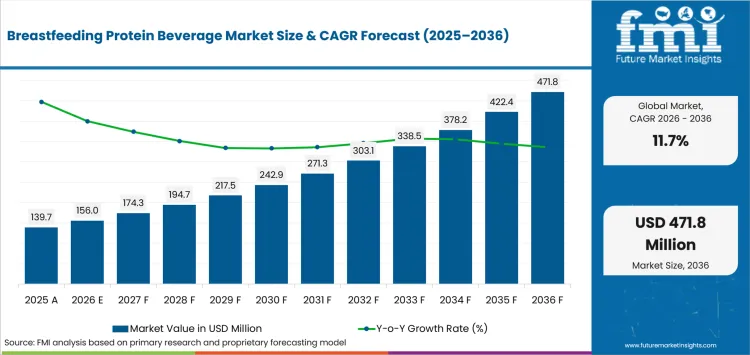
USD 156.0 million in 2026 and USD 471.8 million by 2036 at an 11.7% CAGR.
Demand for breastfeeding protein beverages is projected to expand at 11.7% CAGR between 2026 and 2036, increasing valuation from USD 156.0 million to USD 471.8 million. The Office on Women’s Health updated breastfeeding guidance in October 2025 and recommends drinking a glass of water or another beverage with each feed. That repeated drink occasion gives postnatal nutrition brands a practical route for protein formats inside maternal nutrition ingredients planning, provided the serving requires less work than preparing a meal.
Country conditions change how the same convenience need converts into repeat orders across pharmacy and direct digital channels. South Korea carries the a notable CAGR at 11.9%, while Japan is projected at 9.7%. South Korea’s Ministry of Health and Welfare reported in February 2025 that 90.2% of surveyed mothers breastfed, giving specialized maternal nutrition a visible but time-bounded use window. Selected dietary supplements and functional beverages gain relevance when labels separate nutritional support from treatment claims.
Key Takeaways
- Breastfeeding and pumping routines increase demand for convenient protein that fits repeated postpartum eating occasions without preparation burden.
- By product type, RTD lactation protein shakes are estimated to hold 45.3% in 2026 owing to immediate consumption during short feeding windows.
- In 2026, galactagogue-enriched products are expected to lead functional add-on with 42.9% share because milk-supply positioning addresses a specific breastfeeding concern.
- Plant blends are projected to hold 48.0% share in 2026 owing to dairy avoidance and formulation flexibility across maternal protein products.
- Mixed evidence around some galactagogues raises formulation and messaging costs while reducing trust in products that overstate milk-supply effects.
- Some of the key players in this market include Boobie Superfoods, Milk Dust, Better Herbs, Oat Mama, Baby Blues, Pink Stork, Milky Mama, and Legendairy Milk.
Analyst Perspective
"A breastfeeding protein beverage earns repeat orders when its protein dose and taste fit a feeding-day routine without asking the consumer to manage another preparation step. Brands should treat lactation ingredients as a secondary evaluation layer, since the commercial risk rises quickly when a supply-support claim outruns its evidence."
- Nandini Roy Choudhury, Principal Consultant, Future Market Insights
How is the breastfeeding protein beverage market segmented?
The breastfeeding protein beverage market is segmented by product type, functional add-on, protein source, sweetener profile, sales channel, and region.
Product type covers RTD lactation protein shakes, lactation protein smoothie mixes, clear protein lactation drinks, and others. Functional add-on includes galactagogue-enriched, hydration plus electrolytes, plain high-protein, and others. Protein source covers plant blends, whey, collagen, and others. Sweetener profile includes low-sugar, sugar-free, and regular. Sales channel covers online or DTC, retail pharmacy, supermarkets and hypermarkets, specialty and health stores, and others.
What makes RTD lactation protein shakes central to the product type category?
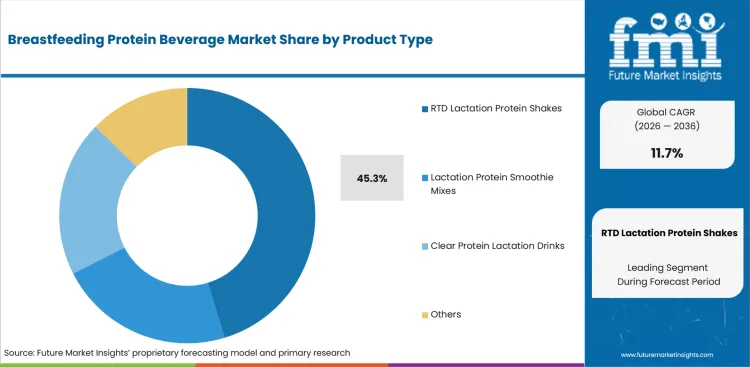
RTD formats remove measuring and cleanup during feeding-day nutrition, which matters when consumers compare ready-to-drink beverages with powders requiring preparation. CDC reported in July 2026 that 86.1% of USA infants born in 2023 were ever breastfed, defining a broad initial use cohort without establishing the modeled share.
- By product type, RTD lactation protein shakes are estimated to hold 45.3% in 2026 owing to sealed servings that remove preparation during short feeding windows.
- Immediate availability supports repeat use across pumping and feeding routines because preparation effort can determine whether a protein serving is consumed on schedule.
Why does galactagogue-enriched lead the functional add-on category?
Galactagogue-enriched products address a milk-supply concern that plain protein does not claim to solve, making formulation evidence central to product evaluation. That distinction shifts commercial scrutiny from protein dose toward ingredient evidence and clear claim boundaries during product review. LactMed revised its moringa review in July 2026 and warns that galactagogues should not replace evaluation of modifiable factors affecting milk production.
- In 2026, galactagogue-enriched products are expected to lead functional add-on with 42.9% share because milk-supply positioning addresses a specific breastfeeding concern.
- Commercial acceptance depends on ingredient-specific cautions and restrained benefit language since botanical ingredients differ in evidence quality and maternal tolerability.
How do plant blends shape demand within the protein source category?
Plant blends let formulators address dairy avoidance while balancing pea and other proteins across one maternal serving. CDC guidance updated in March 2026 notes that vegetarian and vegan breastfeeding mothers may need closer attention to nutrients such as vitamin B12 and iron. That requirement makes protein-source design relevant beyond dairy avoidance within pea protein and plant-based protein formulations.
- Plant blends are projected to hold 48.0% share in 2026 owing to dairy avoidance and multi-source formulation flexibility across breastfeeding-stage nutrition.
- Repeat purchase depends on smooth texture and nutrient completeness since a credible plant source loses commercial value when repeated servings remain difficult to tolerate.
What drives online and DTC within the sales channel category?
Direct digital channels suit breastfeeding nutrition because product education often precedes the first order. The UK Infant Feeding Survey reported in July 2026 that 21% of mothers who sought breastfeeding help or information used websites. That behavior gives postnatal health supplements brands a practical education route before retail expansion reduces discovery friction.
- By sales channel, online and DTC is forecast to represent 47.3% in 2026 driven by direct product education and scheduled replenishment.
- Digital channels retain value after retail entry since subscriptions and detailed ingredient pages support repeat ordering during a short breastfeeding use window.
What are the drivers, restraints and opportunities in the Breastfeeding Protein Beverage Market?
Convenient postpartum nutrition supports demand, evidence limits constrain lactation claims, and independent protein testing provides a trust route for maternal formulations.
- Driver: Sustained breastfeeding produces repeated occasions for portable nutrition during feeding and pumping routines across several months.
- Restraint: Mixed evidence for several galactagogues increases responsible formulation costs and weakens broad milk-supply claims.
- Opportunity: Independent contaminant testing gives maternal protein brands a concrete route to substantiate purity claims during retail review.
Feeding-Day Nutrition Supports Repeat Use
Breastfeeding and pumping produce repeated eating gaps during a use window that can continue for several months. The UK Infant Feeding Survey summary reported in July 2026 that 68% of mothers who started breastfeeding continued for at least six months, documenting a long repeat-use period. A beverage earns recurring orders when protein density and serving size fit those routines, provided taste stays acceptable within protein ingredients used during feeding days.
Galactagogue Evidence Raises the Claim Burden
Functional positioning becomes harder once a beverage implies milk-supply treatment instead of basic nutrition, so claim boundaries become commercially important. LactMed revised its fenugreek review in July 2026 and describes mixed evidence for effectiveness alongside adverse reactions and interaction risks. Brands therefore need ingredient-specific cautions and conservative claims that separate supportive nutrition from treatment across DTC pages and retail labels.
Independent Testing Can Reduce Trust Friction
Maternal protein brands can reduce retail trust friction by documenting contaminant testing for the exact formula under review. Clean Label Project reported in January 2025 that 47% of 160 tested protein powders exceeded at least one federal or state safety threshold. That result raises the commercial value of batch-specific testing for plant-based beverages that use several protein inputs and require consistent sourcing controls.
Which country CAGRs are profiled in the Breastfeeding Protein Beverage Market?
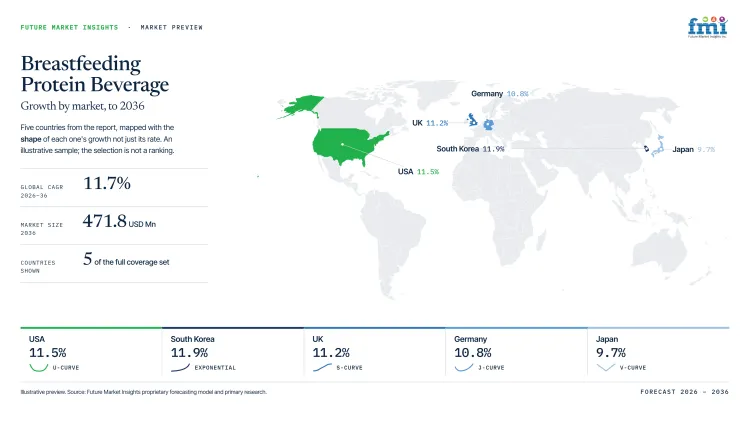
| Country | CAGR |
|---|---|
| South Korea | 11.9% |
| USA | 11.5% |
| UK | 11.2% |
| Germany | 10.8% |
| Japan | 9.7% |
How do country-level CAGRs compare in the Breastfeeding Protein Beverage Market?
The profiled countries span 2.2 percentage points from South Korea at 11.9% to Japan at 9.7%. South Korea and the USA form an upper growth group, while the UK and Germany follow closely. Japan forms a lower transition point because its smaller maternal base makes channel efficiency more important despite continued category expansion.
- South Korea’s postpartum-care centers keep maternal nutrition visible during feeding routines.
- USA brands use DTC education before extending proven products into national retail channels.
- UK pharmacy guidance makes ingredient purpose central to repeat maternal purchasing decisions.
- German nutrient scrutiny rewards precise formulations during maternal product review and localization.
- Japanese localization costs weigh more heavily against a smaller maternal consumer base.
Comparable CAGRs produce different order economics because local channels change conversion costs.
The full report provides country-level CAGR analysis across North America, Latin America, Europe, East Asia, South Asia, Oceania and the Middle East and Africa.
Country-wise Analysis
- USA maternal nutrition brands reach breastfeeding consumers through DTC education and national retail, while high digital acquisition costs punish weak repeat ordering during active lactation. National Center for Health Statistics reported in April 2026 that 3,606,400 births occurred during 2025, creating a substantial annual maternal consumer cohort. The USA is estimated to post 11.5% CAGR over the forecast period, supported by portable formats and broad retail access that encourage initial product trial, with leading brands differentiating themselves by maintaining consistent positioning across digital and in-store channels without presenting routine nutrition as a clinical feeding intervention.
- UK breastfeeding products move between pharmacy and online channels where ingredient purpose and professional guidance strongly influence consumer confidence throughout the postpartum period. The Office for Health Improvement and Disparities reported in June 2026 that breastfeeding at six to eight weeks reached 55.6% in England during 2024 to 2025. Breastfeeding protein beverage demand in the UK is forecast to rise at 11.2% CAGR over the forecast period, driven by demand for convenient nutrition that fits continuing feeding routines, although broader pharmacy adoption relies on clearly explained product benefits rather than lengthy DTC education efforts.
- German maternal nutrition products face close scrutiny of nutrient levels and target-group wording during pharmacy and specialist retail onboarding across established supplement channels. BfR proposed a 150-microgram daily maximum for iodine in supplements targeting pregnant or breastfeeding women in December 2025, reinforcing the importance of carefully specified maternal formulations. Breastfeeding protein beverage sales in Germany are forecast to expand at 10.8% CAGR by 2036, bolstered by specialty nutrition channels that support targeted maternal offerings, while brands with controlled nutrient profiles are generally better positioned to navigate pharmacy review and localization requirements.
- Japanese maternal nutrition launches require localized labels and pack presentation because imported breastfeeding language must align with domestic expectations before gaining retail acceptance across selected urban channels. The Statistics Bureau reported in July 2026 that Japan had 13.35 million children younger than fifteen, highlighting the finite demographic base supporting maternal categories. Adoption of breastfeeding protein beverages in Japan is estimated to expand at 9.7% CAGR through 2036, underpinned by demand for convenient daily postpartum nutrition, whereas smaller pack formats and restrained messaging help suppliers manage trial economics within a concentrated urban distribution model.
- South Korea’s postpartum-care system keeps maternal recovery and feeding support highly visible soon after birth through dedicated care centers and concentrated digital commerce channels. The Ministry of Data and Statistics reported in February 2026 that the country recorded 254.5 thousand live births during 2025, documenting a defined annual maternal consumer base. South Korea’s breastfeeding protein beverage outlook is anticipated to advance at 11.9% CAGR over the assessment period, attributable to the strong fit between low-preparation formats and organized postpartum routines, while suppliers must still navigate carefully worded milk-supply messaging to maximize engagement during a relatively short purchasing window.
Who are the notable companies in the Breastfeeding Protein Beverage Market?
Boobie Superfoods, Milk Dust, Better Herbs, Oat Mama, Baby Blues, Pink Stork, Milky Mama, and Legendairy Milk are the notable companies profiled in this market.
Competition is fragmented across direct breastfeeding-protein brands and broader maternal-protein platforms alongside separate lactation-function specialists. Entry barriers arise from trust and repeat-use performance because corporate scale alone does not secure maternal acceptance. Products need credible maternal positioning plus tolerable taste and accessible replenishment before a specialized breastfeeding protein offer earns regular orders.
- Direct breastfeeding protein specialists include Boobie Superfoods, Milk Dust, Better Herbs, Oat Mama, and Baby Blues with current lactation-stage protein positioning.
- Pink Stork represents broader maternal protein positioning across pregnancy and postpartum use while retaining a protein-specific offer for maternal routines.
- Milky Mama and Legendairy Milk concentrate on lactation functions and hydration, giving both brands adjacent beverage relevance beyond direct protein formats.
Competitive Benchmarking: Breastfeeding Protein Beverage Market
| Company | Breastfeeding-Stage Fit | Functional Format Breadth | Channel Breadth | Geographic Reach |
|---|---|---|---|---|
| Boobie Superfoods | High | High | High | United States retail and DTC |
| Milk Dust | High | High | Medium | United States DTC |
| Better Herbs | High | Medium | Medium | India DTC and marketplaces |
| Oat Mama | High | High | High | United States retail and DTC |
| Baby Blues | High | Medium | Medium | United States DTC |
| Pink Stork | Medium | Medium | High | United States retail and DTC |
| Milky Mama | Medium | High | Medium | United States DTC and specialist channels |
| Legendairy Milk | Medium | High | High | United States national retail and DTC |
Scoring basis: High breastfeeding-stage fit requires a current direct breastfeeding-specific protein offer while Medium covers a broader lactation beverage or postpartum protein route. High functional breadth requires three or more documented functions while Medium requires two and Low identifies one. High channel breadth requires national retail plus DTC while Medium covers two narrower routes and Low identifies one documented route.
Key Developments in the Breastfeeding Protein Beverage Market
- In March 2026, Legendairy Milk expanded into Sprouts Farmers Market nationwide with lactation and women’s-wellness products available through the retailer.
- In July 2025, Milk Dust announced Electro Milk and opened a waitlist for the breastfeeding hydration drink with electrolytes and lactation herbs.
- In March 2025, Oat Mama gained Target distribution for lactation products within the retailer’s expanded baby assortment.
Key Players in the Breastfeeding Protein Beverage Market
Dedicated Breastfeeding Protein Brands
- Boobie Superfoods
- Milk Dust
- Better Herbs
- Oat Mama
- Baby Blues
Maternal Protein Platform
- Pink Stork
Lactation Function Specialists
- Milky Mama
- Legendairy Milk
Breastfeeding Protein Beverage Market - Report Scope
| Coverage field | Report scope |
|---|---|
| Market breakdown | By product type, functional add-on, protein source, sweetener profile, sales channel, and region. |
| Quantitative Units | USD million. |
| Market Definition | Commercial protein beverages and drink powders explicitly positioned for breastfeeding or postpartum use, including lactation-oriented functional formulations. |
| Regions Covered | North America, Latin America, Europe, East Asia, South Asia and Pacific, and Middle East and Africa. |
| Countries Covered | USA, UK, Germany, Japan, South Korea, and 20+ countries included in the full report. |
| Key Companies Profiled | Boobie Superfoods, Milk Dust, Better Herbs, Oat Mama, Baby Blues, Pink Stork, Milky Mama, and Legendairy Milk. |
| Forecast Period | 2026 to 2036. |
| Approach | Primary and secondary research with market triangulation. |
Breastfeeding Protein Beverage Market - Research Methodology
| Method | Approach |
|---|---|
| Primary Research | FMI analysts gathered input from manufacturers, service providers, technology developers, distributors, end users, procurement teams, and subject-matter experts. Interviews examined purchasing decisions, product or service evaluation, adoption barriers, approval requirements, pricing considerations, and expectations for technical or commercial support. Respondents were also asked what evidence is required before a trial, pilot, or initial order develops into regular purchasing. |
| Desk Research | Desk research covered government statistics, regulatory publications, trade data, industry associations, technical literature, standards, company filings, product information, and official corporate announcements. Sources were reviewed for relevance, publication date, geographic coverage, and consistency with the defined market scope. Claims relating to performance, applications, approvals, capacity, investment, and commercial activity were retained only when supported by credible public evidence. |
| Market Sizing and Forecasting | The market model combined the baseline value with historical performance, segment structure, pricing and volume indicators, adoption levels, company participation, and country-level demand conditions. Forecast assumptions considered economic activity, investment trends, regulatory developments, technology adoption, purchasing cycles, supply availability, and barriers to wider market use. Segment and regional estimates were reconciled before the final market total was calculated. |
| Data Validation | Estimates were checked against multiple independent indicators, including public data, company activity, trade patterns, industry developments, and findings from primary interviews. Validation also tested whether products, services, applications, and company revenues fell within the defined market boundaries. Adjacent categories, unsupported claims, overlapping revenues, and activities without direct market relevance were excluded to reduce double counting and maintain consistency across segments and countries. |
Breastfeeding Protein Beverage Market by Segments
Breastfeeding Protein Beverage Market segmented by Product Type:
- RTD Lactation Protein Shakes
- Lactation Protein Smoothie Mixes
- Clear Protein Lactation Drinks
- Others
Breastfeeding Protein Beverage Market segmented by Functional Add-On:
- Galactagogue-Enriched
- Hydration + Electrolytes
- Plain High-Protein
- Others
Breastfeeding Protein Beverage Market segmented by Protein Source:
- Plant Blends
- Whey
- Collagen
- Others
Breastfeeding Protein Beverage Market segmented by Sweetener Profile:
- Low-Sugar
- Sugar-Free
- Regular
Breastfeeding Protein Beverage Market segmented by Sales Channel:
- Online / DTC
- Retail Pharmacy
- Supermarkets & Hypermarkets
- Specialty & Health Stores
- Others
Breastfeeding Protein Beverage Market by Region:
- North America
- United States
- Canada
- Latin America
- Brazil
- Mexico
- Argentina
- Chile
- Western Europe
- Germany
- France
- United Kingdom
- Italy
- Spain
- Benelux
- Nordics
- Eastern Europe
- Poland
- Czech Republic
- Romania
- Hungary
- East Asia
- China
- Japan
- South Korea
- South Asia and Pacific
- India
- ASEAN
- Australia and New Zealand
- Middle East and Africa
- GCC Countries
- South Africa
- Türkiye
- Israel
Research Sources and Bibliography
- Office on Women’s Health. (2025, October 23). Breastfeeding and everyday life
- Ministry of Health and Welfare, Republic of Korea. (2025, February 5). 2024년 산후조리 실태조사 결과 발표
- Centers for Disease Control and Prevention. (2026, July 31). About Breastfeeding Data
- USA National Library of Medicine, LactMed. (2026, July 15). Moringa
- Centers for Disease Control and Prevention. (2026, March 27). Maternal Diet and Breastfeeding
- Department of Health and Social Care. (2026, July 21). Infant feeding survey 2024: full report
- Department of Health and Social Care. (2026, July 21). Infant feeding survey 2024: summary of main findings
- USA National Library of Medicine, LactMed. (2026, July 15). Fenugreek
- Clean Label Project. (2025, January 9). Nearly Half of Top-Selling Protein Powders Exceed Safety Thresholds for Heavy Metal Contamination
- National Center for Health Statistics. (2026, April). Births: Provisional Data for 2025
- Office for Health Improvement and Disparities. (2026, June 2). Breastfeeding at 6 to 8 weeks, 2024 to 2025 statistical commentary
- German Federal Institute for Risk Assessment. (2025, December 19). Update (2025): maximum levels proposed for iodine in foods including food supplements
- Statistics Bureau of Japan. (2026, July 21). 2026年(令和8年)7月報
- Ministry of Data and Statistics. (2026, February 25). Preliminary Results of Birth and Death Statistics in 2025
- Boobie Superfoods. (2026, January 5). Pregnancy Safe Protein Powder That Actually Works For You
- Milk Dust. (2025, July 8). Hydration + Milk Supply: Why It Matters and What Every Breastfeeding Mom Should Know
- Better Herbs. (2025, December 26). Top Natural Galactagogues to Increase Breast Milk Supply
- Oat Mama. (2026, March 24). Postpartum Doorstep Delights: Magical Moringa Latte
- Baby Blues. (2026, February 20). Guide to Protein Powder for Breastfeeding Moms
- Pink Stork. (2025, August 5). Is Protein Powder Safe During Pregnancy? 2026 Expert Guide
- Milky Mama. (2025, December 23). Boosting Milk Supply: What Supplements Help with Lactation?
- Legendairy Milk. (2026, March). Legendairy Milk Now at Sprouts: Lactation & Wellness Support on Your Grocery Run
- Target Corporation. (2025, March 20). Target’s Baby Boom: Thousands of New Items for Your Little Bundle of Joy
- Legendairy Milk. (2025, November 20). She’s Thirsty + She’s Electric: Now Available In-Store at Walmart!
- Baby Blues. (2025, July 15). Meet Milky Whey: Our NEW daily lactation support protein
- Pink Stork. (2025, April 14). Meet the Pink Stork Expert Panel: Empowering Women with Science, Compassion, and Expertise
This bibliography is provided for reader reference and is not exhaustive. The full report contains the complete reference list and detailed citations
This Report Answers
- How large is the breastfeeding protein beverage market in 2026 and 2036?
- Which postpartum conditions support the 11.7% market CAGR?
- Why do RTD lactation protein shakes lead product type demand?
- How do galactagogue-enriched and plant-based formulations differ?
- Why does online and DTC remain important for replenishment?
- How do growth conditions differ across the five profiled countries?
- Which companies compete across breastfeeding protein and lactation nutrition?
- Which claim constraints can weaken repeat purchasing?
Frequently Asked Questions
How big is the breastfeeding protein beverage market in 2026?
The breastfeeding protein beverage market is valued at USD 156.0 million in 2026 and is projected to reach USD 471.8 million by 2036. Repeated feeding and pumping routines support demand for portable nutrition during the limited postpartum use period.
What is the CAGR of the breastfeeding protein beverage market from 2026 to 2036?
The breastfeeding protein beverage market is projected to grow at a CAGR of 11.7% between 2026 and 2036. Expansion is supported by portable postpartum nutrition and repeat purchasing during breastfeeding periods that can continue for several months.
Which product type leads the breastfeeding protein beverage market?
The RTD lactation protein shakes segment is expected to hold 45.3% of the breastfeeding protein beverage market in 2026, driven by immediate consumption during short feeding windows. Sealed servings remove mixing and cleanup from routine feeding-day nutrition during repeated breastfeeding and pumping sessions.
Which protein source leads the breastfeeding protein beverage market?
The plant blends segment is expected to hold 48.0% of the breastfeeding protein beverage market in 2026, supported by dairy avoidance and formulation flexibility. Multi-source formulations also give brands more control over taste and amino-acid balance across repeated postpartum servings.
Which countries are projected to record the highest growth in the breastfeeding protein beverage market?
South Korea is projected to grow at 11.9% CAGR in the breastfeeding protein beverage market, followed by the USA at 11.5% and the UK at 11.2% through 2036. The upper group pairs strong breastfeeding participation with digital or specialist channels that support discovery and replenishment.
Which companies are active in the breastfeeding protein beverage market?
Key companies operating in the breastfeeding protein beverage market include Boobie Superfoods, Milk Dust, Better Herbs, Oat Mama, Baby Blues, Pink Stork, Milky Mama, and Legendairy Milk. These companies compete on lactation-stage positioning and protein formulation while channel access determines trial and repeat ordering.
Preview the report firsthand - request a free sample
Get SampleGet the brochure for pricing and purchase details.
Get PDFTable of Content
- Key Takeaways
- Market Size and CAGR
- Top Growth Driver
- Fastest Growing Segment
- Leading Region
- Key Companies
- Emerging Opportunities
- Executive Summary
- Global Market Outlook
- Demand-side Trends
- Supply-side Trends
- Technology Roadmap Analysis
- Analysis and Recommendations
- Analyst Perspective (What is happening? Why now? What should investors know?)
- Key Questions Answered
- How large is the market?
- What is the CAGR?
- What are key trends?
- Which region dominates?
- Who are the leaders?
- Market Overview
- Market Coverage / Taxonomy
- Market Definition / Scope / Limitations
- Research Methodology
- Chapter Orientation
- Analytical Lens and Working Hypotheses
- Market Structure, Signals, and Trend Drivers
- Benchmarking and Cross-market Comparability
- Market Sizing, Forecasting, and Opportunity Mapping
- Research Design and Evidence Framework
- Desk Research Programme (Secondary Evidence)
- Expert Input and Fieldwork (Primary Evidence)
- Tooling, Models, and Reference Databases
- Data Engineering and Model Build
- Quality Assurance and Audit Trail
- Market Background
- Market Dynamics (Drivers, Restraints, Opportunity, Trends)
- Scenario Forecast (Optimistic, Likely, Conservative)
- Impact Analysis
- AI Impact
- Sustainability Impact
- Regulatory Impact
- Technology Impact
- Consumer / Buyer Analysis
- Purchase Drivers
- Adoption Barriers
- Buyer Journey
- Opportunity Map Analysis
- Product Life Cycle Analysis
- Supply Chain Analysis
- Investment Feasibility Matrix
- Value Chain Analysis
- PESTLE and Porter's Analysis
- Regulatory Landscape
- Regional Parent Market Outlook
- Production and Consumption Statistics
- Import and Export Statistics
- Global Market Analysis and Forecast, 2021 to 2036
- Historical Market Size Value (USD Million) Analysis, 2021 to 2025
- Current and Future Market Size Value (USD Million) Projections, 2026 to 2036
- Y-o-Y Growth Trend Analysis
- Absolute $ Opportunity Analysis
- Global Market Pricing Analysis, 2021 to 2036
- Global Market Analysis and Forecast, By Product Type, 2021 to 2036
- Introduction / Key Findings
- Historical Market Size Value (USD Million) Analysis By Product Type, 2021 to 2025
- Current and Future Market Size Value (USD Million) Analysis and Forecast By Product Type, 2026 to 2036
- RTD Lactation Protein Shakes
- Lactation Protein Smoothie Mixes
- Clear Protein Lactation Drinks
- Others
- RTD Lactation Protein Shakes
- Y-o-Y Growth Trend Analysis By Product Type, 2021 to 2025
- Absolute $ Opportunity Analysis By Product Type, 2026 to 2036
- Global Market Analysis and Forecast, By Functional Add-On, 2021 to 2036
- Introduction / Key Findings
- Historical Market Size Value (USD Million) Analysis By Functional Add-On, 2021 to 2025
- Current and Future Market Size Value (USD Million) Analysis and Forecast By Functional Add-On, 2026 to 2036
- Galactagogue-Enriched
- Hydration + Electrolytes
- Plain High-Protein
- Others
- Galactagogue-Enriched
- Y-o-Y Growth Trend Analysis By Functional Add-On, 2021 to 2025
- Absolute $ Opportunity Analysis By Functional Add-On, 2026 to 2036
- Global Market Analysis and Forecast, By Protein Source, 2021 to 2036
- Introduction / Key Findings
- Historical Market Size Value (USD Million) Analysis By Protein Source, 2021 to 2025
- Current and Future Market Size Value (USD Million) Analysis and Forecast By Protein Source, 2026 to 2036
- Plant Blends
- Whey
- Collagen
- Others
- Plant Blends
- Y-o-Y Growth Trend Analysis By Protein Source, 2021 to 2025
- Absolute $ Opportunity Analysis By Protein Source, 2026 to 2036
- Global Market Analysis and Forecast, By Sweetener Profile, 2021 to 2036
- Introduction / Key Findings
- Historical Market Size Value (USD Million) Analysis By Sweetener Profile, 2021 to 2025
- Current and Future Market Size Value (USD Million) Analysis and Forecast By Sweetener Profile, 2026 to 2036
- Low-Sugar
- Sugar-Free
- Regular
- Low-Sugar
- Y-o-Y Growth Trend Analysis By Sweetener Profile, 2021 to 2025
- Absolute $ Opportunity Analysis By Sweetener Profile, 2026 to 2036
- Global Market Analysis and Forecast, By Sales Channel, 2021 to 2036
- Introduction / Key Findings
- Historical Market Size Value (USD Million) Analysis By Sales Channel, 2021 to 2025
- Current and Future Market Size Value (USD Million) Analysis and Forecast By Sales Channel, 2026 to 2036
- Online / DTC
- Retail Pharmacy
- Supermarkets & Hypermarkets
- Specialty & Health Stores
- Others
- Online / DTC
- Y-o-Y Growth Trend Analysis By Sales Channel, 2021 to 2025
- Absolute $ Opportunity Analysis By Sales Channel, 2026 to 2036
- Global Market Analysis and Forecast, By Region, 2021 to 2036
- Introduction
- Historical Market Size Value (USD Million) Analysis By Region, 2021 to 2025
- Current Market Size Value (USD Million) Analysis and Forecast By Region, 2026 to 2036
- North America
- Latin America
- Western Europe
- Eastern Europe
- East Asia
- South Asia and Pacific
- Middle East & Africa
- Market Attractiveness Analysis By Region
- North America Market Analysis and Forecast, By Country, 2021 to 2036
- Historical Market Size Value (USD Million) Trend Analysis By Market Taxonomy, 2021 to 2025
- Market Size Value (USD Million) Forecast By Market Taxonomy, 2026 to 2036
- By Country
- USA
- Canada
- By Product Type
- By Functional Add-On
- By Protein Source
- By Sweetener Profile
- By Sales Channel
- By Country
- Market Attractiveness Analysis
- By Country
- By Product Type
- By Functional Add-On
- By Protein Source
- By Sweetener Profile
- By Sales Channel
- Key Takeaways
- Latin America Market Analysis and Forecast, By Country
- Historical Market Size Value (USD Million) Trend Analysis By Market Taxonomy, 2021 to 2025
- Market Size Value (USD Million) Forecast By Market Taxonomy, 2026 to 2036
- By Country
- Brazil
- Mexico
- Chile
- Rest of Latin America
- By Product Type
- By Functional Add-On
- By Protein Source
- By Sweetener Profile
- By Sales Channel
- By Country
- Market Attractiveness Analysis
- By Country
- By Product Type
- By Functional Add-On
- By Protein Source
- By Sweetener Profile
- By Sales Channel
- Key Takeaways
- Western Europe Market Analysis and Forecast, By Country
- Historical Market Size Value (USD Million) Trend Analysis By Market Taxonomy, 2021 to 2025
- Market Size Value (USD Million) Forecast By Market Taxonomy, 2026 to 2036
- By Country
- Germany
- UK
- Italy
- Spain
- France
- Nordic
- BENELUX
- Rest of Western Europe
- By Product Type
- By Functional Add-On
- By Protein Source
- By Sweetener Profile
- By Sales Channel
- By Country
- Market Attractiveness Analysis
- By Country
- By Product Type
- By Functional Add-On
- By Protein Source
- By Sweetener Profile
- By Sales Channel
- Key Takeaways
- Eastern Europe Market Analysis and Forecast, By Country
- Historical Market Size Value (USD Million) Trend Analysis By Market Taxonomy, 2021 to 2025
- Market Size Value (USD Million) Forecast By Market Taxonomy, 2026 to 2036
- By Country
- Russia
- Poland
- Hungary
- Balkan & Baltic
- Rest of Eastern Europe
- By Product Type
- By Functional Add-On
- By Protein Source
- By Sweetener Profile
- By Sales Channel
- By Country
- Market Attractiveness Analysis
- By Country
- By Product Type
- By Functional Add-On
- By Protein Source
- By Sweetener Profile
- By Sales Channel
- Key Takeaways
- East Asia Market Analysis and Forecast, By Country
- Historical Market Size Value (USD Million) Trend Analysis By Market Taxonomy, 2021 to 2025
- Market Size Value (USD Million) Forecast By Market Taxonomy, 2026 to 2036
- By Country
- China
- Japan
- South Korea
- By Product Type
- By Functional Add-On
- By Protein Source
- By Sweetener Profile
- By Sales Channel
- By Country
- Market Attractiveness Analysis
- By Country
- By Product Type
- By Functional Add-On
- By Protein Source
- By Sweetener Profile
- By Sales Channel
- Key Takeaways
- South Asia and Pacific Market Analysis and Forecast, By Country
- Historical Market Size Value (USD Million) Trend Analysis By Market Taxonomy, 2021 to 2025
- Market Size Value (USD Million) Forecast By Market Taxonomy, 2026 to 2036
- By Country
- India
- ASEAN
- Australia & New Zealand
- Rest of South Asia and Pacific
- By Product Type
- By Functional Add-On
- By Protein Source
- By Sweetener Profile
- By Sales Channel
- By Country
- Market Attractiveness Analysis
- By Country
- By Product Type
- By Functional Add-On
- By Protein Source
- By Sweetener Profile
- By Sales Channel
- Key Takeaways
- Middle East & Africa Market Analysis and Forecast, By Country
- Historical Market Size Value (USD Million) Trend Analysis By Market Taxonomy, 2021 to 2025
- Market Size Value (USD Million) Forecast By Market Taxonomy, 2026 to 2036
- By Country
- Kingdom of Saudi Arabia
- Other GCC Countries
- Türkiye
- South Africa
- Other African Union
- Rest of Middle East & Africa
- By Product Type
- By Functional Add-On
- By Protein Source
- By Sweetener Profile
- By Sales Channel
- By Country
- Market Attractiveness Analysis
- By Country
- By Product Type
- By Functional Add-On
- By Protein Source
- By Sweetener Profile
- By Sales Channel
- Key Takeaways
- Key Countries Market Analysis
- USA
- Pricing Analysis
- Market Share Analysis, 2025
- By Product Type
- By Functional Add-On
- By Protein Source
- By Sweetener Profile
- By Sales Channel
- Canada
- Pricing Analysis
- Market Share Analysis, 2025
- By Product Type
- By Functional Add-On
- By Protein Source
- By Sweetener Profile
- By Sales Channel
- Mexico
- Pricing Analysis
- Market Share Analysis, 2025
- By Product Type
- By Functional Add-On
- By Protein Source
- By Sweetener Profile
- By Sales Channel
- Brazil
- Pricing Analysis
- Market Share Analysis, 2025
- By Product Type
- By Functional Add-On
- By Protein Source
- By Sweetener Profile
- By Sales Channel
- Chile
- Pricing Analysis
- Market Share Analysis, 2025
- By Product Type
- By Functional Add-On
- By Protein Source
- By Sweetener Profile
- By Sales Channel
- Germany
- Pricing Analysis
- Market Share Analysis, 2025
- By Product Type
- By Functional Add-On
- By Protein Source
- By Sweetener Profile
- By Sales Channel
- UK
- Pricing Analysis
- Market Share Analysis, 2025
- By Product Type
- By Functional Add-On
- By Protein Source
- By Sweetener Profile
- By Sales Channel
- Italy
- Pricing Analysis
- Market Share Analysis, 2025
- By Product Type
- By Functional Add-On
- By Protein Source
- By Sweetener Profile
- By Sales Channel
- Spain
- Pricing Analysis
- Market Share Analysis, 2025
- By Product Type
- By Functional Add-On
- By Protein Source
- By Sweetener Profile
- By Sales Channel
- France
- Pricing Analysis
- Market Share Analysis, 2025
- By Product Type
- By Functional Add-On
- By Protein Source
- By Sweetener Profile
- By Sales Channel
- India
- Pricing Analysis
- Market Share Analysis, 2025
- By Product Type
- By Functional Add-On
- By Protein Source
- By Sweetener Profile
- By Sales Channel
- ASEAN
- Pricing Analysis
- Market Share Analysis, 2025
- By Product Type
- By Functional Add-On
- By Protein Source
- By Sweetener Profile
- By Sales Channel
- Australia & New Zealand
- Pricing Analysis
- Market Share Analysis, 2025
- By Product Type
- By Functional Add-On
- By Protein Source
- By Sweetener Profile
- By Sales Channel
- China
- Pricing Analysis
- Market Share Analysis, 2025
- By Product Type
- By Functional Add-On
- By Protein Source
- By Sweetener Profile
- By Sales Channel
- Japan
- Pricing Analysis
- Market Share Analysis, 2025
- By Product Type
- By Functional Add-On
- By Protein Source
- By Sweetener Profile
- By Sales Channel
- South Korea
- Pricing Analysis
- Market Share Analysis, 2025
- By Product Type
- By Functional Add-On
- By Protein Source
- By Sweetener Profile
- By Sales Channel
- Russia
- Pricing Analysis
- Market Share Analysis, 2025
- By Product Type
- By Functional Add-On
- By Protein Source
- By Sweetener Profile
- By Sales Channel
- Poland
- Pricing Analysis
- Market Share Analysis, 2025
- By Product Type
- By Functional Add-On
- By Protein Source
- By Sweetener Profile
- By Sales Channel
- Hungary
- Pricing Analysis
- Market Share Analysis, 2025
- By Product Type
- By Functional Add-On
- By Protein Source
- By Sweetener Profile
- By Sales Channel
- Kingdom of Saudi Arabia
- Pricing Analysis
- Market Share Analysis, 2025
- By Product Type
- By Functional Add-On
- By Protein Source
- By Sweetener Profile
- By Sales Channel
- Türkiye
- Pricing Analysis
- Market Share Analysis, 2025
- By Product Type
- By Functional Add-On
- By Protein Source
- By Sweetener Profile
- By Sales Channel
- South Africa
- Pricing Analysis
- Market Share Analysis, 2025
- By Product Type
- By Functional Add-On
- By Protein Source
- By Sweetener Profile
- By Sales Channel
- USA
- Market Structure Analysis
- Competition Dashboard
- Competition Benchmarking
- Market Share Analysis of Top Players
- By Regional
- By Product Type
- By Functional Add-On
- By Protein Source
- By Sweetener Profile
- By Sales Channel
- Emerging Startups
- Innovation Benchmarking
- Competition Analysis
- Competition Deep Dive
- Majka
- Overview
- Product Portfolio
- Profitability by Market Segments
- Sales Footprint
- Strategy Overview
- Marketing Strategy
- Product Strategy
- Channel Strategy
- Boobie Superfoods
- Milky Mama
- Oat Mama
- Needed
- Chiyo
- UpSpring
- Legendairy Milk
- Majka
- Case Studies
- Success Stories
- Recent Developments
- Competition Deep Dive
- Assumptions & Acronyms Used


