

- Industry Size (2026)
- USD 2714.7 Mn
- Forecast (2036)
- USD 6771.2 Mn
- CAGR (2026 to 2036)
- 9.5%
Postnatal Nutrition Market Size, Market Forecast and Outlook By FMI
The postnatal nutrition market was valued at USD 652.73 million in 2025, projected to reach USD 2714.7 million in 2026, and is forecast to expand to USD 6771.2 million by 2036 at a 9.5% CAGR. Maternal health awareness and the medicalization of postpartum nutritional recovery are creating a dedicated product category that addresses the specific nutrient depletion, lactation demands, and physical recovery needs of new mothers. Healthcare professional recommendation is converting postnatal nutrition from an informal dietary practice into a structured supplementation and functional food protocol.
FMI is of the opinion that the market is fragmented across functional food, beverage, and supplement formats because postnatal nutrition needs span multiple consumption occasions from meal replacement to targeted supplementation. Nutritional support holds the leading health indication share at 26.0% as the broadest category covering general micronutrient replenishment. Iron replenishment, milk production enhancement, and mood support represent higher-growth sub-segments as clinical evidence creates specific health claims for targeted postnatal products.
Summary of Postnatal Nutrition Market
- Postnatal Nutrition Market Definition
- Postnatal nutrition encompasses functional foods, beverages, and dietary supplements specifically formulated to address the nutritional recovery, lactation support, and health restoration needs of mothers during the postpartum period. These products target nutrient depletion from pregnancy and childbirth, provide galactagogue support for breastfeeding, and address specific postnatal health concerns including iron deficiency, bone health, mood regulation, and immune recovery.
- Demand Drivers in the Market
- Postpartum nutrient depletion awareness: Clinical research documenting the extent of maternal nutrient depletion during pregnancy and lactation, particularly iron, calcium, DHA, and B-vitamins, is creating evidence-based justification for systematic postnatal supplementation. As per FMI, obstetricians and midwives are incorporating postnatal nutrition protocols into standard postpartum care recommendations.
- Lactation support product commercialization: FMI analysts note that galactagogue-containing functional foods and supplements designed to support breast milk production are creating a high-engagement product category that addresses the primary nutritional concern of breastfeeding mothers. Products combining fenugreek, blessed thistle, and brewer's yeast with essential vitamins capture the dual need for lactation and nutritional support.
- Postpartum mood and mental health focus: Based on FMI's analysis, growing awareness of postpartum mood disorders is creating demand for postnatal nutrition products formulated with omega-3 DHA, B-vitamins, magnesium, and adaptogenic herbs that support mental health during the postpartum period. The gut-brain axis research linking microbiome health to mood regulation further expands the formulation toolkit for postnatal mood support products.
- Key Segments Analyzed in the FMI Report
- Functional food integration: Functional Food holds 20.2% share in 2026. Postnatal functional foods including fortified snack bars, meal replacement shakes, and nutrient-dense ready meals integrate postnatal nutrition into daily eating routines without requiring separate supplement dosing.
- Nutritional support broad base: Nutritional Support commands 26.0% share in 2026. General micronutrient replenishment represents the broadest health indication capturing all new mothers experiencing post-pregnancy nutrient depletion regardless of specific clinical conditions.
- Iron replenishment targeted growth: Iron Replenishment is a high-growth sub-segment as postpartum iron deficiency anaemia affects up to 30% of new mothers, creating a specific clinical need that targeted iron supplement products address with documented dosing protocols.
- Analyst Opinion at FMI
- FMI analysts observe that the postnatal nutrition market is at an early commercialization stage where product differentiation occurs through health indication specificity and healthcare professional endorsement. Brands that develop condition-specific postnatal products with clinical evidence for defined health outcomes (iron recovery, lactation volume, mood support) will capture higher margins than general-purpose postnatal multivitamin products. The market opportunity is amplified by the willingness of new mothers to invest in premium health products during the emotionally heightened postpartum period.
- Strategic Implications / Executive Takeaways
- Maternal health brands should develop condition-specific postnatal nutrition product lines addressing iron recovery, lactation support, and mood health as separate SKUs rather than combining all functions into a single multivitamin.
- Healthcare professional education programmes should integrate postnatal nutrition protocols into obstetric and midwifery training to establish systematic supplementation as a standard postpartum care component.
- E-commerce platforms should develop curated postnatal nutrition bundles that combine functional food, supplement, and beverage products into subscription programmes aligned with postpartum recovery timelines.
- Methodology
- Primary Research: FMI conducted technical interviews with procurement specialists and operations directors across 40 countries to validate adoption timelines.
- Desk Research: Analysts aggregated public regulatory documentation, industry standards, and corporate disclosure filings.
- Market-Sizing and Forecasting: Forecasting models apply hybrid methodology starting with global production metrics and projecting adoption conversion rates.
- Data Validation and Update Cycle: Segment forecasts undergo cross-validation against quarterly and annual industry production volumes.
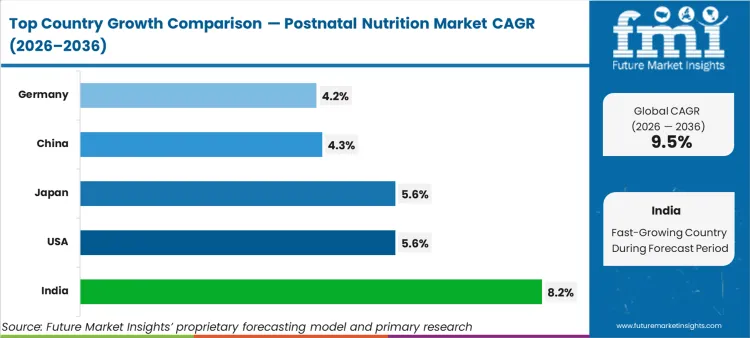
India leads with an 8.2% CAGR, driven by the traditional postnatal nutrition culture combined with growing organized retail and e-commerce distribution of branded postnatal products. USA and Japan both track at 5.6%, reflecting established maternal health supplement categories and physician recommendation pathways. China registers a 4.3% pace as the maternity care market develops branded postnatal nutrition offerings for urban consumers. Germany tracks at 4.2% anchored by the EU health claims framework and pharmacy-distributed maternal nutrition products.
Postnatal Nutrition Market Key Takeaways
| Metric | Details |
|---|---|
| Industry Size (2026) | USD 2714.7 million |
| Industry Value (2036) | USD 6771.2 million |
| CAGR (2026-2036) | 9.5% |
Postnatal Nutrition Market Definition
Postnatal nutrition encompasses functional foods, beverages, and dietary supplements specifically formulated to address the nutritional recovery, lactation support , and health restoration needs of mothers during the postpartum period. These products target nutrient depletion from pregnancy and childbirth, provide galactagogue support for breastfeeding, and address specific postnatal health concerns including iron deficiency, bone health, mood regulation, and immune recovery.
Postnatal Nutrition Market Inclusions
Market scope includes postnatal functional foods, recovery beverages, and dietary supplements targeting maternal nutritional support, milk production, iron replenishment, bone health, mood support, digestive health, energy, and immune function. The report covers global and regional market sizes from 2026 to 2036, segmented by product type, health indication, and geography.
Postnatal Nutrition Market Exclusions
Prenatal nutrition products designed for consumption during pregnancy are excluded. Infant formula and baby nutrition products fall outside scope. General women's health supplements without specific postnatal positioning are excluded from the valuation.
Postnatal Nutrition Market Research Methodology
- Primary Research: Analysts engaged with procurement specialists, production managers, and supply chain directors to map purchasing cycles and supplier qualification requirements.
- Desk Research: Data collection aggregated regulatory filings, industry standards, trade association publications, and public company disclosures.
- Market-Sizing and Forecasting: Baseline values derive from hybrid top-down and bottom-up methodology, applying region-specific adoption curves through 2036.
- Data Validation and Update Cycle: Projections tested against publicly reported production volumes, trade data, and industry benchmarks with annual recalibration.
Top Postnatal Nutrition Market Dynamics and Industry Trends
Navigating Postpartum Nutrition: Why Meeting Nutritional Needs is Crucial
According to a consumer survey by FMI, even with dietary supplements, many expectant mothers may not get enough of some important vitamins and minerals, such as folate, choline, iron, calcium, potassium, magnesium, zinc, and vitamins D, C, A, B6, K, and E. Following delivery, the body needs more of these nutrients to support lactation and aid in recovery, thus higher amounts are needed.
Postpartum diet is important for both physical and mental wellbeing, according to some nutritionists. Taking care of their own nutritional needs might seem burdensome to new parents, who frequently experience exhaustion from restless nights, fatigue from nursing, and the demands of recuperation. This emphasizes how crucial it is to provide adequate nutrition first priority during the postpartum phase in order to maintain both physical and mental well-being.
Rising Emphasis on Bone Health in Postnatal Nutrition Supplements
As the importance of bone health becomes more widely recognized, it has become a significant health claim in postnatal nutrition supplements. This shift is especially noticeable in markets like Thailand, Malaysia, and India, where there is a rapidly growing need for supplements that support bone health. The requirement to restore and maintain bone density which might be hampered during pregnancy due to elevated calcium demands drives the emphasis on bone health in postnatal care.
After giving birth, women's bodies undergo major changes, making proper bone support essential for their general health and recuperation. Important elements like calcium, magnesium, and vitamin D are found in supplements, which are becoming more and more popular as consumers seek out items that support long-term bone health as well as recovery. The increasing recognition of the importance of postnatal bone health is shaping market trends and driving the growth of specialized supplements designed to cater these needs.
Growing Demand for DHA and EPA in Postnatal Nutrition
The increasing need for DHA (docosahexaenoic acid) and EPA (eicosapentaenoic acid) in postnatal nutrition can be attributed to their vital roles in brain growth and health.
Two important omega-3 fatty acids that are known to improve mood management and cognitive performance are DHA and EPA. Their rising use in postnatal nutrition products is a result of this, and it is indicative of a larger movement to improve the health of both mothers and their infants. This change addresses new mothers' postpartum mental health requirements in addition to assisting with their physical recovery.
It's becoming increasingly common to find DHA and EPA included in functional meals and beverages. Companies such as Nestlé, for example, have added DHA to their postnatal nutrition bars and drinks to promote
Comparison of Historical vs Forecast Outlook for Postnatal Nutrition Sales (2020 to 2024 vs 2026 to 2036)
Global sales increased at a CAGR of 596.1% from 2020 to 2024. For the next ten years (2026 to 2036), projections are that value will rise at 9.5% CAGR.
Onwards from 2025, The postnatal nutrition market has seen a noteworthy change in recent years, with a focus on natural ingredients and convenience, which aligns with the changing needs and tastes of new mothers.
The requirement for items that easily fit into the hectic lives of post-delivery women who frequently juggle several duties, including caring for their newborn and managing their own recovery is emphasized by the increased desire for on-the-go versions. As a result, there is now a greater selection of products that prioritize portability and convenience of use.
The rise in popularity of plant-based juices and drinks enhanced with beneficial components is one of the major trends. These goods meet the growing demand from customers for natural and health-conscious products. To promote postnatal health, plant-based drinks supplemented with vital vitamins and minerals include those prepared from almond, soy, or oat milk.
Drinks enhanced with calcium and vitamin D, for example, are very well-liked because these nutrients are essential for bone health and healing after childbirth. To further improve the nutritional profile of these drinks, functional additives like omega-3 fatty acids which are crucial for cognitive function and general health-are being included.
Another major area of interest for postnatal nutrition product development is flavor innovation. Producers are adding more distinctive and enticing tastes to their products in an effort to boost flavor and promote regular consumption. Products like protein- and mineral-enriched cookies and chocolate drinks with added protein have been introduced as a result.
These products satisfy the need for fun and decadent foods that fit into a hectic schedule in addition to offering necessary nutrients. For instance, protein-enriched biscuits are a sensible option for postpartum women who require quick and wholesome snacks since they provide a simple means of increasing protein consumption while simultaneously satiating desires.
Market Concentration in the Postnatal Nutrition Sector
In the dynamic market of postnatal nutrition, the competitive landscape is shaped by a combination of multinational corporations (MNCs) and regional players, each leveraging their unique strengths to capture market share and provide to diverse consumer needs.
Global leaders in the postnatal nutrition market include multinational corporations (MNCs) like Abbott and Nestlé. They can set the bar for product quality and innovation because to their wide distribution networks, well-known brands, and powerful research capabilities. For example, the company's capacity to manufacture premium goods that meet international standards helps Nestlé's line of postnatal supplements, which includes their Materna brand. Their worldwide reach guarantees a stable supply chain and broad accessibility, enabling them to effectively cater to various markets.
In a comparable manner, Abbott's Similac brand enjoys high acclaim because to its cutting-edge formulas that promote the health of both mom and baby. These international businesses often enter into strategic alliances and make deals to expand their product offerings and increase their market share, which helps them stay ahead of the competition.
Conversely, regional players concentrate on customized solutions that meet regional demands and tastes. Businesses like Danone and GSK Consumer Healthcare are excellent at customizing their products to fit unique local needs. For instance, GSK's Pregnacare product line offers formulations that are well-suited to the dietary customs and medical demands of various locales, all while taking local nutritional needs into consideration.
Local consumers are more likely to connect with Danone's brands since they frequently use ingredients unique to the area and follow local laws. These regional businesses are able to operate with fewer costs and more flexibility because they are skilled at comprehending and incorporating area agricultural practices and government restrictions into their products.
The coexistence of MNCs and regional players creates a competitive and resilient marketplace. MNCs drive global innovation and set benchmarks for product quality and efficacy, while regional players offer customized solutions that are finely tuned to local market conditions. This interplay fosters a dynamic industry environment where various consumer needs are addressed through a broad range of products and approaches.
In summary, the postnatal nutrition market benefits from the strategic contributions of both multinational corporations and regional players. MNCs bring global expertise and innovation, ensuring high-quality and widely available products, while regional companies provide localized, cost-effective solutions that cater to specific market requirements. This competitive landscape enhances the industry's ability to meet diverse consumer needs across different regions.
Key Trends Driving Demand in the Postnatal Nutrition Market
Healthy Snacking Trend Revolutionizes Postnatal Nutrition Market
The market for postnatal nutrition is being greatly impacted by the growing popularity of healthy snacking, which is helping to guide the industry in the direction of more favourable growth. This change is especially noticeable in the way postnatal nutrition products are created to satisfy the demands of new moms who are looking for solutions that are both easy and nourishing.
The emphasis on healthful snacking is in line with the increasing understanding of the value of balanced meals and the necessity of making quick, good food decisions. Having availability to ready-to-eat, nutrient-dense snacks is especially important for new mothers, who frequently have to balance the duties of caring for a new born with recovery time.
A wide range of goods, including nutrient-dense snacks, protein-rich biscuits, and fortified bars, have been introduced as a result of this trend and are expressly meant for postnatal care.
Rising Focus on Mental Well-being Fuels Demand for Brain Health Supplements in Postnatal Nutrition
The demand for postnatal nutrition products, especially those intended to improve cognitive function, is being driven primarily by the growing acknowledgment of the significance of mental health in conjunction with physical healing. Incorporating brain health supplements with components like choline has become an essential element of new moms' wellness routines as they navigate the difficult postpartum period.
Postnatal supplements are increasingly include choline, an important vitamin recognized for its function in promoting brain health and cognitive development. This change responds to the complex requirements of new moms by reflecting a larger trend where mental health is given similar weight as physical health.
The growing recognition of postpartum mental health conditions, like as depression and anxiety, has led to a more comprehensive approach to postnatal care.
Clean Label Movement Drives Demand for Transparent and Health-Conscious Postnatal Nutrition Products
As more and more new moms demand transparency and purity in their diets, the market for postnatal nutrition is changing due to customer preferences for clean label products. Postnatal nutrition is increasingly focusing on clean label claims, such as grass-fed dairy protein, organic components, gluten-free alternatives, and the lack of artificial sweeteners and preservatives. This change is indicative of a larger movement in consumption that places a high emphasis on food integrity and little processing.
When consumer awareness of ingredient origin and product transparency increases, there is a growing demand for prenatal nutrition solutions that meet clean label requirements. Products that offer consumers nutritional benefits and the reassurance that they are manufactured sustainably and without artificial substances tend to attract them. Dairy products collected from grass-fed cows are consumed for their quality and nutritional composition. Organic products are preferred due to absence of synthetic additives and pesticides.
Analysis of Top Countries Using Postnatal Nutrition Products
The following table shows the estimated growth rates of the top three territories. USA and Germany are set to exhibit high consumption, recording CAGRs of 4.3% and 3.4%, respectively, through 2036.
| Countries | CAGR 2026 to 2036 |
|---|---|
| USA | 5.6% |
| Germany | 4.2% |
| India | 8.2% |
| China | 4.3% |
| Japan | 5.6% |
High Birth Rate and Rising Incomes in India to Fuel Demand for Postnatal Nutrition Products
The postnatal nutrition industry in the India is projected to exhibit a CAGR of 8.2% during the assessment period. By 2036, revenue from the sales of this sector in the country is expected to reach USD 81.2 million.
India's increasing birth rate and rising per capita income create considerable prospects in the postnatal nutrition sector. With one of the world's highest birth rates, the number of new mothers requiring special care is steadily increasing. As families grow, there is a greater need for effective postnatal items like vitamins and functional foods.
At the same time, India's economic expansion increases disposable income, allowing more families to afford high-quality nutrition items. This increased purchasing power enables new mothers to obtain high-quality postnatal vitamins and functional meals that aid in their recovery and overall well-being. As more Indian families prioritize health and nutrition, the postnatal goods business is anticipated to grow dramatically.
Demand Outlook in USA
The demand in USA is expected to rise at a CAGR of 5.6% during the forecast period (2026 to 2036). By 2036, USA is expected to account for 23.6% of sales in the world.
In the United States, there has been a major increase in the use of postnatal supplements as new mothers are looking at specific health indication, such as vitamin D deficiency and mental health. Vitamin D is necessary for a variety of functions, including bone health and immune support, which are especially important in after delivery period. Many mothers fail to receive enough vitamin D through diet and sunlight alone, so they rely on pills to fill the gap.
Along with addressing vitamin D deficiency, postnatal supplements are being marketed for the ability to support mental health. After childbirth period can be emotionally and physically challenging, with many new mothers experiencing mood swings, tiredness, and increased stress.
Increased Product Launches in Germany Expected to Propel Sales
In Germany, the postnatal nutrition market is expected to grow with a higher CAGR, supported by an increased number of product launches in the category of postnatal on-the-go snacks and ready-to-drink beverages. These new products are specially designed to cater to the nutritional needs of women in the postpartum stage, with a strong focus on convenience and comprehensive health support.
The surge in product innovation is marked as companies introduce a variety of fortified snacks and beverages with high content of vitamins and minerals and other essential ingredients. These products are formulated to help new mothers meet their increased nutritional requirements while managing the demands of a busy lifestyle. For instance, fortified protein bars, nutrient-dense smoothies, and ready-to-drink shakes are becoming popular choices.
Postnatal Nutrition Industry Analysis by Top Investment Segments
Rising Demand for the Ready-To-Eat Nutrition Snacks Support Growth
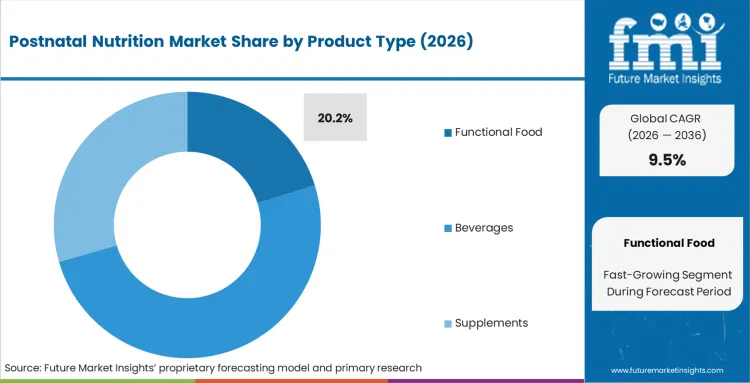
| Segment | Product Type (By Snacks) |
|---|---|
| Value Share (2026) | 20.2% |
Functional foods such as protein bars, fortified cereals, and nutrient-enriched biscuits are gaining popularity as they provide essential vitamins and minerals in a convenient to carry format. These products are specifically custom-made to support the nutritional needs of postpartum women, offering a practical solution for those who are balancing the demands of a new-born with their own recovery
The increased demand for on-the-go products is an important driver of growth in the postnatal nutrition market. With busy lifestyles becoming more difficult, new mothers are looking for easy yet healthy solutions that can effortlessly can be used in the busy schedules. This shift is leading to a surge in the availability and variety of postnatal nutrition products designed for ease and efficiency.
Beverages, including ready-to-drink shakes and fortified juices, are also contributing to this trend. These beverages are formulated with essential nutrients like iron, calcium, and vitamins that are crucial for postpartum health. Their ready-to-consume nature ensures that new mothers can easily incorporate these supplements into their daily routine without the need for extensive preparation.
The Bone & Joint Health, and Brain Health Indications is likely to dominate the sales
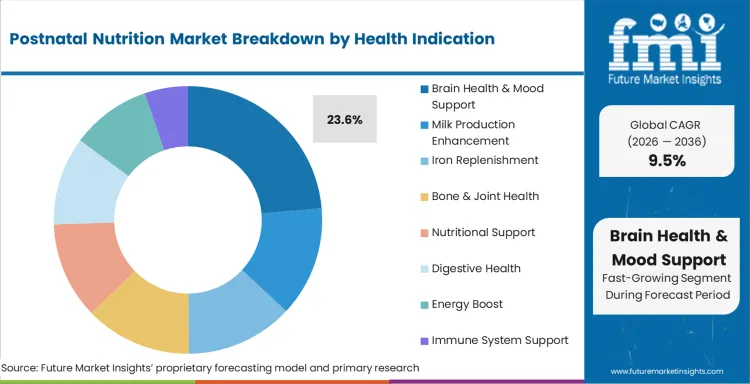
| Segment | Health Condition (By bone and joint health) |
|---|---|
| Value Share (2026) | 23.6% |
In recent years, bone and joint health, along with brain health claims, have gained significant traction in the postnatal nutrition market, driving a surge in product sales. These health claims are becoming increasingly prominent as new mothers seek comprehensive support to recover from childbirth and ensure their overall well-being.
Bone and joint health is a major focus, given the increased demand for supplements that help replenish lost nutrients and support skeletal strength after pregnancy. Products fortified with calcium, vitamin D, and magnesium are in high demand, as these nutrients are crucial for maintaining bone density and joint flexibility during the postpartum period. The emphasis on bone and joint health is expected to dominate the indication segment, reflecting the growing awareness of the importance of recovery and long-term bone health for new mothers.
Competitive Outlook in the Postnatal Nutrition Industry
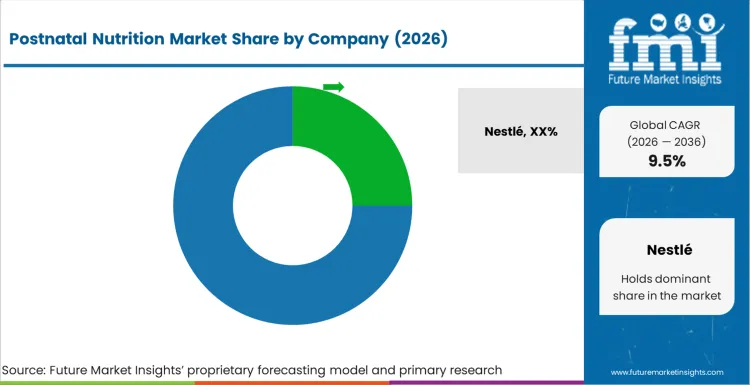
Companies are strategizing on innovation and product differentiation to standout from their competitors. Their major investments are in product development with multiple health benefits in the same products and minimally processed ingredients.
They also form strategic alliances and partnerships which add value to the company’s products. There have been changing marketing strategies. For example, manufacturers are focusing on building relations with the local suppliers and distributors to enhance the reach and create awareness amongst consumes.
Leading Postnatal Nutrition Brands by Market Share
- Nestlé
- Abbott Laboratories
- Danone
- GlaxoSmithKline
- Mead Johnson Nutrition
- Procter & Gamble
- BioCare Copenhagen
- Vitabiotics
- Evonik Industries
- Herbalife Nutrition
- The Honest Company
- New Chapter
- Enfamil
- Ortho Molecular Products
- Garden of Life
- Others
Scope of the Report
| Metric | Value |
|---|---|
| Quantitative Units | USD 2714.7 million to USD 6771.2 million, at a CAGR of 9.5% |
| Market Definition | Postnatal nutrition encompasses functional foods, beverages, and dietary supplements specifically formulated to address the nutritional recovery, lactation support, and health restoration needs of mothers during the postpartum period. These products target nutrient depletion from pregnancy and childbirth, provide galactagogue support for breastfeeding, and address specific postnatal health concerns including iron deficiency, bone health, mood regulation, and immune recovery. |
| Product Type Segmentation | Functional Food, Beverages, Supplements |
| Health Indication Segmentation | Nutritional Support, Milk Production Enhancement, Iron Replenishment, Bone & Joint Health, Brain Health & Mood Support, Digestive Health, Energy Boost, Immune System Support |
| Regions Covered | North America, Latin America, Europe, East Asia, South Asia, Oceania, Middle East & Africa |
| Countries Covered | India, USA, Japan, China, Germany, and 40 plus countries |
| Key Companies Profiled | Nestle, Abbott Laboratories, Danone, GlaxoSmithKline, Mead Johnson Nutrition, Procter & Gamble, BioCare Copenhagen, Vitabiotics, Evonik Industries, Herbalife Nutrition, The Honest Company, New Chapter, Ortho Molecular Products, Garden of Life |
| Forecast Period | 2026 to 2036 |
| Approach | Hybrid top-down and bottom-up modelling anchored by primary interviews and public data benchmarking |
Top Investment Segments Studied in the Postnatal Nutrition Market
By Product Type:
As per composition, the industry has been categorized into Functional Food, (Protein Bars, Protein Powders, Fortified Cereals, Lactation Cookies, Lactation Bars, Recovery Soups, Nutrient-Rich Stews, Crips), Beverages (Herbal Teas, Fortified Milk, Lactation Teas, Ready-To-Drink Smoothies, Electrolyte Drinks), Supplements (Vitamins and Minerals, Herbal Supplements, Calcium Supplements, Iron Supplements, Omega-3 Fatty Acids, Probiotics, Herbal Supplements, Magnesium Supplements)
By Primary Ingredients:
This segment is further categorized into Protein, Multivitamin and Minerals, Omega-3 Fatty Acids, Iron, Calcium, Vitamin D, Folic Acid, Magnesium, Vitamin C, Zinc, Choline, Fiber, Others.
By Health Indication:
As per Health Indication, the industry has been categorized into Nutritional Support, Milk Production Enhancement, Iron Replenishment, Bone & Joint Health, Brain Health & Mood Support, Digestive Health, Energy Boost, Immune System Support.
By Sales Channel:
This segment is further categorized into Prescription Supplements, Over the Counter Supplements (OTC), and Online Retail.
By Region:
Industry analysis has been carried out in key countries of North America, Latin America, Europe, East Asia, South Asia, Oceania, and the Middle East & Africa.
Bibliography
- World Health Organization. (2024). Guideline on Postnatal Care of the Mother and Newborn. WHO.
- European Food Safety Authority. (2024). Scientific Opinions on Nutrient Requirements During Lactation. EFSA Journal.
- National Institutes of Health. (2024). Office of Dietary Supplements: Nutrient Recommendations for Lactating Women. NIH.
- American College of Obstetricians and Gynecologists. (2024). Committee Opinion on Postpartum Nutrition. ACOG.
- International Confederation of Midwives. (2024). Essential Competencies: Postnatal Nutrition Guidance. ICM.
This bibliography is provided for reader reference. The full FMI report contains the complete reference list with primary research documentation.
Frequently Asked Questions
How large is the demand for Postnatal Nutrition in the global market in 2026?
Demand for Postnatal Nutrition in the global market is estimated to be valued at USD 2714.7 million in 2026.
What will be the market size of Postnatal Nutrition in the global market by 2036?
Market size for Postnatal Nutrition is projected to reach USD 6771.2 million by 2036.
What is the expected demand growth for Postnatal Nutrition in the global market between 2026 and 2036?
Demand for Postnatal Nutrition is expected to grow at a CAGR of 9.5% between 2026 and 2036.
Which Product Type is poised to lead global sales by 2026?
Functional Food accounts for 20.2% share in 2026.
How significant is the role of Nutritional Support in Health Indication?
Nutritional Support commands 26.0% of the health indication segment in 2026.
What is the growth outlook for India?
India is projected to grow at a CAGR of 8.2% during 2026 to 2036.
What is the growth rate for USA in this market?
USA is projected to expand at a CAGR of 5.6% during 2026 to 2036.
What is Postnatal Nutrition and what is it mainly used for?
Postnatal nutrition encompasses functional foods, beverages, and dietary supplements specifically formulated to address the nutritional recovery, lactation support, and health restoration needs of mothers during the postpartum period. These products target nutrient depletion from pregnancy and childbirth, provide galactagogue support for breastfeeding, and address specific postnatal health concerns including iron deficiency, bone health, mood regulation, and immune recovery.
What is included in the scope of this Postnatal Nutrition report?
Market scope includes postnatal functional foods, recovery beverages, and dietary supplements targeting maternal nutritional support, milk production, iron replenishment, bone health, mood support, digestive health, energy, and immune function. The report covers global and regional market sizes from 2026 to 2036, segmented by product type, health indication, and geography.
What is excluded from the scope of this report?
Prenatal nutrition products designed for consumption during pregnancy are excluded. Infant formula and baby nutrition products fall outside scope.
What does market forecast mean on this page?
The market forecast represents a model-based projection built on defined industry and supply chain assumptions for strategic planning purposes.
How does FMI build and validate the Postnatal Nutrition forecast?
Forecasting models apply a hybrid top-down and bottom-up methodology and cross-validate projections against publicly available industry data and primary research inputs.
What does zero reliance on speculative third-party market research mean here?
Primary interviews, verified public regulatory documentation, and official industry standards registries are used instead of unverified syndicated estimates.
Preview the report firsthand - request a free sample
Get SampleGet the brochure for pricing and purchase details.
Get PDFTable of Content
- Executive Summary
- Global Market Outlook
- Demand-side Trends
- Supply-side Trends
- Technology Roadmap Analysis
- Analysis and Recommendations
- Market Overview
- Market Coverage / Taxonomy
- Market Definition / Scope / Limitations
- Research Methodology
- Chapter Orientation
- Analytical Lens and Working Hypotheses
- Market Structure, Signals, and Trend Drivers
- Benchmarking and Cross-market Comparability
- Market Sizing, Forecasting, and Opportunity Mapping
- Research Design and Evidence Framework
- Desk Research Programme (Secondary Evidence)
- Company Annual and Sustainability Reports
- Peer-reviewed Journals and Academic Literature
- Corporate Websites, Product Literature, and Technical Notes
- Earnings Decks and Investor Briefings
- Statutory Filings and Regulatory Disclosures
- Technical White Papers and Standards Notes
- Trade Journals, Industry Magazines, and Analyst Briefs
- Conference Proceedings, Webinars, and Seminar Materials
- Government Statistics Portals and Public Data Releases
- Press Releases and Reputable Media Coverage
- Specialist Newsletters and Curated Briefings
- Sector Databases and Reference Repositories
- FMI Internal Proprietary Databases and Historical Market Datasets
- Subscription Datasets and Paid Sources
- Social Channels, Communities, and Digital Listening Inputs
- Additional Desk Sources
- Expert Input and Fieldwork (Primary Evidence)
- Primary Modes
- Qualitative Interviews and Expert Elicitation
- Quantitative Surveys and Structured Data Capture
- Blended Approach
- Why Primary Evidence is Used
- Field Techniques
- Interviews
- Surveys
- Focus Groups
- Observational and In-context Research
- Social and Community Interactions
- Stakeholder Universe Engaged
- C-suite Leaders
- Board Members
- Presidents and Vice Presidents
- R&D and Innovation Heads
- Technical Specialists
- Domain Subject-matter Experts
- Scientists
- Physicians and Other Healthcare Professionals
- Governance, Ethics, and Data Stewardship
- Research Ethics
- Data Integrity and Handling
- Primary Modes
- Tooling, Models, and Reference Databases
- Desk Research Programme (Secondary Evidence)
- Data Engineering and Model Build
- Data Acquisition and Ingestion
- Cleaning, Normalisation, and Verification
- Synthesis, Triangulation, and Analysis
- Quality Assurance and Audit Trail
- Market Background
- Market Dynamics
- Drivers
- Restraints
- Opportunity
- Trends
- Scenario Forecast
- Demand in Optimistic Scenario
- Demand in Likely Scenario
- Demand in Conservative Scenario
- Opportunity Map Analysis
- Product Life Cycle Analysis
- Supply Chain Analysis
- Investment Feasibility Matrix
- Value Chain Analysis
- PESTLE and Porter’s Analysis
- Regulatory Landscape
- Regional Parent Market Outlook
- Production and Consumption Statistics
- Import and Export Statistics
- Market Dynamics
- Global Market Analysis 2021 to 2025 and Forecast, 2026 to 2036
- Historical Market Size Value (USD Million) Analysis, 2021 to 2025
- Current and Future Market Size Value (USD Million) Projections, 2026 to 2036
- Y-o-Y Growth Trend Analysis
- Absolute $ Opportunity Analysis
- Global Market Pricing Analysis 2021 to 2025 and Forecast 2026 to 2036
- Global Market Analysis 2021 to 2025 and Forecast 2026 to 2036, By Product Type
- Introduction / Key Findings
- Historical Market Size Value (USD Million) Analysis By Product Type , 2021 to 2025
- Current and Future Market Size Value (USD Million) Analysis and Forecast By Product Type , 2026 to 2036
- Functional Food
- Beverages
- Supplements
- Functional Food
- Y-o-Y Growth Trend Analysis By Product Type , 2021 to 2025
- Absolute $ Opportunity Analysis By Product Type , 2026 to 2036
- Global Market Analysis 2021 to 2025 and Forecast 2026 to 2036, By Health Indication
- Introduction / Key Findings
- Historical Market Size Value (USD Million) Analysis By Health Indication, 2021 to 2025
- Current and Future Market Size Value (USD Million) Analysis and Forecast By Health Indication, 2026 to 2036
- Brain Health & Mood Support
- Milk Production Enhancement
- Iron Replenishment
- Bone & Joint Health
- Nutritional Support
- Digestive Health
- Energy Boost
- Immune System Support
- Brain Health & Mood Support
- Y-o-Y Growth Trend Analysis By Health Indication, 2021 to 2025
- Absolute $ Opportunity Analysis By Health Indication, 2026 to 2036
- Global Market Analysis 2021 to 2025 and Forecast 2026 to 2036, By Region
- Introduction
- Historical Market Size Value (USD Million) Analysis By Region, 2021 to 2025
- Current Market Size Value (USD Million) Analysis and Forecast By Region, 2026 to 2036
- North America
- Latin America
- Western Europe
- Eastern Europe
- East Asia
- South Asia and Pacific
- Middle East & Africa
- Market Attractiveness Analysis By Region
- North America Market Analysis 2021 to 2025 and Forecast 2026 to 2036, By Country
- Historical Market Size Value (USD Million) Trend Analysis By Market Taxonomy, 2021 to 2025
- Market Size Value (USD Million) Forecast By Market Taxonomy, 2026 to 2036
- By Country
- USA
- Canada
- Mexico
- By Product Type
- By Health Indication
- By Country
- Market Attractiveness Analysis
- By Country
- By Product Type
- By Health Indication
- Key Takeaways
- Latin America Market Analysis 2021 to 2025 and Forecast 2026 to 2036, By Country
- Historical Market Size Value (USD Million) Trend Analysis By Market Taxonomy, 2021 to 2025
- Market Size Value (USD Million) Forecast By Market Taxonomy, 2026 to 2036
- By Country
- Brazil
- Chile
- Rest of Latin America
- By Product Type
- By Health Indication
- By Country
- Market Attractiveness Analysis
- By Country
- By Product Type
- By Health Indication
- Key Takeaways
- Western Europe Market Analysis 2021 to 2025 and Forecast 2026 to 2036, By Country
- Historical Market Size Value (USD Million) Trend Analysis By Market Taxonomy, 2021 to 2025
- Market Size Value (USD Million) Forecast By Market Taxonomy, 2026 to 2036
- By Country
- Germany
- UK
- Italy
- Spain
- France
- Nordic
- BENELUX
- Rest of Western Europe
- By Product Type
- By Health Indication
- By Country
- Market Attractiveness Analysis
- By Country
- By Product Type
- By Health Indication
- Key Takeaways
- Eastern Europe Market Analysis 2021 to 2025 and Forecast 2026 to 2036, By Country
- Historical Market Size Value (USD Million) Trend Analysis By Market Taxonomy, 2021 to 2025
- Market Size Value (USD Million) Forecast By Market Taxonomy, 2026 to 2036
- By Country
- Russia
- Poland
- Hungary
- Balkan & Baltic
- Rest of Eastern Europe
- By Product Type
- By Health Indication
- By Country
- Market Attractiveness Analysis
- By Country
- By Product Type
- By Health Indication
- Key Takeaways
- East Asia Market Analysis 2021 to 2025 and Forecast 2026 to 2036, By Country
- Historical Market Size Value (USD Million) Trend Analysis By Market Taxonomy, 2021 to 2025
- Market Size Value (USD Million) Forecast By Market Taxonomy, 2026 to 2036
- By Country
- China
- Japan
- South Korea
- By Product Type
- By Health Indication
- By Country
- Market Attractiveness Analysis
- By Country
- By Product Type
- By Health Indication
- Key Takeaways
- South Asia and Pacific Market Analysis 2021 to 2025 and Forecast 2026 to 2036, By Country
- Historical Market Size Value (USD Million) Trend Analysis By Market Taxonomy, 2021 to 2025
- Market Size Value (USD Million) Forecast By Market Taxonomy, 2026 to 2036
- By Country
- India
- ASEAN
- Australia & New Zealand
- Rest of South Asia and Pacific
- By Product Type
- By Health Indication
- By Country
- Market Attractiveness Analysis
- By Country
- By Product Type
- By Health Indication
- Key Takeaways
- Middle East & Africa Market Analysis 2021 to 2025 and Forecast 2026 to 2036, By Country
- Historical Market Size Value (USD Million) Trend Analysis By Market Taxonomy, 2021 to 2025
- Market Size Value (USD Million) Forecast By Market Taxonomy, 2026 to 2036
- By Country
- Kingdom of Saudi Arabia
- Other GCC Countries
- Turkiye
- South Africa
- Other African Union
- Rest of Middle East & Africa
- By Product Type
- By Health Indication
- By Country
- Market Attractiveness Analysis
- By Country
- By Product Type
- By Health Indication
- Key Takeaways
- Key Countries Market Analysis
- USA
- Pricing Analysis
- Market Share Analysis, 2025
- By Product Type
- By Health Indication
- Canada
- Pricing Analysis
- Market Share Analysis, 2025
- By Product Type
- By Health Indication
- Mexico
- Pricing Analysis
- Market Share Analysis, 2025
- By Product Type
- By Health Indication
- Brazil
- Pricing Analysis
- Market Share Analysis, 2025
- By Product Type
- By Health Indication
- Chile
- Pricing Analysis
- Market Share Analysis, 2025
- By Product Type
- By Health Indication
- Germany
- Pricing Analysis
- Market Share Analysis, 2025
- By Product Type
- By Health Indication
- UK
- Pricing Analysis
- Market Share Analysis, 2025
- By Product Type
- By Health Indication
- Italy
- Pricing Analysis
- Market Share Analysis, 2025
- By Product Type
- By Health Indication
- Spain
- Pricing Analysis
- Market Share Analysis, 2025
- By Product Type
- By Health Indication
- France
- Pricing Analysis
- Market Share Analysis, 2025
- By Product Type
- By Health Indication
- India
- Pricing Analysis
- Market Share Analysis, 2025
- By Product Type
- By Health Indication
- ASEAN
- Pricing Analysis
- Market Share Analysis, 2025
- By Product Type
- By Health Indication
- Australia & New Zealand
- Pricing Analysis
- Market Share Analysis, 2025
- By Product Type
- By Health Indication
- China
- Pricing Analysis
- Market Share Analysis, 2025
- By Product Type
- By Health Indication
- Japan
- Pricing Analysis
- Market Share Analysis, 2025
- By Product Type
- By Health Indication
- South Korea
- Pricing Analysis
- Market Share Analysis, 2025
- By Product Type
- By Health Indication
- Russia
- Pricing Analysis
- Market Share Analysis, 2025
- By Product Type
- By Health Indication
- Poland
- Pricing Analysis
- Market Share Analysis, 2025
- By Product Type
- By Health Indication
- Hungary
- Pricing Analysis
- Market Share Analysis, 2025
- By Product Type
- By Health Indication
- Kingdom of Saudi Arabia
- Pricing Analysis
- Market Share Analysis, 2025
- By Product Type
- By Health Indication
- Turkiye
- Pricing Analysis
- Market Share Analysis, 2025
- By Product Type
- By Health Indication
- South Africa
- Pricing Analysis
- Market Share Analysis, 2025
- By Product Type
- By Health Indication
- USA
- Market Structure Analysis
- Competition Dashboard
- Competition Benchmarking
- Market Share Analysis of Top Players
- By Regional
- By Product Type
- By Health Indication
- Competition Analysis
- Competition Deep Dive
- Nestlé
- Overview
- Product Portfolio
- Profitability by Market Segments (Product/Age /Sales Channel/Region)
- Sales Footprint
- Strategy Overview
- Marketing Strategy
- Product Strategy
- Channel Strategy
- Abbott Laboratories
- Danone
- GlaxoSmithKline
- Mead Johnson Nutrition
- Procter & Gamble
- BioCare Copenhagen
- Vitabiotics
- Evonik Industries
- Herbalife Nutrition
- The Honest Company
- New Chapter
- Enfamil
- Ortho Molecular Products
- Garden of Life
- Others
- Nestlé
- Competition Deep Dive
- Assumptions & Acronyms Used


