

- Market Size (2026)
- USD 511.9 Mn
- Forecast (2036)
- USD 970.0 Mn
- CAGR (2026 to 2036)
- 6.6%
How big is Cystic Fibrosis Nutrition Products Market in 2026?
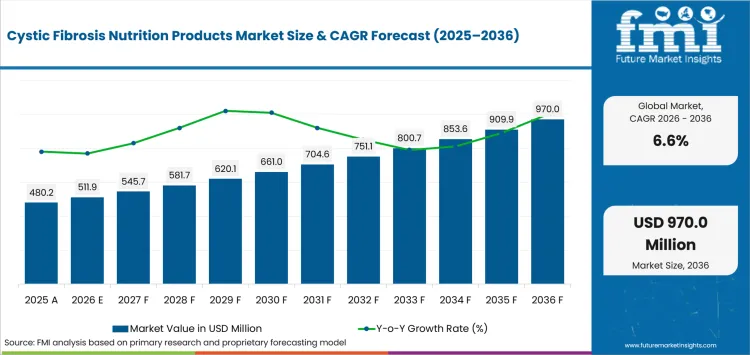
USD 511.9 million in 2026 and USD 970.0 million by 2036 at a 6.6% CAGR.
The cystic fibrosis nutrition products market is projected to expand from USD 511.9 million in 2026 to USD 970.0 million by 2036 at 6.6% CAGR. Longer survival keeps dietitian-directed nutrition relevant through more years of changing weight and gastrointestinal needs. In its October 2025 registry report, the Cystic Fibrosis Foundation recorded median predicted survival at 65.4 years for people born from 2020 through 2024. A longer care horizon extends repeat medical nutrition use beyond pediatric growth support into adult weight and absorption management.
Country economics differ as specialist-center density and reimbursement routes determine whether prescribed nutrition reaches households without interruption. The Cystic Fibrosis Trust documented 11,381 registered people in the United Kingdom during 2024 in its October 2025 annual report. A concentrated registry population gives clinical nutrition companies a clearer account map for prescribing and home replenishment. Japan requires narrower stocking since extremely low case density makes broad commercial distribution less efficient.
Key Takeaways
- Longer survival extends repeat nutrition management into adulthood and increases the value of age-spanning oral, enteral, and micronutrient portfolios.
- Based on product type, high-calorie high-protein ONS is projected to account for 43.5% in 2026 due to oral escalation preceding tube feeding.
- By age group, pediatric is estimated to hold 47.4% in 2026 owing to growth monitoring that brings dietetic intervention earlier in care.
- In 2026, RTD is expected to lead product form with 43.4% share because preparation-free use reduces daily administration steps.
- Wider variation in body weight and metabolic status limits blanket calorie escalation and increases the need for individualized dietitian review.
- Some of the key players in this market include Danone Nutricia, Abbott, Nestle Health Science, Vitaflo (Nestle Health Science), Fresenius Kabi, Solace Nutrition, Kate Farms, and Medtrition.
Analyst Perspective
"Unit price is a weak comparison if a formula is poorly tolerated or fails to follow the patient from clinic initiation into home use. In cystic fibrosis nutrition, commercial value depends on dietitian-adjustable calorie delivery plus reimbursement and resupply that survive regimen changes."
- Anurag Sharma, Principal Consultant, Future Market Insights
How is the Cystic Fibrosis Nutrition Products Market segmented?
The market is analyzed by product type, age group, product form, end user, sales channel and region.
Product type includes high-calorie high-protein ONS, enteral tube feeds, fat-soluble vitamin blends, salt and electrolyte products and others. Age group separates pediatric, adolescent and adult users and product form covers RTD, powders, puddings and semi-solids plus other forms. End user covers homecare plus CF centers and hospitals, with sales channels spanning hospital pharmacy, retail pharmacy, online and institutional tenders.
Why does RTD lead the Product form category?
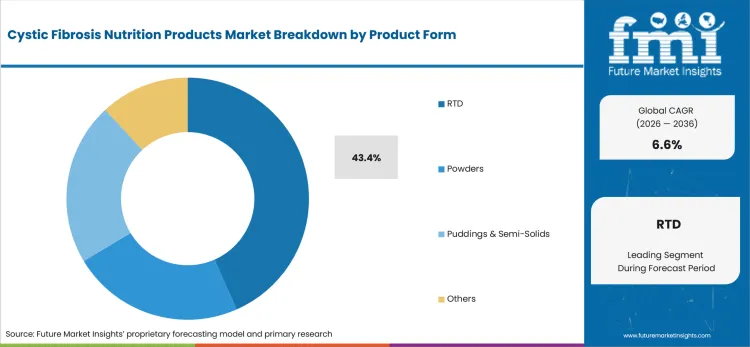
RTD products remove measuring and mixing steps during school days or treatment periods spent away from specialist care. Sealed portions also give caregivers a clearer daily repeat-use routine than powder preparation.
- RTD is set to lead the product form with 43.4% share in 2026 due to preparation-free use during mobile daily routines.
- In the October 2025 Cystic Fibrosis Foundation report, 72.5% of Registry participants reported working or studying during 2024. Prepared medical food formats reduce mixing steps during daily schedules that already carry treatment demands outside specialist clinics.
Why does High-calorie high-protein ONS lead the Product type category?
High-calorie high-protein ONS gives dietitians a lower-burden escalation route for inadequate oral intake without immediately moving to tube feeding. The format can raise calorie density without abandoning familiar oral administration during specialist review.
- By product type, high-calorie high-protein ONS is forecast to represent 43.5% in 2026 driven by oral escalation that usually precedes tube feeding.
- Hospital protocols keep concentrated oral supplements near specialist review before patients continue the regimen at home. Frimley Health NHS Foundation Trust approved its inpatient cystic fibrosis nutrition guide in April 2026 and listsoral clinical supplementsfor weight maintenance.
Why does Pediatric lead the Age group category?
Pediatric nutrition is judged against growth trajectories, so missed weight or height gains can bring dietetic intervention forward. Caregivers also control preparation and repeated household use, which makes palatability and coverage central to adherence.
- The pediatric segment is likely to capture 47.4% share in 2026 attributable to growth monitoring that brings nutrition support earlier in care.
- Pediatric purchasing remains sensitive to public coverage because repeated nutrition support extends well beyond one clinic visit. The October 2025 Cystic Fibrosis Foundation registry report recorded Medicaid or state-program coverage for 56.7% of children aged ten or younger.
Why does Homecare lead the End user category?
Homecare becomes commercially decisive once a specialist regimen is established since most consumption occurs between clinic visits. Delivery reliability and manageable preparation determine whether prescribed nutrition becomes a durable household routine.
- Homecare is projected to hold 48.9% share in 2026 owing to repeated daily intake between specialist visits.
- Homecare access forenteral nutritiondepends on financial support remaining available after dietitians establish a repeated household regimen. The October 2025 Cystic Fibrosis Foundation report recorded patient-assistance-program participation at 48.9% during 2024.
What are the drivers, restraints and opportunities in the Cystic Fibrosis Nutrition Products Market?
Longer survival extends repeat nutrition management, wider body-weight variation limits uniform calorie escalation and age-spanning formats improve continuity between specialist care and home use.
- Driver: Longer survival extends the years in which dietitians manage calorie intake, malabsorption, and age-specific nutritional needs.
- Restraint: Rising overweight and obesity make uniform high-calorie escalation less suitable for a growing portion of the CF population.
- Opportunity: Age-spanning oral and enteral formats can preserve nutrition continuity as patients shift between school, work, hospital, and home care.
Longer survival extends nutrition management horizon
Nutrition demand now extends further into adult life as survival improves and care pathways retain patients for more years. Adults represented more than 61.0% of the USA Registry population in the Cystic Fibrosis Foundation's October 2025 report. Longer adult follow-up increases the years in which dietitians adjust oral supplements or enteral formula for weight and gastrointestinal complications, which supports repeated purchasing without assuming every adult needs the same calorie density.
Weight status makes uniform calorie escalation less suitable
Long-term cystic fibrosis care now spans a wider body-weight range than a uniform high-calorie approach can address safely. Cystic Fibrosis Foundation data published in October 2025 put 42.5% of adults in the overweight or obese categories during 2024. Higher body weight does not remove malabsorption risk, so dietary supplements and calorie-dense products need more selective dietitian use based on individual nutritional status.
Age-spanning formats widen product roles
Adult routines increasingly place medical nutrition outside the clinic for much of the week. The Cystic Fibrosis Trust recorded 68.2% of people aged 16 or older in work or study during 2024. Portable oral formats and pediatric tube feeding products therefore need refill routes that remain practical during workdays and independent home use, giving companies a revenue route through convenience without weakening clinical specificity.
Which country CAGRs are profiled in the Cystic Fibrosis Nutrition Products Market?
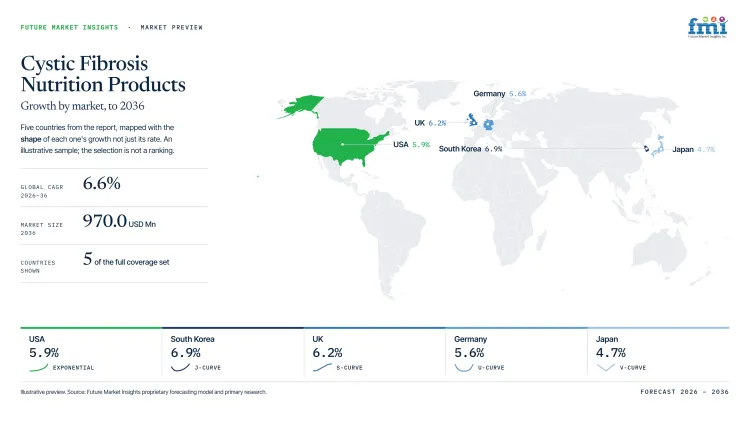
| Country | CAGR |
|---|---|
| South Korea | 6.9% |
| UK | 6.2% |
| USA | 5.9% |
| Germany | 5.6% |
| Japan | 4.7% |
How do country-level CAGRs compare in the Cystic Fibrosis Nutrition Products Market?
The 2.2-point spread separates South Korea and the UK from a tightly grouped USA-Germany middle band. Japan occupies the lower end because its tiny patient pool weakens broad inventory economics despite specialist care. Service cost and refill economics can outweigh small rate differences in a rare-disease nutrition portfolio.
- South Korea's small base turns modest absolute gains into faster percentage growth.
- UK geography allows national replenishment without the long service distances of larger markets.
- USA scale offers deeper absolute demand even with CAGR below the UK.
- Germany's adult-heavy patient mix keeps maintenance nutrition relevant at a mid-range growth rate.
- Japan needs tighter SKU selection because low turnover weakens broad inventory economics.
Similar CAGRs still require different channel and inventory strategies for commercial entry. The full report provides country-level CAGR analysis across North America, Latin America, Europe, East Asia, South Asia, Oceania and the Middle East and Africa.
Country-wise Analysis
- Accredited cystic fibrosis centers concentrate nutrition decisions in the USA where payer mix still determines whether prescribed products reach households without interruption. The Cystic Fibrosis Foundation reported in October 2025 that private insurance covered 59.9% of its 2024 Registry population and the USA is forecast to expand at 5.9% CAGR by 2036. Multiple payer rules still complicate continuation after clinic visits because companies need reimbursement support and age-spanning formats that preserve oral or tube-fed supply during treatment changes.
- Specialist NHS services give prescribed products a clear clinical entry route in the UK where discharge continuity determines whether hospital recommendations become repeat home supply. The Cystic Fibrosis Trust recorded 65.2% of registered patients aged 16 or older in October 2025 and the UK is anticipated to advance at 6.2% CAGR. An adult-heavy patient mix raises maintenance demand but companies still need reliable community replenishment after each regimen leaves the clinic.
- German cystic fibrosis care is concentrated in specialist ambulatory clinics that handle dietetic follow-up and repeated product continuity. Mukoviszidose e.V. documented 83 clinics nationally in July 2026 and Germany is estimated to post 5.6% CAGR over the forecast period. The focused account base simplifies dietitian engagement but each clinic carries more service responsibility for adult-relevant formats and reliable household logistics.
- Japan treats cystic fibrosis as an exceptionally rare specialist condition where low case density makes broad retail inventory uneconomic. The Ministry of Health stated in February 2026 that national median survival was 24 years with nutrition therapy centered on pancreatic enzymes plus high-protein and high-fat diets. Demand is forecast to rise at 4.7% CAGR over the forecast period as focused distribution concentrates ONS and micronutrient support near specialist centers.
- South Korea concentrates rare-disease care in designated institutions which gives nutrition companies a smaller hospital account base and keeps general retail turnover low. The Korea Disease Control and Prevention Agency expanded the specialist network to 19 institutions in March 2026 and South Korea is predicted to advance at 6.9% CAGR through 2036. Centralized follow-up concentrates repeat ordering in hospitals so controlled distribution remains more economical than a dedicated retail footprint for slow-moving products.
Who are the notable companies in the Cystic Fibrosis Nutrition Products Market?
Danone Nutricia, Abbott, Nestle Health Science, Vitaflo (Nestle Health Science), Fresenius Kabi, Solace Nutrition, Kate Farms, and Medtrition are the notable companies profiled in this market.
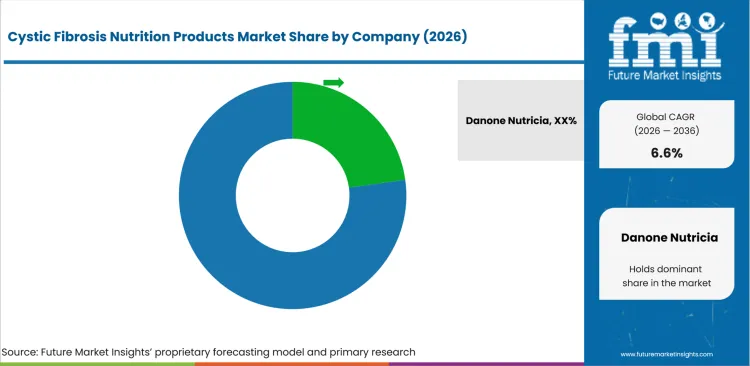
Broad medical-nutrition groups compete with specialists focused on narrower administration or absorption problems in cystic fibrosis care. Danone Nutricia, Abbott, Nestle Health Science, Vitaflo (Nestle Health Science), Fresenius Kabi and Solace Nutrition span broad portfolios or closer condition relevance. Kate Farms and Medtrition widen format choice through plant-based or concentrated protein products, with entry depending on clinical fit and tube feeding formula access.
- Broad platforms: Danone Nutricia, Abbott, Nestle Health Science, Vitaflo (Nestle Health Science) and Fresenius Kabi span broad or specialist nutrition portfolios.
- Fat-malabsorption specialist: Solace Nutrition focuses on nutrition for fat-absorption disorders that explicitly include cystic fibrosis within its documented use cases.
- Alternative-format companies: Kate Farms and Medtrition support oral or tube-fed use through plant-based formulas and concentrated protein products.
Competitive Benchmarking: Cystic Fibrosis Nutrition Products Market
| Company | 2025-2026 nutrition activity | Oral-to-tube evidence | CF or malabsorption proximity | Geographic Reach |
|---|---|---|---|---|
| Danone Nutricia | High | Medium | Medium | Global |
| Abbott | Medium | Low | Low | Global |
| Nestle Health Science | High | High | Medium | Global |
| Vitaflo (Nestle Health Science) | Medium | Medium | Medium | Europe and more than 40 countries |
| Fresenius Kabi | High | High | Medium | Global |
| Solace Nutrition | High | Medium | High | United States |
| Kate Farms | Medium | High | Medium | United States |
| Medtrition | Medium | High | Medium | United States and international accounts |
Scoring basis: High recent activity requires two current records from January 2025 onward and Medium requires one qualifying action. Low requires a current filing without a comparable action. Oral-to-tube evidence is High for both routes, Medium for one route plus another clinical setting and Low for one documented route. Condition proximity is High for explicit cystic fibrosis or fat-malabsorption evidence, Medium for disease-related malnutrition and Low for general nutrition. Geographic reach records operating regions without altering capability scores.
Key Developments in the Cystic Fibrosis Nutrition Products Market
- In July 2025, Danone completed its majority acquisition of Kate Farms to expand specialized nutrition reach in North America.
- In March 2025, Medtrition launched ProSource Cup products for oral and tube-fed patients requiring concentrated protein.
- In January 2025, Solace Nutrition returned Encala to open sale for fat-malabsorption disorders including cystic fibrosis.
Key Players in the Cystic Fibrosis Nutrition Products Market
Broad and specialist medical nutrition platforms
- Danone Nutricia
- Abbott
- Nestle Health Science
- Vitaflo (Nestle Health Science)
Clinical and fat-malabsorption nutrition specialists
- Fresenius Kabi
- Solace Nutrition
Alternative-format medical nutrition suppliers
- Kate Farms
- Medtrition
Cystic Fibrosis Nutrition Products Market - Report Scope
| Coverage field | Report scope |
|---|---|
| Market breakdown | By product type, age group, product form, end user, sales channel and region. |
| Quantitative Units | USD million. |
| Market Definition | Commercial medical nutrition products used to support calorie, protein, enteral, micronutrient, electrolyte and malabsorption-related needs in cystic fibrosis care. |
| Regions Covered | North America, Latin America, Europe, East Asia, South Asia and Pacific and Middle East and Africa. |
| Countries Covered | USA, UK, Germany, Japan, South Korea, and more than 25 additional countries included in the full report. |
| Key Companies Profiled | Danone Nutricia, Abbott, Nestle Health Science, Vitaflo (Nestle Health Science), Fresenius Kabi, Solace Nutrition, Kate Farms, Medtrition |
| Forecast Period | 2026 to 2036. |
| Approach | Primary and secondary research with market triangulation. |
Cystic Fibrosis Nutrition Products Market - Research Methodology
| Method | Approach |
|---|---|
| Primary Research | FMI analysts gathered input from manufacturers, service providers, technology developers, distributors, end users, procurement teams, and subject-matter experts. Interviews examined purchasing decisions, product or service evaluation, adoption barriers, approval requirements, pricing considerations, and expectations for technical or commercial support. Respondents were also asked what evidence is required before a trial, pilot, or initial order develops into regular purchasing. |
| Desk Research | Desk research covered government statistics, regulatory publications, trade data, industry associations, technical literature, standards, company filings, product information, and official corporate announcements. Sources were reviewed for relevance, publication date, geographic coverage, and consistency with the defined market scope. Claims relating to performance, applications, approvals, capacity, investment, and commercial activity were retained only when supported by credible public evidence. |
| Market Sizing and Forecasting | The market model combined the baseline value with historical performance, segment structure, pricing and volume indicators, adoption levels, company participation, and country-level demand conditions. Forecast assumptions considered economic activity, investment trends, regulatory developments, technology adoption, purchasing cycles, supply availability, and barriers to wider market use. Segment and regional estimates were reconciled before the final market total was calculated. |
| Data Validation | Estimates were checked against multiple independent indicators, including public data, company activity, trade patterns, industry developments, and findings from primary interviews. Validation also tested whether products, services, applications, and company revenues fell within the defined market boundaries. Adjacent categories, unsupported claims, overlapping revenues, and activities without direct market relevance were excluded to reduce double counting and maintain consistency across segments and countries. |
Cystic Fibrosis Nutrition Products Market by Segments
Cystic Fibrosis Nutrition Products Market segmented by Product Type:
- High-Calorie High-Protein ONS
- Enteral Tube Feeds
- Fat-Soluble Vitamin Blends (ADEK)
- Salt & Electrolyte Products
- Others
Cystic Fibrosis Nutrition Products Market segmented by Age Group:
- Pediatric
- Adolescent
- Adult
Cystic Fibrosis Nutrition Products Market segmented by Product Form:
- RTD
- Powders
- Puddings & Semi-Solids
- Others
Cystic Fibrosis Nutrition Products Market segmented by End User:
- Homecare
- CF Centers & Hospitals
- Others
Cystic Fibrosis Nutrition Products Market segmented by Sales Channel:
- Hospital Pharmacy
- Retail Pharmacy
- Online
- Institutional Tender
- Others
Cystic Fibrosis Nutrition Products Market by Region:
- North America
- United States
- Canada
- Latin America
- Brazil
- Mexico
- Argentina
- Chile
- Western Europe
- Germany
- France
- United Kingdom
- Italy
- Spain
- Benelux
- Nordics
- Eastern Europe
- Poland
- Czech Republic
- Romania
- Hungary
- East Asia
- China
- Japan
- South Korea
- South Asia and Pacific
- India
- ASEAN
- Australia and New Zealand
- Middle East and Africa
- GCC Countries
- South Africa
- Türkiye
- Israel
Research Sources and Bibliography
- Cystic Fibrosis Foundation. (2025, October). 2024 Annual Data Report.
- Cystic Fibrosis Trust. (2025, October). UK Cystic Fibrosis Registry 2024 Annual Data Report.
- Frimley Health NHS Foundation Trust. (2026, April 1). Cystic Fibrosis Inpatient Nutrition Guide.
- Fresenius Kabi. (2025, December 23). 2025 Year in Review.
- Danone. (2025, July 1). Danone completes the acquisition of Kate Farms, enhancing its USA specialized nutrition offerings.
- Mukoviszidose e.V. (2026, July 6). Registerdaten neu gedacht: Digitaler Berichtsband macht Versorgung sichtbar.
- Ministry of Health, Labour and Welfare. (2026, February 6). 2026
- Korea Disease Control and Prevention Agency. (2026, March 31).
- Medtrition, Inc. (2025, March 25). Medtrition, Inc. launches the ProSource® Cup portfolio.
- Solace Nutrition. (2025, February 7). Encala Returns.
- Nestlé. (2026, March 30). Nestlé introduces an innovative complete nutritional solution for children with special medical nutrition needs.
- Solace Nutrition. (2026, March 18). Solace Nutrition announces exclusive DME distribution partnership with Hearts Enteral for Encala®.
- Abbott. (2026, May 13). Abbott launches Ensure® Strength Pro in India to support healthy ageing.
- Nestlé Deutschland. (2025, November 12). Vitaflo feiert Eröffnung der Werkserweiterung in Rosbach v. d. Höhe.
- Fresenius Kabi. (2026, March 18). Innovating in PLANT-BASED Nutrition.
- Kate Farms. (2025, February 19). Kate Farms Introduces Pediatric Peptide 1.0 in an Organic Natural Strawberry Flavor.
- Nualtra. (2025, July 11). ARFID (Avoidant Restrictive Food Intake Disorder) Webinar 8th July 2025.
- Danone. (2026, February 20). 2025: Another year of strong delivery.
- Nestlé. (2026, February 19). Annual Review 2025.
- Fresenius SE & Co. KGaA. (2026, March 25). Annual Report 2025.
This Report Answers
- What is the cystic fibrosis nutrition products market size in 2026 and what value is forecast for 2036?
- Which clinical needs keep nutrition purchasing repeat-based in cystic fibrosis care?
- Why does high-calorie high-protein ONS lead the product type category?
- Why does pediatric lead the age group category?
- Why does RTD lead the product form category?
- Why does homecare lead the end user category?
- How do profiled country CAGRs differ through 2036?
- Which companies are active and how do their capabilities differ?
- Which restraint and opportunity have the greatest commercial effect through 2036?
Frequently Asked Questions
How big is the cystic fibrosis nutrition products market in 2026?
The cystic fibrosis nutrition products market is valued at USD 511.9 million in 2026 and is projected to reach USD 970.0 million by 2036. Growth is driven by repeat dietitian-directed support for malabsorption, inadequate intake and changing energy needs during long-term care.
What is the CAGR of the cystic fibrosis nutrition products market from 2026 to 2036?
The cystic fibrosis nutrition products market is projected to grow at a CAGR of 6.6% between 2026 and 2036. Expansion is supported by longer survival and repeated nutrition management through oral or enteral care.
Which product type leads the cystic fibrosis nutrition products market?
The high-calorie high-protein ONS segment is expected to hold 43.5% of the cystic fibrosis nutrition products market in 2026, driven by oral escalation prior to tube feeding. Its lower administration burden keeps calorie adjustment practical during dietitian-led oral care between specialist reviews.
Which age group leads the cystic fibrosis nutrition products market?
The pediatric segment is expected to hold 47.4% of the cystic fibrosis nutrition products market in 2026, attributable to growth monitoring that brings dietetic intervention earlier in care. Caregiver-controlled use also makes palatability and reimbursement important during household replenishment between scheduled clinic visits.
Which companies are active in the cystic fibrosis nutrition products market?
Key companies operating in the cystic fibrosis nutrition products market include Danone Nutricia, Abbott, Nestle Health Science, Vitaflo (Nestle Health Science), Fresenius Kabi, Solace Nutrition, Kate Farms, and Medtrition. Their positions differ by nutrition breadth, condition relevance, format choice and route-to-home support during long-term care.
Preview the report firsthand - request a free sample
Get SampleGet the brochure for pricing and purchase details.
Get PDFTable of Content
- Key Takeaways
- Market Size and CAGR
- Top Growth Driver
- Fastest Growing Segment
- Leading Region
- Key Companies
- Emerging Opportunities
- Executive Summary
- Global Market Outlook
- Demand-side Trends
- Supply-side Trends
- Technology Roadmap Analysis
- Analysis and Recommendations
- Analyst Perspective (What is happening? Why now? What should investors know?)
- Key Questions Answered
- How large is the market?
- What is the CAGR?
- What are key trends?
- Which region dominates?
- Who are the leaders?
- Market Overview
- Market Coverage / Taxonomy
- Market Definition / Scope / Limitations
- Research Methodology
- Chapter Orientation
- Analytical Lens and Working Hypotheses
- Market Structure, Signals, and Trend Drivers
- Benchmarking and Cross-market Comparability
- Market Sizing, Forecasting, and Opportunity Mapping
- Research Design and Evidence Framework
- Desk Research Programme (Secondary Evidence)
- Expert Input and Fieldwork (Primary Evidence)
- Tooling, Models, and Reference Databases
- Data Engineering and Model Build
- Quality Assurance and Audit Trail
- Market Background
- Market Dynamics (Drivers, Restraints, Opportunity, Trends)
- Scenario Forecast (Optimistic, Likely, Conservative)
- Impact Analysis
- AI Impact
- Sustainability Impact
- Regulatory Impact
- Technology Impact
- Consumer / Buyer Analysis
- Purchase Drivers
- Adoption Barriers
- Buyer Journey
- Opportunity Map Analysis
- Product Life Cycle Analysis
- Supply Chain Analysis
- Investment Feasibility Matrix
- Value Chain Analysis
- PESTLE and Porter's Analysis
- Regulatory Landscape
- Regional Parent Market Outlook
- Production and Consumption Statistics
- Import and Export Statistics
- Global Market Analysis and Forecast, 2021 to 2036
- Historical Market Size Value (USD Million) Analysis, 2021 to 2025
- Current and Future Market Size Value (USD Million) Projections, 2026 to 2036
- Y-o-Y Growth Trend Analysis
- Absolute $ Opportunity Analysis
- Global Market Pricing Analysis, 2021 to 2036
- Global Market Analysis and Forecast, By Product Type, 2021 to 2036
- Introduction / Key Findings
- Historical Market Size Value (USD Million) Analysis By Product Type, 2021 to 2025
- Current and Future Market Size Value (USD Million) Analysis and Forecast By Product Type, 2026 to 2036
- High-Calorie High-Protein ONS
- Enteral Tube Feeds
- Fat-Soluble Vitamin Blends (ADEK)
- Salt & Electrolyte Products
- Others
- High-Calorie High-Protein ONS
- Y-o-Y Growth Trend Analysis By Product Type, 2021 to 2025
- Absolute $ Opportunity Analysis By Product Type, 2026 to 2036
- Global Market Analysis and Forecast, By Age Group, 2021 to 2036
- Introduction / Key Findings
- Historical Market Size Value (USD Million) Analysis By Age Group, 2021 to 2025
- Current and Future Market Size Value (USD Million) Analysis and Forecast By Age Group, 2026 to 2036
- Pediatric
- Adolescent
- Adult
- Pediatric
- Y-o-Y Growth Trend Analysis By Age Group, 2021 to 2025
- Absolute $ Opportunity Analysis By Age Group, 2026 to 2036
- Global Market Analysis and Forecast, By Product Form, 2021 to 2036
- Introduction / Key Findings
- Historical Market Size Value (USD Million) Analysis By Product Form, 2021 to 2025
- Current and Future Market Size Value (USD Million) Analysis and Forecast By Product Form, 2026 to 2036
- RTD
- Powders
- Puddings & Semi-Solids
- Others
- RTD
- Y-o-Y Growth Trend Analysis By Product Form, 2021 to 2025
- Absolute $ Opportunity Analysis By Product Form, 2026 to 2036
- Global Market Analysis and Forecast, By End User, 2021 to 2036
- Introduction / Key Findings
- Historical Market Size Value (USD Million) Analysis By End User, 2021 to 2025
- Current and Future Market Size Value (USD Million) Analysis and Forecast By End User, 2026 to 2036
- Homecare
- CF Centers & Hospitals
- Others
- Homecare
- Y-o-Y Growth Trend Analysis By End User, 2021 to 2025
- Absolute $ Opportunity Analysis By End User, 2026 to 2036
- Global Market Analysis and Forecast, By Sales Channel, 2021 to 2036
- Introduction / Key Findings
- Historical Market Size Value (USD Million) Analysis By Sales Channel, 2021 to 2025
- Current and Future Market Size Value (USD Million) Analysis and Forecast By Sales Channel, 2026 to 2036
- Hospital Pharmacy
- Retail Pharmacy
- Online
- Institutional Tender
- Others
- Hospital Pharmacy
- Y-o-Y Growth Trend Analysis By Sales Channel, 2021 to 2025
- Absolute $ Opportunity Analysis By Sales Channel, 2026 to 2036
- Global Market Analysis and Forecast, By Region, 2021 to 2036
- Introduction
- Historical Market Size Value (USD Million) Analysis By Region, 2021 to 2025
- Current Market Size Value (USD Million) Analysis and Forecast By Region, 2026 to 2036
- North America
- Latin America
- Western Europe
- Eastern Europe
- East Asia
- South Asia and Pacific
- Middle East & Africa
- Market Attractiveness Analysis By Region
- North America Market Analysis and Forecast, By Country, 2021 to 2036
- Historical Market Size Value (USD Million) Trend Analysis By Market Taxonomy, 2021 to 2025
- Market Size Value (USD Million) Forecast By Market Taxonomy, 2026 to 2036
- By Country
- USA
- Canada
- By Product Type
- By Age Group
- By Product Form
- By End User
- By Sales Channel
- By Country
- Market Attractiveness Analysis
- By Country
- By Product Type
- By Age Group
- By Product Form
- By End User
- By Sales Channel
- Key Takeaways
- Latin America Market Analysis and Forecast, By Country
- Historical Market Size Value (USD Million) Trend Analysis By Market Taxonomy, 2021 to 2025
- Market Size Value (USD Million) Forecast By Market Taxonomy, 2026 to 2036
- By Country
- Brazil
- Mexico
- Chile
- Rest of Latin America
- By Product Type
- By Age Group
- By Product Form
- By End User
- By Sales Channel
- By Country
- Market Attractiveness Analysis
- By Country
- By Product Type
- By Age Group
- By Product Form
- By End User
- By Sales Channel
- Key Takeaways
- Western Europe Market Analysis and Forecast, By Country
- Historical Market Size Value (USD Million) Trend Analysis By Market Taxonomy, 2021 to 2025
- Market Size Value (USD Million) Forecast By Market Taxonomy, 2026 to 2036
- By Country
- Germany
- UK
- Italy
- Spain
- France
- Nordic
- BENELUX
- Rest of Western Europe
- By Product Type
- By Age Group
- By Product Form
- By End User
- By Sales Channel
- By Country
- Market Attractiveness Analysis
- By Country
- By Product Type
- By Age Group
- By Product Form
- By End User
- By Sales Channel
- Key Takeaways
- Eastern Europe Market Analysis and Forecast, By Country
- Historical Market Size Value (USD Million) Trend Analysis By Market Taxonomy, 2021 to 2025
- Market Size Value (USD Million) Forecast By Market Taxonomy, 2026 to 2036
- By Country
- Russia
- Poland
- Hungary
- Balkan & Baltic
- Rest of Eastern Europe
- By Product Type
- By Age Group
- By Product Form
- By End User
- By Sales Channel
- By Country
- Market Attractiveness Analysis
- By Country
- By Product Type
- By Age Group
- By Product Form
- By End User
- By Sales Channel
- Key Takeaways
- East Asia Market Analysis and Forecast, By Country
- Historical Market Size Value (USD Million) Trend Analysis By Market Taxonomy, 2021 to 2025
- Market Size Value (USD Million) Forecast By Market Taxonomy, 2026 to 2036
- By Country
- China
- Japan
- South Korea
- By Product Type
- By Age Group
- By Product Form
- By End User
- By Sales Channel
- By Country
- Market Attractiveness Analysis
- By Country
- By Product Type
- By Age Group
- By Product Form
- By End User
- By Sales Channel
- Key Takeaways
- South Asia and Pacific Market Analysis and Forecast, By Country
- Historical Market Size Value (USD Million) Trend Analysis By Market Taxonomy, 2021 to 2025
- Market Size Value (USD Million) Forecast By Market Taxonomy, 2026 to 2036
- By Country
- India
- ASEAN
- Australia & New Zealand
- Rest of South Asia and Pacific
- By Product Type
- By Age Group
- By Product Form
- By End User
- By Sales Channel
- By Country
- Market Attractiveness Analysis
- By Country
- By Product Type
- By Age Group
- By Product Form
- By End User
- By Sales Channel
- Key Takeaways
- Middle East & Africa Market Analysis and Forecast, By Country
- Historical Market Size Value (USD Million) Trend Analysis By Market Taxonomy, 2021 to 2025
- Market Size Value (USD Million) Forecast By Market Taxonomy, 2026 to 2036
- By Country
- Kingdom of Saudi Arabia
- Other GCC Countries
- Türkiye
- South Africa
- Other African Union
- Rest of Middle East & Africa
- By Product Type
- By Age Group
- By Product Form
- By End User
- By Sales Channel
- By Country
- Market Attractiveness Analysis
- By Country
- By Product Type
- By Age Group
- By Product Form
- By End User
- By Sales Channel
- Key Takeaways
- Key Countries Market Analysis
- USA
- Pricing Analysis
- Market Share Analysis, 2025
- By Product Type
- By Age Group
- By Product Form
- By End User
- By Sales Channel
- Canada
- Pricing Analysis
- Market Share Analysis, 2025
- By Product Type
- By Age Group
- By Product Form
- By End User
- By Sales Channel
- Mexico
- Pricing Analysis
- Market Share Analysis, 2025
- By Product Type
- By Age Group
- By Product Form
- By End User
- By Sales Channel
- Brazil
- Pricing Analysis
- Market Share Analysis, 2025
- By Product Type
- By Age Group
- By Product Form
- By End User
- By Sales Channel
- Chile
- Pricing Analysis
- Market Share Analysis, 2025
- By Product Type
- By Age Group
- By Product Form
- By End User
- By Sales Channel
- Germany
- Pricing Analysis
- Market Share Analysis, 2025
- By Product Type
- By Age Group
- By Product Form
- By End User
- By Sales Channel
- UK
- Pricing Analysis
- Market Share Analysis, 2025
- By Product Type
- By Age Group
- By Product Form
- By End User
- By Sales Channel
- Italy
- Pricing Analysis
- Market Share Analysis, 2025
- By Product Type
- By Age Group
- By Product Form
- By End User
- By Sales Channel
- Spain
- Pricing Analysis
- Market Share Analysis, 2025
- By Product Type
- By Age Group
- By Product Form
- By End User
- By Sales Channel
- France
- Pricing Analysis
- Market Share Analysis, 2025
- By Product Type
- By Age Group
- By Product Form
- By End User
- By Sales Channel
- India
- Pricing Analysis
- Market Share Analysis, 2025
- By Product Type
- By Age Group
- By Product Form
- By End User
- By Sales Channel
- ASEAN
- Pricing Analysis
- Market Share Analysis, 2025
- By Product Type
- By Age Group
- By Product Form
- By End User
- By Sales Channel
- Australia & New Zealand
- Pricing Analysis
- Market Share Analysis, 2025
- By Product Type
- By Age Group
- By Product Form
- By End User
- By Sales Channel
- China
- Pricing Analysis
- Market Share Analysis, 2025
- By Product Type
- By Age Group
- By Product Form
- By End User
- By Sales Channel
- Japan
- Pricing Analysis
- Market Share Analysis, 2025
- By Product Type
- By Age Group
- By Product Form
- By End User
- By Sales Channel
- South Korea
- Pricing Analysis
- Market Share Analysis, 2025
- By Product Type
- By Age Group
- By Product Form
- By End User
- By Sales Channel
- Russia
- Pricing Analysis
- Market Share Analysis, 2025
- By Product Type
- By Age Group
- By Product Form
- By End User
- By Sales Channel
- Poland
- Pricing Analysis
- Market Share Analysis, 2025
- By Product Type
- By Age Group
- By Product Form
- By End User
- By Sales Channel
- Hungary
- Pricing Analysis
- Market Share Analysis, 2025
- By Product Type
- By Age Group
- By Product Form
- By End User
- By Sales Channel
- Kingdom of Saudi Arabia
- Pricing Analysis
- Market Share Analysis, 2025
- By Product Type
- By Age Group
- By Product Form
- By End User
- By Sales Channel
- Türkiye
- Pricing Analysis
- Market Share Analysis, 2025
- By Product Type
- By Age Group
- By Product Form
- By End User
- By Sales Channel
- South Africa
- Pricing Analysis
- Market Share Analysis, 2025
- By Product Type
- By Age Group
- By Product Form
- By End User
- By Sales Channel
- USA
- Market Structure Analysis
- Competition Dashboard
- Competition Benchmarking
- Market Share Analysis of Top Players
- By Regional
- By Product Type
- By Age Group
- By Product Form
- By End User
- By Sales Channel
- Emerging Startups
- Innovation Benchmarking
- Competition Analysis
- Competition Deep Dive
- Danone Nutricia
- Overview
- Product Portfolio
- Profitability by Market Segments
- Sales Footprint
- Strategy Overview
- Marketing Strategy
- Product Strategy
- Channel Strategy
- Abbott
- Nestle Health Science
- Vitaflo (Nestle Health Science)
- Fresenius Kabi
- Solace Nutrition
- Kate Farms
- Medtrition
- Danone Nutricia
- Case Studies
- Success Stories
- Recent Developments
- Competition Deep Dive
- Assumptions & Acronyms Used


