

- Market Size (2026)
- USD 368.4 Mn
- Forecast (2036)
- USD 817.8 Mn
- CAGR (2026 to 2036)
- 8.3%
How big is Diabetic Wound Nutrition Market in 2026?
USD 368.4 million in 2026 and USD 817.8 million by 2036 at an 8.3% CAGR.
Diabetic wound nutrition revenue is projected to rise from USD 368.4 million in 2026 to USD 817.8 million by 2036 at an 8.3% CAGR. A targeted supplement enters the care plan after a diabetic wound prompts nutrition assessment and reveals inadequate intake or elevated protein requirements. The American Diabetes Association's December 2025 foot-care standards state that up to 50% of diabetic peripheral neuropathy cases may be asymptomatic. Specialist teams therefore evaluate nutrition beside vascular status and infection control before ordering wound-focused supplementation.
Country payment and treatment pathways determine whether a documented nutrition need develops into repeat purchasing after specialist wound care. The Korea Disease Control and Prevention Agency's December 2025 survey placed regional diabetes treatment rates between 83.3% and 96.4%. The spread shows that clinical follow-up varies materially inside one national system before product coverage is considered. Companies therefore need channel plans that fit local wound referral and payment practice because formula design cannot resolve access differences alone.
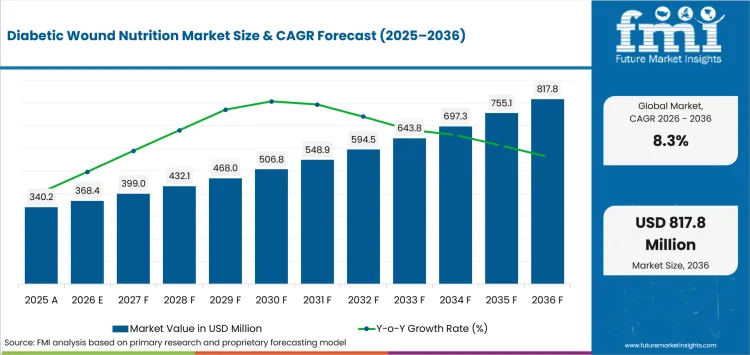
Key Takeaways of Diabetic Wound Nutrition Market
- Demand rises after diabetic wound teams document nutrition risk that warrants targeted oral supplementation within a broader care plan.
- Based on formulation, arginine + glutamine + HMB is projected to account for 35.5% in 2026 due to its wound-focused nutrient profile and modular use.
- The wound type category is forecast to be led by diabetic foot ulcers at 39.8% share in 2026 due to repeated multidisciplinary review during longer care episodes.
- Powder sachets are projected to hold 44.5% share in 2026 owing to compact portions that fit wound-specific dosing and home continuation.
- Low-certainty healing evidence and uneven payment routes limit routine protocol use even where clinicians identify a legitimate nutrition requirement.
- Some of the key players in this market include Abbott (Juven), Nestlé Health Science (Arginaid), Danone Nutricia (Cubitan), Fresenius Kabi, Medtrition (ProHeal), Glutamed (REPAIR), Global Health Products, and B. Braun.
Analyst Perspective
"The stronger commercial position belongs to products that fit diabetes management and remain available after discharge through the same refill route. Unit price becomes secondary once preparation burden or reimbursement friction causes patients to stop the planned nutrition course."
- Anurag Sharma, Principal Consultant, Future Market Insights
How is the Diabetic Wound Nutrition Market segmented?
The diabetic wound nutrition market is segmented by formulation, wound type, product form, end user, sales channel and region.
Formulation covers arginine + glutamine + HMB, arginine + zinc + vitamin C and high-protein diabetic-adapted ONS alongside collagen peptide blends and other formulations. Wound types cover diabetic foot ulcers, post-amputation healing and surgical wounds in diabetics. Product forms include powder sachets, RTD ONS, puddings, gels and other formats. End users cover wound care clinics, hospitals, homecare and long-term care settings. Sales channels include hospital pharmacy, retail pharmacy, online and institutional tender routes.
Why do Diabetic Foot Ulcers lead the Wound type category?
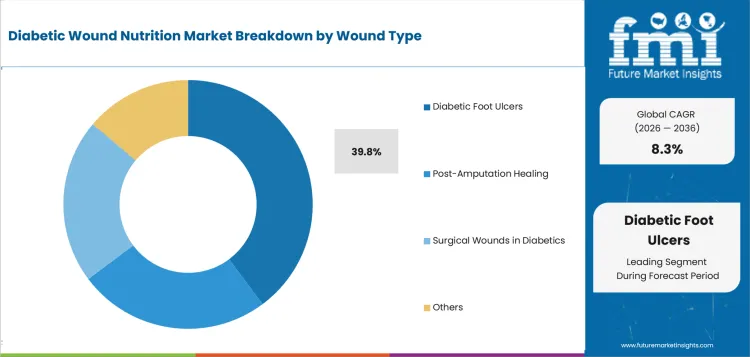
Diabetic foot ulcers keep nutrition assessment inside repeated chronic wound care because healing often extends beyond one clinical encounter. Wound skin care and infection control proceed beside nutrition support, so supplementation cannot substitute for the broader foot-care plan.
- Diabetic foot ulcers are set to lead the wound type category with 39.8% share in 2026 due to repeated multidisciplinary review and longer supplementation windows.
- Diabetic foot-ulcer care often involves a prolonged specialist pathway that keeps nutrition review close to wound management. The November 2025 National Diabetes Foot Care Audit found 20.2% of professionally referred patients received expert assessment within three days and another 48.5% within three to thirteen days.
Why does Arginine + Glutamine + HMB lead the Formulation category?
Wound clinicians use this nutrient combination as a modular layer beside the patient's existing oral clinical nutrition plan. Clinicians evaluate the blend alongside medical food options because its dose must fit wound-related nutrition goals without disrupting diabetes management.
- By formulation, arginine + glutamine + HMB is estimated to hold 35.5% in 2026 owing to familiar wound-focused nutrient architecture and portioned dosing.
- Wound-focused supplementation must fit the patient's broader diabetes nutrition plan before clinicians maintain it through repeated care. The American Diabetes Association stated in December 2025 that people with diabetes should receive individualized medical nutrition therapy from an experienced registered dietitian.
Why do Powder sachets lead the Product Form category?
Powder sachets let clinicians specify a concentrated serving without requiring a full beverage during a single nutrition session. Ready-to-consume enteral nutrition competes on preparation effort because it removes mixing before administration. Other clinical nutrition formats compete on portability and continuity after patients leave specialist care.
- In 2026, powder sachets are expected to lead product form with 44.5% share because compact portions fit wound-specific dosing and home continuation.
- Ready-to-consume formats reduce preparation work and make convenience a stronger competing benefit against portioned powders. Global Health Products launched LiquaCel HC in March 2025 with a fill-shake-sip bottle that avoids separate cups.
Why do Wound care clinics lead the End user category?
Wound care clinics influence initiation because one visit can assess ulcer severity and nutrition risk before home continuation. Their role extends into home healthcare after clinicians document a supplement plan. Home care services then determine whether the same plan continues outside the clinic through supply.
- By end user, wound care clinics are forecast to represent 40.0% in 2026 driven by specialist assessment that links product selection with monitored wound management.
- NHS England's February 2026 community-service specification places diabetic foot ulcers inside specialist wound care and includes nutrition or dietetics within multidisciplinary support. The same specification describes hospital-to-home pathways that give clinics a role in continuation.
What are the drivers, restraints and opportunities in the diabetic wound nutrition market?
Diabetic wound burden expands the eligible care pool, but evidence and reimbursement limit routine protocol use and clinic-to-home formats offer the clearest revenue route.
- Driver: Diabetes burden increases wound episodes that require nutrition screening before targeted supplementation enters specialist care plans.
- Restraint: Reimbursement rules and limited wound-healing proof narrow the cases that progress into routine supplement orders.
- Opportunity: Low-volume diabetes-compatible products can retain clinically initiated demand after patients return home through a reliable replenishment route.
Diabetes burden increases nutrition-screening opportunities
A diabetic wound becomes a nutrition-order opportunity after specialist review identifies intake or protein needs that ordinary meals are not meeting. CDC's January 2026 National Diabetes Statistics Report estimated 40.1 million people in the United States had diagnosed or undiagnosed diabetes during 2023. The national risk pool reaches product demand through wound clinics and dietitians that document a specific nutrition need during active care.
Evidence and reimbursement narrow routine adoption
Reimbursement limits narrow use even where clinicians identify a plausible reason for extra protein or a targeted nutrient blend. Germany's May 2026 Arzneimittel-Richtlinie states that disease-adapted special products offered specifically for diabetes mellitus are not prescribable under covered enteral-nutrition rules. Manufacturers therefore need a product classification and payment route that fit local rules before routine protocol use becomes commercially realistic.
Clinic-to-home continuity converts initiation into repeat use
Repeat purchasing depends on a home replenishment route that continues after a clinic or hospital starts the nutrition plan. Global Health Products joined the HPS group purchasing network in May 2025 under Contract 1087 for healthcare and senior-living members. The agreement widens institutional access, and retail delivery then determines whether initial clinical use develops into repeat orders after discharge from supervised care.
Which country CAGRs are profiled in the diabetic wound nutrition market?
| Country | CAGR |
|---|---|
| South Korea | 8.8% |
| USA | 7.9% |
| UK | 7.6% |
| Germany | 7.3% |
| Japan | 6.3% |
How do country-level CAGRs compare in the diabetic wound nutrition market?
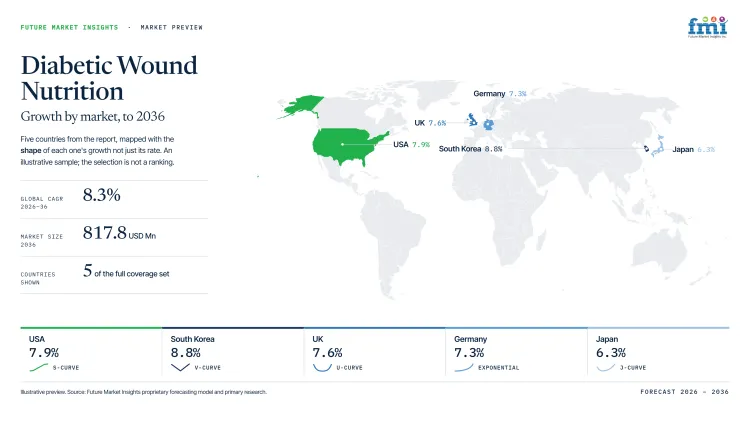
Forecast growth spans 2.5 percentage points from South Korea at 8.8% to Japan at 6.3%. South Korea forms the upper tier and USA follows at 7.9%, creating a visible lead over UK and Germany. Japan ranks lower because individualized nutrition planning limits standardized wound-specific use more often than in faster profiled markets.
- South Korea converts high treatment participation into referrals through its diabetes-service network.
- USA pairs specialist wound capacity with retail access for post-discharge nutrition refills.
- UK community services place dietetics beside diabetic foot care through integrated referrals.
- Germany screens disease-adapted formulas through reimbursement classification before covered prescribing begins nationally.
- Japan favors individualized nutrition planning over standardized wound adjuncts during diabetes follow-up.
Forecast pace separates country opportunity without ranking absolute market revenue by size. The full report provides country-level CAGR analysis across North America, Latin America, Europe, East Asia, South Asia, Oceania and the Middle East and Africa.
Country-wise Analysis
- South Korea's specialist diabetes network reaches a high share of diagnosed adults, yet complication screening varies enough to change local wound-nutrition follow-up. Diabetic wound nutrition demand in South Korea is forecast to rise at 8.8% CAGR over the forecast period because treated patients stay engaged with clinical services. KDCA's December 2025 community survey recorded a 93.2% diabetes treatment rate among diagnosed adults aged 30 years or older and a 51.8% kidney-complication screening rate. The gap between treatment and complication screening leaves room for focused referral education, but companies still need regional clinical partners and replenishment channels to reach patients consistently.
- USA wound clinics can start targeted nutrition during specialist care, but payment responsibility often changes after discharge into outpatient purchasing. CDC's January 2026 National Diabetes Statistics Report estimated that 12.0% of the USA population had diabetes during 2023. The USA diabetic wound nutrition sector is projected to record 7.9% CAGR during the assessment period, tied to specialist capacity and broad retail access. Clinical reach therefore exceeds reimbursed continuity, which makes formulary placement and reliable home availability more important than national diabetes prevalence alone. Companies with hospital access also need retail or direct-delivery coverage so a clinically selected product stays available after discharge.
- UK community wound services increasingly manage diabetic foot care outside hospitals and can bring dietetic input into the same referral pathway. OHID reported in April 2026 that 58.2% of people with type 2 or other diabetes received all eight recommended care processes in the year ending March 2025. Incomplete care-process coverage means nutrition screening still depends on local service execution and cannot be assumed from national pathway design. In the UK, diabetic wound nutrition demand is predicted to advance at 7.6% CAGR through 2036, helped by coordinated community care and established discharge routes. Commercial execution therefore depends on local pathway participation and pharmacy availability after specialist assessment.
- German clinical teams have mature diabetes services, but reimbursement classification directly affects whether disease-adapted enteral formulas can enter covered prescribing. Robert Koch Institute surveillance published in March 2025 found that 68.9% of adults aged 45 or older with type 2 diabetes received a foot examination in the prior year. Germany is estimated to post 7.3% CAGR over the forecast period, attributable to systematic foot monitoring and a mature clinical nutrition base. The foot-examination base gives wound-focused nutrition a clinical entry point, though product classification keeps reimbursement strategy central to market entry. Manufacturers therefore need early payer review before expanding disease-adapted positioning through national clinical and pharmacy channels.
- Japanese diabetes care provides a large diagnosed-risk pool and frequent nutrition follow-up. Wound-focused supplementation stays individualized within broader dietary management instead of following a uniform adjunct protocol. Japan's Ministry of Health published its national nutrition survey in December 2025 and estimated about 11 million people were strongly suspected of having diabetes. Adoption of diabetic wound nutrition in Japan is estimated to expand at 6.3% CAGR through 2036, given sustained diabetes management and an aging population with complex nutrition needs. The market offers scale for targeted education but less room for broad protocol claims than faster-growing South Korea, so clinical positioning must stay patient-specific.
Who are the notable companies in the diabetic wound nutrition market?
Abbott (Juven), Nestlé Health Science (Arginaid), Danone Nutricia (Cubitan), Fresenius Kabi, Medtrition (ProHeal), Glutamed (REPAIR), Global Health Products, and B. Braun are the notable companies serving this market.
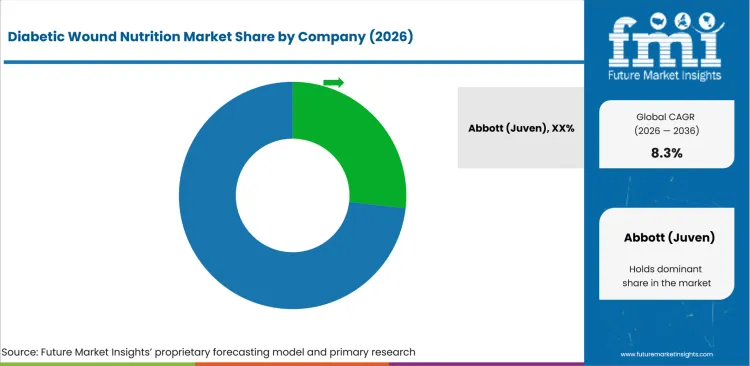
Competition separates wound-specific brands from broad clinical nutrition platforms and modular protein specialists. Surgical wound care competes for specialist attention, while diabetes-compatible evidence raises entry barriers. Repeat demand then depends on continuity after patients leave supervised care.
- Abbott (Juven), Nestlé Health Science (Arginaid), Danone Nutricia (Cubitan) and Fresenius Kabi operate through broad medical nutrition portfolios with institutional reach.
- Medtrition (ProHeal), Glutamed (REPAIR) and Global Health Products emphasize compact protein or wound-support formats for supervised nutrition plans.
- B. Braun contributes hospital nutrition infrastructure, although its public evidence is broader than dedicated diabetic wound formulations.
Competitive Benchmarking: diabetic wound nutrition market
| Company | Wound-Nutrition Specificity | Recent Portfolio Action | Clinical Route Evidence | Geographic Reach |
|---|---|---|---|---|
| Abbott (Juven) | Medium | High | High | Global |
| Nestlé Health Science (Arginaid) | Medium | High | Medium | Global |
| Danone Nutricia (Cubitan) | Medium | High | High | Global |
| Fresenius Kabi | Medium | Medium | Medium | Global |
| Medtrition (ProHeal) | High | High | High | USA and 50+ countries |
| Glutamed (REPAIR) | High | High | Low | South Africa |
| Global Health Products | High | High | High | North America |
| B. Braun | Low | Medium | Medium | Global |
Scoring basis: High wound-nutrition specificity requires direct evidence for wound or hard-to-heal nutrition. Medium covers diabetes or clinical nutrition with wound relevance and Low covers broader hospital nutrition. Recent portfolio action is High for a 2025-2026 wound or diabetes launch. Medium marks broader clinical nutrition action and Low marks an adjacent action. Clinical-route evidence is High for three or more verified settings. Medium requires two verified settings and Low requires one.
Source basis: official company newsrooms and filings support the capability thresholds applied to each company row.
Key Developments in the diabetic wound nutrition market
- In January 2026, Global Health Products expanded PUSH 20+ access through Gordon Food Service. The agreement added a foodservice purchasing route for supervised wound-support nutrition.
- In July 2025, Danone completed its majority acquisition of Kate Farms. The deal expanded its specialized nutrition reach through hospital, home and online channels.
- In November 2025, Abbott launched an advanced Ensure Diabetes Care formula with more protein and fiber. The launch widened its diabetes-compatible oral nutrition portfolio alongside Juven.
Key Players in the diabetic wound nutrition market
Large medical and clinical nutrition companies
- Abbott (Juven)
- Nestlé Health Science (Arginaid)
- Danone Nutricia (Cubitan)
- Fresenius Kabi
Specialized protein and wound nutrition companies
- Medtrition (ProHeal)
- Glutamed (REPAIR)
- Global Health Products
Hospital nutrition systems company
- B. Braun
Diabetic wound nutrition market - Report Scope
| Coverage field | Report scope |
|---|---|
| Market breakdown | By formulation, wound type, product form, end user, sales channel and region. |
| Quantitative Units | USD Million. |
| Market Definition | Commercial oral and enteral nutrition products used to address wound-related protein or targeted nutrient needs in people with diabetes under clinical or supervised self-care pathways. |
| Regions Covered | North America, Latin America, Western Europe, Eastern Europe, East Asia, South Asia and Pacific and Middle East and Africa. |
| Countries Covered | South Korea, USA, UK, Germany, Japan, and 20+ countries included in the full report. |
| Key Companies Profiled | Abbott (Juven), Nestlé Health Science (Arginaid), Danone Nutricia (Cubitan), Fresenius Kabi, Medtrition (ProHeal), Glutamed (REPAIR), Global Health Products, and B. Braun. |
| Forecast Period | 2026 to 2036. |
| Approach | Primary and secondary research with market triangulation. |
Diabetic wound nutrition market - Research Methodology
| Method | Approach |
|---|---|
| Primary Research | FMI analysts gathered input from manufacturers, service providers, technology developers, distributors, end users, procurement teams, and subject-matter experts. Interviews examined purchasing decisions, product or service evaluation, adoption barriers, approval requirements, pricing considerations, and expectations for technical or commercial support. Respondents were also asked what evidence is required before a trial, pilot, or initial order develops into regular purchasing. |
| Desk Research | Desk research covered government statistics, regulatory publications, trade data, industry associations, technical literature, standards, company filings, product information, and official corporate announcements. Sources were reviewed for relevance, publication date, geographic coverage, and consistency with the defined market scope. Claims relating to performance, applications, approvals, capacity, investment, and commercial activity were retained only when supported by credible public evidence. |
| Market Sizing and Forecasting | The market model combined the baseline value with historical performance, segment structure, pricing and volume indicators, adoption levels, company participation, and country-level demand conditions. Forecast assumptions considered economic activity, investment trends, regulatory developments, technology adoption, purchasing cycles, supply availability, and barriers to wider market use. Segment and regional estimates were reconciled before the final market total was calculated. |
| Data Validation | Estimates were checked against multiple independent indicators, including public data, company activity, trade patterns, industry developments, and findings from primary interviews. Validation also tested whether products, services, applications, and company revenues fell within the defined market boundaries. Adjacent categories, unsupported claims, overlapping revenues, and activities without direct market relevance were excluded to reduce double counting and maintain consistency across segments and countries. |
Diabetic wound nutrition market by Segments
Diabetic wound nutrition market segmented by Formulation:
- Arginine + Glutamine + HMB
- Arginine + Zinc + Vitamin C
- High-Protein Diabetic-Adapted ONS
- Collagen Peptide Blends
- Others
Diabetic wound nutrition market segmented by Wound Type:
- Diabetic Foot Ulcers
- Post-Amputation Healing
- Surgical Wounds in Diabetics
- Others
Diabetic wound nutrition market segmented by Product Form:
- Powder Sachets
- RTD ONS
- Puddings & Gels
- Others
Diabetic wound nutrition market segmented by End User:
- Wound Care Clinics
- Hospitals
- Homecare
- Long-Term Care
- Others
Diabetic wound nutrition market segmented by Sales Channel:
- Hospital Pharmacy
- Retail Pharmacy
- Online
- Institutional Tender
- Others
Diabetic wound nutrition market by Region:
- North America
- United States
- Canada
- Latin America
- Brazil
- Mexico
- Argentina
- Chile
- Western Europe
- Germany
- France
- United Kingdom
- Italy
- Spain
- Benelux
- Nordics
- Eastern Europe
- Poland
- Czech Republic
- Romania
- Hungary
- East Asia
- China
- Japan
- South Korea
- South Asia and Pacific
- India
- ASEAN
- Australia and New Zealand
- Middle East and Africa
- GCC Countries
- South Africa
- Türkiye
- Israel
Research Sources and Bibliography
- American Diabetes Association Professional Practice Committee for Diabetes. (2025, December 8). 12. Retinopathy, Neuropathy, and Foot Care: Standards of Care in Diabetes-2026. https://doi.org/10.2337/dc26-S012
- American Diabetes Association Professional Practice Committee for Diabetes. (2025, December 8). 5. Facilitating Positive Health Behaviors and Well-being to Improve Health Outcomes: Standards of Care in Diabetes-2026. https://doi.org/10.2337/dc26-S005
- Centers for Disease Control and Prevention. (2026, January 21). National Diabetes Statistics Report. https://www.cdc.gov/diabetes/php/data-research/index.html
- Korea Disease Control and Prevention Agency. (2025, December 8). 2025년 지역사회건강조사 결과 발표. https://kdca.go.kr/kdca/2847/subview.do?enc=Zm5jdDF8QEB8JTJGYmJzJTJGa2RjYSUyRjQxJTJGMjE1NTEzJTJGYXJ0Y2xWaWV3LmRvJTNG
- Office for Health Improvement and Disparities. (2026, April 8). Diabetes profile: statistical commentary, April 2026. https://www.gov.uk/government/statistics/diabetes-profile-update-april-2026/diabetes-profile-statistical-commentary-april-2026
- Ministry of Health, Labour and Welfare, Japan. (2025, December 2). 令和6年国民健康・栄養調査 結果公表. https://www.mhlw.go.jp/stf/newpage_66279.html
- NHS England Digital. (2025, November 13). National Diabetes Foot Care Audit 2020 to 2025. https://digital.nhs.uk/data-and-information/publications/statistical/national-diabetes-footcare-audit/2025
- National Diabetes Surveillance at the Robert Koch Institute. (2025, March 31). Quality of type 2 diabetes care: Medical foot examination - Adults. https://edoc.rki.de/handle/176904/12574
- NHS England. (2026, February 5). Standardising community health services - core component descriptions. https://www.england.nhs.uk/long-read/standardising-community-health-services-core-component-descriptions/
- Gemeinsamer Bundesausschuss. (2026, May 27). Richtlinie über die Verordnung von Arzneimitteln in der vertragsärztlichen Versorgung (Arzneimittel-Richtlinie/AM-RL). https://www.g-ba.de/downloads/62-492-4186/AM-RL-2026-05-27_iK-2026-07-23_AT-22-07-2026-B4.pdf
- Medtrition, Inc. (2025, March 25). Medtrition launches the ProSource Cup portfolio. https://www.medtrition.com/wp-content/uploads/2025/03/ProSource-Cup-Press-Release-March-2025.pdf
- Global Health Products. (2025, May 19). Strategic Partnership with HPS GPO Expands Our Reach. https://globalhp.com/strategic-partnership-with-hps-gpo-expands-our-reach/
- Global Health Products. (2026, January 26). Gordon Food Service Now Stocking Select Products. https://globalhp.com/gordon-food-service-now-stocking-select-products/
- Danone. (2025, July 1). Danone completes the acquisition of Kate Farms, enhancing its USA specialized nutrition offerings. https://www.danone.com/newsroom/press-releases/kate-farms-acquisition.html
- Abbott. (2025, November 13). Abbott launches new and advanced Ensure Diabetes Care, a clinically proven formula to help manage blood sugar. https://www.abbott.com/en-in/news/press-releases/abbott-launches-new-and-advanced-ensure-diabetes-care-a-clinically-proven-formula-to-help-manage-blood-sugar
- Abbott. (2025, April 16). Abbott delivers top-tier Q1 sales and EPS growth. https://www.abbott.com/en-us/corpnewsroom/strategy-and-strength/abbott-delivers-top-tier-q1-sales-and-eps-growth
- Nestlé. (2025, April 24). Three-month sales 2025: Delivering broad-based growth, executing on strategy. https://www.nestle.com/media/pressreleases/allpressreleases/three-month-sales-2025
- Danone. (2025, February 25). Nutricia lanza Fortimel Plantbased Protein®, un nuevo suplemento nutricional oral hiperproteico completamente vegetal para el manejo de la DRE. https://www.danone.com/es/es/prensa/comunicados-de-prensa/lanzamiento-fortimel.html
- Fresenius Kabi. (2025, February 25). Advancing clinical nutrition research: The JUMPstart program enters its fourth wave. https://www.fresenius-kabi.com/news/jumpstart-clinical-nutrition-program-enters-wave-4
- Global Health Products. (2025, March 20). Introducing LiquaCel® HC: The Convenient Calorie & Protein Solution. https://globalhp.com/introducing-liquacel-hc-the-convenient-protein-calorie-solution/
- Global Health Products. (2026, April 21). Introducing LiquaCel TF: A New Standard in Enteral Protein Nutrition. https://globalhp.com/introducing-liquacel-tf-a-new-standard-in-enteral-protein-nutrition/
- Glutamed. (2025, July 8). A new product for hard-to-heal wounds: Introducing Glutamed REPAIR. https://glutamed.co.za/blogs/news/a-new-product-for-hard-to-heal-wounds-introducing-glutamed-repair
- Abbott. (2025, April 9). An Update on Our Sturgis Facility and a Misleading ProPublica Story. https://www.abbott.com/en-us/corpnewsroom/nutrition-health-and-wellness/an-update-on-our-sturgis-facility-and-a-misleading-propublica-story
- B. Braun. (2026, March 26). Fiscal year 2025: B. Braun meets targets and drives innovation. https://www.bbraun.com/en/about-us/media/press-releases/fiscal-year-2025-b-braun-meets-targets-and-drives-innovation.html
This bibliography is provided for reader reference and is not exhaustive. The full report contains the complete reference list and detailed citations.
This Report Answers
- What is the diabetic wound nutrition market size in 2026 and what value is forecast by 2036?
- Which clinical conditions convert diabetes burden into targeted wound-nutrition demand?
- Why does arginine + glutamine + HMB hold the leading formulation position in 2026?
- Why do diabetic foot ulcers account for the largest wound type share in 2026?
- How do powder sachets retain the leading product form position against ready-to-consume formats?
- How do country growth rates differ among South Korea, USA, UK, Germany and Japan?
- Which companies serve wound-focused nutrition and broader clinical nutrition routes?
- How do evidence limits and reimbursement rules affect routine use from 2026 to 2036?
- What determines whether clinically initiated supplementation continues after discharge?
Frequently Asked Questions
How big is the diabetic wound nutrition market in 2026?
The diabetic wound nutrition market is valued at USD 368.4 million in 2026 and is projected to reach USD 817.8 million by 2036. Growth follows diabetic wound episodes that bring nutrition screening into specialist care.
What is the CAGR of the diabetic wound nutrition market from 2026 to 2036?
The diabetic wound nutrition market is projected to grow at a CAGR of 8.3% between 2026 and 2036. Expansion depends on diabetes burden and specialist wound pathways that convert documented nutrition needs into repeat purchasing.
Which formulation leads the diabetic wound nutrition market?
The arginine + glutamine + HMB segment is expected to hold 35.5% of formulation revenue in 2026, driven by modular dosing that fits individualized nutrition plans. Clinicians can add the nutrient blend without replacing the patient's wider diabetes diet.
Which countries are projected to record the highest growth in the diabetic wound nutrition market?
South Korea is projected to grow at 8.8% CAGR, followed by USA at 7.9% and UK at 7.6% through 2036. Their growth paths differ because clinical follow-up, payment routes and post-discharge supply vary by country.
Which companies are active in the diabetic wound nutrition market?
Key companies operating in the market include Abbott (Juven), Nestlé Health Science (Arginaid), Danone Nutricia (Cubitan), Fresenius Kabi, Medtrition (ProHeal), Glutamed (REPAIR), Global Health Products, and B. Braun. Their positions differ through wound specificity, institutional access and the strength of post-discharge home replenishment.
Preview the report firsthand - request a free sample
Get SampleGet the brochure for pricing and purchase details.
Get PDFTable of Content
- Key Takeaways
- Market Size and CAGR
- Top Growth Driver
- Fastest Growing Segment
- Leading Region
- Key Companies
- Emerging Opportunities
- Executive Summary
- Global Market Outlook
- Demand-side Trends
- Supply-side Trends
- Technology Roadmap Analysis
- Analysis and Recommendations
- Analyst Perspective (What is happening? Why now? What should investors know?)
- Key Questions Answered
- How large is the market?
- What is the CAGR?
- What are key trends?
- Which region dominates?
- Who are the leaders?
- Market Overview
- Market Coverage / Taxonomy
- Market Definition / Scope / Limitations
- Research Methodology
- Chapter Orientation
- Analytical Lens and Working Hypotheses
- Market Structure, Signals, and Trend Drivers
- Benchmarking and Cross-market Comparability
- Market Sizing, Forecasting, and Opportunity Mapping
- Research Design and Evidence Framework
- Desk Research Programme (Secondary Evidence)
- Expert Input and Fieldwork (Primary Evidence)
- Tooling, Models, and Reference Databases
- Data Engineering and Model Build
- Quality Assurance and Audit Trail
- Market Background
- Market Dynamics (Drivers, Restraints, Opportunity, Trends)
- Scenario Forecast (Optimistic, Likely, Conservative)
- Impact Analysis
- AI Impact
- Sustainability Impact
- Regulatory Impact
- Technology Impact
- Consumer / Buyer Analysis
- Purchase Drivers
- Adoption Barriers
- Buyer Journey
- Opportunity Map Analysis
- Product Life Cycle Analysis
- Supply Chain Analysis
- Investment Feasibility Matrix
- Value Chain Analysis
- PESTLE and Porter's Analysis
- Regulatory Landscape
- Regional Parent Market Outlook
- Production and Consumption Statistics
- Import and Export Statistics
- Global Market Analysis and Forecast, 2021 to 2036
- Historical Market Size Value (USD Million) Analysis, 2021 to 2025
- Current and Future Market Size Value (USD Million) Projections, 2026 to 2036
- Y-o-Y Growth Trend Analysis
- Absolute $ Opportunity Analysis
- Global Market Pricing Analysis, 2021 to 2036
- Global Market Analysis and Forecast, By Formulation, 2021 to 2036
- Introduction / Key Findings
- Historical Market Size Value (USD Million) Analysis By Formulation, 2021 to 2025
- Current and Future Market Size Value (USD Million) Analysis and Forecast By Formulation, 2026 to 2036
- Arginine + Glutamine + HMB
- Arginine + Zinc + Vitamin C
- High-Protein Diabetic-Adapted ONS
- Collagen Peptide Blends
- Others
- Arginine + Glutamine + HMB
- Y-o-Y Growth Trend Analysis By Formulation, 2021 to 2025
- Absolute $ Opportunity Analysis By Formulation, 2026 to 2036
- Global Market Analysis and Forecast, By Wound Type, 2021 to 2036
- Introduction / Key Findings
- Historical Market Size Value (USD Million) Analysis By Wound Type, 2021 to 2025
- Current and Future Market Size Value (USD Million) Analysis and Forecast By Wound Type, 2026 to 2036
- Diabetic Foot Ulcers
- Post-Amputation Healing
- Surgical Wounds in Diabetics
- Others
- Diabetic Foot Ulcers
- Y-o-Y Growth Trend Analysis By Wound Type, 2021 to 2025
- Absolute $ Opportunity Analysis By Wound Type, 2026 to 2036
- Global Market Analysis and Forecast, By Product Form, 2021 to 2036
- Introduction / Key Findings
- Historical Market Size Value (USD Million) Analysis By Product Form, 2021 to 2025
- Current and Future Market Size Value (USD Million) Analysis and Forecast By Product Form, 2026 to 2036
- Powder Sachets
- RTD ONS
- Puddings & Gels
- Others
- Powder Sachets
- Y-o-Y Growth Trend Analysis By Product Form, 2021 to 2025
- Absolute $ Opportunity Analysis By Product Form, 2026 to 2036
- Global Market Analysis and Forecast, By End User, 2021 to 2036
- Introduction / Key Findings
- Historical Market Size Value (USD Million) Analysis By End User, 2021 to 2025
- Current and Future Market Size Value (USD Million) Analysis and Forecast By End User, 2026 to 2036
- Wound Care Clinics
- Hospitals
- Homecare
- Long-Term Care
- Others
- Wound Care Clinics
- Y-o-Y Growth Trend Analysis By End User, 2021 to 2025
- Absolute $ Opportunity Analysis By End User, 2026 to 2036
- Global Market Analysis and Forecast, By Sales Channel, 2021 to 2036
- Introduction / Key Findings
- Historical Market Size Value (USD Million) Analysis By Sales Channel, 2021 to 2025
- Current and Future Market Size Value (USD Million) Analysis and Forecast By Sales Channel, 2026 to 2036
- Hospital Pharmacy
- Retail Pharmacy
- Online
- Institutional Tender
- Others
- Hospital Pharmacy
- Y-o-Y Growth Trend Analysis By Sales Channel, 2021 to 2025
- Absolute $ Opportunity Analysis By Sales Channel, 2026 to 2036
- Global Market Analysis and Forecast, By Region, 2021 to 2036
- Introduction
- Historical Market Size Value (USD Million) Analysis By Region, 2021 to 2025
- Current Market Size Value (USD Million) Analysis and Forecast By Region, 2026 to 2036
- North America
- Latin America
- Western Europe
- Eastern Europe
- East Asia
- South Asia and Pacific
- Middle East & Africa
- Market Attractiveness Analysis By Region
- North America Market Analysis and Forecast, By Country, 2021 to 2036
- Historical Market Size Value (USD Million) Trend Analysis By Market Taxonomy, 2021 to 2025
- Market Size Value (USD Million) Forecast By Market Taxonomy, 2026 to 2036
- By Country
- USA
- Canada
- By Formulation
- By Wound Type
- By Product Form
- By End User
- By Sales Channel
- By Country
- Market Attractiveness Analysis
- By Country
- By Formulation
- By Wound Type
- By Product Form
- By End User
- By Sales Channel
- Key Takeaways
- Latin America Market Analysis and Forecast, By Country
- Historical Market Size Value (USD Million) Trend Analysis By Market Taxonomy, 2021 to 2025
- Market Size Value (USD Million) Forecast By Market Taxonomy, 2026 to 2036
- By Country
- Brazil
- Mexico
- Chile
- Rest of Latin America
- By Formulation
- By Wound Type
- By Product Form
- By End User
- By Sales Channel
- By Country
- Market Attractiveness Analysis
- By Country
- By Formulation
- By Wound Type
- By Product Form
- By End User
- By Sales Channel
- Key Takeaways
- Western Europe Market Analysis and Forecast, By Country
- Historical Market Size Value (USD Million) Trend Analysis By Market Taxonomy, 2021 to 2025
- Market Size Value (USD Million) Forecast By Market Taxonomy, 2026 to 2036
- By Country
- Germany
- UK
- Italy
- Spain
- France
- Nordic
- BENELUX
- Rest of Western Europe
- By Formulation
- By Wound Type
- By Product Form
- By End User
- By Sales Channel
- By Country
- Market Attractiveness Analysis
- By Country
- By Formulation
- By Wound Type
- By Product Form
- By End User
- By Sales Channel
- Key Takeaways
- Eastern Europe Market Analysis and Forecast, By Country
- Historical Market Size Value (USD Million) Trend Analysis By Market Taxonomy, 2021 to 2025
- Market Size Value (USD Million) Forecast By Market Taxonomy, 2026 to 2036
- By Country
- Russia
- Poland
- Hungary
- Balkan & Baltic
- Rest of Eastern Europe
- By Formulation
- By Wound Type
- By Product Form
- By End User
- By Sales Channel
- By Country
- Market Attractiveness Analysis
- By Country
- By Formulation
- By Wound Type
- By Product Form
- By End User
- By Sales Channel
- Key Takeaways
- East Asia Market Analysis and Forecast, By Country
- Historical Market Size Value (USD Million) Trend Analysis By Market Taxonomy, 2021 to 2025
- Market Size Value (USD Million) Forecast By Market Taxonomy, 2026 to 2036
- By Country
- China
- Japan
- South Korea
- By Formulation
- By Wound Type
- By Product Form
- By End User
- By Sales Channel
- By Country
- Market Attractiveness Analysis
- By Country
- By Formulation
- By Wound Type
- By Product Form
- By End User
- By Sales Channel
- Key Takeaways
- South Asia and Pacific Market Analysis and Forecast, By Country
- Historical Market Size Value (USD Million) Trend Analysis By Market Taxonomy, 2021 to 2025
- Market Size Value (USD Million) Forecast By Market Taxonomy, 2026 to 2036
- By Country
- India
- ASEAN
- Australia & New Zealand
- Rest of South Asia and Pacific
- By Formulation
- By Wound Type
- By Product Form
- By End User
- By Sales Channel
- By Country
- Market Attractiveness Analysis
- By Country
- By Formulation
- By Wound Type
- By Product Form
- By End User
- By Sales Channel
- Key Takeaways
- Middle East & Africa Market Analysis and Forecast, By Country
- Historical Market Size Value (USD Million) Trend Analysis By Market Taxonomy, 2021 to 2025
- Market Size Value (USD Million) Forecast By Market Taxonomy, 2026 to 2036
- By Country
- Kingdom of Saudi Arabia
- Other GCC Countries
- Türkiye
- South Africa
- Other African Union
- Rest of Middle East & Africa
- By Formulation
- By Wound Type
- By Product Form
- By End User
- By Sales Channel
- By Country
- Market Attractiveness Analysis
- By Country
- By Formulation
- By Wound Type
- By Product Form
- By End User
- By Sales Channel
- Key Takeaways
- Key Countries Market Analysis
- USA
- Pricing Analysis
- Market Share Analysis, 2025
- By Formulation
- By Wound Type
- By Product Form
- By End User
- By Sales Channel
- Canada
- Pricing Analysis
- Market Share Analysis, 2025
- By Formulation
- By Wound Type
- By Product Form
- By End User
- By Sales Channel
- Mexico
- Pricing Analysis
- Market Share Analysis, 2025
- By Formulation
- By Wound Type
- By Product Form
- By End User
- By Sales Channel
- Brazil
- Pricing Analysis
- Market Share Analysis, 2025
- By Formulation
- By Wound Type
- By Product Form
- By End User
- By Sales Channel
- Chile
- Pricing Analysis
- Market Share Analysis, 2025
- By Formulation
- By Wound Type
- By Product Form
- By End User
- By Sales Channel
- Germany
- Pricing Analysis
- Market Share Analysis, 2025
- By Formulation
- By Wound Type
- By Product Form
- By End User
- By Sales Channel
- UK
- Pricing Analysis
- Market Share Analysis, 2025
- By Formulation
- By Wound Type
- By Product Form
- By End User
- By Sales Channel
- Italy
- Pricing Analysis
- Market Share Analysis, 2025
- By Formulation
- By Wound Type
- By Product Form
- By End User
- By Sales Channel
- Spain
- Pricing Analysis
- Market Share Analysis, 2025
- By Formulation
- By Wound Type
- By Product Form
- By End User
- By Sales Channel
- France
- Pricing Analysis
- Market Share Analysis, 2025
- By Formulation
- By Wound Type
- By Product Form
- By End User
- By Sales Channel
- India
- Pricing Analysis
- Market Share Analysis, 2025
- By Formulation
- By Wound Type
- By Product Form
- By End User
- By Sales Channel
- ASEAN
- Pricing Analysis
- Market Share Analysis, 2025
- By Formulation
- By Wound Type
- By Product Form
- By End User
- By Sales Channel
- Australia & New Zealand
- Pricing Analysis
- Market Share Analysis, 2025
- By Formulation
- By Wound Type
- By Product Form
- By End User
- By Sales Channel
- China
- Pricing Analysis
- Market Share Analysis, 2025
- By Formulation
- By Wound Type
- By Product Form
- By End User
- By Sales Channel
- Japan
- Pricing Analysis
- Market Share Analysis, 2025
- By Formulation
- By Wound Type
- By Product Form
- By End User
- By Sales Channel
- South Korea
- Pricing Analysis
- Market Share Analysis, 2025
- By Formulation
- By Wound Type
- By Product Form
- By End User
- By Sales Channel
- Russia
- Pricing Analysis
- Market Share Analysis, 2025
- By Formulation
- By Wound Type
- By Product Form
- By End User
- By Sales Channel
- Poland
- Pricing Analysis
- Market Share Analysis, 2025
- By Formulation
- By Wound Type
- By Product Form
- By End User
- By Sales Channel
- Hungary
- Pricing Analysis
- Market Share Analysis, 2025
- By Formulation
- By Wound Type
- By Product Form
- By End User
- By Sales Channel
- Kingdom of Saudi Arabia
- Pricing Analysis
- Market Share Analysis, 2025
- By Formulation
- By Wound Type
- By Product Form
- By End User
- By Sales Channel
- Türkiye
- Pricing Analysis
- Market Share Analysis, 2025
- By Formulation
- By Wound Type
- By Product Form
- By End User
- By Sales Channel
- South Africa
- Pricing Analysis
- Market Share Analysis, 2025
- By Formulation
- By Wound Type
- By Product Form
- By End User
- By Sales Channel
- USA
- Market Structure Analysis
- Competition Dashboard
- Competition Benchmarking
- Market Share Analysis of Top Players
- By Regional
- By Formulation
- By Wound Type
- By Product Form
- By End User
- By Sales Channel
- Emerging Startups
- Innovation Benchmarking
- Competition Analysis
- Competition Deep Dive
- Abbott (Juven)
- Overview
- Product Portfolio
- Profitability by Market Segments
- Sales Footprint
- Strategy Overview
- Marketing Strategy
- Product Strategy
- Channel Strategy
- Nestle Health Science (Arginaid)
- Danone Nutricia (Cubitan)
- Fresenius Kabi
- Medtrition (ProHeal)
- Victus
- Global Health Products
- B. Braun
- Abbott (Juven)
- Case Studies
- Success Stories
- Recent Developments
- Competition Deep Dive
- Assumptions & Acronyms Used


