

- Industry Size (2026)
- USD 495.9 Mn
- Forecast (2036)
- USD 1110.9 Mn
- CAGR (2026 to 2036)
- 8.4%
Wound Healing Ultrasound Market Forecast and Outlook 2026 to 2036
The wound healing ultrasound market is set to record a USD 495.9 million valuation in 2026, with scheduled treatment volume extending that base to USD 1,110.9 million by 2036 at an 8.4% CAGR. The constraint in this field is not equipment availability but therapist hours, room slots, and patient adherence to multi visit protocols. Devices earn their place by shortening sessions, reducing setup friction, and fitting into tightly booked care blocks. Departments standardize routines to keep staff rotation simple. Once a protocol is fixed, changing platforms creates scheduling risk rather than technical risk.
Revenue behavior in this segment follows patient throughput patterns, not capital cycles. Clinics expand capacity by adding shifts or rooms before they add new device types. Missed appointments and interrupted treatment courses shape realized utilization more than theoretical demand. Service interruptions carry an immediate opportunity cost because idle rooms still carry staff cost. Group operators prefer platforms that share probes and consumables across sites to keep logistics simple. Refurbishment and redeployment matter more than frequent replacement. Profit for suppliers follows fleet uptime, service response speed, and redeployment efficiency rather than headline feature sets.
Quick Stats for Wound Healing Ultrasound Market
- Wound Healing Ultrasound Market Value (2026): USD 495.9 million
- Wound Healing Ultrasound Market Forecast Value (2036): USD 1,110.9 million
- Wound Healing Ultrasound Market Forecast CAGR (2026-2036): 8.4%
- Leading Product Type in Wound Healing Ultrasound Market: Low-frequency ultrasound therapy
- Leading Application in Wound Healing Ultrasound Market: Chronic wounds
- Leading End User in Wound Healing Ultrasound Market: Wound care clinics and hospital outpatient departments
- Key Growth Regions in Wound Healing Ultrasound Market: Asia Pacific, North America, Europe
- Top Players in Wound Healing Ultrasound Market: Misonix, Sanuwave, Smith & Nephew, Medtronic, Arobella
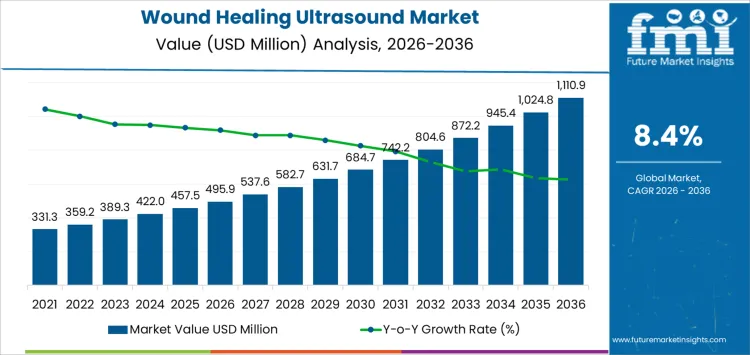
What Is the Growth Forecast for the Wound Healing Ultrasound Market through 2036?
Care pathway design and reimbursement practice shape demand for the wound healing ultrasound market more than overall patient volumes. In 2026, at about USD 495.9 million, use is concentrated in chronic wound clinics, rehabilitation centers, and hospital outpatient departments where treatment protocols emphasize faster closure and lower complication risk. Device selection is tied to clinical guidelines and staff training programs, which fixes purchasing patterns across long equipment life cycles. Utilization rises as providers expand ultrasound assisted therapy into diabetic ulcers, pressure injuries, and post-surgical wounds. The steady increase reflects broader protocol adoption and more sites adding the modality to standard care pathways rather than rapid replacement of existing treatment equipment.
Evidence accumulation and service economics guide the later phase of the wound healing ultrasound market. As value approaches roughly USD 1,110.9 million by 2036, buyers focus on treatment consistency, device uptime, and ease of integration into daily clinic workflow. Manufacturers invest in durability, simplified interfaces, and service support networks as installed bases grow. The move from under five hundred million into the low one point three billion reflects accumulated placement across many care settings rather than a single change in clinical practice standards. Suppliers that combine clinical credibility, reliable equipment performance, and predictable support coverage tend to secure long term positions in wound care therapy portfolios.
Wound Healing Ultrasound Market Key Takeaways
| Metric | Value |
|---|---|
| Market Value (2026) | USD 495.9 million |
| Forecast Value (2036) | USD 1,110.9 million |
| Forecast CAGR 2026 to 2036 | 8.4% |
How Is the Wound Healing Ultrasound Market Changing Treatment Pathways for Chronic Wounds?
Wound healing ultrasound systems deliver low intensity acoustic energy to stimulate tissue repair in chronic and slow closing wounds. Clinics use them for diabetic foot ulcers, pressure injuries, and post-surgical sites where standard dressings fail to progress closure. Earlier care pathways relied on debridement, topical agents, and compression alone, which left many patients on long treatment cycles. Ultrasound therapy adds a physical stimulus that influences perfusion, cellular activity, and edema management. Providers specify equipment by output stability, applicator design, treatment protocols, and infection control compatibility. Use fits outpatient wound centers and hospital wards because sessions are short and repeatable. Adoption follows protocol reviews rather than equipment refresh cycles, since the modality changes visit structure and staffing patterns over time.
Purchasing decisions involve wound care directors, nursing leadership, and finance teams because treatment time and consumable use affect clinic capacity. Earlier deployments were limited to specialist centers, which kept volumes small and training informal. Current programs focus on standard protocols, shared devices across rooms, and documented outcomes for audit review. Manufacturers compete on applicator durability, calibration control, and service response rather than peak power claims. Providers evaluate total cost through visit counts, staff utilization, and healing progression, not device price alone. Reimbursement rules and coding clarity shape utilization patterns in each health system. Distributors add value through training and maintenance coverage. Demand tracks chronic disease and aging populations, where clinics seek shorter courses while keeping complication rates within targets defined.
What Factors Are Shaping the Demand for Wound Healing Ultrasound Market in 2026 by Product Type and Application?
Specification in Wound Healing Ultrasound Market is driven by clinical protocol selection, reimbursement positioning, and integration into wound care pathways rather than by routine device replacement. Once a therapy approach is adopted within a facility or network, equipment choice becomes part of standardized treatment algorithms and staff training programs. This links demand to expansion of wound care services, protocol updates, and consolidation of treatment centers. Segment structure reflects differences in energy delivery, treatment depth, and session duration. Buyers prioritize clinical evidence support, ease of use in outpatient settings, and predictable maintenance because therapy utilization depends on workflow fit and patient throughput. Volume development therefore follows service line growth and care model standardization rather than short term fluctuations in patient visits.
How Does Product Type Selection Influence Treatment Scope and Operating Economics in the Wound Healing Ultrasound Market?
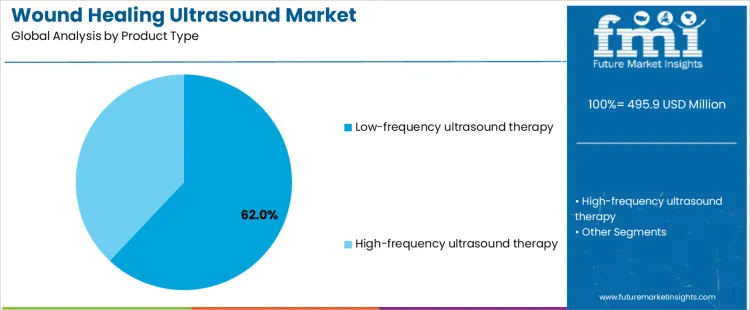
Low frequency ultrasound therapy represents about 62% of demand in the Wound Healing Ultrasound Market because it supports debridement, stimulation of tissue response, and management of chronic wound environments. These systems are integrated into routine wound care protocols and can be applied across a wide range of lesion types. High frequency ultrasound therapy serves more targeted applications focused on superficial tissue and diagnostic adjacent use, which limits its role in complex wound management. The two categories differ in power requirements, applicator design, and treatment time per session, which affects patient scheduling and staff utilization. Each type establishes distinct training requirements, maintenance routines, and consumable usage patterns.
From an operational and financial perspective, product type choice fixes the service delivery model. Low frequency systems support higher utilization across diverse cases, which improves equipment amortization. High frequency systems are used in narrower indications, resulting in lower utilization but simpler procedures. Once a clinic or hospital standardizes on a modality, changes are uncommon because protocols, reimbursement coding, and staff competencies are aligned to that choice. Demand by product type therefore follows clinical pathway adoption and evidence based guideline evolution rather than short term purchasing preferences.
Why Does Application Mix Determine Volume Concentration and Care Setting Requirements in the Wound Healing Ultrasound Market?
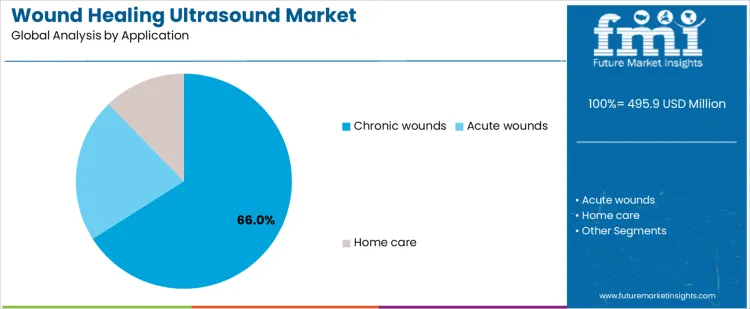
Chronic wounds account for about 66% of demand in the Wound Healing Ultrasound Market because these conditions require repeated interventions over extended treatment periods. This creates sustained utilization in specialized wound care clinics and outpatient departments. Acute wounds involve shorter treatment courses and are often managed through conventional methods, which limits device usage frequency. Home care represents a smaller but growing setting, where portability, ease of operation, and safety features influence adoption. These differences explain why equipment deployment concentrates in facilities managing long term wound populations rather than in general surgical or emergency care settings.
Application mix also shapes purchasing and deployment models. Chronic wound centers invest in equipment as part of long term service capability development. Acute care providers acquire devices selectively to support specific protocols. Home care providers require simplified systems and training support, which slows adoption and limits volume. The resulting demand structure concentrates utilization in chronic care environments while other settings contribute incremental growth. Segment shares therefore move with demographic trends, prevalence of chronic conditions, and organization of wound care services rather than with short term changes in injury incidence.
How Is the Wound Healing Ultrasound Market Being Defined By Therapy Consistency And Clinical Workflow Fit?
The Wound Healing Ultrasound Market is shaped by how reliably ultrasound therapy can be delivered within routine wound care protocols. Chronic wound treatment depends on repeated sessions, consistent dosing, and good patient compliance. Buyers focus on ease of use, treatment time, device reliability, and compatibility with existing wound care routines. Selection decisions involve wound care clinicians, nursing teams, and hospital procurement groups. This positions ultrasound therapy devices as part of daily clinical operations rather than as specialized equipment used only in limited cases, making workflow integration and treatment repeatability central to adoption decisions.
How Is Protocol Standardization Changing Expectations in The Wound Healing Ultrasound Market?
Wound care providers increasingly follow structured treatment pathways to ensure consistent outcomes across patients and care settings. This is changing expectations in the Wound Healing Ultrasound Market toward devices that support predictable treatment parameters and simple operation. Clinicians prefer systems that can be used across different wound types without complex setup. This reduces training burden and minimizes variation between operators. As a result, device evaluation focuses on treatment consistency, clear user guidance, and compatibility with existing documentation practices rather than on complex feature sets that are rarely used in routine care.
Where Is Ongoing Treatment Volume Being Built in The Wound Healing Ultrasound Market?
Ongoing treatment volume is being built in long-term care facilities, outpatient wound clinics, and home care programs that manage large numbers of chronic wound patients. These settings create repeat usage because patients require multiple treatment sessions over extended periods. The Wound Healing Ultrasound Market also benefits when providers expand service lines focused on diabetic foot ulcers, pressure injuries, and post-surgical wounds. There is opportunity for suppliers that support training, protocol development, and service programs. Being integrated into standard care pathways creates recurring device utilization and repeat consumable or service revenue.
Why Do Evidence Requirements and Reimbursement Limit Faster Uptake in The Wound Healing Ultrasound Market?
Healthcare providers rely on clinical guidelines and reimbursement policies when adopting new therapies. If coverage is unclear or evidence is seen as insufficient, adoption slows. The Wound Healing Ultrasound Market faces scrutiny because clinicians must justify time and resource allocation for each therapy session. In addition, some providers remain comfortable with established treatment methods and are cautious about adding new modalities. Equipment cost, training needs, and scheduling impact also affect decisions. These factors keep usage concentrated in practices that already specialize in advanced wound care rather than across all care settings.
What is the Demand for Wound Healing Ultrasound by Country?
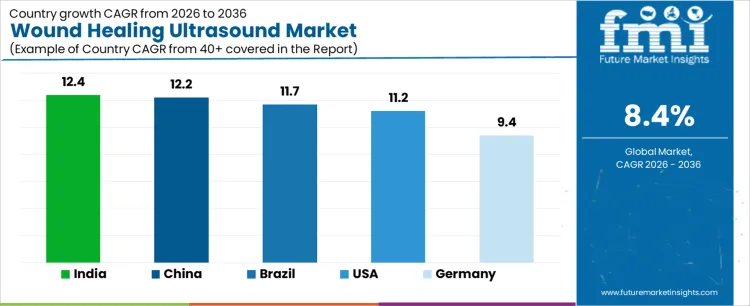
| Country | CAGR |
|---|---|
| USA | 11.2% |
| Brazil | 11.7% |
| China | 12.2% |
| India | 12.4% |
| Germany | 9.4% |
Demand for wound healing ultrasound is rising as hospitals and clinics expand advanced wound care programs for chronic ulcers, post-surgical wounds, and trauma cases. India leads with a 12.4% CAGR, supported by growing diabetes related wound burden, expansion of specialty wound care centers, and wider adoption in mid-sized hospitals. China follows at 12.2%, driven by large patient volumes, modernization of hospital equipment, and focus on reducing healing time and complications. Brazil records 11.7%, reflecting broader access to advanced wound management in private and public facilities. The USA grows at 11.2%, shaped by outpatient wound care clinics and reimbursement backed therapy adoption. Germany, at 9.4%, reflects structured uptake in a mature clinical environment.
How Are Clinical Pathway Programs Shaping Demand in the Wound Healing Ultrasound Market in the United States?
Clinical pathway integration across hospital networks keeps wound care demand in the United States on an 11.2% CAGR path. Procurement decisions sit with wound care committees and capital review boards. Adoption focuses on chronic ulcers, post-surgical wounds, and diabetic foot management. Device choice emphasizes dosing control, treatment time, and documentation output for reimbursement files. Once a platform is approved, deployment expands across multiple sites inside the same network. Training programs and protocol alignment influence utilization rates. Import systems serve higher acuity centers. Local service coverage affects uptime planning. Spending follows clinic expansion and service line growth plans. Replacement cycles remain long. Commercial success depends on inclusion in standardized care pathways and reference programs rather than isolated department purchases today.
How Are Private Hospital Networks Driving Demand in the Wound Healing Ultrasound Market in Brazil?
Private hospital investment and outpatient wound clinics keep Wound Healing Ultrasound Market demand in Brazil on an 11.7% CAGR path. Purchasing authority concentrates inside large hospital groups and specialty care chains. Use cases include pressure injuries, vascular ulcers, and trauma recovery. Device evaluation balances treatment throughput, reliability, and training burden. Import platforms dominate early deployments. Local distributors manage installation and clinical education. Once a system gains acceptance, rollout extends across affiliated centers. Reimbursement documentation and audit readiness influence utilization. Procurement timing aligns with clinic openings and service line upgrades. Public sector adoption remains slower. Replacement cycles stay long. Commercial success depends on access to leading groups and reference sites rather than broad distributor shelf presence or fragmented clinic sales today.
What Are National Care Programs Driving in the Wound Healing Ultrasound Market in China?
National chronic disease programs and hospital expansion keep Wound Healing Ultrasound Market demand in China on a 12.2% CAGR path. Tertiary hospitals and regional centers control most purchase decisions. Deployment targets diabetic foot care, post-operative recovery, and complex ulcers. Domestic suppliers cover standard systems while international brands serve advanced platforms. Tender processes and multi-year plans shape timing. Data capture and report formats influence selection. Training scale and service reach affect rollout speed. Once approved, systems are replicated across many sites. Spending follows facility upgrades and capacity growth. Replacement demand remains limited. Commercial success depends on placement inside public hospital catalogs and provincial programs rather than pursuit of small private clinics and long procurement cycles today across regions nationwide.
Why Are Care Network Expansions Driving Demand in the Wound Healing Ultrasound Market in India?
Network expansion of wound clinics and specialty hospitals keeps Wound Healing Ultrasound Market demand in India on a 12.4% CAGR path. Central medical committees and chain operators guide nominations. Use cases include diabetic ulcers, surgical wounds, and trauma recovery. Device choice emphasizes ease of use, training speed, and operating reliability. Import platforms serve higher acuity centers. Domestic suppliers address routine workloads. Procurement aligns with new clinic openings and capacity additions. Pilot programs precede wider rollout. Documentation requirements influence utilization. Service coverage affects uptime planning. Replacement cycles remain long. Commercial success depends on participation in chain level programs and reference deployments rather than selling to independent clinics and regional hospital groups during multi year expansion plans today across states nationwide programs.
How Are Guideline and Reimbursement Systems Shaping Demand in the Wound Healing Ultrasound Market in Germany?
Clinical guideline adoption and reimbursement discipline keep Wound Healing Ultrasound Market demand in Germany on a 9.4% CAGR path. University hospitals and large care centers control most purchases. Evaluation emphasizes evidence quality, treatment protocols, and documentation output. Procurement follows health technology assessment steps and budget cycles. Import suppliers dominate due to performance expectations. Once approved, systems deploy across departments with shared workflows. Training and audit readiness influence utilization. Spending aligns with quality improvement initiatives and outpatient expansion. Replacement cycles stay long. Data integration affects reporting efficiency. Commercial success depends on guideline inclusion and framework access rather than individual physician preference or small clinic buying and regional hospital networks under multiyear planning cycles today nationwide programs with steady funding approvals.
How Do Device Makers Compete for Clinical Adoption in the Wound Healing Ultrasound Market?
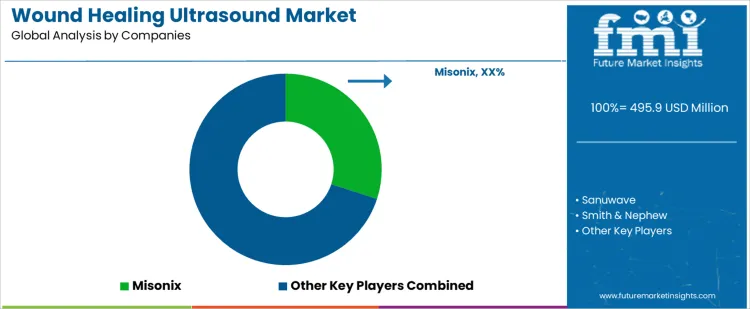
Wound healing ultrasound system selection follows clinical pathway design and nursing workflow rather than simple equipment comparison. Care teams define wound types, treatment frequency, bedside handling, and infection control steps before choosing devices. Misonix, Sanuwave, Smith and Nephew, Medtronic, Arobella compete through different clinical use cases and deployment models. Once a device enters protocols, staff training, consumable stocking, and documentation practices fix the platform. Misonix holds positions in debridement oriented workflows with established procedure sets. Sanuwave targets regenerative stimulation approaches for chronic wounds. Smith and Nephew links ultrasound tools with broader wound care portfolios. Medtronic approaches the field through hospital capital equipment relationships. Arobella focuses on compact systems for clinics and outpatient centers.
Competitive outcomes reflect clinical confidence, ease of use, and service coverage rather than headline technical claims. Committees examine evidence strength, treatment time, patient tolerance, and cleaning procedures during evaluation. Nursing managers value devices that fit ward routines and reduce handling complexity. Procurement teams review consumable usage, maintenance intervals, and training burden. Misonix benefits from established placement in surgical and advanced wound care settings. Sanuwave secures interest where regenerative protocols guide therapy choices. Smith and Nephew gains leverage through integrated dressing and therapy programs. Medtronic holds positions in institutions that standardize capital equipment sourcing. Arobella competes in cost sensitive outpatient environments that require portable systems. Market positions vary by care setting, reimbursement rules, and clinical governance models.
Key Players in the Wound Healing Ultrasound Market
- Misonix
- Sanuwave
- Smith & Nephew
- Medtronic
- Arobella
- Others
Scope of the Report
| Items | Values |
|---|---|
| Quantitative Units (2026) | USD Million |
| Product Type | Low-frequency ultrasound therapy; High-frequency ultrasound therapy |
| Application | Chronic wounds; Acute wounds |
| End User | Hospitals; Wound care clinics; Home care |
| Region | Asia Pacific; Europe; North America; Latin America; Middle East & Africa |
| Countries Covered | United States, Canada, Mexico, Germany, United Kingdom, France, Italy, Spain, Nordic, BENELUX, China, Japan, South Korea, India, Australia & New Zealand, ASEAN, Brazil, Chile, Saudi Arabia, Turkey, South Africa, Rest of regions |
| Key Companies Profiled | Misonix; Sanuwave; Smith & Nephew; Medtronic; Arobella |
| Additional Attributes | Dollar by sales by product type and application, installed base by care setting, utilization rate by clinic type, service and maintenance intensity, reimbursement driven adoption patterns, training and protocol standardization impact, redeployment and refurbishment flows, uptime and session throughput metrics |
Wound Healing Ultrasound Market Segmentation
Product Type:
- Low-frequency ultrasound therapy
- High-frequency ultrasound therapy
Application:
- Chronic wounds
- Acute wounds
End User:
- Hospitals
- Wound care clinics
- Home care
Region:
- Asia Pacific
- China
- Japan
- South Korea
- India
- Australia & New Zealand
- ASEAN
- Rest of Asia Pacific
- Europe
- Germany
- United Kingdom
- France
- Italy
- Spain
- Nordic
- BENELUX
- Rest of Europe
- North America
- United States
- Canada
- Mexico
- Latin America
- Brazil
- Chile
- Rest of Latin America
- Middle East & Africa
- Kingdom of Saudi Arabia
- Other GCC Countries
- Turkey
- South Africa
- Other African Union
- Rest of Middle East & Africa
Bibliography
- Flynn, K. J. (2023). Chronic wound healing models and mechanisms. In NCBI Bookshelf. USA National Library of Medicine.
- Liu, E., Xiong, H., Zhang, W., Shen, Y., Li, Y., & Zhao, J. (2024). Efficacy and safety of ultrasound-assisted wound debridement in chronic wound healing: A systematic review and meta-analysis. Frontiers in Endocrinology, 15, Article 1393251.
- Jiménez-García, J. F., Arboledas-Bellón, J., Ruiz-Fernández, C., & Gutiérrez-García, M. (2025). The use of ultrasound by nurses in the assessment of complex chronic wounds: a scoping review. Journal of Wound Management, 26(2), 118-127.
- Boerman, O., Abedin, Z., DiMaria-Glalili, R. A., et al. (2023). Gene expression changes in therapeutic ultrasound-treated venous leg ulcers. Frontiers in Medicine, 10, 1144182.
Frequently Asked Questions
How big is the wound healing ultrasound market in 2026?
The global wound healing ultrasound market is estimated to be valued at USD 495.9 million in 2026.
What will be the size of wound healing ultrasound market in 2036?
The market size for the wound healing ultrasound market is projected to reach USD 1,110.9 million by 2036.
How much will be the wound healing ultrasound market growth between 2026 and 2036?
The wound healing ultrasound market is expected to grow at a 8.4% CAGR between 2026 and 2036.
What are the key product types in the wound healing ultrasound market?
The key product types in wound healing ultrasound market are low-frequency ultrasound therapy and high-frequency ultrasound therapy.
Which application segment to contribute significant share in the wound healing ultrasound market in 2026?
In terms of application, chronic wounds segment to command 66.0% share in the wound healing ultrasound market in 2026.
Preview the report firsthand - request a free sample
Get SampleGet the brochure for pricing and purchase details.
Get PDFTable of Content
- Executive Summary
- Global Market Outlook
- Demand-side Trends
- Supply-side Trends
- Technology Roadmap Analysis
- Analysis and Recommendations
- Market Overview
- Market Coverage / Taxonomy
- Market Definition / Scope / Limitations
- Market Background
- Market Dynamics
- Drivers
- Restraints
- Opportunity
- Trends
- Scenario Forecast
- Demand in Optimistic Scenario
- Demand in Likely Scenario
- Demand in Conservative Scenario
- Opportunity Map Analysis
- Product Life Cycle Analysis
- Supply Chain Analysis
- Investment Feasibility Matrix
- Value Chain Analysis
- PESTLE and Porter’s Analysis
- Regulatory Landscape
- Regional Parent Market Outlook
- Production and Consumption Statistics
- Import and Export Statistics
- Market Dynamics
- Global Market Analysis 2021 to 2025 and Forecast, 2026 to 2036
- Historical Market Size Value (USD Million) Analysis, 2021 to 2025
- Current and Future Market Size Value (USD Million) Projections, 2026 to 2036
- Y-o-Y Growth Trend Analysis
- Absolute $ Opportunity Analysis
- Global Market Pricing Analysis 2021 to 2025 and Forecast 2026 to 2036
- Global Market Analysis 2021 to 2025 and Forecast 2026 to 2036, By Product Type
- Introduction / Key Findings
- Historical Market Size Value (USD Million) Analysis By Product Type , 2021 to 2025
- Current and Future Market Size Value (USD Million) Analysis and Forecast By Product Type , 2026 to 2036
- Low-frequency ultrasound therapy
- High-frequency ultrasound therapy
- Low-frequency ultrasound therapy
- Y-o-Y Growth Trend Analysis By Product Type , 2021 to 2025
- Absolute $ Opportunity Analysis By Product Type , 2026 to 2036
- Global Market Analysis 2021 to 2025 and Forecast 2026 to 2036, By Application
- Introduction / Key Findings
- Historical Market Size Value (USD Million) Analysis By Application, 2021 to 2025
- Current and Future Market Size Value (USD Million) Analysis and Forecast By Application, 2026 to 2036
- Chronic wounds
- Acute wounds
- Home care
- Chronic wounds
- Y-o-Y Growth Trend Analysis By Application, 2021 to 2025
- Absolute $ Opportunity Analysis By Application, 2026 to 2036
- Global Market Analysis 2021 to 2025 and Forecast 2026 to 2036, By End User
- Introduction / Key Findings
- Historical Market Size Value (USD Million) Analysis By End User, 2021 to 2025
- Current and Future Market Size Value (USD Million) Analysis and Forecast By End User, 2026 to 2036
- Hospitals
- Wound care clinics
- Hospitals
- Y-o-Y Growth Trend Analysis By End User, 2021 to 2025
- Absolute $ Opportunity Analysis By End User, 2026 to 2036
- Global Market Analysis 2021 to 2025 and Forecast 2026 to 2036, By Region
- Introduction
- Historical Market Size Value (USD Million) Analysis By Region, 2021 to 2025
- Current Market Size Value (USD Million) Analysis and Forecast By Region, 2026 to 2036
- North America
- Latin America
- Western Europe
- Eastern Europe
- East Asia
- South Asia and Pacific
- Middle East & Africa
- Market Attractiveness Analysis By Region
- North America Market Analysis 2021 to 2025 and Forecast 2026 to 2036, By Country
- Historical Market Size Value (USD Million) Trend Analysis By Market Taxonomy, 2021 to 2025
- Market Size Value (USD Million) Forecast By Market Taxonomy, 2026 to 2036
- By Country
- USA
- Canada
- Mexico
- By Product Type
- By Application
- By End User
- By Country
- Market Attractiveness Analysis
- By Country
- By Product Type
- By Application
- By End User
- Key Takeaways
- Latin America Market Analysis 2021 to 2025 and Forecast 2026 to 2036, By Country
- Historical Market Size Value (USD Million) Trend Analysis By Market Taxonomy, 2021 to 2025
- Market Size Value (USD Million) Forecast By Market Taxonomy, 2026 to 2036
- By Country
- Brazil
- Chile
- Rest of Latin America
- By Product Type
- By Application
- By End User
- By Country
- Market Attractiveness Analysis
- By Country
- By Product Type
- By Application
- By End User
- Key Takeaways
- Western Europe Market Analysis 2021 to 2025 and Forecast 2026 to 2036, By Country
- Historical Market Size Value (USD Million) Trend Analysis By Market Taxonomy, 2021 to 2025
- Market Size Value (USD Million) Forecast By Market Taxonomy, 2026 to 2036
- By Country
- Germany
- UK
- Italy
- Spain
- France
- Nordic
- BENELUX
- Rest of Western Europe
- By Product Type
- By Application
- By End User
- By Country
- Market Attractiveness Analysis
- By Country
- By Product Type
- By Application
- By End User
- Key Takeaways
- Eastern Europe Market Analysis 2021 to 2025 and Forecast 2026 to 2036, By Country
- Historical Market Size Value (USD Million) Trend Analysis By Market Taxonomy, 2021 to 2025
- Market Size Value (USD Million) Forecast By Market Taxonomy, 2026 to 2036
- By Country
- Russia
- Poland
- Hungary
- Balkan & Baltic
- Rest of Eastern Europe
- By Product Type
- By Application
- By End User
- By Country
- Market Attractiveness Analysis
- By Country
- By Product Type
- By Application
- By End User
- Key Takeaways
- East Asia Market Analysis 2021 to 2025 and Forecast 2026 to 2036, By Country
- Historical Market Size Value (USD Million) Trend Analysis By Market Taxonomy, 2021 to 2025
- Market Size Value (USD Million) Forecast By Market Taxonomy, 2026 to 2036
- By Country
- China
- Japan
- South Korea
- By Product Type
- By Application
- By End User
- By Country
- Market Attractiveness Analysis
- By Country
- By Product Type
- By Application
- By End User
- Key Takeaways
- South Asia and Pacific Market Analysis 2021 to 2025 and Forecast 2026 to 2036, By Country
- Historical Market Size Value (USD Million) Trend Analysis By Market Taxonomy, 2021 to 2025
- Market Size Value (USD Million) Forecast By Market Taxonomy, 2026 to 2036
- By Country
- India
- ASEAN
- Australia & New Zealand
- Rest of South Asia and Pacific
- By Product Type
- By Application
- By End User
- By Country
- Market Attractiveness Analysis
- By Country
- By Product Type
- By Application
- By End User
- Key Takeaways
- Middle East & Africa Market Analysis 2021 to 2025 and Forecast 2026 to 2036, By Country
- Historical Market Size Value (USD Million) Trend Analysis By Market Taxonomy, 2021 to 2025
- Market Size Value (USD Million) Forecast By Market Taxonomy, 2026 to 2036
- By Country
- Kingdom of Saudi Arabia
- Other GCC Countries
- Turkiye
- South Africa
- Other African Union
- Rest of Middle East & Africa
- By Product Type
- By Application
- By End User
- By Country
- Market Attractiveness Analysis
- By Country
- By Product Type
- By Application
- By End User
- Key Takeaways
- Key Countries Market Analysis
- USA
- Pricing Analysis
- Market Share Analysis, 2025
- By Product Type
- By Application
- By End User
- Canada
- Pricing Analysis
- Market Share Analysis, 2025
- By Product Type
- By Application
- By End User
- Mexico
- Pricing Analysis
- Market Share Analysis, 2025
- By Product Type
- By Application
- By End User
- Brazil
- Pricing Analysis
- Market Share Analysis, 2025
- By Product Type
- By Application
- By End User
- Chile
- Pricing Analysis
- Market Share Analysis, 2025
- By Product Type
- By Application
- By End User
- Germany
- Pricing Analysis
- Market Share Analysis, 2025
- By Product Type
- By Application
- By End User
- UK
- Pricing Analysis
- Market Share Analysis, 2025
- By Product Type
- By Application
- By End User
- Italy
- Pricing Analysis
- Market Share Analysis, 2025
- By Product Type
- By Application
- By End User
- Spain
- Pricing Analysis
- Market Share Analysis, 2025
- By Product Type
- By Application
- By End User
- France
- Pricing Analysis
- Market Share Analysis, 2025
- By Product Type
- By Application
- By End User
- India
- Pricing Analysis
- Market Share Analysis, 2025
- By Product Type
- By Application
- By End User
- ASEAN
- Pricing Analysis
- Market Share Analysis, 2025
- By Product Type
- By Application
- By End User
- Australia & New Zealand
- Pricing Analysis
- Market Share Analysis, 2025
- By Product Type
- By Application
- By End User
- China
- Pricing Analysis
- Market Share Analysis, 2025
- By Product Type
- By Application
- By End User
- Japan
- Pricing Analysis
- Market Share Analysis, 2025
- By Product Type
- By Application
- By End User
- South Korea
- Pricing Analysis
- Market Share Analysis, 2025
- By Product Type
- By Application
- By End User
- Russia
- Pricing Analysis
- Market Share Analysis, 2025
- By Product Type
- By Application
- By End User
- Poland
- Pricing Analysis
- Market Share Analysis, 2025
- By Product Type
- By Application
- By End User
- Hungary
- Pricing Analysis
- Market Share Analysis, 2025
- By Product Type
- By Application
- By End User
- Kingdom of Saudi Arabia
- Pricing Analysis
- Market Share Analysis, 2025
- By Product Type
- By Application
- By End User
- Turkiye
- Pricing Analysis
- Market Share Analysis, 2025
- By Product Type
- By Application
- By End User
- South Africa
- Pricing Analysis
- Market Share Analysis, 2025
- By Product Type
- By Application
- By End User
- USA
- Market Structure Analysis
- Competition Dashboard
- Competition Benchmarking
- Market Share Analysis of Top Players
- By Regional
- By Product Type
- By Application
- By End User
- Competition Analysis
- Competition Deep Dive
- Misonix
- Overview
- Product Portfolio
- Profitability by Market Segments (Product/Age /Sales Channel/Region)
- Sales Footprint
- Strategy Overview
- Marketing Strategy
- Product Strategy
- Channel Strategy
- Sanuwave
- Smith & Nephew
- Medtronic
- Arobella
- Others
- Misonix
- Competition Deep Dive
- Assumptions & Acronyms Used
- Research Methodology


