


- The dehydration monitoring systems market is expected to be valued at USD 639.7 million in 2026 and is projected to reach USD 1,156.4 million by 2036, growing at a CAGR of 6.1% from 2026 to 2036, driven by the growth of preventive care and remote patient monitoring
- Reimbursement pressure in healthcare is indirectly affecting adoption of dehydration monitoring systems by constraining budgets for continuous monitoring technologies in hospitals and outpatient care.
- Providers are forced to prioritize essential diagnostics over continuous physiological monitoring upgrades due to declining or stagnant reimbursement rates for preventive and chronic care management.
- Hospitals are increasingly bundling dehydration monitoring with broader remote patient monitoring programs to justify reimbursement eligibility and enhance cost recovery
- Reimbursement scrutiny is tighter for homecare and elderly monitoring programs, slowing adoption of premium wearable hydration systems despite their clinical benefits.
- Vendors are increasingly moving to value-based pricing models that link dehydration monitoring outputs to measurable outcomes, such as decreased hospital readmissions and prevention of complications.
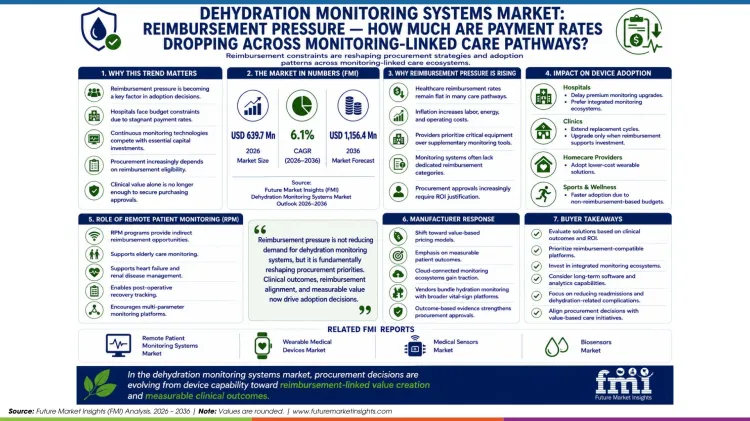
The healthcare reimbursement dynamics are being observed to have an increasing impact on the dehydration monitoring systems market, although the devices may not always be directly reimbursed as stand-alone equipment. Rather, their adoption is linked to broader care pathways such as remote patient monitoring, chronic disease management, emergency care optimization and post-operative recovery programmes.
According to Future Market Insights, the market is expected to increase from US$ 639.7 million in 2026 to US$ 1,156.4 million by 2036, with a steady CAGR of 6.1%. "This growth highlights the rising clinical demand for continuous hydration assessment across hospitals, sports medicine, elderly care and home healthcare ecosystems.
But reimbursement pressure is emerging as an important structural constraint impacting procurement decisions.
Indirect Reimbursement Dependency in Monitoring Systems
Unlike imaging or surgical devices, dehydration monitoring systems do not fall within a well-defined, stand-alone reimbursement bucket. Instead, they are integrated into wider clinical workflows such as ICU monitoring, emergency care triage, dialysis support and chronic disease management.
This creates an indirect dependence on reimbursement schemes. When reimbursement rates tighten for hospital stays, chronic care episodes, or outpatient monitoring programs, hospitals cut spending on supplementary monitoring technologies, even if those technologies improve outcomes.
In many health care systems, reimbursement models still focus on episodic care rather than continuous monitoring. Consequently, hydration tracking systems are often seen as “enhancement tools” rather than essential, reimbursable assets.
This classification has a big impact on procurement behaviour.
Declining Margins and Budget Reallocation
Hospitals operating under fixed reimbursement schedules are experiencing growing cost pressures from inflation in labour, energy and consumables. Capital expenditure budgets are squeezed if reimbursement rates don’t change proportionally.
In such settings, dehydration monitoring systems, especially wearable and continuous monitoring devices, are competing with other priorities such as imaging upgrades, electronic health record integration, and expansion of critical care equipment.
This means procurement teams are slow to adopt advanced hydration monitoring platforms unless they are directly tied to reimbursable clinical pathways.
Role of Remote Patient Monitoring Reimbursement
The major offsetting factor is the growth of reimbursement programs for remote patient monitoring (RPM) in several developed markets. These programs enable health care providers to bill for the continuous monitoring of patients in settings outside of hospitals.
Dehydration monitoring systems can be incorporated into RPM frameworks indirectly in the following ways:
- Monitoring elderly care
- Heart failure and renal disease management
- Post-operative recovery tracking
- Athlete monitoring programs in clinical sports medicine
But reimbursement eligibility is frequently tied to monitoring a number of parameters, not just hydration. This pushes vendors to include hydration sensors in larger platforms that track a range of vital signs
Impact on Device Adoption Behaviour
Limits on reimbursements are shifting purchasing habits among healthcare providers:
- Hospitals are focusing on integrated monitoring platforms rather than on standalone hydration devices
- Clinics delay upgrades until they can be justified through reimbursement
- Homecare providers favour low-cost wearables that provide basic functionality.
- Sports and wellness sectors move faster because budgets are not reimbursement-based
This divergence is creating a split adoption landscape, where reimbursement sensitive buyers are slowing premium adoption while non-reimbursed segments are speeding up the uptake of innovation.
Shift Toward Outcome-Based Value Justification
To work around reimbursement restrictions, manufacturers are moving more and more dehydration monitoring systems into value-based care models.
Instead of marketing devices based on hardware capability, vendors focus on measurable outcomes such as:
- Lower hospital readmission rates from complications of dehydration
- Improving ICU Fluid Management Efficiency
- Reduced incidence of heat stress in monitored populations
Shorter recovery times for patients after surgery
This outcome-based positioning is critical to winning procurement approval in reimbursement-constrained environments.
Emerging Market Pressure and Delayed Adoption
Reimbursement constraints are further magnified in emerging health care systems. Many hospitals are funded through public health funding models which are budget constrained and see advanced monitoring systems as secondary investments.
This translates into longer adoption cycles, extended use of basic monitoring equipment, and a slower transition to continuous hydration tracking technologies.
But this delay is also creating a latent pool of demand. And with the momentum of healthcare digitization and changing reimbursement mechanisms, these markets should come into a fast catch-up phase.
Bottom Line
The pressure to get reimbursed isn’t directly cutting demand for dehydration monitoring systems, but it’s fundamentally changing where, how and why these systems are being adopted. The market continues to grow steadily at 6.1% CAGR through 2036, however procurement decisions are increasingly tied to reimbursement-linked care pathways and measurable clinical value rather than standalone device capability.

