


- The dental piezoelectric ultrasonic unit market is valued at USD 265.1 Million in 2026 and is projected to reach USD 431.9 Million by 2036 (CAGR 5%) as the market faces increasing competitive pressure from China-based manufacturers expanding their global exports.
- Chinese manufacturers are gaining market share in price-sensitive dental markets through aggressive pricing and rapid product localization.
- Cost advantages are driving deeper penetration in emerging economies, especially in the Asia Pacific, Latin America and parts of Eastern Europe.
- There are quality perception gaps, particularly in high-precision periodontal applications, with Western and Japanese brands dominating premium adoption.
- Mid-tier dental clinics are increasingly taking to China-origin ultrasonic units due to acceptable performance levels combined with drastically lower acquisition costs.
- The competitive landscape is moving towards a two-tiered market structure: premium performance-oriented brands vs cost-optimized high-volume Chinese suppliers.
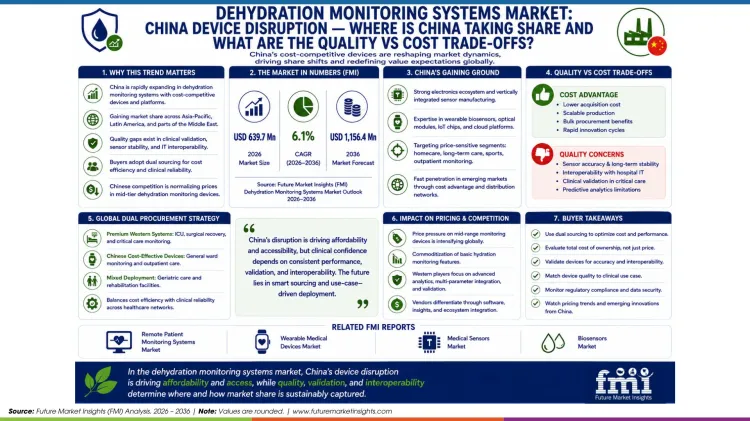
China’s growing role in global medical device manufacturing is having an increasing impact on the dental piezoelectric ultrasonic unit market. The market is anticipated to grow from USD 265.1 Mn in 2026 to USD 431.9 Mn by 2036, at a CAGR of 5% during the forecast period, driven by the increasing adoption of ultrasonic scaling technologies across dental care systems globally, according to FMI.
In this growth environment, China-based manufacturers are steadily changing the dynamics of competition by adopting cost-efficient production models and expanding export capabilities. While Western and Japanese companies used to dominate the ultrasonic device segment in the earlier phases, China is now emerging as a strong contender in the mid- and lower-tier market segments.
Price competitiveness is the most critical driver of Chinese penetration. Chinese manufacturers can offer ultrasonic units at much lower price points than established global brands thanks to lower labor costs, manufacturing scale and vertically integrated supply chains. This cost advantage is especially relevant in developing areas where dental infrastructure is developing but cost constraints continue to be a major problem.
Of course, price is not the only determinant of the competitive landscape. Quality differentiation is still a major hurdle for full-scale replacement of premium brands. There are three critical areas where the established European and Japanese manufacturers still have an advantage: 1) accurate frequency control, 2) stable energy output and 3) rugged hand piece design for piezoelectric ultrasonic units. As a result, the market is increasingly bifurcated.
Premium dental clinics, dental departments in hospitals and specialty periodontal centers continue to favor high-end ultrasonic systems due to their reliability, precision and consistent performance over the long term in the clinical environment. These segments are less price-sensitive and are more focused on clinical outcomes.
On the other hand, mid-level and cost-sensitive clinics are more inclined to consider devices from China, especially when performance differences are slight for routine scaling and prophylaxis procedures. This is particularly true in high volume general dental practices where equipment use is high, and replacement cycles are shorter.
Improving product quality is also part of China’s market expansion. Over the past decade, Chinese manufacturers have made great strides in upgrading their design standards to include better piezoelectric materials, improved ergonomics and enhanced sterilization compatibility. For standard dental procedures the performance gap is closing, but for premium applications, it still exists.
From a procurement perspective, dental clinics are increasingly weighing the trade-offs between short-term cost savings and long-term reliability. This is leading to a segmented adoption model with China taking share in price-driven procurement cycles, but not fully displacing premium suppliers is high-end clinical settings.
Global manufacturers are also changing strategies due to competitive pressure. To stay price competitive and retain brand positioning, many are introducing mid-market product lines, outsourcing components or localizing production.
Ultimately, China’s role in the dental piezoelectric ultrasonic unit market is not defined by full substitution but by selective disruption across cost-sensitive segments, reinforcing a multi-tier global market structure.

