

- Market Size (2026)
- USD 947.7 Mn
- Forecast (2036)
- USD 2458.0 Mn
- CAGR (2026 to 2036)
- 10.0%
How big is Endoscopic Imaging Logistics and Service Market in 2026?
USD 947.7 million in 2026 and USD 2,458.0 million by 2036 at a 10.0% CAGR.
Demand for endoscopic imaging logistics and service is anticipated to expand at 10.0% CAGR through 2036 supported by hospital investment in coordinated equipment availability. Industry valuation is projected to increase from USD 947.7 million in 2026 to USD 2458.0 million by 2036 reflecting the same service-intensive purchasing model. Hospital systems create spending through coordinated equipment delivery and image-chain uptime together with repair coverage and validated reprocessing support across procedure rooms. The related reprocessing chemicals category clarifies why scope availability depends on compatible cleaning workflows rather than imaging hardware alone. Centers for Disease Control and Prevention research published in August 2025 found that 61.4% of United States adults aged 45 to 75 were current with colorectal screening during 2022. The same study estimated that 32.3% had never received screening, leaving substantial clinical workload outside established pathways. Service contracts gain value through reliable turnaround and documented scope readiness alongside consistent image performance across expanding diagnostic programs.
United Kingdom providers operate through accredited service standards, while United States networks rely more heavily on local capital ownership and multi-site service contracts. NHS England published its May 2026 diagnostic collection in July 2026 and recorded 53,184 colonoscopies. The same publication recorded 61,334 gastroscopies during May 2026 across the corresponding national service category. The dataset showed 25,743 colonoscopy patients waiting longer than six weeks during the reporting month. It also showed 24,241 gastroscopy patients waiting longer than six weeks during the same period. High waiting volumes raise the economic value of reprocessing devices that return scopes to service while separate operating measures clarify procedure capacity and service performance. American hospital groups emphasize vendor response and loaner coverage; British units align equipment capacity with staffing evidence and accreditation requirements across public care pathways.
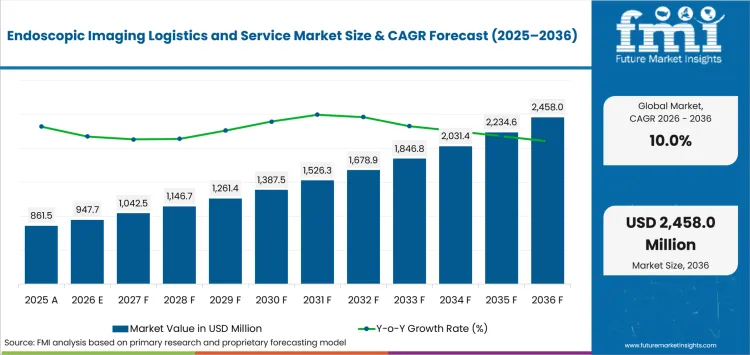
Key Takeaways of Endoscopic Imaging Logistics and Service Market
- Demand for endoscopic imaging logistics and service is driven by procedure growth connecting imaging capacity with equipment availability and validated service responsibility, as unavailable scopes cancel procedures even with adequate clinical staffing.
- By service type, logistics services hold the leading share at 36.3% in 2026, supported by control over delivery, repair routing, and replacement coordination.
- Hospitals lead end-user demand at 38.8% share in 2026, owing to their management of complex procedure volumes and capital assets across departments.
- Endoscopic imaging systems account for 37.8% equipment share in 2026, driven by integrated processors and light sources alongside display hardware.
- Gastroenterology captures 44.0% specialty share in 2026, attributable to broad scope fleets and disciplined reprocessing support.
- South Korea, the UK, and Germany record CAGRs of 12.2%, 11.8%, and 10.4% respectively through 2036, while Japan and the USA require different service designs because local approval routes and facility dispersion change maintenance economics.
- Competition centers on Olympus, FUJIFILM Healthcare, KARL STORZ, Stryker, STERIS, Getinge, PENTAX Medical, and Agiliti, with vendors differentiating through integrated platform and technical support, multispecialty visualization, reprocessing workflow depth, and portfolio flexibility.
Analyst Perspective
"Long-term value in endoscopic services is determined by equipment availability and operational continuity rather than capital investment alone. Healthcare providers are evaluating service models that minimize downtime, support efficient fleet management, and maintain consistent clinical performance across procedure volumes. Organizations that deliver dependable maintenance, rapid turnaround, and robust technical support will strengthen their position as hospitals seek greater efficiency from endoscopy operations."
- Anurag Sharma, Principal Analyst at Future Market Insights
Source: FMI's proprietary forecasting model and primary research
How is the Endoscopic Imaging Logistics And Service Market segmented?
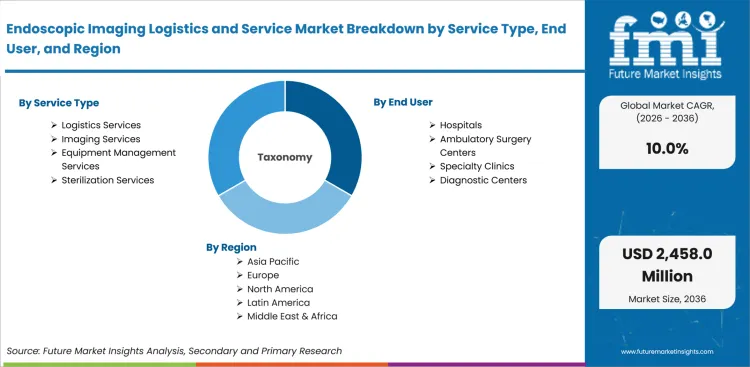
The endoscopic imaging logistics and service industry is segmented by service type and end user alongside equipment type and application plus region.
Service type distinguishes logistics support from imaging services together with equipment management and sterilization within the defined revenue boundary. End-user analysis separates hospitals from ambulatory centers together with specialty clinics and diagnostic centers under different ownership structures. Equipment type separates complete imaging systems from video endoscopes alongside accessories and platforms used across clinical procedure rooms. Application analysis follows gastroenterology and pulmonology together with urology and ENT procedures that create different service requirements. Regional analysis compares local registration and distribution with financing conditions and maintenance access across every approved country.
How do logistics services support equipment availability within the service type category?
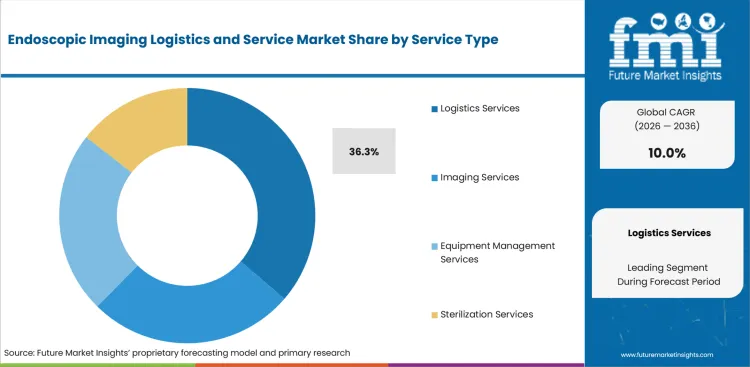
Endoscopy departments need coordinated delivery and repair routing because delayed scopes can reduce procedure capacity across several clinical rooms. Olympus currently describes temporary loaners and on-site support together with rapid turnaround and service agreements for endoscopy equipment. The service package connects endoscope reprocessing with asset movement across a complete equipment availability plan. Commercial evaluation therefore concerns accountable uptime ownership rather than freight movement or basic courier performance.
- Logistics services are projected to account for 36.3% share within service type during 2026 supported by control over repair routing and replacement availability. Hospitals gain a clearer operating baseline when delivery status and service escalation remain visible across each endoscopy location.
- Clinical engineering teams use logistics services to coordinate loaners and collect damaged scopes without disrupting validated reprocessing routes. Adoption strengthens through contracts that define turnaround targets and responsibility for equipment condition during transit. Contract terms help endoscopy managers protect procedure schedules across several locations while maintaining a traceable equipment history.
What supports the hospital position within the end-user category?
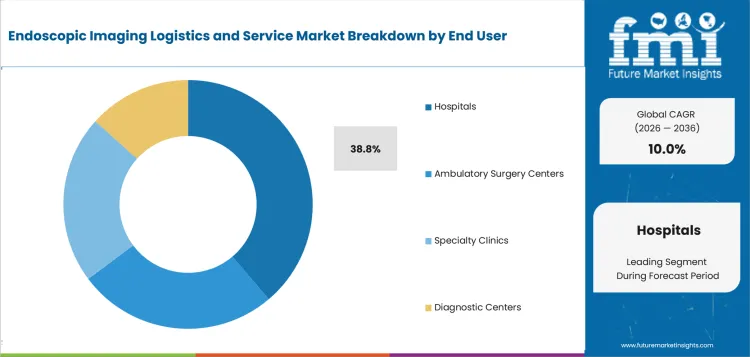
Hospitals combine diagnostic procedures with emergency and therapeutic workloads that require broad scope inventories and dependable room turnover. The operating model concentrates clinical engineering and infection prevention alongside purchasing and endoscopy leadership inside one capital plan. A related medical devices portfolio can widen service complexity because each platform carries different maintenance and training obligations. Smaller ambulatory surgical centers require leaner service coverage and cannot easily absorb prolonged equipment downtime.
- In 2026, hospitals are estimated to hold 38.8% share of end user, owing to their mixed procedure volumes and centralized equipment ownership. Large facilities can spread service contracts across several rooms while maintaining common repair and reprocessing controls across shared service networks.
- Hospital endoscopy units prioritize dependable capacity across colonoscopy and gastroscopy lists rather than isolated device performance. JAG reported in June 2025 that 517 services were registered across the UK and Ireland while 223 held accreditation. Accreditation requirements raise the value of documented service support and trained personnel across every participating endoscopy unit.
How are endoscopic imaging systems positioned within the equipment type category?
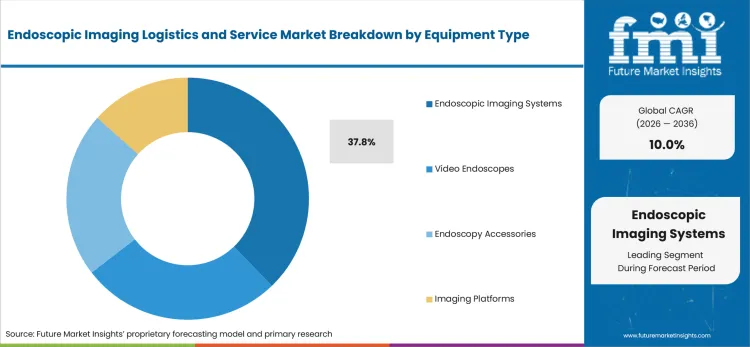
Complete imaging systems coordinate processors and illumination alongside displays and compatible endoscopes through one clinical image chain. Hospitals evaluate platform compatibility alongside service continuity because partial upgrades can create uneven image quality and training burdens. The wider hybrid endoscopy category illustrates how integrated rooms add workflow dependencies beyond a single processor. Clinical engineering teams therefore assess the complete chain rather than purchasing isolated components with separate support assumptions.
- Endoscopic imaging systems are forecast to represent 37.8% share of equipment type in 2026 driven by their control over image capture and display. Fujifilm launched the ELUXEO 8000 system in October 2025 with 4K output and compatibility across several scope generations. Cross-generation compatibility can protect earlier scope investments throughout a processor replacement program and reduce avoidable fleet disruption.
- Gastroenterologists and pulmonologists compare image modes with scope compatibility alongside service response and documentation integration during system selection. Adoption depends on proving that new visualization features improve clinical work without creating unsupported maintenance complexity. Clinical teams need training and compatible loaner coverage before advanced imaging modes become reliable routine tools.
What makes gastroenterology central to the application category?
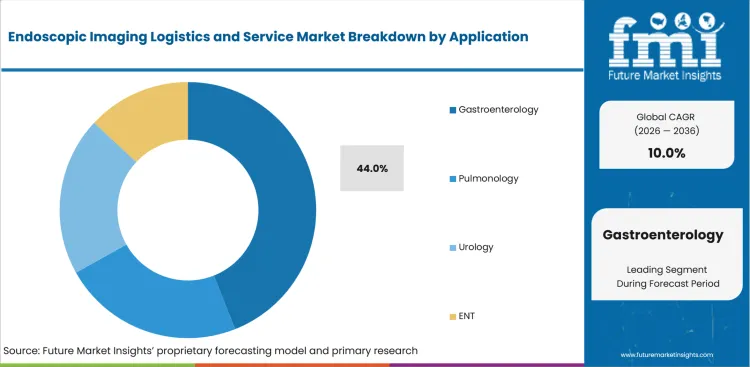
Gastroenterology requires diagnostic and therapeutic procedures across upper and lower digestive pathways within high-volume clinical programs. The American Cancer Society reported in March 2026 that 158,850 new colorectal cancer cases were expected across the United States during 2026. The same report estimated 55,230 deaths from the disease across the United States during 2026. The clinical burden supports continuing demand for dependable flexible endoscopes and service systems that preserve image quality across repeated use. Fleet planning must account for reprocessing time and repair exposure across several specialized scope types.
- Gastroenterology is likely to capture 44.0% share within application in 2026 attributable to broad screening and treatment use across hospitals and outpatient centers. The segment needs diverse scopes plus processors that support routine examinations and advanced interventions across complex gastroenterology workflows.
- Digestive disease programs adopt service models that protect daily list capacity through repair coverage and available replacements. Their adoption mechanism differs from segment scale because clinical continuity depends on each scope returning safely to service. Hospitals therefore need inventory plans that balance specialty scope diversity with predictable turnaround during busy procedure days.
What are the drivers, restraints, and opportunities in the Endoscopic Imaging Logistics And Service Market?
Screening and therapeutic workloads support demand; reprocessing compatibility limits routine use; structured training creates a practical expansion route.
- Driver: Expanding endoscopy pathways increase spending on imaging capacity and accountable equipment support across clinical networks.
- Restraint: Complex reprocessing instructions and compatibility changes can remove equipment from service or require retraining.
- Opportunity: Training partnerships and modular service contracts can reduce adoption risk for advanced endoscopic procedures.
Screening programs create a direct workload driver for imaging systems and service coverage across participating clinics. CDC reported in April 2026 that its colorectal cancer control program works with clinics and hospitals serving adults aged 45 to 75. The same April 2026 program record identified 38 recipients and evidence-based interventions designed to increase screening across participating health systems. Service providers benefit through repeatable equipment demand but must align support with the capacity of each participating site.
Reprocessing compatibility creates a material restraint because a small accessory change can interrupt a complete scope workflow. The FDA posted an Olympus OER-Pro recall in March 2026 covering 3,354 units distributed nationwide. The agency stated that specified valves were no longer compatible with OER-Pro and OER-Elite reprocessors. Hospitals had to stop the affected reprocessing process and retrain personnel using revised operating instructions. Commercial adoption weakens without clear compatibility control across equipment and accessories together with reprocessing disinfectants used throughout the validated workflow.
Advanced procedure training creates a practical opportunity for imaging suppliers that combine equipment with supervised skill development. Commercial value improves through realistic simulation and repeatable competency assessment rather than equipment demonstrations alone. Fujifilm and EndoSim announced a United States training partnership in February 2025 that expanded distribution of an endoscopic tissue simulation model. Comparable programs can shorten the path from capital purchase to confident clinical use across multiple procedure teams.
Which country CAGRs are profiled in the Endoscopic Imaging Logistics And Service Market?
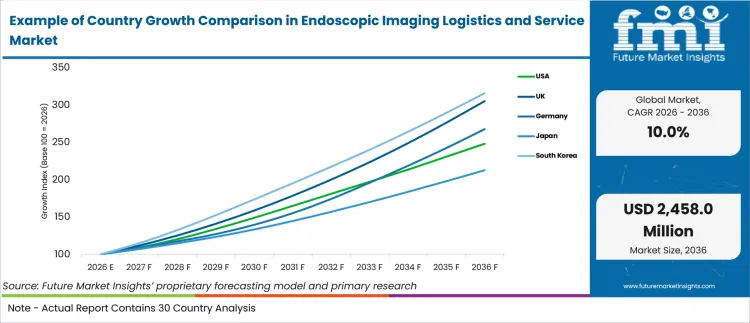
| Country | CAGR |
|---|---|
| USA | 9.5% |
| UK | 11.8% |
| Germany | 10.4% |
| Japan | 7.8% |
| South Korea | 12.2% |
How do country-level CAGRs compare in the Endoscopic Imaging Logistics And Service Market?
The country comparison spans 4.4 percentage points from South Korea at 12.2% to Japan at 7.8% reflecting measured differences among approved national forecasts. South Korea and the UK form a close upper pair with a measured 0.4-point separation between their forecasts. Germany sits 1.5 points below the UK and remains 0.8 points above the United States forecast. Japan remains 1.7 points below the United States and therefore falls outside the central forecast cluster. The measured spacing suggests three distinct entry groups rather than one uniform adoption route for commercial planning.
- South Korea and the UK occupy the upper cluster through different mechanisms involving concentrated tertiary care and accredited public service capacity.
- Germany and the USA form a middle group with separate regulatory and service economics across hospital purchasing systems.
- Japan sits outside the central cluster because local approval and compact facility requirements can lengthen commercial preparation.
- The 4.4-point range remains moderate enough that service execution can outweigh forecast spacing during individual purchasing decisions.
- Similar CAGRs can produce different revenue timing because registration and maintenance distance interact with staffing and financing to determine usable equipment capacity.
Entry plans should compare product clearance with local distributor authority and documented maintenance capacity across the complete forecast period. A favorable rate cannot compensate for weak training or long service travel that reduces procedure availability. The full report provides country-level CAGR analysis across North America, Latin America, Europe, East Asia, South Asia, Oceania and the Middle East and Africa.
Country-wise Analysis
- United States hospital networks purchase FDA-cleared imaging platforms through capital budgets and service agreements that often cover several dispersed sites. The United States endoscopic imaging logistics and service market is projected to grow at 9.5% CAGR through 2036 supported by established endoscopy programs and direct OEM service. Olympus announced FDA clearance in May 2025 for its EZ1500 gastroscope and colonoscope within the EVIS X1 system. Related United States reprocessing demand illustrates how local service coverage extends beyond equipment clearance across clinical networks. Clearance enables commercial access while each health system must separately contract service response and loaner coverage across dispersed sites. Contract terms should define response standards for every hospital and outpatient location throughout the service term.
- UK endoscopy services operate through public purchasing structures and JAG accreditation requirements that connect equipment capacity with workforce evidence. The local endoscopic imaging logistics and service outlook is anticipated to advance at 11.8% CAGR over the assessment period linked to diagnostic waiting lists and standardized quality controls. JAG released safe staffing guidance in March 2026 that requires services to evidence sustainable staffing under accreditation standards. Accreditation supports consistent procurement but incomplete workforce plans can leave installed equipment underused across scheduled procedure lists. Suppliers need training plans that fit NHS rosters and protect service schedules across each accredited endoscopy unit.
- German providers must manage medical-device registration and documentation through European rules while coordinating regional technical service. Germany’s endoscopic imaging logistics and service sector is estimated to post 10.4% CAGR over the forecast period shaped by mature hospital infrastructure and formal compliance duties. BfArM states that four EUDAMED modules became mandatory on May 28, 2026 with a six-month transition for device registration. The common database supports traceability but adds migration work for manufacturers and importers serving German healthcare providers. Market entry requires complete UDI records with German-language service documentation and reliable spare-parts access throughout the installed base.
- Japanese endoscopy providers must use nationally approved systems and establish local training plus replacement routes for each approved technology. Demand for the endoscopic imaging logistics and service market in Japan is forecast to rise at 7.8% CAGR over the forecast period linked to approved technologies and disciplined clinical workflows. PMDA listed PillCam COLON 2 approval dated December 19 and PillCam SB 3 approval dated December 22 during its 2025 review summary. The approvals expand diagnostic options but product-specific training and maintenance requirements create additional preparation for hospital teams. Commercial contracts therefore need product-specific training and replacement routes that remain workable across every intended deployment site.
- South Korean hospitals route novel endoscopic procedures through formal health-technology assessment before reimbursement and patient-payment terms are established. Adoption of endoscopic imaging logistics and service in South Korea is estimated to expand at 12.2% CAGR through 2036 linked to structured technology assessment and specialist procedure pathways. HIRA published its endoscopic anti-reflux mucosal resection assessment in September 2025 and confirmed non-covered status under defined patient criteria. The decision creates a regulated pathway but leaves financing dependent on hospital policy and patient payment. Commercial teams must pair equipment access with specialist training and procedure-specific economic evidence for each hospital approval pathway.
Who are the notable companies in the Endoscopic Imaging Logistics And Service Market?
Olympus and FUJIFILM Healthcare join KARL STORZ and PENTAX Medical alongside STERIS and Getinge plus Agiliti and Stryker as notable companies shaping this market.
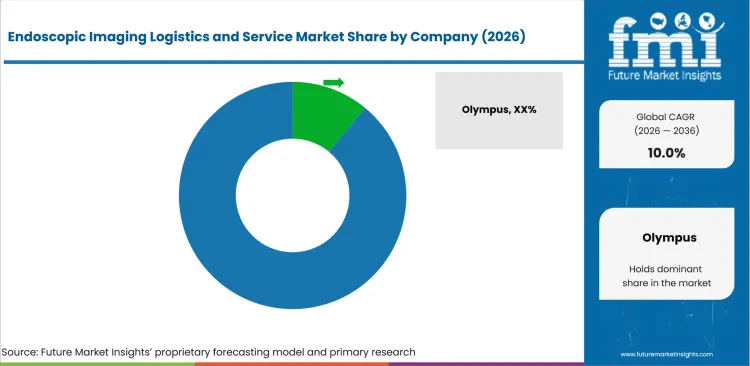
The competitive structure combines imaging-platform owners with reprocessing specialists and independent repair organizations across clinical equipment workflows. Platform manufacturers compete through scope compatibility and visualization breadth while service providers compete through turnaround and equipment availability. Current official company pages show distinct roles across ENT endoscopy and broader procedure settings that require separate support capabilities. Selection depends on who controls each handoff between image capture and cleaning alongside repair and return to clinical service. Hospital groups therefore evaluate portfolio breadth separately from local maintenance coverage and reprocessing responsibility during contracting decisions.
- Olympus and FUJIFILM Healthcare join PENTAX Medical and Stryker as imaging-platform providers with different scope portfolios and service arrangements. Hospitals compare processor compatibility and OEM repair access before standardizing equipment across multiple clinical departments.
- KARL STORZ joins STERIS and Getinge in connecting endoscopy equipment with reprocessing or integrated service functions. Their commercial relevance depends on validated compatibility and the ability to support clinical uptime across local installations.
- Agiliti provides independent flexible-endoscope repair and on-site service options across United States healthcare facilities with established technical coverage. Independent support can broaden repair choices but hospitals must verify OEM specifications and validated reprocessing after each repair.
Competitive Benchmarking: Endoscopic Imaging Logistics and Service Market
| Company | Imaging Platform | Reprocessing Support | Service Logistics | Geographic Reach |
|---|---|---|---|---|
| Olympus | High | High | High | Global |
| FUJIFILM Healthcare | High | High | High | Global |
| KARL STORZ | High | Medium | High | Global |
| PENTAX Medical | High | Medium | Medium | Global |
| STERIS | Medium | High | High | Global |
| Getinge | Low | High | Medium | Global |
| Agiliti | Low | Low | High | United States |
| Stryker | High | Medium | Medium |
Global |
Key Developments in the Endoscopic Imaging Logistics and Service Market
- In June 2026, Olympus launched 4K LCD monitors in 27-inch plus 31.5-inch and 42.5-inch formats for Olympus endoscopy systems. Initial availability covered Japan and Europe together with Canada and selected Asia-Pacific and Latin American markets during the launch. The added display choices strengthen image-chain standardization across rooms that need different monitor sizes and lighting conditions.
- In June 2026, FUJIFILM Healthcare opened a New Jersey endoscopy warehouse to expand national logistics support. The Fairfield facility measures 18,000 square feet and began operations during May alongside its existing service center. Warehouse relocation created space for the Wayne service center to expand about 1.5 times while supporting faster turnaround for United States customers.
- In March 2026, KARL STORZ received FDA clearance for the FIVE S 6.5 sterile single-use bronchoscope with a 3.0 millimeter working channel. The scope integrates with the C-MAC monitor and supports airway inspection together with secretion clearance procedures. Shared visualization can reduce daily setup complexity for critical-care teams already using the C-MAC platform.
- In June 2026, Getinge launched the Aquadis Endo 110 automated endoscope reprocessor with a standard cycle time of twenty minutes. Getinge stated that the system raises throughput by up to 36% against previous models and automates channel connections. The release addresses scope availability and traceability requirements inside high-volume reprocessing departments managing complex inventories.
Key Players in the Endoscopic Imaging Logistics and Service Market
Imaging and Endoscopy Platform Providers
- Olympus
- FUJIFILM Healthcare
- PENTAX Medical
- Stryker
Integrated Reprocessing and Service Providers
- KARL STORZ
- STERIS
- Getinge
Independent Equipment Service Provider
- Agiliti
Endoscopic Imaging Logistics and Service Market - Report Scope
| Coverage field | Report scope |
|---|---|
| Market breakdown | Service type, end user, equipment type, application, and region. |
| Quantitative Units | Revenue in USD Million, CAGR in %. |
| Market Definition | Products and services that support endoscopic image capture plus equipment delivery, repair, reprocessing coordination, and clinical availability. |
| Regions Covered | North America, Latin America, Western Europe, Eastern Europe, East Asia, South Asia and Pacific, and Middle East and Africa. |
| Countries Covered | USA, UK, Germany, Japan, and South Korea. |
| Key Companies Profiled | Olympus, FUJIFILM Healthcare, KARL STORZ, PENTAX Medical, STERIS, Getinge, Agiliti, and Stryker. |
| Forecast Period | 2026 to 2036. |
| Approach | Hybrid bottom-up and top-down market sizing supported by primary interviews and official desk research. |
Endoscopic Imaging Logistics and Service Market - Research Methodology
| Method | Approach |
|---|---|
| Primary Research | FMI analysts gathered input from manufacturers, service providers, technology developers, distributors, end users, procurement teams, and subject-matter experts. Interviews examined purchasing decisions, product or service evaluation, adoption barriers, approval requirements, pricing considerations, and expectations for technical or commercial support. Respondents were also asked what evidence is required before a trial, pilot, or initial order develops into regular purchasing. |
| Desk Research | Desk research covered government statistics, regulatory publications, trade data, industry associations, technical literature, standards, company filings, product information, and official corporate announcements. Sources were reviewed for relevance, publication date, geographic coverage, and consistency with the defined market scope. Claims relating to performance, applications, approvals, capacity, investment, and commercial activity were retained only when supported by credible public evidence. |
| Market Sizing and Forecasting | The market model combined the baseline value with historical performance, segment structure, pricing and volume indicators, adoption levels, company participation, and country-level demand conditions. Forecast assumptions considered economic activity, investment trends, regulatory developments, technology adoption, purchasing cycles, supply availability, and barriers to wider market use. Segment and regional estimates were reconciled before the final market total was calculated. |
| Data Validation | Estimates were checked against multiple independent indicators, including public data, company activity, trade patterns, industry developments, and findings from primary interviews. Validation also tested whether products, services, applications, and company revenues fell within the defined market boundaries. Adjacent categories, unsupported claims, overlapping revenues, and activities without direct market relevance were excluded to reduce double counting and maintain consistency across segments and countries. |
Endoscopic Imaging Logistics and Service Market by Segments
Endoscopic Imaging Logistics and Service Market segmented by Service Type:
- Logistics Services
- Imaging Services
- Equipment Management Services
- Sterilization Services
Endoscopic Imaging Logistics and Service Market segmented by End User:
- Hospitals
- Ambulatory Surgery Centers
- Specialty Clinics
- Diagnostic Centers
Endoscopic Imaging Logistics and Service Market segmented by Equipment Type:
- Endoscopic Imaging Systems
- Video Endoscopes
- Endoscopy Accessories
- Imaging Platforms
Endoscopic Imaging Logistics and Service Market segmented by Application:
- Gastroenterology
- Pulmonology
- Urology
- ENT
Endoscopic Imaging Logistics and Service Market by Region:
- North America
- United States
- Canada
- Latin America
- Brazil
- Mexico
- Argentina
- Chile
- Western Europe
- Germany
- France
- United Kingdom
- Italy
- Spain
- Benelux
- Nordics
- Eastern Europe
- Poland
- Czech Republic
- Romania
- Hungary
- East Asia
- China
- Japan
- South Korea
- South Asia and Pacific
- India
- ASEAN
- Australia and New Zealand
- Middle East and Africa
- GCC Countries
- South Africa
- Türkiye
- Israel
Research Sources and Bibliography
- Centers for Disease Control and Prevention. (2025, August 7). Baseline Estimates of Colorectal Cancer Screening Among Adults Aged 45 to 75 Years, Behavioral Risk Factor Surveillance System, 2022.
- NHS England. (2026, July 9). Monthly Diagnostic Waiting Times and Activity: May 2026.
- Olympus America. (n.d.). Service & Repair.
- Joint Advisory Group on GI Endoscopy. (2025, June 9). JAG annual report.
- FUJIFILM Healthcare Americas Corporation. (2025, October 22). Fujifilm Launches Next-Generation ELUXEO® Endoscopic Imaging System with Enhanced LED Multi-Light Technology.
- McDowell, S. (2026, March 2). Colorectal Cancer Drops in Older Adults and Rises in Younger Ones. American Cancer Society.
- Centers for Disease Control and Prevention. (2026, April 8). About the Colorectal Cancer Control Program.
- USA Food and Drug Administration. (2026, March 20). Class 2 Device Recall Olympus Endoscope Reprocessor OER-Pro.
- FUJIFILM Healthcare Americas Corporation. (2025, February 12). Fujifilm and EndoSim Partner to Expand Access to Advanced Endoscopy Training.
- Olympus Corporation. (2025, May 28). Olympus Announces FDA Clearance of Its Most Advanced Imaging Endoscopes.
- Joint Advisory Group on GI Endoscopy. (2026, March 31). New JAG Safe Staffing Guidance now available!
- Federal Institute for Drugs and Medical Devices. (n.d.). Europe and EUDAMED.
- Pharmaceuticals and Medical Devices Agency. (n.d.). 2025[2025 Review Summaries].
- Health Insurance Review & Assessment Service. (2025, September 8). [(2025 Fifth Medical Procedures Expert Evaluation Committee) Endoscopic Anti-Reflux Mucosal Resection].
- Olympus Corporation. (2026, June 24). Olympus Launches 4K LCD Monitors to Enhance Clarity in Endoscopic Diagnosis and Therapy.
- FUJIFILM Healthcare Americas Corporation. (2026, June 18). Fujifilm Opens New Endoscopy Warehouse Facility in Fairfield, NJ, Expanding Service Operations and Supporting Continued Business Growth.
- KARL STORZ. (2026, March 11). KARL STORZ Receives FDA Clearance for FIVE S 6.5 Bronchoscope.
- Getinge. (2026, June 11). Getinge elevates automated endoscope reprocessing with Aquadis Endo 110.
- PENTAX Medical. (n.d.). Endoscopes by PENTAX Medical for advanced medical imaging.
- PENTAX Medical. (n.d.). PENTAX Medical: The History of our company & innovations.
- STERIS. (n.d.). Endoscopy Equipment, Instruments, and Reprocessing Products.
The bibliography contains official sources supporting statistical and regulatory claims together with company and competitive capability claims.
This Report Answers
- How large is the endoscopic imaging logistics and service market in 2026 and 2036?
- Which operating pressures support investment in endoscopic imaging systems and service capacity?
- Why do logistics services hold 36.3% share within service type during 2026?
- How do hospitals evaluate equipment availability and reprocessing support across endoscopy departments?
- Why do endoscopic imaging systems represent 37.8% share within equipment type during 2026?
- How do country growth rates differ across the USA, UK, Germany, Japan, and South Korea?
- Which companies provide imaging platforms, reprocessing systems, or endoscope repair services?
- What limits routine adoption across imaging, repair, logistics, and reprocessing workflows?
- How can training and service contracts improve the economics of advanced endoscopic procedures?
Frequently Asked Questions
How big is the Endoscopic Imaging Logistics and Service Market in 2026?
The endoscopic imaging logistics and service market is valued at USD 947.7 million in 2026 and is forecast to reach USD 2458.0 million by 2036. Growth reflects hospitals prioritizing equipment availability, coordinated repair logistics, validated reprocessing support, and dependable service continuity across expanding endoscopy procedure volumes.
What is the CAGR of the Endoscopic Imaging Logistics and Service Market from 2026 to 2036?
The endoscopic imaging logistics and service market grows at a CAGR of 10.0% between 2026 and 2036, supported by increasing diagnostic procedure volumes, greater investment in equipment uptime, and service models that improve fleet management across hospital endoscopy departments.
Which service type leads the Endoscopic Imaging Logistics and Service Market?
Logistics services account for 36.3% of the endoscopic imaging logistics and service market by service type in 2026, driven by demand for coordinated equipment delivery, repair routing, replacement management, and documented service accountability that helps maintain uninterrupted endoscopy schedules.
How much will the Endoscopic Imaging Logistics and Service Market add between 2026 and 2036?
The endoscopic imaging logistics and service market is set to add USD 1,510.3 million between 2026 and 2036, growing from USD 947.7 million to USD 2,458.0 million as healthcare providers strengthen service infrastructure, equipment availability, and reprocessing support across high-volume endoscopy programs.
Who are the leading companies in the Endoscopic Imaging Logistics and Service Market?
Eight companies lead the endoscopic imaging logistics and service market, including Olympus, FUJIFILM Healthcare, KARL STORZ, PENTAX Medical, STERIS, Getinge, Agiliti, and Stryker, competing through integrated imaging platforms, reprocessing systems, technical service capabilities, and endoscope repair support.
Preview the report firsthand - request a free sample
Get SampleGet the brochure for pricing and purchase details.
Get PDFTable of Content
- Key Takeaways
- Market Size and CAGR
- Top Growth Driver
- Fastest Growing Segment
- Leading Region
- Key Companies
- Emerging Opportunities
- Executive Summary
- Global Market Outlook
- Demand-side Trends
- Supply-side Trends
- Technology Roadmap Analysis
- Analysis and Recommendations
- Analyst Perspective (What is happening? Why now? What should investors know?)
- Key Questions Answered
- How large is the market?
- What is the CAGR?
- What are key trends?
- Which region dominates?
- Who are the leaders?
- Market Overview
- Market Coverage / Taxonomy
- Market Definition / Scope / Limitations
- Research Methodology
- Chapter Orientation
- Analytical Lens and Working Hypotheses
- Market Structure, Signals, and Trend Drivers
- Benchmarking and Cross-market Comparability
- Market Sizing, Forecasting, and Opportunity Mapping
- Research Design and Evidence Framework
- Desk Research Programme (Secondary Evidence)
- Expert Input and Fieldwork (Primary Evidence)
- Tooling, Models, and Reference Databases
- Data Engineering and Model Build
- Quality Assurance and Audit Trail
- Market Background
- Market Dynamics (Drivers, Restraints, Opportunity, Trends)
- Scenario Forecast (Optimistic, Likely, Conservative)
- Impact Analysis
- AI Impact
- Sustainability Impact
- Regulatory Impact
- Technology Impact
- Consumer / Buyer Analysis
- Purchase Drivers
- Adoption Barriers
- Buyer Journey
- Opportunity Map Analysis
- Product Life Cycle Analysis
- Supply Chain Analysis
- Investment Feasibility Matrix
- Value Chain Analysis
- PESTLE and Porter's Analysis
- Regulatory Landscape
- Regional Parent Market Outlook
- Production and Consumption Statistics
- Import and Export Statistics
- Global Market Analysis and Forecast, 2021 to 2036
- Historical Market Size Value (USD Million) Analysis, 2021 to 2025
- Current and Future Market Size Value (USD Million) Projections, 2026 to 2036
- Y-o-Y Growth Trend Analysis
- Absolute $ Opportunity Analysis
- Global Market Pricing Analysis, 2021 to 2036
- Global Market Analysis and Forecast, By Service Type, 2021 to 2036
- Introduction / Key Findings
- Historical Market Size Value (USD Million) Analysis By Service Type, 2021 to 2025
- Current and Future Market Size Value (USD Million) Analysis and Forecast By Service Type, 2026 to 2036
- Logistics Services
- Imaging Services
- Equipment Management Services
- Sterilization Services
- Logistics Services
- Y-o-Y Growth Trend Analysis By Service Type, 2021 to 2025
- Absolute $ Opportunity Analysis By Service Type, 2026 to 2036
- Global Market Analysis and Forecast, By End User, 2021 to 2036
- Introduction / Key Findings
- Historical Market Size Value (USD Million) Analysis By End User, 2021 to 2025
- Current and Future Market Size Value (USD Million) Analysis and Forecast By End User, 2026 to 2036
- Hospitals
- Ambulatory Surgery Centers
- Specialty Clinics
- Diagnostic Centers
- Hospitals
- Y-o-Y Growth Trend Analysis By End User, 2021 to 2025
- Absolute $ Opportunity Analysis By End User, 2026 to 2036
- Global Market Analysis and Forecast, By Equipment Type, 2021 to 2036
- Introduction / Key Findings
- Historical Market Size Value (USD Million) Analysis By Equipment Type, 2021 to 2025
- Current and Future Market Size Value (USD Million) Analysis and Forecast By Equipment Type, 2026 to 2036
- Endoscopic Imaging Systems
- Video Endoscopes
- Endoscopy Accessories
- Imaging Platforms
- Endoscopic Imaging Systems
- Y-o-Y Growth Trend Analysis By Equipment Type, 2021 to 2025
- Absolute $ Opportunity Analysis By Equipment Type, 2026 to 2036
- Global Market Analysis and Forecast, By Application, 2021 to 2036
- Introduction / Key Findings
- Historical Market Size Value (USD Million) Analysis By Application, 2021 to 2025
- Current and Future Market Size Value (USD Million) Analysis and Forecast By Application, 2026 to 2036
- Gastroenterology
- Pulmonology
- Urology
- ENT
- Gastroenterology
- Y-o-Y Growth Trend Analysis By Application, 2021 to 2025
- Absolute $ Opportunity Analysis By Application, 2026 to 2036
- Global Market Analysis and Forecast, By Region, 2021 to 2036
- Introduction
- Historical Market Size Value (USD Million) Analysis By Region, 2021 to 2025
- Current Market Size Value (USD Million) Analysis and Forecast By Region, 2026 to 2036
- North America
- Latin America
- Western Europe
- Eastern Europe
- East Asia
- South Asia and Pacific
- Middle East & Africa
- Market Attractiveness Analysis By Region
- North America Market Analysis and Forecast, By Country, 2021 to 2036
- Historical Market Size Value (USD Million) Trend Analysis By Market Taxonomy, 2021 to 2025
- Market Size Value (USD Million) Forecast By Market Taxonomy, 2026 to 2036
- By Country
- USA
- Canada
- By Service Type
- By End User
- By Equipment Type
- By Application
- By Country
- Market Attractiveness Analysis
- By Country
- By Service Type
- By End User
- By Equipment Type
- By Application
- Key Takeaways
- Latin America Market Analysis and Forecast, By Country
- Historical Market Size Value (USD Million) Trend Analysis By Market Taxonomy, 2021 to 2025
- Market Size Value (USD Million) Forecast By Market Taxonomy, 2026 to 2036
- By Country
- Brazil
- Mexico
- Chile
- Rest of Latin America
- By Service Type
- By End User
- By Equipment Type
- By Application
- By Country
- Market Attractiveness Analysis
- By Country
- By Service Type
- By End User
- By Equipment Type
- By Application
- Key Takeaways
- Western Europe Market Analysis and Forecast, By Country
- Historical Market Size Value (USD Million) Trend Analysis By Market Taxonomy, 2021 to 2025
- Market Size Value (USD Million) Forecast By Market Taxonomy, 2026 to 2036
- By Country
- Germany
- UK
- Italy
- Spain
- France
- Nordic
- BENELUX
- Rest of Western Europe
- By Service Type
- By End User
- By Equipment Type
- By Application
- By Country
- Market Attractiveness Analysis
- By Country
- By Service Type
- By End User
- By Equipment Type
- By Application
- Key Takeaways
- Eastern Europe Market Analysis and Forecast, By Country
- Historical Market Size Value (USD Million) Trend Analysis By Market Taxonomy, 2021 to 2025
- Market Size Value (USD Million) Forecast By Market Taxonomy, 2026 to 2036
- By Country
- Russia
- Poland
- Hungary
- Balkan & Baltic
- Rest of Eastern Europe
- By Service Type
- By End User
- By Equipment Type
- By Application
- By Country
- Market Attractiveness Analysis
- By Country
- By Service Type
- By End User
- By Equipment Type
- By Application
- Key Takeaways
- East Asia Market Analysis and Forecast, By Country
- Historical Market Size Value (USD Million) Trend Analysis By Market Taxonomy, 2021 to 2025
- Market Size Value (USD Million) Forecast By Market Taxonomy, 2026 to 2036
- By Country
- China
- Japan
- South Korea
- By Service Type
- By End User
- By Equipment Type
- By Application
- By Country
- Market Attractiveness Analysis
- By Country
- By Service Type
- By End User
- By Equipment Type
- By Application
- Key Takeaways
- South Asia and Pacific Market Analysis and Forecast, By Country
- Historical Market Size Value (USD Million) Trend Analysis By Market Taxonomy, 2021 to 2025
- Market Size Value (USD Million) Forecast By Market Taxonomy, 2026 to 2036
- By Country
- India
- ASEAN
- Australia & New Zealand
- Rest of South Asia and Pacific
- By Service Type
- By End User
- By Equipment Type
- By Application
- By Country
- Market Attractiveness Analysis
- By Country
- By Service Type
- By End User
- By Equipment Type
- By Application
- Key Takeaways
- Middle East & Africa Market Analysis and Forecast, By Country
- Historical Market Size Value (USD Million) Trend Analysis By Market Taxonomy, 2021 to 2025
- Market Size Value (USD Million) Forecast By Market Taxonomy, 2026 to 2036
- By Country
- Kingdom of Saudi Arabia
- Other GCC Countries
- Türkiye
- South Africa
- Other African Union
- Rest of Middle East & Africa
- By Service Type
- By End User
- By Equipment Type
- By Application
- By Country
- Market Attractiveness Analysis
- By Country
- By Service Type
- By End User
- By Equipment Type
- By Application
- Key Takeaways
- Key Countries Market Analysis
- USA
- Pricing Analysis
- Market Share Analysis, 2025
- By Service Type
- By End User
- By Equipment Type
- By Application
- Canada
- Pricing Analysis
- Market Share Analysis, 2025
- By Service Type
- By End User
- By Equipment Type
- By Application
- Mexico
- Pricing Analysis
- Market Share Analysis, 2025
- By Service Type
- By End User
- By Equipment Type
- By Application
- Brazil
- Pricing Analysis
- Market Share Analysis, 2025
- By Service Type
- By End User
- By Equipment Type
- By Application
- Chile
- Pricing Analysis
- Market Share Analysis, 2025
- By Service Type
- By End User
- By Equipment Type
- By Application
- Germany
- Pricing Analysis
- Market Share Analysis, 2025
- By Service Type
- By End User
- By Equipment Type
- By Application
- UK
- Pricing Analysis
- Market Share Analysis, 2025
- By Service Type
- By End User
- By Equipment Type
- By Application
- Italy
- Pricing Analysis
- Market Share Analysis, 2025
- By Service Type
- By End User
- By Equipment Type
- By Application
- Spain
- Pricing Analysis
- Market Share Analysis, 2025
- By Service Type
- By End User
- By Equipment Type
- By Application
- France
- Pricing Analysis
- Market Share Analysis, 2025
- By Service Type
- By End User
- By Equipment Type
- By Application
- India
- Pricing Analysis
- Market Share Analysis, 2025
- By Service Type
- By End User
- By Equipment Type
- By Application
- ASEAN
- Pricing Analysis
- Market Share Analysis, 2025
- By Service Type
- By End User
- By Equipment Type
- By Application
- Australia & New Zealand
- Pricing Analysis
- Market Share Analysis, 2025
- By Service Type
- By End User
- By Equipment Type
- By Application
- China
- Pricing Analysis
- Market Share Analysis, 2025
- By Service Type
- By End User
- By Equipment Type
- By Application
- Japan
- Pricing Analysis
- Market Share Analysis, 2025
- By Service Type
- By End User
- By Equipment Type
- By Application
- South Korea
- Pricing Analysis
- Market Share Analysis, 2025
- By Service Type
- By End User
- By Equipment Type
- By Application
- Russia
- Pricing Analysis
- Market Share Analysis, 2025
- By Service Type
- By End User
- By Equipment Type
- By Application
- Poland
- Pricing Analysis
- Market Share Analysis, 2025
- By Service Type
- By End User
- By Equipment Type
- By Application
- Hungary
- Pricing Analysis
- Market Share Analysis, 2025
- By Service Type
- By End User
- By Equipment Type
- By Application
- Kingdom of Saudi Arabia
- Pricing Analysis
- Market Share Analysis, 2025
- By Service Type
- By End User
- By Equipment Type
- By Application
- Türkiye
- Pricing Analysis
- Market Share Analysis, 2025
- By Service Type
- By End User
- By Equipment Type
- By Application
- South Africa
- Pricing Analysis
- Market Share Analysis, 2025
- By Service Type
- By End User
- By Equipment Type
- By Application
- USA
- Market Structure Analysis
- Competition Dashboard
- Competition Benchmarking
- Market Share Analysis of Top Players
- By Regional
- By Service Type
- By End User
- By Equipment Type
- By Application
- Emerging Startups
- Innovation Benchmarking
- Competition Analysis
- Competition Deep Dive
- Olympus
- Overview
- Product Portfolio
- Profitability by Market Segments
- Sales Footprint
- Strategy Overview
- Marketing Strategy
- Product Strategy
- Channel Strategy
- Fujifilm Healthcare
- KARL STORZ
- Steris
- Getinge
- Agiliti Health
- Stryker
- Medtronic
- Crothall Healthcare
- Sodexo Healthcare
- Olympus
- Case Studies
- Success Stories
- Recent Developments
- Competition Deep Dive
- Assumptions & Acronyms Used


