

- Industry Size (2026)
- USD 816.72 Mn
- Forecast (2036)
- USD 1.26 Bn
- CAGR (2026 to 2036)
- 4.4%
Endoscope Detergents And Disinfectants Market Size, Market Forecast and Outlook By FMI
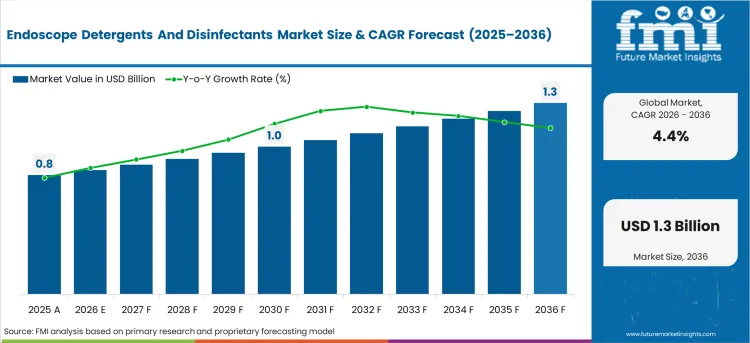
The endoscope detergents and disinfectants market was valued at USD 782.30 million in 2025, projected to reach USD 816.72 million in 2026, and is forecast to expand to USD 1.26 billion by 2036 at a 4.4% CAGR. As per FMI, rising endoscopic procedure volumes across gastroenterology, pulmonology, and urology departments, combined with tightening reprocessing compliance mandates from infection control accreditation bodies, are sustaining demand for validated cleaning and high-level disinfection chemistries. Endoscope reprocessing failures remain a leading cause of healthcare-associated infection outbreaks linked to contaminated duodenoscopes, creating non-discretionary procurement demand for detergents and disinfectants that meet validated efficacy thresholds against biofilm-forming organisms.
Summary of Endoscope Detergents And Disinfectants Market
- Market snapshot
- The endoscope detergents and disinfectants market is valued at USD 782.30 million in 2025 and is projected to reach USD 1.26 billion by 2036.
- The industry is expected to grow at a 4.4% CAGR from 2026 to 2036, creating an incremental opportunity of USD 439.55 million.
- The market is a regulated healthcare consumable category where infection control accreditation mandates, endoscope reprocessing guidelines, and high-level disinfection efficacy requirements define procurement patterns.
- Demand and growth drivers
- Demand is sustained by rising endoscopic procedure volumes across gastroenterology, pulmonology, and urology, each requiring validated reprocessing between patient uses.
- Infection control accreditation bodies mandate high-level disinfection for all semi-critical endoscopes, creating non-discretionary consumable procurement requirements.
- Enzymatic multi-enzyme detergent formulations are gaining share due to superior biofilm disruption and narrow-lumen cleaning efficacy in complex endoscope architectures.
- Among key countries, China leads at 5.9% CAGR, followed by India at 5.5%, Germany at 5.1%, France at 4.6%, the UK at 4.2%, and the USA at 3.7%.
- Product and segment view
- Endoscope detergents and disinfectants are validated reprocessing chemistries used to clean and disinfect flexible and rigid endoscopes between patient procedures.
- Chemical properties include acidic, neutral, alkaline, and enzymatic formulations; potency levels include low-level, medium-level, and high-level disinfectants.
- Neutral leads by Chemical Properties with 34.0% share in 2026, compatible with the widest range of endoscope materials and automated reprocessor systems.
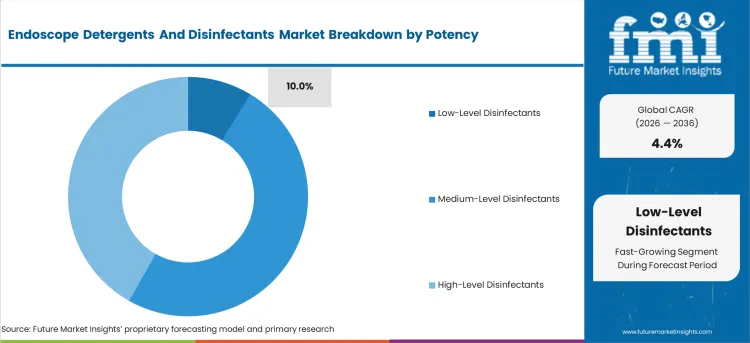
- High-Level Disinfectants leads by Potency with 48.0% share in 2026 as regulatory guidelines mandate HLD processing for all semi-critical endoscopes.
- Scope includes endoscope cleaning detergents and disinfectant solutions; excludes sterilisation equipment, automated endoscope reprocessors, and single-use endoscope accessories.
- Geography and competitive outlook
- China and India are the fastest-growing markets due to endoscopy suite expansion and hospital accreditation compliance adoption. The USA and Germany anchor mature, guideline-compliance-driven consumable demand.
- Competition is shaped by validated efficacy documentation, AER system compatibility, and biofilm disruption performance.
- Key players include MEDIVATORS Inc., STERIS plc, Borer Chemie AG, Cantel Medical, Getinge AB, Olympus Corporation, Vesimin Health, MDD Company GmbH, Georg Pauldrach, SIRMAXO CHEMICALS PVT. LTD, and Serim Research Corporation.
- Analyst opinion at FMI
- Sabyasachi Ghosh, Principal Consultant for Healthcare and Infection Control, opines: 'As per FMI, endoscope reprocessing chemical procurement operates under a zero-tolerance compliance framework where substitution of validated chemistries with unqualified alternatives creates direct patient safety liability. Hospitals that standardise on enzymatic pre-cleaning detergents combined with FDA-cleared high-level disinfectants achieve the most consistent reprocessing audit outcomes. Chemistry suppliers without AER compatibility certifications across the installed base of major reprocessor brands face declining hospital formulary inclusion as sterile processing departments consolidate approved product lists to reduce validation burden.'
- Strategic implications / Executive takeaways
- Sterile processing directors must standardise endoscope reprocessing chemical formularies on validated detergent-disinfectant combinations with documented AER compatibility across the facility's installed reprocessor base.
- Infection control officers should specify enzymatic multi-enzyme pre-cleaning detergents for complex endoscope architectures with narrow lumens to reduce biofilm-associated reprocessing failure risk.
- Procurement teams must evaluate chemistry suppliers on validated efficacy data breadth, AER compatibility certification coverage, and shelf-life stability under hospital storage conditions.
Endoscope Detergents And Disinfectants Market key takeaways
| Metric | Details |
|---|---|
| Industry Size (2026) | USD 816.72 million |
| Industry Value (2036) | USD 1.26 billion |
| CAGR (2026 to 2036) | 4.4% |
Source: Future Market Insights, 2026
FMI opines that the high-level disinfectant (HLD) segment commands the largest potency share because regulatory guidelines from the FDA, European Medicines Agency, and national health authorities mandate HLD processing for all semi-critical endoscopes that contact mucous membranes. Enzymatic detergents are the fastest-growing chemistry type as multi-enzyme formulations demonstrate superior biofilm disruption and channel cleaning efficacy in complex endoscope architectures with narrow lumens. The shift from manual reprocessing to automated endoscope reprocessor (AER) systems is standardising detergent and disinfectant consumption per cycle, creating predictable per-procedure consumable demand that procurement teams can budget with unit-level accuracy.
China leads with a 5.9% CAGR through 2036 as hospital endoscopy suite expansion and updated infection control standards increase reprocessing chemical consumption. India follows at 5.5%, driven by growing gastroenterology procedure volumes and hospital accreditation compliance requirements under NABH standards. Germany registers a 5.1% pace as EU Medical Device Regulation reprocessing validation requirements tighten. France expands at 4.6% on the back of HAS accreditation endoscope hygiene audit requirements. The United Kingdom maintains a 4.2% trajectory driven by NHS decontamination standards and CQC inspection compliance. The United States tracks at 3.7%, reflecting mature FDA-cleared HLD consumption with incremental growth from single-use endoscope accessories reducing but not eliminating reprocessing volumes.
Endoscope Detergents And Disinfectants Market definition
Endoscope detergents and disinfectants are validated reprocessing chemistries used in the cleaning and high-level disinfection of flexible and rigid endoscopes between patient procedures. The category covers enzymatic pre-cleaning detergents, neutral pH cleaning solutions, and high-level disinfectant formulations (glutaraldehyde-based, ortho-phthalaldehyde, peracetic acid, hydrogen peroxide) used in manual and automated endoscope reprocessing workflows across hospital, diagnostic centre, and clinic settings.
Endoscope Detergents And Disinfectants Market inclusions
Market scope includes enzymatic and non-enzymatic endoscope cleaning detergents and high-level, medium-level, and low-level disinfectant solutions. The report covers global and regional market sizes for 2026 to 2036 with segment breakdowns by chemical properties, potency, and end user.
Endoscope Detergents And Disinfectants Market exclusions
The scope excludes automated endoscope reprocessor hardware, sterilisation equipment (autoclaves, ethylene oxide sterilisers), single-use endoscope accessories, and general-purpose hospital surface disinfectants not validated for endoscope reprocessing.
Endoscope Detergents And Disinfectants Market research methodology
- Primary research: Analysts engaged with sterile processing department managers, infection control officers, and endoscopy suite directors to map reprocessing chemical selection criteria and formulary standardisation decisions.
- Desk research: Data collection aggregated FDA 510(k) HLD clearance databases, SGNA reprocessing guidelines, EU MDR reprocessing validation requirements, and published endoscopic procedure volume statistics.
- Market sizing and forecasting: Baseline values derive from a bottom-up aggregation of reprocessing chemical consumption per endoscopic procedure, applying procedure volume growth curves and AER adoption penetration rates by geography.
- Data validation and update cycle: Projections are cross-validated against published infection control consumable company revenue disclosures and hospital procurement survey data from professional associations.
Identification of Restraining Elements in the Endoscope Detergents and Disinfectants Market
Although the expert analysts at FMI have revealed growth-propelling factors in the prevailing endoscope and disinfectants market, some aspects are also identified to inhibit the growth of the market. They are:
- The post-surgical adverse events and deaths associated with infected endoscopes have drastically impacted the market growth.
- The endoscopes of Olympus Medical have been recalled on a large scale due to events of death, and the company had to pay for the legal settlements with patients.
- Adequate cleaning, disinfection, and/or sterilization of endoscopes has been a challenge for hospital/clinical facilities despite the availability of recommended guidelines, which may impede the market growth.
The healthcare policies such as Medicaid and Medicare have kept the costs associated with Healthcare-associated Infections (HAIs), including SSIs, out of coverage. Hence, the patients have to pay it out of their pocket, which is a major factor restricting the growth of the market.
Regional Insights
Performance of North America Endoscope Detergents and Disinfectants Market
North America is currently dominating the market and is projected to account for a total of 35.1% market share of endoscopes and disinfectants during the forecast period.
The USA is a leading country in North America, which is surging the market by collecting huge revenue in recent years. In addition to this, the demand for safe and effective surgical procedures has been rising in the US over the last few years, with over 15 million endoscopy procedures performed annually. This is propelling the endoscope detergents and disinfectants market size in the coming years.
Inspect of European Endoscope Detergents and Disinfectants Market
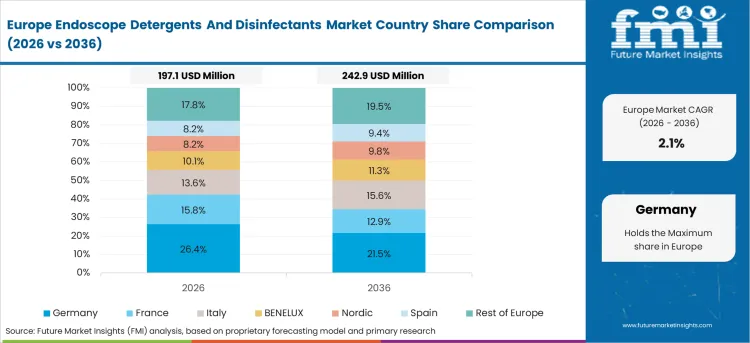
Europe is projected to follow the North American region and hold a significant market share of 29.1% in the forum among all the regions during the forecast period.
Due to the rising numbers of healthcare infrastructure and the presence of rising patients and geriatric populations in the region, it is likely to impact the market in the long run for Europe. With increasing age, gastrointestinal (GI) related diseases increase. The endoscope is used in the diagnosis and treatment of GI-related diseases.
Brief Overview of Dominating Segments
| Segment | QuaternaryAmmonium Compounds (By Type) |
|---|---|
| Market Share in Base Year | 31.4% |
| Attributing Reasons | These compounds aid in controlling the spread of healthcare-associated infections in hospitals and clinics |
| Segment | Medical Device Disinfectant (By Product) |
|---|---|
| Market Share in Base Year | 45.7% |
| Attributing Reasons | The increasing number of surgical procedures across the globe may be considered to be one of the major reasons for driving the segment over the forecast period. |
| Segment | Business to Business (By Sales Channel) |
|---|---|
| Market Share in Base Year | 65.1% |
| Attributing Reasons | Medical device disinfectants, enzymatic cleaners, and surface disinfectants are major antiseptics and disinfectants highly marketed under the B2B sales channel. |
| Segment | Hospital (By End-Use) |
|---|---|
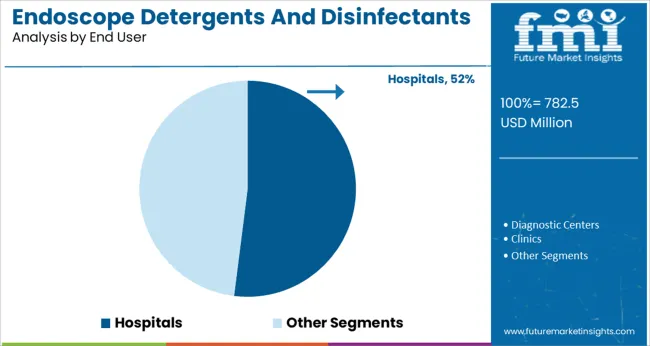
| Market Share in Base Year | 46.2% |
| Attributing Reasons | The increasing incidence of hospital-acquired infections across the globe is one of the major reasons for segment growth over the forecast period. |
Start-up Ecosystem
Start-ups Companies are Innovating in the Endoscope Detergents and Disinfectants Market
The technology in medicine is popped out by the various clinical and Research and Development institutions. Nowadays, start-up companies are interested in making unique devices to help patients throughout their treatment and recovery. This is likely to increase the opportunities in the endoscope detergents market in recent years.
Top Start-ups in the Endoscope Detergents and Disinfectants Market
| Start-up Company | EnVision Endoscopy |
|---|---|
| Base Country and Year | USA-based Start-up, 206 |
| Developments | The start-up provides various clinical surgeries with innovative and effective solutions. They are developing endoscopic surgery devices to help patients to recover their health with minimal expense. However, the company is developing a low-cost IGSS (Image Guided Suturing System) for managing gastrointestinal defects. |
| Start-up Company | MiWendo |
|---|---|
| Base Country and Year | Spain-based Start-up, 2026 |
| Developments | The company is using microwave technology with a safe electromagnetic that is used to attach at conventional colonoscopy. Hence, it helps to detect polyps 360 Degrees and benign tissues |
Competitive Landscape
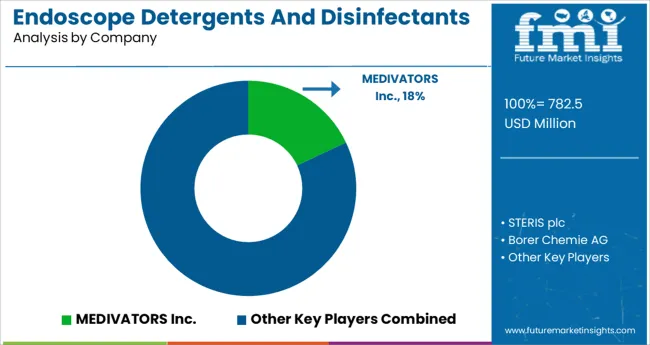
Biggies Stirring Up the Soup in the Endoscope Detergents and Disinfectants Market
The key players are focusing on the product, which hits consumers desires. These players are adopting various methods to acquire a maximum share of the market, some of them are mergers, acquisitions, and product launches.
Recent Developments in the Endoscope Detergents and Disinfectants:
- In November 2024, the Environmental Protection Agency (EPA) of the USA approved 3M's disinfectant TB Quat for SARS-CoV-2, which is a ready-to-use cleaner. Third-party lab testing of 3M's disinfectant TB Quat ready-to-use cleaner on hard, non-porous surfaces with a 60-second contact period proved the disinfectant's effectiveness against the virus.
- January 2024, 5 SC Johnson home cleaning products have been added to Health Canada's list of effective disinfectants for use against SARS-CoV-2.
The newly adopted robotic systems were introduced in telesurgery in recent years. The first of this surgery is called the Lindbergh operation, which is a more effective and innovative surgery.
The Key Players in the global Endoscope Detergents and Disinfectants Market include
- MEDIVATORS Inc.
- STERIS plc
- Borer Chemie AG
- Cantel Medical
- Getinge AB
- Olympus Corporation
- Vesimin Health
- MDD Company GmbH
- Georg Pauldrach
- SIRMAXO CHEMICALS PVT.LTD
- Serim Research Corporation
Scope of the report
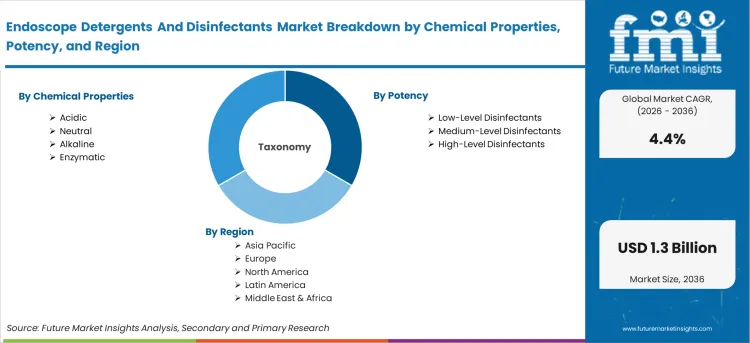
| Metric | Value |
|---|---|
| Quantitative Units | USD 816.72 million to USD 1.26 billion, at a CAGR of 4.4% |
| Market Definition | Endoscope detergents and disinfectants are validated reprocessing chemistries for cleaning and high-level disinfection of flexible and rigid endoscopes between patient procedures. |
| Chemical Properties Segmentation | Acidic, Neutral, Alkaline, Enzymatic |
| Potency Segmentation | Low-Level Disinfectants, Medium-Level Disinfectants, High-Level Disinfectants |
| End User Segmentation | Hospitals, Diagnostic Centers, Clinics |
| Regions Covered | North America, Latin America, Europe, East Asia, South Asia, Oceania, Middle East & Africa |
| Countries Covered | China, India, Germany, France, UK, USA, and 40 plus countries |
| Key Companies Profiled | MEDIVATORS Inc., STERIS plc, Borer Chemie AG, Cantel Medical, Getinge AB, Olympus Corporation, Vesimin Health, MDD Company GmbH, Georg Pauldrach, SIRMAXO CHEMICALS PVT. LTD, Serim Research Corporation |
| Forecast Period | 2026 to 2036 |
| Approach | Bottom-up methodology starting with reprocessing chemical consumption per procedure, projecting procedure volume growth and AER adoption rates. |
Key Segments in the Endoscope Detergents and Disinfectants Market
By Chemical Properties:
- Acidic
- Neutral
- Alkaline
- Enzymatic
By Potency:
- Low-Level Disinfectants
- Medium-Level Disinfectants
- High-Level Disinfectants
By End User:
- Hospitals
- Diagnostic Centers
- Clinics
By Region:
- North America
- Latin America
- Asia Pacific
- Middle East and Africa (MEA)
- Europe
Bibliography
- 1. United States Food and Drug Administration. (2024). Reprocessing of reusable medical devices: FDA guidance on high-level disinfection. FDA.
- 2. Society of Gastroenterology Nurses and Associates. (2024). Standards of infection prevention in the gastroenterology setting. SGNA.
- 3. European Commission. (2024). EU Medical Device Regulation 2017/745: Reprocessing validation requirements. European Commission.
- 4. World Health Organization. (2024). Decontamination and reprocessing of medical devices for healthcare facilities. WHO.
- 5. National Accreditation Board for Hospitals & Healthcare Providers, India. (2024). NABH accreditation standards: Endoscope reprocessing compliance requirements. NABH.
- 6. Organisation for Economic Co-operation and Development. (2024). Health at a Glance 2024: Endoscopic procedure volume indicators. OECD.
This bibliography is provided for reader reference. The full Future Market Insights report contains the complete reference list with primary research documentation.
Frequently Asked Questions
How large is the demand for endoscope detergents and disinfectants in 2026?
Demand for endoscope detergents and disinfectants in the global market is estimated to be valued at USD 816.72 million in 2026.
What will be the market size by 2036?
Market size for endoscope detergents and disinfectants is projected to reach USD 1.26 billion by 2036.
What is the expected demand growth between 2026 and 2036?
Demand for endoscope detergents and disinfectants is expected to grow at a CAGR of 4.4% between 2026 and 2036.
Which Chemical Properties lead in 2026?
Neutral accounts for 34.0% in 2026, compatible with the widest range of endoscope materials and automated reprocessor systems.
Which Potency level leads in 2026?
High-Level Disinfectants accounts for 48.0% in 2026 as regulatory guidelines mandate HLD processing for all semi-critical endoscopes contacting mucous membranes.
What is driving demand in China?
Hospital endoscopy suite expansion and updated national infection control standards are increasing validated reprocessing chemical consumption per facility.
What is included in the scope?
The scope covers endoscope cleaning detergents and disinfectant solutions; excludes reprocessor hardware, sterilisation equipment, and single-use endoscope accessories.
Preview the report firsthand - request a free sample
Get SampleGet the brochure for pricing and purchase details.
Get PDFTable of Content
- Global Market Outlook
- Demand-side Trends
- Supply-side Trends
- Technology Roadmap Analysis
- Analysis and Recommendations
- Market Overview
- Market Coverage / Taxonomy
- Market Definition / Scope / Limitations
- Research Methodology
- Benchmarking and Cross-market Comparability
- Market Sizing, Forecasting, and Opportunity Mapping
- Research Design and Evidence Framework
- Desk Research Programme (Secondary Evidence)
- Company Annual and Sustainability Reports
- Peer-reviewed Journals and Academic Literature
- Corporate Websites, Product Literature, and Technical Notes
- Earnings Decks and Investor Briefings
- Statutory Filings and Regulatory Disclosures
- Technical White Papers and Standards Notes
- Trade Journals, Industry Magazines, and Analyst Briefs
- Conference Proceedings, Webinars, and Seminar Materials
- Government Statistics Portals and Public Data Releases
- Press Releases and Reputable Media Coverage
- Specialist Newsletters and Curated Briefings
- Sector Databases and Reference Repositories
- FMI Internal Proprietary Databases and Historical Market Datasets
- Subscription Datasets and Paid Sources
- Social Channels, Communities, and Digital Listening Inputs
- Additional Desk Sources
- Expert Input and Fieldwork (Primary Evidence)
- Primary Modes
- Qualitative Interviews and Expert Elicitation
- Quantitative Surveys and Structured Data Capture
- Blended Approach
- Why Primary Evidence is Used
- Field Techniques
- Interviews
- Surveys
- Focus Groups
- Observational and In-context Research
- Social and Community Interactions
- Stakeholder Universe Engaged
- C-suite Leaders
- Board Members
- Demand in Optimistic Scenario
- Demand in Likely Scenario
- Demand in Conservative Scenario
- Opportunity Map Analysis
- Product Life Cycle Analysis
- Supply Chain Analysis
- Investment Feasibility Matrix
- Value Chain Analysis
- PESTLE and Porter’s Analysis
- Regulatory Landscape
- Regional Parent Market Outlook
- Production and Consumption Statistics
- Import and Export Statistics
- Primary Modes
- Global Market Analysis 2021 to 2025 and Forecast, 2026 to 2036
- Historical Market Size Value (USD Million) Analysis, 2021 to 2025
- Current and Future Market Size Value (USD Million) Projections, 2026 to 2036
- Y-o-Y Growth Trend Analysis
- Absolute $ Opportunity Analysis
- Global Market Pricing Analysis 2021 to 2025 and Forecast 2026 to 2036
- Global Market Analysis 2021 to 2025 and Forecast 2026 to 2036, By Chemical Properties
- Introduction / Key Findings
- Historical Market Size Value (USD Million) Analysis By Chemical Properties , 2021 to 2025
- Current and Future Market Size Value (USD Million) Analysis and Forecast By Chemical Properties , 2026 to 2036
- Acidic
- Neutral
- Alkaline
- Enzymatic
- Acidic
- Y-o-Y Growth Trend Analysis By Chemical Properties , 2021 to 2025
- Absolute $ Opportunity Analysis By Chemical Properties , 2026 to 2036
- Global Market Analysis 2021 to 2025 and Forecast 2026 to 2036, By Potency
- Introduction / Key Findings
- Historical Market Size Value (USD Million) Analysis By Potency, 2021 to 2025
- Current and Future Market Size Value (USD Million) Analysis and Forecast By Potency, 2026 to 2036
- Low-Level Disinfectants
- Medium-Level Disinfectants
- High-Level Disinfectants
- Low-Level Disinfectants
- Y-o-Y Growth Trend Analysis By Potency, 2021 to 2025
- Absolute $ Opportunity Analysis By Potency, 2026 to 2036
- Global Market Analysis 2021 to 2025 and Forecast 2026 to 2036, By End User
- Introduction / Key Findings
- Historical Market Size Value (USD Million) Analysis By End User, 2021 to 2025
- Current and Future Market Size Value (USD Million) Analysis and Forecast By End User, 2026 to 2036
- Hospitals
- Diagnostic Centers
- Clinics
- Hospitals
- Y-o-Y Growth Trend Analysis By End User, 2021 to 2025
- Absolute $ Opportunity Analysis By End User, 2026 to 2036
- Global Market Analysis 2021 to 2025 and Forecast 2026 to 2036, By Region
- Introduction
- Historical Market Size Value (USD Million) Analysis By Region, 2021 to 2025
- Current Market Size Value (USD Million) Analysis and Forecast By Region, 2026 to 2036
- North America
- Latin America
- Western Europe
- Eastern Europe
- East Asia
- South Asia and Pacific
- Middle East & Africa
- Market Attractiveness Analysis By Region
- North America Market Analysis 2021 to 2025 and Forecast 2026 to 2036, By Country
- Historical Market Size Value (USD Million) Trend Analysis By Market Taxonomy, 2021 to 2025
- Market Size Value (USD Million) Forecast By Market Taxonomy, 2026 to 2036
- By Country
- USA
- Canada
- Mexico
- By Chemical Properties
- By Potency
- By End User
- By Country
- Market Attractiveness Analysis
- By Country
- By Chemical Properties
- By Potency
- By End User
- Key Takeaways
- Latin America Market Analysis 2021 to 2025 and Forecast 2026 to 2036, By Country
- Historical Market Size Value (USD Million) Trend Analysis By Market Taxonomy, 2021 to 2025
- Market Size Value (USD Million) Forecast By Market Taxonomy, 2026 to 2036
- By Country
- Brazil
- Chile
- Rest of Latin America
- By Chemical Properties
- By Potency
- By End User
- By Country
- Market Attractiveness Analysis
- By Country
- By Chemical Properties
- By Potency
- By End User
- Key Takeaways
- Western Europe Market Analysis 2021 to 2025 and Forecast 2026 to 2036, By Country
- Historical Market Size Value (USD Million) Trend Analysis By Market Taxonomy, 2021 to 2025
- Market Size Value (USD Million) Forecast By Market Taxonomy, 2026 to 2036
- By Country
- Germany
- UK
- Italy
- Spain
- France
- Nordic
- BENELUX
- Rest of Western Europe
- By Chemical Properties
- By Potency
- By End User
- By Country
- Market Attractiveness Analysis
- By Country
- By Chemical Properties
- By Potency
- By End User
- Key Takeaways
- Eastern Europe Market Analysis 2021 to 2025 and Forecast 2026 to 2036, By Country
- Historical Market Size Value (USD Million) Trend Analysis By Market Taxonomy, 2021 to 2025
- Market Size Value (USD Million) Forecast By Market Taxonomy, 2026 to 2036
- By Country
- Russia
- Poland
- Hungary
- Balkan & Baltic
- Rest of Eastern Europe
- By Chemical Properties
- By Potency
- By End User
- By Country
- Market Attractiveness Analysis
- By Country
- By Chemical Properties
- By Potency
- By End User
- Key Takeaways
- East Asia Market Analysis 2021 to 2025 and Forecast 2026 to 2036, By Country
- Historical Market Size Value (USD Million) Trend Analysis By Market Taxonomy, 2021 to 2025
- Market Size Value (USD Million) Forecast By Market Taxonomy, 2026 to 2036
- By Country
- China
- Japan
- South Korea
- By Chemical Properties
- By Potency
- By End User
- By Country
- Market Attractiveness Analysis
- By Country
- By Chemical Properties
- By Potency
- By End User
- Key Takeaways
- South Asia and Pacific Market Analysis 2021 to 2025 and Forecast 2026 to 2036, By Country
- Historical Market Size Value (USD Million) Trend Analysis By Market Taxonomy, 2021 to 2025
- Market Size Value (USD Million) Forecast By Market Taxonomy, 2026 to 2036
- By Country
- India
- ASEAN
- Australia & New Zealand
- Rest of South Asia and Pacific
- By Chemical Properties
- By Potency
- By End User
- By Country
- Market Attractiveness Analysis
- By Country
- By Chemical Properties
- By Potency
- By End User
- Key Takeaways
- Middle East & Africa Market Analysis 2021 to 2025 and Forecast 2026 to 2036, By Country
- Historical Market Size Value (USD Million) Trend Analysis By Market Taxonomy, 2021 to 2025
- Market Size Value (USD Million) Forecast By Market Taxonomy, 2026 to 2036
- By Country
- Kingdom of Saudi Arabia
- Other GCC Countries
- Turkiye
- South Africa
- Other African Union
- Rest of Middle East & Africa
- By Chemical Properties
- By Potency
- By End User
- By Country
- Market Attractiveness Analysis
- By Country
- By Chemical Properties
- By Potency
- By End User
- Key Takeaways
- Key Countries Market Analysis
- USA
- Pricing Analysis
- Market Share Analysis, 2025
- By Chemical Properties
- By Potency
- By End User
- Canada
- Pricing Analysis
- Market Share Analysis, 2025
- By Chemical Properties
- By Potency
- By End User
- Mexico
- Pricing Analysis
- Market Share Analysis, 2025
- By Chemical Properties
- By Potency
- By End User
- Brazil
- Pricing Analysis
- Market Share Analysis, 2025
- By Chemical Properties
- By Potency
- By End User
- Chile
- Pricing Analysis
- Market Share Analysis, 2025
- By Chemical Properties
- By Potency
- By End User
- Germany
- Pricing Analysis
- Market Share Analysis, 2025
- By Chemical Properties
- By Potency
- By End User
- UK
- Pricing Analysis
- Market Share Analysis, 2025
- By Chemical Properties
- By Potency
- By End User
- Italy
- Pricing Analysis
- Market Share Analysis, 2025
- By Chemical Properties
- By Potency
- By End User
- Spain
- Pricing Analysis
- Market Share Analysis, 2025
- By Chemical Properties
- By Potency
- By End User
- France
- Pricing Analysis
- Market Share Analysis, 2025
- By Chemical Properties
- By Potency
- By End User
- India
- Pricing Analysis
- Market Share Analysis, 2025
- By Chemical Properties
- By Potency
- By End User
- ASEAN
- Pricing Analysis
- Market Share Analysis, 2025
- By Chemical Properties
- By Potency
- By End User
- Australia & New Zealand
- Pricing Analysis
- Market Share Analysis, 2025
- By Chemical Properties
- By Potency
- By End User
- China
- Pricing Analysis
- Market Share Analysis, 2025
- By Chemical Properties
- By Potency
- By End User
- Japan
- Pricing Analysis
- Market Share Analysis, 2025
- By Chemical Properties
- By Potency
- By End User
- South Korea
- Pricing Analysis
- Market Share Analysis, 2025
- By Chemical Properties
- By Potency
- By End User
- Russia
- Pricing Analysis
- Market Share Analysis, 2025
- By Chemical Properties
- By Potency
- By End User
- Poland
- Pricing Analysis
- Market Share Analysis, 2025
- By Chemical Properties
- By Potency
- By End User
- Hungary
- Pricing Analysis
- Market Share Analysis, 2025
- By Chemical Properties
- By Potency
- By End User
- Kingdom of Saudi Arabia
- Pricing Analysis
- Market Share Analysis, 2025
- By Chemical Properties
- By Potency
- By End User
- Turkiye
- Pricing Analysis
- Market Share Analysis, 2025
- By Chemical Properties
- By Potency
- By End User
- South Africa
- Pricing Analysis
- Market Share Analysis, 2025
- By Chemical Properties
- By Potency
- By End User
- USA
- Market Structure Analysis
- Competition Dashboard
- Competition Benchmarking
- Market Share Analysis of Top Players
- By Regional
- By Chemical Properties
- By Potency
- By End User
- Competition Analysis
- Competition Deep Dive
- MEDIVATORS Inc.
- Overview
- Product Portfolio
- Profitability by Market Segments (Product/Age /Sales Channel/Region)
- Sales Footprint
- Strategy Overview
- Marketing Strategy
- Product Strategy
- Channel Strategy
- STERIS plc
- Borer Chemie AG
- Cantel Medical
- Getinge AB
- Olympus Corporation
- Vesimin Health
- MDD Company GmbH
- Georg Pauldrach
- SIRMAXO CHEMICALS PVT.LTD
- Serim Research Corporation
- MEDIVATORS Inc.
- Competition Deep Dive
- Desk Research Programme (Secondary Evidence)
- Assumptions & Acronyms Used


