

- Market Size (2026)
- USD 823.6 Mn
- Forecast (2036)
- USD 1729.3 Mn
- CAGR (2026 to 2036)
- 7.7%
How big is Endoscopic Service and Support Market in 2026?
USD 823.6 million in 2026 and USD 1,729.3 million by 2036 at a 7.7% CAGR.
Demand for endoscopic service and support is forecast to expand at a 7.7% CAGR through 2036, increasing valuation from USD 823.6 million in 2026 to USD 1729.3 million by 2036. Reusable endoscope fleets require scheduled inspection and rapid corrective repair because a single unavailable device can delay several planned procedures. In May 2025, Hull University Teaching Hospitals NHS Trust awarded STERIS Solutions an endoscope service-maintenance contract running through March 2028 in the United Kingdom. The award confirms that hospitals purchase continuing maintenance as an operating service rather than relying on isolated emergency repairs. Loaner access and parts availability become material selection factors across endoscope reprocessing devices that support tightly scheduled clinical workflows. Hospital engineering teams therefore compare repair turnaround with model coverage and traceable testing across mixed equipment fleets. A contract creates measurable value when service records protect procedure capacity and support timely release following repair.
United States hospitals often combine OEM agreements with national independent repair coverage, whereas Japanese facilities frequently emphasize authorized service routes for specialized endoscope models. American health systems manage dispersed sites and mixed fleets that reward multivendor contracts with rapid loaner delivery. Japanese endoscopy units operate near domestic manufacturers and may place greater weight on model-specific technicians and structured handling education. Current service selection also depends on whether flexible endoscope platforms can receive compatible parts without extended transport delays. Both routes require traceable release criteria across reprocessing workflows because repair quality cannot be separated from safe clinical reuse. American networks may prioritize geographic reach, whereas Japanese facilities may prioritize specialized local expertise for delicate internal channels. Hospital groups should test actual response coverage and replacement compatibility before committing procedure capacity to one service route.
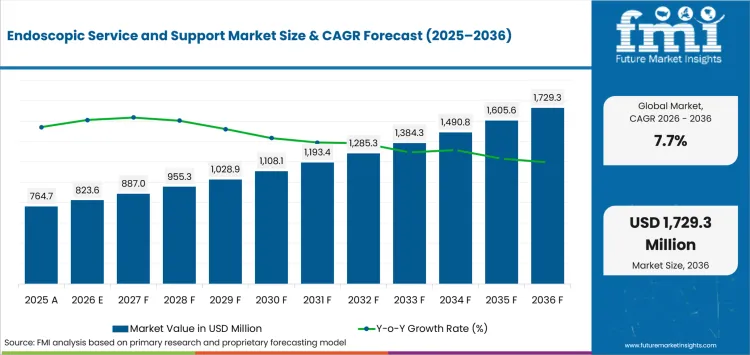
Key Takeaways of Endoscopic Service and Support Market
- Demand for endoscopic service and support is driven by every unavailable scope restricting scheduled diagnostic and therapeutic capacity, with preventive maintenance identifying wear before channel performance or image quality disrupts patient schedules.
- By service type, preventive maintenance holds the leading share at 36.1% in 2026, supported by scheduled inspections that improve uptime planning and reduce surprise failures.
- Hospitals lead end-user demand at 37.2% share in 2026, attributable to larger fleets and broader procedure responsibilities across specialized scope categories.
- Flexible endoscopes account for 43.0% device-type share in 2026, owing to delicate channels and repeated reprocessing exposure during routine clinical use.
- OEM services capture 53.5% service-provider share in 2026, driven by direct parts access and controlled service procedures despite higher contract costs for some equipment portfolios.
- Japan, Germany, and South Korea record CAGRs of 9.6%, 9.1%, and 6.0% respectively through 2036, while the UK and USA form a narrower growth band shaped by capacity planning and service coverage.
- Competition centers on Olympus, FUJIFILM, KARL STORZ, PENTAX Medical, STERIS, Agiliti, Probo Medical, and Richard Wolf, with vendors differentiating through endoscope portfolios paired with repair centers, structured education programs, multivendor repair coverage, and specialized scope response time.
Analyst Perspective
"The endoscopic service and support market is increasingly defined by equipment availability and clinical continuity rather than maintenance activity alone. Healthcare providers are evaluating service partners on their ability to minimize procedure disruptions, extend endoscope lifecycle, and maintain compliance with quality and infection-control standards. Companies that deliver predictable turnaround times, dependable technical expertise, and proactive service management will be better positioned to secure long-term contracts with hospitals and ambulatory care centers."
- Anurag Sharma, Principal Analyst at Future Market Insights
Source: FMI's proprietary forecasting model and primary research
How is the Endoscopic Service And Support Market segmented?
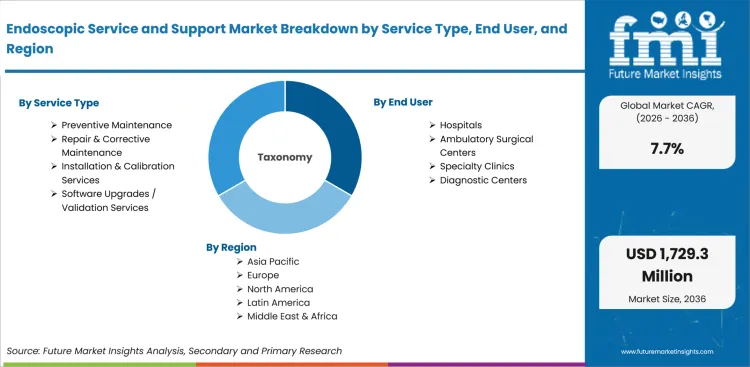
The endoscopic service and support market is segmented by service type, end user, device type, service provider, and region.
The segmentation framework separates purchased work from the organizations using equipment and the devices requiring support. Service type distinguishes scheduled preventive work from corrective repair and installation or software-validation activities across supported equipment. End user identifies hospitals and outpatient facilities with different fleet sizes and procedure schedules across distinct purchasing models. Device type separates flexible scopes from rigid scopes and supporting video systems or accessories across specialized clinical workflows. Service provider distinguishes OEM agreements from independent contracts and work completed by in-house biomedical teams. Regional analysis compares service access and purchasing conditions across national health systems without mixing equipment sales with support revenue.
What supports demand for preventive maintenance within the service type category?
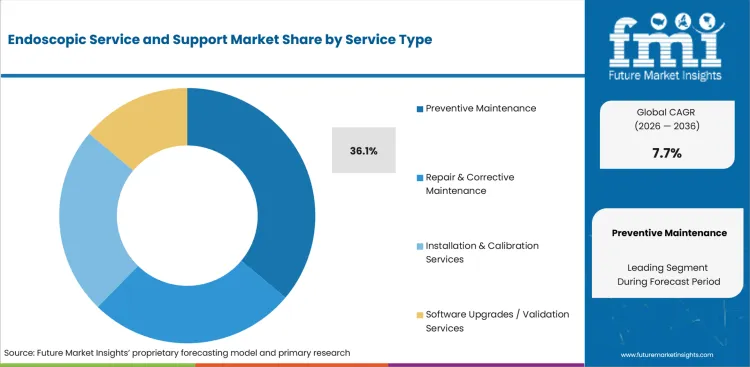
Reusable endoscopy equipment needs scheduled inspection to detect channel leaks and control damage before visible failure interrupts clinical procedures. Preventive programs connect inspection with maintenance records and model-specific testing across every supported device in the hospital fleet. A January 2026 contract notice from South Eastern Health and Social Care Trust required weekly testing and continuing service for Wassenburg equipment across Northern Ireland. The requirement demonstrates why reprocessing chemicals and equipment checks must remain compatible across a purchased preventive program.
- By service type, preventive maintenance is projected to account for 36.1% share in 2026 across the defined category, supported by scheduled inspections that reduce surprise failures and make annual service costs easier for hospital finance departments to plan.
- Hospital biomedical departments use preventive programs to coordinate leak testing with procedure schedules and reprocessing controls across every department. Providers improve adoption by recording wear patterns and recommending repairs early enough to protect routine clinical sessions and scarce backup equipment.
How do hospitals evaluate endoscopic service and support within the end user category?
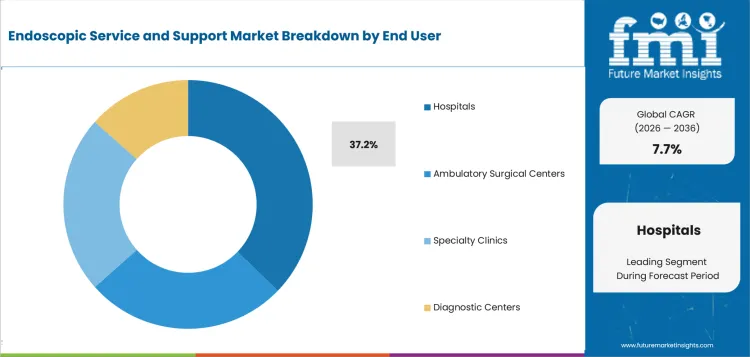
Hospitals manage larger endoscopy fleets across diagnostic and therapeutic departments with varied procedure schedules and specialized equipment requirements. A failed processor or flexible scope can delay several sessions because replacement equipment must match the planned intervention. Service plans therefore combine field support with model-specific loaners and scheduling controls across recurring workloads. Similar capacity pressure affects ambulatory surgical centers that operate with smaller inventories and fewer backup systems.
- By end user, hospitals are estimated to hold 37.2% share in 2026 across the approved category structure, attributable to larger device inventories and continuous procedure schedules that justify broader maintenance contracts across several departments and specialized scope categories within one organization. Recurring clinical workloads also raise the cost of fragmented support across separate departments and device groups.
- Clinical engineering departments select agreements that define repair response times and replacement devices for each covered model. DHSC and NHS England reported in May 2025 that 44,000 fewer patients waited longer than six weeks across England. The same release identified 169 community diagnostic centers and supports contracts that preserve session capacity rather than focusing narrowly on isolated repair charges.
Why are flexible endoscopes central to the device type category?
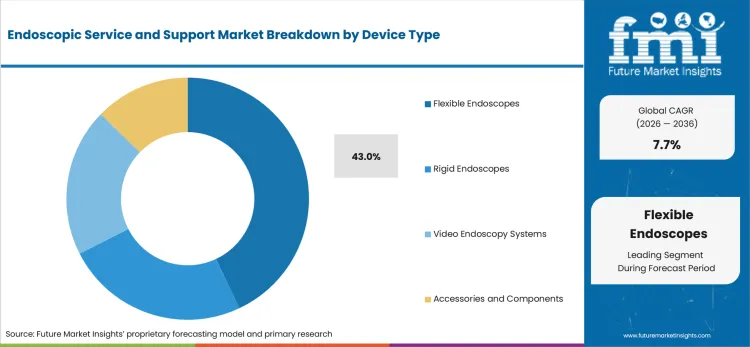
Flexible scopes combine delicate insertion tubes with internal channels that receive repeated clinical use and reprocessing exposure. In March 2024, CDC guidance called for facility-level training and competency assurance across flexible-endoscope reprocessing programs in the United States. Service programs therefore address handling damage and leak testing alongside image performance across frequently used equipment. Providers often coordinate repairs with endoscopy visualization systems that share processors and documentation workflows across several endoscopy units.
- In 2026, flexible endoscopes are expected to represent 43.0% of device type within the approved category structure, owing to frequent handling and technically complex repairs across gastrointestinal and pulmonary fleets that operate throughout each clinical week with limited backup capacity.
- Endoscopy units favor coverage that includes rapid diagnosis and suitable loaners for frequently used flexible models across scheduled procedures. Effective support also checks processor compatibility because an electronic fault can resemble internal scope damage and delay the correct repair decision during clinical operations.
How are OEM services positioned within the service provider category?
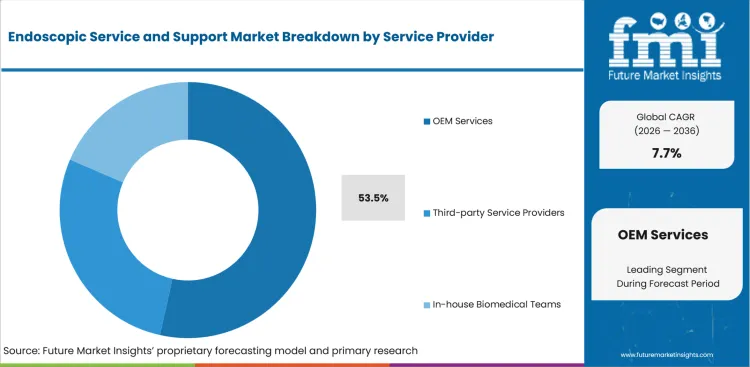
OEM service programs combine proprietary technical documentation with model-specific parts and authorized repair processes for covered endoscopy platforms. Hospitals often value that direct technical control for complex failures involving processors or specialized internal channels. Independent service organizations compete through multivendor contracts and broader fleet administration across mixed equipment installed in several departments. OEM agreements remain attractive where endoscopy video systems require software updates and validated compatibility across connected clinical components.
- By service provider, OEM services are forecast to represent 53.5% share in 2026 across the approved category structure, driven by proprietary diagnostics and direct parts access for hospitals operating complex equipment under controlled clinical and reprocessing procedures across several departments.
- Hospital engineering departments use OEM agreements to manage model-specific changes through one accountable technical channel. The FDA posted a nationwide United States recall in March 2026 covering 3,354 accessory units that became incompatible with Olympus OER-Pro and OER-Elite systems. Direct support can coordinate replacements and staff retraining without fragmenting responsibility across several repair organizations.
What are the drivers, restraints, and opportunities in the Endoscopic Service And Support Market?
Procedure capacity supports service demand while model complexity restricts substitution and integrated support creates a practical opening for broader contracts.
- Driver: Expanding endoscopy capacity increases the financial effect of unavailable scopes and delayed repair response across hospital schedules.
- Restraint: Model-specific processing requirements restrict substitution and require technical evidence before repaired equipment returns to clinical service.
- Opportunity: Integrated contracts can combine repair and training with loaner management and documented preventive maintenance across mixed fleets.
Hospital procedure growth increases the financial effect of unavailable scopes and weak repair response across scheduled clinical sessions. NHS England reported in October 2025 that capacity investments supported 275,000 additional endoscopies during the 2024/25 period across England. The added workload expands the number of daily sessions exposed to equipment failures and delayed loaner delivery. Service agreements gain commercial value when response commitments preserve established diagnostic capacity rather than offering broad maintenance coverage without measurable timing.
Model-specific processing requirements limit substitution across repaired scopes and automated reprocessors during clinical release decisions. Hospitals must match each repaired device with validated instructions before clinical staff resume scheduled use. In November 2021, the FDA explained that automated endoscope reprocessor manufacturers validate effectiveness with the specific endoscopes identified in product labeling across the United States. Clinical engineering teams therefore reconcile repair records with endoscope reprocessing instructions for every supported configuration. Alternative providers face slower adoption until compatibility evidence and testing procedures cover each named device.
Integrated contracts create an opening for hospitals seeking equipment maintenance and workforce support through one service route. Hospital operators can combine inspection schedules with loaner management and technical training under one agreement. Medical devices support gains value when facility upkeep and equipment responsibilities share measurable performance terms. In August 2025, Countess of Chester Hospital NHS Foundation Trust published a United Kingdom framework covering facility design and equipment provision alongside maintenance and optional supplier financing. Providers must define inspection coverage and replacement rules so hospitals can compare costs with avoided downtime.
Which country CAGRs are profiled in the Endoscopic Service And Support Market?
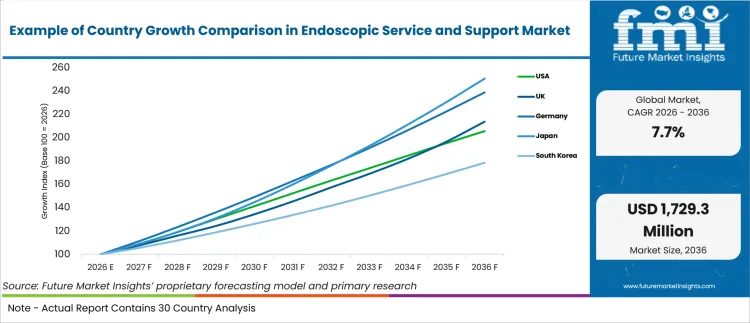
| Country | CAGR |
|---|---|
| USA | 7.5% |
| UK | 7.9% |
| Germany | 9.1% |
| Japan | 9.6% |
| South Korea | 6.0% |
How do country-level CAGRs compare in the Endoscopic Service And Support Market?
The country forecast range covers 3.6 percentage points, also Japan and Germany form a close upper cluster with a measured separation of 0.5 percentage point. The UK and USA create another compressed pair with a difference of 0.4 percentage point. A 1.2-point interval separates Germany from the UK and marks the most material gap inside the central group. South Korea sits outside that group by 1.5 percentage points from the USA and 3.6 points from Japan.
- Japan’s position reflects domestic equipment expertise and formal service requirements that support specialized repair capacity across local endoscopy providers.
- Germany remains close to Japan because substantial procedure workloads coexist with operator responsibility for validated processing and technical documentation.
- The UK occupies the central band through public capacity investment and multi-organization contracts that can aggregate service demand across providers.
- The USA remains near the UK despite mixed equipment fleets and several contract routes that change service-selection economics across hospital networks.
- South Korea’s position combines nationally organized screening with formal repair-business requirements that increase quality-control obligations for service organizations.
Similar CAGRs can produce different entry conditions because service distance and training responsibilities change the total ownership cost. Public purchasing cycles and device documentation also shape contract timing across otherwise comparable growth profiles. The full report provides country-level CAGR analysis across North America, Latin America, Europe, East Asia, South Asia, Oceania and the Middle East and Africa.
Country-wise Analysis
- United States hospitals follow FDA expectations that reusable devices remain tied to manufacturer instructions and documented quality controls. National OEM and independent networks create several contract routes for mixed fleets across dispersed health systems. Demand for endoscopic service and support in the USA is forecast to rise at a 7.5% CAGR by 2036. In January 2023, the FDA published facility guidance covering endoscopy reprocessing units and quality assurance for reusable medical devices across the United States. Broad service coverage supports competition, but model-specific release documentation restricts emergency substitution across covered equipment. Health systems should require named loaner models and traceable testing records before approving multiyear service agreements.
- United Kingdom health systems use public frameworks to combine endoscope repair requirements across several hospital trusts. The UK endoscopic service and support sector is estimated to post a 7.9% CAGR over the assessment period. In June 2025, Business Services Organisation awarded separate lots for flexible and rigid endoscope maintenance across six Northern Ireland health organizations. Multiple contracted providers expand service choice across public facilities that manage different endoscope brands and procedure schedules. Tender administration remains a material friction because performance terms must work across different equipment portfolios and participating trusts. Providers need enforceable turnaround standards that cover each named model throughout the complete service agreement.
- German hospitals combine substantial inpatient procedure activity with formal operator responsibility for safe endoscope processing. The German endoscopic service and support sector is projected to record a 9.1% CAGR during the forecast period. Destatis reported in September 2025 that German hospitals completed 300,475 endoscopic bile-duct operations during 2024. In July 2015, BfArM and the Robert Koch Institute assigned operators responsibility for validated processing and technical safety controls. High procedure density supports specialized repair demand across major clinical centers that operate complex therapeutic endoscope fleets. Detailed documentation requirements increase implementation effort for hospitals that use complex ERCP devices across several clinical departments. Service partners must provide qualified personnel and complete records that withstand infection-control review across every supported device configuration.
- Japanese medical institutions may maintain equipment internally or outsource that work to qualified service organizations under national rules. Adoption of endoscopic service and support in Japan is estimated to expand at 9.6% CAGR through 2036. A February 2025 notice from the Ministry of Health, Labour and Welfare required qualified personnel and detailed standard work instructions for outsourced medical-device maintenance across Japan. Licensed repair routes and domestic equipment expertise support dependable service access across several major Japanese population centers. Formal technician requirements create a material operational burden for smaller facilities with limited internal engineering staff.
- South Korean screening providers operate through a national cancer program that creates recurring endoscopy workloads across public and private facilities. The South Korean endoscopic service and support sector is estimated to post 6.0% CAGR over the forecast period. In September 2025, the Ministry of Health and Welfare confirmed annual colorectal cancer screening for adults aged fifty or older nationwide. Independent medical-device repair businesses also face formal notification and documented quality-control duties under national law. In January 2025, the Ministry of Government Legislation published the amended Medical Devices Act with Article 16 requiring suitable facilities and quality-control systems from August 2025. Local service partners should combine compliant records with dependable technician access across major coverage areas.
Who are the notable companies in the Endoscopic Service And Support Market?
Olympus Corporation, FUJIFILM Corporation, KARL STORZ SE & Co. KG, HOYA Corporation (PENTAX Medical), Richard Wolf GmbH, STERIS plc, Agiliti Inc., and Probo Medical are notable companies in the endoscopic service and support market.
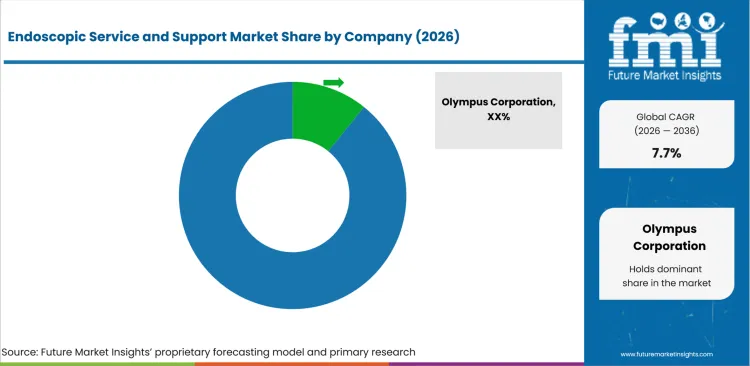
Competition combines OEM service networks with independent repair organizations that support hospital fleets across endoscopy specialties. Manufacturer programs use proprietary parts and technical instructions across installed endoscopy platforms during complex repair and release decisions. Independent providers compete through multivendor coverage and flexible contract administration across dispersed hospital facilities with different device inventories. In July 2025, NHS National Services Scotland evaluated flexible video-endoscopy offers through support and service criteria alongside quality and cost. The procurement structure confirms that commercial selection extends beyond device price across public endoscopy programs. Hospital departments should compare major-repair capability separately from preventive inspection and workforce training support programs. The wider laparoscopic devices market provides context for rigid-scope support without establishing participation in this exact service category.
- Olympus and FUJIFILM operate manufacturer service networks with repair centers and field support tied to their endoscopy platforms across national hospital networks. Direct technical access supports model-specific work across installed fleets but hospitals must compare contract flexibility across mixed equipment portfolios.
- KARL STORZ and PENTAX Medical combine OEM repair options with preventive programs and structured customer education across several regions. Their selection case strengthens for facilities needing model-specific support and consistent training with documented service records across recurring workflows.
- STERIS and Agiliti provide multivendor flexible-endoscope repair with loaners and defined service programs for hospital customers. Richard Wolf and Probo Medical add specialized alternatives across flexible and rigid devices through different coverage models for recurring maintenance needs.
Competitive Benchmarking: Endoscopic Service and Support Market
| Company | Endoscope Repair Coverage | Preventive and Uptime Support | Training and Workflow Support | Geographic Reach |
|---|---|---|---|---|
| Olympus Corporation | Medium | Medium | High | Global |
| FUJIFILM Corporation | Medium | High | High | North America, Asia, and Europe |
| KARL STORZ SE & Co. KG | Medium | High | High | Global |
| HOYA Corporation (PENTAX Medical) | Medium | High | High | Global |
| Richard Wolf GmbH | Medium | High | High | Europe and North America |
| STERIS plc | High | High | Medium | North America and Europe |
| Agiliti Inc. | High | High | High | United States |
| Probo Medical | High | High | Medium | North America |
Key Developments in the Endoscopic Service and Support Market
- In June 2024, FUJIFILM India opened a Mumbai service center dedicated to gastroscope and bronchoscope repairs alongside high-end processor support. The company stated in July 2024 that five major and two satellite centers served more than twenty Indian states. Added local tools and technician training shortened the repair route for installed hospital equipment across a wider service area.
- In June 2025, Probo Medical announced a strategic partnership that placed endoscope repair services on the MedServ Marketplace platform across the United States. Healthcare providers gained streamlined access to flat-rate and contractual service programs through one digital sourcing route. The arrangement can reduce onboarding effort for facilities seeking qualified repair capacity without a long procurement cycle.
- In October 2025, PENTAX Medical announced a multiyear partnership with IRCAD North America at its Charlotte location in North Carolina. PENTAX Medical agreed to supply imaging systems and endoscopic devices for training and research programs serving healthcare professionals. The collaboration gives service teams a structured setting for supporting advanced equipment use and specialized support planning across recurring clinical courses.
- In May 2026, FUJIFILM Healthcare Europe broke ground on a European Endoscopy Training Center in Milan that is scheduled for completion during 2027. The planned facility supports hands-on education and technical collaboration for healthcare professionals across several European countries. Regional training capacity can improve equipment handling and create a clearer support route for complex endoscopy platforms.
Key Players in the Endoscopic Service and Support Market
Endoscope OEM Service Providers
- Olympus Corporation
- FUJIFILM Corporation
- KARL STORZ SE & Co. KG
- HOYA Corporation (PENTAX Medical)
- Richard Wolf GmbH
Multivendor Endoscope Repair Providers
- STERIS plc
- Agiliti Inc.
- Probo Medical
Visualization and Reprocessing Support Providers
- Stryker Corporation
- Getinge AB
Endoscopic Service and Support Market - Report Scope
| Coverage field | Report scope |
|---|---|
| Market breakdown | Service Type, End User, Device Type, Service Provider, and region. |
| Quantitative Units | Revenue in USD Million, CAGR in %. |
| Market Definition | Services used to maintain, repair, install, calibrate, validate, upgrade, and support reusable endoscopy equipment within clinical operations. |
| Regions Covered | North America, Latin America, Western Europe, Eastern Europe, East Asia, South Asia and Pacific, and Middle East and Africa. |
| Countries Covered | USA, UK, Germany, Japan, and South Korea. |
| Key Companies Profiled | Olympus Corporation, FUJIFILM Corporation, KARL STORZ SE & Co. KG, HOYA Corporation (PENTAX Medical), Richard Wolf GmbH, STERIS plc, Agiliti Inc., Probo Medical, Stryker Corporation, and Getinge AB. |
| Forecast Period | 2026 to 2036. |
| Approach | Hybrid bottom-up and top-down sizing supported by primary research and official desk research across service demand, fleet conditions, pricing, and country adoption routes. |
Endoscopic Service and Support Market - Research Methodology
| Method | Approach |
|---|---|
| Primary Research | FMI analysts gathered input from manufacturers, service providers, technology developers, distributors, end users, procurement teams, and subject-matter experts. Interviews examined purchasing decisions, product or service evaluation, adoption barriers, approval requirements, pricing considerations, and expectations for technical or commercial support. Respondents were also asked what evidence is required before a trial, pilot, or initial order develops into regular purchasing. |
| Desk Research | Desk research covered government statistics, regulatory publications, trade data, industry associations, technical literature, standards, company filings, product information, and official corporate announcements. Sources were reviewed for relevance, publication date, geographic coverage, and consistency with the defined market scope. Claims relating to performance, applications, approvals, capacity, investment, and commercial activity were retained only when supported by credible public evidence. |
| Market Sizing and Forecasting | The market model combined the baseline value with historical performance, segment structure, pricing and volume indicators, adoption levels, company participation, and country-level demand conditions. Forecast assumptions considered economic activity, investment trends, regulatory developments, technology adoption, purchasing cycles, supply availability, and barriers to wider market use. Segment and regional estimates were reconciled before the final market total was calculated. |
| Data Validation | Estimates were checked against multiple independent indicators, including public data, company activity, trade patterns, industry developments, and findings from primary interviews. Validation also tested whether products, services, applications, and company revenues fell within the defined market boundaries. Adjacent categories, unsupported claims, overlapping revenues, and activities without direct market relevance were excluded to reduce double counting and maintain consistency across segments and countries. |
Endoscopic Service and Support Market by Segments
Endoscopic Service and Support Market segmented by Service Type:
- Preventive Maintenance
- Repair & Corrective Maintenance
- Installation & Calibration Services
- Software Upgrades / Validation Services
Endoscopic Service and Support Market segmented by End User:
- Hospitals
- Ambulatory Surgical Centers
- Specialty Clinics
- Diagnostic Centers
Endoscopic Service and Support Market segmented by Device Type:
- Flexible Endoscopes
- Rigid Endoscopes
- Video Endoscopy Systems
- Accessories and Components
Endoscopic Service and Support Market segmented by Service Provider:
- OEM Services
- Third-party Service Providers
- In-house Biomedical Teams
Endoscopic Service and Support Market by Region:
- North America
- United States
- Canada
- Latin America
- Brazil
- Mexico
- Argentina
- Chile
- Western Europe
- Germany
- France
- United Kingdom
- Italy
- Spain
- Benelux
- Nordics
- Eastern Europe
- Poland
- Czech Republic
- Romania
- Hungary
- East Asia
- China
- Japan
- South Korea
- South Asia and Pacific
- India
- ASEAN
- Australia and New Zealand
- Middle East and Africa
- GCC Countries
- South Africa
- Türkiye
- Israel
Research Sources and Bibliography
- Hull University Teaching Hospitals NHS Trust. (2025, May 28). SERVICE MAINTENANCE OF ENDOSCOPE EQUIPMENT. Find a Tender.
- South Eastern Health & Social Care Trust. (2026, January 21). Service and Maintenance of Wassenburg Endoscope Washer Disinfectors & Drying Cabinets - SEHSCT. Find a Tender.
- Centers for Disease Control and Prevention. (2024, March 5). Essential Elements of a Reprocessing Program for Flexible Endoscopes - Recommendations of the Healthcare Infection Control Practices Advisory Committee.
- Department of Health and Social Care & NHS England. (2025, May 14). Tens of thousands more patients receiving crucial scans quicker.
- USA Food and Drug Administration. (2026, March 20). Class 2 Device Recall Olympus Endoscope Reprocessor OERPro.
- NHS England. (2025, October 31). Performance report.
- USA Food and Drug Administration. (2021, November 2). Information about Automated Endoscope Reprocessors (AERs) and FDA’s Evaluation.
- Countess of Chester Hospital NHS Foundation Trust. (2025, August 22). Sterile Services and Endoscopy Decontamination Facility Solutions Framework. Find a Tender.
- USA Food and Drug Administration. (2023, January 10). Information for Health Care Facilities: Reprocessing of Reusable Medical Devices.
- Business Services Organisation, Procurement and Logistics Service. (2025, June 10). Maintenance and/or Repair of Endoscopes and Related Ancillary Equipment [5460920]. Find a Tender.
- Statistisches Bundesamt (Destatis). (2025, September 30). Krankenhäuser: Die 20 häufigsten Operationen insgesamt (OPS 5).
- Bundesinstitut für Arzneimittel und Medizinprodukte & Robert Koch-Institut. (2015, July 17). Hinweis des BfArM und des RKI zu komplex aufgebauten Endoskopen (Duodenoskopen), deren Aufbereitung und damit verbundenen Infektionsrisiken.
- Ministry of Health, Labour and Welfare. (2025, February 7). [Partial revision of the notice concerning partial enforcement of the amended Medical Care Act].
- Ministry of Health and Welfare. (2025, September 30). [National cancer screening program].
- Ministry of Government Legislation. (2025, January 31).[Medical Devices Act] (Act No. 20753; effective August 1, 2025).
- NHS National Services Scotland. (2025, July 17). Flexible Video Endoscopy Consumables and Single use Scope. Find a Tender.
- FUJIFILM India Private Limited. (2024, July 15). FUJIFILM India Expands National Footprint with New Endoscopy Center in Mumbai.
- Muny, S. (2025, June 18). Probo Medical and MedServ Marketplace Inc. Announce Strategic Partnership to Expand Access to Repair Solutions and On-Demand Service Delivery. Probo Medical.
- PENTAX Medical. (2025, October 24). PENTAX Medical Partners with IRCAD North America to Further Surgical Education and Innovation.
- FUJIFILM Healthcare Europe GmbH. (2026, May 21). FUJIFILM Breaks Ground on New European Endoscopy Training Center in Milan.
- Olympus Corporation. (n.d.). Endoscope Repair Service: Strengthening our brand through quality.
- FUJIFILM Healthcare Americas Corporation. (n.d.). Endoscopy Customer Service & Support.
This bibliography is provided for reader reference and is not exhaustive. The full report contains the complete reference list and detailed citations.
This Report Answers
- How large is the endoscopic service and support market in 2026 and 2036?
- Which operating pressures support spending on endoscope maintenance and repair services?
- Why does preventive maintenance hold the principal service type share in 2026?
- How do hospitals evaluate service coverage across complex endoscopy fleets?
- Why do flexible endoscopes require specialized repair and preventive support?
- How do country growth rates compare across the USA, UK, Germany, Japan, and South Korea?
- Which companies provide OEM or independent endoscope service coverage?
- What limits substitution across model-specific repair and reprocessing workflows?
- How can integrated service contracts reduce downtime and repeat equipment damage?
Frequently Asked Questions
How big is the Endoscopic Service and Support Market in 2026?
The endoscopic service and support market is valued at USD 823.6 million in 2026 and is forecast to reach USD 1729.3 million by 2036. Growth reflects reusable endoscope fleets requiring scheduled inspection and rapid corrective repair since a single unavailable device can delay several planned procedures.
What is the CAGR of the Endoscopic Service and Support Market from 2026 to 2036?
The endoscopic service and support market grows at a CAGR of 7.7% between 2026 and 2036, supported by expanding endoscopy capacity that increases the financial effect of unavailable scopes and delayed repair response across hospital schedules.
Which service provider leads the Endoscopic Service and Support Market?
OEM services account for 53.5% of the endoscopic service and support market by service provider in 2026, driven by proprietary diagnostics and direct parts access for hospitals operating complex equipment under controlled clinical and reprocessing procedures.
How much will the Endoscopic Service and Support Market add between 2026 and 2036?
The endoscopic service and support market is set to add USD 905.7 million between 2026 and 2036, growing from USD 823.6 million to USD 1729.3 million as integrated repair, loaner, and training contracts extend across a widening base of hospital endoscopy fleets.
Who are the leading companies in the Endoscopic Service and Support Market?
Five companies lead the endoscopic service and support market, including Olympus, FUJIFILM, KARL STORZ, PENTAX Medical, and Richard Wolf, competing through OEM repair centers, field support, structured education, and multivendor coverage for hospital fleets.
Preview the report firsthand - request a free sample
Get SampleGet the brochure for pricing and purchase details.
Get PDFTable of Content
- Key Takeaways
- Market Size and CAGR
- Top Growth Driver
- Fastest Growing Segment
- Leading Region
- Key Companies
- Emerging Opportunities
- Executive Summary
- Global Market Outlook
- Demand-side Trends
- Supply-side Trends
- Technology Roadmap Analysis
- Analysis and Recommendations
- Analyst Perspective (What is happening? Why now? What should investors know?)
- Key Questions Answered
- How large is the market?
- What is the CAGR?
- What are key trends?
- Which region dominates?
- Who are the leaders?
- Market Overview
- Market Coverage / Taxonomy
- Market Definition / Scope / Limitations
- Research Methodology
- Chapter Orientation
- Analytical Lens and Working Hypotheses
- Market Structure, Signals, and Trend Drivers
- Benchmarking and Cross-market Comparability
- Market Sizing, Forecasting, and Opportunity Mapping
- Research Design and Evidence Framework
- Desk Research Programme (Secondary Evidence)
- Expert Input and Fieldwork (Primary Evidence)
- Tooling, Models, and Reference Databases
- Data Engineering and Model Build
- Quality Assurance and Audit Trail
- Market Background
- Market Dynamics (Drivers, Restraints, Opportunity, Trends)
- Scenario Forecast (Optimistic, Likely, Conservative)
- Impact Analysis
- AI Impact
- Sustainability Impact
- Regulatory Impact
- Technology Impact
- Consumer / Buyer Analysis
- Purchase Drivers
- Adoption Barriers
- Buyer Journey
- Opportunity Map Analysis
- Product Life Cycle Analysis
- Supply Chain Analysis
- Investment Feasibility Matrix
- Value Chain Analysis
- PESTLE and Porter's Analysis
- Regulatory Landscape
- Regional Parent Market Outlook
- Production and Consumption Statistics
- Import and Export Statistics
- Global Market Analysis and Forecast, 2021 to 2036
- Historical Market Size Value (USD Million) Analysis, 2021 to 2025
- Current and Future Market Size Value (USD Million) Projections, 2026 to 2036
- Y-o-Y Growth Trend Analysis
- Absolute $ Opportunity Analysis
- Global Market Pricing Analysis, 2021 to 2036
- Global Market Analysis and Forecast, By Service Type, 2021 to 2036
- Introduction / Key Findings
- Historical Market Size Value (USD Million) Analysis By Service Type, 2021 to 2025
- Current and Future Market Size Value (USD Million) Analysis and Forecast By Service Type, 2026 to 2036
- Preventive Maintenance
- Repair & Corrective Maintenance
- Installation & Calibration Services
- Software Upgrades / Validation Services
- Preventive Maintenance
- Y-o-Y Growth Trend Analysis By Service Type, 2021 to 2025
- Absolute $ Opportunity Analysis By Service Type, 2026 to 2036
- Global Market Analysis and Forecast, By End User, 2021 to 2036
- Introduction / Key Findings
- Historical Market Size Value (USD Million) Analysis By End User, 2021 to 2025
- Current and Future Market Size Value (USD Million) Analysis and Forecast By End User, 2026 to 2036
- Hospitals
- Ambulatory Surgical Centers
- Specialty Clinics
- Diagnostic Centers
- Hospitals
- Y-o-Y Growth Trend Analysis By End User, 2021 to 2025
- Absolute $ Opportunity Analysis By End User, 2026 to 2036
- Global Market Analysis and Forecast, By Device Type, 2021 to 2036
- Introduction / Key Findings
- Historical Market Size Value (USD Million) Analysis By Device Type, 2021 to 2025
- Current and Future Market Size Value (USD Million) Analysis and Forecast By Device Type, 2026 to 2036
- Flexible Endoscopes
- Rigid Endoscopes
- Video Endoscopy Systems
- Accessories and Components
- Flexible Endoscopes
- Y-o-Y Growth Trend Analysis By Device Type, 2021 to 2025
- Absolute $ Opportunity Analysis By Device Type, 2026 to 2036
- Global Market Analysis and Forecast, By Service Provider, 2021 to 2036
- Introduction / Key Findings
- Historical Market Size Value (USD Million) Analysis By Service Provider, 2021 to 2025
- Current and Future Market Size Value (USD Million) Analysis and Forecast By Service Provider, 2026 to 2036
- OEM Services
- Third-party Service Providers
- In-house Biomedical Teams
- OEM Services
- Y-o-Y Growth Trend Analysis By Service Provider, 2021 to 2025
- Absolute $ Opportunity Analysis By Service Provider, 2026 to 2036
- Global Market Analysis and Forecast, By Region, 2021 to 2036
- Introduction
- Historical Market Size Value (USD Million) Analysis By Region, 2021 to 2025
- Current Market Size Value (USD Million) Analysis and Forecast By Region, 2026 to 2036
- North America
- Latin America
- Western Europe
- Eastern Europe
- East Asia
- South Asia and Pacific
- Middle East & Africa
- Market Attractiveness Analysis By Region
- North America Market Analysis and Forecast, By Country, 2021 to 2036
- Historical Market Size Value (USD Million) Trend Analysis By Market Taxonomy, 2021 to 2025
- Market Size Value (USD Million) Forecast By Market Taxonomy, 2026 to 2036
- By Country
- USA
- Canada
- By Service Type
- By End User
- By Device Type
- By Service Provider
- By Country
- Market Attractiveness Analysis
- By Country
- By Service Type
- By End User
- By Device Type
- By Service Provider
- Key Takeaways
- Latin America Market Analysis and Forecast, By Country
- Historical Market Size Value (USD Million) Trend Analysis By Market Taxonomy, 2021 to 2025
- Market Size Value (USD Million) Forecast By Market Taxonomy, 2026 to 2036
- By Country
- Brazil
- Mexico
- Chile
- Rest of Latin America
- By Service Type
- By End User
- By Device Type
- By Service Provider
- By Country
- Market Attractiveness Analysis
- By Country
- By Service Type
- By End User
- By Device Type
- By Service Provider
- Key Takeaways
- Western Europe Market Analysis and Forecast, By Country
- Historical Market Size Value (USD Million) Trend Analysis By Market Taxonomy, 2021 to 2025
- Market Size Value (USD Million) Forecast By Market Taxonomy, 2026 to 2036
- By Country
- Germany
- UK
- Italy
- Spain
- France
- Nordic
- BENELUX
- Rest of Western Europe
- By Service Type
- By End User
- By Device Type
- By Service Provider
- By Country
- Market Attractiveness Analysis
- By Country
- By Service Type
- By End User
- By Device Type
- By Service Provider
- Key Takeaways
- Eastern Europe Market Analysis and Forecast, By Country
- Historical Market Size Value (USD Million) Trend Analysis By Market Taxonomy, 2021 to 2025
- Market Size Value (USD Million) Forecast By Market Taxonomy, 2026 to 2036
- By Country
- Russia
- Poland
- Hungary
- Balkan & Baltic
- Rest of Eastern Europe
- By Service Type
- By End User
- By Device Type
- By Service Provider
- By Country
- Market Attractiveness Analysis
- By Country
- By Service Type
- By End User
- By Device Type
- By Service Provider
- Key Takeaways
- East Asia Market Analysis and Forecast, By Country
- Historical Market Size Value (USD Million) Trend Analysis By Market Taxonomy, 2021 to 2025
- Market Size Value (USD Million) Forecast By Market Taxonomy, 2026 to 2036
- By Country
- China
- Japan
- South Korea
- By Service Type
- By End User
- By Device Type
- By Service Provider
- By Country
- Market Attractiveness Analysis
- By Country
- By Service Type
- By End User
- By Device Type
- By Service Provider
- Key Takeaways
- South Asia and Pacific Market Analysis and Forecast, By Country
- Historical Market Size Value (USD Million) Trend Analysis By Market Taxonomy, 2021 to 2025
- Market Size Value (USD Million) Forecast By Market Taxonomy, 2026 to 2036
- By Country
- India
- ASEAN
- Australia & New Zealand
- Rest of South Asia and Pacific
- By Service Type
- By End User
- By Device Type
- By Service Provider
- By Country
- Market Attractiveness Analysis
- By Country
- By Service Type
- By End User
- By Device Type
- By Service Provider
- Key Takeaways
- Middle East & Africa Market Analysis and Forecast, By Country
- Historical Market Size Value (USD Million) Trend Analysis By Market Taxonomy, 2021 to 2025
- Market Size Value (USD Million) Forecast By Market Taxonomy, 2026 to 2036
- By Country
- Kingdom of Saudi Arabia
- Other GCC Countries
- Türkiye
- South Africa
- Other African Union
- Rest of Middle East & Africa
- By Service Type
- By End User
- By Device Type
- By Service Provider
- By Country
- Market Attractiveness Analysis
- By Country
- By Service Type
- By End User
- By Device Type
- By Service Provider
- Key Takeaways
- Key Countries Market Analysis
- USA
- Pricing Analysis
- Market Share Analysis, 2025
- By Service Type
- By End User
- By Device Type
- By Service Provider
- Canada
- Pricing Analysis
- Market Share Analysis, 2025
- By Service Type
- By End User
- By Device Type
- By Service Provider
- Mexico
- Pricing Analysis
- Market Share Analysis, 2025
- By Service Type
- By End User
- By Device Type
- By Service Provider
- Brazil
- Pricing Analysis
- Market Share Analysis, 2025
- By Service Type
- By End User
- By Device Type
- By Service Provider
- Chile
- Pricing Analysis
- Market Share Analysis, 2025
- By Service Type
- By End User
- By Device Type
- By Service Provider
- Germany
- Pricing Analysis
- Market Share Analysis, 2025
- By Service Type
- By End User
- By Device Type
- By Service Provider
- UK
- Pricing Analysis
- Market Share Analysis, 2025
- By Service Type
- By End User
- By Device Type
- By Service Provider
- Italy
- Pricing Analysis
- Market Share Analysis, 2025
- By Service Type
- By End User
- By Device Type
- By Service Provider
- Spain
- Pricing Analysis
- Market Share Analysis, 2025
- By Service Type
- By End User
- By Device Type
- By Service Provider
- France
- Pricing Analysis
- Market Share Analysis, 2025
- By Service Type
- By End User
- By Device Type
- By Service Provider
- India
- Pricing Analysis
- Market Share Analysis, 2025
- By Service Type
- By End User
- By Device Type
- By Service Provider
- ASEAN
- Pricing Analysis
- Market Share Analysis, 2025
- By Service Type
- By End User
- By Device Type
- By Service Provider
- Australia & New Zealand
- Pricing Analysis
- Market Share Analysis, 2025
- By Service Type
- By End User
- By Device Type
- By Service Provider
- China
- Pricing Analysis
- Market Share Analysis, 2025
- By Service Type
- By End User
- By Device Type
- By Service Provider
- Japan
- Pricing Analysis
- Market Share Analysis, 2025
- By Service Type
- By End User
- By Device Type
- By Service Provider
- South Korea
- Pricing Analysis
- Market Share Analysis, 2025
- By Service Type
- By End User
- By Device Type
- By Service Provider
- Russia
- Pricing Analysis
- Market Share Analysis, 2025
- By Service Type
- By End User
- By Device Type
- By Service Provider
- Poland
- Pricing Analysis
- Market Share Analysis, 2025
- By Service Type
- By End User
- By Device Type
- By Service Provider
- Hungary
- Pricing Analysis
- Market Share Analysis, 2025
- By Service Type
- By End User
- By Device Type
- By Service Provider
- Kingdom of Saudi Arabia
- Pricing Analysis
- Market Share Analysis, 2025
- By Service Type
- By End User
- By Device Type
- By Service Provider
- Türkiye
- Pricing Analysis
- Market Share Analysis, 2025
- By Service Type
- By End User
- By Device Type
- By Service Provider
- South Africa
- Pricing Analysis
- Market Share Analysis, 2025
- By Service Type
- By End User
- By Device Type
- By Service Provider
- USA
- Market Structure Analysis
- Competition Dashboard
- Competition Benchmarking
- Market Share Analysis of Top Players
- By Regional
- By Service Type
- By End User
- By Device Type
- By Service Provider
- Emerging Startups
- Innovation Benchmarking
- Competition Analysis
- Competition Deep Dive
- Olympus Corporation
- Overview
- Product Portfolio
- Profitability by Market Segments
- Sales Footprint
- Strategy Overview
- Marketing Strategy
- Product Strategy
- Channel Strategy
- Fujifilm Holdings Corporation
- Karl Storz
- Stryker Corporation
- Medtronic plc
- Hoya Corporation (PENTAX Medical)
- Boston Scientific Corporation
- Conmed Corporation
- Richard Wolf GmbH
- Getinge AB
- Olympus Corporation
- Case Studies
- Success Stories
- Recent Developments
- Competition Deep Dive
- Assumptions & Acronyms Used


