

- Market Size (2026)
- USD 991.3 Mn
- Forecast (2036)
- USD 1986.8 Mn
- CAGR (2026 to 2036)
- 7.2%
How big is Oncology Biomarker Translation Services Market in 2026?
USD 991.3 million in 2026 and USD 1,986.8 million by 2036 at a 7.2% CAGR.
Demand for oncology biomarker translation services are forecast to expand at 7.2% CAGR from 2026 to 2036, supported by biomarker-guided drug development. Industry value is projected to rise from USD 991.3 million in 2026 to USD 1,986.8 million during 2036. Pharmaceutical developers use translation services to turn exploratory findings into validated assays for trial enrollment and treatment selection. A regulated biomarker definition often controls treatment access and creates a direct need for coordinated translation. In May 2026, the FDA approved two companion diagnostic devices with two HER2-positive early-stage breast cancer indications for fam-trastuzumab-deruxtecan-nxki. The paired approvals require consistent assay interpretation and specimen controls across research laboratories and clinical testing sites. Oncology blood testing can improve sample access across trial sites and community clinics without replacing documented method-transfer requirements. Service value therefore depends on reproducible results and clear regulatory ownership across every laboratory supporting the same clinical program.
United States sponsors operate through a mature FDA companion diagnostic pathway and a broad clinical laboratory network. British programs use centralized NHS genomic laboratories that coordinate testing across participating hospitals and specialist cancer services. Japanese programs require reimbursement alignment through designated cancer genomic centers and a formal expert-panel review process. Development teams increasingly connect personalized medicine design with sample logistics and bioinformatics review across several countries. Commercial decisions depend on turnaround time together with assay transferability and clear responsibility for regulatory submissions. Regional growth therefore reflects laboratory readiness and payment access instead of cancer incidence alone across each national system.
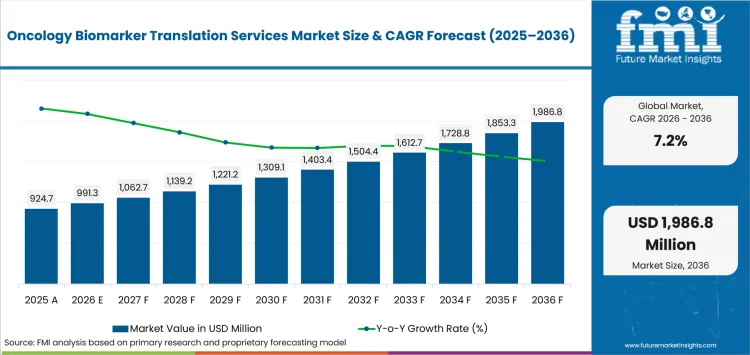
Key Takeaways of Oncology Biomarker Translation Services Market
- Demand for oncology biomarker translation services is driven by biomarker-guided drug development and broader molecular testing, with services creating value by linking biomarker evidence with defined clinical decisions and regulated testing pathways.
- Biomarker discovery services hold the leading share at 36.5% in 2026, attributable to early influence on target selection and trial design where analytical work determines whether later validation spending rests on a credible biological signal.
- Genomic biomarkers lead the biomarker type category at 30.4% share in 2026, underpinned by established sequencing platforms and therapy-linked regulatory pathways supporting comparable enrollment decisions across multicenter studies.
- Precision oncology leads the application category at 35.0% share in 2026, owing to therapy selection requirements across targeted treatments where translated assays connect molecular signals with documented clinical decisions.
- Pharmaceutical and biotechnology companies account for 40.2% end-user share in 2026, supported by outsourced assay development needs across drug and companion diagnostic co-development programs.
- The United Kingdom, Japan, and the USA record CAGRs of 8.8%, 8.1%, and 7.6% respectively through 2036, with Labcorp and IQVIA combining biomarker services with clinical trial operations, and Guardant Health and Foundation Medicine connecting tissue and liquid profiling with biopharma programs.
Analyst Perspective
"Commercial adoption will depend on converting promising biomarkers into clinically validated tests that influence oncology treatment decisions. Developers are prioritizing robust clinical evidence, standardized laboratory practices, and regulatory alignment to support broader clinical use. Companies that strengthen assay validation, multicenter consistency, and long-term technical support will be better positioned to expand precision oncology applications."
- Anurag Sharma, Principal Analyst at Future Market Insights
Source: FMI's proprietary forecasting model and primary research
How is the Oncology Biomarker Translation Services Markett segmented?
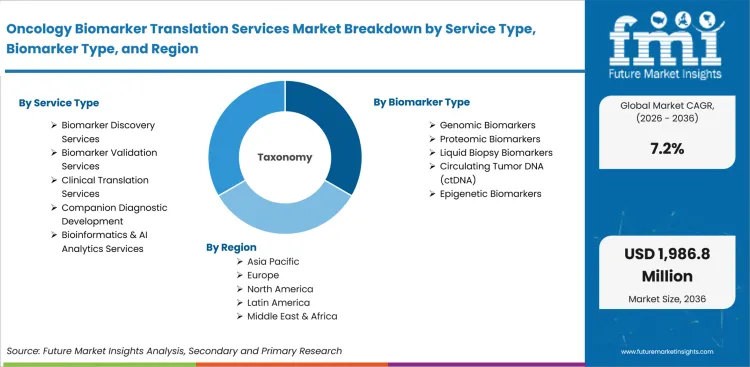
The oncology biomarker translation services industry is segmented by service type, biomarker type, application, end user, and region.
The segmentation framework separates the translation stage from the biological signal and the clinical purpose served. Service type follows technical work from early discovery through validation and companion diagnostic development across regulated oncology programs. Biomarker type distinguishes genomic and proteomic evidence from liquid biopsy and epigenetic signals across different clinical uses. Application analysis connects translated assays with precision oncology and clinical trial decisions across treatment development and patient monitoring. End-user categories identify organizations that fund translation programs or perform laboratory work across the oncology development pathway. Regional analysis compares reimbursement routes and laboratory infrastructure across national systems with different testing access conditions.
What supports demand for biomarker discovery services within the service type category?
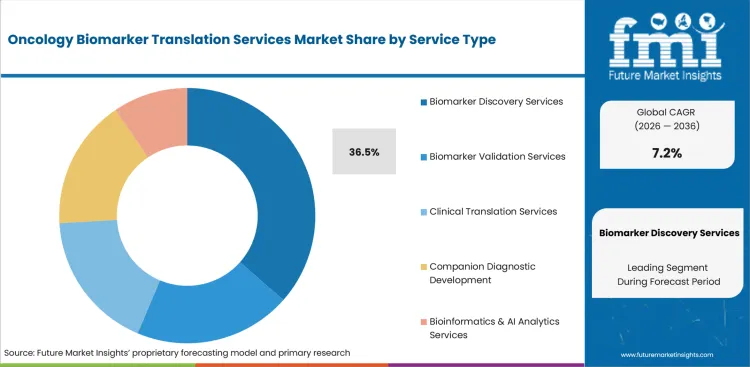
Oncology programs use biomarker discovery services to identify signals that can support later analytical and clinical validation. Discovery teams combine tissue characterization with proteomic or genomic analysis to choose practical assays for multicenter studies. In August 2025, the National Cancer Institute reported that proteogenomic analysis of 80 biopsies from 54 patients identified two resistance biomarkers. The finding supports next-generation cancer diagnostics development through integrated biological measurements rather than one exploratory readout. Translation partners add commercial value by connecting discovery results with clear validation plans and regulatory use.
- The service type category is forecast to be led by biomarker discovery services at 36.5% share in 2026, sustained by their early influence on target selection and trial design. Early analytical work determines whether later validation spending rests on a credible biological signal and a practical assay route.
- Pharmaceutical research teams use biomarker discovery services to compare response and resistance signals across well-characterized patient samples. Effective programs connect exploratory findings with assay feasibility and specimen requirements for later clinical deployment. Integrated discovery planning reduces redesign risk during validation work and multicenter protocol development across regulated studies.
How do genomic biomarkers shape demand within the biomarker type category?
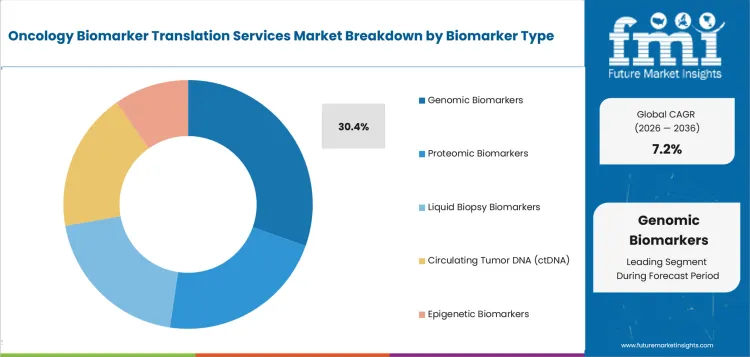
Genomic biomarkers provide a structured basis for matching molecular alterations with targeted therapies and clinical trial eligibility. Multicenter sequencing programs need harmonized panels and controlled interpretation across research laboratories and regulated testing sites. Drug developers assess clinical oncology sequencing services through analytical performance and documented regulatory transferability across testing networks. In November 2025, the FDA approved the Oncomine Dx Target Test for HER2-mutated non-squamous NSCLC patients receiving sevabertinib. Translation teams must preserve the approved interpretation across every participating clinical laboratory supporting the same treatment pathway.
- In 2026, genomic biomarkers are projected to hold 30.4% share within the biomarker type category, underpinned by established sequencing platforms and therapy-linked regulatory pathways. Standardized variant interpretation supports comparable enrollment decisions across multicenter studies and several participating central laboratories. Broad use across targeted drug development programs also creates sustained demand for biomarker translation services.
- Central laboratories use genomic biomarkers to standardize patient selection across sites that receive tissue with variable quality. Adoption depends on bioinformatics review and documented variant interpretation throughout protocol amendments across active multicenter studies. Clinical sponsors also need clear reflex-testing rules for samples that fail sequencing quality thresholds during active studies.
What makes precision oncology central to the application category?
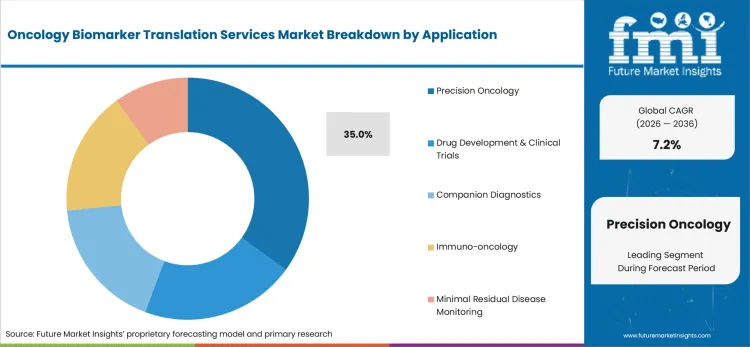
Precision oncology needs translated biomarkers that connect a measurable biological feature with a specific treatment or monitoring decision. In January 2026, the National Cancer Institute reported that a four-marker panel identified 87.5% of early-stage pancreatic cancer cases. The early findings need larger prospective studies and controlled tissue genomic profiling workflows to support routine care decisions. Translation teams create value by defining validation plans and intended-use populations alongside future clinical testing requirements. Clinical sponsors can then separate promising discovery performance from evidence needed for regulatory or reimbursement decisions.
- Precision oncology is likely to capture 35.0% share within the application category in 2026, attributable to treatment selection and monitoring needs across biomarker-defined populations. The application turns laboratory evidence into a documented clinical decision that affects enrollment or targeted therapy selection. Intended-use definitions also require assay performance that remains valid across every selected patient population during clinical testing.
- Cancer centers adopt translated precision assays through pathways that combine molecular review with specialist treatment planning. Commercial adoption strengthens through reports that produce consistent recommendations and reduce avoidable delays during patient management. Laboratories also need defined escalation routes for uncertain variants that cannot support immediate treatment selection.
Why do pharmaceutical & biotechnology companies lead the end user category?
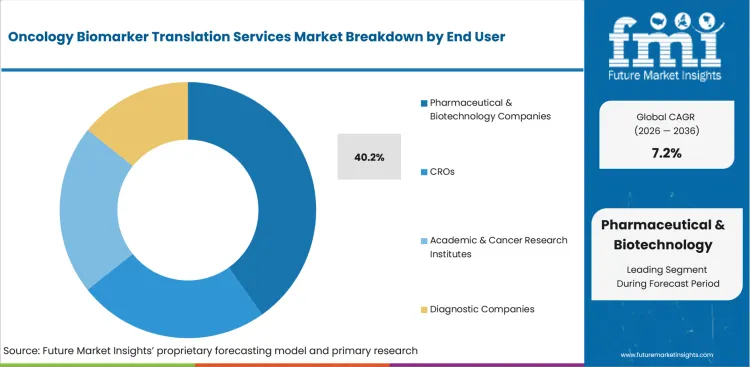
Pharmaceutical and biotechnology companies fund translation work that links therapeutic hypotheses with trial enrollment and companion diagnostic strategies. Drug developers need laboratories that support assay development and clinical sample testing under one documented quality system. In September 2025, the FDA approved imlunestrant with the Guardant360 CDx companion diagnostic for ESR1-mutated advanced or metastatic breast cancer. The paired therapy and diagnostic route keeps companion diagnostics services central to biomarker-defined development programs. Clear contracts reduce execution risk by assigning assay ownership and regulatory responsibilities across every development stage.
- Pharmaceutical and biotechnology companies are set to lead the end-user category with 40.2% share in 2026, enabled by sustained outsourcing of biomarker strategy and clinical testing. Biopharma programs require technical and regulatory continuity from exploratory research through clinical validation and submission.
- Drug development teams use translation services to reduce fragmented handoffs between discovery groups and regulated laboratories. Strong programs document method transfer and sample logistics across every participating clinical site throughout the study. Integrated contracts also assign responsibility for assay changes during protocol amendments and subsequent regulatory review activities.
What are the drivers, restraints, and opportunities in the Oncology Biomarker Translation Services Market?
Commercial expansion depends on validated biomarkers and reliable sample logistics together with evidence that a translated assay changes a defined oncology decision.
- Driver: Biomarker-stratified therapies increase demand for assay development that supports enrollment and treatment selection across regulated oncology programs.
- Restraint: Variable sample quality and incomplete clinical validation can prevent promising signals from becoming reliable tests for routine decisions.
- Opportunity: Integrated discovery-to-diagnostic services can reduce handoffs and preserve analytical continuity throughout therapy development and commercialization.
Targeted oncology approvals create direct demand for validated testing that identifies eligible patients within defined clinical populations. Drug developers need assay strategies that progress with therapeutic evidence and regulatory milestones throughout each oncology program. In December 2025, the FDA granted regular approval to rucaparib for BRCA-mutated metastatic castration-resistant prostate cancer. The agency required patient selection through an approved companion diagnostic for the authorized treatment population. Translation laboratories can support longer engagements that combine assay validation with trial testing and submission planning across the therapeutic lifecycle.
Analytical uncertainty limits growth if a promising biomarker produces inconsistent results across specimen types or laboratory methods. In February 2025, the National Institutes of Health reported that current multi-cancer detection tests had not demonstrated reduced cancer mortality. The agency also identified unresolved sensitivity and specificity requirements for safe use across broad screening populations. Molecular diagnostics programs need clear validation limits and clinical follow-up responsibilities prior to wider deployment. Commercial adoption slows if test results create uncertain actions or avoidable confirmatory procedures for oncology care teams.
Integrated translation creates an opportunity to connect biomarker evidence with regulatory planning and scalable clinical testing through one program. In May 2026, the FDA approved a new ESR1 companion diagnostic indication for Guardant360 CDx. The approval shows how genomic risk stratification can support treatment selection through a regulated liquid biopsy pathway. Translation laboratories can expand program value through assay transfer and clinical operations that remain aligned with the intended use. Drug developers gain clearer accountability across stages that otherwise rely on disconnected laboratories and separate regulatory teams.
Which country CAGRs are profiled in the Oncology Biomarker Translation Services Market?
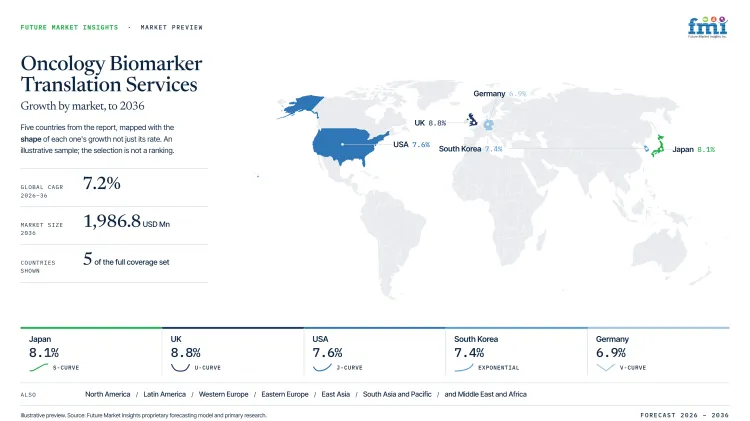
| Country | CAGR |
|---|---|
| USA | 7.6% |
| UK | 8.8% |
| Germany | 6.9% |
| Japan | 8.1% |
| South Korea | 7.4% |
How do country-level CAGRs compare in the Oncology Biomarker Translation Services Market?
The country outlook range spans 1.9 percentage points and shows a compressed growth profile rather than sharply separated national trajectories. The United Kingdom and Japan form the upper cluster with a 0.7-point difference between their approved forecast rates. USA and South Korea occupy the middle band through laboratory networks that support multicountry oncology studies. Germany stands 0.5 points below South Korea and 1.9 points below the United Kingdom. The spacing reflects reimbursement routes and laboratory organization instead of a simple difference in national cancer burden.
- The United Kingdom combines centralized public testing with national implementation pathways that can place translated assays across coordinated hospital networks.
- Japan combines national reimbursement rules with expert-panel review that gives genomic testing a defined route into specialist treatment decisions.
- The USA supports biomarker translation through established therapeutic approvals and a large network of regulated clinical research laboratories.
- South Korea provides approved institutional capacity for next-generation sequencing and applies formal conditions to reimbursed genomic testing.
- Germany advances through a national genomic medicine program that links university hospitals with statutory insurance funding and secure data infrastructure.
Similar forecast rates can produce different commercial conditions through local service capacity and payment rules. Translation laboratories therefore need country-specific regulatory support and dependable local partnerships across the five profiled systems. The full report provides country-level CAGR analysis across North America and Latin America during the forecast period. Coverage also includes Europe and East Asia together with South Asia and the Middle East and Africa.
Country-wise Analysis
- United States oncology programs use regulated clinical laboratories to deliver oncology molecular diagnostics through an established companion diagnostic pathway. Sales of oncology biomarker translation services in the USA are forecast to expand at 7.6% CAGR by 2036, supported by established companion diagnostic approvals and national laboratory coverage. In January 2025, the FDA approved sotorasib with panitumumab and the therascreen KRAS RGQ PCR Kit for eligible KRAS G12C-mutated colorectal cancer patients. The January 2020 CMS coverage determination also limits national NGS payment to defined cancer and laboratory conditions. FDA approval provides a direct adoption route whereas CMS coverage rules restrict broader reimbursement across national oncology programs. Translation laboratories need scalable sample logistics and clear coverage evidence to serve community oncology sites.
- United Kingdom oncology programs use centralized NHS genomic laboratory hubs and coordinated treatment pathways across participating hospitals. In the United Kingdom the oncology biomarker translation services market is predicted to advance at 8.8% CAGR through 2036, driven by centralized genomic laboratories and national implementation pathways. In May 2025 NHS England reported that blood-first testing could reach 15,000 suspected lung cancer patients each year. National procurement gives translation laboratories a defined route into participating hospitals across the coordinated testing program. Budget pressure and regional implementation differences can restrict access outside established NHS genomic pathways during national rollout.
- Germany's oncology genomic services connect university hospitals through a federal platform with decentralized clinical and genomic data nodes. By 2036 the oncology biomarker translation services market in Germany is projected to grow at 6.9% CAGR, reflecting statutory insurance participation and coordinated sequencing infrastructure. In August 2025 BfArM confirmed successful initial data transfer across a national program connecting 28 university hospitals. The operating milestone creates a direct service enabler for multicenter biomarker programs across participating institutions. Strict security controls and decentralized storage increase integration work for external laboratories entering the program. Commercial participation requires compliant interfaces and coordinated sample governance across approved German institutions and data nodes.
- Japanese cancer genomic services operate through designated centers and expert-panel review within national reimbursement rules. Japan's oncology biomarker translation services sector is projected to record 8.1% CAGR during the assessment period, enabled by reimbursed panel testing and structured clinical interpretation. In February 2026 the Ministry of Health revised testing fee guidance for qualifying tumor and blood genomic panels. The payment pathway supports translation work at institutions that meet expert-panel requirements and national quality standards. Formal review can extend turnaround times and concentrate commercial demand within specialized cancer genomic centers. Market entry requires Japanese-language interpretation workflows and experienced local regulatory support for reimbursed oncology programs.
- South Korean genomic testing operates through institutions formally approved for next-generation sequencing gene panel examinations under national rules. Adoption of oncology biomarker translation services in South Korea is estimated to expand at 7.4% CAGR through 2036, attributable to approved NGS institutions and tertiary-hospital testing capacity. In August 2025 the Health Insurance Review and Assessment Service listed 81 approved testing institutions. The approved network provides a defined base for clinical genomic testing and oncology trial support nationwide. Selective coverage and hospital concentration can limit regional access outside the largest tertiary care networks. Translation laboratories need local partnerships and clear reimbursement documentation to expand beyond major tertiary centers.
Who are the notable companies in the Oncology Biomarker Translation Services Market?
Labcorp, IQVIA, Charles River Laboratories, Thermo Fisher Scientific Inc., Roche Diagnostics, Illumina, Inc., Guardant Health, Inc., Foundation Medicine, Inc., Eurofins Scientific, and ICON plc are the notable companies shaping this market.
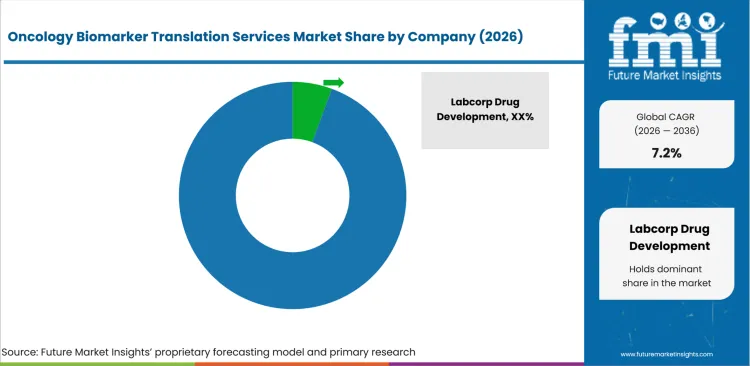
Competition spans central laboratories and diagnostic platform developers alongside precision oncology testing specialists with different regulatory roles. Labcorp and IQVIA combine biomarker laboratory services with clinical trial operations across established international testing networks. Charles River Laboratories and ICON support translational studies through assay development and regulated research services. Thermo Fisher Scientific and Illumina provide sequencing platforms for companion diagnostic programs across clinical laboratories. Roche Diagnostics contributes tissue-based testing capabilities across established oncology treatment-selection pathways and regulated pathology laboratory networks. Guardant Health and Foundation Medicine connect genomic profiling with biomarker-driven biopharma programs across several regions. Eurofins Scientific provides specialized clinical testing through laboratory networks supporting pharmaceutical development programs across Europe. Competitive fit depends on the translation stage and regulatory pathway required by each drug program.
- Translational and central laboratory providers include Labcorp and IQVIA alongside the laboratory network operated by Charles River Laboratories. ICON plc and Eurofins Scientific support assay development or specialized clinical testing across defined program stages. Contract selection centers on method transfer and controlled sample operations rather than unrelated corporate scale.
- Thermo Fisher Scientific and Illumina join Roche Diagnostics as the diagnostic platform and assay development group. The group supports biomarker programs through sequencing systems and regulated assay development across clinical laboratories. Drug developers must define deployment responsibilities and regulatory coverage across every intended testing geography within each program.
- Guardant Health and Foundation Medicine form the precision oncology testing specialist group within the competitive roster. Their tissue and liquid profiling services support clinical trials and companion diagnostic strategies across biomarker-defined patient groups. Selection depends on assay eligibility and sample requirements together with access across the drug developer's target countries.
Competitive Benchmarking: Oncology Biomarker Translation Services Market
| Company | Translational Biomarker Services | Companion Diagnostic Support | Clinical Trial Integration | Geographic Reach |
|---|---|---|---|---|
| Labcorp | High | High | High | Global |
| IQVIA | High | High | High | Global |
| Charles River Laboratories | High | Medium | Medium | Global |
| Thermo Fisher Scientific Inc. | Medium | High | Medium | Global |
| Illumina, Inc. | Medium | High | Medium | Global |
| Guardant Health, Inc. | High | High | High | North America, Europe and Asia |
| Foundation Medicine, Inc. | High | High | High | North America, Europe and Asia |
| ICON plc | High | High | High | Global |
Key Developments in the Oncology Biomarker Translation Services Market
- In May 2025, Labcorp: The precision oncology portfolio expanded through new tests for solid tumors and hematologic malignancies. The announcement also added biopharma services that support oncology trials and companion diagnostic development across several program stages. Global testing options can reduce assay handoffs across trial phases and support consistent results in multicenter development programs.
- In May 2025, Illumina: The clinical oncology portfolio expanded through wider access to TruSight Oncology Comprehensive and the planned Pillar oncoReveal CDx offering. The announcement connected distributable genomic profiling with companion diagnostic testing on Illumina systems across participating laboratories. Clinical laboratories gained additional deployment options for regulated testing near participating trial sites and regional care networks.
- In April 2026, Guardant Health: A multiyear collaboration with Nuvalent began using tissue and liquid offerings from the Guardant Infinity platform. The companies plan to support global clinical studies and evaluate companion diagnostic development for investigational therapies. The agreement connects biomarker analysis with clinical development and possible commercial diagnostic deployment across future treatment programs.
- In January 2025, Roche: FDA approval covered the PATHWAY anti-HER2/neu assay as a companion diagnostic for HER2-ultralow metastatic breast cancer. The approval added a regulated method for identifying patients eligible for ENHERTU within the newly defined population. Pathology laboratories gained a clear HER2-ultralow interpretation for treatment eligibility decisions across regulated oncology care pathways.
Key Players in the Oncology Biomarker Translation Services Market
Translational and Clinical Laboratory Providers
- Labcorp
- IQVIA
- Charles River Laboratories
- Eurofins Scientific
- ICON plc
Diagnostic Platform and Assay Developers
- Thermo Fisher Scientific Inc.
- Roche Diagnostics
- Illumina, Inc.
Precision Oncology Testing Specialists
- Guardant Health, Inc.
- Foundation Medicine, Inc.
Oncology Biomarker Translation Services Market - Report Scope
| Coverage field | Report scope |
|---|---|
| Market breakdown | Service type, biomarker type, application, end user, and region |
| Quantitative Units | Revenue in USD Million, CAGR in %. |
| Market Definition | Services that translate oncology biomarker findings into analytically validated and clinically deployable tests for drug development or treatment decisions. |
| Regions Covered | North America, Latin America, Western Europe, Eastern Europe, East Asia, South Asia and Pacific, and Middle East and Africa |
| Countries Covered | USA, Canada, Brazil, Mexico, Argentina, Chile, Germany, France, United Kingdom, Italy, Spain, Poland, China, Japan, South Korea, India, Australia, GCC Countries, South Africa, Türkiye, and Israel |
| Key Companies Profiled | Labcorp, IQVIA, Charles River Laboratories, Thermo Fisher Scientific Inc., Roche Diagnostics, Illumina, Inc., Guardant Health, Inc., Foundation Medicine, Inc., Eurofins Scientific, and ICON plc |
| Forecast Period | 2026 to 2036 |
| Approach | Hybrid bottom-up and top-down market sizing supported by primary interviews and official desk research. |
Oncology Biomarker Translation Services Market - Research Methodology
| Method | Approach |
|---|---|
| Primary Research | FMI analysts gathered input from manufacturers, service providers, technology developers, distributors, end users, procurement teams, and subject-matter experts. Interviews examined purchasing decisions, product or service evaluation, adoption barriers, approval requirements, pricing considerations, and expectations for technical or commercial support. Respondents were also asked what evidence is required before a trial, pilot, or initial order develops into regular purchasing. |
| Desk Research | Desk research covered government statistics, regulatory publications, trade data, industry associations, technical literature, standards, company filings, product information, and official corporate announcements. Sources were reviewed for relevance, publication date, geographic coverage, and consistency with the defined market scope. Claims relating to performance, applications, approvals, capacity, investment, and commercial activity were retained only when supported by credible public evidence. |
| Market Sizing and Forecasting | The market model combined the baseline value with historical performance, segment structure, pricing and volume indicators, adoption levels, company participation, and country-level demand conditions. Forecast assumptions considered economic activity, investment trends, regulatory developments, technology adoption, purchasing cycles, supply availability, and barriers to wider market use. Segment and regional estimates were reconciled before the final market total was calculated. |
| Data Validation | Estimates were checked against multiple independent indicators, including public data, company activity, trade patterns, industry developments, and findings from primary interviews. Validation also tested whether products, services, applications, and company revenues fell within the defined market boundaries. Adjacent categories, unsupported claims, overlapping revenues, and activities without direct market relevance were excluded to reduce double counting and maintain consistency across segments and countries. |
Oncology Biomarker Translation Services Market by Segments
Oncology Biomarker Translation Services Market segmented by Service Type:
- Biomarker Discovery Services
- Biomarker Validation Services
- Clinical Translation Services
- Companion Diagnostic Development
- Bioinformatics & AI Analytics Services
Oncology Biomarker Translation Services Market segmented by Biomarker Type:
- Genomic Biomarkers
- Proteomic Biomarkers
- Liquid Biopsy Biomarkers
- Circulating Tumor DNA (ctDNA)
- Epigenetic Biomarkers
Oncology Biomarker Translation Services Market segmented by Application:
- Precision Oncology
- Drug Development & Clinical Trials
- Companion Diagnostics
- Immuno-oncology
- Minimal Residual Disease Monitoring
Oncology Biomarker Translation Services Market segmented by End User:
- Pharmaceutical & Biotechnology Companies
- CROs
- Academic & Cancer Research Institutes
- Diagnostic Companies
Oncology Biomarker Translation Services Market by Region:
- North America
- United States
- Canada
- Latin America
- Brazil
- Mexico
- Argentina
- Chile
- Western Europe
- Germany
- France
- United Kingdom
- Italy
- Spain
- Benelux
- Nordics
- Eastern Europe
- Poland
- Czech Republic
- Romania
- Hungary
- East Asia
- China
- Japan
- South Korea
- South Asia and Pacific
- India
- ASEAN
- Australia and New Zealand
- Middle East and Africa
- GCC Countries
- South Africa
- Türkiye
- Israel
Research Sources and Bibliography
- USA Food and Drug Administration. (2026, May 15). FDA approves two separate indications for fam-trastuzumab deruxtecan-nxki in HER2-positive early-stage breast cancer.
- National Cancer Institute. (2025, August 26). Proteogenomic Analysis of Clinical Trial Samples Identifies New Biomarkers.
- USa Food and Drug Administration. (2025, November 19). FDA grants accelerated approval to sevabertinib for non-squamous non-small cell lung cancer.
- National Cancer Institute. (2026, January 30). Researchers identify new blood markers that may detect early pancreatic cancer.
- USA Food and Drug Administration. (2025, September 25). FDA approves imlunestrant for ER-positive, HER2-negative, ESR1-mutated advanced or metastatic breast cancer.
- USA Food and Drug Administration. (2025, December 17). FDA grants regular approval to rucaparib for metastatic castration-resistant prostate cancer.
- National Institutes of Health. (2025, February 13). Detecting cancer.
- Guardant Health. (2026, May 4). Guardant Health Receives FDA Approval for Guardant360® CDx as a Companion Diagnostic for Arvinas and Pfizer’s VEPPANU (vepdegestrant) for Patients with ER+/HER2- Advanced Breast Cancer with ESR1 Mutations.
- USA Food and Drug Administration. (2025, January 16). FDA approves sotorasib with panitumumab for KRAS G12C-mutated colorectal cancer.
- Centers for Medicare & Medicaid Services. (2020, January 27). NCD - Next Generation Sequencing (NGS) (90.2).
- NHS England. (2025, May 30). NHS first in world to roll out ‘revolutionary’ blood test for cancer patients.
- Federal Institute for Drugs and Medical Devices. (2025, August 7). Bessere Diagnosen und Therapien durch Genommedizin: Modellvorhaben startet Datenübertragung [Better diagnoses and therapies through genomic medicine: Model project begins data transfer].
- Ministry of Health, Labour and Welfare. (2026, February 27). 検査料の点数の取扱いについて [Handling of medical test fee points].
- Health Insurance Review and Assessment Service. (2025, August 5). 2025년 하반기 차세대염기서열분석(NGS)기반 유전자패널검사 승인기관 안내 [Approved institutions for NGS-based gene panel testing in the second half of 2025].
- Labcorp. (n.d.). Companion diagnostics development for IVDs and LDTs.
- Charles River Laboratories. (n.d.). Translational Biomarker Strategies.
- Thermo Fisher Scientific. (n.d.). NGS Solutions for Companion Diagnostics.
- Illumina. (n.d.). Cancer Companion Diagnostics. ;
- Guardant Health. (n.d.). BioPharma Solutions | Clinical Development.
- Labcorp. (2025, May 30). Labcorp Expands Oncology Portfolio to Improve Patient Care and Advance Cancer Research.
- Illumina. (2025, May 28). Illumina expands clinical oncology portfolio unlocking new standard of care and access to precision therapies.
- Guardant Health. (2026, April 30). Guardant Health Announces Multi-Year Strategic Collaboration with Nuvalent to Develop Companion Diagnostics and Support Potential Commercialization of Targeted Cancer Therapies Using the Guardant Infinity™ Platform.
- Roche. (2025, January 31). Roche receives FDA approval for the first companion diagnostic to identify patients with HER2-ultralow metastatic breast cancer eligible for ENHERTU.
This bibliography is provided for reader reference and is not exhaustive. The full report contains the complete reference list and detailed citations
This Report Answers
- How large is the oncology biomarker translation services market in 2026 and 2036?
- Which clinical and regulatory conditions support demand for biomarker translation services?
- Why do biomarker discovery services hold the leading service type share during 2026?
- How do genomic biomarkers support companion diagnostic and clinical trial decisions?
- Why does precision oncology represent the leading application share during 2026?
- How do country growth rates compare across the USA, UK, Germany, Japan, and South Korea?
- Which companies provide translational biomarker and companion diagnostic capabilities?
- What limits the conversion of exploratory biomarkers into reliable clinical tests?
- How can integrated translation services reduce development handoffs and regulatory risk?
Frequently Asked Questions
How big is the Oncology Biomarker Translation Services Market in 2026?
The oncology biomarker translation services market is valued at USD 991.3 million in 2026 and is forecast to reach USD 1,986.8 million by 2036.
What is the CAGR of the Oncology Biomarker Translation Services Market from 2026 to 2036?
The oncology biomarker translation services market is projected to grow at a CAGR of 7.2% between 2026 and 2036, supported by biomarker-stratified therapies increasing demand for assay development that supports enrollment and treatment selection across regulated oncology programs.
Which application leads the Oncology Biomarker Translation Services Market?
Precision oncology accounts for 35.0% of the oncology biomarker translation services market by application in 2026, driven by treatment selection and monitoring needs across biomarker-defined populations where translated assays connect laboratory evidence with documented clinical decisions.
Which country is growing fastest in the Oncology Biomarker Translation Services Market?
The United Kingdom is the fastest-growing segment in the oncology biomarker translation services market, expanding at an 8.8% CAGR through 2036, ahead of the market average of 7.2%, strengthened by centralized NHS genomic laboratory hubs and national implementation pathways placing translated assays across coordinated hospital networks.
Who are the leading companies in the Oncology Biomarker Translation Services Market?
Leading companies in the oncology biomarker translation services market include Labcorp, IQVIA, Charles River Laboratories, Thermo Fisher Scientific, Roche Diagnostics, Illumina, Guardant Health, Foundation Medicine, Eurofins Scientific, and ICON, competing across translational laboratory services, diagnostic platform development, and precision oncology testing programs.
Preview the report firsthand - request a free sample
Get SampleGet the brochure for pricing and purchase details.
Get PDFTable of Content
- Key Takeaways
- Market Size and CAGR
- Top Growth Driver
- Fastest Growing Segment
- Leading Region
- Key Companies
- Emerging Opportunities
- Executive Summary
- Global Market Outlook
- Demand-side Trends
- Supply-side Trends
- Technology Roadmap Analysis
- Analysis and Recommendations
- Analyst Perspective (What is happening? Why now? What should investors know?)
- Key Questions Answered
- How large is the market?
- What is the CAGR?
- What are key trends?
- Which region dominates?
- Who are the leaders?
- Market Overview
- Market Coverage / Taxonomy
- Market Definition / Scope / Limitations
- Research Methodology
- Chapter Orientation
- Analytical Lens and Working Hypotheses
- Market Structure, Signals, and Trend Drivers
- Benchmarking and Cross-market Comparability
- Market Sizing, Forecasting, and Opportunity Mapping
- Research Design and Evidence Framework
- Desk Research Programme (Secondary Evidence)
- Expert Input and Fieldwork (Primary Evidence)
- Tooling, Models, and Reference Databases
- Data Engineering and Model Build
- Quality Assurance and Audit Trail
- Market Background
- Market Dynamics (Drivers, Restraints, Opportunity, Trends)
- Scenario Forecast (Optimistic, Likely, Conservative)
- Impact Analysis
- AI Impact
- Sustainability Impact
- Regulatory Impact
- Technology Impact
- Consumer / Buyer Analysis
- Purchase Drivers
- Adoption Barriers
- Buyer Journey
- Opportunity Map Analysis
- Product Life Cycle Analysis
- Supply Chain Analysis
- Investment Feasibility Matrix
- Value Chain Analysis
- PESTLE and Porter's Analysis
- Regulatory Landscape
- Regional Parent Market Outlook
- Production and Consumption Statistics
- Import and Export Statistics
- Global Market Analysis and Forecast, 2021 to 2036
- Historical Market Size Value (USD Million) Analysis, 2021 to 2025
- Current and Future Market Size Value (USD Million) Projections, 2026 to 2036
- Y-o-Y Growth Trend Analysis
- Absolute $ Opportunity Analysis
- Global Market Pricing Analysis, 2021 to 2036
- Global Market Analysis and Forecast, By Service Type, 2021 to 2036
- Introduction / Key Findings
- Historical Market Size Value (USD Million) Analysis By Service Type, 2021 to 2025
- Current and Future Market Size Value (USD Million) Analysis and Forecast By Service Type, 2026 to 2036
- Biomarker Discovery Services
- Biomarker Validation Services
- Clinical Translation Services
- Companion Diagnostic Development
- Bioinformatics & AI Analytics Services
- Biomarker Discovery Services
- Y-o-Y Growth Trend Analysis By Service Type, 2021 to 2025
- Absolute $ Opportunity Analysis By Service Type, 2026 to 2036
- Global Market Analysis and Forecast, By Biomarker Type, 2021 to 2036
- Introduction / Key Findings
- Historical Market Size Value (USD Million) Analysis By Biomarker Type, 2021 to 2025
- Current and Future Market Size Value (USD Million) Analysis and Forecast By Biomarker Type, 2026 to 2036
- Genomic Biomarkers
- Proteomic Biomarkers
- Liquid Biopsy Biomarkers
- Circulating Tumor DNA (ctDNA)
- Epigenetic Biomarkers
- Genomic Biomarkers
- Y-o-Y Growth Trend Analysis By Biomarker Type, 2021 to 2025
- Absolute $ Opportunity Analysis By Biomarker Type, 2026 to 2036
- Global Market Analysis and Forecast, By Application, 2021 to 2036
- Introduction / Key Findings
- Historical Market Size Value (USD Million) Analysis By Application, 2021 to 2025
- Current and Future Market Size Value (USD Million) Analysis and Forecast By Application, 2026 to 2036
- Precision Oncology
- Drug Development & Clinical Trials
- Companion Diagnostics
- Immuno-oncology
- Minimal Residual Disease Monitoring
- Precision Oncology
- Y-o-Y Growth Trend Analysis By Application, 2021 to 2025
- Absolute $ Opportunity Analysis By Application, 2026 to 2036
- Global Market Analysis and Forecast, By End User, 2021 to 2036
- Introduction / Key Findings
- Historical Market Size Value (USD Million) Analysis By End User, 2021 to 2025
- Current and Future Market Size Value (USD Million) Analysis and Forecast By End User, 2026 to 2036
- Pharmaceutical & Biotechnology Companies
- CROs
- Academic & Cancer Research Institutes
- Diagnostic Companies
- Pharmaceutical & Biotechnology Companies
- Y-o-Y Growth Trend Analysis By End User, 2021 to 2025
- Absolute $ Opportunity Analysis By End User, 2026 to 2036
- Global Market Analysis and Forecast, By Region, 2021 to 2036
- Introduction
- Historical Market Size Value (USD Million) Analysis By Region, 2021 to 2025
- Current Market Size Value (USD Million) Analysis and Forecast By Region, 2026 to 2036
- North America
- Latin America
- Western Europe
- Eastern Europe
- East Asia
- South Asia and Pacific
- Middle East & Africa
- Market Attractiveness Analysis By Region
- North America Market Analysis and Forecast, By Country, 2021 to 2036
- Historical Market Size Value (USD Million) Trend Analysis By Market Taxonomy, 2021 to 2025
- Market Size Value (USD Million) Forecast By Market Taxonomy, 2026 to 2036
- By Country
- USA
- Canada
- By Service Type
- By Biomarker Type
- By Application
- By End User
- By Country
- Market Attractiveness Analysis
- By Country
- By Service Type
- By Biomarker Type
- By Application
- By End User
- Key Takeaways
- Latin America Market Analysis and Forecast, By Country
- Historical Market Size Value (USD Million) Trend Analysis By Market Taxonomy, 2021 to 2025
- Market Size Value (USD Million) Forecast By Market Taxonomy, 2026 to 2036
- By Country
- Brazil
- Mexico
- Chile
- Rest of Latin America
- By Service Type
- By Biomarker Type
- By Application
- By End User
- By Country
- Market Attractiveness Analysis
- By Country
- By Service Type
- By Biomarker Type
- By Application
- By End User
- Key Takeaways
- Western Europe Market Analysis and Forecast, By Country
- Historical Market Size Value (USD Million) Trend Analysis By Market Taxonomy, 2021 to 2025
- Market Size Value (USD Million) Forecast By Market Taxonomy, 2026 to 2036
- By Country
- Germany
- UK
- Italy
- Spain
- France
- Nordic
- BENELUX
- Rest of Western Europe
- By Service Type
- By Biomarker Type
- By Application
- By End User
- By Country
- Market Attractiveness Analysis
- By Country
- By Service Type
- By Biomarker Type
- By Application
- By End User
- Key Takeaways
- Eastern Europe Market Analysis and Forecast, By Country
- Historical Market Size Value (USD Million) Trend Analysis By Market Taxonomy, 2021 to 2025
- Market Size Value (USD Million) Forecast By Market Taxonomy, 2026 to 2036
- By Country
- Russia
- Poland
- Hungary
- Balkan & Baltic
- Rest of Eastern Europe
- By Service Type
- By Biomarker Type
- By Application
- By End User
- By Country
- Market Attractiveness Analysis
- By Country
- By Service Type
- By Biomarker Type
- By Application
- By End User
- Key Takeaways
- East Asia Market Analysis and Forecast, By Country
- Historical Market Size Value (USD Million) Trend Analysis By Market Taxonomy, 2021 to 2025
- Market Size Value (USD Million) Forecast By Market Taxonomy, 2026 to 2036
- By Country
- China
- Japan
- South Korea
- By Service Type
- By Biomarker Type
- By Application
- By End User
- By Country
- Market Attractiveness Analysis
- By Country
- By Service Type
- By Biomarker Type
- By Application
- By End User
- Key Takeaways
- South Asia and Pacific Market Analysis and Forecast, By Country
- Historical Market Size Value (USD Million) Trend Analysis By Market Taxonomy, 2021 to 2025
- Market Size Value (USD Million) Forecast By Market Taxonomy, 2026 to 2036
- By Country
- India
- ASEAN
- Australia & New Zealand
- Rest of South Asia and Pacific
- By Service Type
- By Biomarker Type
- By Application
- By End User
- By Country
- Market Attractiveness Analysis
- By Country
- By Service Type
- By Biomarker Type
- By Application
- By End User
- Key Takeaways
- Middle East & Africa Market Analysis and Forecast, By Country
- Historical Market Size Value (USD Million) Trend Analysis By Market Taxonomy, 2021 to 2025
- Market Size Value (USD Million) Forecast By Market Taxonomy, 2026 to 2036
- By Country
- Kingdom of Saudi Arabia
- Other GCC Countries
- Türkiye
- South Africa
- Other African Union
- Rest of Middle East & Africa
- By Service Type
- By Biomarker Type
- By Application
- By End User
- By Country
- Market Attractiveness Analysis
- By Country
- By Service Type
- By Biomarker Type
- By Application
- By End User
- Key Takeaways
- Key Countries Market Analysis
- USA
- Pricing Analysis
- Market Share Analysis, 2025
- By Service Type
- By Biomarker Type
- By Application
- By End User
- Canada
- Pricing Analysis
- Market Share Analysis, 2025
- By Service Type
- By Biomarker Type
- By Application
- By End User
- Mexico
- Pricing Analysis
- Market Share Analysis, 2025
- By Service Type
- By Biomarker Type
- By Application
- By End User
- Brazil
- Pricing Analysis
- Market Share Analysis, 2025
- By Service Type
- By Biomarker Type
- By Application
- By End User
- Chile
- Pricing Analysis
- Market Share Analysis, 2025
- By Service Type
- By Biomarker Type
- By Application
- By End User
- Germany
- Pricing Analysis
- Market Share Analysis, 2025
- By Service Type
- By Biomarker Type
- By Application
- By End User
- UK
- Pricing Analysis
- Market Share Analysis, 2025
- By Service Type
- By Biomarker Type
- By Application
- By End User
- Italy
- Pricing Analysis
- Market Share Analysis, 2025
- By Service Type
- By Biomarker Type
- By Application
- By End User
- Spain
- Pricing Analysis
- Market Share Analysis, 2025
- By Service Type
- By Biomarker Type
- By Application
- By End User
- France
- Pricing Analysis
- Market Share Analysis, 2025
- By Service Type
- By Biomarker Type
- By Application
- By End User
- India
- Pricing Analysis
- Market Share Analysis, 2025
- By Service Type
- By Biomarker Type
- By Application
- By End User
- ASEAN
- Pricing Analysis
- Market Share Analysis, 2025
- By Service Type
- By Biomarker Type
- By Application
- By End User
- Australia & New Zealand
- Pricing Analysis
- Market Share Analysis, 2025
- By Service Type
- By Biomarker Type
- By Application
- By End User
- China
- Pricing Analysis
- Market Share Analysis, 2025
- By Service Type
- By Biomarker Type
- By Application
- By End User
- Japan
- Pricing Analysis
- Market Share Analysis, 2025
- By Service Type
- By Biomarker Type
- By Application
- By End User
- South Korea
- Pricing Analysis
- Market Share Analysis, 2025
- By Service Type
- By Biomarker Type
- By Application
- By End User
- Russia
- Pricing Analysis
- Market Share Analysis, 2025
- By Service Type
- By Biomarker Type
- By Application
- By End User
- Poland
- Pricing Analysis
- Market Share Analysis, 2025
- By Service Type
- By Biomarker Type
- By Application
- By End User
- Hungary
- Pricing Analysis
- Market Share Analysis, 2025
- By Service Type
- By Biomarker Type
- By Application
- By End User
- Kingdom of Saudi Arabia
- Pricing Analysis
- Market Share Analysis, 2025
- By Service Type
- By Biomarker Type
- By Application
- By End User
- Türkiye
- Pricing Analysis
- Market Share Analysis, 2025
- By Service Type
- By Biomarker Type
- By Application
- By End User
- South Africa
- Pricing Analysis
- Market Share Analysis, 2025
- By Service Type
- By Biomarker Type
- By Application
- By End User
- USA
- Market Structure Analysis
- Competition Dashboard
- Competition Benchmarking
- Market Share Analysis of Top Players
- By Regional
- By Service Type
- By Biomarker Type
- By Application
- By End User
- Emerging Startups
- Innovation Benchmarking
- Competition Analysis
- Competition Deep Dive
- Labcorp Drug Development
- Overview
- Product Portfolio
- Profitability by Market Segments
- Sales Footprint
- Strategy Overview
- Marketing Strategy
- Product Strategy
- Channel Strategy
- IQVIA
- Charles River Laboratories
- Thermo Fisher Scientific Inc.
- Roche Diagnostics
- Illumina, Inc.
- Guardant Health, Inc.
- Foundation Medicine, Inc.
- Eurofins Scientific
- ICON plc
- Labcorp Drug Development
- Case Studies
- Success Stories
- Recent Developments
- Competition Deep Dive
- Assumptions & Acronyms Used


