

- Market Size (2026)
- USD 1.6 Bn
- Forecast (2036)
- USD 4.8 Bn
- CAGR (2026 to 2036)
- 11.5%
How big is Cross-Population Oncology Biomarker Market in 2026?
USD 1.6 billion in 2026 and USD 4.8 billion by 2036 at an 11.5% CAGR.
Demand for cross-population oncology biomarkers is forecast to expand at 11.5% CAGR between 2026 and 2036, increasing valuation from USD 1.6 billion in 2026 to USD 4.8 billion by 2036. Oncology teams create value by linking a validated biomarker result with treatment selection and a defined care decision. Commercial uptake therefore depends on representative datasets and reproducible laboratory performance across ancestry groups within routine care pathways. The National Cancer Institute stated in January 2025 that diverse participation can improve detection and diagnosis across populations. The need for representative evidence connects assay development with established companion diagnostics and interpretation services. Laboratories earn recurring revenue once clinical teams trust results enough to order them within standard care pathways.
United States laboratories operate through broad commercial networks that support national ordering and centralized interpretation for complex oncology panels. The United Kingdom routes genomic testing through public laboratory hubs and commissioned test eligibility across defined cancer pathways. Germany is building a regulated genome-sequencing pilot with insurer funding yet routine coverage remains narrower than the pilot framework. Japan combines a national cancer genomic database with designated testing institutions and disciplined expert-panel review. South Korea applies a formal device-review route that raises evidence requirements for NGS tumor profiling systems. Distinct national routes create different purchasing cases for tissue assays and liquid biopsy services despite similar clinical goals. Commercial plans must therefore match local reimbursement and laboratory capacity rather than transfer one launch model across every country.
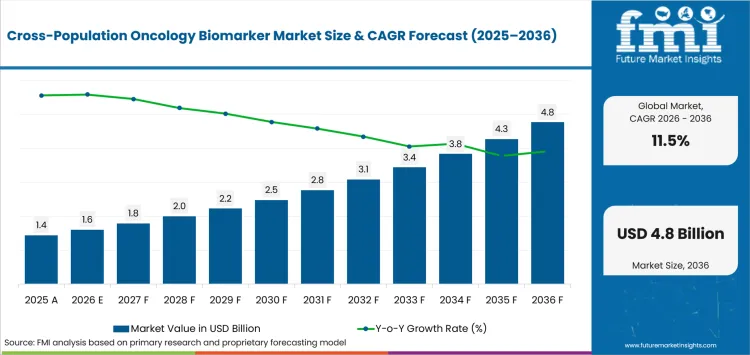
| Metric | Value |
|---|---|
| 2025 Market Size | USD 1.4 billion |
| 2026 Market Size | USD 1.6 billion |
| 2036 Market Size | USD 4.8 billion |
| Forecast CAGR (2026-2036) | 11.5% |
| Biomarker Type Focus | Genomic Biomarkers (37.3% share in 2026) |
| Cancer Type Focus | Lung Cancer (26.5% share in 2026) |
| Application Focus | Early Cancer Detection (44.8% share in 2026) |
Summary of the Cross-Population Oncology Biomarker Market
| Market Signal | Commercial Impact |
|---|---|
| Demand and Growth Drivers | Clinical teams purchase cross-population biomarker services when results clarify a treatment or detection decision across representative patient groups.
|
| Product and Segment View | Commercial architecture spans discovery biomarkers and regulated assays together with laboratory services that convert results into clinical reports.
|
| Geography and Growth Outlook | National demand differs through reimbursement rules and laboratory networks together with local evidence standards for clinical implementation.
|
| Competitive Landscape | Competition separates clinical testing services from assay developers and platform companies that support laboratory execution across multiple geographies.
|
| Analyst Perspective | The commercial test is whether an assay remains clinically interpretable across populations without creating unresolved confirmation or reimbursement work.
|
Source: FMI's proprietary forecasting model and primary research
How is the cross-population oncology biomarker market segmented?
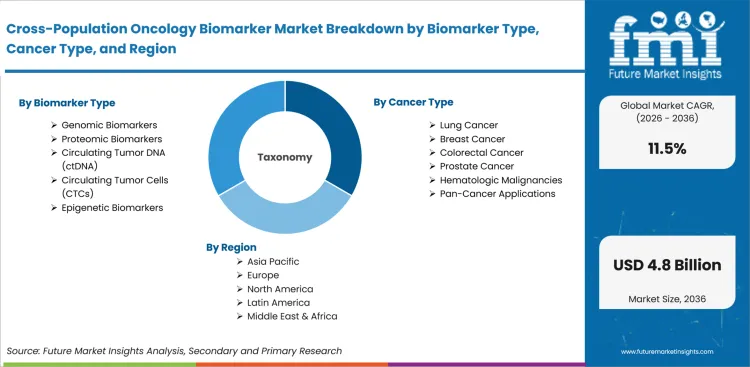
The Cross-Population Oncology Biomarker Market is segmented by Biomarker Type, Cancer Type, Population Type, Application, and Region.
The segmentation framework separates biological signals from cancer settings and the clinical decisions supported by each test. Biomarker type distinguishes genomic and protein signals from circulating cellular or epigenetic material used by laboratories. Cancer type separates disease pathways that require different specimens and treatment rules across oncology services. Population type identifies cohorts needed to test representative performance and interpretation across clinically relevant ancestry groups. Application analysis follows detection and treatment selection through prognosis and residual disease monitoring during patient care. Regional analysis compares access through national laboratory networks and reimbursement systems that influence routine ordering.
How are genomic biomarkers positioned within the biomarker type category?
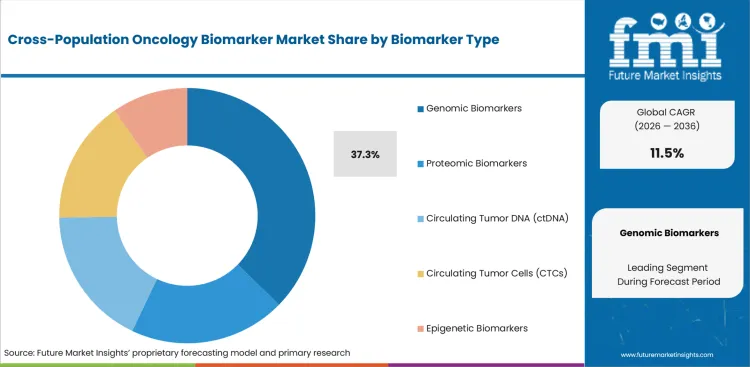
Genomic biomarkers identify alterations that can connect a tumor profile with a targeted treatment or another defined clinical action. Foundation Medicine reported in December 2025 that its tissue and liquid platforms had reached 100 approved and active companion diagnostic indications across the United States and Japan. Foundation Medicine’s approval breadth supports recurring use of clinical oncology sequencing across several solid-tumor pathways. Laboratories must still control sample quality and interpretation so a broad panel does not produce an unusable result.
- By biomarker type, genomic biomarkers are projected to account for 37.3% share in 2026, supported by their direct connection with therapy eligibility. Broad panels also support repeatable laboratory menus across several cancers without requiring a separate platform for every alteration.
- Oncology laboratories select genomic biomarkers to consolidate variant detection and clinical interpretation within one validated workflow. Adoption depends on coverage and reporting rules that distinguish actionable findings from exploratory signals so physicians can make a documented treatment decision without additional interpretive delay.
How does lung cancer shape biomarker-testing workflows?
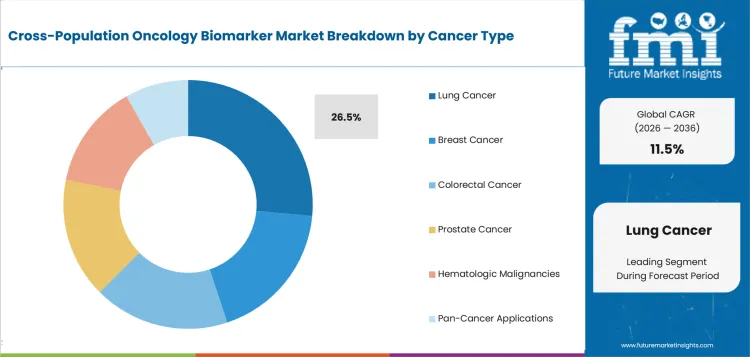
Lung cancer care contains several molecularly defined treatment routes that require timely testing before first-line or later treatment begins. The FDA approved an Oncomine Dx Target Test indication in November 2025 for ERBB2 or HER2 activating mutations in non-small cell lung cancer. The approval provides a direct regulatory route between a detected alteration and therapy eligibility for qualifying patients. Laboratories need rapid tissue processing or a validated plasma alternative so delayed results do not interrupt treatment planning.
- Lung cancer is estimated to represent 26.5% of the cancer type category in 2026 because molecular stratification affects several therapy choices. The segment benefits from established testing sequences that include tissue profiling and reflex blood testing during difficult sampling situations.
- Thoracic oncology programs use biomarker testing to identify actionable alterations before treatment selection becomes fixed. Integrated molecular diagnostics services gain preference when laboratories provide predictable turnaround and clear escalation for inadequate specimens or discordant plasma results across community and specialist care settings.
How do cancer centers evaluate biomarkers across ethnically diverse populations?
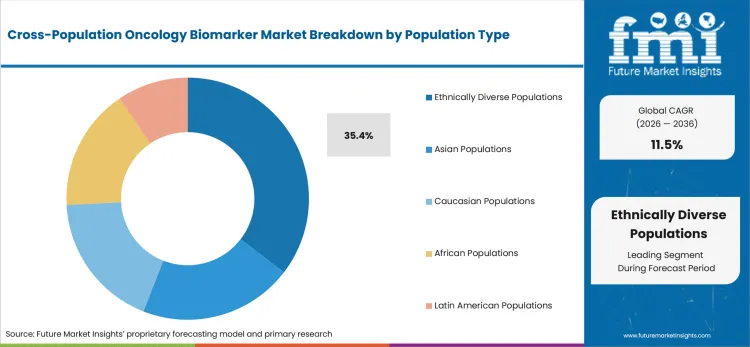
Cross-population validation requires evidence that a biomarker performs across ancestry groups and clinical settings with different disease patterns. The active NCI EQUAL trial studies a blood test for EGFR-related lung cancer among non-tobacco-using Asian and Latinx or Hispanic individuals who often fall outside standard screening eligibility. The trial design also examines practical barriers and facilitators that influence testing deployment across participating communities. Developers therefore need representative enrollment plus localized referral routes rather than a broad diversity statement without operational detail.
- Ethnically diverse populations are forecast to hold 35.4% of the population type category in 2026 as representative validation becomes a purchasing requirement. The segment position reflects the need to reduce interpretation uncertainty across ancestry-linked variant frequencies and clinical presentation patterns.
- Cancer centers use diverse cohorts to evaluate assay sensitivity and variant interpretation within the populations they serve. Adoption also depends on bioinformatics platforms that can manage ancestry-aware reference data without turning population labels into unsupported clinical conclusions during routine reporting.
What drives adoption of biomarkers for early cancer detection?
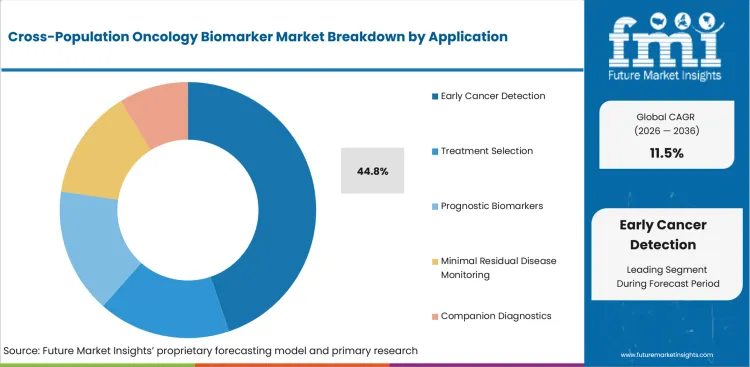
Early cancer detection expands biomarker use beyond treatment-linked testing and requires a defined path from positive signal to diagnostic resolution. The National Cancer Institute selected two assays in January 2025 for a Vanguard study planned to enroll as many as 24,000 participants. The program places cancer detection biomarkers inside a structured clinical evaluation rather than treating analytical performance as sufficient evidence. Commercial adoption therefore depends on available confirmation capacity and durable payer confidence alongside acceptable assay accuracy.
- Early cancer detection is projected to capture 44.8% of the application category in 2026 through its ability to expand testing before symptoms appear. Its share also reflects broad interest in blood-based screening across cancers that lack established population screening programs.
- Health systems evaluate early detection assays through diagnostic yield and follow-up workload together with false-positive consequences. A test becomes easier to purchase when providers can route every positive signal toward imaging or tissue confirmation without creating unmanaged specialty demand across participating care networks.
What are the drivers, restraints, and opportunities in the cross-population oncology biomarker market?
Treatment-linked biomarker decisions support recurring demand across oncology pathways with clear treatment consequences and clinical ownership. Uneven population validation and variable reimbursement constrain routine use across laboratories serving diverse patients and payer structures. Integrated testing and interpretation services create a practical opening by reducing confirmation work and unclear clinical responsibility.
- Driver: Precision oncology pathways create recurring test demand whenever a biomarker result determines therapy eligibility or changes monitoring intensity.
- Restraint: Limited population representation and variable coverage can prevent technically valid assays from entering routine clinical pathways.
- Opportunity: Integrated assay and interpretation services can connect representative validation with confirmatory testing and documented clinical action.
Treatment selection creates repeatable demand because clinicians need a documented molecular basis for many targeted oncology therapies across established care pathways. The National Cancer Institute explains that biomarker testing identifies cancer changes that can help physicians choose treatment. Commercial clinical diagnostics therefore gain value through report formats that connect one alteration with an approved action. Laboratories can justify recurring orders when turnaround time and coverage remain predictable across common cancer pathways.
Population representation remains a material restraint because variant prevalence and assay performance can differ across ancestry groups within development cohorts. A 2025 JAMA Oncology study indexed by PubMed documented genetic ancestry differences in biomarker-based eligibility for precision oncology therapies. Laboratories also need disciplined NGS workflow quality control so technical variation does not compound demographic uncertainty. Adoption slows when developers cannot separate biological differences from sample handling and incomplete reference data.
Integrated monitoring creates an opportunity for providers that combine blood-based assays with interpretation and defined escalation pathways. Bio-Rad announced in July 2025 that it acquired Stilla Technologies and introduced its QX700 droplet digital PCR systems. Adjacent diagnostic exosome biomarkers can broaden future discovery pipelines without replacing established clinical validation during assay development. Commercial success requires clear test purpose and service ownership rather than a platform claim covering unrelated care decisions.
Which country CAGRs are profiled in the cross-population oncology biomarker market?
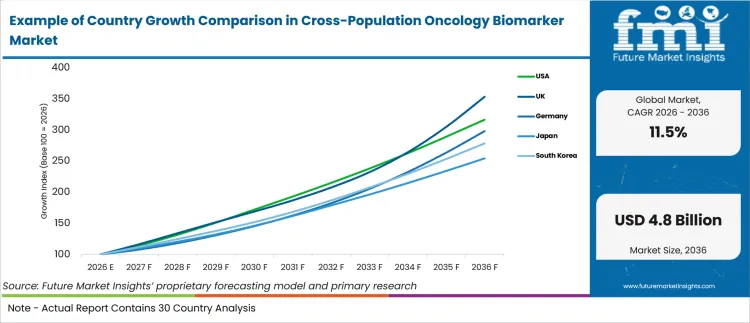
| Country | CAGR |
|---|---|
| USA | 12.2% |
| UK | 13.5% |
| Germany | 11.5% |
| Japan | 9.8% |
| South Korea | 10.8% |
How do country-level CAGRs compare in the cross-population oncology biomarker market?
The country comparison spans 3.7 percentage points from the UK rate to the Japan rate. The UK and USA form an upper pair with a measured 1.3-point separation between their forecast rates. Germany and South Korea sit within 0.7 point of each other and form the middle band. Japan remains outside that band by one percentage point compared with South Korea’s forecast rate. The pattern reflects different implementation routes rather than a direct measure of current market size or installed testing volume.
- The UK and USA combine comparatively stronger forecast rates with different purchasing structures through public commissioning and commercial laboratory access.
- Germany occupies the central position as insurer-funded genomic sequencing develops through a structured pilot instead of complete routine coverage.
- South Korea remains close to Germany while formal device guidance places technical validation and review discipline at the center of entry planning.
- Japan records a lower forecast rate despite extensive panel-testing experience because actionable findings do not consistently translate into new targeted treatment.
Similar forecast rates can create different commercial outcomes through distinct evidence thresholds and available service capacity. A provider may face centralized public purchasing in one country and reference-laboratory contracting in another. Local training and reimbursement conditions therefore matter as much as forecast spacing during market-entry planning. The full report provides country-level CAGR analysis across North America, Latin America, Europe, East Asia, South Asia, Oceania and the Middle East and Africa.
Country-wise Analysis
- United States oncology testing operates through national reference laboratories and continuing FDA companion diagnostic decisions. The USA cross-population oncology biomarker market is projected to grow at 12.2% CAGR through 2036, supported by national laboratory access and treatment-linked approvals. The FDA approved Guardant360 CDx on June 10, 2026 for ERBB2 or HER2 activating mutations in non-small cell lung cancer. Plasma testing enables access when tissue is limited yet negative results can require tissue confirmation. Laboratories therefore need payer coverage and a reliable reflex pathway before expanding ordering across community oncology sites.
- The United Kingdom routes genomic testing through a nationally commissioned service and seven genomic laboratory hubs with defined eligibility criteria. The UK cross-population oncology biomarker market is projected to grow at 13.5% CAGR across the ten-year forecast window, supported by coordinated public laboratory capacity. A government review published in March 2026 reported more than 870,000 genomic tests each year through the service. The review also reported that the service had sequenced more than 150,000 genomes through routine and specialist pathways. Public infrastructure supports adoption across hubs yet directory approval and capacity constraints can delay new technologies. Commercial providers must demonstrate clinical value and fit existing workflows before procurement becomes realistic within commissioned services.
- Germany is integrating genome sequencing through a national pilot that connects university hospitals with secure data infrastructure and insurer funding. Germany’s cross-population oncology biomarker market is estimated to post 11.5% CAGR over the forecast period, supported by structured genomic care pathways. The Federal Ministry of Health reported in March 2026 that first patients had enrolled and statutory insurance covered pilot-care costs. The ministry also states that genomic medicine has not entered standard insured care across the national system. Companies need compliant data handling and specialist partnerships while routine reimbursement remains the principal local friction.
- Japan uses designated institutions and a national cancer genomic database to support expert-panel review of comprehensive genomic profiling. Japan’s cross-population oncology biomarker sector is forecast to advance at 9.8% CAGR through 2036, shaped by designated genomic testing institutions. The National Cancer Center reported in January 2026 that analysis covered more than 50,000 registered cases and 8.0% received new targeted treatment overall. The national data network supports evidence generation yet limited treatment conversion weakens immediate commercial value for laboratories. Test providers need stronger trial access and interpretation support alongside dependable assay availability across designated institutions.
- South Korea places NGS tumor-profiling devices within a formal in vitro diagnostic approval and review framework. Tertiary cancer centers provide advanced laboratory capacity but national entry requires local documentation and regulatory coordination. South Korea’s cross-population oncology biomarker sector is forecast to record 10.8% CAGR over assessment period, supported by advanced tertiary care and formal guidance. The Ministry of Food and Drug Safety issued dedicated approval guidance on December 31, 2025 for NGS-based tumor profiling devices. Clear review expectations support planning yet Korean-language submissions and local documentation create material entry work for manufacturers. Manufacturers need regulatory partners and laboratory training before deployment can expand beyond major cancer centers.
Who are the notable companies in the cross-population oncology biomarker market?
Guardant Health, Inc.; Foundation Medicine, Inc.; Roche Diagnostics; Illumina, Inc.; Thermo Fisher Scientific Inc.; Exact Sciences Corporation, an Abbott company; Bio-Rad Laboratories, Inc.; QIAGEN N.V.; GRAIL, Inc.; and Natera, Inc.
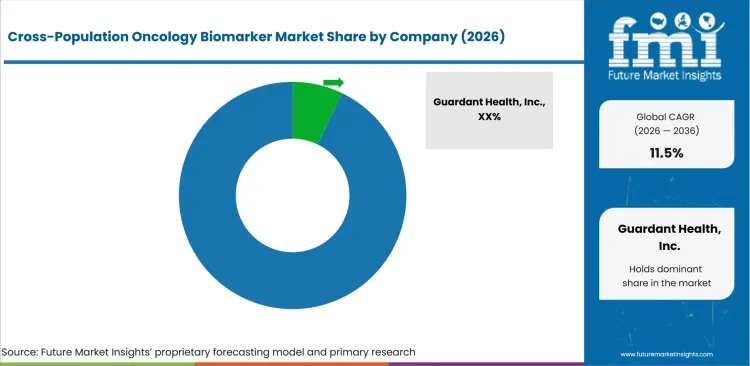
Competition combines regulated testing services with assay developers and laboratory platform companies that influence different steps of the clinical workflow. Illumina announced Japanese regulatory approval for TruSight Oncology Comprehensive in May 2025 and expanded comprehensive genomic profiling access through local laboratories. Abbott completed its acquisition of Exact Sciences on March 23, 2026 while the existing cancer-testing portfolio and customer service routes remained active. Foundation Medicine operates as an independent affiliate of Roche and GRAIL remains independent following its completed 2024 spin-off from Illumina. The field therefore spans complete clinical services and enabling in vitro diagnostics rather than one interchangeable product category. Selection depends on the intended decision and reimbursement route together with sample type and local service coverage.
- Guardant Health and Foundation Medicine provide comprehensive genomic profiling through blood or tissue services while Natera emphasizes tumor-informed residual disease monitoring. Each company competes through clinical reporting and payer access rather than sequencing hardware alone within routine oncology care.
- Roche Diagnostics and Thermo Fisher Scientific develop companion assays that identify therapy-eligible patients while Illumina and Bio-Rad support laboratory execution through sequencing or digital PCR platforms. The commercial value of these platform companies depends on validation and service continuity across installed laboratory systems.
- Abbott’s Exact Sciences business and GRAIL focus on multi-cancer early detection while QIAGEN combines companion diagnostic development with scalable PCR and NGS workflows. The distinct provider roles broaden addressable applications but require different evidence and confirmatory-care pathways for routine adoption.
Competitive Benchmarking: Cross-Population Oncology Biomarker Market
| Company | Treatment Selection | Early Detection and Monitoring | Laboratory Platform Support | Geographic Reach |
|---|---|---|---|---|
| Guardant Health, Inc. | High | High | Medium | Global |
| Foundation Medicine, Inc. | High | Medium | Medium | United States and Japan |
| Roche Diagnostics | High | Medium | High | Global |
| Illumina, Inc. | High | Medium | High | Global |
| Thermo Fisher Scientific Inc. | High | Low | High | Global |
| Exact Sciences (Abbott) | Medium | High | Medium | United States |
| Bio-Rad Laboratories, Inc. | Low | Medium | High | Global |
| QIAGEN N.V. | High | Medium | High | Global |
| GRAIL, Inc. | Low | High | Low | United States and United Kingdom |
| Natera, Inc. | Medium | High | Low | United States and selected international markets |
Treatment Selection receives High for a dedicated commercial assay or service that directly determines therapy eligibility. Medium reflects direct profiling support without broad therapy-matching coverage and Low reflects a documented enabling role without a standalone treatment-selection offer. Early Detection and Monitoring receives High for a dedicated commercial screening or residual-disease portfolio across defined clinical pathways. Medium reflects an active adjacent program and Low reflects narrow platform support without a broad clinical service. Laboratory Platform Support receives High for commercially available instruments or assay systems across multiple laboratories. Medium reflects a centralized proprietary platform and Low reflects a service model without general platform access. Every rating uses official records for the named capability rather than company size or broad corporate reputation.
Source basis: Official regulatory records, company newsrooms, current product documentation, and investor materials.
Key Developments in the Cross-Population Oncology Biomarker Market
- In September 2025, Exact Sciences Corporation launched the Cancerguard multi-cancer early detection blood test as a laboratory-developed test in the United States. Nationwide blood collection through Quest Diagnostics sites created a practical access route beyond specialist oncology centers. The service model reduced travel friction while preserving centralized laboratory processing and a defined confirmation pathway for positive findings.
- In April 2025, Natera announced the broad clinical launch of the Signatera Genome minimal residual disease test following pan-cancer validation across more than three thousand plasma samples. The launch expanded tumor-informed monitoring toward whole-genome analysis while retaining a centralized service model for recurring testing. Oncology programs gained a broader monitoring option that remained linked to patient-specific tumor information and repeated blood collection.
- In June 2025, QIAGEN N.V. added two strategic partnerships for minimal residual disease testing across solid tumors and lymphoma. The agreements connected QIAcuity digital PCR with blood-based monitoring and advanced a kit-based NGS route for decentralized clinical laboratories. The partnerships expanded assay-development choices while preserving separate validation requirements for each cancer pathway and laboratory setting.
- In May 2025, Roche Diagnostics received FDA approval for the VENTANA MET SP44 RxDx Assay to identify non-small cell lung cancer patients eligible for EMRELIS. The approval added a tissue-based protein biomarker route alongside genomic companion diagnostic options for treatment selection. Pathology laboratories gained a defined immunohistochemistry workflow that could use existing tissue-processing infrastructure and established interpretation controls.
Key Players in the Cross-Population Oncology Biomarker Market
Clinical Genomic Profiling and Monitoring Providers
- Guardant Health, Inc.
- Foundation Medicine, Inc.
- Natera, Inc.
Assay and Laboratory Platform Companies
- Roche Diagnostics
- Illumina, Inc.
- Thermo Fisher Scientific Inc.
- Bio-Rad Laboratories, Inc.
- QIAGEN N.V.
Multi-Cancer Early Detection Providers
- Exact Sciences Corporation, an Abbott company
- GRAIL, Inc.
Cross-Population Oncology Biomarker Market - Report Scope
| Coverage field | Report scope |
|---|---|
| Market breakdown | By Biomarker Type, Cancer Type, Population Type, Application, and Region |
| Quantitative Units | USD billion |
| Market Definition | Products and services that identify or interpret oncology biomarkers across defined population groups for cancer detection, treatment selection, prognosis, or disease monitoring. |
| Regions Covered | North America, Latin America, Western Europe, Eastern Europe, East Asia, South Asia and Pacific, and Middle East and Africa. |
| Countries Covered | USA, UK, Germany, Japan, South Korea, and more than 30 countries within the complete report. |
| Key Companies Profiled | Guardant Health, Foundation Medicine, Roche Diagnostics, Illumina, Thermo Fisher Scientific, Exact Sciences (Abbott), Bio-Rad, QIAGEN, GRAIL, and Natera. |
| Forecast Period | 2026 to 2036. |
| Approach | Hybrid bottom-up and top-down market sizing supported by segment-level analysis, product participation assessment, country adoption patterns, regulatory evaluation, and clinical workflow validation. |
Cross-Population Oncology Biomarker Market - Research Methodology
| Method | Approach |
|---|---|
| Primary Research | FMI analysts gathered input from manufacturers, service providers, technology developers, distributors, end users, procurement teams, and subject-matter experts. Interviews examined purchasing decisions, product or service evaluation, adoption barriers, approval requirements, pricing considerations, and expectations for technical or commercial support. Respondents were also asked what evidence is required before a trial, pilot, or initial order develops into regular purchasing. |
| Desk Research | Desk research covered government statistics, regulatory publications, trade data, industry associations, technical literature, standards, company filings, product information, and official corporate announcements. Sources were reviewed for relevance, publication date, geographic coverage, and consistency with the defined market scope. Claims relating to performance, applications, approvals, capacity, investment, and commercial activity were retained only when supported by credible public evidence. |
| Market Sizing and Forecasting | The market model combined the baseline value with historical performance, segment structure, pricing and volume indicators, adoption levels, company participation, and country-level demand conditions. Forecast assumptions considered economic activity, investment trends, regulatory developments, technology adoption, purchasing cycles, supply availability, and barriers to wider market use. Segment and regional estimates were reconciled before the final market total was calculated. |
| Data Validation | Estimates were checked against multiple independent indicators, including public data, company activity, trade patterns, industry developments, and findings from primary interviews. Validation also tested whether products, services, applications, and company revenues fell within the defined market boundaries. Adjacent categories, unsupported claims, overlapping revenues, and activities without direct market relevance were excluded to reduce double counting and maintain consistency across segments and countries. |
Cross-Population Oncology Biomarker Market by Segments
Cross-Population Oncology Biomarker Market segmented by Biomarker Type:
- Genomic Biomarkers
- Proteomic Biomarkers
- Circulating Tumor DNA (ctDNA)
- Circulating Tumor Cells (CTCs)
- Epigenetic Biomarkers
Cross-Population Oncology Biomarker Market segmented by Cancer Type:
- Lung Cancer
- Breast Cancer
- Colorectal Cancer
- Prostate Cancer
- Hematologic Malignancies
- Pan-Cancer Applications
Cross-Population Oncology Biomarker Market segmented by Population Type:
- Ethnically Diverse Populations
- Asian Populations
- Caucasian Populations
- African Populations
- Latin American Populations
Cross-Population Oncology Biomarker Market segmented by Application:
- Early Cancer Detection
- Treatment Selection
- Prognostic Biomarkers
- Minimal Residual Disease Monitoring
- Companion Diagnostics
Cross-Population Oncology Biomarker Market by Region
- North America
- United States
- Canada
- Latin America
- Brazil
- Mexico
- Argentina
- Chile
- Western Europe
- Germany
- France
- United Kingdom
- Italy
- Spain
- Benelux
- Nordics
- Eastern Europe
- Poland
- Czech Republic
- Romania
- Hungary
- East Asia
- China
- Japan
- South Korea
- South Asia and Pacific
- India
- ASEAN
- Australia and New Zealand
- Middle East and Africa
- GCC Countries
- South Africa
- Türkiye
- Israel
Research Sources and Bibliography
- National Cancer Institute. (2025, January 31). Cancer Research Needs People from All Backgrounds.
- National Cancer Institute. (n.d.). A New Blood Test for the Early Detection of Lung Cancer in Non-Tobacco Using Asian and Latinx/Hispanic Individuals, EQUAL Trial.
- National Cancer Institute, Division of Cancer Prevention. (2025, January 7). NCI Selects Two Assays for the Vanguard Study on Multi-Cancer Detection Tests.
- National Cancer Institute. (2021, December 14). Biomarker Testing for Cancer Treatment.
- USA Food and Drug Administration. (2026, June 10). Premarket Approval P200010/S027: Guardant360 CDx.
- USA Food and Drug Administration. (2025, November 19). Premarket Approval P160045/S050: Oncomine Dx Target Test.
- USA Food and Drug Administration. (2024, August 21). Premarket Approval P230011: TruSight Oncology Comprehensive.
- Department of Health and Social Care. (2026, March 5). Code on Genetic Testing and Insurance: 3-Year Review 2025.
- Federal Ministry of Health. (2026, March 2). genomeDE - National Strategy for Genomic Medicine.
- National Cancer Center Japan. (2026, January 8). [Clinical utility of cancer gene panel testing in routine practice].
- Ministry of Food and Drug Safety. (2025, December 31).[Guideline for approval and review of NGS-based tumor profiling in vitro diagnostic medical devices].
- Foundation Medicine. (2025, December 4). Foundation Medicine Achieves Historic Milestone of 100 Approved and Active Companion Diagnostic Indications, Solidifying Leadership in Precision Medicine.
- Illumina. (2025, May 27). Illumina Comprehensive Genomic Profiling Test for Cancer Receives Regulatory Approval in Japan.
- Exact Sciences Corporation. (2025, September 10). Exact Sciences Launches Cancerguard™, First-of-Its-Kind Multi-Cancer Early Detection Blood Test.
- Natera. (2025, April 24). Natera Announces Broad Clinical Launch of Ultra-Sensitive Signatera™ Genome MRD Test.
- QIAGEN. (2025, June 2). QIAGEN Expands Portfolio for Minimal Residual Disease (MRD) Testing in Oncology with New Strategic Partnerships.
- Roche Diagnostics. (2025, May 15). Roche Receives FDA Approval for the VENTANA MET (SP44) RxDx Assay as the First Companion Diagnostic to Identify Non-Small Cell Lung Cancer Patients Eligible for Treatment with EMRELIS™.
- Bio-Rad Laboratories. (2025, July 7). Bio-Rad Expands Droplet Digital PCR Offering Through Strategic Acquisition and Platform Rollout.
- GRAIL. (2026, February 19). Landmark NHS-Galleri Trial Demonstrates a Substantial Reduction in Stage IV Cancer Diagnoses, Increased Stage I and II Detection of Deadly Cancers, and Four-Fold Higher Cancer Detection Rate.
- Thermo Fisher Scientific. (2025, September 30). [Insurance coverage announced for a companion diagnostic system].
- Arora, K., Suehnholz, S. P., Zhang, H., Ostrovnaya, I., Kundra, R., Nandakumar, S., Nissan, M. H., Brannon, A. R., Bandlamudi, C., Ladanyi, M., Drilon, A., Brown, C. L., Solit, D. B., Schultz, N., Berger, M. F., & Chakravarty, D. (2025, January 9). Genetic Ancestry-Based Differences in Biomarker-Based Eligibility for Precision Oncology Therapies. JAMA Oncology, 11(3), 310-316. https://doi.org/10.1001/jamaoncol.2024.5794.
- Guardant Health. (n.d.). Guardant Complete® for Early and Advanced Stage Cancer.
- Foundation Medicine. (n.d.). Our Products and Services.
- Abbott. (2026, April 16). Q1 progress positions Abbott for accelerating growth in 2026.
- GRAIL. (2024, June 24). GRAIL to Begin Trading on the Nasdaq Stock Exchange.
This bibliography is provided for reader reference and is not exhaustive. The full report contains the complete reference list and detailed citations.
This Report Answers
- How large is the cross-population oncology biomarker market in 2026 and 2036?
- What supports growth in the cross-population oncology biomarker market through 2036?
- How do genomic biomarkers shape treatment selection across cancer populations?
- Why does lung cancer remain central to biomarker testing and companion diagnostics?
- How do population representation and ancestry-aware interpretation affect assay validation?
- How do country growth rates compare across the USA, UK, Germany, Japan, and South Korea?
- Which companies provide clinical tests and enabling laboratory platforms in this market?
- What technical and reimbursement constraints can limit routine biomarker adoption?
- Which commercial developments are changing early detection and residual disease monitoring?
- What should health systems evaluate before scaling cross-population oncology biomarker testing?
Frequently Asked Questions
What is driving growth in the cross-population oncology biomarker market?
Treatment-linked testing supports growth as oncology teams increasingly require molecular evidence before selecting targeted therapies. Broader population validation also expands clinical confidence across patients whose ancestry groups were underrepresented in earlier development datasets.
Who are the key players in the cross-population oncology biomarker market?
Key participants include clinical profiling providers and multi-cancer detection developers together with assay and laboratory platform companies. Their roles differ through sample type and clinical application as well as regulatory status and service coverage.
What is a notable restraint in the cross-population oncology biomarker market?
Uneven population representation can weaken interpretation confidence for variants with different ancestry-linked frequencies across development cohorts. Adoption also slows when reimbursement does not cover the test or the required confirmatory diagnostic work.
Why should executives track the cross-population oncology biomarker market?
The market connects oncology diagnostics with targeted therapy access and early detection programs across several national systems. Executives should track which evidence standards convert technical performance into routine purchasing and reimbursed clinical use.
What business problem does the cross-population oncology biomarker market address?
The market helps clinical teams translate complex biological signals into a defined cancer detection or treatment decision. Representative evidence reduces the risk that one assay performs differently across populations without clear clinical explanation.
What should oncology laboratories evaluate in the cross-population oncology biomarker market?
Oncology laboratories should evaluate specimen requirements and analytical performance together with interpretation rules and turnaround time. Contracts also need clear responsibilities for failed samples and confirmatory testing as well as software updates and service response.
What limits return on investment in the cross-population oncology biomarker market?
Return declines when low testing volume leaves specialized workflows underused or results fail to change clinical management. Uncertain coverage and extended confirmation pathways can also transfer costs toward hospitals without creating corresponding treatment value.
What supports long-term commercial confidence in the cross-population oncology biomarker market?
Long-term confidence depends on representative validation and regulated clinical utility across several cancer pathways and population groups. Durable providers also need reimbursement access and reliable service networks that preserve result quality across operating locations.
Preview the report firsthand - request a free sample
Get SampleGet the brochure for pricing and purchase details.
Get PDFTable of Content
- Key Takeaways
- Market Size and CAGR
- Top Growth Driver
- Fastest Growing Segment
- Leading Region
- Key Companies
- Emerging Opportunities
- Executive Summary
- Global Market Outlook
- Demand-side Trends
- Supply-side Trends
- Technology Roadmap Analysis
- Analysis and Recommendations
- Analyst Perspective (What is happening? Why now? What should investors know?)
- Key Questions Answered
- How large is the market?
- What is the CAGR?
- What are key trends?
- Which region dominates?
- Who are the leaders?
- Market Overview
- Market Coverage / Taxonomy
- Market Definition / Scope / Limitations
- Research Methodology
- Chapter Orientation
- Analytical Lens and Working Hypotheses
- Market Structure, Signals, and Trend Drivers
- Benchmarking and Cross-market Comparability
- Market Sizing, Forecasting, and Opportunity Mapping
- Research Design and Evidence Framework
- Desk Research Programme (Secondary Evidence)
- Expert Input and Fieldwork (Primary Evidence)
- Tooling, Models, and Reference Databases
- Data Engineering and Model Build
- Quality Assurance and Audit Trail
- Market Background
- Market Dynamics (Drivers, Restraints, Opportunity, Trends)
- Scenario Forecast (Optimistic, Likely, Conservative)
- Impact Analysis
- AI Impact
- Sustainability Impact
- Regulatory Impact
- Technology Impact
- Consumer / Buyer Analysis
- Purchase Drivers
- Adoption Barriers
- Buyer Journey
- Opportunity Map Analysis
- Product Life Cycle Analysis
- Supply Chain Analysis
- Investment Feasibility Matrix
- Value Chain Analysis
- PESTLE and Porter's Analysis
- Regulatory Landscape
- Regional Parent Market Outlook
- Production and Consumption Statistics
- Import and Export Statistics
- Global Market Analysis and Forecast, 2021 to 2036
- Historical Market Size Value (USD Billion) Analysis, 2021 to 2025
- Current and Future Market Size Value (USD Billion) Projections, 2026 to 2036
- Y-o-Y Growth Trend Analysis
- Absolute $ Opportunity Analysis
- Global Market Pricing Analysis, 2021 to 2036
- Global Market Analysis and Forecast, By Biomarker Type, 2021 to 2036
- Introduction / Key Findings
- Historical Market Size Value (USD Billion) Analysis By Biomarker Type, 2021 to 2025
- Current and Future Market Size Value (USD Billion) Analysis and Forecast By Biomarker Type, 2026 to 2036
- Genomic Biomarkers
- Proteomic Biomarkers
- Circulating Tumor DNA (ctDNA)
- Circulating Tumor Cells (CTCs)
- Epigenetic Biomarkers
- Genomic Biomarkers
- Y-o-Y Growth Trend Analysis By Biomarker Type, 2021 to 2025
- Absolute $ Opportunity Analysis By Biomarker Type, 2026 to 2036
- Global Market Analysis and Forecast, By Cancer Type, 2021 to 2036
- Introduction / Key Findings
- Historical Market Size Value (USD Billion) Analysis By Cancer Type, 2021 to 2025
- Current and Future Market Size Value (USD Billion) Analysis and Forecast By Cancer Type, 2026 to 2036
- Lung Cancer
- Breast Cancer
- Colorectal Cancer
- Prostate Cancer
- Hematologic Malignancies
- Pan-Cancer Applications
- Lung Cancer
- Y-o-Y Growth Trend Analysis By Cancer Type, 2021 to 2025
- Absolute $ Opportunity Analysis By Cancer Type, 2026 to 2036
- Global Market Analysis and Forecast, By Population Type, 2021 to 2036
- Introduction / Key Findings
- Historical Market Size Value (USD Billion) Analysis By Population Type, 2021 to 2025
- Current and Future Market Size Value (USD Billion) Analysis and Forecast By Population Type, 2026 to 2036
- Ethnically Diverse Populations
- Asian Populations
- Caucasian Populations
- African Populations
- Latin American Populations
- Ethnically Diverse Populations
- Y-o-Y Growth Trend Analysis By Population Type, 2021 to 2025
- Absolute $ Opportunity Analysis By Population Type, 2026 to 2036
- Global Market Analysis and Forecast, By Application, 2021 to 2036
- Introduction / Key Findings
- Historical Market Size Value (USD Billion) Analysis By Application, 2021 to 2025
- Current and Future Market Size Value (USD Billion) Analysis and Forecast By Application, 2026 to 2036
- Early Cancer Detection
- Treatment Selection
- Prognostic Biomarkers
- Minimal Residual Disease Monitoring
- Companion Diagnostics
- Early Cancer Detection
- Y-o-Y Growth Trend Analysis By Application, 2021 to 2025
- Absolute $ Opportunity Analysis By Application, 2026 to 2036
- Global Market Analysis and Forecast, By Region, 2021 to 2036
- Introduction
- Historical Market Size Value (USD Billion) Analysis By Region, 2021 to 2025
- Current Market Size Value (USD Billion) Analysis and Forecast By Region, 2026 to 2036
- North America
- Latin America
- Western Europe
- Eastern Europe
- East Asia
- South Asia and Pacific
- Middle East & Africa
- Market Attractiveness Analysis By Region
- North America Market Analysis and Forecast, By Country, 2021 to 2036
- Historical Market Size Value (USD Billion) Trend Analysis By Market Taxonomy, 2021 to 2025
- Market Size Value (USD Billion) Forecast By Market Taxonomy, 2026 to 2036
- By Country
- USA
- Canada
- By Biomarker Type
- By Cancer Type
- By Population Type
- By Application
- By Country
- Market Attractiveness Analysis
- By Country
- By Biomarker Type
- By Cancer Type
- By Population Type
- By Application
- Key Takeaways
- Latin America Market Analysis and Forecast, By Country
- Historical Market Size Value (USD Billion) Trend Analysis By Market Taxonomy, 2021 to 2025
- Market Size Value (USD Billion) Forecast By Market Taxonomy, 2026 to 2036
- By Country
- Brazil
- Mexico
- Chile
- Rest of Latin America
- By Biomarker Type
- By Cancer Type
- By Population Type
- By Application
- By Country
- Market Attractiveness Analysis
- By Country
- By Biomarker Type
- By Cancer Type
- By Population Type
- By Application
- Key Takeaways
- Western Europe Market Analysis and Forecast, By Country
- Historical Market Size Value (USD Billion) Trend Analysis By Market Taxonomy, 2021 to 2025
- Market Size Value (USD Billion) Forecast By Market Taxonomy, 2026 to 2036
- By Country
- Germany
- UK
- Italy
- Spain
- France
- Nordic
- BENELUX
- Rest of Western Europe
- By Biomarker Type
- By Cancer Type
- By Population Type
- By Application
- By Country
- Market Attractiveness Analysis
- By Country
- By Biomarker Type
- By Cancer Type
- By Population Type
- By Application
- Key Takeaways
- Eastern Europe Market Analysis and Forecast, By Country
- Historical Market Size Value (USD Billion) Trend Analysis By Market Taxonomy, 2021 to 2025
- Market Size Value (USD Billion) Forecast By Market Taxonomy, 2026 to 2036
- By Country
- Russia
- Poland
- Hungary
- Balkan & Baltic
- Rest of Eastern Europe
- By Biomarker Type
- By Cancer Type
- By Population Type
- By Application
- By Country
- Market Attractiveness Analysis
- By Country
- By Biomarker Type
- By Cancer Type
- By Population Type
- By Application
- Key Takeaways
- East Asia Market Analysis and Forecast, By Country
- Historical Market Size Value (USD Billion) Trend Analysis By Market Taxonomy, 2021 to 2025
- Market Size Value (USD Billion) Forecast By Market Taxonomy, 2026 to 2036
- By Country
- China
- Japan
- South Korea
- By Biomarker Type
- By Cancer Type
- By Population Type
- By Application
- By Country
- Market Attractiveness Analysis
- By Country
- By Biomarker Type
- By Cancer Type
- By Population Type
- By Application
- Key Takeaways
- South Asia and Pacific Market Analysis and Forecast, By Country
- Historical Market Size Value (USD Billion) Trend Analysis By Market Taxonomy, 2021 to 2025
- Market Size Value (USD Billion) Forecast By Market Taxonomy, 2026 to 2036
- By Country
- India
- ASEAN
- Australia & New Zealand
- Rest of South Asia and Pacific
- By Biomarker Type
- By Cancer Type
- By Population Type
- By Application
- By Country
- Market Attractiveness Analysis
- By Country
- By Biomarker Type
- By Cancer Type
- By Population Type
- By Application
- Key Takeaways
- Middle East & Africa Market Analysis and Forecast, By Country
- Historical Market Size Value (USD Billion) Trend Analysis By Market Taxonomy, 2021 to 2025
- Market Size Value (USD Billion) Forecast By Market Taxonomy, 2026 to 2036
- By Country
- Kingdom of Saudi Arabia
- Other GCC Countries
- Türkiye
- South Africa
- Other African Union
- Rest of Middle East & Africa
- By Biomarker Type
- By Cancer Type
- By Population Type
- By Application
- By Country
- Market Attractiveness Analysis
- By Country
- By Biomarker Type
- By Cancer Type
- By Population Type
- By Application
- Key Takeaways
- Key Countries Market Analysis
- USA
- Pricing Analysis
- Market Share Analysis, 2025
- By Biomarker Type
- By Cancer Type
- By Population Type
- By Application
- Canada
- Pricing Analysis
- Market Share Analysis, 2025
- By Biomarker Type
- By Cancer Type
- By Population Type
- By Application
- Mexico
- Pricing Analysis
- Market Share Analysis, 2025
- By Biomarker Type
- By Cancer Type
- By Population Type
- By Application
- Brazil
- Pricing Analysis
- Market Share Analysis, 2025
- By Biomarker Type
- By Cancer Type
- By Population Type
- By Application
- Chile
- Pricing Analysis
- Market Share Analysis, 2025
- By Biomarker Type
- By Cancer Type
- By Population Type
- By Application
- Germany
- Pricing Analysis
- Market Share Analysis, 2025
- By Biomarker Type
- By Cancer Type
- By Population Type
- By Application
- UK
- Pricing Analysis
- Market Share Analysis, 2025
- By Biomarker Type
- By Cancer Type
- By Population Type
- By Application
- Italy
- Pricing Analysis
- Market Share Analysis, 2025
- By Biomarker Type
- By Cancer Type
- By Population Type
- By Application
- Spain
- Pricing Analysis
- Market Share Analysis, 2025
- By Biomarker Type
- By Cancer Type
- By Population Type
- By Application
- France
- Pricing Analysis
- Market Share Analysis, 2025
- By Biomarker Type
- By Cancer Type
- By Population Type
- By Application
- India
- Pricing Analysis
- Market Share Analysis, 2025
- By Biomarker Type
- By Cancer Type
- By Population Type
- By Application
- ASEAN
- Pricing Analysis
- Market Share Analysis, 2025
- By Biomarker Type
- By Cancer Type
- By Population Type
- By Application
- Australia & New Zealand
- Pricing Analysis
- Market Share Analysis, 2025
- By Biomarker Type
- By Cancer Type
- By Population Type
- By Application
- China
- Pricing Analysis
- Market Share Analysis, 2025
- By Biomarker Type
- By Cancer Type
- By Population Type
- By Application
- Japan
- Pricing Analysis
- Market Share Analysis, 2025
- By Biomarker Type
- By Cancer Type
- By Population Type
- By Application
- South Korea
- Pricing Analysis
- Market Share Analysis, 2025
- By Biomarker Type
- By Cancer Type
- By Population Type
- By Application
- Russia
- Pricing Analysis
- Market Share Analysis, 2025
- By Biomarker Type
- By Cancer Type
- By Population Type
- By Application
- Poland
- Pricing Analysis
- Market Share Analysis, 2025
- By Biomarker Type
- By Cancer Type
- By Population Type
- By Application
- Hungary
- Pricing Analysis
- Market Share Analysis, 2025
- By Biomarker Type
- By Cancer Type
- By Population Type
- By Application
- Kingdom of Saudi Arabia
- Pricing Analysis
- Market Share Analysis, 2025
- By Biomarker Type
- By Cancer Type
- By Population Type
- By Application
- Türkiye
- Pricing Analysis
- Market Share Analysis, 2025
- By Biomarker Type
- By Cancer Type
- By Population Type
- By Application
- South Africa
- Pricing Analysis
- Market Share Analysis, 2025
- By Biomarker Type
- By Cancer Type
- By Population Type
- By Application
- USA
- Market Structure Analysis
- Competition Dashboard
- Competition Benchmarking
- Market Share Analysis of Top Players
- By Regional
- By Biomarker Type
- By Cancer Type
- By Population Type
- By Application
- Emerging Startups
- Innovation Benchmarking
- Competition Analysis
- Competition Deep Dive
- Guardant Health, Inc.
- Overview
- Product Portfolio
- Profitability by Market Segments
- Sales Footprint
- Strategy Overview
- Marketing Strategy
- Product Strategy
- Channel Strategy
- Foundation Medicine, Inc.
- Roche Diagnostics
- Illumina, Inc.
- Thermo Fisher Scientific Inc.
- Exact Sciences Corporation
- Bio-Rad Laboratories, Inc.
- Qiagen N.V.
- Grail, Inc.
- Natera, Inc.
- Guardant Health, Inc.
- Case Studies
- Success Stories
- Recent Developments
- Competition Deep Dive
- Assumptions & Acronyms Used


