

- Market Size (2026)
- USD 1100.8 Mn
- Forecast (2036)
- USD 2443.5 Mn
- CAGR (2026 to 2036)
- 8.3%
How big is Endoscopic Imaging Service Market in 2026?
USD 1,100.8 million in 2026 and USD 2,443.5 million by 2036 at an 8.3% CAGR.
Demand for endoscopic imaging services is projected to rise at 8.3% CAGR between 2026 and 2036, taking industry valuation from USD 1100.8 million to USD 2443.5 million. Recurring procedure workloads support that valuation through maintenance and interpretation services delivered across hospital or specialty-care networks. Service spending rises as procedure teams require reliable image capture and equipment uptime across flexible endoscope systems. The American Cancer Society estimated 158,850 new colorectal cancer cases for 2026 in January 2026. That disease burden sustains diagnostic and surveillance workload for gastroenterology teams across hospitals and specialty centers. Hospitals convert workload into recurring revenue through scheduling support and maintenance contracts across diagnostic imaging services. Providers therefore compare image quality with uptime guarantees rather than treating equipment purchase and service support as separate decisions.
Public health systems and commercial providers create different adoption routes across the United States and the United Kingdom. United States providers use hospital networks and ambulatory surgical centers to spread procedures across several purchasing models. NHS England reported in October 2025 that capacity investment delivered 275,000 additional endoscopies during the 2024/25 reporting period. British procurement places greater weight on waiting-list relief and service availability across regional endoscopy units. American contracts more often separate equipment ownership from service coverage across hospital groups and independent centers. Both systems require trained technicians and validated replacement routes because imaging downtime interrupts entire procedure lists. Reporting time and service response then determine whether installed systems improve throughput without shifting burden elsewhere.
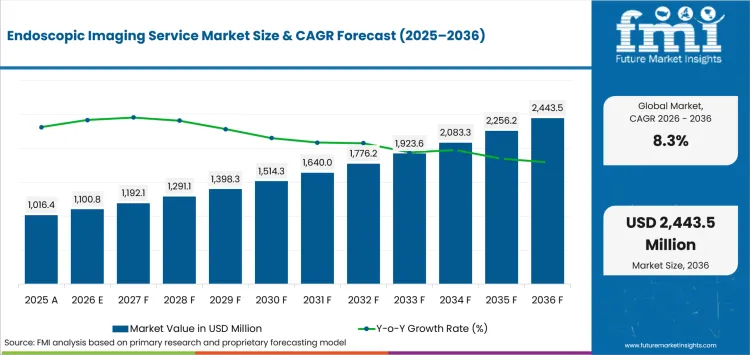
Key Takeaways of Endoscopic Imaging Service Market
- Demand for endoscopic imaging services is driven by diagnostic workload creating recurring spending through dependable imaging performance and accountable service coverage that protects scheduled procedure capacity.
- By service type, imaging procedure services hold the leading share at 44.0% in 2026, supported by direct responsibility for procedure delivery.
- Hospitals lead end-user demand at 31.6% share in 2026, reflecting concentrated rooms and recurring equipment support needs.
- Endoscopic imaging systems account for 43.2% equipment-type share in 2026, enabled by integrated processors and display infrastructure.
- Gastroenterology captures 34.0% application share in 2026, influenced by screening and surveillance workloads across digestive care.
- South Korea records the highest CAGR at 10.3% through 2036, enabled by dense tertiary-care capacity and organized cancer screening pathways, while the USA, Germany, and UK follow more measured paths shaped by established networks and public procurement.
- Competition centers on Olympus, Fujifilm Healthcare, KARL STORZ, Stryker, Medtronic, PENTAX Medical, STERIS, and Agiliti Health, with vendors differentiating through integrated processor-scope service programs, operating-room visualization, AI-assisted colonoscopy, and mixed-fleet repair coverage.
Analyst Perspective
"The endoscopic imaging service market is increasingly evaluated on its ability to sustain clinical throughput while preserving imaging quality across the equipment lifecycle. Healthcare providers are assessing image performance, system availability, and service responsiveness as distinct operational measures that directly influence procedure capacity. Companies that combine dependable technical support, predictable maintenance, and validated workflow integration will be better positioned to build long-term relationships with hospitals and endoscopy centers."
- Anurag Sharma, Principal Analyst at Future Market Insights
Source: FMI's proprietary forecasting model and primary research
How is the Endoscopic Imaging Service Market segmented?
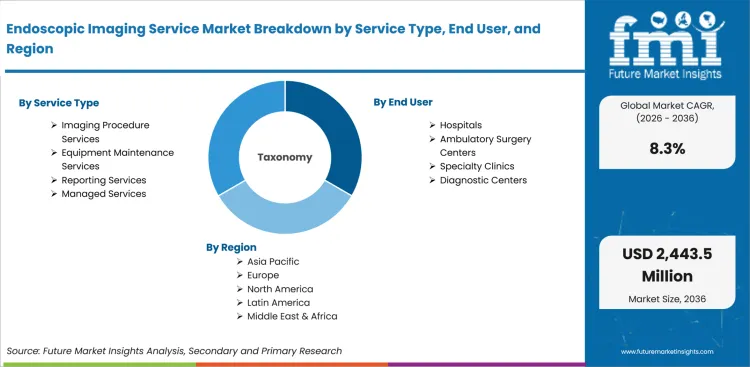
The endoscopic imaging service market is segmented by Service Type, End User, Equipment Type, Application, and Region.
Service type separates imaging procedure delivery from equipment maintenance and reporting contracts that assign operating responsibility. End user distinguishes hospitals from ambulatory surgery centers and specialty facilities with different utilization or purchasing models. Equipment type separates complete imaging systems from video endoscopes and capsule systems together with supporting accessories. Application maps service demand across gastroenterology and pulmonology as well as urology and ear nose throat procedures.
What supports demand for imaging procedure services within the service type category?
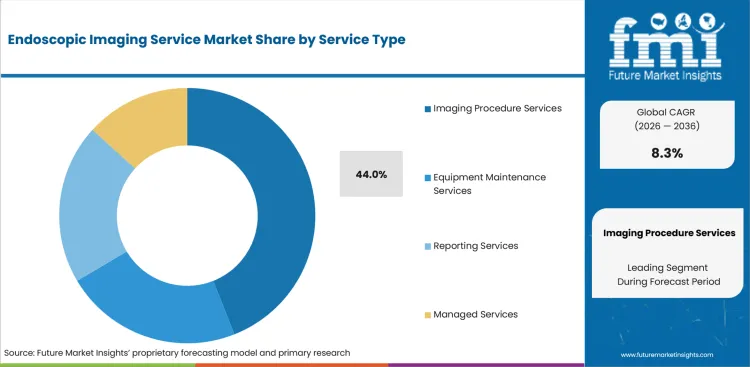
Imaging procedure services coordinate equipment access and clinical scheduling across a complete endoscopy session rather than a single repair event. The Northern Ireland Department of Health reported in November 2025 that endoscopy waits fell 62% by 24,410 patients through regional centers and flexible capacity. That operating model shows how managed procedure capacity can convert equipment availability into completed examinations across constrained systems. Service providers therefore assess staffing accountability and scheduling ownership beside image quality during each contract selection.
- Imaging procedure services are projected to account for 44.0% of service type revenue in 2026, supported by direct responsibility for completing scheduled examinations. The category combines imaging access with staffing coordination and workflow ownership across each patient appointment within regional hospital networks.
- Hospital networks use imaging procedure services to add capacity without purchasing every system or employing every technical specialist internally. Adoption depends on clear clinical governance and documented escalation routes that preserve patient safety during unexpected equipment or staffing failures across peak demand periods.
How do hospitals convert endoscopy workload into recurring service demand?
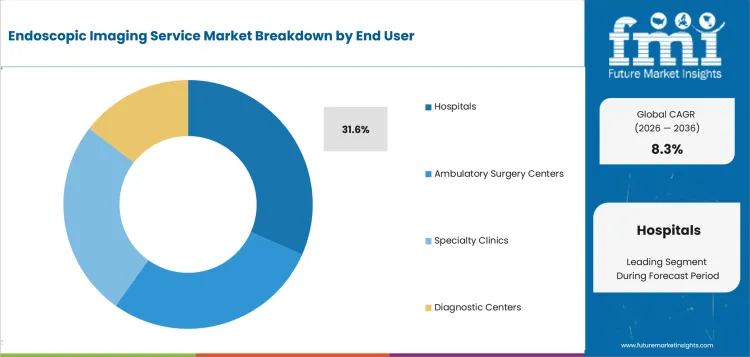
Hospitals concentrate several procedure rooms and clinical specialties around shared imaging processors and technical support teams. A failed processor can therefore disrupt multiple lists even though individual scopes remain available for clinical use. Fujifilm announced in June 2026 that its new 18,000-square-foot warehouse enabled a service-center expansion to approximately 1.5 times its earlier size. Hospitals favor providers that connect installed equipment with responsive logistics and repair capacity across normal operating schedules.
- Hospitals are estimated to hold 31.6% of end-user revenue in 2026, owing to concentrated procedure volume and complex asset fleets. Centralized purchasing also supports standardized training and maintenance agreements across several departments and clinical specialties within the same health system.
- Clinical engineering teams compare service response and compatibility across endoscopy visualization systems used in gastroenterology and surgical suites. Hospitals expand contracts once providers demonstrate loaner access and preventive maintenance that protect scheduled cases without creating separate support channels during routine operating weeks.
How are endoscopic imaging systems positioned within the equipment type category?
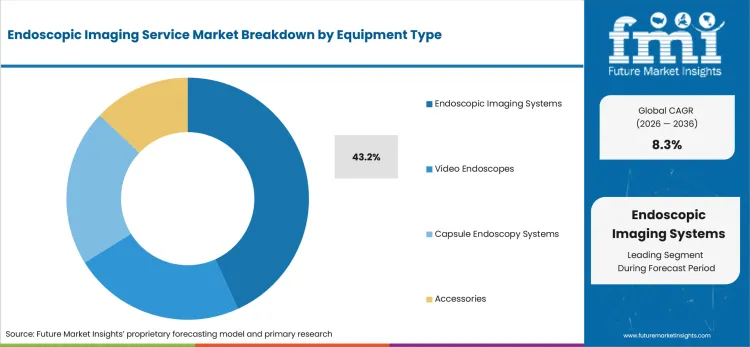
Endoscopic imaging systems combine processors and light sources with monitors and compatible scopes across one clinical image chain. Platform compatibility reduces setup changes and supports consistent image handling across several rooms or specialties. Procurement committees therefore examine upgrade paths and service coverage alongside image specifications during platform selection. Olympus launched new 4K LCD monitors in June 2026 for Japan and several international markets as part of its endoscopy portfolio. The development reinforces the need for service providers that support complete connected platforms rather than isolated components.
- Endoscopic imaging systems are forecast to represent 43.2% of equipment type revenue in 2026, enabled by their central role in image acquisition. Processors and displays also create recurring calibration or maintenance needs that remain visible across each supported scope family.
- Endoscopy departments select integrated systems to simplify training and preserve consistent image output across rotating clinical teams. Service value increases as providers coordinate software updates and component replacement without interrupting validated settings across connected rooms and preserve documented configuration control.
What makes gastroenterology central to the application category?
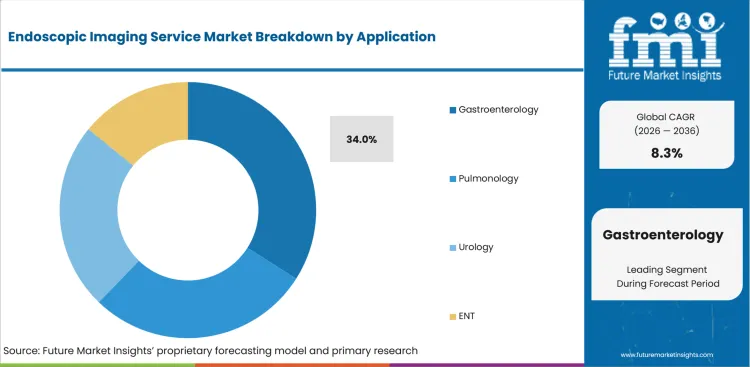
Gastroenterology combines screening and surveillance with therapeutic procedures that require dependable imaging across varied patient pathways. CDC researchers reported in August 2025 that 53.4% of adults aged 45 to 75 had received colonoscopy within ten years during 2023. The statistic establishes a broad procedural base for service planning without independently proving the approved application share. Gastroenterology providers need consistent visualization and rapid repair support because a single room often serves many procedure types.
- Gastroenterology is anticipated to capture 34.0% share in 2026, reflecting recurring colonoscopy and upper gastrointestinal workloads. The category also benefits from shared processors that support diagnostic observation and therapeutic intervention during the same appointment across recurring care pathways.
- Gastroenterologists evaluate AI colonoscopy monitoring as an adjunct to established imaging rather than a substitute for specialist judgment. Adoption strengthens through training and documented quality measures that separate detection support from complete clinical interpretation responsibilities during routine departmental quality review.
What are the drivers, restraints, and opportunities in the Endoscopic Imaging Service Market?
Screening and surveillance workload supports demand; reprocessing and uptime obligations restrain adoption; connected AI and service models create a practical opening for better procedure quality.
- Driver: Screening and surveillance programs create recurring procedure workloads that require dependable imaging availability across hospitals and specialty centers.
- Restraint: Complex reprocessing and repair obligations can remove expensive scopes from service and disrupt scheduled procedure capacity.
- Opportunity: Connected interpretation tools and managed support can improve quality oversight without replacing specialist clinical judgment.
Unmet screening needs create recurring demand for reliable image capture and available procedure slots across established care pathways. CDC researchers reported in August 2025 that 69.4 million adults aged 45 to 75 were current with screening and 32.3% had never been screened. Hospitals and specialty centers need dependable equipment capacity to serve both surveillance patients and newly eligible populations. Service contracts gain value through uptime guarantees and response standards that convert equipment availability into completed examinations.
Reusable endoscopes create an operating constraint because complex cleaning and repair requirements can reduce available procedure capacity. Facilities therefore evaluate endoscope reprocessing devices together with scope design and service coverage across the complete instrument cycle. The FDA posted a November 2025 recall covering 7,023 EVIS EXERA III duodenovideoscopes following reports of positive cultures and infections. Hospitals must maintain validated training and replacement routes so reprocessing corrections do not interrupt essential procedures. Adoption remains constrained across sites that lack nearby service coverage or dependable loaner equipment for required turnaround periods.
Connected interpretation creates a credible opening for service providers that combine software access with workflow validation and clinical training. Providers can use medical imaging software to structure review and documentation without replacing the endoscopist responsible for diagnosis. Managed contracts can also combine compatibility testing with updates and user support across several procedure rooms. Olympus announced the commercial launch of OLYSENSE CAD/AI in the United States and Europe during September 2025. The opportunity depends on defined oversight and local performance monitoring that separate software assistance from clinical accountability.
Which country CAGRs are profiled in the Endoscopic Imaging Service Market?
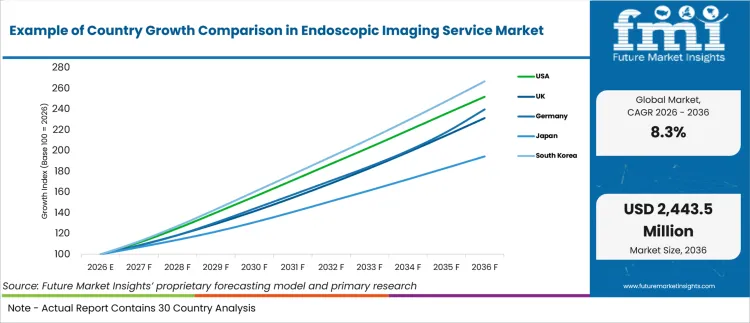
| Country | CAGR |
|---|---|
| USA | 9.7% |
| UK | 8.8% |
| Germany | 9.1% |
| Japan | 6.9% |
| South Korea | 10.3% |
How do country-level CAGRs compare in the Endoscopic Imaging Service Market?
The five-country comparison spans 3.4 percentage points and separates one measured upper pair from a lower outlier. South Korea and the USA remain within 0.6 percentage point across the complete forecast window. Germany and the UK form another compressed pair with a difference of 0.3 percentage point. Japan sits 1.9 points below the UK and therefore follows a more measured forecast path. The measured spacing reflects different entry conditions rather than current market size or installed-base rankings between countries. The overall range remains moderate enough that service readiness can outweigh small forecast differences during market entry.
- South Korea and the USA occupy the upper band through different screening systems and service-purchasing structures.
- Germany remains close to the USA but channels adoption through statutory coverage and regulated clinical practice.
- The UK follows Germany closely while public procurement places greater weight on waiting-list relief and regional capacity.
- Japan remains outside the central cluster through longer replacement cycles and demanding product qualification requirements.
- Similar percentages can produce different revenue timing as service coverage and training determine usable installed capacity.
Comparable CAGRs can create different entry conditions through reimbursement and service reach together with facility scale and purchasing cycles. The full report provides country-level CAGR analysis across North America, Latin America, Europe, East Asia, South Asia, Oceania and the Middle East and Africa.
Country-wise Analysis
- United States providers distribute endoscopy workload across large hospitals and independent centers with separate service purchasing arrangements. Demand for endoscopic imaging services in the USA is projected to rise at 9.7% CAGR through 2036, shaped by broad screening activity and extensive provider networks. The CDC reported in June 2025 that about seven in ten adults aged 50 to 75 were current with colorectal cancer screening. Procedure volume enables recurring support contracts but fragmented payment and site ownership can complicate standardization across networks. Vendors need national repair routes and loaner coverage that protect procedure lists across both hospital and outpatient settings.
- United Kingdom endoscopy purchasing operates through public systems that connect equipment capacity with national waiting-time objectives. The UK endoscopic imaging service outlook is anticipated to advance at 8.8% CAGR during the forecast period, supported by capacity programs and regional service planning. The Department of Health and Social Care reported in May 2025 that 44,000 fewer patients waited longer than six weeks for diagnostic tests. Public investment enables additional activity but workforce availability and constrained budgets remain material frictions for sustained expansion. Service providers need durable support commitments that protect regional procedure throughput after temporary capacity funding programs conclude.
- Germany combines statutory screening access with a distributed network of hospital departments and specialist gastroenterology practices. The G-BA confirmed in April 2025 that women and men aged 50 can receive two screening colonoscopies ten years apart. Germany’s endoscopic imaging service sector is estimated to post 9.1% CAGR through 2036, reflecting standardized access and established clinical infrastructure. ERCP device workflows also require local training and documented reprocessing across technically complex gastrointestinal procedures. Coverage creates an adoption enabler but regulatory documentation and service consistency remain demanding across dispersed sites. Commercial plans should include German-language training and responsive parts logistics that reach smaller specialist practices outside major cities.
- Japanese facilities value compact equipment and dependable local support across procedure rooms with limited physical space. Adoption of endoscopic imaging services in Japan is estimated to expand at 6.9% CAGR by 2036, linked to replacement cycles and strict quality expectations. Olympus announced in October 2025 that EVIS X1 systems with NBI+TXI observation mode would begin sales in Japan during November. Broader ENT endoscopy systems create adjacent service demand but each specialty requires separate accessories and training. Domestic product availability enables replacement programs while qualification effort and technician capacity can delay multi-site deployment. Service providers should offer compact loaner equipment and locally stocked parts that preserve scheduled procedures during maintenance periods.
- South Korea combines organized cancer screening with dense tertiary hospitals and advanced digital clinical infrastructure. The South Korean endoscopic imaging service sector is forecast to record 10.3% CAGR from 2026 to 2036, enabled by screening participation and concentrated specialist capacity. National Health Insurance Service data dated March 2026 placed the provisional 2025 cancer-screening participation rate at 61.4% across six cancer programs. High participation supports procedure throughput but technical service remains concentrated around major urban medical centers. Distributors need trained field engineers and financing structures that extend reliable support beyond Seoul and other large cities.
Who are the notable companies in the Endoscopic Imaging Service Market?
Olympus, Fujifilm Healthcare, KARL STORZ, Stryker, Medtronic, PENTAX Medical, STERIS, and Agiliti Health are the notable companies shaping this market.
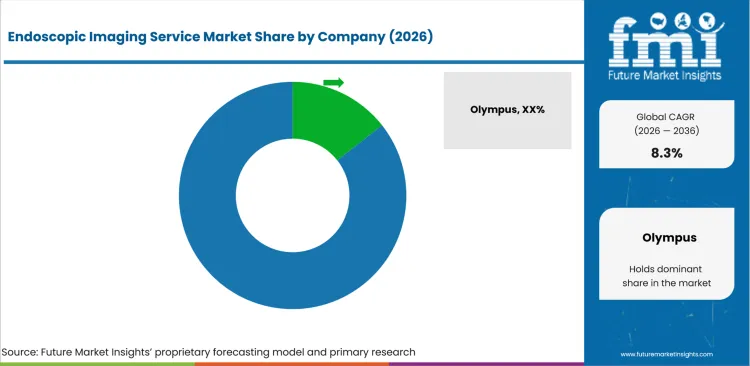
Competition separates integrated imaging platforms from specialist software and independent repair services across the endoscopy equipment lifecycle. Olympus documents a combined portfolio covering processors and scopes together with digital tools and original-equipment service. Fujifilm Healthcare and PENTAX Medical combine gastrointestinal imaging systems with technical support for installed equipment. KARL STORZ and Stryker connect procedural imaging with laparoscopic visualization equipment and operating-room workflow support. Medtronic supplies an AI-assisted colonoscopy module that supports interpretation rather than replacing the complete endoscope platform. STERIS and Agiliti Health document flexible-endoscope repair programs that emphasize turnaround and procedure continuity across high-use facilities. Selection therefore depends on exact platform fit and local service reach rather than corporate scale alone.
- Olympus and Fujifilm Healthcare join PENTAX Medical as integrated gastrointestinal platform providers with proprietary imaging systems and original-equipment support.
- KARL STORZ and Stryker supply multispecialty visualization and workflow integration while Medtronic adds AI-assisted colonoscopy interpretation.
- STERIS and Agiliti Health provide independent repair coverage that supports mixed flexible-endoscope fleets and reduces procedure disruption.
Competitive Benchmarking: Endoscopic Imaging Service Market
| Company | Imaging Platform Breadth | Service and Repair Coverage | Workflow and Data Integration | Geographic Reach |
|---|---|---|---|---|
| Olympus | High | High | High | Global |
| Fujifilm Healthcare | High | High | Medium | Global |
| KARL STORZ | High | High | High | Global |
| Stryker | High | High | Medium | Global |
| Medtronic | Medium | Medium | High | North America and Europe |
| PENTAX Medical | High | High | Medium | Global |
| STERIS | Low | High | Medium | Global |
| Agiliti Health | Low | High | Low | United States |
Key Developments in the Endoscopic Imaging Service Market
- In May 2025, Olympus announced FDA clearance for its EZ1500 series gastroscope and colonoscope using Extended Depth of Field technology within the EVIS X1 system. The continuously broad focus reduces focal adjustment during mucosal inspection and expands the service requirement for validated processor compatibility and specialist training across United States installations and future platform upgrades.
- In October 2025, Fujifilm Healthcare launched the ELUXEO 8000 Endoscopic Imaging System with a combined processor and light source plus compatibility across several endoscope generations. The platform adds 4K imaging and several light modes across mixed fleets that include older compatible endoscopes. Hospitals therefore require integration support and coordinated maintenance that preserve consistent settings across multiple endoscope generations.
- In February 2026, Medtronic announced CE Mark for ColonPRO software and the next-generation GI Genius module for AI-assisted colonoscopy. ColonPRO adds real-time polyp sizing while the updated GI Genius module creates procedural highlights across approved European installations. Multi-site endoscopy programs therefore require validation and technical training that assign software oversight or escalation responsibility across clinical teams.
- In July 2025, PENTAX Medical and Advanced Sterilization Products made the Sterilizable DEC reusable duodenoscope available in the United States with a 68-minute sterilization pathway. The system gives hospitals another infection-control option but requires compatible sterilization equipment and trained service teams with documented procedures before routine deployment across ERCP departments. Hospitals must validate each sterilization cycle and maintain local technical support so high-use ERCP rooms retain dependable scope availability.
Key Players in the Endoscopic Imaging Service Market
Integrated Endoscopy Platform Providers
- Olympus
- Fujifilm Healthcare
- KARL STORZ
- Stryker
- PENTAX Medical
AI and Procedure Support Providers
- Medtronic
Independent Endoscope Service Providers
- STERIS
- Agiliti Health
Endoscopic Imaging Service Market - Report Scope
| Coverage field | Report scope |
|---|---|
| Market breakdown | Service Type, End User, Equipment Type, Application, and region. |
| Quantitative Units | Revenue in USD Million, CAGR in %. |
| Market Definition | Services supporting endoscopic image acquisition, system availability, interpretation, reporting, maintenance, and managed workflow delivery for diagnostic and procedural care. |
| Regions Covered | North America, Latin America, Western Europe, Eastern Europe, East Asia, South Asia and Pacific, and Middle East and Africa. |
| Countries Covered | USA, UK, Germany, Japan, and South Korea |
| Key Companies Profiled | Olympus, Fujifilm Healthcare, KARL STORZ, Stryker, Medtronic, PENTAX Medical, STERIS, and Agiliti Health |
| Forecast Period | 2026 to 2036. |
| Approach | Hybrid bottom-up and top-down market sizing supported by primary interviews and official desk research. |
Endoscopic Imaging Service Market - Research Methodology
| Method | Approach |
|---|---|
| Primary Research | FMI analysts gathered input from manufacturers, service providers, technology developers, distributors, end users, procurement teams, and subject-matter experts. Interviews examined purchasing decisions, product or service evaluation, adoption barriers, approval requirements, pricing considerations, and expectations for technical or commercial support. Respondents were also asked what evidence is required before a trial, pilot, or initial order develops into regular purchasing. |
| Desk Research | Desk research covered government statistics, regulatory publications, trade data, industry associations, technical literature, standards, company filings, product information, and official corporate announcements. Sources were reviewed for relevance, publication date, geographic coverage, and consistency with the defined market scope. Claims relating to performance, applications, approvals, capacity, investment, and commercial activity were retained only when supported by credible public evidence. |
| Market Sizing and Forecasting | The market model combined the baseline value with historical performance, segment structure, pricing and volume indicators, adoption levels, company participation, and country-level demand conditions. Forecast assumptions considered economic activity, investment trends, regulatory developments, technology adoption, purchasing cycles, supply availability, and barriers to wider market use. Segment and regional estimates were reconciled before the final market total was calculated. |
| Data Validation | Estimates were checked against multiple independent indicators, including public data, company activity, trade patterns, industry developments, and findings from primary interviews. Validation also tested whether products, services, applications, and company revenues fell within the defined market boundaries. Adjacent categories, unsupported claims, overlapping revenues, and activities without direct market relevance were excluded to reduce double counting and maintain consistency across segments and countries. |
Endoscopic Imaging Service Market by Segments
Endoscopic Imaging Service Market segmented by Service Type:
- Imaging Procedure Services
- Equipment Maintenance Services
- Reporting Services
- Managed Services
Endoscopic Imaging Service Market segmented by End User:
- Hospitals
- Ambulatory Surgery Centers
- Specialty Clinics
- Diagnostic Centers
Endoscopic Imaging Service Market segmented by Equipment Type:
- Endoscopic Imaging Systems
- Video Endoscopes
- Capsule Endoscopy Systems
- Accessories
Endoscopic Imaging Service Market segmented by Application:
- Gastroenterology
- Pulmonology
- Urology
- ENT
Endoscopic Imaging Service Market by Region:
- North America
- United States
- Canada
- Latin America
- Brazil
- Mexico
- Argentina
- Chile
- Western Europe
- Germany
- France
- United Kingdom
- Italy
- Spain
- Benelux
- Nordics
- Eastern Europe
- Poland
- Czech Republic
- Romania
- Hungary
- East Asia
- China
- Japan
- South Korea
- South Asia and Pacific
- India
- ASEAN
- Australia and New Zealand
- Middle East and Africa
- GCC Countries
- South Africa
- Türkiye
- Israel
Research Sources and Bibliography
- American Cancer Society. (2026, January 14). Key Statistics for Colorectal Cancer.
- NHS England. (2025, October 31). Performance report.
- Department of Health Northern Ireland. (2025, November 24). Significant Reduction in Endoscopy Waiting Lists.
- FUJIFILM Healthcare Americas Corporation. (2026, June 17). Fujifilm Opens New Endoscopy Warehouse Facility in Fairfield, NJ, Expanding Service Operations and Supporting Continued Business Growth.
- Olympus Corporation. (2026, June 24). Olympus Launches 4K LCD Monitors to Enhance Clarity in Endoscopic Diagnosis and Therapy Supporting Accurate Diagnosis for Better Patient Outcomes.
- Sabatino, S. A., Thompson, T. D., Croswell, J. M., Villarroel, M. A., Rodriguez, J. L., Adam, E. E., & Richardson, L. C. (2025, August 14). Use of Cancer Screening Tests, United States, 2023.
- King, S. C., King, J., Thomas, C. C., & Richardson, L. C. (2025, August 7). Baseline Estimates of Colorectal Cancer Screening Among Adults Aged 45 to 75 Years, Behavioral Risk Factor Surveillance System, 2022.
- USA Food and Drug Administration. (2025, November 21). Class 2 Device Recall: EVIS EXERA III Duodenovideoscope.
- Olympus Corporation. (2025, September 30). Olympus Launches OLYSENSE™ CAD/AI in the US and Europe Unlocking the Power of Intelligent Endoscopy. AI-powered tools help clinicians detect GI lesions earlier and improve care pathways.
- Centers for Disease Control and Prevention. (2025, June 11). Use of Colorectal Cancer Screening Tests.
- Department of Health and Social Care. (2025, May 14). Tens of thousands more patients receiving crucial scans quicker.
- Gemeinsamer Bundesausschuss. (2025, April 1). Darmkrebs-Vorsorge: Darmspiegelung jetzt auch für Frauen ab 50 Jahren möglich.
- Olympus Corporation. (2025, October 29). Olympus Introduces NBI+TXI™ Observation Mode to the EVIS X1™ Endoscopy System CV-1500 Video System Center.
- National Health Insurance Service. (2026, March 31). [Annual trend in health screening participation rates].
- Olympus America. (n.d.). CORE by Olympus - Technology.
- Fujifilm Healthcare. (n.d.). Endoscopy/Endoluminal Surgery.
- KARL STORZ. (n.d.). OR1 Integration Platform.
- Stryker. (n.d.). ProCare Services.
- Medtronic. (n.d.). GI Genius™ Intelligent Endoscopy Module.
- PENTAX Medical. (n.d.). Biliary & pancreatic solutions: Advanced care & technologies.
- STERIS. (n.d.). Flexible Endoscope Repair Services.
- Agiliti Health. (n.d.). Flexible Endoscope Repair | Service & Maintenance.
- Olympus Corporation. (2025, May 28). Olympus Announces FDA Clearance of Its Most Advanced Imaging Endoscopes EDOF™ Technology Provides a Continuously Sharp Image with Minimal Focal Adjustment as Part of the EVIS X1™ Endoscopy System.
- FUJIFILM Healthcare Americas Corporation. (2025, October 22). Fujifilm Launches Next-Generation ELUXEO® Endoscopic Imaging System with Enhanced LED Multi-Light Technology.
- Medtronic. (2026, February 23). Medtronic announces CE Mark for the next generation GI Genius™ module and ColonPRO™ software.
- PENTAX Medical. (2025, September 23). PENTAX Medical and ASP Launch the Sterilizable DEC™ Duodenoscope.
This bibliography provides selected reader references while the full report contains the complete source list and detailed citations.
This Report Answers
- How large is the endoscopic imaging service market in 2026 and 2036?
- Which clinical and operating pressures support spending on endoscopic imaging services?
- Why do imaging procedure services account for 44.0% of service type revenue in 2026?
- How do hospitals create recurring demand for imaging support and equipment maintenance?
- Why do endoscopic imaging systems represent 43.2% of equipment type revenue in 2026?
- How does gastroenterology influence image quality and service requirements across procedure settings?
- How do country growth rates differ across the USA, UK, Germany, Japan, and South Korea?
- Which companies provide integrated platforms, AI modules, or independent endoscope repair services?
- What operational constraints and service openings shape endoscopic imaging adoption through 2036?
Frequently Asked Questions
How big is the Endoscopic Imaging Service Market in 2026?
The endoscopic imaging service market is valued at USD 1100.8 million in 2026 and is forecast to reach USD 2443.5 million by 2036. Growth reflects increasing demand for imaging procedure services, dependable equipment uptime, and managed service models that support expanding endoscopy workloads across hospitals and specialty care centers.
What is the CAGR of the Endoscopic Imaging Service Market from 2026 to 2036?
The endoscopic imaging service market grows at a CAGR of 8.3% between 2026 and 2036, supported by expanding colorectal screening programs, recurring diagnostic procedures, and greater reliance on integrated maintenance and imaging support across healthcare facilities.
Which service type leads the Endoscopic Imaging Service Market?
Imaging procedure services account for 44.0% of the endoscopic imaging service market by service type in 2026, supported by direct responsibility for procedure delivery, clinical scheduling, and workflow management that helps healthcare providers maintain consistent examination capacity.
How much will the Endoscopic Imaging Service Market add between 2026 and 2036?
The endoscopic imaging service market is set to add USD 1342.7 million between 2026 and 2036, growing from USD 1100.8 million to USD 2443.5 million as hospitals expand managed imaging services, preventive maintenance programs, and technical support for high-volume endoscopy operations.
Who are the leading companies in the Endoscopic Imaging Service Market?
Eight companies lead the endoscopic imaging service market, including Olympus, Fujifilm Healthcare, KARL STORZ, Stryker, Medtronic, PENTAX Medical, STERIS, and Agiliti Health, competing through integrated imaging platforms, AI-assisted endoscopy, equipment service, and flexible endoscope repair capabilities.
Preview the report firsthand - request a free sample
Get SampleGet the brochure for pricing and purchase details.
Get PDFTable of Content
- Key Takeaways
- Market Size and CAGR
- Top Growth Driver
- Fastest Growing Segment
- Leading Region
- Key Companies
- Emerging Opportunities
- Executive Summary
- Global Market Outlook
- Demand-side Trends
- Supply-side Trends
- Technology Roadmap Analysis
- Analysis and Recommendations
- Analyst Perspective (What is happening? Why now? What should investors know?)
- Key Questions Answered
- How large is the market?
- What is the CAGR?
- What are key trends?
- Which region dominates?
- Who are the leaders?
- Market Overview
- Market Coverage / Taxonomy
- Market Definition / Scope / Limitations
- Research Methodology
- Chapter Orientation
- Analytical Lens and Working Hypotheses
- Market Structure, Signals, and Trend Drivers
- Benchmarking and Cross-market Comparability
- Market Sizing, Forecasting, and Opportunity Mapping
- Research Design and Evidence Framework
- Desk Research Programme (Secondary Evidence)
- Expert Input and Fieldwork (Primary Evidence)
- Tooling, Models, and Reference Databases
- Data Engineering and Model Build
- Quality Assurance and Audit Trail
- Market Background
- Market Dynamics (Drivers, Restraints, Opportunity, Trends)
- Scenario Forecast (Optimistic, Likely, Conservative)
- Impact Analysis
- AI Impact
- Sustainability Impact
- Regulatory Impact
- Technology Impact
- Consumer / Buyer Analysis
- Purchase Drivers
- Adoption Barriers
- Buyer Journey
- Opportunity Map Analysis
- Product Life Cycle Analysis
- Supply Chain Analysis
- Investment Feasibility Matrix
- Value Chain Analysis
- PESTLE and Porter's Analysis
- Regulatory Landscape
- Regional Parent Market Outlook
- Production and Consumption Statistics
- Import and Export Statistics
- Global Market Analysis and Forecast, 2021 to 2036
- Historical Market Size Value (USD Million) Analysis, 2021 to 2025
- Current and Future Market Size Value (USD Million) Projections, 2026 to 2036
- Y-o-Y Growth Trend Analysis
- Absolute $ Opportunity Analysis
- Global Market Pricing Analysis, 2021 to 2036
- Global Market Analysis and Forecast, By Service Type, 2021 to 2036
- Introduction / Key Findings
- Historical Market Size Value (USD Million) Analysis By Service Type, 2021 to 2025
- Current and Future Market Size Value (USD Million) Analysis and Forecast By Service Type, 2026 to 2036
- Imaging Procedure Services
- Equipment Maintenance Services
- Reporting Services
- Managed Services
- Imaging Procedure Services
- Y-o-Y Growth Trend Analysis By Service Type, 2021 to 2025
- Absolute $ Opportunity Analysis By Service Type, 2026 to 2036
- Global Market Analysis and Forecast, By End User, 2021 to 2036
- Introduction / Key Findings
- Historical Market Size Value (USD Million) Analysis By End User, 2021 to 2025
- Current and Future Market Size Value (USD Million) Analysis and Forecast By End User, 2026 to 2036
- Hospitals
- Ambulatory Surgery Centers
- Specialty Clinics
- Diagnostic Centers
- Hospitals
- Y-o-Y Growth Trend Analysis By End User, 2021 to 2025
- Absolute $ Opportunity Analysis By End User, 2026 to 2036
- Global Market Analysis and Forecast, By Equipment Type, 2021 to 2036
- Introduction / Key Findings
- Historical Market Size Value (USD Million) Analysis By Equipment Type, 2021 to 2025
- Current and Future Market Size Value (USD Million) Analysis and Forecast By Equipment Type, 2026 to 2036
- Endoscopic Imaging Systems
- Video Endoscopes
- Capsule Endoscopy Systems
- Accessories
- Endoscopic Imaging Systems
- Y-o-Y Growth Trend Analysis By Equipment Type, 2021 to 2025
- Absolute $ Opportunity Analysis By Equipment Type, 2026 to 2036
- Global Market Analysis and Forecast, By Application, 2021 to 2036
- Introduction / Key Findings
- Historical Market Size Value (USD Million) Analysis By Application, 2021 to 2025
- Current and Future Market Size Value (USD Million) Analysis and Forecast By Application, 2026 to 2036
- Gastroenterology
- Pulmonology
- Urology
- ENT
- Gastroenterology
- Y-o-Y Growth Trend Analysis By Application, 2021 to 2025
- Absolute $ Opportunity Analysis By Application, 2026 to 2036
- Global Market Analysis and Forecast, By Region, 2021 to 2036
- Introduction
- Historical Market Size Value (USD Million) Analysis By Region, 2021 to 2025
- Current Market Size Value (USD Million) Analysis and Forecast By Region, 2026 to 2036
- North America
- Latin America
- Western Europe
- Eastern Europe
- East Asia
- South Asia and Pacific
- Middle East & Africa
- Market Attractiveness Analysis By Region
- North America Market Analysis and Forecast, By Country, 2021 to 2036
- Historical Market Size Value (USD Million) Trend Analysis By Market Taxonomy, 2021 to 2025
- Market Size Value (USD Million) Forecast By Market Taxonomy, 2026 to 2036
- By Country
- USA
- Canada
- By Service Type
- By End User
- By Equipment Type
- By Application
- By Country
- Market Attractiveness Analysis
- By Country
- By Service Type
- By End User
- By Equipment Type
- By Application
- Key Takeaways
- Latin America Market Analysis and Forecast, By Country
- Historical Market Size Value (USD Million) Trend Analysis By Market Taxonomy, 2021 to 2025
- Market Size Value (USD Million) Forecast By Market Taxonomy, 2026 to 2036
- By Country
- Brazil
- Mexico
- Chile
- Rest of Latin America
- By Service Type
- By End User
- By Equipment Type
- By Application
- By Country
- Market Attractiveness Analysis
- By Country
- By Service Type
- By End User
- By Equipment Type
- By Application
- Key Takeaways
- Western Europe Market Analysis and Forecast, By Country
- Historical Market Size Value (USD Million) Trend Analysis By Market Taxonomy, 2021 to 2025
- Market Size Value (USD Million) Forecast By Market Taxonomy, 2026 to 2036
- By Country
- Germany
- UK
- Italy
- Spain
- France
- Nordic
- BENELUX
- Rest of Western Europe
- By Service Type
- By End User
- By Equipment Type
- By Application
- By Country
- Market Attractiveness Analysis
- By Country
- By Service Type
- By End User
- By Equipment Type
- By Application
- Key Takeaways
- Eastern Europe Market Analysis and Forecast, By Country
- Historical Market Size Value (USD Million) Trend Analysis By Market Taxonomy, 2021 to 2025
- Market Size Value (USD Million) Forecast By Market Taxonomy, 2026 to 2036
- By Country
- Russia
- Poland
- Hungary
- Balkan & Baltic
- Rest of Eastern Europe
- By Service Type
- By End User
- By Equipment Type
- By Application
- By Country
- Market Attractiveness Analysis
- By Country
- By Service Type
- By End User
- By Equipment Type
- By Application
- Key Takeaways
- East Asia Market Analysis and Forecast, By Country
- Historical Market Size Value (USD Million) Trend Analysis By Market Taxonomy, 2021 to 2025
- Market Size Value (USD Million) Forecast By Market Taxonomy, 2026 to 2036
- By Country
- China
- Japan
- South Korea
- By Service Type
- By End User
- By Equipment Type
- By Application
- By Country
- Market Attractiveness Analysis
- By Country
- By Service Type
- By End User
- By Equipment Type
- By Application
- Key Takeaways
- South Asia and Pacific Market Analysis and Forecast, By Country
- Historical Market Size Value (USD Million) Trend Analysis By Market Taxonomy, 2021 to 2025
- Market Size Value (USD Million) Forecast By Market Taxonomy, 2026 to 2036
- By Country
- India
- ASEAN
- Australia & New Zealand
- Rest of South Asia and Pacific
- By Service Type
- By End User
- By Equipment Type
- By Application
- By Country
- Market Attractiveness Analysis
- By Country
- By Service Type
- By End User
- By Equipment Type
- By Application
- Key Takeaways
- Middle East & Africa Market Analysis and Forecast, By Country
- Historical Market Size Value (USD Million) Trend Analysis By Market Taxonomy, 2021 to 2025
- Market Size Value (USD Million) Forecast By Market Taxonomy, 2026 to 2036
- By Country
- Kingdom of Saudi Arabia
- Other GCC Countries
- Türkiye
- South Africa
- Other African Union
- Rest of Middle East & Africa
- By Service Type
- By End User
- By Equipment Type
- By Application
- By Country
- Market Attractiveness Analysis
- By Country
- By Service Type
- By End User
- By Equipment Type
- By Application
- Key Takeaways
- Key Countries Market Analysis
- USA
- Pricing Analysis
- Market Share Analysis, 2025
- By Service Type
- By End User
- By Equipment Type
- By Application
- Canada
- Pricing Analysis
- Market Share Analysis, 2025
- By Service Type
- By End User
- By Equipment Type
- By Application
- Mexico
- Pricing Analysis
- Market Share Analysis, 2025
- By Service Type
- By End User
- By Equipment Type
- By Application
- Brazil
- Pricing Analysis
- Market Share Analysis, 2025
- By Service Type
- By End User
- By Equipment Type
- By Application
- Chile
- Pricing Analysis
- Market Share Analysis, 2025
- By Service Type
- By End User
- By Equipment Type
- By Application
- Germany
- Pricing Analysis
- Market Share Analysis, 2025
- By Service Type
- By End User
- By Equipment Type
- By Application
- UK
- Pricing Analysis
- Market Share Analysis, 2025
- By Service Type
- By End User
- By Equipment Type
- By Application
- Italy
- Pricing Analysis
- Market Share Analysis, 2025
- By Service Type
- By End User
- By Equipment Type
- By Application
- Spain
- Pricing Analysis
- Market Share Analysis, 2025
- By Service Type
- By End User
- By Equipment Type
- By Application
- France
- Pricing Analysis
- Market Share Analysis, 2025
- By Service Type
- By End User
- By Equipment Type
- By Application
- India
- Pricing Analysis
- Market Share Analysis, 2025
- By Service Type
- By End User
- By Equipment Type
- By Application
- ASEAN
- Pricing Analysis
- Market Share Analysis, 2025
- By Service Type
- By End User
- By Equipment Type
- By Application
- Australia & New Zealand
- Pricing Analysis
- Market Share Analysis, 2025
- By Service Type
- By End User
- By Equipment Type
- By Application
- China
- Pricing Analysis
- Market Share Analysis, 2025
- By Service Type
- By End User
- By Equipment Type
- By Application
- Japan
- Pricing Analysis
- Market Share Analysis, 2025
- By Service Type
- By End User
- By Equipment Type
- By Application
- South Korea
- Pricing Analysis
- Market Share Analysis, 2025
- By Service Type
- By End User
- By Equipment Type
- By Application
- Russia
- Pricing Analysis
- Market Share Analysis, 2025
- By Service Type
- By End User
- By Equipment Type
- By Application
- Poland
- Pricing Analysis
- Market Share Analysis, 2025
- By Service Type
- By End User
- By Equipment Type
- By Application
- Hungary
- Pricing Analysis
- Market Share Analysis, 2025
- By Service Type
- By End User
- By Equipment Type
- By Application
- Kingdom of Saudi Arabia
- Pricing Analysis
- Market Share Analysis, 2025
- By Service Type
- By End User
- By Equipment Type
- By Application
- Türkiye
- Pricing Analysis
- Market Share Analysis, 2025
- By Service Type
- By End User
- By Equipment Type
- By Application
- South Africa
- Pricing Analysis
- Market Share Analysis, 2025
- By Service Type
- By End User
- By Equipment Type
- By Application
- USA
- Market Structure Analysis
- Competition Dashboard
- Competition Benchmarking
- Market Share Analysis of Top Players
- By Regional
- By Service Type
- By End User
- By Equipment Type
- By Application
- Emerging Startups
- Innovation Benchmarking
- Competition Analysis
- Competition Deep Dive
- Olympus
- Overview
- Product Portfolio
- Profitability by Market Segments
- Sales Footprint
- Strategy Overview
- Marketing Strategy
- Product Strategy
- Channel Strategy
- Fujifilm Healthcare
- KARL STORZ
- Stryker
- Medtronic
- Steris
- Getinge
- Agiliti Health
- Canon Medical
- Hologic
- Olympus
- Case Studies
- Success Stories
- Recent Developments
- Competition Deep Dive
- Assumptions & Acronyms Used


