


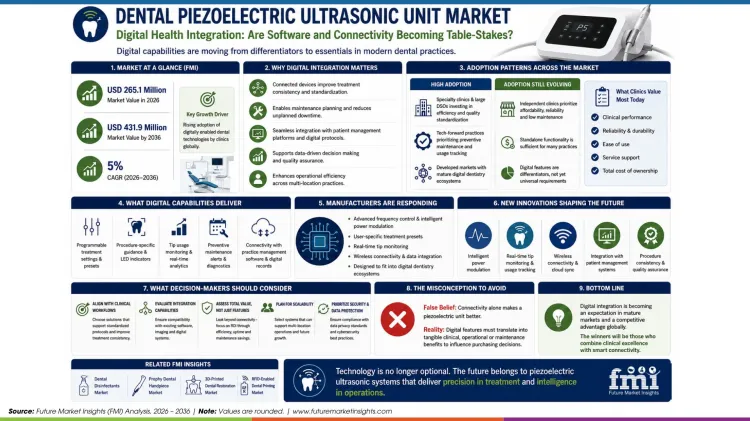
- The dental piezoelectric ultrasonic units market is expected to expand from USD 265.1 Million in 2026 to USD 431.9 Million in 2036, growing at a CAGR of 5% owing to the rising adoption of digitally enabled dental technologies by clinics.
- High-volume dental clinics are adopting connected devices to improve treatment consistency, facilitate maintenance planning and streamline clinical operations.
- Connected devices are being looked at by high-volume dental clinics to increase treatment consistency, assist in maintenance planning, and simplify clinical operations.
- Integration of patient management platforms and digital treatment protocols is anticipated to add value to next-generation piezoelectric systems.
- Manufacturers are adding LED guidance, intelligent power modulation and user-specific treatment presets, positioning for wider adoption by technology-forward practices.
- For a lot of independent clinics, standalone functionality is still fine, but in mature dental markets, digital capabilities are moving from being a premium feature to a competitive necessity.
The dental piezoelectric ultrasonic unit market is entering a new stage of technological evolution where hardware performance may not be the sole factor that determines competitive success. Historically, buying decisions were driven by precision scaling, ergonomic design, irrigation efficacy and versatility across various clinical applications. But more and more, digital integration is becoming a meaningful consideration in procurement conversations.
The market is expected to reach USD 431.9 million by 2036 from USD 265.1 million in 2026, at a CAGR of 5% during the forecast period. The growth indicates not only a growing demand for minimally invasive dentistry but a wider investment in modern dental infrastructure.
In the last decade, the digital transformation in dentistry has been significantly accelerated. In many developed healthcare markets, practice management software, digital imaging systems, intraoral scanners and electronic patient records have become standard components of clinical workflows. With this ecosystem’s maturity comes a greater expectation for procedural equipment.
The piezoelectric ultrasonic unit is not always fully automated just because it is connected to the network. Instead, it’s the ability to better integrate into digitally managed environments. Programmable treatment settings, procedure-specific presets, tip usage monitoring, and improved maintenance diagnostics can improve consistency and reduce administrative burden.
Modern dental clinics are increasingly focused on the optimization of workflows. Equipment that supports standardized treatment protocols and minimizes setup variability is therefore well aligned with these operational objectives. In multi-location dental service organizations (DSOs), digital capabilities could also enable more standardized delivery of care across geographically dispersed practices.
The adoption of ultrasonic systems with digital features is most active in specialty clinics and large group practices. Frequently, these organizations are investing in technologies that both increase efficiency and reinforce quality assurance initiatives. Hence, the presence of connectivity features that can support preventive maintenance scheduling or tracking of equipment utilization patterns can gain relevance. At the same time, adoption patterns remain uneven across the market.
Affordability and clinical effectiveness are still prioritized over advanced connectivity features by independent practices. However, for many providers, reliability and low maintenance requirements remain higher priorities than software integration. This results in a tiered market environment where digital functionality is a differentiator, not a universal requirement. Manufacturers are responding through product diversification strategies.
The development of advanced piezoelectric systems is increasingly focused on smart capabilities, in addition to traditional clinical benefits. “The future market landscape is expected to see enhanced frequency controls, digital customization and improved compatibility with wider practice management ecosystems.
A number of emerging innovations have potential to build long-term support. Intelligent power modulation could enable procedure-specific optimization and real-time tip monitoring could improve planning of maintenance and procedural consistency. Wireless capabilities and integration with patient management systems could further streamline treatment workflows.
The broader shift toward digital dentistry also supports these developments.
Clinics that are investing in chairside CAD/CAM systems, digital diagnostics and integrated treatment planning platforms may be more inclined to prefer procedural devices that are able to operate in interconnected environments. As dental providers are looking for operational efficiencies, the value proposition associated with digitally enabled equipment is likely to increase.
However, connectivity alone is unlikely to drive purchasing decisions.
Procurement teams are still assessing piezoelectric ultrasonic units based on clinical performance, durability, service support and total cost of ownership. So any further investment in digital capabilities must show tangible benefits in efficiency, maintenance management or treatment consistency. Segment trends further support this outlook.
North America continues to be a key market with high penetration of advanced dental technologies and high investment in infrastructure for modern practice. Stable demand in Europe from precision-based treatment modalities and large opportunities in Asia Pacific as clinics continue to upgrade their service offerings.
The question isn't if software and connectivity will impact the dental piezoelectric ultrasonic unit market, but when these features will be expected.
Digital integration is still a competitive advantage today, concentrated in technologically sophisticated practices. But over time, greater emphasis on workflow efficiency, standardization and data-driven clinical operations could make these features baseline expectations across broader segments of the market.
Bottom Line
The digital integration is slowly changing the value creation in the dental piezoelectric ultrasonic unit market. Clinical accuracy and reliability are still critical factors in the buying decision, but dental practices are increasingly choosing software that is compatible and connected. As practices increasingly invest in digital ecosystems, manufacturers that can combine procedural excellence with meaningful workflow integration are likely to solidify their competitive positioning throughout the forecast period.

