


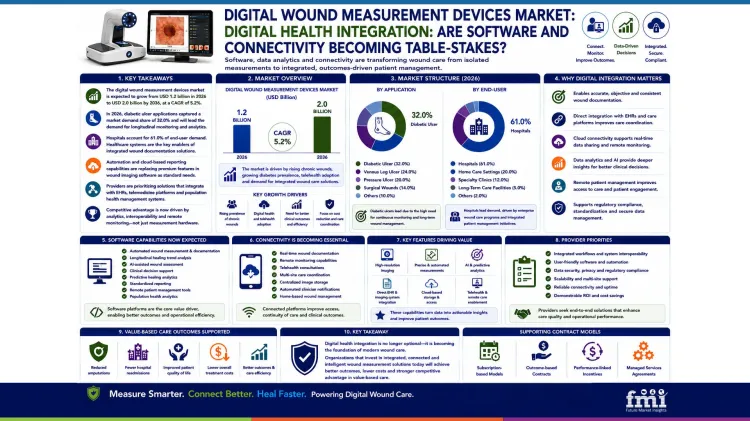
- The digital wound measurement devices market is expected to grow from USD 1.2 billion in 2026 to USD 2.0 billion by 2036 at a CAGR of 5.2%. for the forecast period.
- In 2026, diabetic ulcer applications captured a market demand share of 32.0% and will lead the demand for longitudinal wound monitoring, analytics and remote patient management capabilities.
- Largest end-user demand is from hospitals (61.0%). Healthcare systems are the key enablers of integrated wound documentation and enterprise wound management solutions.
- Automation and cloud-based reporting capabilities are replacing premium features in wound imaging software as standard procurement requirements.
- Healthcare providers are increasingly looking for solutions that integrate with electronic health records, telemedicine platforms and population health management systems to improve care coordination and clinical efficiency.
- Competitive advantage is no longer solely defined by the measurement hardware but increasingly analytics capabilities, interoperability and remote monitoring functionality.
Introduction
Digital transformation is changing the way wound care management is done. Healthcare providers are increasingly adopting technologies that can enable remote surveillance, evidence based decision making and longitudinal patient management. As the environment evolves, digital wound measurement devices are shifting from standalone imaging devices to being incorporated into larger digital health ecosystems.
The digital wound measurement devices market size is expected to reach USD 1.2 billion by 2026 and USD 2.0 billion by 2036 at a CAGR of 5.2%. The growth is driven by the increasing prevalence of chronic wounds, the rising incidence of diabetes and increasing adoption of telehealth and remote care programs.
Previously, wounds were measured manually, and assessed subjectively by clinical observation. Healthcare systems are seeking technologies that will offer objective data, facilitate care coordination and cater to the needs of digital documentation.
The investment that healthcare organisations are making in enterprise digital infrastructures means that the ability to integrate software and connect digitally is rapidly becoming table-stakes in the digital wound measurement devices market.
Market Context
Chronic wounds constitute a major and increasing burden to healthcare systems around the world. Diabetic foot ulcers, venous leg ulcers, pressure injuries and surgical wounds are often protracted, necessitate repeated clinical appraisal and consume significant healthcare resources.
Inconsistent documentation and difficulty tracking patients over time are common issues with traditional wound assessment. Manual measurement and visual assessment are variable, which limits treatment standardisation and evaluation of outcomes.
To overcome these limitations, digital wound measurement technologies allow for accurate wound documentation, automated measurement and standardized monitoring protocols.
The market structure points to the strategic significance of digital integration. The diabetic ulcer applications segment is expected to have a market demand of 32.0% in 2026 due to the need for long-term wound management solutions and continuous monitoring. Hospitals accounted for a 61.0% share in end-user demand and are looking for technologies that can enable enterprise-wide wound care programs and integrated patient management initiatives.
These trends are fueling increased investment in software platforms, cloud infrastructure and interoperable wound management ecosystems.
Software Is Becoming the Core Value Driver
Increasingly, the value proposition of digital wound measurement devices is being defined by their software functionality.
In the past, wound measurement systems were concerned on image acquisition and dimension assessment. Healthcare settings today require much broader capabilities.
Systems healthcare providers increasingly demand to deliver:
- Automated wound measurement and documentation
- Longitudinal healing trend analysis
- Artificial intelligence-assisted wound assessment
- Clinical decision support functionalities
- Predictive healing analytics
- Standardized reporting capabilities
- Remote patient management tools
- Population health analytics
Software platforms can improve clinical workflows by decreasing documentation time and increasing consistency of measures.
The use of artificial intelligence is becoming ever more important. Today, advanced algorithms are helping clinicians identify wound features, track healing progress, and make evidence-based treatment choices.
Cloud-based software platforms also enable centralized data management, allowing healthcare providers to access patient data in multiple care settings.
Software features are increasingly driving purchase decisions as wound management becomes more data driven.
Connectivity Is Becoming Essential
Connectivity has emerged as another major market requirement.
Healthcare organizations are increasingly asking for technologies that allow real-time information exchange between providers, patients and care management teams. The days of justifying standalone systems that do not interface with the broader healthcare infrastructure are waning.
Connected wound measurement platforms support:
- Real-time wound documentation
- Remote monitoring capabilities
- Telehealth consultations
- Multi-site care coordination
- Centralized image storage
- Automated clinician notifications
- Home-based wound management programs
Connectivity is particularly important in chronic wound management. As patients with diabetic ulcers often need to be continuously assessed for long periods, remote monitoring and digital communications are becoming increasingly useful.
The rapid proliferation of telehealth programs has further accelerated the demand for connected wound assessment technologies. Wound care is increasingly being looked at by providers as a solution that can be taken outside of traditional clinical settings.
With healthcare delivery becoming more decentralized, connected wound measurement systems are transitioning from optional features to essential infrastructure components.
Interoperability Is Reshaping Procurement Decisions
Interoperability has become a critical purchasing criterion.
Healthcare organizations have complex technology environments with electronic health records, telemedicine platforms, clinical imaging systems, and population health management applications.
Digital wound measurement devices must integrate effectively within these ecosystems to maximize their clinical value.
Procurement teams increasingly prioritize technologies capable of:
- Electronic health record integration
- Enterprise imaging interoperability
- Telehealth platform connectivity
- Cloud-based information sharing
- Centralized reporting capabilities
- Multi-facility data access
- Standardized documentation workflows
Integrated platforms improve clinician productivity by embedding wound information within existing workflows and reducing reliance on manual documentation processes.
Healthcare providers increasingly recognize that fragmented information systems can delay treatment decisions and increase administrative burden.
Consequently, interoperability is rapidly becoming a baseline expectation rather than a competitive differentiator.
Segment Insights
Diabetic ulcer applications are one of the key drivers for digital integration in the market and are expected to contribute to 32.0% of the market demand in 2026. Digital documentation and longitudinal analytics are particularly relevant for such injuries, which often require long-term follow-up and multidisciplinary care coordination.
More and more healthcare providers are turning to software-enabled monitoring platforms to help standardize treatment and intervene early if the wound isn’t healing as expected.
The growing importance of diabetic ulcer management is driving demand for technologies that enable remote delivery of care and evidence-based decision making.
These needs still underpin investment in digitally integrated wound management platforms
End-User Insights
Hospitals account for 61.0% of the market demand and are the main drivers of digital transformation initiatives in the digital wound measurement devices market.
For large healthcare systems, enterprise wound management solutions that improve consistency of documentation, support multidisciplinary collaboration and support quality reporting initiatives are becoming more important.
Hospitals can standardize their wound assessment practices and improve the coordination of care across departments and facilities by using digital wound measurement technologies.
With the shift in healthcare delivery toward more decentralized care models, home health providers are increasingly adopting connected wound measurement technologies.
Increasing demand for remote consultation and home wound monitoring programs with the emergence of telemedicine.
Software integration and connectivity are having an increasing impact on technology adoption across all end-user segments.
Purchasing and Buyer Behaviour
Procurement priorities are evolving rapidly.
Healthcare providers increasingly evaluate digital wound measurement technologies based on:
- Electronic health record integration
- Cloud connectivity
- Telehealth compatibility
- Artificial intelligence capabilities
- Automated reporting functionality
- Cybersecurity protections
- Scalability and interoperability
- Long-term software support services
Information technology departments now play increasingly important roles in procurement processes because wound management systems are becoming integrated components of healthcare information infrastructures.
Hospitals increasingly seek vendors capable of delivering continuous software innovation and supporting enterprise digital transformation strategies.
These changing expectations are reshaping supplier relationships and increasing the importance of long-term technology partnerships.
Competitive Implications
Digital health integration is transforming competition in the digital wound measurement devices market.
Manufacturers are increasingly competing on ecosystem capabilities, not just imaging hardware. Companies that can integrate wound measurement technologies with analytics platforms, cloud infrastructure and remote monitoring capabilities are strengthening their competitive position.
Artificial intelligence, predictive analytics and integration with telehealth are becoming important sources of differentiation.
Strategic partnerships between digital health providers, electronic health record vendors and telemedicine companies are also increasingly important.
Barriers to entry are rising as building secure, scalable and interoperable software platforms requires huge investments in software engineering, cybersecurity and regulatory compliance.
In the face of growing digital expectations, software leadership is emerging as the key factor for long-term competitiveness in the market.
Strategic Implications
The digital wound measurement devices market is shifting to a digitally integrated health tech segment where software functionality and connectivity capabilities are the main drivers of value creation.
Healthcare providersa are seeking technologies for remote monitoring, chronic disease management and data-driven wound care strategies. These priorities include procurement’s expectations and competitive environment.
Manufacturers that continue to push hardware features without building more complete digital ecosystems could find themselves under increasing competitive pressure.
The ability to offer integrated platforms that optimize workflow efficiency, support longitudinal patient management and enable evidence-based clinical decision making will be an increasing determinant of market leadership.
So analytics, cloud infrastructure, artificial intelligence and interoperability investments are quickly becoming strategic imperatives.
Bottom Line
In the digital wound measurement device market, software integration and connectivity are of increasing importance. Hospitals and healthcare providers are broadening telehealth programs and investing in digital infrastructure for the enterprise. For purchasing decisions, hardware measurement is no longer enough. It’s about interoperability, analytics capabilities and ecosystem integration more and more. Manufacturers that can marry precise wound assessment with scalable digital platforms will be best positioned to capture long-term growth opportunities and landscape competitive positioning in a more connected wound care landscape.

