


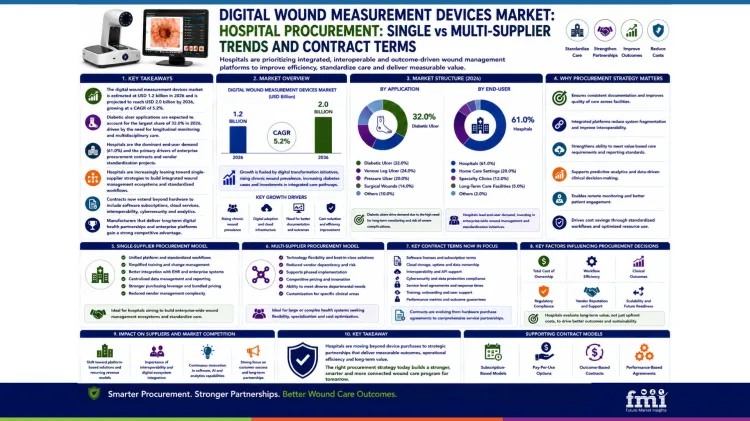
- The digital wound measurement devices market is estimated at USD 1.2 billion in 2026 and is projected to reach USD 2.0 billion by 2036, growing at a CAGR of 5.2% during the forecast period, as procurement demand is increasingly driven by digital transformation initiatives and chronic wound management programs.
- The diabetic ulcer applications are expected to account for the largest share of 32.0% in 2026. Healthcare providers are required to invest in scalable wound assessment platforms that enable longitudinal monitoring and multidisciplinary care coordination.
- Hospitals are the dominant end-user demand (61.0%) and the primary drivers of enterprise procurement contracts and vendor standardization projects for large healthcare systems.
- Multi-supplier models still have a role to play in technology flexibility and cost optimization, but hospitals looking to build integrated wound management ecosystems and standardized documentation workflows are increasingly leaning toward single-supplier procurement strategies.
- The contract infrastructure is increasingly going beyond hardware acquisition to include software subscriptions, cloud services, interoperability support, cybersecurity protections, and analytics capabilities.
- The competitive positioning of manufacturers is increasingly determined by the ability to provide long-term digital health partnerships and enterprise wound management platforms, and not just stand-alone measurement devices.
Introduction
Digital wound measurement technologies are changing how hospitals buy products. Healthcare organizations are increasingly recognizing that wound management is not only a clinical activity, but also an operational and financial imperative that directly impacts patient outcomes, resource utilization, and quality metrics.
The Digital Wound Measurement Devices Market is projected to grow from USD 1.2 billion in 2026 to USD 2.0 billion by 2036 at a CAGR of 5.2%.. Growth is increasingly supported by the rising prevalence of diabetes, the growing burden of chronic wounds and investments in digitally integrated care pathways by healthcare providers.
Over the years, wound assessment technologies have been purchased as stand-alone instruments to improve the accuracy of a measurement. Procurement, today, is vastly more comprehensive. Hospitals seek to unify wound documentation, care coordination, analytics and remote patient management in one platform.
This evolution is changing the way procurement, supplier relationship and competition work in the digital wound measurement devices market.
Market Context
Chronic wound management is one of the most resource intensive care pathways in healthcare. Diabetic ulcers, pressure injuries, venous leg ulcers and surgical wounds are generally associated with long treatment times and multi-disciplinary clinical involvement.
Healthcare systems are thus seeking technologies that will enhance efficiency of workflow and standardize delivery of care.
The market structure reveals the significance of institutional procurement activity. Hospitals, which account for 61.0% of the end-user segment, continue to be the biggest purchasers of digital wound measurement technologies. On the other hand, diabetic ulcer applications segment can be accounted for 32.0% of the total market which signifies the requirement for long-term monitoring solutions as a part of chronic disease management initiatives.
Many different departments across a healthcare organization are using digital wound assessment technologies, including wound care centers, endocrinology units, home health programs, and surgical services. This wider usage complicates procurement and raises the stakes in the choice of suppliers.
Consequently, hospitals are turning increasingly to enterprise purchasing strategies that emphasize scalability, interoperability and long-term vendor support.
Single-Supplier Procurement Strategies
More healthcare organizations are considering purchasing digital wound measurement technology through single-vendor agreements.
There are many operational advantages to single-supplier models. Standardized wound assessment technologies at the facility level improve consistency in documentation, facilitate clinician training, and allow for centralized management of information.
Enterprise agreements also facilitate the integration of wound measurement systems with electronic health records and telehealth platforms. Healthcare providers are increasingly leveraging these capabilities to enhance care coordination and reduce fragmentation of workflow.
Many large integrated delivery networks utilize a single-supplier approach to facilitate enterprise wound management programs and standardize patient assessment processes across multiple facilities.
Single supplier arrangements can also improve buying leverage. Hospitals typically negotiate bundled deals that include software licenses, implementation services, cloud storage, analytics tools and long-term support services.
With healthcare providers continuing to embrace digital transformation, the trend of supplier consolidation is proving to be an attractive strategy to improve operational efficiencies and ease technology governance.
Multi-Supplier Procurement Trends
Supplier consolidation is a growing trend, but many healthcare organizations still rely on multiple suppliers to meet their procurement needs.
Large academic medical centers and complex health systems often have multiple vendor relationships to provide technology flexibility and reduce the risk of dependency.
Multi-supplier models are also used by health care providers to assess emerging technologies and to supplement specialized capabilities that may not be available from a single supplier.
Procurement teams also prefer diversified supplier relationships as it provides better negotiating leverage and limits the risk of vendor concentration.
Multi-supplier strategies can be very helpful to hospitals with heterogeneous information technology environments or those that want to develop customized solutions for a specific clinical department.
Another key consideration is the robustness of supply chains. Healthcare organizations are becoming increasingly aware of the operational risks of relying too much on a single vendor.
Consequently, a number of health systems are still trying to balance the efficiencies of standardization with the flexibility of diverse vendor relationships.
Contract Structures Are Becoming More Comprehensive
Contract structures within the digital wound measurement devices market have evolved considerably.
Traditional procurement agreements primarily focused on device acquisition and maintenance obligations. Contemporary contracts increasingly encompass software capabilities, cloud services, analytics functionality, and interoperability support.
Healthcare providers increasingly seek contractual commitments regarding:
- Software upgrade pathways
- Cloud storage capabilities
- Electronic health record integration
- Cybersecurity protections
- Technical support response times
- Artificial intelligence functionality
- Telehealth compatibility
- User training programs
- Data migration support
- System scalability
Long-term subscription agreements are becoming increasingly common as healthcare organizations seek continuous software innovation and predictable operational costs.
Performance-based service agreements are also gaining importance. Procurement teams increasingly expect suppliers to provide measurable commitments regarding implementation timelines, system availability, and technical support performance.
These expanded contract requirements reflect the growing strategic importance of wound management technologies within enterprise healthcare infrastructures.
Segment Insights
The major focus of diabetic ulcer applications remains on hospital procurement strategies, which will account for 32.0% of the market demand in 2026.
These wounds often require long treatment durations and intensive monitoring, and digital measuring technologies are very valuable in supporting longitudinal assessment and multidisciplinary care coordination.
Healthcare providers are looking for platforms that can provide objective measurements, monitor healing progression and support early intervention strategies.
The economic burden of diabetic wound complications further fuels the demand for technologies that can improve treatment consistency and reduce resource utilization.
The ongoing global rise in diabetes prevalence will ensure that diabetic wound management continues to be a major driver of procurement activity.
Buyer Behaviour and Decision-Making
Procurement decision making is increasingly multidimensional.
Accurate measurements, patient results and efficient workflow are what clinical leaders care about. Info tech departments look at the interoperability, cybersecurity, and cloud capabilities. Financial stakeholders care about total cost of ownership and long-term ROI.
Wound assessment technologies also impact documentation consistency and clinical performance metrics, which is why quality management teams are increasingly involved in purchasing decisions.
Increasingly, health care providers are looking for vendors who can be long-term technology partners, not just equipment suppliers.
Vendor stability, software innovation roadmaps and service capabilities are becoming increasingly important in purchasing decisions.
Changing expectations are also changing procurement processes across the marketplace.
Competitive Implications
Procurement transformation is playing a major role in changing the competitive landscape in the digital wound measurement devices market.
Manufacturers who can provide integrated wound management ecosystems are increasingly gaining competitive advantages. Health care providers are increasingly gravitating toward measurement and analytics, telehealth and cloud-based information management solutions.
Single supplier procurement trends are creating opportunities for larger vendors with broad digital capabilities and extensive service infrastructures.
At the same time, multi-supplier strategies create opportunities for specialized vendors that can offer differentiated analytics, artificial intelligence tools and niche clinical functions.
Alliances with electronic health record providers, telemedicine companies and cloud infrastructure vendors will become increasingly strategic.
The ability to compete is less about measurement hardware and more about ecosystem capabilities, software services, and long-term customer support.
Strategic Implications
The hospital purchasing strategies are increasingly shaping the structure of the digital wound measurement devices market.
Health care organizations are increasingly looking for technologies that provide integrated care, standardized documentation and long-term digital transformation initiatives. Procurement decisions are no longer based on the purchase of devices alone. The focus is more on broader issues like enterprise information management and operational resilience.
Manufacturers who will be best positioned for future growth opportunities will be those who can deliver scalable, interoperable and service-oriented solutions.
Procurement excellence and long-term partnership capabilities will become increasingly important sources of competitive advantage throughout the forecast period, given the increasing importance of chronic wound management, particularly in the care pathways of diabetic ulcer patients.
Bottom Line
Digital wound measurement devices market procurement shifts from transactional buying to strategic digital health partnerships Many hospitals are moving toward single-vendor models for the benefits of standardization and integration, but multi-vendor approaches are a flexible and leverageable option in the marketplace. As hospitals modernize their wound management infrastructure and expand chronic care programs, contract structures, interoperability capabilities and long-term service commitments will become increasingly important to supplier competitiveness and procurement value.

