


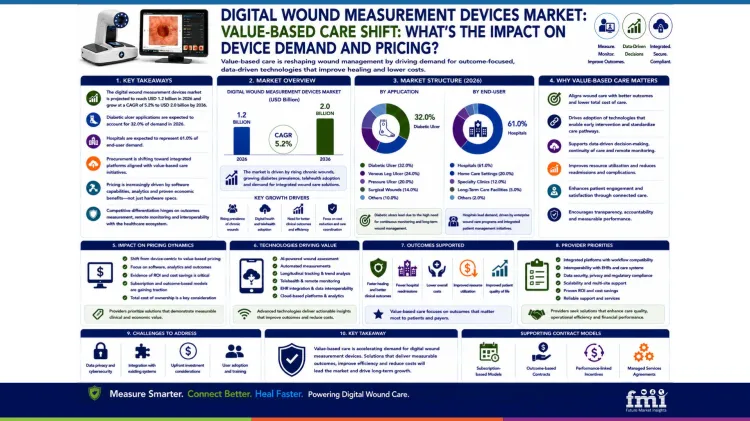
- The digital wound measurement devices market is projected to reach USD 1.2 billion in 2026 and is expected to grow at a CAGR of 5.2% to USD 2.0 billion by 2036. The increasing acceptance of value-based wound management strategies and chronic care programs support growth.
- Diabetic ulcer applications are expected to have a demand of 32.0% in 2026. Early intervention and long-term monitoring are becoming increasingly important as it helps to lower treatment costs and improve patient outcomes.
- Hospitals are expected to account for 61.0% of end-user demand. The end-user is adopting digital wound assessment technologies to standardize care pathways and reduce preventable complications.
- Procurement priorities are shifting from single-function measurement devices to integrated platforms with value-based care initiatives that can improve healing outcomes and reduce resource utilization.
- Pricing is being driven more by software capabilities, analytics functionality and proven economic benefits, not just the hardware specs.
- Today, competitive differentiation is increasingly about the capability to measure outcomes, remote monitoring capabilities and interoperability with the broader healthcare information ecosystem.
Introduction
Healthcare systems worldwide are rapidly transitioning to value-based care models that focus on quality outcomes, operational efficiencies and long-term cost containment. And it’s changing how we see and buy healthcare technology.
In wound care, value-based care is driving strong demand for technology that can improve healing outcomes and reduce unnecessary healthcare utilization. Chronic wounds, such as diabetic foot ulcers, pressure injuries and venous leg ulcers, impose the greatest clinical and economic burden and often require long-term treatment and multiple visits to healthcare providers.
In this context digital wound measurement devices are more and more used as strategic tools. These technologies allow objective wound assessment, standardized documentation and longitudinal tracking, helping health care providers to improve outcomes and optimize resource allocation.
The Digital Wound Measurement Devices Market is projected to grow from USD 1.2 billion in 2026 to USD 2.0 billion by 2036 at a CAGR of 5.2%. Increasing demand for technologies to support preventive intervention, data-driven clinical decision-making and efficient wound management practices by healthcare organizations is driving the market growth.
As value-based care continues to be embraced globally, digital wound measurement technologies are evolving from documentation tools to outcome-focused care tools.
Market Context
Chronic wounds are among the most resource consuming conditions in health care. Diabetic ulcers, pressure injuries and surgical wounds generally require long treatment periods, regular assessment and multidisciplinary management.
Current wound assessment techniques are largely reliant on subjective observations and manual measurements. This leads to inconsistencies in wound assessment which hinders planning treatment and evaluating wound outcomes.
Value-based care models are now stressing not only concrete improvements in healing outcomes but also the efficient utilization of healthcare resources. Therefore, health care providers need technologies that can offer objective clinical data and help them adhere to standardized care protocols.
Digital wound measurement devices meet these challenges by providing enhanced assessment, longitudinal tracking, and evidence-based interventions.
Because of the market structure they are strategically important. Diabetic Ulcer Applications are the second costliest and clinically complex chronic wound categories with 32.0% of market demand in 2026. Hospitals account for 61.0% of end-user demand and look for technologies that can help improve care coordination and reduce variability in treatment.
Healthcare organizations are increasingly accountable for outcomes and expenditures, and the demand for digitally-enabled wound management solutions is accelerating.
Value-Based Care Is Expanding Device Demand
The shift towards value-based healthcare is generating new demand drivers for digital wound measurement technologies.
Healthcare providers are increasingly aware that delayed wound healing is often associated with increased costs of treatment, increased risk of hospitalization and poorer outcomes for patients. That means that technologies that enable early intervention and standardized assessment are highly aligned with the goals of value-based care.
Digital wound measurement systems improve the consistency of wound documentation and enable clinicians to objectively monitor healing over time. This allows for earlier recognition of treatment failure and proper adjustment of care plans.
Preventive intervention strategies are increasingly important in the management of diabetic wounds. Diabetic ulcers account for 32.0% of the market demand and are commonly associated with complications leading to substantial healthcare expenditure. However, early recognition of poor wound healing can greatly reduce the risk of prolonged hospitalisation and specialist treatment.
This makes digital wound measurement technologies important in outcome-driven healthcare settings as they allow for longitudinal monitoring and support evidence-based decision-making.
As healthcare systems continue to shift towards more preventive care and cost effectiveness, the demand for digitally integrated wound assessment platforms will continue to grow.
Impact on Pricing Dynamics
The pricing and evaluation of digital wound measurement technologies are fundamentally changing under value-based care.
Historically, procurement decisions have been based on device acquisition costs and imaging specifications. Today, healthcare organizations are looking at technologies more and more in terms of their total value creation and their tangible impact on clinical and economic outcomes.
Providers increasingly seek solutions capable of:
- Reducing healing times
- Improving documentation consistency
- Supporting early intervention strategies
- Enhancing workflow efficiency
- Reducing avoidable complications
- Improving multidisciplinary care coordination
- Facilitating remote monitoring initiatives
Technologies that demonstrate measurable improvements in these areas are increasingly capable of commanding premium pricing.
At the same time, healthcare budget constraints are creating pricing pressure on products that cannot clearly demonstrate clinical and economic value.
Manufacturers are therefore increasingly emphasizing analytics capabilities, software integration, and remote monitoring functionalities as mechanisms for strengthening value propositions.
Pricing models are gradually shifting away from hardware-focused transactions and toward software-enabled platforms capable of generating measurable outcome improvements.
Segment Insights
The applications of diabetic ulcer hold 32.0% of the market demand in 2026 and are among the highest growth drivers in the digital wound measurement devices market.
Such injuries usually demand long treatment periods and large resource utilization. Health care providers are increasingly looking for technologies that can support continuous monitoring and early intervention strategies.
Digital wound measurement platforms allow clinicians to make more objective assessments and track patients over time, helping them to identify where treatment is not working and optimise care pathways.
Another driver for technologies that could reduce preventable healthcare costs and improve patient outcomes is the economic burden of diabetic wound complications.
The value-based care initiatives are concentrating more on chronic disease management and preventive intervention, and the diabetic wound applications are likely to continue to be the key demand drivers.
End-User Insights
Hospitals account for 61.0% of the market demand, remaining the largest beneficiaries of value-based investments in digital wound management technologies.
Large health systems are adopting standardized wound care programs with the goal of improving consistency of care and reducing resource utilization. The goals are supported by objective data and multidisciplinary collaboration provided by digital wound measurement technologies.
Hospitals are also under increasing pressure to improve quality measures and reduce complication rates. These priorities are closely linked to technologies that support evidence-based decision making and enhance monitoring capacity.
As the healthcare delivery model shifts to decentralized care, home healthcare providers and outpatient wound care centers are also investing more in digital assessment technologies.
Outcome-based reimbursement schemes are being witnessed to increase the strategic importance of digitally enabled wound assessment platforms across all end-user segments.
Procurement and Buyer Behavior
Procurement strategies are rapidly changing in value-based healthcare.
Healthcare providers are increasingly evaluating digital wound measurement technologies on multidimensional criteria, beyond simply the functionality of the device.
Purchasing decisions increasingly prioritize:
- Total cost of ownership
- Electronic health record integration
- Automated reporting capabilities
- Telehealth compatibility
- Remote monitoring functionality
- Analytics capabilities
- Workflow efficiency improvements
- Long-term software support
Clinical leaders, information technology departments, quality management teams and financial stakeholders participate actively in procurement decisions.
Healthcare organizations are looking for technology partners to help them with long-term wound management strategies and digital transformation initiatives.
Such shifting expectations are reshaping the competitive landscape across the market.
Competitive Implications
Digital wound measurement devices market is witnessing a paradigm shift with the advent of value-based care.
Manufacturers are under growing pressure to prove quantifiable enhancements in the wound healing process and healthcare efficiency.
Analytics capabilities, artificial intelligence tools, remote monitoring capability and interoperability support are emerging as key sources of competitive differentiation.
Companies with the capacity to embed wound measurement technologies into wider chronic care management ecosystems are bolstering their positions in the marketplace.
Partnerships with telehealth providers, healthcare information technology companies and analytics firms are also becoming increasingly important.
The competitive advantage will increasingly be about showing outcome improvement and economic value, not just measuring hardware performance.
Strategic Implications
Value-based care is transforming digital wound measurement devices from documentation tools into strategic healthcare infrastructure assets.
Healthcare providers are increasingly looking for technologies that can improve healing outcomes, reduce complications and promote efficient use of resources.
Manufacturers that align their product development strategies to these priorities will be best positioned to capture future growth opportunities.
Investments in analytics, artificial intelligence, interoperability and remote monitoring capabilities are likely to be increasingly important determinants of the long-term market competitiveness.
With healthcare systems placing greater emphasis on preventive care and quantifiable results, digital technologies for wound measurement will become increasingly vital in managing chronic wounds.
Bottom Line
Value-based care is fundamentally reshaping the digital wound measurement devices market, linking technology adoption to better healing outcomes, fewer complications and long-term healthcare efficiencies. Diabetic Ulcer Applications and Hospitals remain the largest market demand contributors for the Diabetic Ulcer market accounting for 32.0% and 61.0% respectively. Manufacturers able to demonstrate measurable clinical and economic value with digitally integrated, outcome-based wound assessment platforms will be best positioned to capitalize on the shift to value-based healthcare delivery in the market.

