


By Nikhil Kaitwade
Etidronic acid is becoming more important as industries try to run water systems more efficiently and stay within tighter discharge rules. It is widely used to control scale and stabilize peroxide, which keeps it relevant in power, chemicals, detergents, and industrial water treatment.
What is changing around the Etidronic Acid Market right now
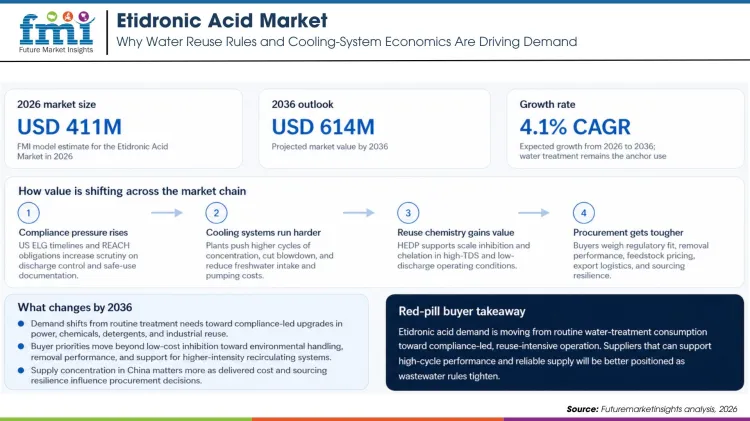
- US power plants face tougher wastewater limits set in the 2024 Steam Electric Effluent Guidelines final rule.
- Europe keeps pressure on phosphonate handling through REACH registration, dossier obligations, and downstream safety communications.
US power plants face tougher wastewater limits set in the 2024 Steam Electric Effluent Guidelines final rule. Utilities must curb discharges from flue gas desulfurization and bottom ash, which pushes more aggressive cooling-water control and chemical programs.
Europe keeps pressure on phosphonate handling through REACH registration, dossier obligations, and downstream safety communications. HEDP holds active registrations in the ECHA database with defined hazard and use profiles. This keeps the molecule in play for water treatment and detergents. Forces buyers to document safe-use measures across the chain.
Evolution and Forecast of the Etidronic Acid Market
| 2015-2025 | 2026-2036 |
|---|---|
| Demand was shaped mainly by routine industrial water-treatment needs, detergent uses, and the established role of phosphonates in scale and corrosion control. | Demand is likely to be shaped more directly by wastewater compliance, higher reuse targets, and the need to run recirculating systems at greater chemical intensity. |
| Buyers focused largely on reliable scale inhibition, chelation performance, and cost-effective operation in cooling and cleaning systems. | Buyers are likely to focus more on regulatory fit, environmental handling, removal performance, and the ability to support high-TDS and low-discharge operating conditions. |
| Market growth depended mainly on steady industrial expansion and conventional water-treatment chemistry demand. | Market growth is likely to depend more on compliance-led upgrades in power, chemicals, and industrial water reuse systems, especially in Asia. |
| Supply economics were important, but procurement was less exposed to concentrated production geography in the narrative around demand. | Supply concentration in China is likely to matter more as buyers pay closer attention to feedstock pricing, export logistics, and sourcing resilience. |
What is Driving Demand in the Etidronic Acid Market
- Cooling-tower economics continue to favor higher cycles of concentration, especially where plants want to reduce blowdown, freshwater intake, and pumping costs.
- China and India are adding demand through water-efficiency and discharge-control policies that increase the need for stable recirculating water-treatment programs.
Cooling tower economics reward higher cycles of concentration when discharge is constrained. Plants that reduce blowdown cut freshwater intake and pumping power. Only if scale and corrosion are controlled. HEDP's threshold inhibition and chelation allow those higher cycles at low dosage.
Policy in China and India adds volume. China's 14th Five-Year agenda targets a 16% cut in water use per unit of GDP by 2025 and promotes circular economy upgrades. Industrial parks and power generators respond by expanding reuse and tightening water chemistry. India's norms cap specific water consumption for new thermal plants and push zero liquid discharge, which increases the chemical intensity of recirculating systems. Trade publications and CPCB guidance detail these thresholds and the operational steps plants take to comply.
| Signal | What it points to |
|---|---|
| Cooling tower economics reward higher cycles of concentration when discharge is constrained. | Cooling tower economics reward higher cycles of concentration when discharge is constrained. |
| Policy in China and India adds volume. | Policy in China and India adds volume. |
What Buyers Need to Watch in the Etidronic Acid Market
- Regulatory timing matters because wastewater-rule implementation can lift chemical demand, while plant retirements and retrofit decisions can soften volume site by site.
- Environmental-fate scrutiny is also important, since buyers may need to track wastewater removal performance and reformulate if downstream limits become tighter.
US ELG timelines trigger near-term chemical demand. Unit retirements and cooling retrofits can mute volumes plant by plant. FDA environmental reviews and related filings note HEDP removal by adsorption in wastewater treatment and persistence of complexed phosphonates in receiving waters. Buyers should track removal performance when switching from phosphates to phosphonates in detergents or cleaning lines. If municipal operators push tighter phosphorus proxies or adsorptive load limits, formulations may need blend changes.
- What Is Likely to Shape the Next Phase of the Etidronic Acid Market
- Operating practice is shifting toward higher cycles and reuse across Asian thermal fleets.
- On supply, production remains concentrated in China, with large phosphonate makers serving export markets.
Operating practice is shifting toward higher cycles and reuse across Asian thermal fleets. Indian utilities report expanded reuse, blowdown recapture, and zero liquid discharge adoption. These practices increase reliance on inhibitors like HEDP to stabilize high-TDS systems.
On supply, production remains concentrated in China, with large phosphonate makers serving export markets. Feedstock pricing and export logistics will set delivered costs. FMI's model points to a market moving from about USD 411 million in 2026 to USD 614 million by 2036 at a 4.1% CAGR, with water treatment as the anchor use and China leading growth. That aligns with compliance-led capital and OPEX trends in power, chemicals, and detergents tracked in the sources below.
Bibliography
- https://www.epa.gov/eg/steam-electric-power-generating-effluent-guidelines-2023-proposed-rule
- https://www.epa.gov/system/files/documents/2024-08/2024-steam-electric-implementation-briefing.pdf
- https://echa.europa.eu/registration-dossier/-/registered-dossier/16011
- https://www.fao.org/fileadmin/user_upload/jecfa_additives/docs/Monograph1/Additive-231-m1-corr.pdf
- https://northmetal.net/wp-content/uploads/Hydroxyethylidene-Diphosphonic-Acid-HEDP-C2H8O7P2-DeQuest-2010-Belclene-660-Codex-661-Phos-6-NQ6600-2809-21-4-SDS.pdf
- https://wb.fujian.gov.cn/English/latest/202108/t20210809_5665713.htm
- https://www.iea.org/policies/24989-14th-five-year-plan-on-circular-economy
- https://cpcb.nic.in/uploads/Thermal_Power_Plant_overview.pdf
- https://powerline.net.in/2021/11/08/controlling-discharge/
- https://powerline.net.in/2021/08/30/curbing-consumption-2/
- https://www.epa.gov/newsreleases/epa-finalizes-power-plant-effluent-limitation-guidelines-save-money-and-reduce
- https://ntpc.co.in/hi/node/2213
- https://www.futuremarketinsights.com/reports/etidronic-acid-market

