

- Market Size (2026)
- USD 113.8 Mn
- Forecast (2036)
- USD 489.2 Mn
- CAGR (2026 to 2036)
- 15.7%
How big is Microwave Assisted Processing Mining Market in 2026?
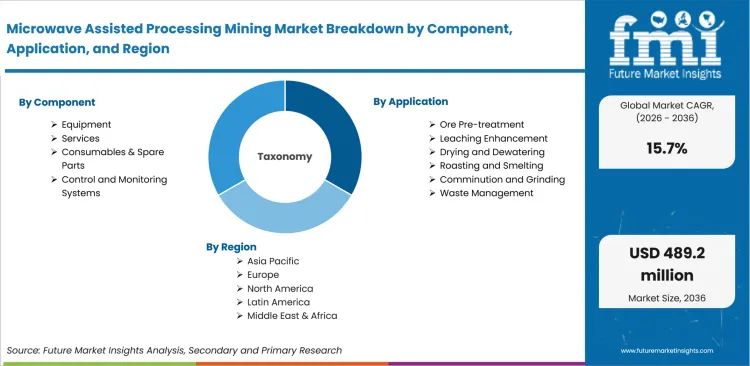
USD 113.8 million in 2026 and USD 489.2 million by 2036 at a 15.7% CAGR.
Sales of microwave-assisted processing mining systems are estimated to rise at 15.7% CAGR through 2036, increasing valuation from USD 113.8 million in 2026 to USD 489.2 million by 2036. Mining operators are increasingly prioritizing technologies that reduce comminution energy consumption and improve mineral recovery across existing processing circuits. Metso reported in January 2026 that it sold more than twenty Vertimill grinding mills during 2025 with 67 megawatts of combined installed power. The orders show that mines already fund lower-energy comminution routes through equipment with measurable operating records. Microwave treatment must therefore demonstrate a comparable whole-circuit benefit through specific energy and downstream liberation or recovery changes. Measured results guide mineral processing equipment choices and show whether continuous feeders preserve performance across changing feed conditions.
Australian projects often operate far from specialist service teams while Japanese programs can draw on domestic microwave engineering and laboratory capability. The Department of Industry reported in February 2025 that Parliament approved a 10% incentive for eligible processing costs across 31 critical minerals. The incentive improves economics for qualifying Australian processing assets but does not establish acceptance of a microwave route. Japanese projects face a different test through careful full-process qualification and access to local reactor-development expertise. Both settings require stable feeding and measured downstream value before surface mining equipment budgets include generators and process-specific applicators. Commercial plans must also define spare power modules and field-service responsibility across extended production campaigns.
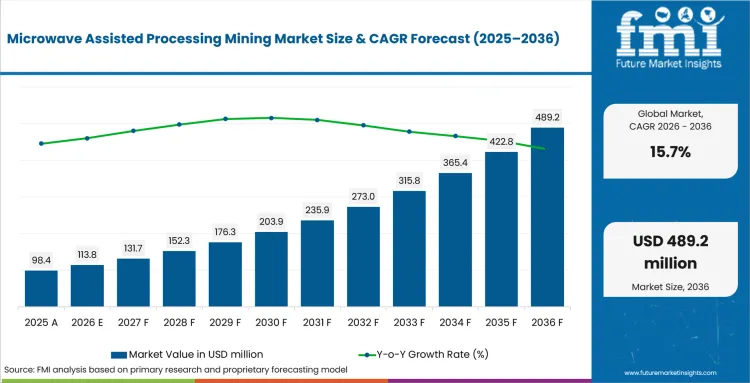
Key Takeaways of Microwave Assisted Processing Mining Market
- Selective microwave heating attracts investment through measurable whole-circuit energy or recovery gains across mineral phases with suitable dielectric response.
- Equipment holds 55.0% share in 2026 through system value concentrated in power delivery and process-specific applicators.
- Ore pre-treatment captures 29.0% by application in 2026 through measurable grinding or liberation gains created ahead of the main comminution circuit.
- Base metals account for 35.0% of mineral type revenue in 2026 through established liberation and recovery measures across nickel and copper processing routes.
- Ore-specific dielectric response and unstable continuous feeding can prevent a successful sample result from transferring into dependable industrial operation.
- The verified competitive set includes Microwave Chemical Co., Ltd., Arca Climate Technologies Inc., Crescend Technologies, LLC, and Jenike & Johanson, Inc. Their roles span reactor development and mineral activation beside solid-state power and bulk-material engineering.
Analyst Perspective
“Representative ore must show a repeatable whole-circuit benefit before microwave treatment deserves capital beyond a controlled pilot. Engineering teams should compare added electrical load with verified grinding energy and downstream recovery across changing feed conditions. Commercial plans must define feeder control and shielding beside maintenance access and ownership of surrounding process changes.”
- Nikhil Kaitwade, Principal Analyst, Future Market Insights
How is the Microwave Assisted Processing Mining Market segmented?
The microwave assisted processing mining market is assessed by Component, Application, Mineral Type, End User, Deployment Scale, and Region.
Component separates microwave generators, applicators, controls, monitoring systems, engineering services, replacement parts, and technical support used throughout an operating program. Application distinguishes ore pre-treatment, leaching enhancement, drying, roasting, grinding, smelting, and waste-processing routes through their different performance measures. Mineral type groups ores according to metallurgical response and the evidence required for transfer between sites and operating conditions. End user separates mine owners, mineral processors, equipment manufacturers, and research organizations according to investment authority and technical responsibility. Deployment scale distinguishes laboratory discovery, pilot validation, modular equipment, and continuous industrial operation across progressively larger treatment campaigns. Regional analysis compares project access, service coverage, and plant integration across process automation systems without treating geography as proof of technical performance.
Why does equipment lead the component category?
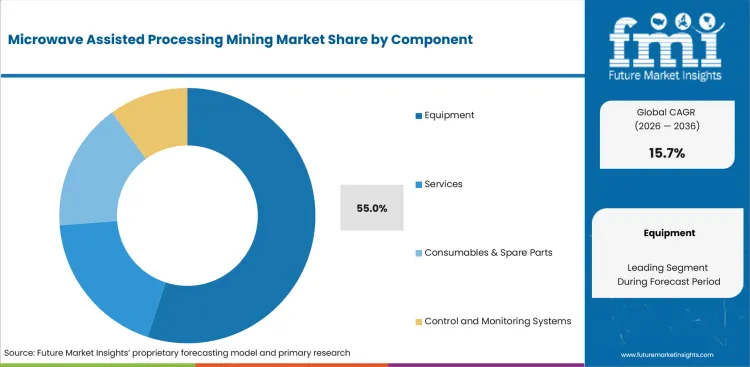
Microwave equipment determines how electrical energy enters moving mineral feed during a defined treatment stage and planned throughput range. A complete installation combines oscillators and applicators with shielding and feeder controls that protect output across changing moisture and particle size. Microwave Chemical reported in June 2025 that its Yokohama laboratory would manage oscillator design and prototyping through validation for commercialization. The laboratory program supports industrial automation integration through power control that responds to reflected energy and changing mineral conditions.
- The component category is forecast to be led by equipment at 55.0% share in 2026 due to the capital value concentrated in power delivery and process-specific hardware. The allocation covers complete hardware spending rather than a generator purchased without shielding or feed control. Continuous operation also requires maintainable controls and dependable technical support across the full treatment line.
- Mining groups introduce equipment through staged campaigns that cover representative feed and planned throughput across several operating conditions. Engineering teams compare reflected-power limits with temperature control to identify unstable response across moisture and particle-size changes. Service distance creates a separate adoption test because oscillator failures can interrupt microwave treatment and downstream material flow during the same shift.
How does ore pre-treatment shape demand in the application category?
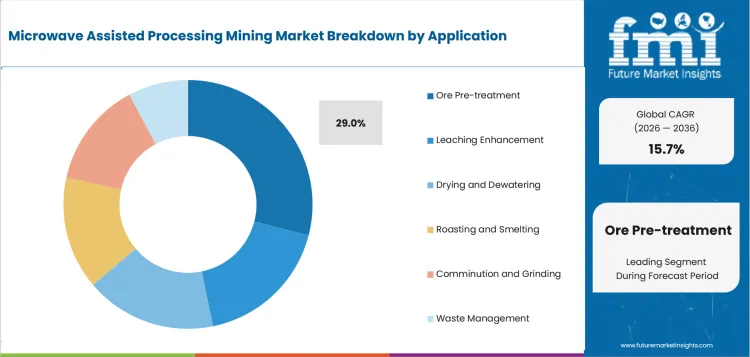
Ore pre-treatment exposes mineral feed ahead of grinding and seeks fractures that reduce later breakage energy or improve liberation. Jenike & Johanson announced a September 2025 partnership with Crescend that combines bulk-material handling and solid-state microwave power for selective heat ore treatment. The project links feeder design and exposure control with later grinding machinery performance instead of evaluating generator output alone. Project economics require representative comparisons across ore hardness and moisture variation throughout the planned production range.
- By application, ore pre-treatment is forecast to represent 29.0% in 2026 driven by its ability to influence grinding energy and mineral liberation ahead of milling. The allocation reflects savings that appear through later grinding or liberation results across complete processing circuits. Commercial value requires repeatable treatment across the planned feed range and comparable untreated reference samples.
- Processing plants favor ore pre-treatment through retrofit trials that preserve existing mills and classifiers during initial qualification campaigns. The application provides a measured adoption route without requiring a complete rebuild of every downstream processing stage. Expansion slows if feed presentation changes the heating pattern or creates another continuous-flow constraint beside the existing grinding circuit.
What keeps base metals ahead within mineral type?
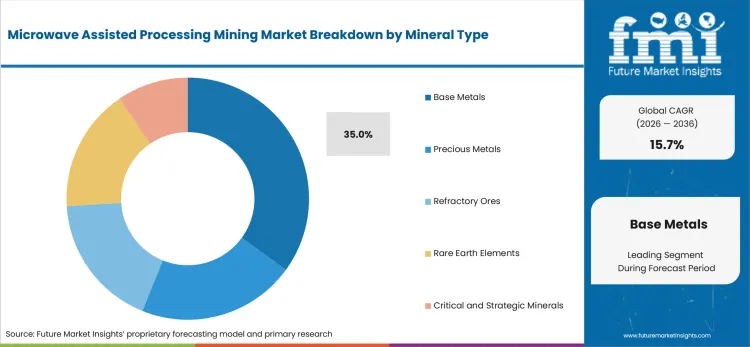
Base-metal circuits provide measurable liberation and recovery endpoints across nickel and copper routes during technical and commercial qualification. Representative mineralogy controls transfer between projects because gangue composition changes heating contrast and later metallurgical performance. Process teams can compare liberation gains with recovery and reagent use across mining flotation chemicals programs that already track metallurgical response. Microwave Chemical reported in April 2026 that bench-scale microwave calcination reached the target temperature across several dozen kilograms of manganese nodule ore.
- By mineral type, base metals are estimated to hold 35.0% in 2026 owing to operators comparing treatment gains through established metallurgical endpoints. The allocation reflects access to several ores with comparable metallurgical endpoints and established plant measurements. Technical approval depends on representative mineralogy and complete circuit results rather than one favorable laboratory sample.
- Base-metal processors adopt microwave treatment through campaigns that cover hardness and moisture variation across planned production samples. Engineering review connects specific energy with grinding and recovery changes across each treated and untreated test batch. Investment approval weakens if metallurgical gains lack a measurable whole-circuit energy advantage across several representative ore benches.
How do mining companies evaluate microwave-assisted processing within the end user category?
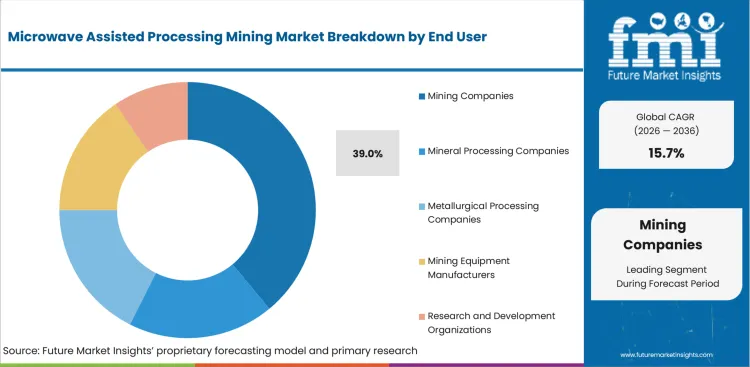
Mining companies control representative ore and capital decisions across the complete processing route during project qualification and site planning. Arca and Giga Metals reported in January 2026 that their ten-year agreement covers sampling and pilot-scale testing at the Turnagain nickel project. The arrangement demonstrates why mine owners control material access and operating data during process qualification and techno-economic review. Mine scheduling and downstream product strategy also connect the project with broader smart mining investment plans.
- In 2026, mining companies are expected to lead end user with 39.0% share because mine owners provide representative feed and approve every plant-level process change. Their position reflects authority over pilot design and integration budgets across complete mining projects. Revenue develops through approvals that connect test results with plant constraints and accountable maintenance responsibility.
- Mine operators favor projects that assign energy measurement and maintenance ownership throughout every representative pilot campaign. Established mine plans provide production schedules that support later capital review across the same mineral feed range. Adoption stalls if technology developers lack dependable downstream data or sufficient material to test seasonal changes in ore quality.
What supports industrial-scale operations within the deployment scale category?
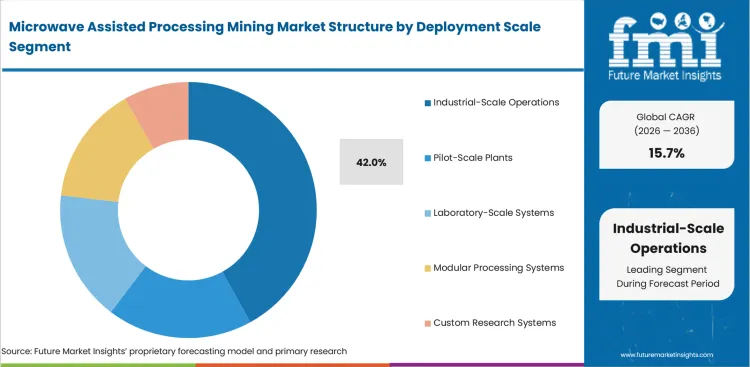
Industrial systems must treat continuous feed while controlling microwave power and temperature across changing mineral composition and planned production rates. Plant acceptance requires stable output through scheduled campaigns that expose feeder and shielding performance across extended operation. Microwave Chemical and Mitsui reported in September 2025 that their lithium pilot plant would continuously calcine approximately 700 tonnes of ore each year. The demonstration connects aggregate processing equipment with continuous-operation proof and dependable feeding across an integrated treatment line.
- Based on deployment scale, industrial-scale operations are projected to account for 42.0% in 2026 due to complete treatment lines carrying greater value than laboratory or pilot systems. The allocation reflects power delivery and process controls beside feeders and shielding across complete facilities. Revenue expands through phased capacity additions that preserve surrounding process uptime and defined maintenance access.
- Large plants adopt microwave systems through phased treatment lines that isolate performance and maintenance risks during commissioning. Site engineers require spare-parts access and documented shutdown procedures across every high-power treatment area. Expansion proceeds through repeatable operating evidence because continuous production exposes feeding and shielding weaknesses across adjacent material-handling stages.
What are the drivers, restraints, and opportunities in the Microwave Assisted Processing Mining?
Lower comminution energy supports demand while ore variability restrains scale-up and commercial-readiness programs create a route for qualified mineral projects.
- Driver: Energy-intensive grinding creates a measurable target for selective microwave treatment that improves breakage or mineral liberation across responsive ores.
- Restraint: Ore variability and unstable feeding raise qualification expense across continuous high-throughput treatment lines during industrial scale-up and commercial engineering.
- Opportunity: Commercial-readiness programs can support difficult ores that show measurable downstream gains and pass defined integration and maintenance gates.
High grinding energy creates a direct operating target for treatment that reduces later breakage work across responsive mineral phases. CEEC reported in March 2025 that future comminution technologies require assessment across economics and operability beside technical readiness and environmental performance. Microwave projects must therefore show a whole-circuit benefit rather than a favorable heating result from one controlled sample. Commercial proposals can compete with other industrial furnaces through measured specific energy and downstream recovery across representative feed conditions.
Ore variability limits transfer between a successful sample test and a dependable commercial campaign across changing production feed. Rio Tinto reported in November 2025 that it paused the planned BioIron pilot facility because the microwave-assisted furnace required further technical and design work. The decision demonstrates that promising chemistry cannot replace dependable reactor and feeding performance during scale-up. Industrial approval therefore requires defined feed specifications and measured operating gates before larger equipment commitments enter final engineering review.
Commercial-readiness programs create an opening for developers that connect laboratory evidence with integrated pilot operation across representative ore. Technology teams can use supported demonstrations to establish mass balance and maintenance requirements across a complete processing route. Natural Resources Canada reported in May 2026 that its CMRDD program supports processing technologies moving toward commercial deployment at readiness levels six through eight. Competitive applications require investment-ready plans that explain domestic processing value and the next engineering milestone.
Which country CAGRs are profiled in the Microwave Assisted Processing Mining?
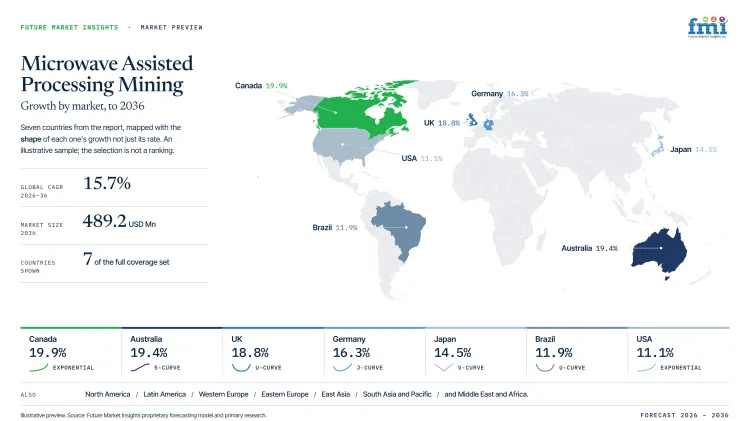
| Country | CAGR |
|---|---|
| Canada | 19.9% |
| Australia | 19.4% |
| UK | 18.8% |
| Germany | 16.3% |
| Japan | 14.5% |
| Brazil | 11.9% |
| USA | 11.1% |
How do country-level CAGRs compare in the Microwave Assisted Processing Mining?
The profiled rates span 8.8 percentage points between Canada and the USA across seven approved geographic outlooks. Canada and Australia form a narrow upper band separated by half a percentage point. The UK remains close to that band while Germany creates the clearest internal break across the comparison. Japan occupies a separate middle position and Brazil remains close to the USA. Project access and scale-up support explain the spacing more directly than laboratory performance across these outlooks.
- Canada and Australia remain closely spaced through active critical-mineral projects and defined pilot pathways across both processing environments.
- The UK sits slightly below Australia through international research links that support extraction studies without proving continuous microwave operation.
- Germany creates the clearest internal break through strict energy economics and formal qualification requirements for unfamiliar processing equipment.
- Japan occupies the middle range through domestic process-development capability and rigorous assessment of complete mineral-refining routes.
- Brazil and the USA form the lower pair despite different project settings and government support routes for mineral-processing demonstrations.
Commercial sequencing should follow verified ore response and local service readiness rather than the displayed CAGR alone. A lower growth rate can produce stronger returns in locations with established engineering support and shorter maintenance delays. Country plans should therefore link staffing and spare-parts investment to qualified projects instead of forecast rank.
Country-wise Analysis
- Canada combines critical-mineral projects with federal programs that support movement from research into demonstration across defined industrial sites. Adoption of microwave-assisted mineral processing in Canada is estimated to expand at 19.9% CAGR through 2036, reinforced by commercial-readiness support and access to critical-mineral demonstration projects. Arca reported in May 2026 that NRC IRAP would provide advisory services and up to USD 2 million for a research and demonstration project. The funding route supports mineral activation trials through defined technical milestones and field-deployable equipment plans. Remote mine locations remain a material friction because specialized microwave maintenance and representative sample logistics can extend response times. Commercial plans need regional service coverage and clear responsibility for power modules during field campaigns.
- Australian mineral projects combine large ore volumes with long service distances across producing regions and specialized processing centres. Livium reported in September 2025 that it signed a term sheet with the University of Melbourne for microwave rare-earth extraction technology and an Australian prototype route. Microwave-assisted processing mining demand in Australia is forecast to rise at 19.4% CAGR over the forecast period, shaped by local rare-earth testwork and prototype development through domestic research partners. The collaboration provides domestic research capability and a defined feedstock role for scale-up work across rare-earth processing. Commercial deployment remains constrained by remote maintenance coverage and the need to compare energy savings with complete leaching performance. Project teams should establish spare-parts access during prototype planning for isolated processing sites.
- The UK combines university process expertise with international programs designed around defined critical-mineral supply and extraction challenges. The UK microwave-assisted processing mining sector is projected to record 18.8% CAGR during the assessment period, influenced by international research links supporting critical-mineral extraction and processing studies. UK Research and Innovation reported in July 2025 that five UK-Canada partnerships would develop responsible mining and processing technologies. The partnerships provide routes for technical comparison and shared validation across mineral projects with different feed characteristics. Commercial adoption remains limited by the small domestic mining base and the need to secure representative ore from operating partners. Engineering groups must pair laboratory capability with mine access and long-term service plans for larger treatment systems.
- German processing plants apply strict energy accounting and formal engineering review to unfamiliar high-power equipment across industrial operations. Statistisches Bundesamt reported in November 2025 that energy use across energy-intensive industries increased 3.2% during 2024. Microwave-assisted mineral processing sales in Germany are forecast to expand at 16.3% CAGR by 2036, linked to formal engineering approval and close scrutiny of electricity-intensive industrial processes. The official figure reinforces the need for a transparent energy balance across microwave treatment and every downstream process stage. Germany offers strong furnace and control-system expertise but limited domestic mine access for representative testing. Developers need operating partners abroad and a service model that supports qualification at German engineering standards.
- Japan combines microwave engineering capability with careful evaluation of complete mineral-refining routes and their commercial feasibility. The Ministry of Economy, Trade and Industry stated in February 2026 that rare-earth mud industrialization requires verification from mining through separation and refining beside economic feasibility. In Japan, microwave-assisted mineral processing demand is predicted to advance at 14.5% CAGR through 2036 aided by domestic mineral-processing research and rigorous full-route economic assessment. The national requirement favors staged demonstrations that connect reactor performance with complete process economics across the refining route. Domestic technical support is a clear enabler but limited local ore production restricts representative feed access. Developers need overseas mining partners and dependable sample programs for broader mineral routes.
- Brazil combines a diversified mineral base with projects spread across producing states and uneven specialist service coverage. BNDES reported in November 2025 that financing supported a microwave-based bauxite-residue demonstration plant in Pará for pre-industrial validation. Brazil's microwave-assisted processing mining outlook is anticipated to advance at 11.9% CAGR over the assessment period, underpinned by a microwave-based bauxite-residue demonstration route in Pará. The planned facility provides a local route for continuous demonstration and downstream product qualification across a defined residue stream. Commercial entry remains concentrated around mineral corridors because distant mine regions need dependable sample logistics and nearby maintenance support. Equipment providers should establish regional service partners during production planning for remote locations.
- United States mining projects combine strong laboratory capability with long permitting and commercialization pathways across federal and private lands. The Department of Energy announced in September 2025 up to USD 80 million for proving grounds and up to USD 15 million for laboratory research. By 2036, the USA's microwave-assisted processing mining market is projected to grow at 11.1% CAGR supported by federal proving-ground support for emerging mining and mineral-processing technologies. The programs enable representative testing but do not replace mine permitting or accountable plant integration during commercial engineering. Project developers must separate federal research support from site approval and equipment responsibility throughout each deployment plan. Long service distances across western mining regions also require dependable field technicians and spare-power coverage.
Who are the notable companies in the Microwave Assisted Processing Mining?
Microwave Chemical Co., Ltd., Arca Climate Technologies Inc., Crescend Technologies, LLC, Jenike & Johanson, Inc., Wave Aluminium Brasil S.A., Rio Tinto, Northern Minerals Limited, PMET Resources Inc., Mitsui & Co., Ltd., Giga Metals Corporation, Livium Ltd., and Microwave Techniques LLC are notable companies in this market.
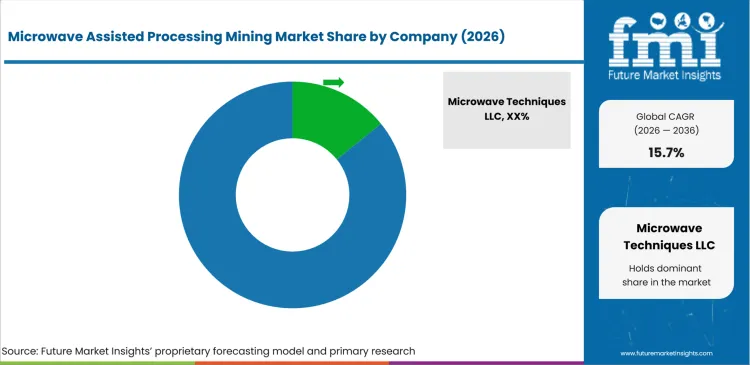
The competitive outlook combines microwave process developers with engineering groups and mine owners that provide representative mineral feed. Microwave Chemical develops reactor and refining routes while Crescend supplies solid-state power for selective ore treatment. Jenike & Johanson contributes bulk-material engineering and Arca applies microwave activation to reactive mine waste. Livium reported in January 2026 that rare-earth testwork consistently exceeded 90% leach efficiency for neodymium and praseodymium ahead of prototype development. Commercial selection also depends on stable feed presentation across sorting equipment and downstream recovery stages.
- Microwave Chemical and Arca develop mineral-processing routes through refining and mineral activation programs across verified mineral projects. Crescend and Jenike & Johanson combine solid-state power with bulk-material engineering for controlled ore exposure and dependable feeding.
- Wave Aluminium and Rio Tinto control project routes for microwave residue treatment and microwave-assisted ironmaking research. Northern Minerals and Mitsui provide mineral access or commercialization support across refining programs with defined pilot stages.
- PMET Resources and Giga Metals provide representative mineral access for lithium and nickel project studies. Livium controls a licensed rare-earth extraction route while Microwave Techniques supplies industrial microwave equipment for engineered processing systems.
Competitive Benchmarking: Microwave Assisted Processing Mining Market
| Company | Verified Mineral Project | Microwave Process Responsibility | Scale-Up Participation | Geographic Reach |
|---|---|---|---|---|
| Microwave Chemical Co., Ltd. | High | High | High | Japan and Canadian pilot |
| Arca Climate Technologies Inc. | High | High | High | Canada and Australia |
| Crescend Technologies, LLC | Medium | High | Medium | United States partnership |
| Jenike & Johanson, Inc. | Medium | Medium | Medium | United States partnership |
| Wave Aluminium Brasil S.A. | Medium | High | High | Brazil |
| Rio Tinto | Medium | Medium | Medium | Australia and United Kingdom |
| PMET Resources Inc. | Medium | Low | Medium | Canada |
| Livium Ltd. | Medium | Medium | Medium | Australia and worldwide licence |
Key Developments in the Microwave Assisted Processing Mining Market
- In May 2026, Microwave Chemical completed bench-scale reduction of approximately 15 kilograms of iron ore with its standard microwave metallurgical unit. The company identified process optimization and continuous-operation verification as remaining requirements for practical implementation across steel and mining routes. The result extends the technology beyond laboratory reduction while preserving clear engineering gates for later commercialization partners.
- In June 2025, Arca received a USD 315,000 MICA award to advance its microwave Mineral Activation technology for mine waste. The project is intended to increase mineral reactivity and support further commercialization work across defined tailings streams. The award provides a dated development route without presenting future treatment performance as completed industrial deployment.
- In June 2026, PMET Resources signed a memorandum with Mitsui and Microwave Chemical for pilot testing of microwave calcination on spodumene ore. PMET supplies representative mineral samples while Microwave Chemical manages the technical program and future equipment specifications. Mitsui evaluates results and supports commercialization discussions after the pilot work establishes technical and economic feasibility.
- In November 2025, Livium secured exclusive global rights to University of Melbourne microwave technology for rare-earth extraction. The binding agreement requires a pilot facility after prototype work and creates a defined commercialization route for scaled recovery testing. Commercial progress remains dependent on reactor construction and verified performance across representative rare-earth feed.
Key Players in the Microwave Assisted Processing Mining Market
Microwave Process Developers
- Microwave Chemical Co., Ltd.
- Arca Climate Technologies Inc.
- Crescend Technologies, LLC
- Jenike & Johanson, Inc.
- Wave Aluminium Brasil S.A.
Project and Commercialization Participants
- Rio Tinto
- Northern Minerals Limited
- PMET Resources Inc.
- Mitsui & Co., Ltd.
- Giga Metals Corporation
- Livium Ltd.
Industrial Microwave Equipment Participant
- Microwave Techniques LLC
Microwave Assisted Processing Mining Market - Report Scope
| Coverage field | Report scope |
|---|---|
| Market breakdown | Component, Application, Mineral Type, End User, Deployment Scale, and Region. |
| Quantitative Units | Revenue in USD Million, CAGR in %. |
| Market Definition | Microwave generators, applicators, controls, and process systems used to pre-treat ore, weaken rock, assist comminution, heating, drying, leaching, or mineral separation. |
| Regions Covered | North America, Latin America, Western Europe, Eastern Europe, East Asia, South Asia and Pacific, and Middle East and Africa. |
| Countries Covered | Canada, Australia, UK, Germany, Japan, Brazil, and USA. |
| Key Companies Profiled | Microwave Chemical Co., Ltd., Arca Climate Technologies Inc., Crescend Technologies, LLC, Jenike & Johanson, Inc., Wave Aluminium Brasil S.A., Rio Tinto, Northern Minerals Limited, PMET Resources Inc., Mitsui & Co., Ltd., Giga Metals Corporation, Livium Ltd., and Microwave Techniques LLC. |
| Forecast Period | 2026 to 2036. |
| Approach | Hybrid bottom-up and top-down market sizing supported by category share analysis, country-level growth assessment, company participation mapping, and technology validation based on specific energy consumption, throughput performance, mineral liberation efficiency, and continuous-feed control capabilities. |
Microwave Assisted Processing Mining Market - Research Methodology
| Method | Approach |
|---|---|
| Primary Research | FMI analysts gathered input from manufacturers, service providers, technology developers, distributors, end users, procurement teams, and subject-matter experts. Interviews examined purchasing decisions, product or service evaluation, adoption barriers, approval requirements, pricing considerations, and expectations for technical or commercial support. Respondents were also asked what evidence is required before a trial, pilot, or initial order develops into regular purchasing. |
| Desk Research | Desk research covered government statistics, regulatory publications, trade data, industry associations, technical literature, standards, company filings, product information, and official corporate announcements. Sources were reviewed for relevance, publication date, geographic coverage, and consistency with the defined market scope. Claims relating to performance, applications, approvals, capacity, investment, and commercial activity were retained only when supported by credible public evidence. |
| Market Sizing and Forecasting | The market model combined the baseline value with historical performance, segment structure, pricing and volume indicators, adoption levels, company participation, and country-level demand conditions. Forecast assumptions considered economic activity, investment trends, regulatory developments, technology adoption, purchasing cycles, supply availability, and barriers to wider market use. Segment and regional estimates were reconciled before the final market total was calculated. |
| Data Validation | Estimates were checked against multiple independent indicators, including public data, company activity, trade patterns, industry developments, and findings from primary interviews. Validation also tested whether products, services, applications, and company revenues fell within the defined market boundaries. Adjacent categories, unsupported claims, overlapping revenues, and activities without direct market relevance were excluded to reduce double counting and maintain consistency across segments and countries. |
Microwave Assisted Processing Mining Market by Segments
Microwave Assisted Processing Mining Market segmented by Component:
- Equipment
- Microwave Generators
- Microwave Processing Reactors
- Services
- Engineering and System Integration
- Installation and Commissioning
- Consumables & Spare Parts
- Magnetrons and Microwave Sources
- Waveguides and Replacement Components
- Control and Monitoring Systems
- Process Control Systems
- Temperature and Energy Monitoring Systems
Microwave Assisted Processing Mining Market segmented by Application:
- Ore Pre-treatment
- Microwave-Assisted Rock Breakage
- Microwave-Assisted Mineral Liberation
- Leaching Enhancement
- Microwave-Assisted Leaching
- Enhanced Hydrometallurgical Recovery
- Drying and Dewatering
- Mineral Concentrate Drying
- Ore Dewatering
- Roasting and Smelting
- Microwave-Assisted Roasting
- Microwave-Assisted Smelting
- Comminution and Grinding
- Microwave-Assisted Crushing
- Microwave-Assisted Grinding
- Waste Management
- Tailings Treatment
- Mining Waste Processing
Microwave Assisted Processing Mining Market segmented by Mineral Type:
- Base Metals
- Copper Ores
- Nickel and Zinc Ores
- Precious Metals
- Gold Ores
- Silver and Platinum Group Metal Ores
- Refractory Ores
- Refractory Gold Ores
- Complex Sulfide Ores
- Rare Earth Elements
- Rare Earth Oxide Ores
- Rare Earth Phosphate Ores
- Critical and Strategic Minerals
- Lithium-Bearing Ores
- Cobalt and Other Critical Mineral Ores
Microwave Assisted Processing Mining Market segmented by End User:
- Mining Companies
- Large Mining Corporations
- Mid-Sized Mining Companies
- Mineral Processing Companies
- Mineral Beneficiation Plants
- Ore Concentration Facilities
- Metallurgical Processing Companies
- Hydrometallurgical Operators
- Pyrometallurgical Operators
- Mining Equipment Manufacturers
- Mineral Processing Equipment OEMs
- Mining Technology Providers
- Research and Development Organizations
- University Research Centers
- Government and Industrial Research Laboratories
Microwave Assisted Processing Mining Market segmented by Deployment Scale:
- Industrial-Scale Operations
- Continuous Processing Systems
- Large-Throughput Processing Plants
- Pilot-Scale Plants
- Pilot Mineral Processing Units
- Demonstration-Scale Systems
- Laboratory-Scale Systems
- Laboratory Microwave Reactors
- Bench-Scale Processing Systems
- Modular Processing Systems
- Mobile Microwave Processing Units
- Modular Containerized Systems
- Custom Research Systems
- Application-Specific Systems
- Prototype Processing Units
Microwave Assisted Processing Mining Market by Region:
- North America
- United States
- Canada
- Latin America
- Brazil
- Mexico
- Argentina
- Chile
- Western Europe
- Germany
- France
- United Kingdom
- Italy
- Spain
- Benelux
- Nordics
- Eastern Europe
- Poland
- Czech Republic
- Romania
- Hungary
- East Asia
- China
- Japan
- South Korea
- South Asia and Pacific
- India
- ASEAN
- Australia and New Zealand
- Middle East and Africa
- GCC Countries
- South Africa
- Türkiye
- Israel
Research Sources and Bibliography
- Metso Corporation. (2026, January 13). Record year for Metso stirred mills as mining industry opts for energy-efficient comminution technology.
- Australian Government Department of Industry, Science and Resources. (2025, February 11). Incentive for critical minerals production and processing in Australia.
- Microwave Chemical Co., Ltd. (2025, June 19). Full-Scale Launch of Microwave Oscillator Development - New R&D Lab Launched in Yokohama.
- Jenike & Johanson, Inc. (2025, September 9). Jenike & Johanson and Crescend Partner to Advance SHOT Microwave Ore Treatment.
- Microwave Chemical Co., Ltd. (2026, April 28).
- Arca Climate Technologies Inc. and Giga Metals Corporation. (2026, January 14). Arca and Giga Metals sign exclusive agreement to explore carbon removal at B.C. nickel project with potential to remove 220 million tonnes of atmospheric carbon dioxide.
- Mitsui & Co., Ltd. and Microwave Chemical Co., Ltd. (2025, September 29). Launch of Demonstration Experiment for the Joint Development of Microwave-based Low-carbon Lithium Ore Refining Technology.
- Coalition for Eco Efficient Comminution (CEEC). (2025, March 30). CEEC REPORT - FUTURE OF COMMINUTION WORKSHOP.
- Rio Tinto. (2025, November 17). Rio Tinto partners with Calix to test low-emissions steel making in Western Australia, pauses BioIron.
- Natural Resources Canada. (2026, May 4). Critical Minerals Research, Development and Demonstration Program.
- Arca Climate Technologies Inc. (2026, May 26). Arca Secures Funding Support for New Industrial Carbon Mineralization Project.
- Livium Ltd. (2025, September 9). Livium Signs Term Sheet for REE Extraction Technology.
- UK Research and Innovation. (2025, July 3). UK-Canada to improve critical minerals mining and supply chains.
- Statistisches Bundesamt. (2025, November 14). Energieverbrauch der Industrie 2024 um 1,9 % gestiegen.
- Ministry of Economy, Trade and Industry. (2026, February 3). Press Conference by Minister Akazawa (Excerpt).
- Agência BNDES de Notícias. (2025, November 16). Com R$ 221 mi, BNDES financia planta demonstração inovadora de beneficiamento de resíduos de bauxita no Pará.
- USA Department of Energy. (2025, September 26). USA Department of Energy Launches Mine of the Future Initiatives to Bolster the USA Mining Industry.
- Livium Ltd. (2026, January 30). Quarterly Activities Report - December 2025 (Q2 FY26).
- Microwave Chemical Co., Ltd. (2026, May 26). Successful Reduction of Iron Ore Using a Standard Bench-Scale Microwave Unit for Metallurgical/Mining Processes - A Step Forward Toward Contributing to Carbon Neutrality in the Steelmaking Process.
- Arca Climate Technologies Inc. (2025, June 17). MICA awards Arca $315,000 to advance Mineral Activation.
- PMET Resources Inc. (2026, June 17). PMET Advances On-Site Lithium Refining Strategy Through Technology Collaboration MOU with Mitsui and MWCC.
- Livium Ltd. (2025, November 17). Exclusive Global Rights to UoM REE Extraction Technology.
This bibliography is provided for reader reference and is not exhaustive. The full report contains the complete reference list and detailed citations.
This Report Answers
- How large is the Microwave Assisted Processing Mining market in 2026 and 2036?
- Which operating pressures support investment in microwave-assisted ore treatment?
- Why does Equipment account for the largest Component share in 2026?
- How does Ore Pre-treatment influence comminution and mineral liberation decisions?
- Why do Base Metals represent the largest Mineral Type share in 2026?
- How do country growth rates differ across Canada, Australia, Europe, Japan, Brazil, and the USA?
- Which companies provide microwave process development, engineering, equipment, or representative mineral access?
- What limits uniform treatment and return on investment across variable ores?
- How should pilot evidence guide industrial-scale microwave processing decisions?
Frequently Asked Questions
How big is the Microwave Assisted Processing Mining Market in 2026?
The microwave assisted processing mining market is valued at USD 113.8 million in 2026 and is forecast to reach USD 489.2 million by 2036.
What is the CAGR of the Microwave Assisted Processing Mining Market from 2026 to 2036?
The microwave assisted processing mining market is projected to grow at a CAGR of 15.7% between 2026 and 2036, supported by rising adoption of advanced ore pre-treatment technologies, increasing focus on lower-energy comminution, and commercial validation of industrial-scale microwave processing systems.
Which component leads the Microwave Assisted Processing Mining Market?
Equipment accounts for 55.0% of the microwave assisted processing mining market by component in 2026, reflecting the high capital value of microwave generators, applicators, shielding systems, and process-specific hardware required for continuous mineral treatment.
How much will the Microwave Assisted Processing Mining Market add between 2026 and 2036?
The microwave assisted processing mining market is expected to add USD 375.4 million between 2026 and 2036, increasing from USD 113.8 million to USD 489.2 million as mining companies expand pilot programs, industrial-scale deployments, and energy-efficient mineral processing investments.
Who are the leading companies in the Microwave Assisted Processing Mining Market?
Leading companies in the microwave assisted processing mining market include Microwave Chemical Co., Ltd., Arca Climate Technologies Inc., Crescend Technologies, LLC, Jenike & Johanson, Inc., Wave Aluminium Brasil S.A., Rio Tinto, Northern Minerals Limited, PMET Resources Inc., Mitsui & Co., Ltd., Giga Metals Corporation, Livium Ltd., and Microwave Techniques LLC. These companies compete through microwave process development, reactor engineering, mineral-processing technologies, pilot-scale validation, and industrial microwave equipment.
Preview the report firsthand - request a free sample
Get SampleGet the brochure for pricing and purchase details.
Get PDFTable of Content
- Key Takeaways
- Market Size and CAGR
- Top Growth Driver
- Fastest Growing Segment
- Leading Region
- Key Companies
- Emerging Opportunities
- Executive Summary
- Global Market Outlook
- Demand-side Trends
- Supply-side Trends
- Technology Roadmap Analysis
- Analysis and Recommendations
- Analyst Perspective (What is happening? Why now? What should investors know?)
- Key Questions Answered
- How large is the market?
- What is the CAGR?
- What are key trends?
- Which region dominates?
- Who are the leaders?
- Market Overview
- Market Coverage / Taxonomy
- Market Definition / Scope / Limitations
- Research Methodology
- Chapter Orientation
- Analytical Lens and Working Hypotheses
- Market Structure, Signals, and Trend Drivers
- Benchmarking and Cross-market Comparability
- Market Sizing, Forecasting, and Opportunity Mapping
- Research Design and Evidence Framework
- Desk Research Programme (Secondary Evidence)
- Expert Input and Fieldwork (Primary Evidence)
- Tooling, Models, and Reference Databases
- Data Engineering and Model Build
- Quality Assurance and Audit Trail
- Market Background
- Market Dynamics (Drivers, Restraints, Opportunity, Trends)
- Scenario Forecast (Optimistic, Likely, Conservative)
- Impact Analysis
- AI Impact
- Sustainability Impact
- Regulatory Impact
- Technology Impact
- Consumer / Buyer Analysis
- Purchase Drivers
- Adoption Barriers
- Buyer Journey
- Opportunity Map Analysis
- Product Life Cycle Analysis
- Supply Chain Analysis
- Investment Feasibility Matrix
- Value Chain Analysis
- PESTLE and Porter's Analysis
- Regulatory Landscape
- Regional Parent Market Outlook
- Production and Consumption Statistics
- Import and Export Statistics
- Global Market Analysis and Forecast, 2021 to 2036
- Historical Market Size Value (USD million) Analysis, 2021 to 2025
- Current and Future Market Size Value (USD million) Projections, 2026 to 2036
- Y-o-Y Growth Trend Analysis
- Absolute $ Opportunity Analysis
- Global Market Pricing Analysis, 2021 to 2036
- Global Market Analysis and Forecast, By Component, 2021 to 2036
- Introduction / Key Findings
- Historical Market Size Value (USD million) Analysis By Component, 2021 to 2025
- Current and Future Market Size Value (USD million) Analysis and Forecast By Component, 2026 to 2036
- Equipment
- Microwave Generators
- Microwave Processing Reactors
- Services
- Engineering and System Integration
- Installation and Commissioning
- Consumables & Spare Parts
- Magnetrons and Microwave Sources
- Waveguides and Replacement Components
- Control and Monitoring Systems
- Process Control Systems
- Temperature and Energy Monitoring Systems
- Equipment
- Y-o-Y Growth Trend Analysis By Component, 2021 to 2025
- Absolute $ Opportunity Analysis By Component, 2026 to 2036
- Global Market Analysis and Forecast, By Application, 2021 to 2036
- Introduction / Key Findings
- Historical Market Size Value (USD million) Analysis By Application, 2021 to 2025
- Current and Future Market Size Value (USD million) Analysis and Forecast By Application, 2026 to 2036
- Ore Pre-treatment
- Microwave-Assisted Rock Breakage
- Microwave-Assisted Mineral Liberation
- Leaching Enhancement
- Microwave-Assisted Leaching
- Enhanced Hydrometallurgical Recovery
- Drying and Dewatering
- Mineral Concentrate Drying
- Ore Dewatering
- Roasting and Smelting
- Microwave-Assisted Roasting
- Microwave-Assisted Smelting
- Comminution and Grinding
- Microwave-Assisted Crushing
- Microwave-Assisted Grinding
- Waste Management
- Tailings Treatment
- Mining Waste Processing
- Ore Pre-treatment
- Y-o-Y Growth Trend Analysis By Application, 2021 to 2025
- Absolute $ Opportunity Analysis By Application, 2026 to 2036
- Global Market Analysis and Forecast, By Mineral Type, 2021 to 2036
- Introduction / Key Findings
- Historical Market Size Value (USD million) Analysis By Mineral Type, 2021 to 2025
- Current and Future Market Size Value (USD million) Analysis and Forecast By Mineral Type, 2026 to 2036
- Base Metals
- Copper Ores
- Nickel and Zinc Ores
- Precious Metals
- Gold Ores
- Silver and Platinum Group Metal Ores
- Refractory Ores
- Refractory Gold Ores
- Complex Sulfide Ores
- Rare Earth Elements
- Rare Earth Oxide Ores
- Rare Earth Phosphate Ores
- Critical and Strategic Minerals
- Lithium-Bearing Ores
- Cobalt and Other Critical Mineral Ores
- Base Metals
- Y-o-Y Growth Trend Analysis By Mineral Type, 2021 to 2025
- Absolute $ Opportunity Analysis By Mineral Type, 2026 to 2036
- Global Market Analysis and Forecast, By End User, 2021 to 2036
- Introduction / Key Findings
- Historical Market Size Value (USD million) Analysis By End User, 2021 to 2025
- Current and Future Market Size Value (USD million) Analysis and Forecast By End User, 2026 to 2036
- Mining Companies
- Large Mining Corporations
- Mid-Sized Mining Companies
- Mineral Processing Companies
- Mineral Beneficiation Plants
- Ore Concentration Facilities
- Metallurgical Processing Companies
- Hydrometallurgical Operators
- Pyrometallurgical Operators
- Mining Equipment Manufacturers
- Mineral Processing Equipment OEMs
- Mining Technology Providers
- Research and Development Organizations
- University Research Centers
- Government and Industrial Research Laboratories
- Mining Companies
- Y-o-Y Growth Trend Analysis By End User, 2021 to 2025
- Absolute $ Opportunity Analysis By End User, 2026 to 2036
- Global Market Analysis and Forecast, By Deployment Scale, 2021 to 2036
- Introduction / Key Findings
- Historical Market Size Value (USD million) Analysis By Deployment Scale, 2021 to 2025
- Current and Future Market Size Value (USD million) Analysis and Forecast By Deployment Scale, 2026 to 2036
- Industrial-Scale Operations
- Continuous Processing Systems
- Large-Throughput Processing Plants
- Pilot-Scale Plants
- Pilot Mineral Processing Units
- Demonstration-Scale Systems
- Laboratory-Scale Systems
- Laboratory Microwave Reactors
- Bench-Scale Processing Systems
- Modular Processing Systems
- Mobile Microwave Processing Units
- Modular Containerized Systems
- Custom Research Systems
- Application-Specific Systems
- Prototype Processing Units
- Industrial-Scale Operations
- Y-o-Y Growth Trend Analysis By Deployment Scale, 2021 to 2025
- Absolute $ Opportunity Analysis By Deployment Scale, 2026 to 2036
- Global Market Analysis and Forecast, By Region, 2021 to 2036
- Introduction
- Historical Market Size Value (USD million) Analysis By Region, 2021 to 2025
- Current Market Size Value (USD million) Analysis and Forecast By Region, 2026 to 2036
- North America
- Latin America
- Western Europe
- Eastern Europe
- East Asia
- South Asia and Pacific
- Middle East & Africa
- Market Attractiveness Analysis By Region
- North America Market Analysis and Forecast, By Country, 2021 to 2036
- Historical Market Size Value (USD million) Trend Analysis By Market Taxonomy, 2021 to 2025
- Market Size Value (USD million) Forecast By Market Taxonomy, 2026 to 2036
- By Country
- USA
- Canada
- By Component
- By Application
- By Mineral Type
- By End User
- By Deployment Scale
- By Country
- Market Attractiveness Analysis
- By Country
- By Component
- By Application
- By Mineral Type
- By End User
- By Deployment Scale
- Key Takeaways
- Latin America Market Analysis and Forecast, By Country
- Historical Market Size Value (USD million) Trend Analysis By Market Taxonomy, 2021 to 2025
- Market Size Value (USD million) Forecast By Market Taxonomy, 2026 to 2036
- By Country
- Brazil
- Mexico
- Chile
- Rest of Latin America
- By Component
- By Application
- By Mineral Type
- By End User
- By Deployment Scale
- By Country
- Market Attractiveness Analysis
- By Country
- By Component
- By Application
- By Mineral Type
- By End User
- By Deployment Scale
- Key Takeaways
- Western Europe Market Analysis and Forecast, By Country
- Historical Market Size Value (USD million) Trend Analysis By Market Taxonomy, 2021 to 2025
- Market Size Value (USD million) Forecast By Market Taxonomy, 2026 to 2036
- By Country
- Germany
- UK
- Italy
- Spain
- France
- Nordic
- BENELUX
- Rest of Western Europe
- By Component
- By Application
- By Mineral Type
- By End User
- By Deployment Scale
- By Country
- Market Attractiveness Analysis
- By Country
- By Component
- By Application
- By Mineral Type
- By End User
- By Deployment Scale
- Key Takeaways
- Eastern Europe Market Analysis and Forecast, By Country
- Historical Market Size Value (USD million) Trend Analysis By Market Taxonomy, 2021 to 2025
- Market Size Value (USD million) Forecast By Market Taxonomy, 2026 to 2036
- By Country
- Russia
- Poland
- Hungary
- Balkan & Baltic
- Rest of Eastern Europe
- By Component
- By Application
- By Mineral Type
- By End User
- By Deployment Scale
- By Country
- Market Attractiveness Analysis
- By Country
- By Component
- By Application
- By Mineral Type
- By End User
- By Deployment Scale
- Key Takeaways
- East Asia Market Analysis and Forecast, By Country
- Historical Market Size Value (USD million) Trend Analysis By Market Taxonomy, 2021 to 2025
- Market Size Value (USD million) Forecast By Market Taxonomy, 2026 to 2036
- By Country
- China
- Japan
- South Korea
- By Component
- By Application
- By Mineral Type
- By End User
- By Deployment Scale
- By Country
- Market Attractiveness Analysis
- By Country
- By Component
- By Application
- By Mineral Type
- By End User
- By Deployment Scale
- Key Takeaways
- South Asia and Pacific Market Analysis and Forecast, By Country
- Historical Market Size Value (USD million) Trend Analysis By Market Taxonomy, 2021 to 2025
- Market Size Value (USD million) Forecast By Market Taxonomy, 2026 to 2036
- By Country
- India
- ASEAN
- Australia & New Zealand
- Rest of South Asia and Pacific
- By Component
- By Application
- By Mineral Type
- By End User
- By Deployment Scale
- By Country
- Market Attractiveness Analysis
- By Country
- By Component
- By Application
- By Mineral Type
- By End User
- By Deployment Scale
- Key Takeaways
- Middle East & Africa Market Analysis and Forecast, By Country
- Historical Market Size Value (USD million) Trend Analysis By Market Taxonomy, 2021 to 2025
- Market Size Value (USD million) Forecast By Market Taxonomy, 2026 to 2036
- By Country
- Kingdom of Saudi Arabia
- Other GCC Countries
- Türkiye
- South Africa
- Other African Union
- Rest of Middle East & Africa
- By Component
- By Application
- By Mineral Type
- By End User
- By Deployment Scale
- By Country
- Market Attractiveness Analysis
- By Country
- By Component
- By Application
- By Mineral Type
- By End User
- By Deployment Scale
- Key Takeaways
- Key Countries Market Analysis
- USA
- Pricing Analysis
- Market Share Analysis, 2025
- By Component
- By Application
- By Mineral Type
- By End User
- By Deployment Scale
- Canada
- Pricing Analysis
- Market Share Analysis, 2025
- By Component
- By Application
- By Mineral Type
- By End User
- By Deployment Scale
- Mexico
- Pricing Analysis
- Market Share Analysis, 2025
- By Component
- By Application
- By Mineral Type
- By End User
- By Deployment Scale
- Brazil
- Pricing Analysis
- Market Share Analysis, 2025
- By Component
- By Application
- By Mineral Type
- By End User
- By Deployment Scale
- Chile
- Pricing Analysis
- Market Share Analysis, 2025
- By Component
- By Application
- By Mineral Type
- By End User
- By Deployment Scale
- Germany
- Pricing Analysis
- Market Share Analysis, 2025
- By Component
- By Application
- By Mineral Type
- By End User
- By Deployment Scale
- UK
- Pricing Analysis
- Market Share Analysis, 2025
- By Component
- By Application
- By Mineral Type
- By End User
- By Deployment Scale
- Italy
- Pricing Analysis
- Market Share Analysis, 2025
- By Component
- By Application
- By Mineral Type
- By End User
- By Deployment Scale
- Spain
- Pricing Analysis
- Market Share Analysis, 2025
- By Component
- By Application
- By Mineral Type
- By End User
- By Deployment Scale
- France
- Pricing Analysis
- Market Share Analysis, 2025
- By Component
- By Application
- By Mineral Type
- By End User
- By Deployment Scale
- India
- Pricing Analysis
- Market Share Analysis, 2025
- By Component
- By Application
- By Mineral Type
- By End User
- By Deployment Scale
- ASEAN
- Pricing Analysis
- Market Share Analysis, 2025
- By Component
- By Application
- By Mineral Type
- By End User
- By Deployment Scale
- Australia & New Zealand
- Pricing Analysis
- Market Share Analysis, 2025
- By Component
- By Application
- By Mineral Type
- By End User
- By Deployment Scale
- China
- Pricing Analysis
- Market Share Analysis, 2025
- By Component
- By Application
- By Mineral Type
- By End User
- By Deployment Scale
- Japan
- Pricing Analysis
- Market Share Analysis, 2025
- By Component
- By Application
- By Mineral Type
- By End User
- By Deployment Scale
- South Korea
- Pricing Analysis
- Market Share Analysis, 2025
- By Component
- By Application
- By Mineral Type
- By End User
- By Deployment Scale
- Russia
- Pricing Analysis
- Market Share Analysis, 2025
- By Component
- By Application
- By Mineral Type
- By End User
- By Deployment Scale
- Poland
- Pricing Analysis
- Market Share Analysis, 2025
- By Component
- By Application
- By Mineral Type
- By End User
- By Deployment Scale
- Hungary
- Pricing Analysis
- Market Share Analysis, 2025
- By Component
- By Application
- By Mineral Type
- By End User
- By Deployment Scale
- Kingdom of Saudi Arabia
- Pricing Analysis
- Market Share Analysis, 2025
- By Component
- By Application
- By Mineral Type
- By End User
- By Deployment Scale
- Türkiye
- Pricing Analysis
- Market Share Analysis, 2025
- By Component
- By Application
- By Mineral Type
- By End User
- By Deployment Scale
- South Africa
- Pricing Analysis
- Market Share Analysis, 2025
- By Component
- By Application
- By Mineral Type
- By End User
- By Deployment Scale
- USA
- Market Structure Analysis
- Competition Dashboard
- Competition Benchmarking
- Market Share Analysis of Top Players
- By Regional
- By Component
- By Application
- By Mineral Type
- By End User
- By Deployment Scale
- Emerging Startups
- Innovation Benchmarking
- Competition Analysis
- Competition Deep Dive
- Microwave Techniques LLC
- Overview
- Product Portfolio
- Profitability by Market Segments
- Sales Footprint
- Strategy Overview
- Marketing Strategy
- Product Strategy
- Channel Strategy
- Fricke und Mallah Microwave Technology GmbH
- SAIREM S.A.S.
- Muegge GmbH
- Cober Electronics, Inc.
- Richardson Electronics, Ltd.
- Comet AG
- L3Harris Technologies, Inc.
- Teledyne e2v
- Milestone Srl
- Microwave Techniques LLC
- Case Studies
- Success Stories
- Recent Developments
- Competition Deep Dive
- Assumptions & Acronyms Used


