

- Market Size (2026)
- USD 1.5 Bn
- Forecast (2036)
- USD 2.8 Bn
- CAGR (2026 to 2036)
- 6.4%
How big is Straw Bale Construction Materials Market in 2026?
USD 1.5 billion in 2026 and USD 2.8 billion by 2036 at a 6.4% CAGR.
Demand for straw bale construction materials are estimated to rise at 6.4% CAGR through 2036, increasing valuation from USD 1.5 billion in 2026 to USD 2.8 billion by 2036. Growing adoption of low-carbon building materials is increasing interest in engineered straw-based systems for commercial and institutional construction projects. EcoCocon reported in October 2025 that the Logistics Centre West project specified 40,000 square meters of its prefabricated straw wall system. The project demonstrates that engineered straw panels can function as prefabricated building systems for larger non-residential envelopes through coordinated design and factory production. Architects must resolve panel tolerances and erection plans during foundation and window design across every large project. Large programs also require stable factory capacity across several coordinated delivery phases and weather-sensitive installation periods.
Loose bales and factory panels follow different purchasing routes across the same defined building materials revenue boundary. Site-built walls give specialist contractors direct control over bale selection and compression throughout each planned installation sequence. Panelized systems transfer quality checks toward manufacturing teams and project engineers during design and production planning. EcoCocon’s January 2026 moisture guidance states that bales below 20% moisture content provide a sound basis for installation. The threshold connects crop storage and delivery inspection with wall durability across every construction method. Developers compare installed cost and schedule certainty alongside thermal performance during the final wall-system assessment for approval.
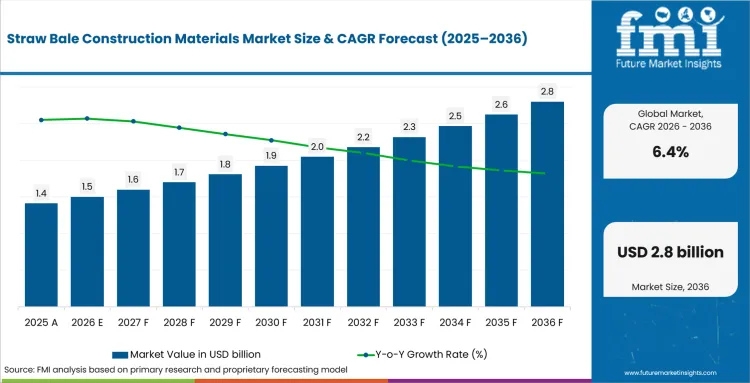
Key Takeaways of Straw Bale Construction Materials Market
- Demand expands through projects that combine bio-based building materials with documented moisture control and code-compliant wall detailing across the complete construction sequence.
- By product type, wheat straw is estimated to hold 51.0% in 2026 owing to broad crop availability and familiar bale handling practices.
- Residential buildings are projected to represent 54.0% of application in 2026, supported by custom housing layouts that accommodate thicker walls and energy-focused design decisions.
- The residential construction segment is forecast to account for 52.0% of end user in 2026, enabled by specialist builders that create financeable material specifications.
- Moisture exposure and uneven approval knowledge remain material restraints due to required inspection points and accountable weather protection during enclosure.
- Prefabricated wall-system providers include EcoCocon and Modulina alongside Verdant Building Products and Viva Living Homes across regional panel routes. Processed-straw specialists include SLAM-PA and EKOPANELY alongside ISO-STROH and Ortech Industries across defined board and insulation formats.
Analyst Perspective
“Straw bale construction becomes commercially repeatable through disciplined material grading and clear weather protection across every delivery stage. Site-built bales give contractors greater fitting flexibility whereas prefabricated panels require earlier design decisions and dependable transport planning. Companies gain repeat orders by providing tested wall assemblies with regional technical support and named responsibility for moisture checks. Documented operating capabilities turn agricultural residue into financeable construction packages for housing and larger building programs.”
- Nikhil Kaitwade, Principal Analyst, Future Market Insights
How is the Straw Bale Construction Materials Market segmented?
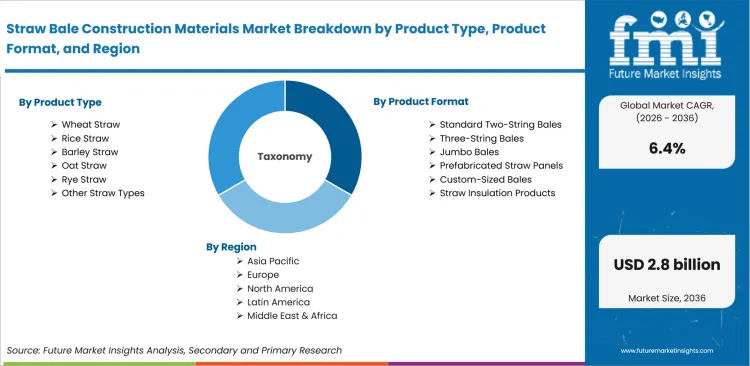
The straw bale construction materials industry is segmented by product type, product format, construction method, application, end user, distribution channel, and region.
The segmentation separates agricultural bales from factory-made panels, compressed boards, and processed insulation products through distinct product choices. Product type identifies crop residue; product format records whether straw reaches the site as conventional bales, engineered panels, boards, or loose insulation. Construction method distinguishes load-bearing walls from infill systems built around a separate structural frame, which changes engineering responsibility and installation planning. Application identifies the building type; end user identifies the organization that purchases materials and coordinates installation across the project. Distribution channel separates direct project sales from specialist distribution and agricultural sourcing, preventing general building materials revenue from entering the estimate without a documented straw transaction. Selected shares describe 2026 demand within each parent category, so the framework preserves different commercial mechanisms across sourcing and installation.
What keeps wheat straw ahead within product type?
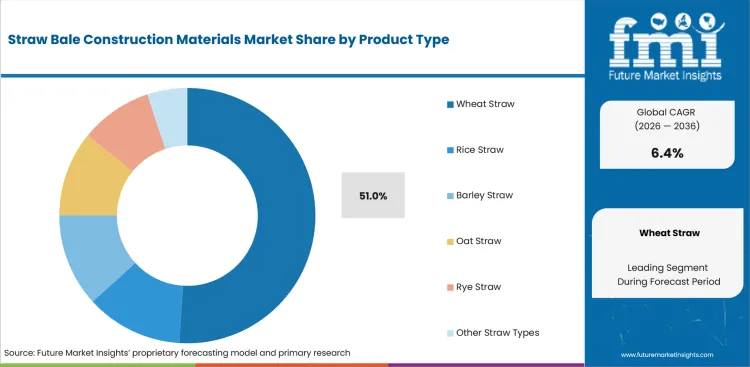
Wheat straw benefits from an extensive agricultural supply base that spans established grain-producing regions across several continents. The World Agricultural Outlook Board projected global wheat output at 819.97 million metric tonnes for 2026/27 in July 2026. The figure confirms a large residue stream but does not establish construction demand or building-grade material availability. Regional processors must screen density and moisture so green building materials specifications become traceable wall components for funded projects.
- Wheat straw is likely to capture 51.0% share in 2026, attributable to its broad agricultural availability and familiar bale handling. Inconsistent density increases framing adjustments and plaster preparation, so the segment performs best near grading and covered storage capacity. Local sourcing strengthens its position by reducing transport exposure between agricultural storage and the construction site.
- Natural-building contractors increasingly purchase wheat straw through agreements that define bale dimensions and moisture limits ahead of delivery. Crop availability alone cannot protect insulation performance during enclosure, so project teams need reliable rejection procedures and storage records. Consistent documentation also gives architects a defensible basis for approving replacement material and documenting compliance during site inspections.
Which buying mechanism supports standard two-string bales in the product format category?
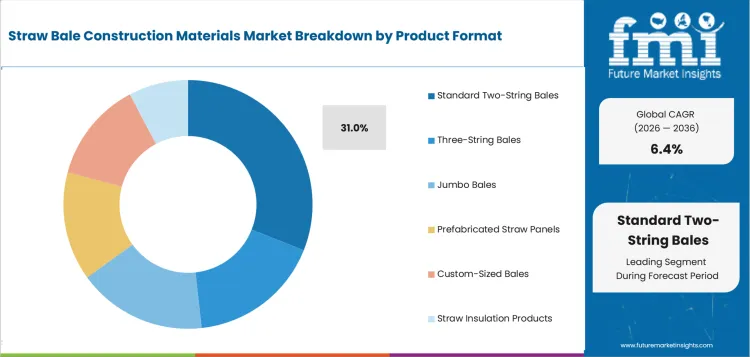
Standard two-string bales suit crews that source conventional agricultural packs and adjust framing around actual dimensions. Manageable unit weight supports manual handling and lets contractors replace damaged units without remanufacturing complete wall sections. Conventional dimensions also fit self-build projects that can tolerate measured adjustments around openings and corners. Comparisons with thermal insulation materials become useful as plaster and air-sealing work enters the installed cost.
- Standard two-string bales are projected to hold 31.0% share in 2026, owing to manageable unit weight and established farm supply channels. Dimensional variation can increase timber adjustments across repeated wall sections, weakening the format on tightly scheduled developments. Contractors value the format most in projects that prioritize adaptable site work over factory-level dimensional consistency.
- Standard two-string bales are drawing demand from self-builders and specialist contractors, supported by flexible site fitting and easy replacement of damaged units. The 2025 Residential Code of New York State contains Appendix BJ for strawbale construction and gives reviewers a defined reference for conventional assemblies. Smaller projects retain flexibility through manual fitting and direct inspection of every bale ahead of installation.
What supports the position of Non-Load-Bearing within the construction method category?
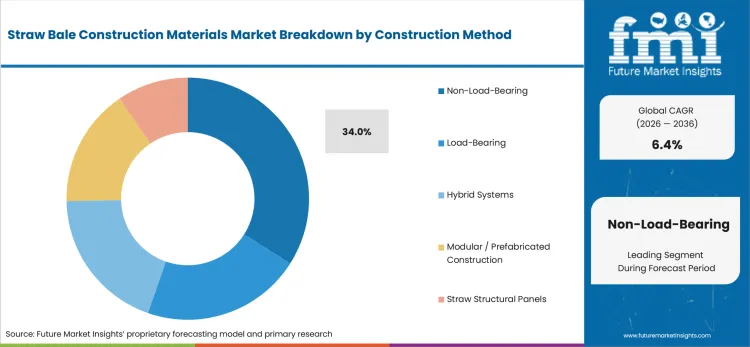
Non-load-bearing walls place structural responsibility on timber or another frame and use straw for enclosure and insulation. The separate frame lets engineers verify gravity loads independently as contractors manage bale density and enclosure tolerances. Roof-first sequencing protects building envelope systems during placement and supports coordinated compression with render detailing around openings. The method simplifies responsibility across familiar framing trades while retaining straw within the thermal enclosure.
- By construction method, non-load-bearing systems are estimated to hold 34.0% share in 2026 owing to clearer responsibility for structural loads. The 2024 International Residential Code includes Appendix BJ provisions for structural and nonstructural strawbale walls. The separate frame supports this position across projects that use conventional engineering oversight without asking the bale wall to carry roof or floor loads.
- Adoption of non-load-bearing systems is gaining momentum in roof-first projects, supported by protected bale placement during uncertain construction weather. Exposed sites face weaker conversion as inadequate cover raises moisture readings and can force material replacement. Protected sequencing therefore affects adoption more directly than the selected frame material across weather-sensitive sites.
Why does residential buildings lead the application category?
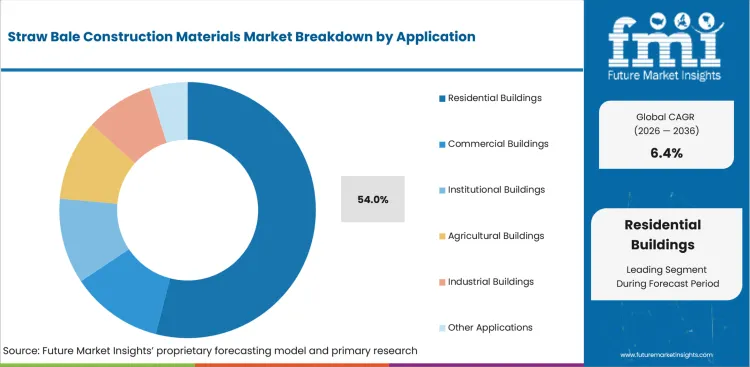
Residential projects accommodate thick straw walls through designs that value stable indoor temperatures and deep window reveals. Thick assemblies require early coordination of wall depth around windows and usable floor area during design planning. EcoCocon opened ETC Hyllie in May 2026 as a twelve-story residential building using prefabricated straw wall panels. The completed project demonstrates urban-scale application but cannot establish broad adoption across housing programs or regional development pipelines. Commercial value arises from early integration of building thermal insulation and wall thickness within the architectural process.
- The application category is forecast to be led by residential buildings at 54.0% share in 2026 due to flexible layouts and direct owner involvement. Custom homes can allocate floor area and window details around thicker assemblies more readily than constrained retrofits. Early architectural integration protects usable space and reduces late changes around openings or service penetrations.
- Demand for residential building applications is expected to grow among custom housing developers, supported by designs that qualify one wall system across limited unit counts. Bespoke detailing can weaken schedule certainty, so wider subdivision adoption needs repeatable costing and lender confidence. Contractors must demonstrate that the selected assembly can be repeated without custom redesign across every dwelling in a larger program.
How does residential construction shape demand in the end user category?
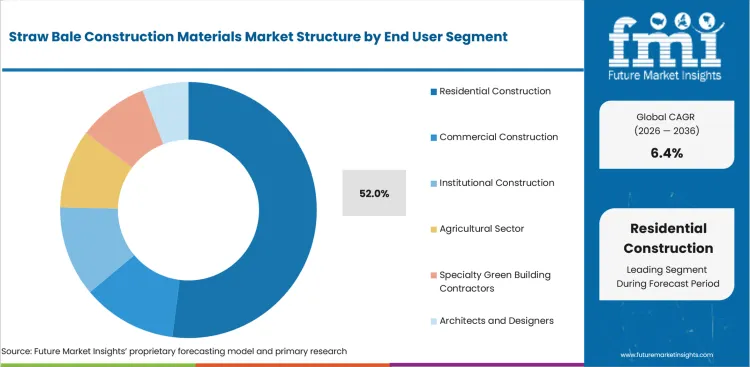
Residential contractors convert architectural interest into material orders by coordinating structural design with complete straw wall-system delivery. Controlled pre-assembly can transfer membranes and connections into factory conditions well ahead of scheduled site delivery. The approach improves trade coordination but requires earlier decisions around openings and interfaces across the complete wall package. Contractors compare this route with insulation boards whenever predictable thickness and installation time influence warranties or schedules.
- Based on end user, residential construction is projected to account for 52.0% in 2026 due to coordinated design and enclosure responsibility. Repeated housing layouts strengthen this position across planned developments with consistent wall details and coordinated enclosure schedules. Residential contractors compare whole-wall cost against familiar framing and insulation packages during approval of a complete straw assembly.
- Residential contractors are expected to favor coordinated straw wall packages over separately sourced materials, supported by repeatable details and trained installation teams. EcoCocon reported in March 2026 that pre-assembly transfers membranes and connections into controlled conditions ahead of site delivery. Repeat purchasing improves as contracts assign each interface to named construction teams with clear inspection and warranty responsibility.
What keeps direct sales ahead within distribution channel?
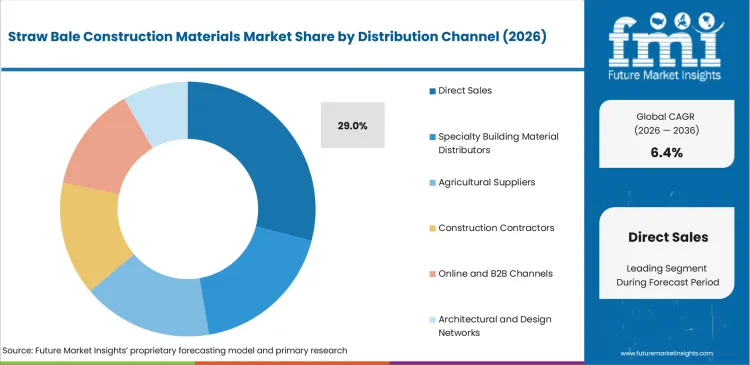
Direct project sales let manufacturers review detailed drawings and installation schedules ahead of every planned site delivery. Regional service coverage is necessary for unloading coordination and time-sensitive installation questions across active building sites. The direct-sales route places modular construction products within a coordinated supply process rather than anonymous stock availability. Manufacturers can confirm panel quantities and transport sequences before material leaves the factory for each project.
- Direct sales are set to lead the distribution channel with 29.0% share in 2026 due to project-specific quantities and technical coordination. Ecological Building Systems announced a United Kingdom and Ireland partnership with EcoCocon in July 2025 as its official distributor and technical partner. The arrangement supports local logistics and responsive technical guidance across active construction schedules and time-sensitive deliveries.
- Purchase activity through direct sales is anticipated to rise, reinforced by early drawing review and project-specific fabrication schedules. Remote sites need dependable unloading equipment and qualified installers during critical enclosure stages, creating a different channel constraint. Local partners determine whether technical advice reaches contractors soon enough to protect enclosure schedules and material condition.
What are the drivers, restraints, and opportunities in the Straw Bale Construction Materials Market?
Demand gains support from funded projects and tested wall assemblies. Moisture exposure and unfamiliar approval routes remain material restraints. Standardized panel packages and regional technical partners create the clearest expansion route.
- Driver: Funded building programs create direct demand for projects with secured land and technical partners for straw-panel construction.
- Restraint: Moisture exposure and unfamiliar approval routes add inspection work during storage and incomplete enclosure across weather-sensitive projects.
- Opportunity: Standardized panels and trained regional partners can reduce site variation and create repeatable specification and delivery routes.
Funded municipal recovery programs is expected to drive demand for prefabricated straw panels through defined projects and technical partnerships. Modulina reported in July 2026 that Bucha signed a cooperation agreement with Rebuild Green partners including Modulina Straw Panels. The agreement creates a formal project-development route but does not establish completed procurement or broad municipal adoption. Manufacturers can convert the opening by aligning panel design with local engineering and finance requirements. Orders depend on funded specifications and accountable delivery rather than general interest in natural materials.
Panels and loose bales remain vulnerable until the complete wall receives weather protection, making moisture exposure a material restraint. EcoCocon’s June 2026 technical specification requires full protection from water ingress throughout unloading and storage. Installation teams must maintain equivalent protection during assembly so the wall retains material quality beneath its final finish. Jurisdictions without a recognized straw pathway can extend design review and require additional project records. Repeat projects therefore need standard moisture documents and trained reviewers to reduce delay and replacement costs.
Completed public buildings create a credible opening by giving municipal teams a visible reference for natural wall systems. Small public projects can test material coordination and reviewer confidence without committing municipalities to wider programs. The European Commission reported in April 2026 that the Bucha Forest Classroom used straw panels and natural wood within a completed educational space. Manufacturers can convert this reference into repeatable specifications through project-specific design packages and regional technical partners. Commercial value develops through accountable installation support rather than unrestricted material availability across local projects.
Which country CAGRs are profiled in the Straw Bale Construction Materials Market?
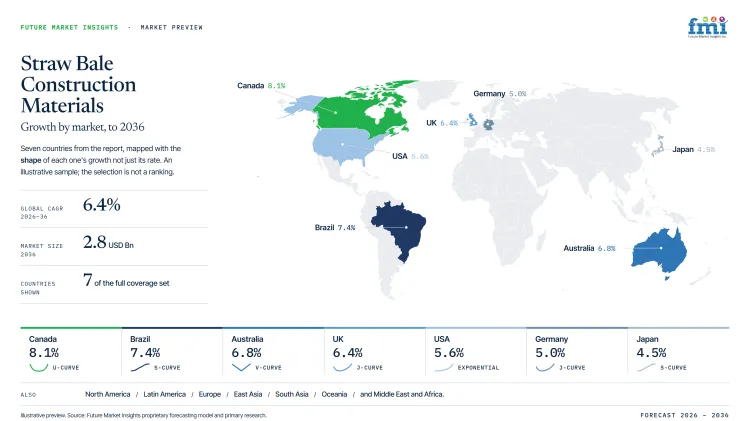
| Country | CAGR |
|---|---|
| Canada | 8.1% |
| Brazil | 7.4% |
| Australia | 6.8% |
| UK | 6.4% |
| USA | 5.6% |
| Germany | 5.0% |
| Japan | 4.5% |
How do country-level CAGRs compare in the Straw Bale Construction Materials Market?
The profiled country rates span 3.6 percentage points between Canada and Japan across the complete comparison set. Canada and Brazil form an upper pair separated by 0.7 points as Australia and the UK remain within 0.4 points. The USA and Germany create another 0.6-point interval with Japan positioned 0.5 points below Germany. The measured gaps compare forecast pace rather than revenue quality due to material differences in approval routes and service coverage.
- Canada combines a strong forecast rate with broad grain production but regional distance can raise technical support and delivery costs.
- Brazil follows closely through southern wheat production, yet humidity and uneven specialist coverage can complicate storage and installation control.
- Australia sits near the middle of the comparison as housing demand supports trials but long service distances limit repeatable national coverage.
- The UK remains close to Australia through established specialist knowledge and larger projects remain shaped by warranty and building-control evidence.
- The USA reflects a substantial construction base but state and local code adoption creates uneven commercial routes for straw assemblies.
- Germany combines formal technical review with an active housing pipeline but installation economics remain demanding for unfamiliar wall systems.
- Japan requires careful moisture and seismic detailing which can slow conversion despite a substantial agricultural residue base and dense construction markets.
Project size and local service capacity can produce different commercial outcomes from comparable CAGRs across these countries. The full report extends the country comparison across North America and Latin America alongside Europe. Coverage also includes East Asia and South Asia together with Oceania and the Middle East and Africa.
Country-wise Analysis
- Provincial approval routes and long transport distances shape Canada’s commercial path for straw wall systems across widely separated construction regions. Straw bale construction materials demand in Canada is forecast to rise at 8.1% CAGR over the forecast period, supported by grain availability and regional natural-building expertise. Statistics Canada reported in December 2025 that national wheat production reached 40.0 million tonnes during 2025. The crop base gives processors substantial residue for grading near suitable projects but does not prove construction demand. Cold or wet building seasons require covered staging and rapid enclosure to protect material during installation. Regional technical partners remain essential across distant projects that cannot depend on factory staff for every installation question. The strongest entry route combines local bale screening with documents that municipal reviewers can assess ahead of site work.
- Southern grain-producing states give Brazil a practical feedstock route near established storage and transport networks for wheat straw. Humid transport conditions make covered storage and short regional routes necessary for maintaining bale quality. By 2036, Brazil’s straw bale construction materials market is projected to grow at 7.4% CAGR shaped by regional wheat residue availability and specialist construction knowledge. IBGE estimated Brazil’s 2025 wheat production at 7.8 million tonnes in its January 2026 national forecast. The crop base supports local grading but cannot prove building demand or year-round construction quality. Extended regional routes can expose screened bales to rainfall during delivery and temporary site storage. Commercial expansion depends on local processing partners that can grade material and serve projects without long uncovered logistics routes.
- State-specific energy assessment routes shape Australian approvals for unfamiliar wall types across custom housing and regional construction projects. The Australian straw bale construction materials sector is projected to record 6.8% CAGR during the assessment period, influenced by custom housing demand and domestic panel availability. The New South Wales Planning Portal reported in February 2025 that BASIX added straw panel walls as an external-wall option for houses. Current BASIX guidance directs straw-bale dwellings to simulation and requires certifier evidence for other wall types. The defined route gives projects a workable application process but increases modeling and documentation requirements. Wide service distances can raise technical support and delivery costs for factory-made panels across remote locations. Bushfire exposure adds site-specific detailing that manufacturers must resolve to make repeated orders practical across regional housing programs.
- Formal building-control review and established natural-building networks shape the United Kingdom route for unfamiliar straw wall systems. Specialist design knowledge supports small projects but warranty acceptance and insurer confidence remain material barriers for larger developments. Adoption of straw bale construction materials in the United Kingdom is estimated to expand at 6.4% CAGR through 2036, reinforced by specialist designers and documented panel systems. The University of Westminster reported in June 2026 that architecture students and staff designed and built an experimental straw bale pavilion. The project develops practical detailing and construction skills but does not prove commercial purchasing across housing programs. Manufacturers need regional technical support that connects structural calculations with moisture protection and installation sequencing. Repeated residential orders require warranty evidence that lenders and building-control teams can review without treating every project as a new experiment.
- State and local code adoption creates different approval routes for straw wall construction across the United States. The United States straw bale construction materials outlook is anticipated to advance at 5.6% CAGR over the assessment period, underpinned by custom housing and regional natural-building activity. The 2025 California Residential Code contains Appendix BJ provisions that define review criteria for strawbale construction assemblies. The code gives California designers a clearer route but cannot establish equivalent acceptance across every jurisdiction. Large geography and uneven installer coverage create substantial service-distance friction for panel manufacturers and specialist contractors. Commercial entry works best in regions that combine local engineering knowledge with protected material storage. National expansion requires repeatable documents that local officials can assess without rebuilding the approval case for every project.
- German projects enter through formal technical documentation and careful lifecycle cost review across state building approval processes. Installers need fire and moisture evidence for unfamiliar wall systems to receive broader commercial consideration. Straw bale construction materials sales in Germany are forecast to expand at 5.0% CAGR by 2036, linked to current technical-assessment and state approval routes. The German Institute for Building Technology announced MVV TB 2025/1 in May 2025 as a model for state technical rules. The formal publication creates a current reference for state technical rules but does not guarantee acceptance across every project or federal state. Technical approval has limited value without trained installation teams, so manufacturers need German-language design support and dependable logistics.
- Japan’s humid climate and seismic design expectations shape the operating case for straw-based walls across local construction markets. Japan’s straw bale construction materials market is estimated to post 4.5% CAGR over the forecast period, associated with selective interest in natural insulation and local residue use. JST’s J-GLOBAL record dated July 2025 indexed a Japanese study that classified domestic and overseas straw-bale construction methods. The study supports a developing technical knowledge base but does not prove purchasing or legal acceptance. Dense urban sites can favor prefabricated delivery, yet limited local references constrain reviewer and contractor confidence. Regional partners need seismic engineering support and moisture details that respond to seasonal rainfall and humidity. Commercial entry depends on documented assemblies and trained specialists rather than national feedstock availability alone.
Who are the notable companies in the Straw Bale Construction Materials Market?
EcoCocon, SLAM-PA s.r.o., Modulina, Verdant Building Products, EKOPANELY CZ s.r.o., ISO-STROH, Viva Living Homes, and Ortech Industries Pty Ltd. are notable companies serving this market.
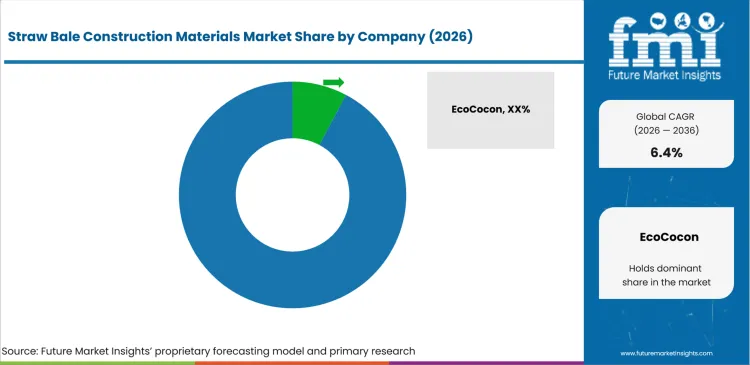
The competitive outlook combines engineered wall-system providers with manufacturers of compressed straw products for different construction applications. EcoCocon and Modulina provide prefabricated wall systems as Verdant Building Products and Viva Living Homes serve regional panel routes. SLAM-PA and EKOPANELY convert agricultural fibre into panel or board products while ISO-STROH supplies processed insulation. Ortech Industries manufactures Durra Panel products for defined wall and ceiling assemblies across commercial and public buildings. The verified company roles overlap with broader insulation systems but differ in structural function and installation responsibility. Project selection therefore depends on verified assembly scope and accessible technical support rather than company size alone.
- EcoCocon and Modulina compete through engineered prefabricated wall systems that require early design coordination and controlled installation planning.
- SLAM-PA supplies prefabricated timber-straw wall panels through a defined Czech manufacturing route and project-specific assembly model. EKOPANELY and Ortech Industries manufacture compressed boards for interior wall and ceiling assemblies that require different installation responsibilities.
- Viva Living Homes provides an Australian prefabricated panel route supported by local manufacturing and project guidance. Regional production illustrates how service coverage influences specification decisions across distant construction areas and regional housing projects. Domestic technical support can reduce response times during design coordination and active installation as imported systems face longer delivery and service routes.
Competitive Benchmarking: Straw Bale Construction Materials Market
| Company | Prefabricated Wall Systems | Straw Material Processing | Technical Support and Delivery | Geographic Reach |
|---|---|---|---|---|
| EcoCocon | High | High | High | Global |
| SLAM-PA s.r.o. | High | High | Medium | Czech Republic |
| Modulina | High | High | Medium | Europe |
| Verdant Building Products | High | High | Medium | United States |
| EKOPANELY CZ s.r.o. | Medium | High | High | Europe and global exports |
| ISO-STROH | Low | High | High | Europe |
| Viva Living Homes | High | Medium | High | Australia |
| Ortech Industries Pty Ltd. | Medium | High | Medium | Australia and global exports |
Key Developments in the Straw Bale Construction Materials Market
- In January 2025, EcoCocon reported that its straw wall panels achieved an REI 45 fire-resistance classification through a completed test program. The result expanded the technical evidence available to architects evaluating panelized straw assemblies for buildings with defined fire requirements. Local approval remains necessary but the classification gives project teams a clearer basis for comparing wall designs during specification and regulatory review.
- In May 2026, EcoCocon issued a declaration of performance under ETA-26/0071 for straw thermal insulation used within its prefabricated panels. The document defines intended use with declared thermal and fire characteristics through a formal European technical assessment route. The declaration gives architects a current performance reference for panel specifications; national rules and project-level review continue to govern approval of the complete wall assembly.
- In September 2025, Modulina announced completion of the Ptahahata bird observatory in Ukraine using donated straw panels across walls and other envelope elements. The completed pilot created a physical reference for full-envelope deployment and coordinated installation within a community building project. Its commercial value lies in demonstrating assembly and coordination under real site conditions rather than proving broad regional demand.
- In July 2025, Ortech Industries documented Durra Panel integration throughout Melbourne Park’s Centrepiece and related public venue spaces. Prefabricated V-shaped ceiling modules combined straw panels with steel sections and custom lifting frames for complex roof installation. The project demonstrates commercial deployment in large public venues and gives commercial specifiers a current reference for acoustic straw panels beyond residential wall systems.
Key Players in the Straw Bale Construction Materials Market
Engineered Straw Wall System Providers
- EcoCocon
- Modulina
- Verdant Building Products
- SLAM-PA s.r.o.
Regional Prefabricated Panel Providers
- Viva Living Homes
Straw Board and Insulation Manufacturers
- EKOPANELY CZ s.r.o.
- ISO-STROH
- Ortech Industries Pty Ltd.
Straw Bale Construction Materials Market - Report Scope
| Coverage field | Report scope |
|---|---|
| Market breakdown | Product Type, Product Format, Construction Method, Application, End User, Distribution Channel, and Region. |
| Market Definition | Agricultural straw bales, prefabricated straw wall panels, processed straw insulation, compressed straw boards, plasters, connectors, and related construction systems used in structural or infill building envelopes. |
| Regions Covered | North America, Latin America, Europe, East Asia, South Asia, Oceania, and Middle East and Africa. |
| Countries Covered | Canada, Brazil, Australia, UK, USA, Germany, and Japan. |
| Key Companies Profiled | EcoCocon, SLAM-PA s.r.o., Modulina, Verdant Building Products, EKOPANELY CZ s.r.o., ISO-STROH, Viva Living Homes, and Ortech Industries Pty Ltd. |
| Forecast Period | 2026 to 2036. |
| Approach | Hybrid bottom-up and top-down market sizing supported by primary interviews and official desk research. |
Straw Bale Construction Materials Market - Research Methodology
| Method | Approach |
|---|---|
| Primary Research | FMI analysts gathered input from manufacturers, service providers, technology developers, distributors, end users, procurement teams, and subject-matter experts. Interviews examined purchasing decisions, product or service evaluation, adoption barriers, approval requirements, pricing considerations, and expectations for technical or commercial support. Respondents were also asked what evidence is required before a trial, pilot, or initial order develops into regular purchasing. |
| Desk Research | Desk research covered government statistics, regulatory publications, trade data, industry associations, technical literature, standards, company filings, product information, and official corporate announcements. Sources were reviewed for relevance, publication date, geographic coverage, and consistency with the defined market scope. Claims relating to performance, applications, approvals, capacity, investment, and commercial activity were retained only when supported by credible public evidence. |
| Market Sizing and Forecasting | The market model combined the baseline value with historical performance, segment structure, pricing and volume indicators, adoption levels, company participation, and country-level demand conditions. Forecast assumptions considered economic activity, investment trends, regulatory developments, technology adoption, purchasing cycles, supply availability, and barriers to wider market use. Segment and regional estimates were reconciled before the final market total was calculated. |
| Data Validation | Estimates were checked against multiple independent indicators, including public data, company activity, trade patterns, industry developments, and findings from primary interviews. Validation also tested whether products, services, applications, and company revenues fell within the defined market boundaries. Adjacent categories, unsupported claims, overlapping revenues, and activities without direct market relevance were excluded to reduce double counting and maintain consistency across segments and countries. |
Straw Bale Construction Materials Market by Segments
Straw Bale Construction Materials Market segmented by Product Type:
- Wheat Straw
- Rice Straw
- Barley Straw
- Oat Straw
- Other Agricultural Straw
Straw Bale Construction Materials Market segmented by Product Format:
- Standard Two-String Bales
- Three-String Bales
- Jumbo Bales
- Prefabricated Straw Panels
- Compressed Straw Boards
- Blown Straw Insulation
Straw Bale Construction Materials Market segmented by Construction Method:
- Non-Load-Bearing
- Post-and-Beam Infill Systems
- Frame-and-Infill Systems
- Load-Bearing
- Stacked Load-Bearing Bale Systems
- Compressed Load-Bearing Bale Systems
- Hybrid Systems
- Timber Frame and Straw Bale Systems
- Steel Frame and Straw Bale Systems
- Modular / Prefabricated Construction
- Prefabricated Straw Panel Systems
- Modular Straw Building Systems
- Straw Structural Panels
- Structural Insulated Straw Panels
- Engineered Straw Wall Systems
Straw Bale Construction Materials Market segmented by Application:
- Residential Buildings
- Single-Family Homes
- Multi-Family Homes
- Commercial Buildings
- Office Buildings
- Retail and Hospitality Buildings
- Institutional Buildings
- Schools and Educational Facilities
- Community and Public Buildings
- Agricultural Buildings
- Barns and Farm Buildings
- Agricultural Storage Facilities
- Industrial Buildings
- Workshops and Light Industrial Buildings
- Warehouses and Storage Buildings
- Other Applications
- Eco-Tourism Facilities
- Temporary and Special-Purpose Structures
Straw Bale Construction Materials Market segmented by End User:
- Residential Construction
- Homeowners and Self-Builders
- Residential Developers
- Commercial Construction
- Commercial Building Developers
- Office and Retail Contractors
- Institutional Construction
- Schools and Educational Institutions
- Public and Community Organizations
- Agricultural Sector
- Farm Owners
- Agricultural Building Operators
- Specialty Green Building Contractors
- Natural Building Specialists
- Architects and Designers
- Sustainable Architecture Firms
- Eco-Construction Design Studios
Straw Bale Construction Materials Market segmented by Distribution Channel:
- Direct Sales
- Direct Manufacturer Sales
- Project-Based Supply Contracts
- Specialty Building Material Distributors
- Natural Building Product Distributors
- Agricultural Suppliers
- Local Straw Suppliers
- Farm and Agricultural Cooperatives
- Construction Contractors
- Specialized Straw Bale Contractors
- Online and B2B Channels
- Online Building Material Platforms
- Architectural and Design Networks
- Architect-Specified Purchasing
- Green Building Associations
Straw Bale Construction Materials Market by Region:
- North America
- USA
- Canada
- Latin America
- Brazil
- Mexico
- Argentina
- Western Europe
- Germany
- UK
- France
- Italy
- Spain
- Nordic
- BENELUX
- Eastern Europe
- Poland
- Romania
- Hungary
- East Asia
- Japan
- China
- South Korea
- South Asia and Pacific
- Australia and New Zealand
- India
- ASEAN
- Middle East and Africa
- GCC Countries
- South Africa
- Türkiye
- Israel
Research Sources and Bibliography
- EcoCocon. (2025, October 9).
- EcoCocon. (2026, January 14).
- World Agricultural Outlook Board. (2026, July 10).
- International Code Council. (2025).
- International Code Council. (2024).
- EcoCocon. (2026, May 23).
- EcoCocon. (2026, March 30).
- Ecological Building Systems. (2025, July 9).
- Modulina. (2026, July 8).
- EcoCocon. (2026, June 4).
- European Commission, Directorate-General for Environment. (2026, April 17).
- Statistics Canada. (2025, December 4).
- Brazilian Institute of Geography and Statistics. (2026, January 15).
- New South Wales Planning Portal. (2025, February 5).
- New South Wales Planning Portal. (2025, March 3).
- University of Westminster. (2026, June 22).
- International Code Council. (2025).
- Deutsches Institut für Bautechnik. (2025, May 20).
- Murakami, T., Ashizawa, R., & Kawai, M. (2025, July 20).
- USA Environmental Protection Agency. (2026, February 24).
- EKOPANELY CZ s.r.o. (n.d.).
- EcoCocon. (2025, January 15).
- EcoCocon. (2026, May 17).
- Modulina. (2025, September 9).
- Ortech Industries Pty Ltd. (2025, July 31).
This bibliography is provided for reader reference and is not exhaustive. The full report contains the complete reference list and detailed citations
This Report Answers
- How large is the straw bale construction materials market in 2026 and 2036?
- Which operating conditions convert agricultural straw into approved construction material orders?
- Why does wheat straw hold the largest product type share during 2026?
- How do conventional bales and prefabricated panels create different purchasing routes?
- Why do residential buildings and residential construction hold substantial category shares?
- How do country growth rates differ across Canada, Brazil, Australia, the UK, the USA, Germany, and Japan?
- Which companies provide prefabricated panels, processed insulation, or compressed straw boards?
- What moisture and code barriers delay wider commercial adoption?
- How can regional training and technical support improve project conversion?
Frequently Asked Questions
How big is the Straw Bale Construction Materials Market in 2026?
The straw bale construction materials market is valued at USD 1.5 billion in 2026 and is forecast to reach USD 2.8 billion by 2036, reflecting growing adoption of low-carbon building materials and engineered straw-based systems across residential and commercial construction projects.
What is the CAGR of the Straw Bale Construction Materials Market from 2026 to 2036?
The straw bale construction materials market is projected to grow at a CAGR of 6.4% between 2026 and 2036, supported by funded building programs that combine bio-based wall systems with documented moisture control and code-compliant detailing across the complete construction sequence.
Which application leads the Straw Bale Construction Materials Market?
Residential buildings account for 54.0% of the straw bale construction materials market by application in 2026, driven by flexible custom housing layouts that accommodate thicker wall assemblies and energy-focused design decisions with direct owner involvement throughout the specification process.
Which country is growing fastest in the Straw Bale Construction Materials Market?
The straw bale construction materials market in Canada is projected to expand at a CAGR of 8.1% through 2036, ahead of Brazil at 7.4%, Australia at 6.8%, the UK at 6.4%, the USA at 5.6%, Germany at 5.0%, and Japan at 4.5%, reflecting broad grain availability and regional natural-building expertise across grain-producing provinces.
Who are the leading companies in the Straw Bale Construction Materials Market?
Leading companies in the straw bale construction materials market include EcoCocon, SLAM-PA s.r.o., Modulina, Verdant Building Products, EKOPANELY CZ s.r.o., ISO-STROH, Viva Living Homes, and Ortech Industries Pty Ltd., spanning engineered prefabricated wall systems, compressed straw boards, and processed insulation products across regional construction markets.
Preview the report firsthand - request a free sample
Get SampleGet the brochure for pricing and purchase details.
Get PDFTable of Content
- Key Takeaways
- Market Size and CAGR
- Top Growth Driver
- Fastest Growing Segment
- Leading Region
- Key Companies
- Emerging Opportunities
- Executive Summary
- Global Market Outlook
- Demand-side Trends
- Supply-side Trends
- Technology Roadmap Analysis
- Analysis and Recommendations
- Analyst Perspective (What is happening? Why now? What should investors know?)
- Key Questions Answered
- How large is the market?
- What is the CAGR?
- What are key trends?
- Which region dominates?
- Who are the leaders?
- Market Overview
- Market Coverage / Taxonomy
- Market Definition / Scope / Limitations
- Research Methodology
- Chapter Orientation
- Analytical Lens and Working Hypotheses
- Market Structure, Signals, and Trend Drivers
- Benchmarking and Cross-market Comparability
- Market Sizing, Forecasting, and Opportunity Mapping
- Research Design and Evidence Framework
- Desk Research Programme (Secondary Evidence)
- Expert Input and Fieldwork (Primary Evidence)
- Tooling, Models, and Reference Databases
- Data Engineering and Model Build
- Quality Assurance and Audit Trail
- Market Background
- Market Dynamics (Drivers, Restraints, Opportunity, Trends)
- Scenario Forecast (Optimistic, Likely, Conservative)
- Impact Analysis
- AI Impact
- Sustainability Impact
- Regulatory Impact
- Technology Impact
- Consumer / Buyer Analysis
- Purchase Drivers
- Adoption Barriers
- Buyer Journey
- Opportunity Map Analysis
- Product Life Cycle Analysis
- Supply Chain Analysis
- Investment Feasibility Matrix
- Value Chain Analysis
- PESTLE and Porter's Analysis
- Regulatory Landscape
- Regional Parent Market Outlook
- Production and Consumption Statistics
- Import and Export Statistics
- Global Market Analysis and Forecast, 2021 to 2036
- Historical Market Size Value (USD billion) Analysis, 2021 to 2025
- Current and Future Market Size Value (USD billion) Projections, 2026 to 2036
- Y-o-Y Growth Trend Analysis
- Absolute $ Opportunity Analysis
- Global Market Pricing Analysis, 2021 to 2036
- Global Market Analysis and Forecast, By Product Type, 2021 to 2036
- Introduction / Key Findings
- Historical Market Size Value (USD billion) Analysis By Product Type, 2021 to 2025
- Current and Future Market Size Value (USD billion) Analysis and Forecast By Product Type, 2026 to 2036
- Wheat Straw
- Standard Wheat Straw Bales
- High-Density Wheat Straw Bales
- Rice Straw
- Standard Rice Straw Bales
- Densified Rice Straw Bales
- Barley Straw
- Standard Barley Straw Bales
- High-Density Barley Straw Bales
- Oat Straw
- Standard Oat Straw Bales
- Densified Oat Straw Bales
- Rye Straw
- Standard Rye Straw Bales
- High-Density Rye Straw Bales
- Other Straw Types
- Mixed Cereal Straw
- Other Agricultural Straw
- Wheat Straw
- Y-o-Y Growth Trend Analysis By Product Type, 2021 to 2025
- Absolute $ Opportunity Analysis By Product Type, 2026 to 2036
- Global Market Analysis and Forecast, By Product Format, 2021 to 2036
- Introduction / Key Findings
- Historical Market Size Value (USD billion) Analysis By Product Format, 2021 to 2025
- Current and Future Market Size Value (USD billion) Analysis and Forecast By Product Format, 2026 to 2036
- Standard Two-String Bales
- Regular Two-String Bales
- High-Density Two-String Bales
- Three-String Bales
- Standard Three-String Bales
- High-Density Three-String Bales
- Jumbo Bales
- Large Rectangular Bales
- Large Square Bales
- Prefabricated Straw Panels
- Structural Straw Panels
- Non-Structural Straw Panels
- Custom-Sized Bales
- Project-Specific Bales
- Custom-Density Bales
- Straw Insulation Products
- Straw Insulation Batts
- Compressed Straw Boards
- Standard Two-String Bales
- Y-o-Y Growth Trend Analysis By Product Format, 2021 to 2025
- Absolute $ Opportunity Analysis By Product Format, 2026 to 2036
- Global Market Analysis and Forecast, By Construction Method, 2021 to 2036
- Introduction / Key Findings
- Historical Market Size Value (USD billion) Analysis By Construction Method, 2021 to 2025
- Current and Future Market Size Value (USD billion) Analysis and Forecast By Construction Method, 2026 to 2036
- Non-Load-Bearing
- Infill Straw Bale Systems
- Frame-and-Infill Systems
- Load-Bearing
- Stacked Load-Bearing Bale Systems
- Compressed Load-Bearing Bale Systems
- Hybrid Systems
- Timber Frame and Straw Bale Systems
- Steel Frame and Straw Bale Systems
- Modular / Prefabricated Construction
- Prefabricated Straw Panel Systems
- Modular Straw Building Systems
- Straw Structural Panels
- Structural Insulated Straw Panels
- Engineered Straw Wall Systems
- Non-Load-Bearing
- Y-o-Y Growth Trend Analysis By Construction Method, 2021 to 2025
- Absolute $ Opportunity Analysis By Construction Method, 2026 to 2036
- Global Market Analysis and Forecast, By Application, 2021 to 2036
- Introduction / Key Findings
- Historical Market Size Value (USD billion) Analysis By Application, 2021 to 2025
- Current and Future Market Size Value (USD billion) Analysis and Forecast By Application, 2026 to 2036
- Residential Buildings
- Single-Family Homes
- Multi-Family Homes
- Commercial Buildings
- Office Buildings
- Retail and Hospitality Buildings
- Institutional Buildings
- Schools and Educational Facilities
- Community and Public Buildings
- Agricultural Buildings
- Barns and Farm Buildings
- Agricultural Storage Facilities
- Industrial Buildings
- Workshops and Light Industrial Buildings
- Warehouses and Storage Buildings
- Other Applications
- Eco-Tourism Facilities
- Temporary and Special-Purpose Structures
- Residential Buildings
- Y-o-Y Growth Trend Analysis By Application, 2021 to 2025
- Absolute $ Opportunity Analysis By Application, 2026 to 2036
- Global Market Analysis and Forecast, By End User, 2021 to 2036
- Introduction / Key Findings
- Historical Market Size Value (USD billion) Analysis By End User, 2021 to 2025
- Current and Future Market Size Value (USD billion) Analysis and Forecast By End User, 2026 to 2036
- Residential Construction
- Homeowners and Self-Builders
- Residential Developers
- Commercial Construction
- Commercial Building Developers
- Office and Retail Contractors
- Institutional Construction
- Schools and Educational Institutions
- Public and Community Organizations
- Agricultural Sector
- Farm Owners
- Agricultural Building Operators
- Specialty Green Building Contractors
- Sustainable Construction Contractors
- Natural Building Specialists
- Architects and Designers
- Sustainable Architecture Firms
- Eco-Construction Design Studios
- Residential Construction
- Y-o-Y Growth Trend Analysis By End User, 2021 to 2025
- Absolute $ Opportunity Analysis By End User, 2026 to 2036
- Global Market Analysis and Forecast, By Distribution Channel
- Introduction / Key Findings
- Historical Market Size Value (USD billion) Analysis By Distribution Channel, 2021 to 2025
- Current and Future Market Size Value (USD billion) Analysis and Forecast By Distribution Channel, 2026 to 2036
- Direct Sales
- Direct Manufacturer Sales
- Project-Based Supply Contracts
- Specialty Building Material Distributors
- Sustainable Building Material Distributors
- Natural Building Product Distributors
- Agricultural Suppliers
- Local Straw Suppliers
- Farm and Agricultural Cooperatives
- Construction Contractors
- Specialized Straw Bale Contractors
- Green Building Contractors
- Online and B2B Channels
- Online Building Material Platforms
- B2B Procurement Portals
- Architectural and Design Networks
- Architect-Specified Procurement
- Green Building Associations
- Direct Sales
- Y-o-Y Growth Trend Analysis By Distribution Channel, 2021 to 2025
- Absolute $ Opportunity Analysis By Distribution Channel, 2026 to 2036
- Global Market Analysis and Forecast, By Region, 2021 to 2036
- Introduction
- Historical Market Size Value (USD billion) Analysis By Region, 2021 to 2025
- Current Market Size Value (USD billion) Analysis and Forecast By Region, 2026 to 2036
- North America
- Latin America
- Western Europe
- Eastern Europe
- East Asia
- South Asia and Pacific
- Middle East & Africa
- Market Attractiveness Analysis By Region
- North America Market Analysis and Forecast, By Country, 2021 to 2036
- Historical Market Size Value (USD billion) Trend Analysis By Market Taxonomy, 2021 to 2025
- Market Size Value (USD billion) Forecast By Market Taxonomy, 2026 to 2036
- By Country
- USA
- Canada
- By Product Type
- By Product Format
- By Construction Method
- By Application
- By End User
- By Distribution Channel
- By Country
- Market Attractiveness Analysis
- By Country
- By Product Type
- By Product Format
- By Construction Method
- By Application
- By End User
- By Distribution Channel
- Key Takeaways
- Latin America Market Analysis and Forecast, By Country
- Historical Market Size Value (USD billion) Trend Analysis By Market Taxonomy, 2021 to 2025
- Market Size Value (USD billion) Forecast By Market Taxonomy, 2026 to 2036
- By Country
- Brazil
- Mexico
- Chile
- Rest of Latin America
- By Product Type
- By Product Format
- By Construction Method
- By Application
- By End User
- By Distribution Channel
- By Country
- Market Attractiveness Analysis
- By Country
- By Product Type
- By Product Format
- By Construction Method
- By Application
- By End User
- By Distribution Channel
- Key Takeaways
- Western Europe Market Analysis and Forecast, By Country
- Historical Market Size Value (USD billion) Trend Analysis By Market Taxonomy, 2021 to 2025
- Market Size Value (USD billion) Forecast By Market Taxonomy, 2026 to 2036
- By Country
- Germany
- UK
- Italy
- Spain
- France
- Nordic
- BENELUX
- Rest of Western Europe
- By Product Type
- By Product Format
- By Construction Method
- By Application
- By End User
- By Distribution Channel
- By Country
- Market Attractiveness Analysis
- By Country
- By Product Type
- By Product Format
- By Construction Method
- By Application
- By End User
- By Distribution Channel
- Key Takeaways
- Eastern Europe Market Analysis and Forecast, By Country
- Historical Market Size Value (USD billion) Trend Analysis By Market Taxonomy, 2021 to 2025
- Market Size Value (USD billion) Forecast By Market Taxonomy, 2026 to 2036
- By Country
- Russia
- Poland
- Hungary
- Balkan & Baltic
- Rest of Eastern Europe
- By Product Type
- By Product Format
- By Construction Method
- By Application
- By End User
- By Distribution Channel
- By Country
- Market Attractiveness Analysis
- By Country
- By Product Type
- By Product Format
- By Construction Method
- By Application
- By End User
- By Distribution Channel
- Key Takeaways
- East Asia Market Analysis and Forecast, By Country
- Historical Market Size Value (USD billion) Trend Analysis By Market Taxonomy, 2021 to 2025
- Market Size Value (USD billion) Forecast By Market Taxonomy, 2026 to 2036
- By Country
- China
- Japan
- South Korea
- By Product Type
- By Product Format
- By Construction Method
- By Application
- By End User
- By Distribution Channel
- By Country
- Market Attractiveness Analysis
- By Country
- By Product Type
- By Product Format
- By Construction Method
- By Application
- By End User
- By Distribution Channel
- Key Takeaways
- South Asia and Pacific Market Analysis and Forecast, By Country
- Historical Market Size Value (USD billion) Trend Analysis By Market Taxonomy, 2021 to 2025
- Market Size Value (USD billion) Forecast By Market Taxonomy, 2026 to 2036
- By Country
- India
- ASEAN
- Australia & New Zealand
- Rest of South Asia and Pacific
- By Product Type
- By Product Format
- By Construction Method
- By Application
- By End User
- By Distribution Channel
- By Country
- Market Attractiveness Analysis
- By Country
- By Product Type
- By Product Format
- By Construction Method
- By Application
- By End User
- By Distribution Channel
- Key Takeaways
- Middle East & Africa Market Analysis and Forecast, By Country
- Historical Market Size Value (USD billion) Trend Analysis By Market Taxonomy, 2021 to 2025
- Market Size Value (USD billion) Forecast By Market Taxonomy, 2026 to 2036
- By Country
- Kingdom of Saudi Arabia
- Other GCC Countries
- Türkiye
- South Africa
- Other African Union
- Rest of Middle East & Africa
- By Product Type
- By Product Format
- By Construction Method
- By Application
- By End User
- By Distribution Channel
- By Country
- Market Attractiveness Analysis
- By Country
- By Product Type
- By Product Format
- By Construction Method
- By Application
- By End User
- By Distribution Channel
- Key Takeaways
- Key Countries Market Analysis
- USA
- Pricing Analysis
- Market Share Analysis, 2025
- By Product Type
- By Product Format
- By Construction Method
- By Application
- By End User
- By Distribution Channel
- Canada
- Pricing Analysis
- Market Share Analysis, 2025
- By Product Type
- By Product Format
- By Construction Method
- By Application
- By End User
- By Distribution Channel
- Mexico
- Pricing Analysis
- Market Share Analysis, 2025
- By Product Type
- By Product Format
- By Construction Method
- By Application
- By End User
- By Distribution Channel
- Brazil
- Pricing Analysis
- Market Share Analysis, 2025
- By Product Type
- By Product Format
- By Construction Method
- By Application
- By End User
- By Distribution Channel
- Chile
- Pricing Analysis
- Market Share Analysis, 2025
- By Product Type
- By Product Format
- By Construction Method
- By Application
- By End User
- By Distribution Channel
- Germany
- Pricing Analysis
- Market Share Analysis, 2025
- By Product Type
- By Product Format
- By Construction Method
- By Application
- By End User
- By Distribution Channel
- UK
- Pricing Analysis
- Market Share Analysis, 2025
- By Product Type
- By Product Format
- By Construction Method
- By Application
- By End User
- By Distribution Channel
- Italy
- Pricing Analysis
- Market Share Analysis, 2025
- By Product Type
- By Product Format
- By Construction Method
- By Application
- By End User
- By Distribution Channel
- Spain
- Pricing Analysis
- Market Share Analysis, 2025
- By Product Type
- By Product Format
- By Construction Method
- By Application
- By End User
- By Distribution Channel
- France
- Pricing Analysis
- Market Share Analysis, 2025
- By Product Type
- By Product Format
- By Construction Method
- By Application
- By End User
- By Distribution Channel
- India
- Pricing Analysis
- Market Share Analysis, 2025
- By Product Type
- By Product Format
- By Construction Method
- By Application
- By End User
- By Distribution Channel
- ASEAN
- Pricing Analysis
- Market Share Analysis, 2025
- By Product Type
- By Product Format
- By Construction Method
- By Application
- By End User
- By Distribution Channel
- Australia & New Zealand
- Pricing Analysis
- Market Share Analysis, 2025
- By Product Type
- By Product Format
- By Construction Method
- By Application
- By End User
- By Distribution Channel
- China
- Pricing Analysis
- Market Share Analysis, 2025
- By Product Type
- By Product Format
- By Construction Method
- By Application
- By End User
- By Distribution Channel
- Japan
- Pricing Analysis
- Market Share Analysis, 2025
- By Product Type
- By Product Format
- By Construction Method
- By Application
- By End User
- By Distribution Channel
- South Korea
- Pricing Analysis
- Market Share Analysis, 2025
- By Product Type
- By Product Format
- By Construction Method
- By Application
- By End User
- By Distribution Channel
- Russia
- Pricing Analysis
- Market Share Analysis, 2025
- By Product Type
- By Product Format
- By Construction Method
- By Application
- By End User
- By Distribution Channel
- Poland
- Pricing Analysis
- Market Share Analysis, 2025
- By Product Type
- By Product Format
- By Construction Method
- By Application
- By End User
- By Distribution Channel
- Hungary
- Pricing Analysis
- Market Share Analysis, 2025
- By Product Type
- By Product Format
- By Construction Method
- By Application
- By End User
- By Distribution Channel
- Kingdom of Saudi Arabia
- Pricing Analysis
- Market Share Analysis, 2025
- By Product Type
- By Product Format
- By Construction Method
- By Application
- By End User
- By Distribution Channel
- Türkiye
- Pricing Analysis
- Market Share Analysis, 2025
- By Product Type
- By Product Format
- By Construction Method
- By Application
- By End User
- By Distribution Channel
- South Africa
- Pricing Analysis
- Market Share Analysis, 2025
- By Product Type
- By Product Format
- By Construction Method
- By Application
- By End User
- By Distribution Channel
- USA
- Market Structure Analysis
- Competition Dashboard
- Competition Benchmarking
- Market Share Analysis of Top Players
- By Regional
- By Product Type
- By Product Format
- By Construction Method
- By Application
- By End User
- By Distribution Channel
- Emerging Startups
- Innovation Benchmarking
- Competition Analysis
- Competition Deep Dive
- EcoCocon
- Overview
- Product Portfolio
- Profitability by Market Segments
- Sales Footprint
- Strategy Overview
- Marketing Strategy
- Product Strategy
- Channel Strategy
- ModCell
- Strawcture Eco
- StrawSIPS
- ISO-STROH
- Ekopanely Boards
- Ortech Industries
- NIDUS Home
- Blue Mountain Hay
- Balco Australia Pty Ltd.
- EcoCocon
- Case Studies
- Success Stories
- Recent Developments
- Competition Deep Dive
- Assumptions & Acronyms Used


