


- EV batteries appear to offer the strongest high-value growth opportunity because battery packs, cells, cooling plates, thermal modules, and housings need increasingly controlled sealed-system validation.
- HVAC and refrigeration offer the broadest compliance-led volume opportunity, supported by tighter refrigerant management and factory release requirements.
- Medical devices are likely to remain a smaller but high-sensitivity niche where leak tests support sterility, fluid containment, packaging integrity, and risk control.
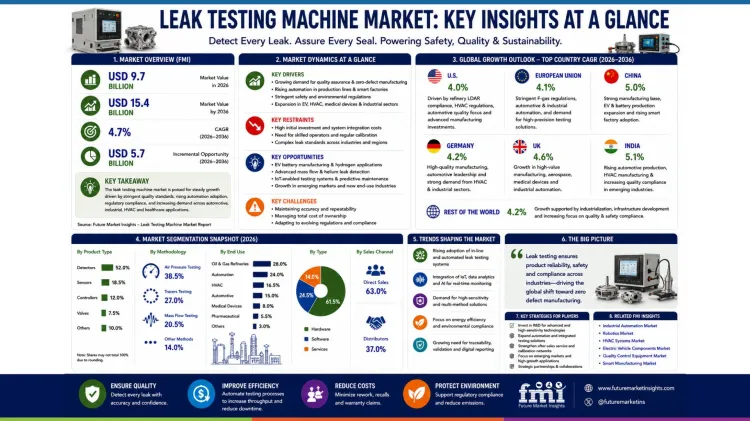
- FMI identifies oil and gas refineries as the largest end-use segment at 28.0% in 2026, while automation represents 24.0%, indicating that industrial process safety remains the market's current revenue base.
- Air-pressure systems fit many high-speed automotive and HVAC applications, while tracer-gas and vacuum methods gain relevance where allowable leak limits are much lower.
- The application with the strongest potential depends on the supplier's capability. EV batteries reward speed and micro-leak sensitivity, HVAC rewards scalable dry testing, and medical devices reward validation depth.
Leak testing demand is moving into applications that cannot afford uncertainty around sealed assemblies. The growth story is not simply about more machines being sold. It is about a shift in the value of the test itself. A leak in a battery enclosure can affect thermal management or electrical safety. A refrigerant leak can create performance, cost, and compliance consequences. A leak in a medical fluid pathway or sterile package can affect product integrity and patient safety.
The three applications are attractive for different reasons.
EV batteries are becoming the most visible growth area because electrified vehicles create multiple sealed subsystems. Battery cells, packs, coolant plates, cooling modules, electrical housings, valves, and pressure-relief elements can require leak validation at different stages of assembly. HVAC and refrigeration continue to create a broad installed-base opportunity because refrigerant containment is a regulatory and operating requirement. Medical devices create a smaller but demanding category where test repeatability and validation can outweigh volume.
The FMI Leak Testing Machine Market report places the overall market at USD 9.7 billion in 2026 and forecasts USD 15.4 billion by 2036. Oil and gas refineries lead end-use demand with a 28.0% share, while automation accounts for 24.0%. This matters because refinery maintenance and factory automation remain the foundation of the market. EV batteries, HVAC, and medical devices are not replacing that base. They are adding higher-growth and more technically differentiated demand pools around it.
EV Batteries Create the Strongest High-Value Expansion Case
Battery production raises the standard for leak testing because failure tolerance can be low and production speed can be high. A battery cell or module may pass through several automated operations before final assembly. Discovering a leak late in the process can increase scrap, rework, and warranty risk. This makes early, repeatable, and traceable testing commercially important.
FMI notes that EV battery pack assembly adds inspection depth because cooling plates and housings need dry integrity testing. It also states that battery manufacturers require systems capable of finding very small leaks without slowing production. The market relevance is clear, since EV growth expands the number of sealed systems needing validation, while battery safety requirements raise the value of better testing methods.
The International Energy Agency reported that electric car sales exceeded 20 million units in 2025. That scale does not translate directly into one leak tester per vehicle or battery pack. It does indicate that the installed manufacturing base for cells, modules, packs, cooling systems, and electrified powertrain components is expanding rapidly. Each production line needs quality-control steps proportionate to the risk and value of the assembly.
The stronger EV opportunity is likely to sit with suppliers able to combine leak-rate sensitivity with production-line throughput. Pressure-decay testing can work for many housings and fluid components. Tracer-gas or vacuum methods can be needed when leak limits are tighter or component geometry makes air testing insufficient. Automated loading, multi-chamber systems, digital records, and fixture robustness become important because the line may operate continuously.
Battery systems also create demand beyond the cell. Cooling plates, coolant circuits, thermal modules, battery pack housings, seals, and high-voltage enclosures may all need validation. This broadens the addressable market for suppliers that can serve different leak-rate thresholds and part sizes. The most valuable supplier is unlikely to be the one selling a single instrument. It is more likely to be the company able to build a test architecture across the battery line.
China illustrates the scale effect. FMI projects China leak testing machine market to grow at 5.0% CAGR through 2036 and links demand to EV platforms, high-speed electronics production, battery packs, thermal systems, sealed housings, and production-line validation. It cites Chinese new-energy vehicle production of 16.626 million units in 2025 as a driver of battery leak inspection demand.
India offers a different version of the same opportunity. FMI expects the country leak testing machine market to grow at 5.1% CAGR, supported by vehicle production clusters, EV two-wheelers, compact passenger vehicles, battery assembly, HVAC modules, and thermal circuits. The systems demanded in India may be more price-sensitive, and high-volume testing and local service access can make the market attractive for flexible, rapidly reconfigurable equipment.
HVAC Offers the Broadest Compliance-Led Demand Base
HVAC and refrigeration are less dramatic than EV batteries, and they offer a wide and recurring leak-testing opportunity. Refrigerant circuits, coils, compressors, condensers, evaporators, valves, pipes, and assembled systems all depend on containment. Manufacturing defects can affect cooling efficiency, energy use, service costs, and compliance obligations.
FMI identifies HVAC refrigeration as one of the core end-use categories and states that refrigerant rules are increasing factory inspection needs as charged systems require stronger release records. Air-pressure testing is particularly relevant because it supports fast dry inspection across HVAC assemblies.
The USA regulatory setting reinforces the need for leak awareness. EPA Section 608 requirements prohibit intentional venting of ozone-depleting refrigerants and their substitutes during maintenance, servicing, repair, or disposal of air-conditioning and refrigeration equipment. EPA also requires corrective action when appliances containing 50 pounds or more of refrigerant exceed applicable leak trigger rates. These rules do not instruct equipment manufacturers to use a particular factory leak tester. They do create a business environment in which refrigerant containment, repair, maintenance records, and leak prevention carry greater importance.
The EU has a similar compliance direction. The European Commission states that the F-gas framework includes leak-check obligations for relevant equipment and that all detected leaks must be repaired without undue delay. It also highlights regular leak checks, maintenance, recovery, and tighter controls to prevent fluorinated greenhouse-gas emissions. Factory leak testing is not identical to field leak checking, and stronger downstream accountability encourages manufacturers to reduce the probability of defects leaving the plant.
The HVAC advantage is breadth. It reaches residential, commercial, industrial, transport, cold-chain, food-service, data-centre, and industrial-process applications. Each individual tester may not require the extreme sensitivity of a battery-cell leak system, and the potential number of units and production lines is extensive. This can make HVAC the most scalable volume market for dry pressure testing, automated fixture stations, and end-of-line verification.
The limitation is price pressure. Many HVAC components are manufactured at high volume and sold into competitive supply chains. Testing equipment suppliers need to prove cycle-time improvement, false-reject reduction, maintenance support, and fixture flexibility. A premium tracer-gas system may be difficult to justify for every appliance or coil line. Standard air-pressure methods may remain dominant where component volumes are large and acceptable leak thresholds are practical.
Medical Devices Represent a Smaller but High-Consequence Market
Medical devices do not necessarily offer the largest leak-testing machine volumes. They can offer some of the highest consequences for failed validation. Fluid pathways, infusion systems, drug-delivery products, sterile packaging, diagnostic cartridges, catheters, containers, and medical assemblies may require controlled integrity checks. A leak can affect sterility, dosage, contamination control, or device performance.
FDA guidance states that manufacturers of devices purporting to be sterile must validate relevant processes, including sterilization, and that stability testing is part of design validation for such devices. Container and closure integrity testing may be used in place of sterility testing under defined stability protocols. This does not create a universal requirement for one leak-testing method, and it reinforces the need for validated evidence when product integrity is safety-critical.
An FDA warning letter issued in 2026 illustrates the operational importance of test-method validation. The agency cited more than 5,000 complaints relating to leaking infusion sets and noted a requirement that the firm water leak tester demonstrate it could consistently and accurately differentiate possible test states. One enforcement action does not define the whole market, and it shows why device makers cannot treat leak testing as a routine production check without validation discipline.
Medical applications can reward suppliers with strong calibration, documentation, repeatability, and validation support. The commercial model may be different from automotive or HVAC. Production volumes can be lower, part geometries more varied, and approval processes more rigorous. The value may sit in a test system ability to generate defensible records rather than process the highest number of parts per minute.
Which Application Has the Strongest Growth Potential?
EV batteries appear to offer the strongest high-value growth opportunity. The reason is the combination of expanding manufacturing capacity, increasing safety expectations, multiple sealed components per system, and demand for fast automated testing. Suppliers with micro-leak capability, robust fixtures, multi-station architecture, and line integration are likely to be best positioned.
HVAC appears to offer the broadest volume opportunity. It benefits from a large global equipment base, factory production of sealed circuits, and a regulatory direction that makes leakage prevention more commercially important. Air-pressure testing is likely to remain particularly relevant because it aligns with high-speed, dry, cost-conscious production.
Medical devices appear to offer the strongest value per validated test in selected applications. The segment is likely to reward suppliers with validation support, highly repeatable fixtures, traceability, and sensitivity appropriate to sterile or fluid-contact products. Its growth may be more selective than battery or HVAC demand, and its barriers can be higher.
Oil and gas refineries will remain the largest end-use market in the FMI 2026 view, reflecting the importance of valves, tanks, heat exchangers, pressure systems, and LDAR-related maintenance. The next growth layer is likely to come from advanced manufacturing applications, particularly EV batteries and HVAC systems, where leak testing is being embedded earlier in the production workflow.
The strongest opportunity is therefore not one universal end market. It is a match between the supplier technical depth and the customer failure risk. EV batteries reward speed and sensitivity. HVAC rewards scalable throughput. Medical devices reward validation strength. A leak-testing supplier that can serve all three with adaptable methodologies and data-driven systems is likely to capture the most balanced growth.

