


- EV battery economics are controlled by both cell makers and OEMs, but near-term cost power still sits closer to cell makers.
- Cell makers influence cost through chemistry, scale, yield, cathode strategy, manufacturing efficiency, and raw material exposure.
- OEMs gain leverage when they standardize EV platforms, localize battery supply, select cost-appropriate chemistry, and design vehicles around pack economics.
- LFP adoption is shifting bargaining power toward scale-driven battery suppliers and vertically integrated automakers.
- The biggest misconception is that the OEM selling the EV automatically controls the EV margin. Battery sourcing, chemistry selection, and manufacturing yield often decide the profit pool first.
- The long-term winners will be OEMs that stop treating the battery as a purchased component and start managing it as the core cost architecture of the vehicle.
The landscape of the EV battery supply chain has shifted from a race for capacity to a race for economics. For a long time, automakers were primarily focused on securing enough battery cells to meet their planned EV launches, while this is important, but it is more concerning to know who actually controls the profit pool, is it the battery cell maker or the OEM selling the vehicle?
The answer is not the same across every region or company. In the near term, cell makers still control a larger part of EV battery economics because they comprise one of the dominant cost layers of the vehicle. Battery cells define much of the pack cost, energy density, safety profile, charging capability, chemistry exposure, and warranty risk. Any change in the parameters like cell yield, cathode prices or LFP penetration leads to significant impact on the economics of the vehicle.
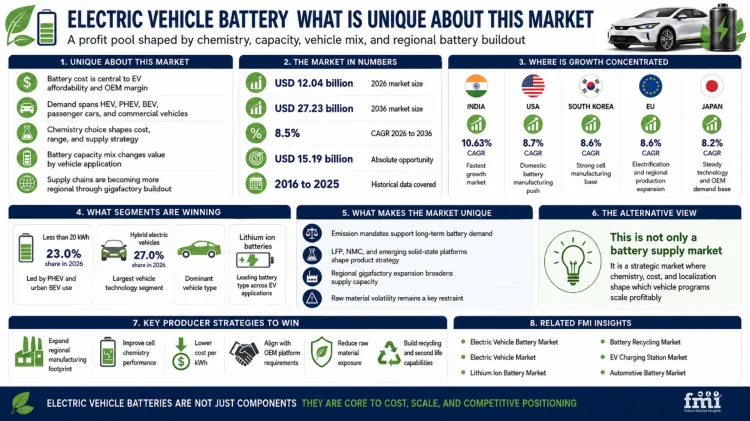
FMI’s Electric Vehicle Battery Market shows why this question matters. The market is segmented by battery capacity, vehicle type, propulsion type, battery type, sales channel, and region. This structure is useful because battery economics are not uniform. A compact urban EV with a smaller LFP pack follows a different cost logic than a long-range premium BEV with a larger nickel-rich battery. A two-wheeler battery performance and specifications are way different than commercial vehicle battery. A replacement battery sale is not the same as an OEM-supplied battery for a new platform. This means economics are controlled through the details, not only through total EV sales.
The current supply chain gives cell makers several advantages. First, they operate across multiple OEM customers, which allows broader learning curves. Second, they control the manufacturing process where quality, scrap rates, yield, coating consistency, cell design, and formation processes can make or break cost. Third, they are closer to chemistry transition. When the industry moves from NMC to LFP in cost-sensitive categories, or when sodium-ion begins to appear in selected use cases, cell makers are often the first to capture the learning benefit.
Scale is the most powerful supplier advantage. IEA data shows that EV battery deployment reached 1.2 TWh in 2025, up almost 30%. China accounted for 60% of global deployment, the EU nearly 15%, and the USA 10%. This matters because scale is not only a volume statistic. It improves equipment utilization, supplier bargaining, engineering feedback, process learning, and materials planning. The region and company with scale can usually move down the cost curve faster.
China’s position is especially important. IEA reports that China accounted for more than 80% of global battery manufacturing capacity in 2025. That does not simply mean China has more plants. It means the Chinese ecosystem has deeper supplier density across cathode materials, anode materials, electrolyte, separators, cell equipment, recycling, and pack integration. This supports faster learning and makes it harder for newer regional battery ecosystems to match cost quickly.
LFP is the clearest example of how chemistry shifts economics. IEA states that LFP accounted for over 55% of EV batteries deployed globally in 2025. This matters because LFP reduces dependence on nickel and cobalt, supports lower-cost models, and offers strong cycle life and safety advantages. For OEMs targeting affordable EVs, LFP is not only a chemistry choice. It is a pricing strategy. Yet LFP know-how, scale, and supply remain concentrated, which means automakers outside China may want the cost benefit but still depend on experienced battery suppliers.
OEMs are not without power. Their strongest control comes before sourcing, not after. An OEM can influence battery economics by deciding the pack size, platform strategy, chemistry mix, model positioning, warranty policy, and production plan. An automaker that designs one vehicle around maximum advertised range may end up with a large and costly pack. Another automaker may choose a smaller LFP pack, better energy management, and a lower entry price. Both are EVs, but their economics are very different.
The best OEMs understand that battery cost must be engineered into the vehicle concept from the beginning. BYD is one of the strongest examples of this model because it combines vehicle manufacturing, battery technology, LFP depth, and plug-in hybrid scale. This gives the company more control over cost, product cadence, and pricing. Tesla also shows how battery sourcing, pack design, software, power electronics, charging ecosystem, and manufacturing can be treated as part of one system rather than separate purchasing decisions.
Legacy manufacturers are adopting new strategies such as battery joint ventures and localized production to improve their competitive positioning. These companies are also consolidating vehicle platforms and diversifying battery chemistries. Industry leaders including General Motors, Ford, and Toyota are currently implementing these localization efforts. The primary motivation for this shift is that greater distance from battery cost management makes it increasingly difficult to sustain healthy margins. Yet, localization alone is insufficient to ensure profitability. Facilities that suffer from low production yields or underutilization can become financial burdens that actually undermine the company's margins.
Cell manufacturers still hold a significant advantage in the current market. They typically scale production more efficiently than automakers can adapt their vehicle platforms to handle battery costs. Success for new facilities depends on a precise combination of skilled labor, specialized equipment, rigorous quality standards, and steady demand. When any of these elements fail to align, battery costs inevitably rise and negatively impact the profitability of automaker.
The bargaining power is also different by vehicle category. In premium EVs, OEMs have more room to absorb battery cost because customers pay for performance, range, brand, and technology. In mass-market EVs, the battery becomes a price barrier. A little increase in price per kWh can influence retail price, incentive dependence, and competitiveness. This is why lower-cost chemistry and high utilization matter most in affordable EV segments.
For commercial vehicles, battery economics are tied to uptime, total cost of ownership, charging downtime, payload, and warranty. Here, OEMs and fleet buyers may value reliability and lifecycle economics more than labelled price alone. Cell makers with proven durability and safety data gain leverage, while OEMs that can integrate battery service, telematics, financing, and fleet support can regain some control.
The misconception to avoid is that the OEM controls EV economics because it owns the brand and customer relationship. That was more true in traditional vehicles, where supplier systems could be negotiated across a mature base. In EVs, the battery is too large, too technical, and too strategically sensitive to be treated as a normal component.
A more effective way to view the market is to see cell manufacturers as the controllers of the cost curve and automakers as the architects of the business model. Cell makers build bargaining power by delivering lower costs, better safety, and superior scale. Automakers, meanwhile, capture margin by designing efficient vehicle platforms that sell at the right price points. Market leadership is not exclusive to one side or the other. Instead, the winner is whichever company best aligns battery chemistry, platform engineering, supply chains, pricing, and the actual customer use case.
Bottom line: cell makers control more of today’s EV battery economics because they sit closest to chemistry, yield, scale, and cost. OEMs can regain power only when battery strategy is built into vehicle design from day one. The long-term winners will not be those that secure the most battery capacity. They will be those that turn battery capacity into profitable, repeatable, and well-positioned EV platforms.

