

- Market Size (2026)
- USD 455.0 Mn
- Forecast (2036)
- USD 6273.0 Mn
- CAGR (2026 to 2036)
- 30.0%
How big is the Off-Highway Autonomy Retrofit Kits Market in 2026?
USD 455.0 million in 2026 and USD 6,273.0 million by 2036 at a 30.0% CAGR.
The off-highway autonomy retrofit kits market is expected to grow strongly, with demand projected to increase at a CAGR of 30.0% between 2026 and 2036. Market revenue is forecast to rise from USD 455.0 million in 2026 to USD 6,273.0 million by 2036. Growth is being driven by the large installed base of off-highway equipment that remains mechanically viable even after its original control systems become outdated. Instead of replacing expensive machinery, operators can extend asset life and improve productivity by retrofitting autonomous technologies. This opportunity is particularly significant in the mining sector. According to the USA Geological Survey, USA nonfuel mineral production reached USD 112 billion in 2025, as reported in February 2026. The scale of mining operations and the extensive use of surface mining equipment create a strong business case for adopting autonomy retrofit kits, enabling operators to modernize fleets without incurring the high costs associated with purchasing new machines.
Commercial use starts on haul roads that repeat the same loading and dumping cycle in each shift. Pronto reported in January 2026 that a mixed Caterpillar and Komatsu fleet moved more than two million tons autonomously at Heidelberg Materials' Lake Bridgeport quarry. The fleet reached this mark with three truck models in less than eight months of commercial operation. Latin American mines often manage long-life fleets from several brands and face a different integration problem. European projects require more approval work for modified steering and braking systems at each operating site. These regional differences change the path to adoption without reducing the basic need for control upgrades. Each region needs smart mining systems that fit existing work rules and maintenance practices for the full fleet.
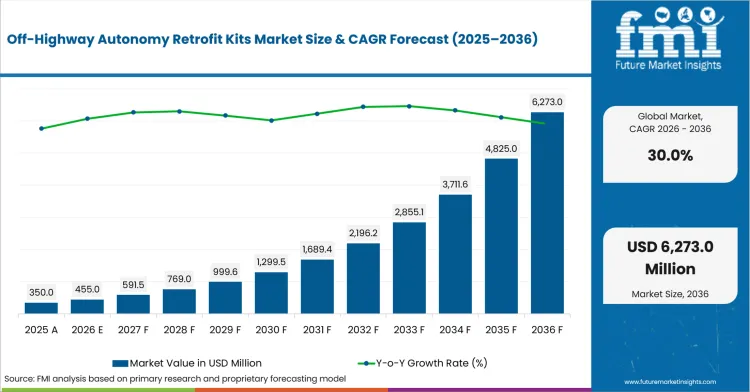
Key Takeaways of Off-Highway Autonomy Retrofit Kits Market
- Demand for off-highway autonomy retrofit kits is driven by equipment economics, allowing mines and quarries to add control to productive trucks that retain years of mechanical life without early replacement.
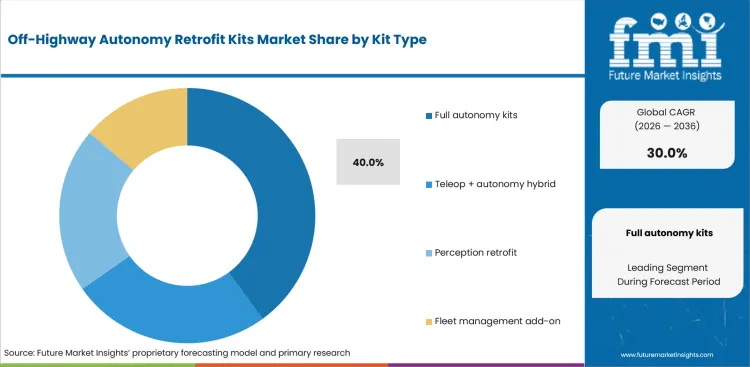
- By kit type, full autonomy kits are expected to lead with 40.0% share in 2026, supported by their suitability for controlled haul routes with limited interaction with manually operated equipment.
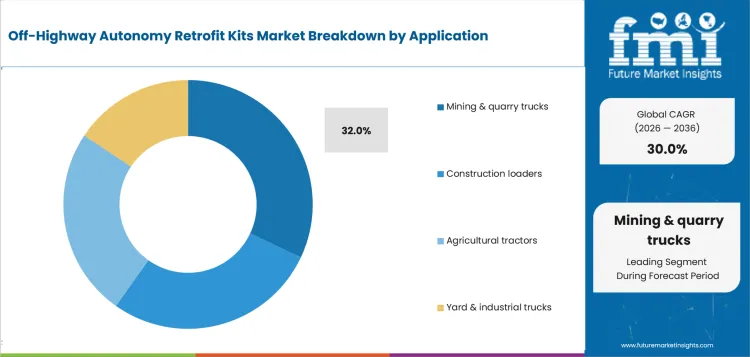
- Mining and quarry trucks are the dominant application segment, projected to hold 32.0% share in 2026, driven by repetitive operating cycles and extended production shifts.
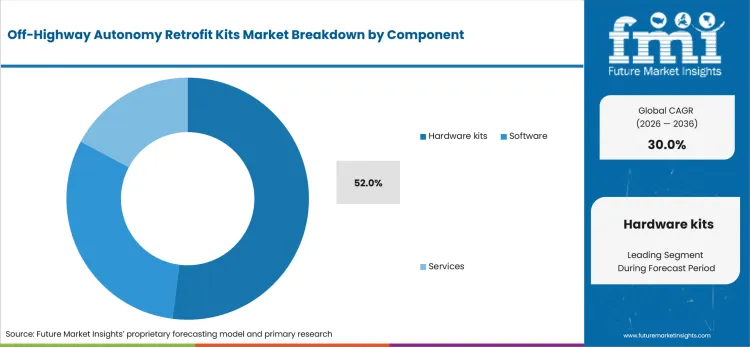
- Hardware kits are estimated to lead the component category with 52.0% share in 2026, driven by demand for rugged sensors and other core autonomy-enabling technologies.
- Software and service revenue is expected to increase as operators require route modifications and ongoing maintenance following initial installations.
- The United States, Latin America, and the European Union are expected to form the higher-growth region tier, advancing at 31.0%, 29.0%, and 28.0% CAGR respectively through 2036, supported by fleet modernization and mixed-brand fleet management needs.
- Competition centers on Caterpillar, Komatsu, Epiroc, Pronto, and Teleo, with vendors differentiating through machine-integrated control and dealer service versus mixed-brand haulage system freedom and remote supervision.
Analyst Perspective
"Fleet automation delivers measurable returns only when retrofit systems remain dependable across different truck platforms, operating cycles, and site conditions without disrupting production. Mine operators are looking for solutions that simplify day-to-day maintenance, allow local teams to recover from routine faults, and scale across expanding fleets without extensive redesign. Suppliers that reduce operational complexity while demonstrating sustained field performance will have the strongest commercial advantage as retrofit autonomy becomes part of mainstream mining operations."
- Nikhil Kaitwade, Principal Analyst, Future Market Insights
How is the Off-Highway Autonomy Retrofit Kits Market segmented?
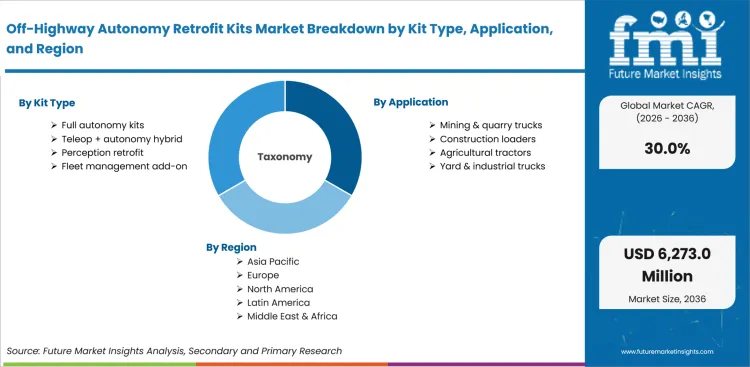
Kit type, application, component, end use, business model, and region
The report separates the market by kit type and application, with component and end use providing two further views. Kit type covers full autonomy and remote operation; sensor upgrades and fleet software complete the category for existing machines. Application distinguishes haul trucks and loaders from tractors and yard vehicles based on the work each machine performs. Component analysis covers control hardware and software together with the field service needed for each installation. End use compares mining and construction with agriculture and industrial yards under different operating conditions. Business model shows whether a project is sold outright, provided as a service, or introduced through a paid pilot. Regional analysis links fleet age and route design with local service access, explaining why agriculture robotics follows a different path from fixed-route haulage.
How do full autonomy kits shape demand within the kit type category?
A full autonomy kit steers and brakes a machine on a defined route without a driver in the cab, and the machine must stop safely if a fault occurs. Caterpillar reported in January 2026 that its autonomous mining fleet had moved more than 11 billion tonnes and travelled over 380 million kilometres. This record sets a demanding benchmark for retrofit kits on older trucks with varied electronics and wear. The software may share some functions with service robotics but the hardware must survive dust and vibration together with braking loads.
- Full autonomy kits are projected to hold 40.0% of the kit type category in 2026. Defined haul roads give the system clear route limits and known stopping points for repeated testing. The case becomes weaker on routes with frequent manual traffic or unexpected equipment movement at the active site.
- Mine managers favor full autonomy on isolated haul cycles with fixed loading points and defined dumping areas. A credible pilot must cover several production shifts and confirm a safe fallback for every truck. Wider use depends on recovery steps that local crews can follow across the route without specialist help.
What supports demand for mining and quarry trucks within the application category?
Haul trucks repeat the same loaded trip throughout each production shift at large mines and quarries, giving software a stable route for speed and braking tests. Mine Safety and Health Administration data for 2025 was accessed in July 2026 and measured the safety burden from powered haulage. Powered haulage caused 13 of 33 USA mining deaths and 426 of 4,792 reported nonfatal injuries that year. These figures explain why mines first automate routes that reduce worker contact with loaded trucks and other heavy equipment.
- By application, mining and quarry trucks are forecast to represent 32.0% share in 2026 driven by repeated haul cycles. Fixed loading and dumping points make results easier to measure than changing construction tasks at active sites. These routes give operators of mobile mining equipment clear data on cycle time and safe stopping performance over several shifts.
- Quarry managers judge a retrofit by cycle consistency and safe contact with loading equipment in production. A useful pilot measures queue time and loader response over several shifts in normal production. A broader rollout needs proof that local crews can recover a truck from sensor faults or communication loss without stopping the route.
How are hardware kits positioned within the component category?
Hardware connects autonomy software to the steering and braking systems already built into an existing machine. Sensors and cables must withstand dust and repeated vibration without losing the signals needed for safe control. Caterpillar presented the next-generation Cat 775 at Bauma in April 2025 as part of its quarry-autonomy plans. The truck includes remote software updates and dealer diagnostics that can run without stopping production. This design shows why retrofit hardware must fit the machine electronics and maintenance process instead of operating as a separate add-on.
- By component, hardware kits are estimated to hold 52.0% share of revenue in 2026 owing to the cost of rugged sensors and control modules in the initial rollout. Mounting design and cable protection affect installation time and long-term reliability under dust and vibration on long shifts at remote mines and quarries.
- Maintenance teams favor accessible parts and clear fault codes throughout normal service at remote operating sites. Reliable machine condition monitoring can identify a weak sensor or actuator early enough to prevent route disruption. Local replacement stock can protect a haul route from long stops and may add more value than an extra software feature at remote operations with limited technician coverage.
What are the drivers, restraints, and opportunities in the Off-Highway Autonomy Retrofit Kits Market?
Long equipment life is expected to sustain demand for autonomy retrofit kits, while integration and safety approval challenges may slow adoption, creating opportunities for scalable deployments in mixed-fleet quarry operations.
- Driver: Heavy trucks often remain productive for years beyond the life of their original control systems. A retrofit protects existing capital and lets an operation add autonomy one route at a time.
- Restraint: Steering and braking changes need a clear safety case for each truck model and traffic plan. A control package may require fresh tests at every new operating location with different traffic rules.
- Opportunity: Open systems can extend autonomous haulage to smaller quarries and mixed-brand fleets through staged projects. Dealer support and staged installation make expansion less disruptive than replacing an entire working fleet.
Long machine life supports retrofit demand by delaying full vehicle replacement in active mining fleets. Komatsu reported in April 2026 that it had commissioned its 1,000th ultra-class autonomous haul truck. The company stated that its autonomous fleet had moved more than 11.5 billion metric tons of material. This operating record shows that autonomous haulage can work in large mine fleets for many years. Smaller operations can use that record to justify staged control upgrades on trucks that remain mechanically sound.
Machine integration creates the main restraint by placing steering and braking under retrofit software control on trucks. An EU-OSHA summary published in January 2025 explains that Regulation (EU) 2023/1230 covers machinery and related products. The regulation treats a safety-related physical or digital change as a substantial modification if it creates a new hazard or raises an existing risk. European projects therefore need a documented risk review and clear operating limits for each route. This work raises early cost and favors companies that align hardware changes with clear software records.
Quarries with smaller mixed fleets offer the clearest opening beyond large mines with full autonomy programs. Komatsu and Pronto launched Smart Quarry Autonomous in August 2025 for quarry-size haul trucks in North America. The program combines Pronto control software with support from the established Komatsu regional service network. Quarry managers can start with selected routes and expand the system as local crews gain experience. This staged path limits disruption and links autonomous control with existing smart construction equipment used elsewhere at the operating site.
Which country and regional CAGRs are profiled in the Off-Highway Autonomy Retrofit Kits Market?
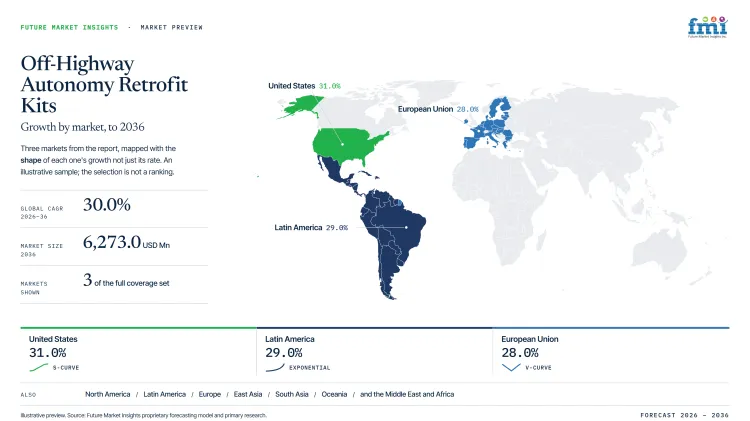
| Country or Region | CAGR |
|---|---|
| United States | 31.0% |
| Latin America | 29.0% |
| European Union | 28.0% |
Source: FMI's proprietary forecasting model and primary research
How do country-level CAGRs compare in the Off-Highway Autonomy Retrofit Kits Market?
The country and regional comparison spans 3.0 percentage points, indicating a relatively concentrated growth outlook across the off-highway autonomy retrofit kits market. The United States leads the comparison at 31.0% CAGR, followed by Latin America at 29.0% and the European Union at 28.0%. The narrow spread suggests that fleet operators across these markets are increasingly evaluating retrofit autonomy solutions, although adoption is influenced by different equipment fleets, operating environments and modernization priorities.
- The United States records the highest CAGR at 31.0%. Mine operators, construction contractors and agricultural businesses are increasingly assessing retrofit autonomy kits that extend the capabilities of existing off-highway equipment without requiring complete fleet replacement. Interest is particularly strong where productivity improvements and safer operation in hazardous environments are key objectives.
- Latin America follows 2.0 percentage points behind the United States with a CAGR of 29.0%. Demand is associated with the region's extensive mining operations and large off-highway equipment base, where retrofit autonomy offers a practical pathway to improve machine utilization and reduce operator exposure in demanding working conditions.
- The European Union posts a CAGR of 28.0%, standing just 1.0 percentage point below Latin America. Adoption reflects continued investment in construction machinery modernization, precision agriculture and quarry operations where autonomous retrofit technologies are evaluated to improve operational consistency and equipment efficiency. Uptake differs across member states because fleet age, labor availability and capital investment priorities vary throughout the region.
Comparable CAGRs can still produce different market entry conditions. Differences in equipment replacement cycles, fleet composition, regulatory frameworks and automation investment strategies influence deployment timelines and long-term commercial opportunities. The full report provides country-level CAGR analysis across North America, Latin America, Europe, East Asia, South Asia, Oceania and the Middle East and Africa.
Country-wise Analysis
-
American aggregate operations provide a practical bridge between mine-scale autonomy and smaller quarry fleets in the United States. Sales of off-highway autonomy retrofit kits in the United States is forecast to advance at 31.0% CAGR during the forecast period. The USA Geological Survey reported in February 2026 that crushed stone output reached 1.5 billion tons in 2025 with a value of USD 27 billion. An estimated 3,500 quarries produced this material, and most run smaller fleets than major metal mines. Their repeated haul cycles create clear retrofit routes without the scale of a full mining system. Local dealer coverage and parts access determine how quickly a successful trial becomes routine production.
-
The off-highway autonomy retrofit kits market in Latin America advances at 29.0% CAGR through 2036.
.The total was 25.7% above the previous portfolio, and copper projects represented 89.8% of planned investment. The same source reported that brownfield projects held 81% of the portfolio, favoring upgrades at operating mines. This pattern supports retrofit work on selected haul routes without forcing broad fleet replacement across active mines. The same need favors control packages for Latin America mining equipment that work with several truck brands at the same mine. - European operations face a longer approval path for software that can steer or brake heavy machinery. Demand in the European Union is expected to expand at 28.0% CAGR from 2026 to 2036. CECE reported in February 2026 that European construction equipment sales increased 4.6% in 2025. A recovering equipment sector gives fleet operators more room to plan control upgrades with clear limits for remote updates and manual recovery. Dealer-led testing can reduce fault time in the first rollout on several machine models at one site. Companies with documented tests and local technical support should reach routine production faster than firms that depend on one-off engineering work. The slower forecast reflects this approval burden rather than weak interest in automation among European operators.
Who are the notable companies in the Off-Highway Autonomy Retrofit Kits Market?
Caterpillar, Komatsu, Epiroc, Pronto, Teleo, and Autonomous Solutions, Inc. represent truck-maker systems, open haulage retrofits, supervised control, and industrial or agricultural fleet automation.
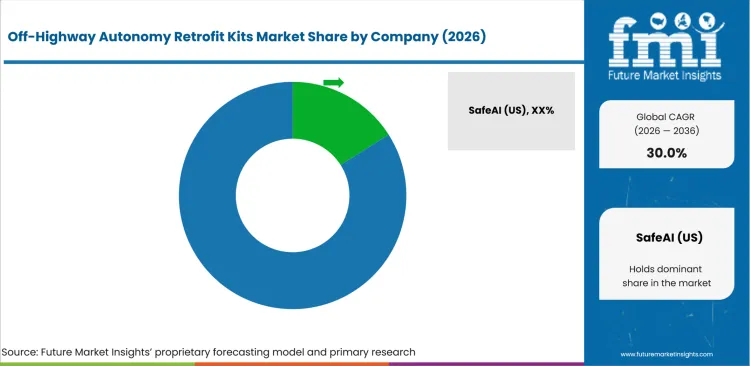
The competitive landscape of the off-highway autonomy retrofit kits market is expected to evolve around several business models that address varying equipment requirements, fleet compositions, and service expectations across end-use industries. Market participants are projected to differentiate themselves through machine compatibility, integration capabilities and the ability to provide reliable operational support throughout the deployment lifecycle
- Caterpillar and Komatsu fit fleets that want truck hardware and autonomous control supported through one dealer network. That model can shorten fault diagnosis and simplify parts planning at remote sites, but it reduces freedom to add machines outside the supported range.
- Epiroc and Pronto compete through open haulage control that supports mixed-brand fleets across long replacement cycles. Their value rises at mines that cannot replace every truck on one schedule, yet open integration needs a clear service boundary for vehicle and control faults.
- Teleo apply retrofit control beyond mine haulage through different operating models for construction and industrial sites. Teleo uses remote supervision for changing construction tasks. Both need reliable communications and local support for sensors and control hardware across each active site.
- Autonomous Solutions, Inc. serves agriculture and other industrial fleets through hardware kits linked to its Mobius control platform. Its cross-industry position suits operations that need one control layer for different vehicle types at one site. Field results must show that the platform can handle seasonal work and changing outdoor routes.
Competitive Benchmarking: Off-Highway Autonomy Retrofit Kits Market
| Company | Retrofit Integration Depth | Mixed-Fleet Coverage | Field-Service Reach | Geographic Reach |
|---|---|---|---|---|
| Caterpillar | High | Medium | High | Global |
| Komatsu | High | Medium | High | Global |
| Epiroc | High | High | High | Global |
| Pronto | High | High | Medium | North America, Latin America, Europe, and Asia Pacific |
| Teleo | High | High | Medium | North America, Europe, and Australia |
| Autonomous Solutions, Inc. | High | High | Medium | North America and selected global projects |
Scoring basis: High indicates broad capability supported by documented products and field use; Medium indicates relevant but narrower coverage. Low indicates limited direct evidence in the assessed dimension compared with other companies in the table.
Source: Future Market Insights competitive analysis for 2026 based on official company disclosures and documented field programs.
Key Developments in the Off-Highway Autonomy Retrofit Kits Market
- In February 2025, Heidelberg Materials signed an agreement with Pronto to install autonomous haulage systems on more than 100 trucks at more than a dozen sites. The first wave follows a mixed-brand pilot in Texas and extends across North America and Europe as well as Asia Pacific. The program shows how a successful quarry pilot can scale into a multi-site rollout across North America, Europe, and Asia Pacific.
- In July 2025, Pronto completed its acquisition of SafeAI and expanded its off-road autonomy range for mining, quarry, and construction fleets. The combined portfolio joins Pronto's camera-based system with SafeAI's multi-sensor option and ASIL D-certified safety framework. This gives mining and quarry operations more choice for varied route conditions and sensing needs during staged rollouts across mixed fleets and broadens the safety options available for older trucks.
- In July 2025, Caterpillar and Luck Stone announced that autonomous Cat 777 trucks had hauled one million tons at Bull Run Quarry in Virginia. The milestone showed repeatable output in a quarry setting and gave aggregates operators a practical reference for planning autonomy beyond large mining operations. The result gives smaller quarry fleets evidence that commercial autonomy does not require ultra-class mining trucks.
- In October 2025, Epiroc and Hancock Iron Ore announced that LinkOA had moved more than 250 million tonnes autonomously at the Roy Hill mine in continuous commercial operation since July 2021. The mixed fleet had travelled around six million kilometres and completed more than 846,000 haul cycles. This record shows how one open control system can support several truck brands over long production periods at a major iron ore operation.
Key Players in the Off-Highway Autonomy Retrofit Kits Market
Truck-maker retrofit and haulage systems
- Caterpillar
- Komatsu
Open control for mixed mining fleets
- Epiroc
- Pronto
Construction, industrial, and agricultural retrofit systems
- Teleo
- Autonomous Solutions, Inc.
Off-Highway Autonomy Retrofit Kits Market - Report Scope
| Report Attribute | Coverage |
|---|---|
| Market Breakdown | Kit Type, Application, Component, End Use, Business Model, and Region |
| Quantitative Units | USD million |
| Market Definition | Retrofit hardware, software, and services that add remote or autonomous control to off-highway machines already in service. |
| Regions Covered | North America, Latin America, Europe, East Asia, South Asia, Oceania, and the Middle East and Africa |
| Countries Covered | United States, Canada, Brazil, Germany, China, India, Australia, and other countries within the regional model |
| Key Companies Profiled | Caterpillar, Komatsu, Epiroc, Pronto, Teleo, and Autonomous Solutions, Inc. |
| Approach | Demand-side review of active fleets and repeatable routes combined with company system analysis and geographic forecast reconciliation |
Source: Future Market Insights - analysis driven by proprietary forecasting models and primary research
Off-Highway Autonomy Retrofit Kits Market - Research Methodology
| Method | Application |
|---|---|
| Primary Research | FMI analysts gathered input from manufacturers, service providers, technology developers, distributors, end users, procurement teams, and subject-matter experts. Interviews examined purchasing decisions, product or service evaluation, adoption barriers, approval requirements, pricing considerations, and expectations for technical or commercial support. Respondents were also asked what evidence is required before a trial, pilot, or initial order develops into regular purchasing. |
| Desk Research | Desk research covered government statistics, regulatory publications, trade data, industry associations, technical literature, standards, company filings, product information, and official corporate announcements. Sources were reviewed for relevance, publication date, geographic coverage, and consistency with the defined market scope. Claims relating to performance, applications, approvals, capacity, investment, and commercial activity were retained only when supported by credible public evidence. |
| Market Sizing and Forecasting | The market model combined the baseline value with historical performance, segment structure, pricing and volume indicators, adoption levels, company participation, and country-level demand conditions. Forecast assumptions considered economic activity, investment trends, regulatory developments, technology adoption, purchasing cycles, supply availability, and barriers to wider market use. Segment and regional estimates were reconciled before the final market total was calculated. |
| Data Validation | Estimates were checked against multiple independent indicators, including public data, company activity, trade patterns, industry developments, and findings from primary interviews. Validation also tested whether products, services, applications, and company revenues fell within the defined market boundaries. Adjacent categories, unsupported claims, overlapping revenues, and activities without direct market relevance were excluded to reduce double counting and maintain consistency across segments and countries. |
Off-Highway Autonomy Retrofit Kits Market by Segments
Off-Highway Autonomy Retrofit Kits Market segmented by Kit Type:
- Full autonomy kits
- Teleoperation plus autonomy hybrid kits
- Perception retrofit kits
- Fleet management add-ons
Off-Highway Autonomy Retrofit Kits Market segmented by Application:
- Mining and quarry trucks
- Construction loaders and haulers
- Agricultural tractors
- Yard and industrial trucks
Off-Highway Autonomy Retrofit Kits Market segmented by Component:
- Hardware kits
- Software
- Services
Off-Highway Autonomy Retrofit Kits Market segmented by End Use:
- Mining
- Construction
- Agriculture
- Industrial yards
Off-Highway Autonomy Retrofit Kits Market segmented by Business Model:
- Direct sale
- Retrofit-as-a-service
- Subscription
- Pilot and scale programs
Off-Highway Autonomy Retrofit Kits Market by Region:
- North America
- United States
- Canada
- Latin America
- Brazil
- Mexico
- Argentina
- Europe
- Germany
- United Kingdom
- France
- Italy
- Spain
- East Asia
- China
- Japan
- South Korea
- South Asia
- India
- Thailand
- Indonesia
- Oceania
- Australia
- New Zealand
- Middle East and Africa
- GCC countries
- South Africa
- Turkey
Research Sources and Bibliography
- USA Geological Survey. (2026, February 6). Value of USA mineral production rose last year, driven by precious metals prices.
- USA Geological Survey. (2026, February). Mineral Commodity Summaries 2026: Stone, crushed.
- Mine Safety and Health Administration. (n.d.). Powered haulage safety. Retrieved July 15, 2026.
- Chilean Copper Commission. (2025, December). Cartera de inversiones mineras proyectadas para los próximos 10 años alcanza US$104.549 millones.
- Committee for European Construction Equipment. (2026, February 26). European construction equipment sector sees moderate recovery in 2025 with 4.6% growth in sales.
- European Agency for Safety and Health at Work. (2025, January 16). Regulation 2023/1230/EU - Machinery.
- Pronto. (2026, January 15). North America’s first fully autonomous mixed-fleet quarry surpasses two million tons hauled.
- Caterpillar. (2026, January 7). Caterpillar unveils the next era of autonomy in construction.
- Caterpillar. (2025, April 6). New Cat 775 off-highway truck previews the next generation design and the future of autonomy.
- Komatsu. (2026, April 21). Komatsu becomes first OEM to commission 1,000 ultra-class autonomous haul trucks.
- Komatsu. (2025, August 7). Komatsu North America and Pronto launch autonomy solution for quarry-size trucks.
- Heidelberg Materials. (2025, February 24). Driving global synergies: Heidelberg Materials to deploy more than 100 autonomous haul trucks around the world.
- Pronto. (2025, July 15). Pronto acquires SafeAI, expanding leadership in off-road autonomy.
- Caterpillar. (2025, July 14). Caterpillar and Luck Stone celebrate one million tons hauled autonomously at Bull Run Quarry.
- Epiroc. (2025, July 10). Epiroc and Hancock Iron Ore reach 200 million tonne milestone in autonomous haulage with LinkOA.
- This bibliography is provided for reader reference and uses primary government, regulatory, official trade body, and company sources.
This Report Answers
- How large is the off-highway autonomy retrofit kits market in 2026 and 2036?
- Why do long equipment lives support retrofit demand across mines and quarries?
- Which kit type and machine application categories lead the 2026 outlook?
- How do hardware and software roles differ during an autonomy retrofit?
- Why do the geographic growth rates follow different adoption paths?
- Which companies compete through machine integration or open retrofit platforms?
- What slows approval of autonomous control on existing heavy equipment?
- How should site leaders test a retrofit pilot for wider production use?
- Which company actions show commercial progress in quarry and mining autonomy?
- What service capabilities determine whether a retrofit program can scale?
Frequently Asked Questions
What is driving growth in the Off-Highway Autonomy Retrofit Kits Market?
Long machine lives make early replacement expensive for mines and quarries that depend on heavy trucks for several production cycles. Retrofit kits add driving control without retiring equipment that retains useful mechanical life in active fleets.
Who are the key players in the Off-Highway Autonomy Retrofit Kits Market?
Caterpillar and Komatsu link retrofit control with their own machines and dealer networks in major mining regions. Epiroc and Pronto focus on mixed mining fleets; Teleo and Cyngn cover construction and industrial vehicles; Autonomous Solutions, Inc. extends into agriculture.
What is a notable restraint in the Off-Highway Autonomy Retrofit Kits Market?
Each installation must match the machine controls and traffic plan used on its daily route. Safety approval becomes harder as software gains authority over steering or braking on an existing machine.
Why should executives track the Off-Highway Autonomy Retrofit Kits Market?
The forecast rises from USD 455.0 million in 2026 to USD 6,273.0 million by 2036. This expansion can reshape fleet renewal plans and increase spending on software and field service.
What business problem does the Off-Highway Autonomy Retrofit Kits Market address?
The market adds autonomous or remote control to equipment that retains useful mechanical life in active fleets. It solves the cost problem of retiring productive machines solely to gain newer control functions.
What should fleet leaders evaluate during retrofit-provider selection?
Fleet leaders should test machine compatibility together with route limits and the planned recovery process. They should confirm who handles software changes and field repairs over the full service period.
What limits return on investment for fleet programs?
Returns weaken if a successful pilot cannot expand to similar machines or production routes during regular production. Custom engineering and unclear maintenance ownership can erase expected labor savings and uptime gains over time.
How do retrofit providers build long-term operating confidence?
Long-term confidence depends on repeatable installations and predictable safety responses for every supported machine model. Fast fault response prevents a failed control part from stopping an entire haul route during production.
Preview the report firsthand - request a free sample
Get SampleGet the brochure for pricing and purchase details.
Get PDFTable of Content
- Key Takeaways
- Market Size and CAGR
- Top Growth Driver
- Fastest Growing Segment
- Leading Region
- Key Companies
- Emerging Opportunities
- Executive Summary
- Global Market Outlook
- Demand-side Trends
- Supply-side Trends
- Technology Roadmap Analysis
- Analysis and Recommendations
- Analyst Perspective (What is happening? Why now? What should investors know?)
- Key Questions Answered
- How large is the market?
- What is the CAGR?
- What are key trends?
- Which region dominates?
- Who are the leaders?
- Market Overview
- Market Coverage / Taxonomy
- Market Definition / Scope / Limitations
- Research Methodology
- Chapter Orientation
- Analytical Lens and Working Hypotheses
- Market Structure, Signals, and Trend Drivers
- Benchmarking and Cross-market Comparability
- Market Sizing, Forecasting, and Opportunity Mapping
- Research Design and Evidence Framework
- Desk Research Programme (Secondary Evidence)
- Expert Input and Fieldwork (Primary Evidence)
- Tooling, Models, and Reference Databases
- Data Engineering and Model Build
- Quality Assurance and Audit Trail
- Market Background
- Market Dynamics (Drivers, Restraints, Opportunity, Trends)
- Scenario Forecast (Optimistic, Likely, Conservative)
- Impact Analysis
- AI Impact
- Sustainability Impact
- Regulatory Impact
- Technology Impact
- Consumer / Buyer Analysis
- Purchase Drivers
- Adoption Barriers
- Buyer Journey
- Opportunity Map Analysis
- Product Life Cycle Analysis
- Supply Chain Analysis
- Investment Feasibility Matrix
- Value Chain Analysis
- PESTLE and Porter's Analysis
- Regulatory Landscape
- Regional Parent Market Outlook
- Production and Consumption Statistics
- Import and Export Statistics
- Global Market Analysis and Forecast, 2021 to 2036
- Historical Market Size Value (USD Mn) Analysis, 2021 to 2025
- Current and Future Market Size Value (USD Mn) Projections, 2026 to 2036
- Y-o-Y Growth Trend Analysis
- Absolute $ Opportunity Analysis
- Global Market Pricing Analysis, 2021 to 2036
- Global Market Analysis and Forecast, By Kit Type, 2021 to 2036
- Introduction / Key Findings
- Historical Market Size Value (USD Mn) Analysis By Kit Type, 2021 to 2025
- Current and Future Market Size Value (USD Mn) Analysis and Forecast By Kit Type, 2026 to 2036
- Full autonomy kits
- Teleop + autonomy hybrid
- Perception retrofit
- Fleet management add-on
- Full autonomy kits
- Y-o-Y Growth Trend Analysis By Kit Type, 2021 to 2025
- Absolute $ Opportunity Analysis By Kit Type, 2026 to 2036
- Global Market Analysis and Forecast, By Application, 2021 to 2036
- Introduction / Key Findings
- Historical Market Size Value (USD Mn) Analysis By Application, 2021 to 2025
- Current and Future Market Size Value (USD Mn) Analysis and Forecast By Application, 2026 to 2036
- Mining & quarry trucks
- Construction loaders
- Agricultural tractors
- Yard & industrial trucks
- Mining & quarry trucks
- Y-o-Y Growth Trend Analysis By Application, 2021 to 2025
- Absolute $ Opportunity Analysis By Application, 2026 to 2036
- Global Market Analysis and Forecast, By Component, 2021 to 2036
- Introduction / Key Findings
- Historical Market Size Value (USD Mn) Analysis By Component, 2021 to 2025
- Current and Future Market Size Value (USD Mn) Analysis and Forecast By Component, 2026 to 2036
- Hardware kits
- Software
- Services
- Hardware kits
- Y-o-Y Growth Trend Analysis By Component, 2021 to 2025
- Absolute $ Opportunity Analysis By Component, 2026 to 2036
- Global Market Analysis and Forecast, By End-use, 2021 to 2036
- Introduction / Key Findings
- Historical Market Size Value (USD Mn) Analysis By End-use, 2021 to 2025
- Current and Future Market Size Value (USD Mn) Analysis and Forecast By End-use, 2026 to 2036
- Mining
- Construction
- Agriculture
- Industrial yards
- Mining
- Y-o-Y Growth Trend Analysis By End-use, 2021 to 2025
- Absolute $ Opportunity Analysis By End-use, 2026 to 2036
- Global Market Analysis and Forecast, By Business Model, 2021 to 2036
- Introduction / Key Findings
- Historical Market Size Value (USD Mn) Analysis By Business Model, 2021 to 2025
- Current and Future Market Size Value (USD Mn) Analysis and Forecast By Business Model, 2026 to 2036
- Direct
- Retrofit-as-a-service
- Subscription
- Pilot programs
- Direct
- Y-o-Y Growth Trend Analysis By Business Model, 2021 to 2025
- Absolute $ Opportunity Analysis By Business Model, 2026 to 2036
- Global Market Analysis and Forecast, By Region, 2021 to 2036
- Introduction
- Historical Market Size Value (USD Mn) Analysis By Region, 2021 to 2025
- Current Market Size Value (USD Mn) Analysis and Forecast By Region, 2026 to 2036
- North America
- Latin America
- Western Europe
- Eastern Europe
- East Asia
- South Asia and Pacific
- Middle East & Africa
- Market Attractiveness Analysis By Region
- North America Market Analysis and Forecast, By Country, 2021 to 2036
- Historical Market Size Value (USD Mn) Trend Analysis By Market Taxonomy, 2021 to 2025
- Market Size Value (USD Mn) Forecast By Market Taxonomy, 2026 to 2036
- By Country
- USA
- Canada
- By Kit Type
- By Application
- By Component
- By End-use
- By Business Model
- By Country
- Market Attractiveness Analysis
- By Country
- By Kit Type
- By Application
- By Component
- By End-use
- By Business Model
- Key Takeaways
- Latin America Market Analysis and Forecast, By Country
- Historical Market Size Value (USD Mn) Trend Analysis By Market Taxonomy, 2021 to 2025
- Market Size Value (USD Mn) Forecast By Market Taxonomy, 2026 to 2036
- By Country
- Brazil
- Mexico
- Chile
- Rest of Latin America
- By Kit Type
- By Application
- By Component
- By End-use
- By Business Model
- By Country
- Market Attractiveness Analysis
- By Country
- By Kit Type
- By Application
- By Component
- By End-use
- By Business Model
- Key Takeaways
- Western Europe Market Analysis and Forecast, By Country
- Historical Market Size Value (USD Mn) Trend Analysis By Market Taxonomy, 2021 to 2025
- Market Size Value (USD Mn) Forecast By Market Taxonomy, 2026 to 2036
- By Country
- Germany
- UK
- Italy
- Spain
- France
- Nordic
- BENELUX
- Rest of Western Europe
- By Kit Type
- By Application
- By Component
- By End-use
- By Business Model
- By Country
- Market Attractiveness Analysis
- By Country
- By Kit Type
- By Application
- By Component
- By End-use
- By Business Model
- Key Takeaways
- Eastern Europe Market Analysis and Forecast, By Country
- Historical Market Size Value (USD Mn) Trend Analysis By Market Taxonomy, 2021 to 2025
- Market Size Value (USD Mn) Forecast By Market Taxonomy, 2026 to 2036
- By Country
- Russia
- Poland
- Hungary
- Balkan & Baltic
- Rest of Eastern Europe
- By Kit Type
- By Application
- By Component
- By End-use
- By Business Model
- By Country
- Market Attractiveness Analysis
- By Country
- By Kit Type
- By Application
- By Component
- By End-use
- By Business Model
- Key Takeaways
- East Asia Market Analysis and Forecast, By Country
- Historical Market Size Value (USD Mn) Trend Analysis By Market Taxonomy, 2021 to 2025
- Market Size Value (USD Mn) Forecast By Market Taxonomy, 2026 to 2036
- By Country
- China
- Japan
- South Korea
- By Kit Type
- By Application
- By Component
- By End-use
- By Business Model
- By Country
- Market Attractiveness Analysis
- By Country
- By Kit Type
- By Application
- By Component
- By End-use
- By Business Model
- Key Takeaways
- South Asia and Pacific Market Analysis and Forecast, By Country
- Historical Market Size Value (USD Mn) Trend Analysis By Market Taxonomy, 2021 to 2025
- Market Size Value (USD Mn) Forecast By Market Taxonomy, 2026 to 2036
- By Country
- India
- ASEAN
- Australia & New Zealand
- Rest of South Asia and Pacific
- By Kit Type
- By Application
- By Component
- By End-use
- By Business Model
- By Country
- Market Attractiveness Analysis
- By Country
- By Kit Type
- By Application
- By Component
- By End-use
- By Business Model
- Key Takeaways
- Middle East & Africa Market Analysis and Forecast, By Country
- Historical Market Size Value (USD Mn) Trend Analysis By Market Taxonomy, 2021 to 2025
- Market Size Value (USD Mn) Forecast By Market Taxonomy, 2026 to 2036
- By Country
- Kingdom of Saudi Arabia
- Other GCC Countries
- Türkiye
- South Africa
- Other African Union
- Rest of Middle East & Africa
- By Kit Type
- By Application
- By Component
- By End-use
- By Business Model
- By Country
- Market Attractiveness Analysis
- By Country
- By Kit Type
- By Application
- By Component
- By End-use
- By Business Model
- Key Takeaways
- Key Countries Market Analysis
- USA
- Pricing Analysis
- Market Share Analysis, 2025
- By Kit Type
- By Application
- By Component
- By End-use
- By Business Model
- Canada
- Pricing Analysis
- Market Share Analysis, 2025
- By Kit Type
- By Application
- By Component
- By End-use
- By Business Model
- Mexico
- Pricing Analysis
- Market Share Analysis, 2025
- By Kit Type
- By Application
- By Component
- By End-use
- By Business Model
- Brazil
- Pricing Analysis
- Market Share Analysis, 2025
- By Kit Type
- By Application
- By Component
- By End-use
- By Business Model
- Chile
- Pricing Analysis
- Market Share Analysis, 2025
- By Kit Type
- By Application
- By Component
- By End-use
- By Business Model
- Germany
- Pricing Analysis
- Market Share Analysis, 2025
- By Kit Type
- By Application
- By Component
- By End-use
- By Business Model
- UK
- Pricing Analysis
- Market Share Analysis, 2025
- By Kit Type
- By Application
- By Component
- By End-use
- By Business Model
- Italy
- Pricing Analysis
- Market Share Analysis, 2025
- By Kit Type
- By Application
- By Component
- By End-use
- By Business Model
- Spain
- Pricing Analysis
- Market Share Analysis, 2025
- By Kit Type
- By Application
- By Component
- By End-use
- By Business Model
- France
- Pricing Analysis
- Market Share Analysis, 2025
- By Kit Type
- By Application
- By Component
- By End-use
- By Business Model
- India
- Pricing Analysis
- Market Share Analysis, 2025
- By Kit Type
- By Application
- By Component
- By End-use
- By Business Model
- ASEAN
- Pricing Analysis
- Market Share Analysis, 2025
- By Kit Type
- By Application
- By Component
- By End-use
- By Business Model
- Australia & New Zealand
- Pricing Analysis
- Market Share Analysis, 2025
- By Kit Type
- By Application
- By Component
- By End-use
- By Business Model
- China
- Pricing Analysis
- Market Share Analysis, 2025
- By Kit Type
- By Application
- By Component
- By End-use
- By Business Model
- Japan
- Pricing Analysis
- Market Share Analysis, 2025
- By Kit Type
- By Application
- By Component
- By End-use
- By Business Model
- South Korea
- Pricing Analysis
- Market Share Analysis, 2025
- By Kit Type
- By Application
- By Component
- By End-use
- By Business Model
- Russia
- Pricing Analysis
- Market Share Analysis, 2025
- By Kit Type
- By Application
- By Component
- By End-use
- By Business Model
- Poland
- Pricing Analysis
- Market Share Analysis, 2025
- By Kit Type
- By Application
- By Component
- By End-use
- By Business Model
- Hungary
- Pricing Analysis
- Market Share Analysis, 2025
- By Kit Type
- By Application
- By Component
- By End-use
- By Business Model
- Kingdom of Saudi Arabia
- Pricing Analysis
- Market Share Analysis, 2025
- By Kit Type
- By Application
- By Component
- By End-use
- By Business Model
- Türkiye
- Pricing Analysis
- Market Share Analysis, 2025
- By Kit Type
- By Application
- By Component
- By End-use
- By Business Model
- South Africa
- Pricing Analysis
- Market Share Analysis, 2025
- By Kit Type
- By Application
- By Component
- By End-use
- By Business Model
- USA
- Market Structure Analysis
- Competition Dashboard
- Competition Benchmarking
- Market Share Analysis of Top Players
- By Regional
- By Kit Type
- By Application
- By Component
- By End-use
- By Business Model
- Emerging Startups
- Innovation Benchmarking
- Competition Analysis
- Competition Deep Dive
- SafeAI (US)
- Overview
- Product Portfolio
- Profitability by Market Segments
- Sales Footprint
- Strategy Overview
- Marketing Strategy
- Product Strategy
- Channel Strategy
- ASI Robotics (US)
- Pronto (US)
- Teleo (US)
- SafeAI (US)
- Case Studies
- Success Stories
- Recent Developments
- Competition Deep Dive
- Assumptions & Acronyms Used


