

- Market Size (2026)
- USD 1.7 Bn
- Forecast (2036)
- USD 5.5 Bn
- CAGR (2026 to 2036)
- 12.5%
How big is Automated & Robotic Parking Systems Market in 2026?
USD 1.7 billion in 2026 and USD 5.5 billion by 2036 at a 12.5% CAGR.
Sales for automated & robotic parking systems is projected to expand at 12.5% CAGR between 2026 and 2036, increasing valuation from USD 1.7 billion in 2026 to USD 5.5 billion by 2036.
Urban redevelopment projects continue to reduce available land for conventional parking infrastructure. Developers increasingly evaluate automated parking solutions to maximize vehicle capacity within restricted building footprints while improving land utilization. In February 2025, Lödige Industries advanced fully automated residential parking system in the USA at a 31-story tower in Philadelphia. The project combines automated vehicle storage with 100% EV charging, illustrating how developers are using automated parking to increase capacity on constrained urban sites. Recent commercial projects also demonstrate a stronger preference for robotic systems that reduce parking time and improve operational efficiency across residential and mixed-use developments.
United States developers increasingly emphasize high-capacity automated parking installations that support dense urban construction projects. Germany continues to focus on engineering validation and long-term system reliability for commercial buildings. China is strengthening local manufacturing capabilities for automated parking equipment. South Korea is accelerating adoption across smart-city developments supported by advanced building automation programs.
Growing investments in intelligent building infrastructure are also supporting deployment. Building owners increasingly compare equipment reliability and lifecycle operating costs before selecting parking automation vendors. Commercial acceptance extends beyond equipment capability and increasingly depends on operational performance throughout the system lifecycle.
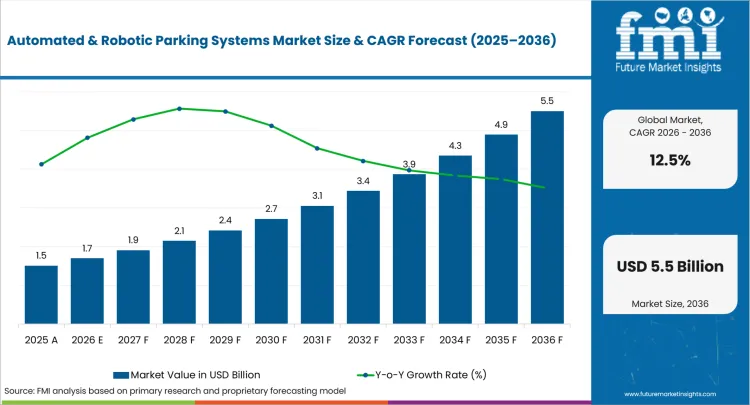
Key Takeaways of Automated & Robotic Parking Systems Market
- Demand for automated and robotic parking systems is driven by urban land availability, with developers evaluating these systems during early project planning to maximize usable building space and improve long-term asset utilization.
- By component, hardware is expected to lead with 60.0% share in 2026, supported by spending on robotic equipment, vehicle-handling systems, and structural infrastructure required for automated parking installation.
- Residential towers is the dominant application segment, projected to hold 36.0% share in 2026, reflecting its role as the preferred setting for automated parking across urban redevelopment projects.
- Shuttle & pallet AGV systems is estimated to lead the system type category with 42.0% share in 2026, driven by flexible system layouts and efficient vehicle handling across high-density parking projects.
- Engineering complexity, integration with smart-building systems, and long-term maintenance capability remain the primary factors shaping vendor selection.
- Competition centers on Lödige Industries, WÖHR Autoparksysteme, Westfalia Parking, Klaus Multiparking, Robotic Parking Systems, Unitronics, CityLift Parking, FATA Automation, and Parkmatic, with vendors differentiating through engineering capability, software integration, and long-term service support.
Analyst Perspective
"The market is increasingly rewarding vendors that deliver dependable performance long after system commissioning. Building owners and project developers are placing greater emphasis on lifecycle efficiency, seamless software integration, and the ability to support evolving building management requirements. Companies that combine engineering capability with digital intelligence, reliable maintenance support, and a strong portfolio of successful installations are likely to secure repeat business and strengthen their competitive standing."
- Nikhil Kaitwade, Principal Consultant at FMI
Source: FMI's proprietary forecasting model and primary research
How is the Automated & Robotic Parking Systems Market segmented?
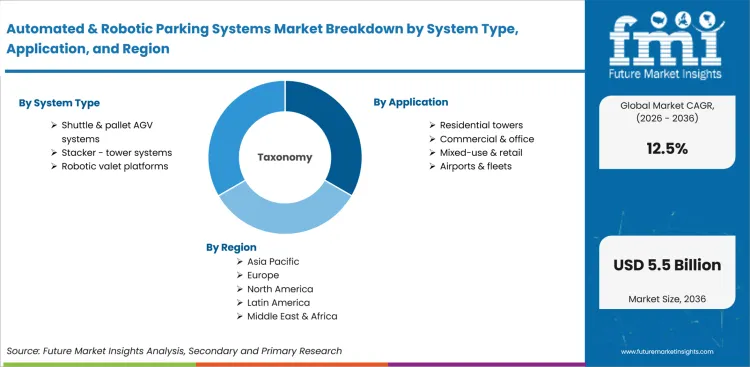
The automated & robotic parking systems industry is segmented by system type, application, component, end user, business model, and region.
The industry is segmented by system type, application, component, end user, business model, and region. System type coverage includes shuttle & pallet AGV systems, stacker tower systems, and robotic valet platforms deployed across residential, commercial, and institutional developments. Application analysis covers residential towers, commercial & office buildings, mixed-use & retail developments, and airports & fleet operations. Component analysis includes hardware, control software, and services associated with automated parking installations. End-user assessment spans developers, parking operators, and municipalities responsible for planning, ownership, and operation of automated parking facilities. Business model analysis evaluates EPC turnkey contracts, equipment sales, and operation & maintenance agreements used throughout commercial deployments. Regional coverage includes North America, Latin America, Europe, East Asia, South Asia & Pacific, Oceania, and the Middle East & Africa across the forecast period.
What defines Shuttle & pallet AGV systems within the System Type category?
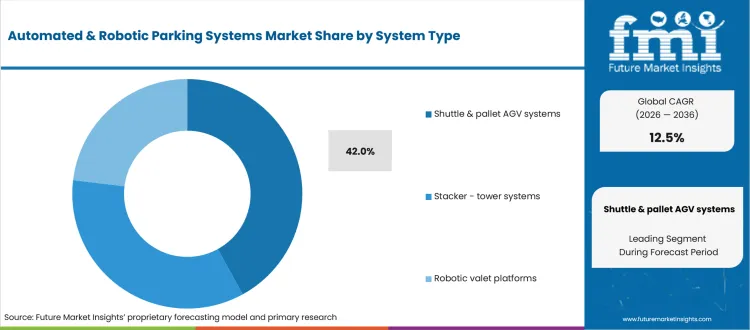
The system type segment comprises shuttle & pallet AGV systems, stacker tower systems, and robotic valet platforms. Shuttle & pallet AGV systems continue attracting commercial demand owing to efficient vehicle transfer, modular layouts, and compatibility with high-density developments.
- By system type, Shuttle & pallet AGV systems are projected to account for 42.0% share in 2026 attributable to efficient space utilization and flexible installation across residential and mixed-use developments.
- Growing commercial deployment is supported by modular system architecture and reduced land requirements, encouraging developers to integrate automated parking into urban construction projects.
How do residential towers influence demand across the application segment?
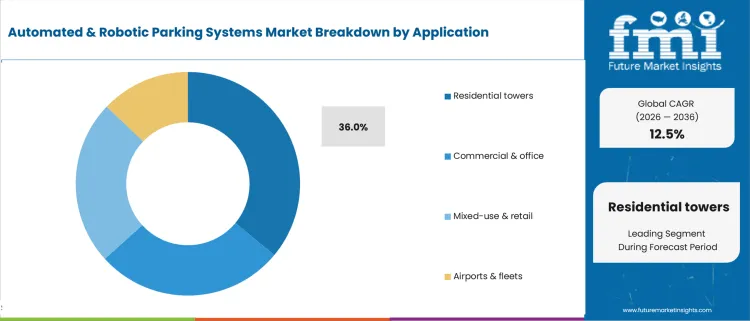
The application segment comprises residential towers, commercial & office buildings, mixed-use & retail developments, and airports & fleets. Residential towers remain the leading application as developers prioritize efficient space utilization, reduced ramp construction, and integration of intelligent parking technologies within high-rise housing projects. Automated parking systems also support growing electric vehicle adoption by enabling dedicated charging infrastructure inside compact parking facilities.
- Residential towers are estimated to account for 36.0% share in 2026 supported by continuing investment in high-rise housing developments and increasing demand for efficient land utilization across metropolitan areas. Commercial & office buildings, mixed-use developments, and airport facilities continue expanding adoption across additional project types.
- Urban housing projects continue strengthening commercial opportunities as developers seek higher parking density together with improved resident convenience and intelligent building integration. Automated parking platforms increasingly support premium residential developments requiring efficient vehicle storage within limited construction footprints.
Why does hardware remain the largest revenue-generating component?
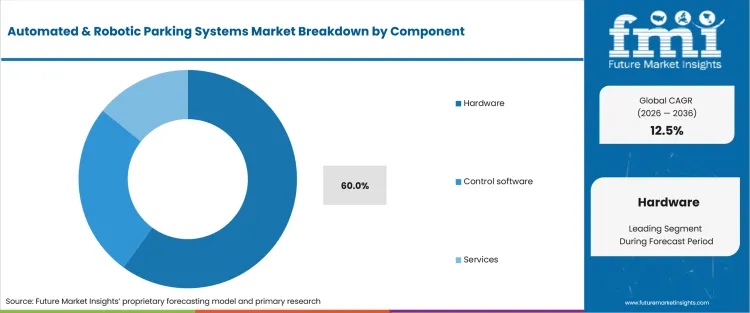
The component segment consists of hardware, control software, and services. Hardware continues accounting for the largest proportion of project expenditure as shuttle mechanisms, lifting systems, structural assemblies, conveyors, sensors, and safety equipment form the core operating infrastructure of automated parking facilities. Buyers increasingly compare equipment durability, maintenance accessibility, and lifecycle performance before approving commercial investments. In 2025, Lödige Industries confirmed that the DOKK1 automated parking facility accommodates 972 parking spaces, processes up to 2,000 vehicles daily, and has completed more than 2.5 million parking operations, highlighting the importance of durable mechanical infrastructure for continuous commercial operation.
- Hardware is projected to capture 60.0% share in 2026 owing to substantial investment in mechanical equipment, lifting technology, structural components, and integrated safety systems. Control software and services continue supporting operational optimization throughout the equipment lifecycle.
- Commercial buyers increasingly prioritize proven hardware performance as automated parking projects require dependable equipment capable of supporting continuous operation across residential and public infrastructure developments. Manufacturers demonstrating long-term operational reliability continue strengthening competitive positioning during commercial qualification.
What are the drivers, restraints, and opportunities in the automated & robotic parking systems market?
Demand is expected to strengthen as urban projects require higher parking density. High installation costs restrain adoption, while smart-city initiatives create growth opportunities.
- Driver: Developers are increasingly evaluating automated parking systems for projects requiring higher parking density without expanding the building footprint.
- Restraint: High capital expenditure and customized engineering requirements continue extending commercial approval and implementation timelines.
- Opportunity: Smart-city development and intelligent building infrastructure are expected to support wider deployment of automated parking technologies across residential and commercial projects.
Urban redevelopment continues strengthening demand for automated parking solutions as available land becomes increasingly limited across major cities. During May 2025, WÖHR Autoparksysteme introduced an expanded Combiparker configuration designed to increase parking capacity while reducing structural space requirements for new developments. The launch reflects how developers increasingly prioritize automated parking technologies that improve land efficiency without requiring larger construction footprints.
Commercial adoption continues facing challenges due to high installation costs and building-specific engineering requirements. Every automated parking installation requires structural integration, equipment customization, and software configuration according to the project layout. Building owners increasingly compare lifecycle operating costs, maintenance requirements, and long-term equipment reliability before approving investment decisions, extending sourcing and project qualification activities.
A significant opportunity continues emerging through smart-city investment programs and intelligent urban infrastructure. During 2025, the European Commission continued supporting smart and sustainable urban mobility initiatives through multiple city development programs, encouraging wider adoption of intelligent transport infrastructure across European municipalities. Parking system vendors are increasingly integrating artificial intelligence and electric vehicle charging capabilities into new installations, improving the commercial value of automated parking systems across future urban developments.
Which country CAGRs are profiled in the Automated & Robotic Parking Systems Market?
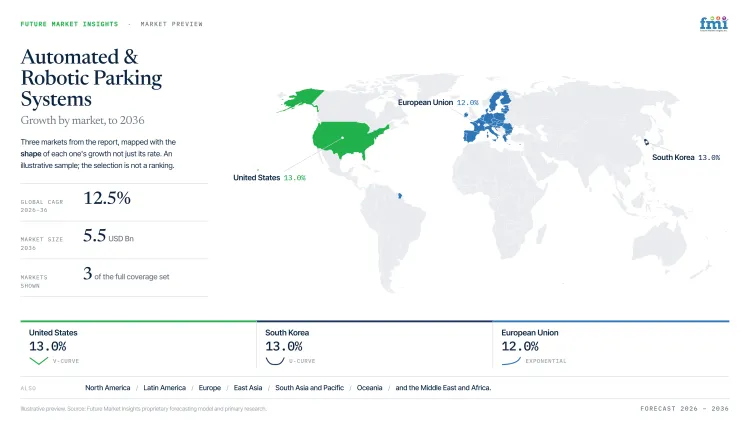
| Country | CAGR |
|---|---|
| United States | 13.0% |
| South Korea | 13.0% |
| European Union | 12.0% |
Source: FMI's proprietary forecasting model and primary research
How do country-level CAGRs compare in the Automated & Robotic Parking Systems Market?
The country comparison spans 1.0 percentage point and reveals two closely aligned growth groups across the automated & robotic parking systems market. The United States and South Korea share the highest CAGR at 13.0%, indicating an identical upper tier of market expansion. The European Union remains only 1.0 percentage point below the leading markets, creating a highly concentrated comparison with limited variation. Urban redevelopment, land constraints and investment in smart infrastructure continue to shape demand for automated parking technologies across all three markets.
- The United States shares the highest position in the comparison as mixed-use developments, high-density residential projects and growing integration of electric vehicle infrastructure continue to encourage deployment of automated parking systems in metropolitan areas.
- South Korea matches the United States at 13.0% CAGR, reflecting the influence of limited urban land availability, widespread smart-city initiatives and continued construction of high-rise residential and commercial developments where automated parking improves space utilization.
- The European Union remains 1.0 percentage point below the United States and South Korea. Growth reflects continued modernization of urban parking infrastructure, while engineering standards, safety requirements and long-term operational performance remain important considerations across member states.
Comparable CAGRs can still produce different market entry conditions. Differences in urban planning priorities, redevelopment activity, building regulations and integration with smart mobility infrastructure influence deployment timelines and long-term adoption strategies. The full report provides country-level CAGR analysis across North America, Latin America, Europe, East Asia, South Asia, Oceania and the Middle East and Africa.
Country-wise Analysis
- High-density redevelopment continues supporting automated parking investments across the United States. Market expansion is estimated at 13.0% CAGR from 2026 to 2036 owing to increasing demand for space-efficient parking solutions in residential and mixed-use developments. The USA Department of Energy reported continued growth in publicly available EV charging infrastructure during 2025, encouraging developers to integrate automated parking with EV-ready buildings. Property developers are increasingly evaluating automated systems to improve parking capacity without increasing the overall project footprint. Manufacturers capable of delivering reliable automation platforms together with long-term maintenance support are expected to strengthen commercial opportunities across metropolitan redevelopment projects.
- Urban land constraints continue encouraging wider deployment across South Korea. Automated & robotic parking systems are anticipated to expand at 13.0% CAGR through 2036 supported by smart-city programs and intensive residential construction. The Ministry of Land, Infrastructure and Transport continues promoting intelligent urban development initiatives that integrate advanced mobility infrastructure into new projects. High-rise residential developments increasingly incorporate automated parking to maximize land utilization and improve vehicle accessibility. System providers offering efficient retrieval technology and intelligent control software are likely to benefit from future commercial installations.
- Engineering quality and building standards continue shaping market activity across the European Union. The regional outlook is projected to advance at 12.0% CAGR from 2026 to 2036 attributable to redevelopment of commercial infrastructure and modernization of urban parking facilities. Regulation and technical validation remain important considerations before automated parking systems receive commercial approval across many projects. Building owners increasingly compare operational reliability and energy efficiency during vendor evaluation. Companies demonstrating successful commercial installations and proven engineering capability are expected to strengthen long-term market positioning.
Who are the notable companies in the Automated & Robotic Parking Systems Market?
Lödige Industries, WÖHR Autoparksysteme, Westfalia Parking, Klaus Multiparking, Unitronics, FATA Automation, Parkmatic, CityLift Parking, Robotic Parking Systems Inc., and MHE Demag are among the companies shaping the automated & robotic parking systems market.
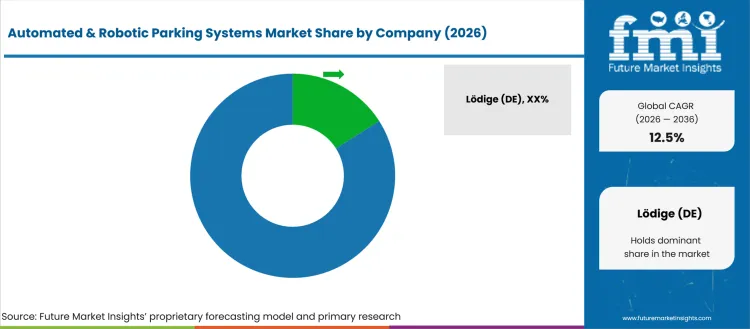
Competition extends beyond supplying automated parking equipment as developers increasingly compare engineering capability, project execution, software integration, and lifecycle support before selecting a technology partner. Companies with experience across residential towers and mixed-use developments continue strengthening their competitive position through completed installations and long-term maintenance services. Integration with electric vehicle charging, intelligent building management systems, and remote monitoring platforms is also becoming an important differentiator across new projects.
- Lödige Industries and WÖHR Autoparksysteme compete through extensive project portfolios and engineering expertise across residential, commercial, and mixed-use developments. Both companies continue expanding automated parking solutions designed to improve land utilization and operational efficiency within space-constrained urban projects. Their experience in complex infrastructure developments supports commercial qualification across high-capacity parking installations.
- Westfalia Parking and Klaus Multiparking focus on modular parking technologies and customized system configurations that accommodate varying building layouts and parking requirements. Product development increasingly emphasizes operational reliability, flexible layouts, and integration with intelligent control software to improve lifecycle performance across commercial installations.
- Robotic Parking Systems Inc., CityLift Parking, Unitronics, FATA Automation, Parkmatic, and MHE Demag strengthen competition through project-specific engineering, automation software, installation capability, and long-term maintenance services. Commercial success increasingly depends on delivering complete parking solutions supported by reliable technical assistance throughout the operating life of each installation.
Competitive Benchmarking: Automated & Robotic Parking Systems Market
| Company | Engineering Capability | Project Portfolio | Software Integration | Service Reach |
|---|---|---|---|---|
| Lödige Industries | HighHigh | High | Global | |
| WÖHR Autoparksysteme | High | High | High | Europe and international markets |
| Westfalia Parking | High | High | Medium | North America and Europe |
| Klaus Multiparking | High | Medium | Medium | Europe and Asia |
| Robotic Parking Systems Inc. | Medium | High | High | North America |
| Unitronics | Medium | Medium | High | Global |
| CityLift Parking | Medium | Medium | Medium | North America |
| FATA Automation | High | Medium | Medium | Europe |
| Parkmatic | Medium | Medium | Medium | Asia-Pacific |
| MHE Demag | Medium | Medium | Medium | Asia-Pacific |
Scoring basis: High indicates substantial capability demonstrated through commercial installations and engineering expertise. Medium indicates established capability across selected applications or regional markets.
Source: Future Market Insights competitive analysis, 2026. Ratings reflect relative portfolio strength, automation capability, project execution, and service coverage.
Key developments in the Automated & Robotic Parking Systems Market
- In January 2025 WÖHR Autoparksysteme expanded its Combiparker portfolio with configurations designed to improve parking density across residential and commercial developments. The updated systems support greater layout flexibility for projects with limited construction space, helping developers optimize available land while maintaining vehicle accessibility.
- In February 2025 Klaus Multiparking introduced new automated parking solutions with integrated electric vehicle charging capabilities for residential and mixed-use developments. The enhancement reflects increasing customer preference for combining parking automation with EV-ready infrastructure as part of modern building design.
Key Players
Companies profiled in this report include:
- Lödige Industries
- WÖHR Autoparksysteme
- Westfalia Parking
- Klaus Multiparking
- Robotic Parking Systems Inc.
- Unitronics
- CityLift Parking
- FATA Automation
- Parkmatic
Automated & Robotic Parking Systems Market Report Scope
| Coverage field | Report scope |
|---|---|
| Market breakdown | System type, application, component, end user, business model, country, and regional analysis. |
| Market Definition | Automated & robotic parking systems use mechanical, electromechanical, and software-controlled technologies to store and retrieve vehicles with minimal human intervention. The scope includes shuttle & pallet AGV systems, stacker tower systems, robotic valet platforms, associated control software, and related services. |
| Regions Covered | North America, Latin America, Europe, East Asia, South Asia and Pacific, Oceania, and the Middle East and Africa. |
| Countries Covered | United States, Canada, Germany, United Kingdom, France, Italy, Spain, China, Japan, South Korea, India, Australia, GCC Countries, and more than 30 additional countries. |
| Key Companies Profiled | Lödige Industries, WÖHR Autoparksysteme, Westfalia Parking, Klaus Multiparking, Robotic Parking Systems Inc., Unitronics, CityLift Parking, FATA Automation, MHE Demag, and Parkmatic. |
| Forecast Period | 2026 to 2036, with 2025 used as the historical market-size reference. |
| Approach | Hybrid bottom-up and top-down sizing that combines vedor evidence with installation trends, application demand patterns, and country-level urban infrastructure developments. |
Source: Future Market Insights - analysis driven by proprietary forecasting models and primary research
Automated & Robotic Parking Systems Market Research Methodology
| Method | Approach |
|---|---|
| Primary Research | FMI analysts gathered input from manufacturers, service providers, technology developers, distributors, end users, sourcing teams, and subject-matter experts. Interviews examined purchasing decisions, product or service evaluation, adoption barriers, approval requirements, pricing considerations, and expectations for technical or commercial support. Respondents were also asked what evidence is required before a trial, pilot, or initial order develops into regular purchasing. |
| Secondary Research | Desk research covered government statistics, regulatory publications, trade data, industry associations, technical literature, standards, company filings, product information, and official corporate announcements. Sources were reviewed for relevance, publication date, geographic coverage, and consistency with the defined market scope. Claims relating to performance, applications, approvals, capacity, investment, and commercial activity were retained only when supported by credible public evidence. |
| Market Estimation | The market model combined the baseline value with historical performance, segment structure, pricing and volume indicators, adoption levels, company participation, and country-level demand conditions. Forecast assumptions considered economic activity, investment trends, regulatory developments, technology adoption, purchasing cycles, supply availability, and barriers to wider market use. Segment and regional estimates were reconciled before the final market total was calculated. |
| Forecast Validation | Estimates were checked against multiple independent indicators, including public data, company activity, trade patterns, industry developments, and findings from primary interviews. Validation also tested whether products, services, applications, and company revenues fell within the defined market boundaries. Adjacent categories, unsupported claims, overlapping revenues, and activities without direct market relevance were excluded to reduce double counting and maintain consistency across segments and countries. |
Source: Future Market Insights (FMI) analysis, based on proprietary forecasting model and primary research
Automated & Robotic Parking Systems Market by Segments
By System Type
- Shuttle & Pallet AGV Systems
- Stacker Tower Systems
- Robotic Valet Platforms
By Application
- Residential Towers
- Commercial & Office
- Mixed-use & Retail
- Airports & Fleets
By Component
- Hardware
- Control Software
- Services
By End User
- Developers
- Parking Operators
- Municipalities
By Business Model
- EPC Turnkey
- Equipment Sale
- Operation & Maintenance (O&M) Contracts
By Region
- North America
- United States
- Canada
- Latin America
- Brazil
- Mexico
- Argentina
- Europe
- Germany
- United Kingdom
- France
- Italy
- Spain
- Rest of Europe
- East Asia
- China
- Japan
- South Korea
- South Asia and Pacific
- India
- Thailand
- Indonesia
- Malaysia
- Singapore
- Rest of South Asia and Pacific
- Oceania
- Australia
- New Zealand
- Middle East and Africa
- GCC Countries
- South Africa
- Turkey
- Rest of Middle East and Africa
Research Sources and Bibliography
- European Commission. (2025). Commission welcomes political agreement on the End-of-Life Vehicles Regulation. European Commission.
- European Commission. (2025). Sustainable and Smart Mobility Strategy implementation updates. European Commission.
- Lödige Industries. (2025, February). Most modern automated parking system in the USA starts operation in residential tower in Philadelphia. Lödige Industries.
- Lödige Industries. (2025, June). Space-saving parking system powers urban transformation in Aarhus. Lödige Industries.
- Klaus Multiparking GmbH. (2025). Automated parking solutions and project references. Klaus Multiparking GmbH.
- WÖHR Autoparksysteme GmbH. (2025). Automated parking systems and product portfolio. WÖHR Autoparksysteme GmbH.
- Robotic Parking Systems Inc. (2025). Automated parking system technology and commercial projects. Robotic Parking Systems Inc.
- USA Department of Energy. (2025). Alternative Fuels Data Center: Electric Vehicle Charging Station Counts. USA Department of Energy.
- United Nations Human Settlements Programme. (2024). World Cities Report 2024: Cities and Climate Action. UN-Habitat.
- International Energy Agency. (2025). Global EV Outlook 2025. International Energy Agency.
- Ministry of Land, Infrastructure and Transport. (2025). Smart City Policy and Urban Development Initiatives. Government of the Republic of Korea.
- Korean Statistical Information Service. (2025). Urban Population Statistics. Statistics Korea.
- Federal Statistical Office of Germany (Destatis). (2025). Construction and Housing Statistics. Destatis.
- Japan Ministry of Land, Infrastructure, Transport and Tourism. (2025). Urban Development and Infrastructure Policy Updates. MLIT Japan.
- International Parking & Mobility Institute. (2025). Parking Trends and Technology Adoption. International Parking & Mobility Institute.
This Report Answers
- What valuation is the automated & robotic parking systems market expected to reach by 2036?
- What CAGR is projected for the automated & robotic parking systems market from 2026 to 2036?
- Which system type is anticipated to generate the highest demand through the forecast period?
- Why are residential towers leading application demand for automated & robotic parking systems?
- Which component accounts for the largest share of market revenue?
- How do country-level growth trends differ across major automated & robotic parking systems markets?
- Which factors are supporting adoption of automated & robotic parking systems?
- Which companies are actively competing in the automated & robotic parking systems market?
- What commercial opportunities are emerging for automated & robotic parking system providers?
- Which regions are expected to create new investment opportunities during the forecast period?
Frequently Asked Questions
What is driving growth in the automated & robotic parking systems market?
Urban redevelopment and limited land availability are encouraging developers to adopt automated parking systems that improve parking capacity while optimizing available building space.
Which system type leads the automated & robotic parking systems market?
Shuttle & pallet AGV systems lead the market owing to efficient vehicle handling, modular layouts, and suitability for high-density residential and commercial developments.
Why do residential towers represent the leading application?
Residential towers require higher parking capacity within limited urban land, making automated parking systems an efficient solution for maximizing usable building space.
Which component accounts for the highest market share?
Hardware accounts for the largest share as mechanical equipment, lifting systems, shuttle mechanisms, and structural components represent the largest portion of installation costs.
Which regions are expected to create attractive growth opportunities?
North America, East Asia, and Europe continue creating significant opportunities through urban redevelopment, smart-city investments, and increasing adoption of intelligent building infrastructure.
Who are the major companies operating in the automated & robotic parking systems market?
Leading participants include Lödige Industries, WÖHR Autoparksysteme, Westfalia Parking, Klaus Multiparking, Robotic Parking Systems Inc., Unitronics, CityLift Parking, FATA Automation, MHE Demag, and Parkmatic.
Preview the report firsthand - request a free sample
Get SampleGet the brochure for pricing and purchase details.
Get PDFTable of Content
- Key Takeaways
- Market Size and CAGR
- Top Growth Driver
- Fastest Growing Segment
- Leading Region
- Key Companies
- Emerging Opportunities
- Executive Summary
- Global Market Outlook
- Demand-side Trends
- Supply-side Trends
- Technology Roadmap Analysis
- Analysis and Recommendations
- Analyst Perspective (What is happening? Why now? What should investors know?)
- Key Questions Answered
- How large is the market?
- What is the CAGR?
- What are key trends?
- Which region dominates?
- Who are the leaders?
- Market Overview
- Market Coverage / Taxonomy
- Market Definition / Scope / Limitations
- Research Methodology
- Chapter Orientation
- Analytical Lens and Working Hypotheses
- Market Structure, Signals, and Trend Drivers
- Benchmarking and Cross-market Comparability
- Market Sizing, Forecasting, and Opportunity Mapping
- Research Design and Evidence Framework
- Desk Research Programme (Secondary Evidence)
- Expert Input and Fieldwork (Primary Evidence)
- Tooling, Models, and Reference Databases
- Data Engineering and Model Build
- Quality Assurance and Audit Trail
- Market Background
- Market Dynamics (Drivers, Restraints, Opportunity, Trends)
- Scenario Forecast (Optimistic, Likely, Conservative)
- Impact Analysis
- AI Impact
- Sustainability Impact
- Regulatory Impact
- Technology Impact
- Consumer / Buyer Analysis
- Purchase Drivers
- Adoption Barriers
- Buyer Journey
- Opportunity Map Analysis
- Product Life Cycle Analysis
- Supply Chain Analysis
- Investment Feasibility Matrix
- Value Chain Analysis
- PESTLE and Porter's Analysis
- Regulatory Landscape
- Regional Parent Market Outlook
- Production and Consumption Statistics
- Import and Export Statistics
- Global Market Analysis and Forecast, 2021 to 2036
- Historical Market Size Value (USD Billion) Analysis, 2021 to 2025
- Current and Future Market Size Value (USD Billion) Projections, 2026 to 2036
- Y-o-Y Growth Trend Analysis
- Absolute $ Opportunity Analysis
- Global Market Pricing Analysis, 2021 to 2036
- Global Market Analysis and Forecast, By System Type, 2021 to 2036
- Introduction / Key Findings
- Historical Market Size Value (USD Billion) Analysis By System Type, 2021 to 2025
- Current and Future Market Size Value (USD Billion) Analysis and Forecast By System Type, 2026 to 2036
- Shuttle & pallet AGV systems
- Stacker - tower systems
- Robotic valet platforms
- Shuttle & pallet AGV systems
- Y-o-Y Growth Trend Analysis By System Type, 2021 to 2025
- Absolute $ Opportunity Analysis By System Type, 2026 to 2036
- Global Market Analysis and Forecast, By Application, 2021 to 2036
- Introduction / Key Findings
- Historical Market Size Value (USD Billion) Analysis By Application, 2021 to 2025
- Current and Future Market Size Value (USD Billion) Analysis and Forecast By Application, 2026 to 2036
- Residential towers
- Commercial & office
- Mixed-use & retail
- Airports & fleets
- Residential towers
- Y-o-Y Growth Trend Analysis By Application, 2021 to 2025
- Absolute $ Opportunity Analysis By Application, 2026 to 2036
- Global Market Analysis and Forecast, By Component, 2021 to 2036
- Introduction / Key Findings
- Historical Market Size Value (USD Billion) Analysis By Component, 2021 to 2025
- Current and Future Market Size Value (USD Billion) Analysis and Forecast By Component, 2026 to 2036
- Hardware
- Control software
- Services
- Hardware
- Y-o-Y Growth Trend Analysis By Component, 2021 to 2025
- Absolute $ Opportunity Analysis By Component, 2026 to 2036
- Global Market Analysis and Forecast, By End User, 2021 to 2036
- Introduction / Key Findings
- Historical Market Size Value (USD Billion) Analysis By End User, 2021 to 2025
- Current and Future Market Size Value (USD Billion) Analysis and Forecast By End User, 2026 to 2036
- Developers
- Parking operators
- Municipalities
- Developers
- Y-o-Y Growth Trend Analysis By End User, 2021 to 2025
- Absolute $ Opportunity Analysis By End User, 2026 to 2036
- Global Market Analysis and Forecast, By Business Model, 2021 to 2036
- Introduction / Key Findings
- Historical Market Size Value (USD Billion) Analysis By Business Model, 2021 to 2025
- Current and Future Market Size Value (USD Billion) Analysis and Forecast By Business Model, 2026 to 2036
- EPC - turnkey
- Equipment sale
- O&M contracts
- EPC - turnkey
- Y-o-Y Growth Trend Analysis By Business Model, 2021 to 2025
- Absolute $ Opportunity Analysis By Business Model, 2026 to 2036
- Global Market Analysis and Forecast, By Region, 2021 to 2036
- Introduction
- Historical Market Size Value (USD Billion) Analysis By Region, 2021 to 2025
- Current Market Size Value (USD Billion) Analysis and Forecast By Region, 2026 to 2036
- North America
- Latin America
- Western Europe
- Eastern Europe
- East Asia
- South Asia and Pacific
- Middle East & Africa
- Market Attractiveness Analysis By Region
- North America Market Analysis and Forecast, By Country, 2021 to 2036
- Historical Market Size Value (USD Billion) Trend Analysis By Market Taxonomy, 2021 to 2025
- Market Size Value (USD Billion) Forecast By Market Taxonomy, 2026 to 2036
- By Country
- USA
- Canada
- By System Type
- By Application
- By Component
- By End User
- By Business Model
- By Country
- Market Attractiveness Analysis
- By Country
- By System Type
- By Application
- By Component
- By End User
- By Business Model
- Key Takeaways
- Latin America Market Analysis and Forecast, By Country
- Historical Market Size Value (USD Billion) Trend Analysis By Market Taxonomy, 2021 to 2025
- Market Size Value (USD Billion) Forecast By Market Taxonomy, 2026 to 2036
- By Country
- Brazil
- Mexico
- Chile
- Rest of Latin America
- By System Type
- By Application
- By Component
- By End User
- By Business Model
- By Country
- Market Attractiveness Analysis
- By Country
- By System Type
- By Application
- By Component
- By End User
- By Business Model
- Key Takeaways
- Western Europe Market Analysis and Forecast, By Country
- Historical Market Size Value (USD Billion) Trend Analysis By Market Taxonomy, 2021 to 2025
- Market Size Value (USD Billion) Forecast By Market Taxonomy, 2026 to 2036
- By Country
- Germany
- UK
- Italy
- Spain
- France
- Nordic
- BENELUX
- Rest of Western Europe
- By System Type
- By Application
- By Component
- By End User
- By Business Model
- By Country
- Market Attractiveness Analysis
- By Country
- By System Type
- By Application
- By Component
- By End User
- By Business Model
- Key Takeaways
- Eastern Europe Market Analysis and Forecast, By Country
- Historical Market Size Value (USD Billion) Trend Analysis By Market Taxonomy, 2021 to 2025
- Market Size Value (USD Billion) Forecast By Market Taxonomy, 2026 to 2036
- By Country
- Russia
- Poland
- Hungary
- Balkan & Baltic
- Rest of Eastern Europe
- By System Type
- By Application
- By Component
- By End User
- By Business Model
- By Country
- Market Attractiveness Analysis
- By Country
- By System Type
- By Application
- By Component
- By End User
- By Business Model
- Key Takeaways
- East Asia Market Analysis and Forecast, By Country
- Historical Market Size Value (USD Billion) Trend Analysis By Market Taxonomy, 2021 to 2025
- Market Size Value (USD Billion) Forecast By Market Taxonomy, 2026 to 2036
- By Country
- China
- Japan
- South Korea
- By System Type
- By Application
- By Component
- By End User
- By Business Model
- By Country
- Market Attractiveness Analysis
- By Country
- By System Type
- By Application
- By Component
- By End User
- By Business Model
- Key Takeaways
- South Asia and Pacific Market Analysis and Forecast, By Country
- Historical Market Size Value (USD Billion) Trend Analysis By Market Taxonomy, 2021 to 2025
- Market Size Value (USD Billion) Forecast By Market Taxonomy, 2026 to 2036
- By Country
- India
- ASEAN
- Australia & New Zealand
- Rest of South Asia and Pacific
- By System Type
- By Application
- By Component
- By End User
- By Business Model
- By Country
- Market Attractiveness Analysis
- By Country
- By System Type
- By Application
- By Component
- By End User
- By Business Model
- Key Takeaways
- Middle East & Africa Market Analysis and Forecast, By Country
- Historical Market Size Value (USD Billion) Trend Analysis By Market Taxonomy, 2021 to 2025
- Market Size Value (USD Billion) Forecast By Market Taxonomy, 2026 to 2036
- By Country
- Kingdom of Saudi Arabia
- Other GCC Countries
- Türkiye
- South Africa
- Other African Union
- Rest of Middle East & Africa
- By System Type
- By Application
- By Component
- By End User
- By Business Model
- By Country
- Market Attractiveness Analysis
- By Country
- By System Type
- By Application
- By Component
- By End User
- By Business Model
- Key Takeaways
- Key Countries Market Analysis
- USA
- Pricing Analysis
- Market Share Analysis, 2025
- By System Type
- By Application
- By Component
- By End User
- By Business Model
- Canada
- Pricing Analysis
- Market Share Analysis, 2025
- By System Type
- By Application
- By Component
- By End User
- By Business Model
- Mexico
- Pricing Analysis
- Market Share Analysis, 2025
- By System Type
- By Application
- By Component
- By End User
- By Business Model
- Brazil
- Pricing Analysis
- Market Share Analysis, 2025
- By System Type
- By Application
- By Component
- By End User
- By Business Model
- Chile
- Pricing Analysis
- Market Share Analysis, 2025
- By System Type
- By Application
- By Component
- By End User
- By Business Model
- Germany
- Pricing Analysis
- Market Share Analysis, 2025
- By System Type
- By Application
- By Component
- By End User
- By Business Model
- UK
- Pricing Analysis
- Market Share Analysis, 2025
- By System Type
- By Application
- By Component
- By End User
- By Business Model
- Italy
- Pricing Analysis
- Market Share Analysis, 2025
- By System Type
- By Application
- By Component
- By End User
- By Business Model
- Spain
- Pricing Analysis
- Market Share Analysis, 2025
- By System Type
- By Application
- By Component
- By End User
- By Business Model
- France
- Pricing Analysis
- Market Share Analysis, 2025
- By System Type
- By Application
- By Component
- By End User
- By Business Model
- India
- Pricing Analysis
- Market Share Analysis, 2025
- By System Type
- By Application
- By Component
- By End User
- By Business Model
- ASEAN
- Pricing Analysis
- Market Share Analysis, 2025
- By System Type
- By Application
- By Component
- By End User
- By Business Model
- Australia & New Zealand
- Pricing Analysis
- Market Share Analysis, 2025
- By System Type
- By Application
- By Component
- By End User
- By Business Model
- China
- Pricing Analysis
- Market Share Analysis, 2025
- By System Type
- By Application
- By Component
- By End User
- By Business Model
- Japan
- Pricing Analysis
- Market Share Analysis, 2025
- By System Type
- By Application
- By Component
- By End User
- By Business Model
- South Korea
- Pricing Analysis
- Market Share Analysis, 2025
- By System Type
- By Application
- By Component
- By End User
- By Business Model
- Russia
- Pricing Analysis
- Market Share Analysis, 2025
- By System Type
- By Application
- By Component
- By End User
- By Business Model
- Poland
- Pricing Analysis
- Market Share Analysis, 2025
- By System Type
- By Application
- By Component
- By End User
- By Business Model
- Hungary
- Pricing Analysis
- Market Share Analysis, 2025
- By System Type
- By Application
- By Component
- By End User
- By Business Model
- Kingdom of Saudi Arabia
- Pricing Analysis
- Market Share Analysis, 2025
- By System Type
- By Application
- By Component
- By End User
- By Business Model
- Türkiye
- Pricing Analysis
- Market Share Analysis, 2025
- By System Type
- By Application
- By Component
- By End User
- By Business Model
- South Africa
- Pricing Analysis
- Market Share Analysis, 2025
- By System Type
- By Application
- By Component
- By End User
- By Business Model
- USA
- Market Structure Analysis
- Competition Dashboard
- Competition Benchmarking
- Market Share Analysis of Top Players
- By Regional
- By System Type
- By Application
- By Component
- By End User
- By Business Model
- Emerging Startups
- Innovation Benchmarking
- Competition Analysis
- Competition Deep Dive
- Lödige (DE)
- Overview
- Product Portfolio
- Profitability by Market Segments
- Sales Footprint
- Strategy Overview
- Marketing Strategy
- Product Strategy
- Channel Strategy
- Westfalia (DE)
- U-tron (IL)
- ParkPlus (US)
- Lödige (DE)
- Case Studies
- Success Stories
- Recent Developments
- Competition Deep Dive
- Assumptions & Acronyms Used


