

- Market Size (2026)
- USD 1.4 Bn
- Forecast (2036)
- USD 5.7 Bn
- CAGR (2026 to 2036)
- 15.0%
How big is the Naval Mine Countermeasures Robotics Market size?
USD 1.4 billion in 2026 and USD 5.7 billion by 2036 at a 15.0% CAGR.
Sales of naval mine countermeasures robotics are estimated to rise at 15.0% CAGR through 2036, increasing valuation from USD 1.4 billion in 2026 to USD 5.7 billion by 2036. Unmanned systems detect and neutralize underwater hazards to secure naval transit paths for crewed vessels entering dangerous waters. Joint military exercises highlight a major transition toward autonomous maritime operations. NATO Allied Maritime Command reported in September 2025 stating Dynamic Messenger 2025 involved more than 2,000 participants and around 260 systems from 22 Allied nations. Large-scale fleet testing confirms notable operational adoption of autonomous hardware across international waters.
Geographic defense priorities shift significantly depending on localized strategic goals. European Union and United Kingdom initiatives focus on remote command centers alongside cooperative mine warfare readiness. The Asia-Pacific and Gulf naval organizations emphasize stand-off operation combined with local shipyard integration. Aligning hardware with regional requirements becomes important as defense agencies expand active uncrewed inventories. United States Navy reported in July 2025 noting its MCM USV program had delivered 9 units to active fleets with 18 more under contract. This widespread fleet modernization accelerates global adoption of remote vehicles and specialized disposal payloads.
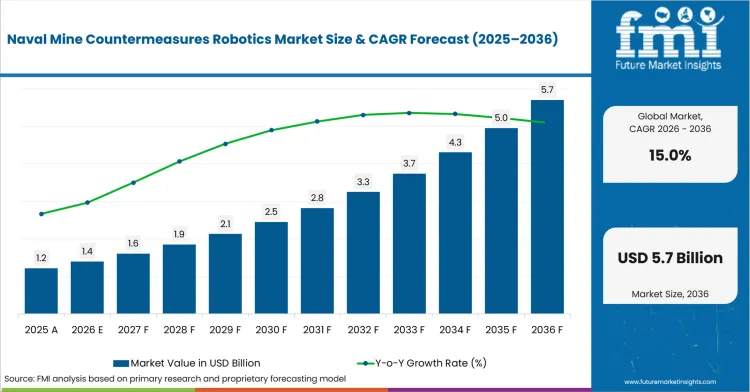
Key Takeaways of Naval Mine Countermeasures Robotics Market
- Demand for naval mine countermeasures robotics is driven by navies shifting dangerous seabed survey and neutralization tasks away from crews, with account decisions reflecting mission safety evidence and integrated system readiness.
- By buyer group, NATO-EU navies are expected to lead with 62.0% share in 2026, led by cooperative programs prioritizing remote mine-warfare capability.
- Route survey & hunting is the dominant application segment, projected to hold 52.0% share in 2026, reflecting safe passage confirmation as a primary mission need.
- Multi-nation programs are estimated to lead the program type category with 52.0% share in 2026, driven by shared development and acceptance pathways.
- Modular system design and sonar pairing remain critical to supplier evaluation, as defense contractors seek integration approaches that reduce risk during naval trials.
- The European Union is expected to lead regional growth at 15.0% CAGR through 2036, supported by cooperative mine-warfare programs and expanding autonomous capability deployment.
- Competition centers on Exail, Thales, ATLAS ELEKTRONIK, Saab, Naval Group, and Bollinger Shipyards, with vendors differentiating through integrated unmanned systems, minesweeping/neutralization capabilities, and vessel integration expertise.
Analyst Perspective
"The naval mine countermeasures robotics market is evolving as defense forces seek autonomous systems that improve mission effectiveness while reducing risks to personnel in high-threat maritime environments. Procurement decisions are influenced by proven operational performance, interoperability with existing naval command systems, and the ability to support complex mine detection and neutralization missions. Suppliers that combine mission-ready robotic platforms with comprehensive operator training, lifecycle support, and systems integration expertise are likely to strengthen long-term partnerships with naval defense organizations."
- Nikhil Kaitwade , Principal Consultant at Future Market Insights
Source: Future Market Insights analysis, 2026.
How is Naval Mine Countermeasures Robotics Market segmented?
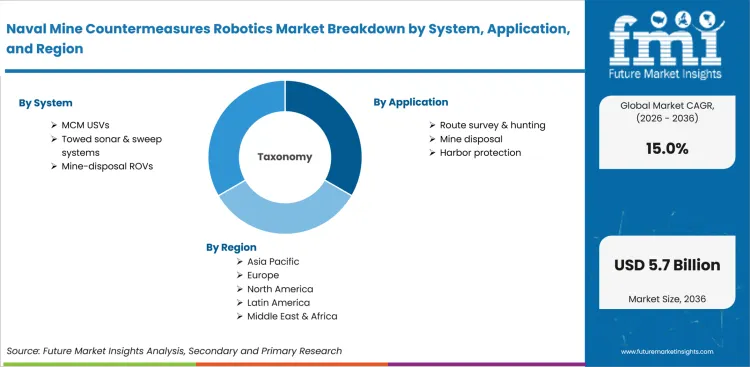
The naval mine countermeasures robotics industry is segmented by system, application, component, end user, business model and region.
The naval mine countermeasures robotics sector covers six parent segments. System coverage includes MCM USVs alongside towed sonar & sweep systems and mine-disposal ROVs. Application coverage includes route survey & hunting, mine disposal and harbor protection. Component coverage includes platforms, sonar & AI processing and services. End user coverage includes NATO-EU navies, Asia-Pacific navies and Gulf & other navies. Business model coverage includes multi-nation programs, national purchase programs and support contracts. Regional coverage includes North America and Latin America. Coverage also includes Europe, East Asia, South Asia, Oceania and Middle East and Africa.
How do MCM USVs shape system purchasing?
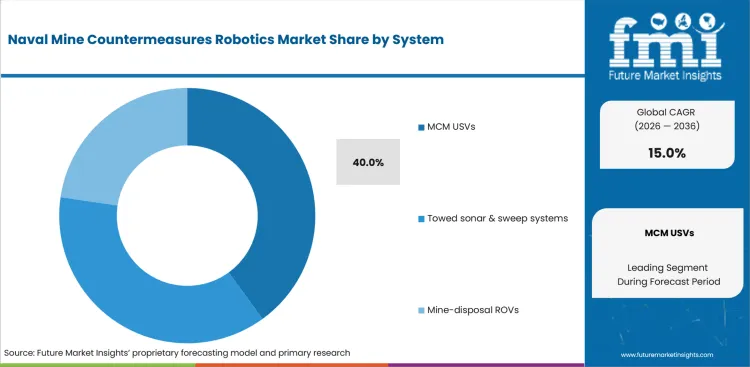
MCM USVs are estimated to lead purchasing as naval teams seek remote minefield access and modular payload flexibility. Fleet teams value vessels supporting mine hunting and safe-route confirmation across littoral operations. Royal Navy reported in April 2026 noting the second of 4 remotely-controlled boats had been delivered under the MMCM program, reinforcing unmanned surface system readiness for mine warfare missions.
- MCM USVs are predicted to garner 40.0% share in 2026, helped by off-board operation and modular mission use. Buyers prefer unmanned surface craft after deployment evidence supports safe-route assessment and fleet integration.
- Towed sonar & sweep systems and mine-disposal ROVs support sonar coverage and neutralization steps. MCM USVs retain selection strength after navies require surface platforms capable of carrying multiple mine-warfare payloads.
How does route survey & hunting lead application demand?
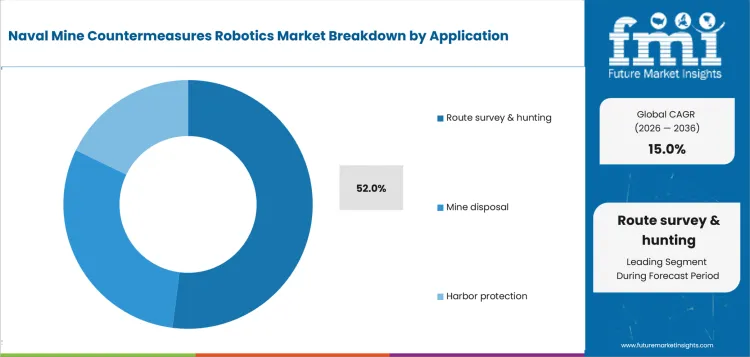
Route survey & hunting is expected to guide application need as naval commanders confirm safe passage before mine disposal begins. Mission planners assess seabed mapping and post-mission analysis before accepting robotic systems into fleet use. Royal Navy reported in February 2025 noting IMX involved more than 30 nations and over 5,000 personnel, promoting route survey and classification use across multinational mine-warfare exercises.
- Based application, route survey & hunting is anticipated to capture 52.0% share in 2026 since naval missions need early detection and classification before clearance activity. Providers gain approval after mission records support seabed survey and contact review.
- Mine disposal and harbor protection serve defined mission profiles involving neutralization and fixed-site defense. Route survey & hunting keeps preference after buyers place safe passage confirmation ahead of later response actions.
How do platforms support component demand?
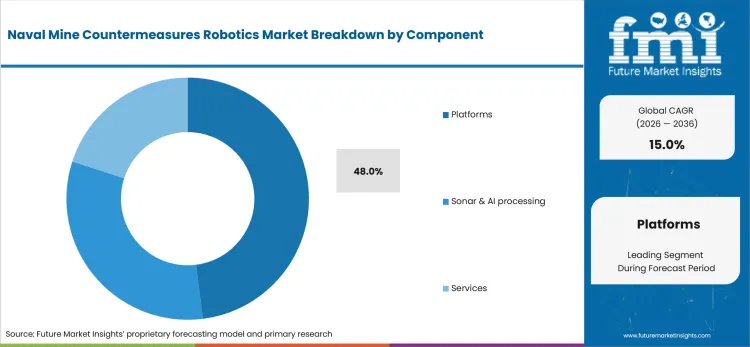
Royal Navy reported in May 2026 noting the 12-metre Ariadne uncrewed vessel docked inside RFA Lyme Bay after trials, influencing platform-led mine hunting deployment. Platforms are anticipated to support component demand as navies prioritize vessels and vehicles carrying sonar and neutralization payloads. System engineers review payload space and launch handling before operational acceptance.
- In 2026, platforms are projected to account for 48.0% share due to vehicle-led spending across unmanned surface and underwater systems. Naval teams prefer platform-led packages after payload and control integration are proven.
- Sonar & AI processing and services support mission interpretation and operational continuity. Platforms gain account attention after buyers compare vessel compatibility and operator training needs.
How do NATO-EU navies influence end user demand?
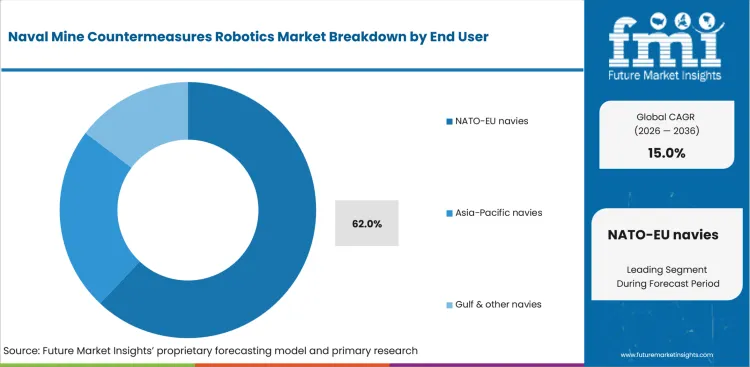
NATO-EU navies are expected to support end user demand as European mine-warfare modernization prioritizes remote operation and shared program execution. Naval buyers assess command handoff and doctrine fit before moving robotic systems into fleet service. European Defence Agency reported in its 2025 annual report noting a catalogue of over 300 unmanned aerial systems from more than 200 manufacturers, reflecting structured capability mapping around unmanned defense assets.
- NATO-EU navies are estimated to secure 62.0% share of end user demand in 2026, backed by cooperative mine-warfare programs and fleet safety needs. Providers gain review strength after systems match naval acceptance and training requirements.
- Asia-Pacific navies and Gulf & other navies generate sustained demand through maritime-route security and port protection needs. NATO-EU navies guide early specification work after joint programs demonstrate remote mine-warfare operations.
How do multi-nation programs support business model demand?
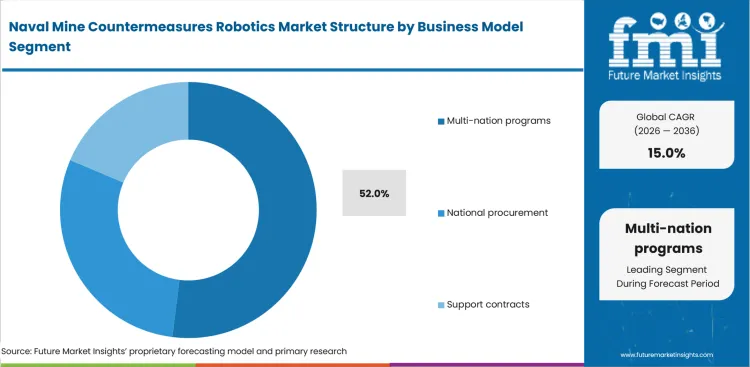
OCCAR reported in April 2025 stating the MMCM neutralization munition passed 2 major milestones, increasing shared qualification work across France and the United Kingdom. Multi-nation programs are anticipated to support business model demand as mine countermeasure robotics requires shared development and acceptance procedures. Program teams value common training centers and remote command architectures across allied fleets.
- By business model, multi-nation programs are likely to represent 52.0% share in 2026 as joint development lowers duplication across complex naval robotics programs. Shared programs improve confidence after requirements are aligned across multiple fleets.
- National purchase programs and support contracts remain useful for sovereign upgrades and fleet sustainment. Multi-nation programs gain preference after defense buyers seek interoperable systems and coordinated acceptance evidence.
What are drivers, restraints, and opportunities in Naval Mine Countermeasures Robotics Market?
Mission safety drives robotic mine-countermeasure adoption and integration proof gaps slow buyer approval across naval programs.
- Driver: Navies are replacing crew-exposed mine clearance methods with robotic systems designed to improve stand-off detection and route confirmation.
- Restraint: Adoption slows if sonar payloads and command centers lack clear integration proof during naval acceptance.
- Opportunity: Providers offering modular unmanned systems and training support improve approval chances across mine-warfare modernization programs.
Modern mine-warfare missions require robotic systems capable of testing autonomous maritime operations before operational use. Royal Navy reported in March 2026 announcing plans to purchase 20 uncrewed boats for operations and development, influencing practical adoption of crewed-uncrewed maritime force models.
Securing new naval sales remains difficult after complex system combinations create verification pressure across vehicles, sensors and command software. Royal Navy reported in March 2026 stating its Mine Hunting Capability program delivered 2 uncrewed surface vessels and 3 SeaCat UUV sets, highlighting the training burden attached to new autonomous mine-countermeasure systems.
Opportunity improves as naval buyers review integrated unmanned systems capable of identification and neutralization from safer distances. Royal Navy reported in February 2025 announcing 3 Iver4 580 uncrewed underwater vessels for minehunting and survey operations, reflecting deeper route survey work and near-continuous deployment.
What country CAGRs are profiled in naval mine countermeasures robotics market?
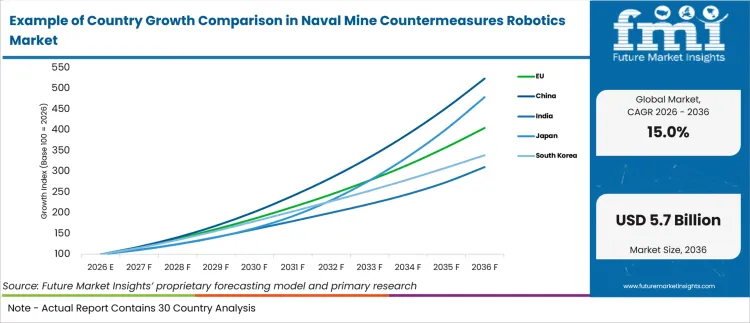
| Country | CAGR |
|---|---|
| EU | 15.0% |
Source: Future Market Insights analysis, 2026.
How do country-level CAGRs compare in Naval mine Countermeasures Robotics Market?
Country demand in naval mine countermeasures robotics is expected to be guided by mine-warfare modernization and cooperative fleet programs. Remote operation and unmanned-system acceptance guide vendor selection. EU programs are likely to connect demand with bilateral capability work and NATO maritime readiness. Asia-Pacific and Gulf programs are anticipated to connect adoption with route security and stand-off clearance needs.
- Cooperative mine-warfare programs combined with autonomous system deployment facilitate broader maritime security capabilities, fueling significant long-term growth across European maritime sectors. OCCAR reported in March 2026 delivering second MMCM system to United Kingdom, reinforcing Europe-led learning around remote survey and neutralization. Strategic investments in high-tech unmanned assets enable naval forces to address hazardous underwater environments without risking human crews. This effectively positions European Union demand for naval mine countermeasures robotics as expected to rise at a 15.0% CAGR during the forecast period.
Who are notable companies in naval mine countermeasures robotics market?
Exail and Thales are expected to shape market direction through integrated unmanned mine-warfare systems. ATLAS ELEKTRONIK GmbH and Saab AB add minesweeping and neutralization capability. Naval Group and Kongsberg Maritime AS support vessel and underwater robotics depth. Textron Systems and Bollinger Shipyards LLC add USA mission-package and unmanned surface vessel exposure.
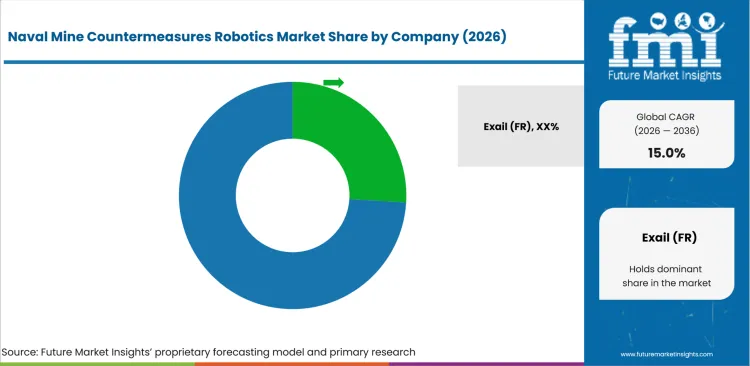
System integration and mission readiness are anticipated to drives the competition in the naval mine countermeasures robotics industry. Remote command software and sonar pairing guide final vendor review. Account teams are likely to compare providers based on acceptance records and support for fleet trials after first approval. Exail is expected to receive review attention due to integrated mine countermeasure robotics. Thales is anticipated to add autonomous command and sonar strength. ATLAS ELEKTRONIK GmbH is projected to compete led by autonomous minesweeping systems. Saab AB is estimated to compete based on mine neutralization systems. Naval Group and Kongsberg Maritime AS are forecast to support demand through naval platform and underwater vehicle depth. Textron Systems and Bollinger Shipyards LLC are likely to add USA mission-package relationships.
- Exail and Thales are expected to gain account attention based on robotic mine-warfare depth and command-system experience. Integrated system delivery is likely to promote programs needing tested unmanned surface and underwater assets.
- ATLAS ELEKTRONIK GmbH and Saab AB are anticipated to compete through minesweeping and neutralization capability. Naval buyers are projected to review payload maturity before operational deployment.
- Naval Group and Kongsberg Maritime AS are forecast to support demand due to naval vessel and underwater systems expertise. Fleet modernization exposure is expected to improve review positions across allied programs.
- Textron Systems and Bollinger Shipyards LLC are estimated to gain review strength through unmanned surface vessel and mission-package delivery. Account attention is likely to improve as navies need tested off-board mine-warfare platforms.
Competitive Benchmarking: Naval Mine Countermeasures Robotics Market
| Company | Portfolio Depth | System Match | Application Support | Service Reach |
|---|---|---|---|---|
| Exail | High | High | High | Global |
| Thales | High | High | High | Global |
| ATLAS ELEKTRONIK GmbH | High | High | High | Europe/Global |
| Saab AB | High | Medium | High | Global |
| Naval Group | High | Medium | High | Global |
| Kongsberg Maritime AS | Medium | Medium | Medium | Global |
| Textron Systems | Medium | High | Medium | United States/Global |
| Bollinger Shipyards LLC | Medium | High | Medium | United States |
Source: Future Market Insights competitive analysis, 2026.
Key Developments in Naval Mine Countermeasures Robotics Market
- In March 2025, Thales delivered an autonomous maritime mine hunting system to the Royal Navy under the MMCM project. Thales stated on March 14, 2025 the system supported autonomous mine hunting, strengthening remote command and fleet deployment confidence.
- In May 2025, Thales was selected to provide an autonomous mine countermeasures system to the Republic of Singapore Navy. Thales stated on May 19, 2025 the Pathmaster solution would detect, classify and localize mines in a single operating cycle, improving unmanned mine-warfare efficiency.
- In June 2025, Exail was selected to equip the Indonesian Navy with a next-generation unmanned MCM system. Exail stated on June 24, 2025 the contract covered 4 Inspector 90 USVs and Mine Identification and Disposal Systems for deployment from 2 MCM motherships, expanding unmanned mine-warfare coverage in Asia-Pacific.
Key Players in Naval Mine Countermeasures Robotics Market
Integrated unmanned mine-warfare system providers
- Exail
- Thales
- ATLAS ELEKTRONIK GmbH
- Saab AB
Naval platform and underwater robotics providers
- Naval Group
- Kongsberg Maritime AS
- L3Harris Technologies, Inc.
Mission-package and unmanned surface vessel partners
- Textron Systems
- Bollinger Shipyards LLC
Naval Mine Countermeasures Robotics Market - Report Scope
| Coverage field | Report scope |
|---|---|
| Market breakdown | Naval Mine Countermeasures Robotics Market breakdown by system, application, component, end user, business model and region |
| Quantitative Units | USD million in 2026 to USD million by 2036 at a CAGR of 15.0% |
| Market Definition | Naval mine countermeasures robotics includes unmanned surface vessels, underwater systems, sonar payloads, mission software and support services used to detect, classify, identify and neutralize naval mines from safer stand-off positions. |
| Regions Covered | North America and Latin America alongside Europe, East Asia, South Asia, Oceania and Middle East and Africa |
| Countries Covered | United States and Canada alongside Brazil, Mexico, Argentina, Germany, United Kingdom, France, Italy, Spain, China, Japan, South Korea, India, Thailand, Indonesia, Australia, New Zealand, GCC countries, South Africa and Türkiye |
| Key Companies Profiled | Exail and Thales alongside ATLAS ELEKTRONIK GmbH, Saab AB, Naval Group, Kongsberg Maritime AS, L3Harris Technologies, Inc., Textron Systems and Bollinger Shipyards LLC |
| Forecast Period | 2026 to 2036 |
| Approach | Hybrid bottom-up and top-down methodology using segment share, country CAGR, naval modernization, mine-warfare readiness, unmanned-system acceptance, vendor portfolio depth and service exposure |
Source: Future Market Insights analysis, 2026.
Naval Mine Countermeasures Robotics Market - Research Methodology
| Method | Approach |
|---|---|
| Primary Research | Primary interviews covered naval program teams and mine-warfare specialists alongside defense integrators, unmanned-system developers, sonar experts and fleet support teams. Discussions focused on stand-off mission planning and vehicle integration. Payload readiness, command software, training needs and service ownership guided repeat-program readiness. |
| Desk Research | Desk research reviewed official naval releases and defense agency reports. Company product pages, program updates, NATO exercise references and autonomous maritime system indicators supported source checks. |
| Market Sizing and Forecasting | Market sizing used a hybrid model across segment mix and country CAGR. Mine-warfare renewal programs, unmanned surface vessel adoption, sonar-system pairing and vendor coverage informed naval mine countermeasures robotics estimates. |
| Data Validation | Data validation compares interview findings from naval engineers, mine-warfare units, defense contractors and fleet maintenance teams against official program signals and vendor capability records. Analysts test country-level expansion against segment shares, country CAGRs, company alignment and official source signals to avoid unsupported claims and unrelated naval robotics leakage. Forecasts are then triangulated across unmanned system deployments, cooperative defense programs and mine-warfare readiness cycles influencing naval mine countermeasures robotics demand. |
Source: Future Market Insights analysis, 2026.
Naval Mine Countermeasures Robotics Market by Segments
Naval Mine Countermeasures Robotics Market segmented by System:
- MCM USVs
- Towed sonar & sweep systems
- Mine-disposal ROVs
Naval Mine Countermeasures Robotics Market segmented by Application:
- Route survey & hunting
- Mine disposal
- Harbor protection
Naval Mine Countermeasures Robotics Market segmented by Component:
- Platforms
- Sonar & AI processing
- Services
Naval Mine Countermeasures Robotics Market segmented by End User:
- NATO-EU navies
- Asia-Pacific navies
- Gulf & other navies
Naval Mine Countermeasures Robotics Market segmented by Business Model:
- Multi-nation programs
- National purchase programs
- Support contracts
Naval Mine Countermeasures Robotics Market by Region:
- North America
- United States
- Canada
- Latin America
- Brazil
- Mexico
- Argentina
- Europe
- Germany
- United Kingdom
- France
- Italy
- Spain
- East Asia
- China
- Japan
- South Korea
- South Asia
- India
- Thailand
- Indonesia
- Oceania
- Australia
- New Zealand
- Middle East and Africa
- GCC countries
- South Africa
- Türkiye
Research Sources and Bibliography
- European Defence Agency. (2026). Annual report 2025. European Defence Agency.
- Exail. (2025, June 24). Exail to equip Indonesian Navy with next-generation unmanned MCM system. Exail.
- Exail Technologies. (2025, May 20). Exail wins a contract with the Singapore Navy for the supply of multiple robotic systems in the field of mine countermeasures. Exail Technologies.
- NATO Allied Maritime Command. (2025, September 15). Dynamic Messenger 2025: NATO drives maritime innovation through Allied experimentation. NATO Allied Maritime Command.
- OCCAR. (2025, April 23). MMCM Neutralisation System- First MNS Live Firing from ROV Successfully Performed. Organisation for Joint Armament Co-operation.
- OCCAR. (2026, March 27). OCCAR delivers second MMCM system to the United Kingdom. Organisation for Joint Armament Co-operation.
- Royal Navy. (2025, February 25). New uncrewed vessels to support Royal Navy minehunting operations. Royal Navy.
- Royal Navy. (2025, February 26). Royal Navy mine warfare experts launch uncrewed tech from allied warship. Royal Navy.
- Royal Navy. (2025, July 4). Royal Navy accepts new autonomous mine hunting system into service. Royal Navy.
- Royal Navy. (2026, March 10). Minehunting course gives sailors the edge in using uncrewed equipment in frontline operations. Royal Navy.
- Royal Navy. (2026, March 11). Navy to buy 20 uncrewed boats as testbeds for future operations. Royal Navy.
- Royal Navy. (2026, April 3). All set for Adventure as second autonomous mine warfare primary system is delivered to Navy. Royal Navy.
- Royal Navy. (2026, May 27). Royal Navy crewless mine-hunting system docks in support ship for the first time ahead of potential Hormuz mission. Royal Navy.
- Thales. (2025, March 14). Thales delivers the world’s first autonomous mine-hunting system to the Royal Navy. Thales.
- Thales. (2025, May 19). Thales to provide a cyber-secured and AI-powered autonomous mine countermeasures system to the Republic of Singapore Navy. Thales.
- United States Navy. (2025, July 2). Mine Countermeasures Unmanned Surface Vehicle. United States Navy.
This bibliography is provided for reader reference and is not exhaustive. The full report contains the complete reference list and detailed citations.
This Report Answers
- What segments shape demand across system, application, component, end user and business model?
- How do naval buyers evaluate naval mine countermeasures robotics before replacing crewed mine-warfare methods?
- How do country CAGRs differ across profiled markets?
- What companies compete through unmanned mine-warfare depth and remote mission support?
- How does FMI validate forecasts using a hybrid bottom-up and top-down approach?
- What factors do account teams address before larger program expansion?
- How do remote command centers and mission evidence affect vendor selection?
- What limits return on investment for teams adding naval mine countermeasures robotics to fleet programs?
- How do sonar payloads and unmanned platforms influence account approval?
- What vendor capabilities improve long-term account confidence?
Frequently Asked Questions
What supports demand in naval mine countermeasures robotics market?
Demand is likely to be supported by navies needing robotic systems protecting crews during mine detection and classification. Accounts are expected to prefer providers combining remote operation proof and fleet support.
Who are key players in naval mine countermeasures robotics market?
Key companies are anticipated to include Exail and Thales among others to support competition. Competition is likely to be based on integrated system evidence and naval service coverage.
What restraint affects naval mine countermeasures robotics market?
A major restraint is the proof burden created during sonar payload and command-center integration reviews. Accounts slow adoption if systems lack acceptance evidence or service response needed for fleet approval.
Why do executives track naval mine countermeasures robotics market?
Executives are expected to track naval mine countermeasures robotics demand as robotic choices affect crew safety and maritime access. Factors such as stand-off detection and vendor support shape buyer reviews.
What business problem does naval mine countermeasures robotics market address?
Naval mine countermeasures robotics market addresses the operational gap created by mine-warfare teams needing safe detection and neutralization before crewed assets approach. Naval buyers need robotic systems supporting mission readiness and field-ready service evidence.
What do account teams evaluate before selecting providers?
Account teams are likely to evaluate system integration and repeat mission reliability before provider approval. Remote operation support and technical documentation are expected to guide final provider review.
What limits return on investment for purchasing teams?
Return on investment weakens if mission performance or account acceptance is not proven before fleet deployment. Rework and retraining reduce expected program gains.
How do providers build long-term account confidence?
Providers build account confidence by delivering consistent robotic system performance and evidence specific to naval mine countermeasures robotics. Acceptance records and responsive troubleshooting support are expected to influence repeat-program trust.
Preview the report firsthand - request a free sample
Get SampleGet the brochure for pricing and purchase details.
Get PDFTable of Content
- Key Takeaways
- Market Size and CAGR
- Top Growth Driver
- Fastest Growing Segment
- Leading Region
- Key Companies
- Emerging Opportunities
- Executive Summary
- Global Market Outlook
- Demand-side Trends
- Supply-side Trends
- Technology Roadmap Analysis
- Analysis and Recommendations
- Analyst Perspective (What is happening? Why now? What should investors know?)
- Key Questions Answered
- How large is the market?
- What is the CAGR?
- What are key trends?
- Which region dominates?
- Who are the leaders?
- Market Overview
- Market Coverage / Taxonomy
- Market Definition / Scope / Limitations
- Research Methodology
- Chapter Orientation
- Analytical Lens and Working Hypotheses
- Market Structure, Signals, and Trend Drivers
- Benchmarking and Cross-market Comparability
- Market Sizing, Forecasting, and Opportunity Mapping
- Research Design and Evidence Framework
- Desk Research Programme (Secondary Evidence)
- Expert Input and Fieldwork (Primary Evidence)
- Tooling, Models, and Reference Databases
- Data Engineering and Model Build
- Quality Assurance and Audit Trail
- Market Background
- Market Dynamics (Drivers, Restraints, Opportunity, Trends)
- Scenario Forecast (Optimistic, Likely, Conservative)
- Impact Analysis
- AI Impact
- Sustainability Impact
- Regulatory Impact
- Technology Impact
- Consumer / Buyer Analysis
- Purchase Drivers
- Adoption Barriers
- Buyer Journey
- Opportunity Map Analysis
- Product Life Cycle Analysis
- Supply Chain Analysis
- Investment Feasibility Matrix
- Value Chain Analysis
- PESTLE and Porter's Analysis
- Regulatory Landscape
- Regional Parent Market Outlook
- Production and Consumption Statistics
- Import and Export Statistics
- Global Market Analysis and Forecast, 2021 to 2036
- Historical Market Size Value (USD Billion) Analysis, 2021 to 2025
- Current and Future Market Size Value (USD Billion) Projections, 2026 to 2036
- Y-o-Y Growth Trend Analysis
- Absolute $ Opportunity Analysis
- Global Market Pricing Analysis, 2021 to 2036
- Global Market Analysis and Forecast, By System, 2021 to 2036
- Introduction / Key Findings
- Historical Market Size Value (USD Billion) Analysis By System, 2021 to 2025
- Current and Future Market Size Value (USD Billion) Analysis and Forecast By System, 2026 to 2036
- MCM USVs
- Towed sonar & sweep systems
- Mine-disposal ROVs
- MCM USVs
- Y-o-Y Growth Trend Analysis By System, 2021 to 2025
- Absolute $ Opportunity Analysis By System, 2026 to 2036
- Global Market Analysis and Forecast, By Application, 2021 to 2036
- Introduction / Key Findings
- Historical Market Size Value (USD Billion) Analysis By Application, 2021 to 2025
- Current and Future Market Size Value (USD Billion) Analysis and Forecast By Application, 2026 to 2036
- Route survey & hunting
- Mine disposal
- Harbor protection
- Route survey & hunting
- Y-o-Y Growth Trend Analysis By Application, 2021 to 2025
- Absolute $ Opportunity Analysis By Application, 2026 to 2036
- Global Market Analysis and Forecast, By Component, 2021 to 2036
- Introduction / Key Findings
- Historical Market Size Value (USD Billion) Analysis By Component, 2021 to 2025
- Current and Future Market Size Value (USD Billion) Analysis and Forecast By Component, 2026 to 2036
- Platforms
- Sonar & AI processing
- Services
- Platforms
- Y-o-Y Growth Trend Analysis By Component, 2021 to 2025
- Absolute $ Opportunity Analysis By Component, 2026 to 2036
- Global Market Analysis and Forecast, By End User, 2021 to 2036
- Introduction / Key Findings
- Historical Market Size Value (USD Billion) Analysis By End User, 2021 to 2025
- Current and Future Market Size Value (USD Billion) Analysis and Forecast By End User, 2026 to 2036
- NATO-EU navies
- Asia-Pacific navies
- Gulf & other navies
- NATO-EU navies
- Y-o-Y Growth Trend Analysis By End User, 2021 to 2025
- Absolute $ Opportunity Analysis By End User, 2026 to 2036
- Global Market Analysis and Forecast, By Business Model, 2021 to 2036
- Introduction / Key Findings
- Historical Market Size Value (USD Billion) Analysis By Business Model, 2021 to 2025
- Current and Future Market Size Value (USD Billion) Analysis and Forecast By Business Model, 2026 to 2036
- Multi-nation programs
- National procurement
- Support contracts
- Multi-nation programs
- Y-o-Y Growth Trend Analysis By Business Model, 2021 to 2025
- Absolute $ Opportunity Analysis By Business Model, 2026 to 2036
- Global Market Analysis and Forecast, By Region, 2021 to 2036
- Introduction
- Historical Market Size Value (USD Billion) Analysis By Region, 2021 to 2025
- Current Market Size Value (USD Billion) Analysis and Forecast By Region, 2026 to 2036
- North America
- Latin America
- Western Europe
- Eastern Europe
- East Asia
- South Asia and Pacific
- Middle East & Africa
- Market Attractiveness Analysis By Region
- North America Market Analysis and Forecast, By Country, 2021 to 2036
- Historical Market Size Value (USD Billion) Trend Analysis By Market Taxonomy, 2021 to 2025
- Market Size Value (USD Billion) Forecast By Market Taxonomy, 2026 to 2036
- By Country
- USA
- Canada
- By System
- By Application
- By Component
- By End User
- By Business Model
- By Country
- Market Attractiveness Analysis
- By Country
- By System
- By Application
- By Component
- By End User
- By Business Model
- Key Takeaways
- Latin America Market Analysis and Forecast, By Country
- Historical Market Size Value (USD Billion) Trend Analysis By Market Taxonomy, 2021 to 2025
- Market Size Value (USD Billion) Forecast By Market Taxonomy, 2026 to 2036
- By Country
- Brazil
- Mexico
- Chile
- Rest of Latin America
- By System
- By Application
- By Component
- By End User
- By Business Model
- By Country
- Market Attractiveness Analysis
- By Country
- By System
- By Application
- By Component
- By End User
- By Business Model
- Key Takeaways
- Western Europe Market Analysis and Forecast, By Country
- Historical Market Size Value (USD Billion) Trend Analysis By Market Taxonomy, 2021 to 2025
- Market Size Value (USD Billion) Forecast By Market Taxonomy, 2026 to 2036
- By Country
- Germany
- UK
- Italy
- Spain
- France
- Nordic
- BENELUX
- Rest of Western Europe
- By System
- By Application
- By Component
- By End User
- By Business Model
- By Country
- Market Attractiveness Analysis
- By Country
- By System
- By Application
- By Component
- By End User
- By Business Model
- Key Takeaways
- Eastern Europe Market Analysis and Forecast, By Country
- Historical Market Size Value (USD Billion) Trend Analysis By Market Taxonomy, 2021 to 2025
- Market Size Value (USD Billion) Forecast By Market Taxonomy, 2026 to 2036
- By Country
- Russia
- Poland
- Hungary
- Balkan & Baltic
- Rest of Eastern Europe
- By System
- By Application
- By Component
- By End User
- By Business Model
- By Country
- Market Attractiveness Analysis
- By Country
- By System
- By Application
- By Component
- By End User
- By Business Model
- Key Takeaways
- East Asia Market Analysis and Forecast, By Country
- Historical Market Size Value (USD Billion) Trend Analysis By Market Taxonomy, 2021 to 2025
- Market Size Value (USD Billion) Forecast By Market Taxonomy, 2026 to 2036
- By Country
- China
- Japan
- South Korea
- By System
- By Application
- By Component
- By End User
- By Business Model
- By Country
- Market Attractiveness Analysis
- By Country
- By System
- By Application
- By Component
- By End User
- By Business Model
- Key Takeaways
- South Asia and Pacific Market Analysis and Forecast, By Country
- Historical Market Size Value (USD Billion) Trend Analysis By Market Taxonomy, 2021 to 2025
- Market Size Value (USD Billion) Forecast By Market Taxonomy, 2026 to 2036
- By Country
- India
- ASEAN
- Australia & New Zealand
- Rest of South Asia and Pacific
- By System
- By Application
- By Component
- By End User
- By Business Model
- By Country
- Market Attractiveness Analysis
- By Country
- By System
- By Application
- By Component
- By End User
- By Business Model
- Key Takeaways
- Middle East & Africa Market Analysis and Forecast, By Country
- Historical Market Size Value (USD Billion) Trend Analysis By Market Taxonomy, 2021 to 2025
- Market Size Value (USD Billion) Forecast By Market Taxonomy, 2026 to 2036
- By Country
- Kingdom of Saudi Arabia
- Other GCC Countries
- Türkiye
- South Africa
- Other African Union
- Rest of Middle East & Africa
- By System
- By Application
- By Component
- By End User
- By Business Model
- By Country
- Market Attractiveness Analysis
- By Country
- By System
- By Application
- By Component
- By End User
- By Business Model
- Key Takeaways
- Key Countries Market Analysis
- USA
- Pricing Analysis
- Market Share Analysis, 2025
- By System
- By Application
- By Component
- By End User
- By Business Model
- Canada
- Pricing Analysis
- Market Share Analysis, 2025
- By System
- By Application
- By Component
- By End User
- By Business Model
- Mexico
- Pricing Analysis
- Market Share Analysis, 2025
- By System
- By Application
- By Component
- By End User
- By Business Model
- Brazil
- Pricing Analysis
- Market Share Analysis, 2025
- By System
- By Application
- By Component
- By End User
- By Business Model
- Chile
- Pricing Analysis
- Market Share Analysis, 2025
- By System
- By Application
- By Component
- By End User
- By Business Model
- Germany
- Pricing Analysis
- Market Share Analysis, 2025
- By System
- By Application
- By Component
- By End User
- By Business Model
- UK
- Pricing Analysis
- Market Share Analysis, 2025
- By System
- By Application
- By Component
- By End User
- By Business Model
- Italy
- Pricing Analysis
- Market Share Analysis, 2025
- By System
- By Application
- By Component
- By End User
- By Business Model
- Spain
- Pricing Analysis
- Market Share Analysis, 2025
- By System
- By Application
- By Component
- By End User
- By Business Model
- France
- Pricing Analysis
- Market Share Analysis, 2025
- By System
- By Application
- By Component
- By End User
- By Business Model
- India
- Pricing Analysis
- Market Share Analysis, 2025
- By System
- By Application
- By Component
- By End User
- By Business Model
- ASEAN
- Pricing Analysis
- Market Share Analysis, 2025
- By System
- By Application
- By Component
- By End User
- By Business Model
- Australia & New Zealand
- Pricing Analysis
- Market Share Analysis, 2025
- By System
- By Application
- By Component
- By End User
- By Business Model
- China
- Pricing Analysis
- Market Share Analysis, 2025
- By System
- By Application
- By Component
- By End User
- By Business Model
- Japan
- Pricing Analysis
- Market Share Analysis, 2025
- By System
- By Application
- By Component
- By End User
- By Business Model
- South Korea
- Pricing Analysis
- Market Share Analysis, 2025
- By System
- By Application
- By Component
- By End User
- By Business Model
- Russia
- Pricing Analysis
- Market Share Analysis, 2025
- By System
- By Application
- By Component
- By End User
- By Business Model
- Poland
- Pricing Analysis
- Market Share Analysis, 2025
- By System
- By Application
- By Component
- By End User
- By Business Model
- Hungary
- Pricing Analysis
- Market Share Analysis, 2025
- By System
- By Application
- By Component
- By End User
- By Business Model
- Kingdom of Saudi Arabia
- Pricing Analysis
- Market Share Analysis, 2025
- By System
- By Application
- By Component
- By End User
- By Business Model
- Türkiye
- Pricing Analysis
- Market Share Analysis, 2025
- By System
- By Application
- By Component
- By End User
- By Business Model
- South Africa
- Pricing Analysis
- Market Share Analysis, 2025
- By System
- By Application
- By Component
- By End User
- By Business Model
- USA
- Market Structure Analysis
- Competition Dashboard
- Competition Benchmarking
- Market Share Analysis of Top Players
- By Regional
- By System
- By Application
- By Component
- By End User
- By Business Model
- Emerging Startups
- Innovation Benchmarking
- Competition Analysis
- Competition Deep Dive
- Exail (FR)
- Overview
- Product Portfolio
- Profitability by Market Segments
- Sales Footprint
- Strategy Overview
- Marketing Strategy
- Product Strategy
- Channel Strategy
- Thales (FR-UK)
- Atlas Elektronik (DE)
- Saab (SE)
- Exail (FR)
- Case Studies
- Success Stories
- Recent Developments
- Competition Deep Dive
- Assumptions & Acronyms Used


