


- Fish oil still leads the omega-3 market, but algae omega is becoming a stronger strategic alternative as brands look for vegan, sustainable, traceable, and low-contaminant DHA and EPA sources.
- The omega-3 market is not moving away from fish oil completely. Instead, it is splitting into two value tracks: fish oil for scale, concentration, and established usage; algae omega for clean-label, plant-based, prenatal, infant nutrition, and sustainability-led positioning.
- FMI states that fish oil accounted for 51% share of the source type segment in 2025, showing that marine-based omega-3 remains the largest supply base in the overall omega-3 market.
- Algae omega is gaining importance because it reduces dependence on wild fish stocks, supports vegan claims, and fits brands targeting clean-label dietary supplements, DHA concentrates, prenatal nutrition, and sustainable omega sourcing.
- The biggest market risk is assuming algae omega will replace fish oil quickly. Fish oil remains commercially strong, while algae omega wins where brand trust, source ethics, and plant-based positioning matter more than lowest cost.
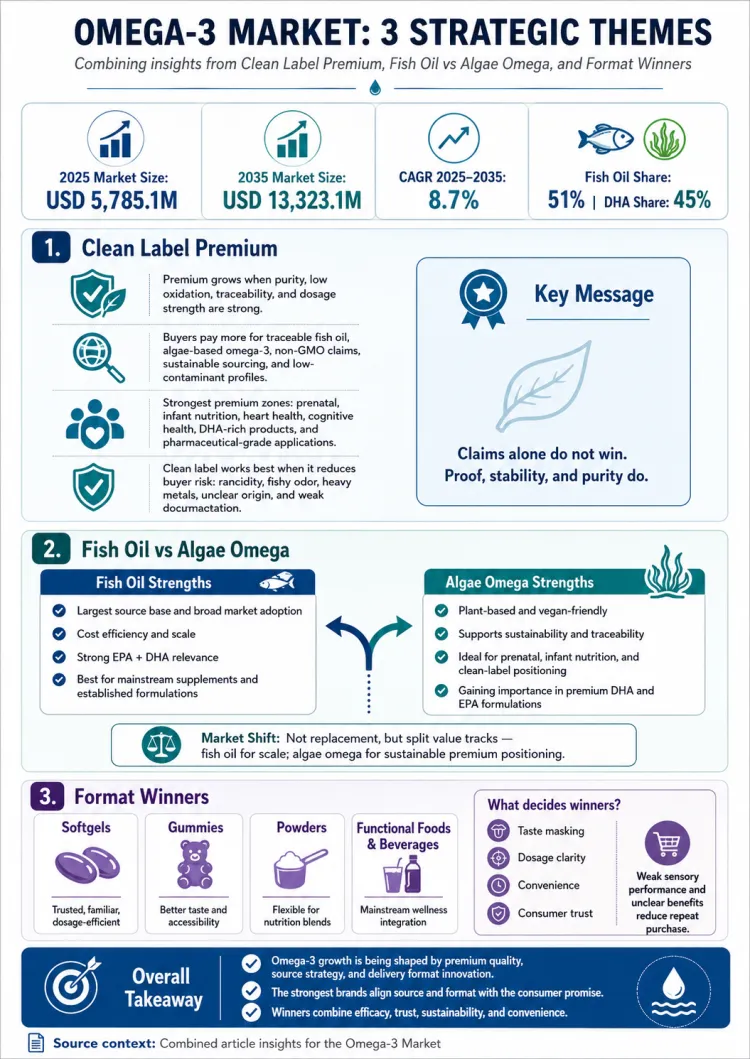
The Omega-3 Market is not experiencing a simple replacement story where algae omega removes fish oil from the market. The better reading is that the market is becoming more segmented. Fish oil continues to dominate because it has scale, established supply chains, high EPA and DHA relevance, and wide use in supplements, clinical nutrition, functional foods, and pharmaceutical applications. At the same time, algae omega is becoming more valuable because brands want plant-based, vegan, traceable, sustainable, and low-contaminant sources of DHA and EPA. According to Future Market Insights, the global omega-3 market was valued at USD 5,785.1 million in 2025 and is projected to reach USD 13,323.1 million by 2035, growing at an 8.7% CAGR. FMI also notes that fish oil accounted for 51% share of the source type segment in 2025, while DHA held 45% share of the product type segment in 2025.
Fish oil remains the anchor of the omega-3 industry because it is familiar, commercially available, and closely associated with EPA and DHA supplementation. For many supplement brands, fish oil still offers a practical balance of cost, concentration, consumer awareness, and established formulation experience. FMI’s Fish Oil Market coverage states that fish oil remains a dominant source within omega-3 ingredients, supported by demand from dietary supplements, clinical nutrition, and pharmaceutical applications. This shows that fish oil is not losing relevance. Instead, it is being pushed to improve on purity, traceability, oxidation control, sustainability documentation, and sensory performance.
The pressure on fish oil is coming from buyer expectations, not just from algae omega competition. Omega-3 buyers are now more concerned about fishy odor, heavy-metal risks, oxidation, marine sustainability, inconsistent source documentation, and label transparency. These concerns do not automatically weaken fish oil demand, but they raise the quality bar. Suppliers that can offer refined, stable, low-oxidation, traceable, and high-concentration fish oil are still well positioned. Suppliers that compete mainly on low price and weak documentation are more vulnerable because premium brands can shift toward better fish oil, omega-3 concentrates, krill oil, or algae-derived alternatives.
Algae omega is gaining strategic importance because it solves a different set of buyer problems. It can support vegan and vegetarian claims, reduce reliance on marine fish stocks, improve source transparency, and fit clean-label positioning more naturally than fish-derived oils. FMI estimates the Algae Omega Market at USD 1.04 billion in 2026, reaching USD 1.49 billion by 2036 at a 3.7% CAGR. FMI also states that dietary supplements are projected to account for 58.0% share of application demand in 2026, while algae omega demand is supported by supplement brands replacing fish oil with algae-derived DHA and EPA formulations. This makes algae omega especially important in premium supplements, prenatal nutrition, infant nutrition, DHA concentrates, and sustainable omega-3 products.
The most important point is that algae omega is not only a vegan substitute. It is also a risk-management tool for brands. A prenatal DHA brand may prefer algae omega because it avoids fish-source concerns and fits maternal nutrition messaging. A children’s supplement brand may use algae omega to reduce taste and origin concerns. A clean-label supplement brand may choose algae omega because it supports plant-based positioning and sustainability claims. A functional food company may value algae-derived DHA if it helps create a cleaner consumer story. In each case, algae omega wins when the buyer needs more than basic omega-3 content.
However, algae omega also faces limits. It is not always the lowest-cost option, and it may not replace fish oil in every high-volume application. Fish oil has scale advantages and remains deeply embedded in the supplement and nutrition supply chain. Algae omega must continue improving on concentration cost, production scale, sensory performance, and application versatility. FMI notes that algae omega adoption is expected to improve when producers reduce concentration costs while maintaining pharmaceutical-grade quality. This means algae omega’s growth depends not only on sustainability demand, but also on whether suppliers can make it commercially attractive for mainstream brands.
The fish oil versus algae omega debate is also closely connected to DHA and EPA positioning. DHA is especially important in prenatal nutrition, infant nutrition, cognitive health, eye health, and brain development claims. EPA is strongly associated with heart health, inflammation support, and prescription-grade omega-3 applications. Since FMI notes that DHA held 45% share of the omega-3 product type segment in 2025, DHA-rich positioning is already a major revenue driver in the market. Algae omega can compete strongly in DHA-led products, while fish oil and omega-3 concentrates remain highly relevant in both EPA and DHA applications.
Omega-3 Concentrates Market growth adds another layer to this competition. Brands that want higher potency, lower capsule burden, and stronger clinical positioning may choose concentrated EPA/DHA products rather than basic fish oil. FMI reports that the omega-3 concentrates market was valued at USD 2.91 billion in 2025 and is estimated to grow to USD 6.33 billion by 2036 at a 6.7% CAGR. This supports the idea that the omega-3 market is not only shifting by source. It is also shifting by strength, delivery format, purity, and health-positioning sophistication.
Krill Oil Supplements Market demand also competes in the premium omega-3 space, especially where brands want to position phospholipid-bound omega-3 and bioavailability. FMI states that the krill oil supplements market is projected to grow from USD 1.16 billion in 2026 to USD 2.78 billion by 2036 at a 9.1% CAGR. This shows that fish oil and algae omega are not the only options shaping the category. The wider omega-3 market is becoming a source-based and benefit-based competition between fish oil, algae omega, krill oil, concentrates, and prescription-grade omega-3 products.
For fish oil suppliers, the strategic requirement is clear. They need to defend their position through purity, potency, oxidation control, certification, sustainable sourcing, and technical documentation. Fish oil can remain a leading source if it becomes cleaner, more traceable, and better aligned with premium supplement and pharmaceutical-grade expectations. It cannot rely only on legacy demand. Buyers are comparing fish oil against algae omega and other premium formats more directly than before.
For algae omega suppliers, the opportunity is also clear. They need to move from niche vegan positioning into broader mainstream supplement and nutrition use. FMI’s algae omega outlook says the market is moving from niche vegan supplementation toward wider plant-based omega-3 use, with spending supported by dietary supplements, prenatal nutrition, DHA concentrates, and sustainable omega sourcing. The suppliers that can offer reliable purity, scalable production, strong DHA and EPA content, and cost improvements will be best placed to capture premium growth.
For brands, the best strategy is not to choose fish oil or algae omega based on trend language alone. The source should match the consumer promise. Fish oil is stronger when the brand needs cost efficiency, high-volume availability, established consumer recognition, and broad EPA/DHA coverage. Algae omega is stronger when the brand needs vegan claims, cleaner origin messaging, sustainability differentiation, prenatal DHA, infant nutrition, and reduced marine sourcing risk. Concentrates are stronger when the brand needs high potency and dosage efficiency. Krill oil is stronger where the brand wants a premium bioavailability story.
Overall, the omega-3 market is moving from one dominant sourcing model to a more diversified sourcing structure. Fish oil remains the volume leader, but algae omega is becoming a premium strategic source for brands that want cleaner, plant-based, sustainable, and traceable DHA and EPA. The market is not abandoning marine omega-3. It is asking marine omega-3 to become cleaner, better documented, and more sustainable while giving algae omega more room to grow in premium and clean-label applications. The winners will be suppliers that understand this split and position their omega-3 source around the buyer’s real problem: cost, potency, trust, sustainability, or formulation performance.

