


- Sports nutrition is not a single price ladder; each format has a different cost-to-serve and margin logic.
- FMI identifies protein supplements as the leading product type in the Sports Nutrition Market, while powder leads by form, confirming the category’s economic center of gravity.
- Powder wins because it offers favorable cost per serving, flexible dosing, storage efficiency, and strong protein delivery economics.
- RTD shakes, bars, gels, gummies, shots, and hybrid functional snacks can defend premiums, but only when they solve convenience, taste, portability, or occasion-specific needs.
- Ingredient economics matter because whey, plant proteins, creatine, caffeine, amino acids, electrolytes, flavors, sweeteners, packaging, and testing all influence profitability.
- The misconception to avoid is that sports nutrition premiumization is only about stronger branding. The real premium is earned when format, dose, convenience, and performance expectation align.
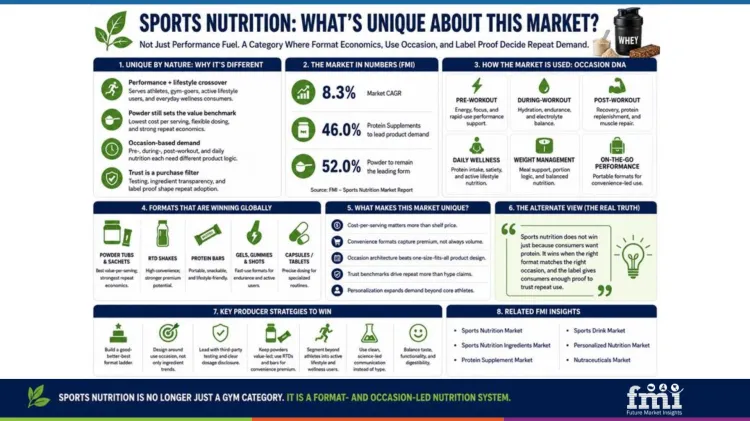
Sports nutrition is often discussed as a fast-growing consumer wellness category, but its economics are more complicated than a simple growth story. In the Sports Nutrition Market , format choice has become one of the most important commercial decisions. A brand selling powder, RTD shakes, bars, gels, gummies, capsules, or shots is not selling the same economic model in different packaging. It is operating in different cost structures, usage occasions, shelf requirements, and margin pools.
This is why a format economics angle fits sports nutrition better than a generic brand-share angle. The key question is not only which brand is visible. It is which format can protect repeat use while managing ingredient cost, packaging cost, channel margin, taste expectations, and consumer willingness to pay. A premium protein RTD and a five-pound protein tub may both sit inside sports nutrition, but they behave very differently.
FMI identifies protein supplements as the leading product type in the Sports Nutrition Market and powder as the leading form. That combination is commercially logical. Powder gives consumers a strong cost-per-serving proposition, flexible dosage, long storage life, and high active ingredient density. For serious gym users, athletes, and routine protein consumers, powder remains hard to displace because it delivers the core benefit efficiently.
The Protein Powder Market reinforces this logic. Powder formats work because they fit the economics of protein delivery. They are easy to store, relatively efficient to ship compared with RTDs, compatible with large pack sizes, and flexible across whey, casein, soy, pea, rice, and blended proteins. This makes powder the anchor format for both mass-market and performance-led sports nutrition.
However, powder dominance does not mean powder captures every premium. Powder can be economical and highly functional, but it requires consumer effort: scooping, mixing, cleaning a shaker, managing clumps, and carrying the product. This creates an opening for ready-to-drink beverages, bars, gels, and single-serve formats. These products charge for convenience, not only nutrition.
The Sports Food Market is useful here because sports nutrition increasingly overlaps with food-like formats. Bars, fortified snacks, protein cookies, gummies, hydration products, and functional beverages can reach users who may not see themselves as supplement buyers. The premium is tied to immediate usability: consume after a workout, during commuting, between meetings, or before a training session without preparation.
RTDs are a good example of the trade-off. They can command a higher price per serving because they remove preparation friction and fit impulse retail, convenience stores, gyms, offices, and post-workout occasions. But they also carry higher packaging, transport, shelf-space, and formulation costs. Protein stability, taste masking, mouthfeel, aseptic or chilled distribution, and packaging durability all matter. A poorly formulated RTD may look premium but fail on taste, aftertaste, or texture.
Bars and snacks face a different challenge. They compete not only with supplements but with confectionery, breakfast bars, meal replacements, and healthy snacks. Their economics depend on protein level, texture system, coating, flavor, sugar reduction, fiber content, shelf life, and retailer margin. A protein bar that tastes medicinal or becomes too hard over time will not retain premium pricing simply because it contains protein.
Ingredient inputs are therefore central to sports nutrition margins. The Sports Nutrition Ingredients Market identifies protein as the leading ingredient segment and dietary supplements as the leading application area. This shows why formulation economics are critical. Protein is not one cost line. Whey isolate, whey concentrate, hydrolysates, collagen, creatine, amino acids, electrolytes, plant proteins, flavors, sweeteners, and functional botanicals all carry different cost and claim implications.
Whey remains especially important. The Whey Protein Ingredients Market matters because whey functionality, digestibility perception, solubility, taste profile, and protein quality still support many premium formulations. At the same time, brands face cost pressure when dairy input prices shift or when high-protein inclusion levels increase. A product promising 25 grams of protein per serving has a different cost base from a lifestyle snack with modest protein fortification.
Plant-based protein creates another economic lane. The Plant-Based Protein Market is relevant because vegan, dairy-free, and allergen-conscious users expand the consumer base. But plant proteins can create taste, texture, solubility, and amino acid profile challenges. Brands that charge a premium for plant-based sports nutrition need to solve grittiness, off-notes, and incomplete mouthfeel rather than relying only on vegan positioning.
The pricing lesson is that sports nutrition should be evaluated by cost-in-use and cost-per-outcome, not only price per pack. A powder may look expensive at the shelf but economical per serving. An RTD may look expensive per serving but valuable because it solves immediacy. A bar may look like a snack but function as a meal bridge. A pre-workout shot may carry a high unit price because it offers a targeted stimulation occasion.
Brands that misread format economics often overextend. A powder brand may launch RTDs without understanding beverage manufacturing economics. A bar brand may add too many active claims and create taste problems. A lifestyle brand may move into performance products without credible dosing. In sports nutrition, every format expansion changes both the cost base and the trust requirement.
The misconception to avoid is that premiumization in sports nutrition comes mainly from branding. Branding opens attention, but the premium is defended by the format’s ability to solve a specific use case at an acceptable cost per serving. Powder wins when the consumer wants efficiency. RTD wins when the consumer wants readiness. Bars win when the consumer wants portability. Pre-workout products win when the consumer wants a targeted effect.
Bottom line: sports nutrition format strategy is an economic decision. The winners will be brands that understand when consumers are paying for protein density, when they are paying for convenience, and when they are paying for verified performance.

