


- Hospital procurement strategies for bone defect repair materials are moving from transactional purchasing to long-term sourcing partnerships focused on supply continuity and standardized quality.
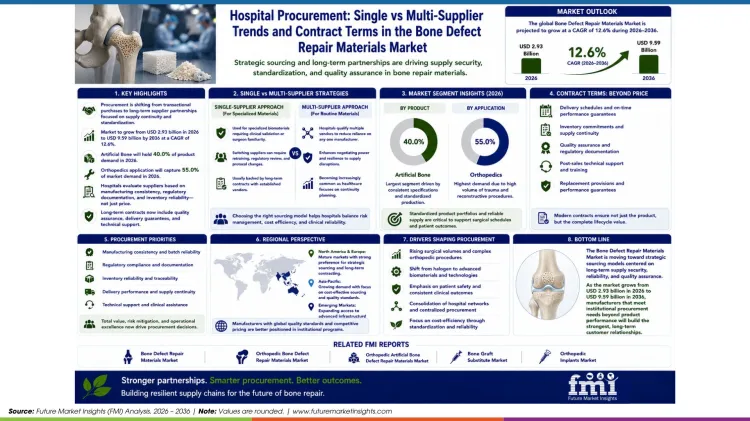
- The global Bone Defect Repair Materials Market is projected to grow from USD 2.9 billion in 2026 to USD 9.6 billion in 2036, at a CAGR of 12.6% during the forecast period (2026-2036).
- Artificial Bone is estimated to lead the material segment with a share of 40.0% of the product demand in 2026.
- In 2026, orthopedics is expected to be 55.0% of the application demand, continuing institutional purchasing activity.
- Hospitals are emphasizing not just price, but manufacturing consistency, documentation quality, inventory reliability and regulatory compliance when choosing suppliers.
- Multi-supplier procurement models are increasingly common for standard products and specialized biomaterials often are covered by long-term supplier agreements.
Procurement Is Becoming More Strategic
The hospital procurement is one of the major factors that drive the demand in the Bone Defect Repair Materials Market. Increasingly, purchasing departments are developing sourcing strategies that look to operational continuity as well as clinical performance.
The market is projected to reach USD 9.6 billion by 2036 from USD 2.9 billion in 2026, presenting additional avenues for suppliers that can ensure steady product availability for large healthcare networks, according to Future Market Insights.
Procurement teams are increasingly focused on long-term value, product consistency and supply assurance rather than just acquisition cost.
Standardized Biomaterials Support Institutional Purchasing
One major trend in procurement is the increasing call for standardized biomaterials.
Healthcare providers can tap into Artificial Bone’s consistent manufacturing specifications and scalable production capacity, which is projected to account for 40.0% of market demand in 2026. These features collectively make it easier to decide what to buy and reduce inter-surgical variability.
Standardization also makes inventory planning easier, because hospitals can stock predictable product availability across multiple departments.
Orthopedic Demand Influences Contract Structures
The orthopedic segment is expected to account for 55.0% of application demand in 2026 and will be the largest driver of institutional procurement.
Hospitals that perform large volume trauma repair and reconstructive procedures require uninterrupted access to approved repair materials. Buyers can negotiate contracts with an emphasis on reliable deliveries that take into account possible delays in supply, which may affect operating schedules and resource planning.
Therefore, the continuity of supply has become an important evaluation criterion in the selection of vendors.
Single Supplier Versus Multi-Supplier Models
Often, specialized biomaterials remain under single-supplier agreements, due to surgeon familiarity with established products and the completion of internal qualification processes by hospitals.
A change of vendor could mean further assessments, changes to the procurement approval process and changes to clinical protocols. For very specialized repair materials, long-term contracts thus remain the standard.
At the same time, many institutions are adopting multi-supplier strategies across a broader array of product categories. Multiple vendor qualification helps hospitals reduce their reliance on specific manufacturers while improving supply robustness and purchasing agility.
Contract Terms Continue to Evolve
Procurement contracts increasingly include requirements beyond the price of products.
Healthcare providers want to see commitments on delivery times, availability of inventory, quality documentation, technical support and regulatory compliance. Manufacturers who can satisfy these wider expectations often improve their competitive position during the evaluation of tenders.
As healthcare systems increase their orthopedic capacity, supplier reliability is becoming as important as product performance.
Bottom Line
Hospital procurement in the Bone Defect Repair Materials Market is transitioning to strategic sourcing models that focus on supply security, standardized quality, and reliable long-term partnerships. The market is projected to reach USD 9.6 billion by 2036 from USD 2.9 billion in 2026. Manufacturers able to supplement steady production with reliable service capabilities are likely to further establish their position in institutional purchasing programs.
Related FMI Reports
- Bone Defect Repair Materials Market
- Orthopedic Bone Defect Repair Materials Market
- Orthopedic Artificial Bone Defect Repair Materials Market
- Bone Graft Substitute Market
- Orthopedic Implants Market
- Biomaterials Market
- Regenerative Medicine Market
- Orthopedic Devices Market
- Tissue Engineering Market
- Medical Biomaterials Market

