


By Sabyasachi Ghosh
Hot and cold therapy packs sit in a practical part of consumer healthcare. They are cheap to buy, easy to store, and familiar to both clinicians and households.
That mix matters in a market where buyers want relief options they can use quickly without adding much cost or clinical complexity. Demand is now being lifted by sports participation, home recovery routines, and a larger over-the-counter wellness aisle.
Why the category is holding up so well
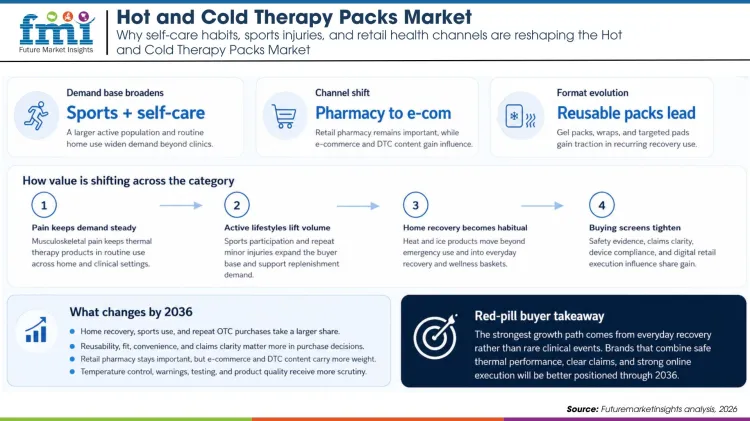
- Musculoskeletal pain remains common enough to keep basic thermal therapy products in routine demand.
- A larger active population is widening the buyer base beyond clinics and into everyday self-care.
The World Health Organization continues to describe musculoskeletal conditions as a major source of disability worldwide, with low back pain alone affecting hundreds of millions of people. That keeps simple heat and cold products relevant because they are often one of the first interventions used before patients escalate to more expensive care.
The consumer side is strengthening at the same time. SFIA participation data show a very large active base in the United States, and fast-growing activities such as pickleball bring a steady stream of strains, soreness, and repeat purchases. This is one reason the market can grow through both retail and clinical channels without depending on a single use case.
Where fresh demand is coming from
- Guideline-backed self-care continues to support repeat purchases of reusable and disposable packs.
- Home recovery routines are turning therapy packs into replenishment products instead of occasional buys.
CDC pain guidance keeps nonpharmacologic care in view, and heat or ice remains one of the most accessible tools for acute discomfort. That matters commercially because it supports sell-through in pharmacies, general merchandise, and e-commerce without requiring a specialist sales pitch.
The product mix is also improving. Reusable gel packs, wraps, and targeted pads fit better into recurring use, especially for households that manage minor injuries at home. As a result, the category is moving away from one-off emergency purchases and toward more deliberate basket-building across sports, wellness, and recovery.
| Market dimension | 2015-2025 | 2026-2036 |
|---|---|---|
| Primary demand base | Clinical use and basic home first-aid purchases dominated. | Home recovery, sports use, and repeat OTC purchases take a larger share. |
| Buyer priority | Low cost and broad availability mattered most. | Reusability, fit, convenience, and claims clarity matter more. |
| Channel mix | Retail pharmacy remained the obvious route to market. | Retail pharmacy stays important, but e-commerce and DTC content carry more weight. |
| Compliance focus | Basic safety and packaging requirements were usually enough. | Temperature control, warnings, and product testing receive more scrutiny. |
| Product format | Standard hot packs and cold packs led the market. | Reusable gel systems, wraps, and targeted pads gain share. |
What buyers should screen more carefully
- Regulatory classification and product safety evidence can no longer be treated as back-office details.
- Digital retail execution now affects volume almost as much as shelf presence does.
FDA device categories for cold packs and disposable hot or cold packs make compliance a concrete buying issue, not just a labeling exercise. Buyers should check device listings, material integrity, leak performance, and any evidence around surface temperature or activation consistency before treating suppliers as interchangeable.
Channel economics have changed too. E-commerce continues to outpace overall retail growth, which means product pages, claims support, and fulfillment reliability directly influence sales. Brands that look strong on a shelf but weak online will give up share in a category where shoppers increasingly compare options before they buy.
What could shift next
- Retailers are likely to apply stricter quality screens to products with burn, leak, or activation risk.
- The most durable growth path still comes from everyday recovery rather than rare clinical events.
Consumer product recalls in adjacent heating categories have already made merchants more cautious about thermal products. That should push suppliers to document heat retention curves, maximum surface temperatures, packaging warnings, and durability with more discipline than before.
The broad demand story remains favorable. High physical activity levels, simple pain-management guidance, and the convenience of at-home use give the category a stable base through 2036. For deeper segment sizing and regional outlooks, see the Future Market Insights report: Hot and Cold Therapy Packs Market (2026 - 2036) - https://www.futuremarketinsights.com/reports/hot-and-cold-therapy-packs-market
Bibliography
- WHO musculoskeletal conditions factsheet: https://www.who.int/news-room/fact-sheets/detail/musculoskeletal-conditions
- CDC Clinical Practice Guideline for Prescribing Opioids for Pain - United States, 2022: https://www.cdc.gov/mmwr/volumes/71/rr/rr7103a1.htm
- NICE NG226 Osteoarthritis in over 16s: diagnosis and management: https://www.nice.org.uk/guidance/ng226
- SFIA 2024 Topline Participation Report: https://sfia.org/resources/sfias-topline-participation-report-shows-247-1-million-americans-were-active-in-2024/
- SFIA 2026 Topline Participation Report: https://sfia.org/resources/participation-hits-new-high-but-majority-of-americans-not-yet-meeting-recommended-guidelines-of-150-minutes-of-weekly-activity-sfias-2026-topline-report-finds/
- FDA 21 CFR 890.5700 Cold pack (LII): https://www.law.cornell.edu/cfr/text/21/890.5700
- FDA 21 CFR 890.5710 Hot or cold disposable pack (510(k) reference): https://www.accessdata.fda.gov/cdrh_docs/pdf15/K151845.pdf
- CPSC recall notice, electric heating blankets and pads: https://www.cpsc.gov/Recalls/2023/Bedshe-International-Recalls-Bedsure-Electric-Heating-Blankets-and-Pads-Due-to-Fire-and-Thermal-Burn-Hazards-Recall-Alert
- US Census Bureau, Q4 2024 e-commerce sales: https://www2.census.gov/historical/ecomm/24q4.pdf

