


By Ismail Sutaria
Tray sealers have become more important because packaging is now treated as part of device performance, not just a finishing step. A weak seal can turn into a sterility failure, a recall event, or an audit problem.
That shift is raising the bar for equipment buyers. Medical device manufacturers and contract packagers now need sealing systems that support validation, traceability, and tighter process control while still handling commercial throughput.
Why compliance is moving to the center of the market
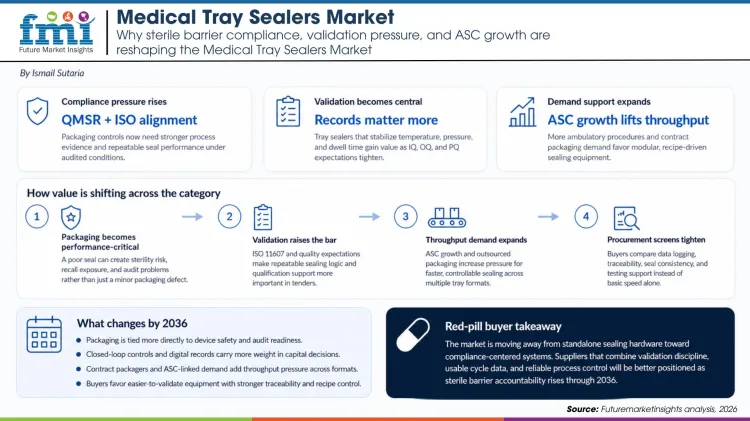
- US quality regulation is moving closer to ISO-based practice, which increases pressure on packaging controls.
- European expectations around sterile barrier performance are reinforcing the same direction of travel.
FDA's final Quality Management System Regulation and its incorporation of ISO 13485 principles push packaging teams toward more disciplined process evidence. That matters directly for tray sealing because buyers need equipment that can support traceable, repeatable sealing under audited conditions.
Europe is reinforcing the same message through EN ISO 11607 alignment and MDR expectations. In practice, this means notified bodies and quality teams will expect stronger evidence that sealing processes are validated and linked to sterile barrier performance rather than treated as routine production steps.
Where demand is getting practical support
- Standards now link packaging performance more tightly to overall device safety and release quality.
- More procedures moving into ambulatory settings are lifting demand for sterile kits and packaged device throughput.
ISO 11607 has effectively made process validation a commercial requirement for credible suppliers. That favors tray sealers that can hold temperature, pressure, and dwell time within tight windows while also producing the records needed for IQ, OQ, and PQ work.
Clinical site-of-care change gives the market another tailwind. As ambulatory surgery centers handle more procedures, OEMs and contract packagers need reliable sealing at higher throughput and across more kit formats. This creates room for modular lines and recipe-driven equipment rather than basic standalone machines alone.
| Market dimension | 2015-2025 | 2026-2036 |
|---|---|---|
| Packaging role | Often treated as a downstream production function. | More clearly tied to device safety and audit readiness. |
| Validation burden | Manual documentation and fragmented controls were more common. | Closed-loop controls and digital records become more valuable. |
| End-market pull | Hospital-focused device packaging drove most decisions. | ASC growth and contract packaging expansion add throughput pressure. |
| Risk focus | Seal defects were important but not always front-of-mind in capital planning. | Recall exposure and traceability make seal integrity a board-level issue. |
| Preferred equipment profile | Basic sealing capability could still win some tenders. | Buyers favor controllable, logged, and easier-to-validate systems. |
What buyers need to verify in tenders
- Packaging failures can still create outsized commercial damage relative to the cost of the sealer itself.
- Test method support matters because validation is inseparable from the equipment decision.
Recall examples tied to seal strength and sterility show why the equipment decision cannot be separated from downstream risk. A lower-cost machine can become expensive very quickly if it introduces process drift, weak seals, or poor documentation.
ASTM methods such as F88, F1929, and F2096 make the validation burden tangible. Buyers should check whether the sealer stabilizes core parameters, exports usable cycle data, and supports the specific testing logic the quality team expects to run during qualification and routine monitoring.
What the next decade is likely to reward
- QMSR timing and audit pressure should keep capex focused on digitally traceable sealing systems.
- Contract packagers that can prove validation discipline are likely to capture more outsourced work.
As quality systems migrate toward tighter ISO-style expectations, equipment that supports recipe management, barcode-driven setup, and reliable e-records will look safer to buyers than machines that rely on operator habit. This is especially true where tray formats change often or compliance teams are already stretched.
European and US evidence expectations point in the same direction: fewer shortcuts, more process proof, and stronger packaging accountability. For broader market sizing and the 2026-2036 outlook, see the Future Market Insights report: Medical Tray Sealers Market (2026 - 2036) - https://www.futuremarketinsights.com/reports/medical-tray-sealers-market
Bibliography
- FDA QMSR final rule overview and effective date: https://www.fda.gov/medical-devices/quality-system-qs-regulationmedical-device-good-manufacturing-practices/proposed-rule-quality-system-regulation-amendments-frequently-asked-questions
- Hogan Lovells summary of QMSR timing and scope: https://www.hoganlovells.com/en/publications/us-device-makers-get-2-years-to-comply-with-fda-quality-management-system-regulations-final-rule
- ISO 11607-1:2019 standard page: https://www.iso.org/standard/70799.html
- ISO 11607-2 process validation text (public mirror excerpt): https://www.packagingconnections.com/v3/sites/default/files/ISO-11607-2-2019.pdf
- Sterile Barrier Association on EN ISO 11607-1:2020/A1:2023 and MDR alignment: https://sterilebarrier.org/for-manufacturers/regulatory-overview/standards/
- CMS CY 2024 OPPS/ASC fact sheet: https://www.cms.gov/newsroom/fact-sheets/cy-2024-medicare-hospital-outpatient-prospective-payment-system-and-ambulatory-surgical-center-0
- ADVI summary noting additions to the ASC Covered Procedures List: https://advi.com/insight/advi-instant-cms-releases-hospital-outpatient-prospective-payment-system-final-rule-for-2024/
- Packaging World on medical contract packaging market growth: https://www.packworld.com/leaders-new/business-drivers-specialty/contract-packaging/article/22938450/medical-contract-packaging-to-soar-by-2032
- California HHS recall note citing low seal strength risk to sterility: https://www.cdph.ca.gov/Programs/CEH/DFDCS/CDPH%20Document%20Library/FDB/DeviceandDrugSafetyProgram/CovidienAbsorbatackRecall.pdf
- FDA recall and early alerts landing page: https://www.fda.gov/medical-devices/medical-device-safety/medical-device-recalls-and-early-alerts
- ASTM F88 overview, LSO: https://lso-inc.com/medical-package-testing/standards/astm-f-standards/astm-f88/
- ASTM F1929 overview, NAMSA: https://namsa.com/services/testing/tests/package-seal-dye-penetration/
- ASTM F2096 overview, LSO: https://lso-inc.com/standards/astm-standards/astm-f2096/

