

- Industry Size (2026)
- USD 1.03 Bn
- Forecast (2036)
- USD 1.78 Bn
- CAGR (2026 to 2036)
- 5.60%
Molded Pulp Inserts Market Size, Market Forecast and Outlook By FMI
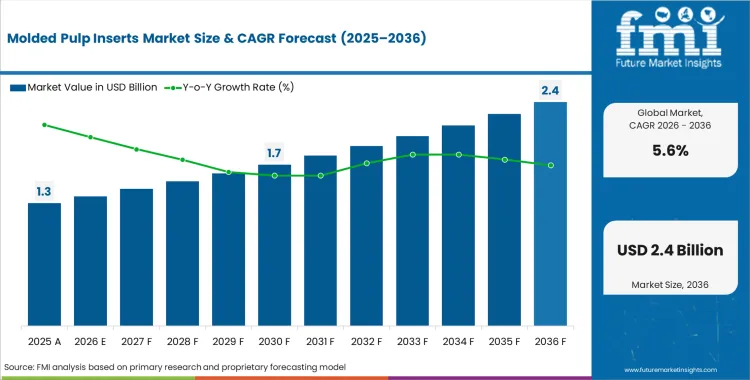
The global valuation for this sector reached USD 0.98 billion in 2025. The industry is projected to reach USD 1.03 billion in 2026 and advance to USD 1.78 billion by 2036. The molded pulp inserts sector is expected to register a 5.60% CAGR through the forecast period. Rising investment in fiber-based cushioning is widening the opportunity as global electronics brands move toward plastic-free drop-test compliant outbound packaging.
Summary of Molded Pulp Inserts Market
- Molded Pulp Inserts Market Snapshot
- The Molded Pulp Inserts Market was valued at USD 0.75 billion in 2025.
- The Molded Pulp Inserts Market is projected to reach USD 1.62 billion by 2036.
- The market is expected to expand at a 7.2% CAGR from 2026 to 2036.
- Incremental opportunity across the assessment period is estimated at USD 0.81 billion.
- Molded Pulp Inserts Market Demand and Growth Drivers
- The market covers custom-fit molded paper-fiber components used to replace foam, plastic trays, and less precise folded corrugate in transit and presentation packaging.
- The EU’s Packaging and Packaging Waste Regulation, which entered into force in February 2025, is accelerating interest in recyclable protective packaging formats.
- Recovered-fiber availability supports category expansion, with paper and cardboard accounting for 40.4% of EU packaging waste in 2023.
- Premium molded-fiber formats are seeing wider use in beauty, personal care, and pharma because improved surface finish and shape precision make them more commercially viable.
- Product and Segment View
- The inserts segment is expected to account for 41.0% share in 2026, reflecting the market’s concentration in custom-fit protective packaging.
- Transfer molded is projected to secure 52.0% share in 2026 because it balances production familiarity with volume economics.
- Supported by circular-material preference and broad recovered-paper availability, recycled pulp is estimated to represent 78.0% of market share in 2026.
- Electronics, because of the need for geometry-controlled protection for fragile devices and accessories, is anticipated to capture 31.0% share in 2026.
- OEM supply is expected to contribute 63.0% of total market share in 2026, as molded pulp inserts are typically specified into packaging programs during product development.
- The product scope also includes trays, end caps, and corner supports made from recycled pulp, virgin pulp, bagasse, and bamboo for protective and presentation applications.
- Geography and Competitive Outlook
- India is anticipated to record the fastest country-level expansion at 8.9% CAGR, followed by China at 8.3% and Germany at 7.6%.
- The market remains fragmented, with Huhtamaki, Hartmann Packaging, PAPACKS, MM Group, EnviroPAK, Henry Molded Products, and Nissha among the active participants.
Molded Pulp Inserts Market Key Takeaways
| Metric | Details |
|---|---|
| Market Size (2026) | USD 0.81 billion |
| Market Forecast (2036) | USD 1.62 billion |
| CAGR (2026 to 2036) | 7.2% |
Source: Future Market Insights (FMI) analysis, based on proprietary forecasting model and primary research
Procurement directors are under rising pressure to phase out expanded polystyrene (EPS) before regional packaging waste taxes begin to erode margins. Delays in shifting to molded fiber inserts can expose manufacturers to layered cost pressure across high-volume retail markets. Many sustainability reports also overlook the technical work involved in the molded pulp insert design process needed to deliver foam-like protective performance. Advanced geometric nesting now allows single-piece molded pulp packaging formats to replace multi-part synthetic assemblies while improving logistics density.
Once contract packagers validate a recycled slurry formulation against vibration tolerances, competing protective formats lose much of their commercial advantage. Qualification protocols are moving beyond basic compression testing and placing greater weight on shock absorption under changing humidity conditions. Operations managers also report faster line performance when automated systems no longer have to manage static-charged synthetic fragments. These operating gains are one reason the industry outlook for molded pulp inserts remains on a positive trend as brands simplify fulfillment and align packaging programs with 2030 circularity targets.
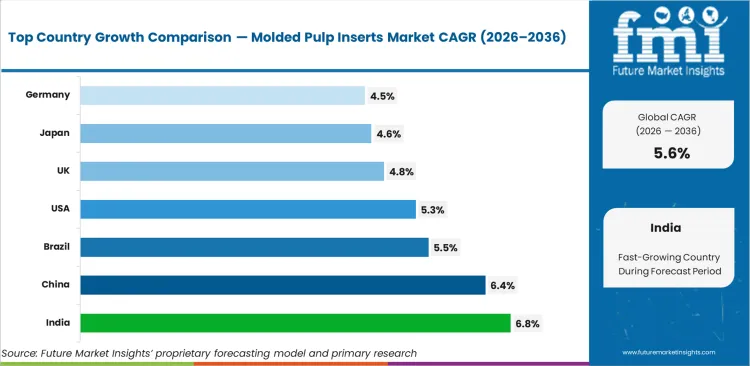
India is expected to record the fastest expansion at 6.8% CAGR in 2026, supported by localized smartphone assembly that is lifting domestic sourcing of protective components. China follows at 6.4%, with export manufacturers facing tighter compliance requirements across overseas markets. Brazil is anticipated to advance at 5.5% as appliance production continues shifting across regional manufacturing hubs. The United States is likely to expand at 5.3%, shaped by retailer-led environmental scorecards that are tightening packaging expectations across supply chains. Germany is projected to rise at 4.5%, while the United Kingdom is set to register 4.8%, reflecting the effect of stricter packaging waste rules. Japan is expected to post 4.6%, supported by the gradual shift toward premium electronics packaging in the same period. The global industry outlook will depend heavily on how quickly regional recycling networks can supply feedstock with consistent quality.
Segmental Analysis
Molded Pulp Inserts Market Analysis by Product type
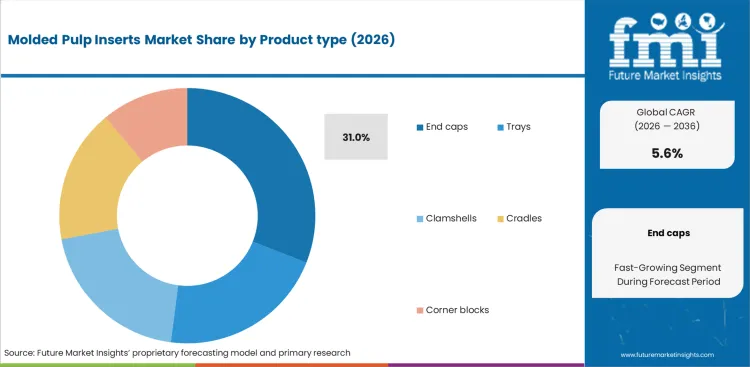
Legacy expanded polystyrene components are losing relevance as circular economy mandates push appliance manufacturers into faster redesign cycles. The end caps segment is expected to account for 31.0% share in 2026 because heavy rectangular chassis products require high corner compression during storage and transit. Packaging engineers are focusing on kinetic energy dispersion through ribbed geometries instead of relying on simple mass replacement. Material data sheets rarely show another operational advantage: draft angles required for tool extraction can also improve stacking density in inbound logistics. Warehousing teams recover meaningful space efficiency when non-nesting foam blocks are replaced with highly nestable molded pulp end caps. Poor draft-angle decisions at the tooling stage can later push freight costs higher by forcing buyers to ship unnecessary air across molded fiber packaging supply chains.
- Initial geometry validation: Packaging engineers are giving greater weight to finite element analysis before physical prototyping to shorten custom tool development timelines. Delays at the digital-validation stage can push product launch schedules outward.
- Vibration resonance clearance: Qualification protocols require confirmation that fiber ribbing frequencies do not align with the resonance profile of internal electronic components. Missing that overlap can lead to internal device damage even when the outer carton remains intact.
- Tooling lifecycle renewal: Sourcing teams need to lock mesh-maintenance schedules into original master agreements. Worn vacuum mesh can reduce wall-thickness consistency and raise transit-risk exposure on mature product lines.
Molded Pulp Inserts Market Analysis by Pulp type
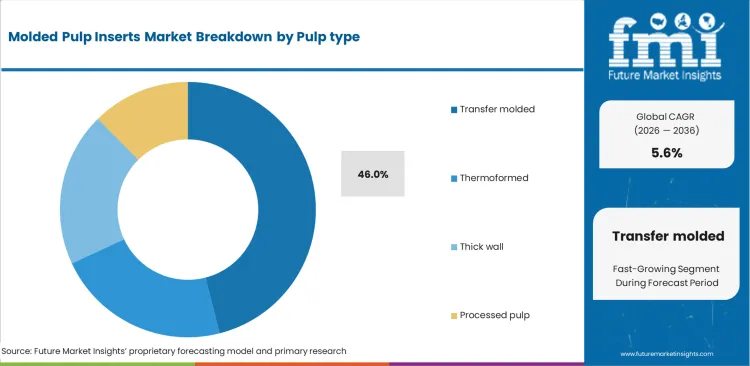
Transfer molded pulp inserts balance the wall thickness needed for protective performance with commercially workable cycle times in concealed packaging applications. The category is expected to account for 46.0% share in 2026, supported by heated transfer molds that deliver consistent dimensional tolerances without the higher energy burden associated with more refined formats. Mid-tier industrial equipment manufacturers often specify this grade because surface finish carries little importance when the component is used for internal carton cushioning. Generalist buyers also tend to over-specify thermoformed pulp inserts for basic shock-absorption tasks, even though smoother surfaces add little value for buried transit components. Buyers that align molded fiber end caps requirements more closely with transfer-grade performance can remove avoidable thermal-processing costs.
- Drying energy optimization: Transfer processing removes most moisture through conventional oven tunnels rather than heated tooling. Plant operators use that separation to raise output more efficiently at scale.
- Moisture content variability: Post-oven shrinkage requires close control over ambient humidity before final packing. Quality teams reject warped parts when factory conditions shift too sharply.
- Total lifecycle footprint: Life cycle models often favor transfer techniques for heavy transit parts because kilowatt-hour use per kilogram is lower than in thermoforming. Environmental teams use these results to strengthen packaging scorecards.
Molded Pulp Inserts Market Analysis by Source
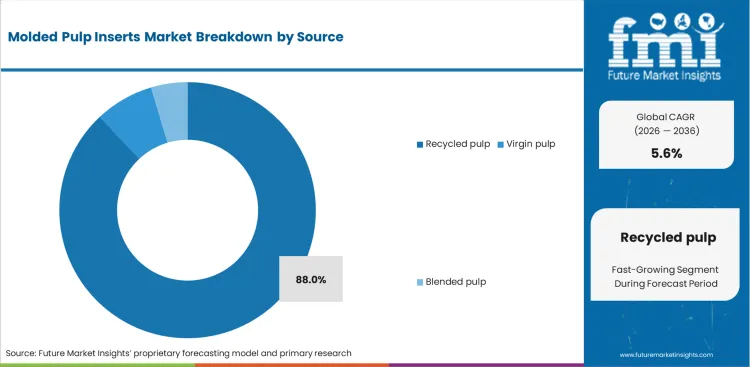
Procurement managers are working under tighter cost controls, which is increasing reliance on post-consumer recovered fiber streams. Recycled pulp is expected to account for 88.0% share in 2026 because secondary transit protection does not require food-contact certification. Large brand owners also use localized old corrugated container collection to reduce exposure to swings in virgin timber pricing. Virgin-fiber specifications remain concentrated in narrower medical-device applications where particulate control standards are stricter. Environmental reporting often misses a key technical issue: repeated recycling shortens fiber length and can gradually weaken drop-test performance. Suppliers that do not blend enough long-fiber input into recycled slurries risk producing packaging inserts that fracture under impact and raise the likelihood of concealed transit damage.
- Fiber length degradation: Repeated municipal recycling shortens cellulose fibers and reduces inherent tear strength. Quality engineers need to monitor batch variation closely to avoid brittle failures during winter shipping periods.
- Contaminant visual masking: Post-consumer feedstock often carries trace ink residue that can create dark spotting on finished parts. Brand teams need to waive strict appearance-uniformity requirements when the material is used for internal transit applications.
- Supply stream localization: Locally sourced recycled feedstock helps manufacturers reduce exposure to swings in international container freight rates. Buyers that tie contracts to municipal recovery-facility output can secure more predictable long-term pricing.
Molded Pulp Inserts Market Analysis by End use
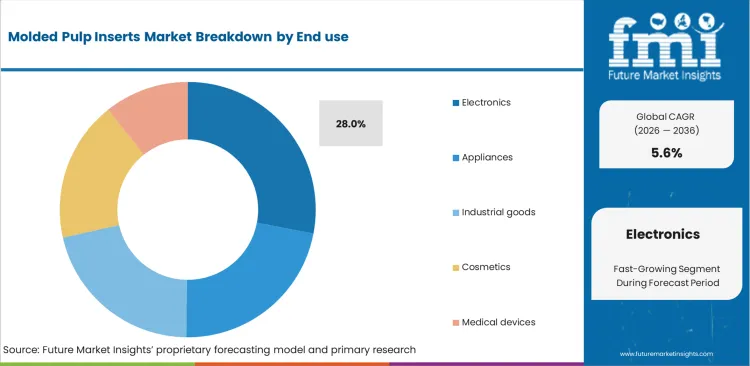
Consumer device companies face the greatest exposure to packaging-waste taxation because high unit volumes move across multiple regulatory jurisdictions. Molded pulp inserts for electronics are expected to account for 28.0% share in 2026 as device manufacturers move toward plastic-free transit protection that can work across global markets. Hardware teams are also integrating cushioning geometry earlier in product design instead of treating protective packaging as a late-stage addition. Ongoing miniaturization is increasing reliance on molded pulp cradles because denser devices concentrate more impact energy and require tighter suspension control. Cosmetic abrasion remains a practical risk in premium electronics. Hard fiber surfaces can mark glossy housings during transport vibration unless molded fiber containers are designed with non-abrasive liners.
- Static discharge mitigation: Untreated pulp helps prevent static buildup and reduces the need for dedicated anti-static foam in many tray applications. Assembly teams can handle bare electronic boards more safely within custom fiber formats.
- Miniaturization density risk: Higher device density requires crush ribs engineered to deform in a controlled way under impact. Design teams need to define specific energy-absorption zones to avoid chassis warping.
- Drop-test qualification standards: Final acceptance for global retail distribution depends heavily on passing ISTA 3A protocols. Logistics teams often delay launch schedules until fiber architectures clear multi-axis drop testing.
Molded Pulp Inserts Market Analysis by Sales channel
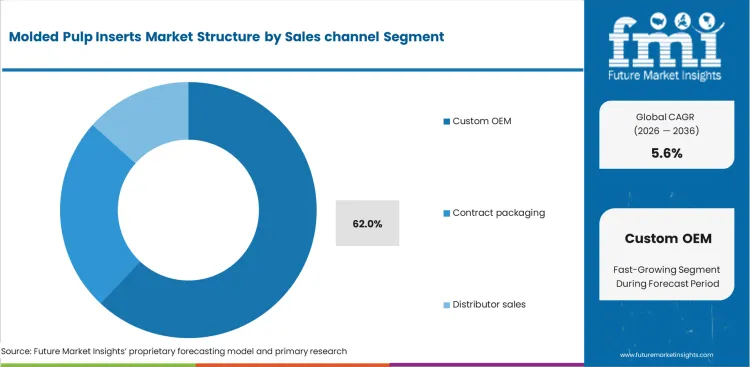
Cost pressure and tooling intensity sit at the center of OEM sourcing decisions. Custom OEM is expected to account for 62.0% share in 2026 because standard shock-absorption profiles are rarely sufficient for irregular device geometries. Dedicated vacuum-forming mesh has to match appliance contours closely to prevent internal movement during transit. Buyers also view tooling investment as a way to secure supply continuity and tighter design control. Distributors are rarely willing to carry complex asymmetrical molded fiber pulp cap geometries without committed volume. Tooling ownership terms often shape bargaining power during contract renewal, and buyers that leave mesh-design intellectual property with suppliers can face weaker flexibility when they need to shift production during peak season.
- Tooling capital amortization: Suppliers often roll upfront mesh-fabrication costs into piece-price calculations over long contract periods. Sourcing teams need clear separation between tooling charges and recurring unit pricing.
- Production capacity allocation: Dedicated custom lines can face acute bottlenecks during fourth-quarter consumer electronics peaks. Supply chain teams need to secure machine-hour commitments well before seasonal production begins.
- Vendor intellectual property: Ownership of digital 3D design files determines future sourcing flexibility. Legal teams need explicit design-ownership terms to support rapid dual-sourcing when a primary facility is disrupted.
Molded Pulp Inserts Market Drivers, Restraints, and Opportunities
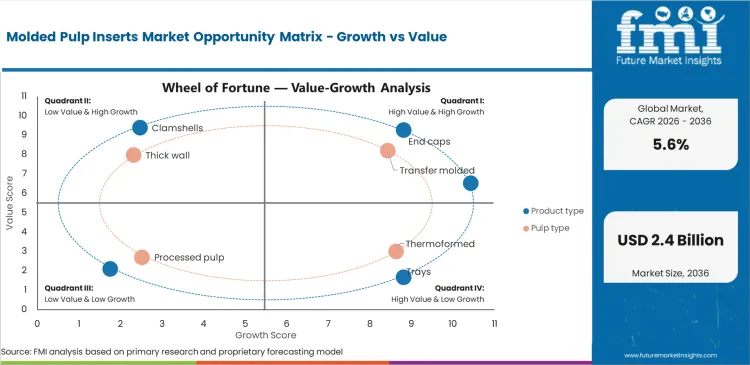
Regional packaging rules are pushing compliance officers at major appliance brands toward faster material substitution. Tax frameworks in regulated markets are raising the cost of synthetic foam to a point where earlier cost-parity arguments are losing relevance. Supply chain teams are being forced to replace legacy multi-part foam assemblies with single-piece repulpable alternatives before fee exposure begins to affect program economics. Delays in qualification can narrow margins across high-volume product lines moving through tightly regulated retail networks in Europe and North America.
Moisture sensitivity remains a practical limitation across maritime shipping routes. Packaging engineers face difficulty maintaining crush resistance when fiber parts absorb ambient humidity during long ocean transit cycles. That exposure often leaves brands choosing between thicker wall designs and added desiccant use, which can dilute the intended cost advantage. Suppliers that can commercialize fluorine-free hydrophobic surface treatments will be better placed to support dense industrial goods moving through tropical shipping corridors.
Opportunities in the Molded Pulp Inserts Market
- Hydrophobic barrier integration: Chemical engineers that reduce moisture absorption without weakening are molded pulp inserts recyclable performance can unlock faster adoption across heavy industrial export sectors.
- Automated robotic handling: Facility managers integrating paper cushion systems with vision-based robotic pick-and-place lines can accelerate contract-packing throughput.
- Finite element analysis software: Developers building simulation tools that account for varying fiber lengths can shorten physical prototyping cycles from weeks to days.
Regional Analysis
Based on regional analysis, the global sector is segmented into Asia Pacific, Americas, and Europe across 40 plus countries.
.webp "Top Country Growth Comparison Molded Pulp Inserts Market Cagr (2026 2036)")
| Country | CAGR (2026 to 2036) |
|---|---|
| India | 6.8% |
| China | 6.4% |
| Brazil | 5.5% |
| United States | 5.3% |
| Germany | 4.5% |
| United Kingdom | 4.8% |
| Japan | 4.6% |
Source: Future Market Insights (FMI) analysis, based on proprietary forecasting model and primary research
Asia Pacific Molded Pulp Inserts Market Analysis
Asia Pacific is seeing faster adoption as smartphone and appliance assembly becomes more localized across major manufacturing hubs. Regional operations teams are under pressure to source protective components closer to production sites because bulky transit packaging is costly to import and inefficient to store. Vendor selection is increasingly shaped by domestic tooling capability and engineering support rather than raw material access alone. Capacity figures only tell part of the story. Buyers now expect local suppliers to refine part geometry, reduce material use, and improve packaging efficiency at the design stage.
- India: In India, the molded pulp inserts industry is expected to expand at a 6.8% CAGR through 2036, supported by rapid localization of mobile-device assembly under domestic incentive schemes. Tier-1 manufacturers are giving preference to nearby insert suppliers so they can avoid unnecessary cross-border freight on bulky protective parts. Fiber cradles are also being integrated into faster robotic packing lines, which helps reduce manual handling errors and improves repeatability. Much of the long-term advantage will come from building vacuum-forming capacity close to major electronics corridors. Vendors that can pair tooling speed with reliable production support are likely to gain ground.
- China: Export-oriented manufacturers in China are reshaping packaging specifications as plastic-free requirements from Western retail customers become harder to ignore. That is one reason the molded pulp inserts market in China is projected to rise at a 6.4% CAGR over the forecast period. Assembly operators are modifying existing lines for single-piece fiber insertion, particularly in electronics and appliance shipments. Static-free insert formats also help improve handling performance while supporting compliance across international markets. Suppliers still need to prove performance under varying humidity conditions, especially for long maritime routes. Those that clear this hurdle are in a better position to win higher-volume logistics packaging contracts.
- Japan: Premium electronics brands in Japan continue to set a high bar for fit, finish, and protective accuracy, which is keeping technical requirements elevated across the category. Engineering teams working on plastic-free packaging for accessories and sensitive components are looking for fiber formats that balance presentation with impact control. Virgin-blend slurries remain relevant where particulate control is tightly managed, particularly around optical and precision electronic products. Material reduction is also becoming more important, but not at the expense of cushioning precision. The molded pulp inserts sector in Japan is anticipated to register a 4.6% CAGR through 2036, reflecting a market where performance and pack presentation are judged together rather than separately.
FMI’s report also covers China, India, Japan, South Korea, Australia, and ASEAN countries beyond the markets discussed above. Regional industry direction is being shaped by electronics assembly shifts, tooling readiness, and the need to source protective packaging closer to manufacturing clusters.
North America and Latin America Molded Pulp Inserts Market Analysis
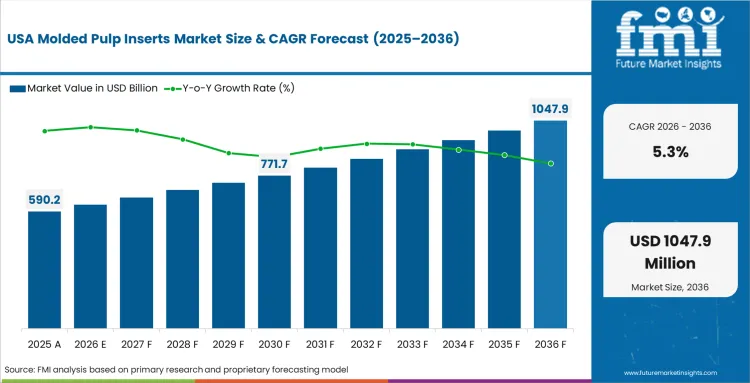
North America and Latin America are seeing wider use of molded pulp inserts as retailer scorecards, recycled-fiber economics, and freight efficiency reshape packaging decisions. Consumer goods companies across both regions are revising protective-packaging formats to reduce synthetic material use and cut transport inefficiencies tied to bulky cushioning. Recovered-paper availability is also influencing where new plants are built, since converters need a stable input stream to manage production economics with less volatility. New capacity is moving closer to recycling infrastructure and major freight corridors rather than to the lowest-cost labor locations. That matters most in logistics packaging, where distance between the converter and the final packer can materially change delivered cost.
- Brazil: Brazil is expected to see molded pulp inserts rise at a 5.5% CAGR through 2036 as white-goods production continues shifting closer to large urban consumption zones. Localized sourcing agreements are helping manufacturers reduce exposure to freight volatility tied to bulky cushioning materials. Replacing expanded polystyrene also makes warehouse handling easier across broad and uneven distribution networks. Nestable fiber end caps are improving storage efficiency and helping logistics teams move appliance volumes more smoothly through regional hubs. In Brazil, the commercial case is tied as much to transport practicality as to material substitution.
- United States: Retail compliance standards are forcing electronics and consumer-goods companies in the United States to move away from synthetic foam in palletized and parcel-based shipments. That shift is expected to support a 5.3% CAGR for the molded pulp inserts market in the country through 2036. Nestable fiber alternatives improve truckload utilization and reduce the amount of space spent moving low-density protective material. Engineering teams are also giving closer attention to shock-absorption performance as they try to lower return rates linked to transit damage. Retail penalties on non-recyclable packaging are adding urgency, but freight efficiency remains one of the clearest operational benefits. That makes logistics packaging a major adoption channel in the United States.
FMI’s report further assesses the United States, Canada, Mexico, and Brazil, along with other regional markets. Industry movement across this geography reflects nearshoring activity, recycled-fiber availability, and the delivered-cost impact of moving bulky protective formats over long freight distances.
Europe Molded Pulp Inserts Market Analysis
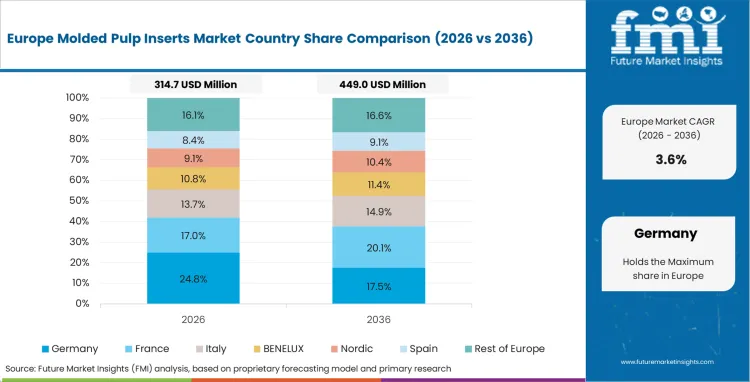
Europe remains regulation-led, with packaging waste rules functioning as enforceable commercial constraints across major markets. Compliance teams have limited room to approve expanded polystyrene in new consumer product programs. Circular-economy rules are also favoring mono-material fiber formats over composite protective solutions that are harder to process in recovery systems. Regional growth is being shaped not only by regulation but also by competition for high-quality recovered corrugated feedstock. Producers of transit-protection formats need stable sourcing agreements as e-commerce box demand competes for the same recycled fiber stream.
- Germany: Germany is expected to post a 4.5% CAGR in the molded pulp inserts market through 2036, with national packaging laws continuing to discourage the use of non-recyclable transit materials. Brand owners are moving toward mono-material moulded fibre pulp packaging to reduce regulatory exposure and simplify packaging compliance. Feedstock quality is becoming just as important as regulation, because insert manufacturers compete directly with corrugated producers for recycled corrugated supply. Buyers are therefore looking beyond price and assessing whether suppliers can secure dependable raw material volumes over time. In Germany, compliance and procurement discipline tend to move together.
- United Kingdom: High e-commerce penetration in grocery and retail channels is giving molded fiber formats a broader role across fulfillment operations in the United Kingdom. Fulfillment centers are standardizing trays and insert formats to reduce hidden breakage during last-mile handling, especially for fragile consumer products. The molded pulp inserts market in the United Kingdom is forecast to advance at a 4.8% CAGR through 2036, supported by this shift toward tighter packaging control across high-volume distribution networks. Drop-test validation is also receiving more attention as operators try to maintain pack quality while removing plastic-based formats from the mix. Well-designed fiber geometries can improve product restraint in selected glass and premium retail applications, making fulfillment efficiency and packaging compliance closely linked in this market.
FMI’s report also evaluates Germany, the United Kingdom, France, Italy, Spain, and the Nordic countries in addition to the countries highlighted above. Regional packaging decisions continue to depend on compliance requirements, feedstock access, and efforts to simplify protective formats for easier recovery and reuse.
Competitive Aligners for Market Players
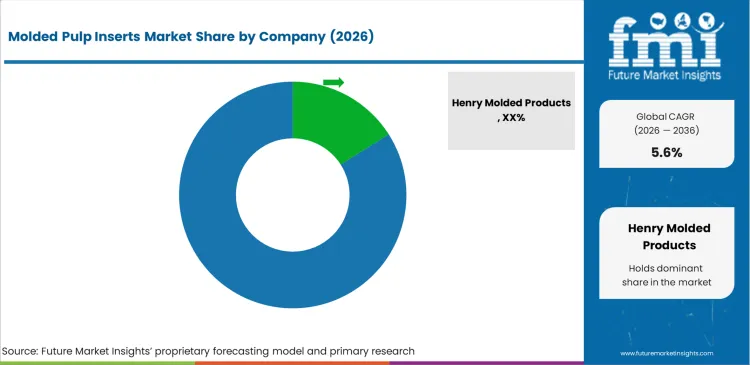
Regional proximity to contract manufacturing clusters often matters more than nominal global output. Henry Molded Products, EnviroPAK, and Keiding, Inc. benefit from placing molding operations close to automotive and appliance assembly plants, where freight distance directly affects delivered cost. Empty molded fiber parts are expensive to move relative to their value density, so long-haul shipping quickly weakens program economics. Buyers therefore put more weight on nearby engineering support and shorter tool-adjustment cycles than on headline production scale.
Established suppliers also benefit from years of accumulated test data tied to specific pack formats. Hartmann Packaging and Huhtamaki have broader reference libraries covering drop performance, wall behavior, and geometry-response patterns across many product types. New entrants can install vacuum-forming equipment without much difficulty, but equipment alone does not close the gap in application knowledge. The harder capability to replicate is knowing how a given insert design will behave under real transit conditions before the first commercial run begins. That knowledge still separates engineered cushioning suppliers from general paper converters entering the category.
Large electronics brands are limiting supplier control by tightening ownership terms around design files. Procurement teams increasingly require CAD and mesh-design rights to remain with the buyer rather than the converter. That gives brands the option to shift high-volume programs across regional suppliers without rebuilding the full design package from scratch. As a result, competitive advantage is moving toward firms that combine fast engineering response with dependable local fiber supply. Scale still matters, but it is no longer the deciding factor in many sourcing decisions.
Key Players in Molded Pulp Inserts Market
- Henry Molded Products
- EnviroPAK
- Keiding, Inc.
- PulpWorks
- Hartmann Packaging
- Huhtamaki
- Nippon Molding Co., Ltd.
Scope of the Report
| Metric | Value |
|---|---|
| Quantitative Units | USD 0.81 billion to USD 1.62 billion, at a CAGR of 7.2% |
| Molded pulp inserts market Definition | Custom-engineered fiber geometries designed to absorb kinetic energy and suspend fragile goods inside cartons. These replace expanded polystyrene foam. |
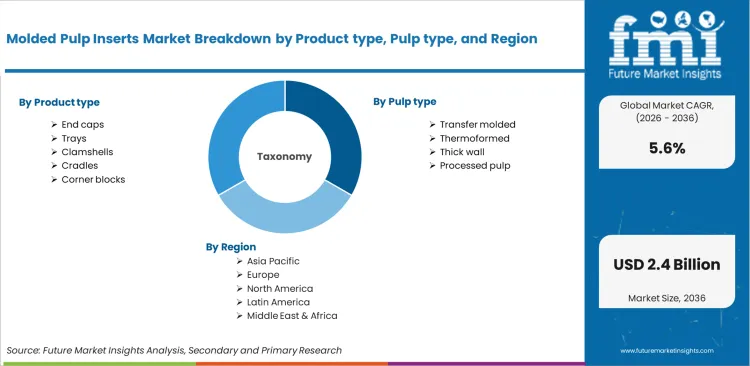
| Segmentation | Product type, Pulp type, Source, End use, Sales channel, and Region |
| Regions Covered | North America, Latin America, Western Europe, Eastern Europe, Asia Pacific, Middle East and Africa |
| Countries Covered | United States, Canada, Brazil, Mexico, Germany, United Kingdom, France, Italy, Spain, Russia, China, Japan, India, South Korea, Australia, GCC Countries, South Africa |
| Key Companies Profiled | Henry Molded Products, EnviroPAK, Keiding, Inc., PulpWorks, Hartmann Packaging, Huhtamaki, Nippon Molding Co., Ltd. |
| Forecast Period | 2026 to 2036 |
| Approach | Historic capital expenditure on custom vacuum-forming mesh tooling across major industrial hubs anchors the baseline capacity calculations. |
Source: Future Market Insights (FMI) analysis, based on proprietary forecasting model and primary research
Molded Pulp Inserts Market Analysis by Segments
Product type:
- End caps
- Trays
- Clamshells
- Cradles
- Corner blocks
Pulp type:
- Transfer molded
- Thermoformed
- Thick wall
- Processed pulp
Source:
- Recycled pulp
- Virgin pulp
- Blended pulp
End use:
- Electronics
- Appliances
- Industrial goods
- Cosmetics
- Medical devices
Sales channel:
- Custom OEM
- Contract packaging
- Distributor sales
Region:
- North America
- Latin America
- Western Europe
- Eastern Europe
- Asia Pacific
- Middle East and Africa
Bibliography
- Hartmann Packaging A/S. (2024). Annual report 2024.
- Humbert, C., Masood, M. A., Toso, M., Roux, N., Collet, M., Regazzi, D., Ma, K., & Dumont, F. (2024, 10th December). Moulded-pulp packaging: A straightforward method for quickly designing, manufacturing and testing complex shapes for crash protection pads. Applied Sciences, 14(24), 11516.
- Pasquier, E., Tutuş, A., & Law, K. N. (2024, 29th September). Effect of raw material and process conditions during the thermoforming of airlaid chemi-thermomechanical pulp. Wood and Fiber Science.
- Ribeiro, A. M., da Silva, J. S., & Gomes, F. J. B. (2025). Development of molded fibers-based packaging from sugarcane bagasse for sustainable alternatives to single-use plastics. BioResources.
- Zhang, Y., Bäcker, M., & Bismarck, A. (2024, 11th November). Natural plant fiber-based materials for packaging applications. Advanced Materials Technologies.
This bibliography is provided for reader reference. The full FMI report contains the complete reference list with primary source documentation.
Frequently Asked Questions
What are molded pulp inserts used for?
The molded pulp secure fragile goods inside cartons, replacing non-recyclable synthetic foams in electronics packaging.
Can molded pulp inserts replace EPS foam?
Yes, they are the primary nature-friendly alternative used to bypass punitive plastic taxes and maintain drop protection.
Are molded pulp inserts recyclable?
Fiber-based inserts are fully recyclable in municipal paper streams and often made from 100% recycled feedstock.
What is the molded pulp insert tooling cost?
Tooling involves upfront capital for custom vacuum-forming mesh, typically amortized into unit pricing over long-term contracts.
Who are leading molded pulp insert suppliers?
Major players include Henry Molded Products, EnviroPAK, Hartmann Packaging, and Huhtamaki, specializing in different fiber designs.
Which industries are driving demand for molded pulp inserts?
Consumer electronics, large appliances, and medical devices are primary drivers due to strict global circularity mandates.
What is the molded pulp insert drop test?
It is a transit validation protocol, such as ISTA 3A, used to verify shock absorption before high-volume production.
How strong are molded pulp inserts?
When engineered with specific ribbing, fiber shapes provide compression strength comparable to synthetic foam through systematic geometry.
What are the cost tradeoffs versus foam or plastic inserts?
Higher upfront tooling costs are offset by reduced regulatory taxes and improved logistics density for fiber-based shipping protection.
Why is Europe important for molded pulp insert growth?
European regulations are among the most stringent globally, mandating rapid circularity across all manufacturing sectors.
What drives transfer molded segment dominance in this sector?
Transfer methodology balances essential wall thickness with viable commercial cycle times for concealed internal carton cushioning.
How does recycled pulp maintain its 78.0% share in 2026?
Secondary transit protection requires zero food-grade contact, allowing maximum utilization of cost-effective post-consumer feedstock.
Why do end caps capture 41.0% product share?
Suspending heavy rectangular chassis items requires extreme corner compression strength achieved through complex engineered fiber ribbing.
What mechanical friction limits maritime shipping applications?
Fiber components absorb ambient humidity during prolonged transit, which can degrade load-bearing crush resistance in tropical climates.
Why does India expand faster than China in this analysis?
Aggressive domestic manufacturing incentives in India drive rapid localization of electronics assembly and adjacent material supply.
What specific advantage do incumbents hold over new entrants?
Established suppliers possess decades of proprietary kinetic energy absorption data and pre-validated geometry libraries.
How do electronics brands manage cosmetic abrasion risk?
Hard fiber surfaces can scratch high-gloss housings, requiring non-abrasive liners or protective bagging inside fiber cavities.
Why is finite element analysis critical for new product launches?
Digital simulation accelerates custom tool creation, reducing physical prototyping cycles and ensuring critical retail launch windows.
What triggers original equipment manufacturer tooling lock-in?
Buyers allowing suppliers to retain exclusive rights to product-specific mesh designs face limited negotiating power during renewals.
How do draft angles impact warehouse logistics?
Required for tool extraction, draft angles improve stacking density, recovering significant storage footprint compared to non-nesting foam.
What dictates raw material quality control parameters?
Repeated recycling shortens cellulose fibers, requiring meticulous batch monitoring to prevent brittle failures during cold-weather shipping.
Why do consumer appliances require custom OEM solutions?
Generic cushioning cannot protect asymmetric device geometries, necessitating vacuum-forming mesh that mirrors specific appliance contours.
How does static discharge mitigation function naturally here?
Untreated pulp prevents static electricity accumulation, allowing technicians to handle bare electronic boards safely without synthetic additives.
What drives facility construction near Mexican border regions?
Heavy formats require minimal transit distance; nearshoring supports integrated North American automotive and electronics supply chains.
Preview the report firsthand - request a free sample
Get SampleGet the brochure for pricing and purchase details.
Get PDFTable of Content
- Executive Summary
- Global Market Outlook
- Demand-side Trends
- Supply-side Trends
- Technology Roadmap Analysis
- Analysis and Recommendations
- Market Overview
- Market Coverage / Taxonomy
- Market Definition / Scope / Limitations
- Research Methodology
- Chapter Orientation
- Analytical Lens and Working Hypotheses
- Market Structure, Signals, and Trend Drivers
- Benchmarking and Cross-market Comparability
- Market Sizing, Forecasting, and Opportunity Mapping
- Research Design and Evidence Framework
- Desk Research Programme (Secondary Evidence)
- Company Annual and Sustainability Reports
- Peer-reviewed Journals and Academic Literature
- Corporate Websites, Product Literature, and Technical Notes
- Earnings Decks and Investor Briefings
- Statutory Filings and Regulatory Disclosures
- Technical White Papers and Standards Notes
- Trade Journals, Industry Magazines, and Analyst Briefs
- Conference Proceedings, Webinars, and Seminar Materials
- Government Statistics Portals and Public Data Releases
- Press Releases and Reputable Media Coverage
- Specialist Newsletters and Curated Briefings
- Sector Databases and Reference Repositories
- FMI Internal Proprietary Databases and Historical Market Datasets
- Subscription Datasets and Paid Sources
- Social Channels, Communities, and Digital Listening Inputs
- Additional Desk Sources
- Expert Input and Fieldwork (Primary Evidence)
- Primary Modes
- Qualitative Interviews and Expert Elicitation
- Quantitative Surveys and Structured Data Capture
- Blended Approach
- Why Primary Evidence is Used
- Field Techniques
- Interviews
- Surveys
- Focus Groups
- Observational and In-context Research
- Social and Community Interactions
- Stakeholder Universe Engaged
- C-suite Leaders
- Board Members
- Presidents and Vice Presidents
- R&D and Innovation Heads
- Technical Specialists
- Domain Subject-matter Experts
- Scientists
- Physicians and Other Healthcare Professionals
- Governance, Ethics, and Data Stewardship
- Research Ethics
- Data Integrity and Handling
- Primary Modes
- Tooling, Models, and Reference Databases
- Desk Research Programme (Secondary Evidence)
- Data Engineering and Model Build
- Data Acquisition and Ingestion
- Cleaning, Normalisation, and Verification
- Synthesis, Triangulation, and Analysis
- Quality Assurance and Audit Trail
- Market Background
- Market Dynamics
- Drivers
- Restraints
- Opportunity
- Trends
- Scenario Forecast
- Demand in Optimistic Scenario
- Demand in Likely Scenario
- Demand in Conservative Scenario
- Opportunity Map Analysis
- Product Life Cycle Analysis
- Supply Chain Analysis
- Investment Feasibility Matrix
- Value Chain Analysis
- PESTLE and Porter’s Analysis
- Regulatory Landscape
- Regional Parent Market Outlook
- Production and Consumption Statistics
- Import and Export Statistics
- Market Dynamics
- Global Market Analysis 2021 to 2025 and Forecast, 2026 to 2036
- Historical Market Size Value (USD Million) Analysis, 2021 to 2025
- Current and Future Market Size Value (USD Million) Projections, 2026 to 2036
- Y-o-Y Growth Trend Analysis
- Absolute $ Opportunity Analysis
- Global Market Pricing Analysis 2021 to 2025 and Forecast 2026 to 2036
- Global Market Analysis 2021 to 2025 and Forecast 2026 to 2036, By Product type
- Introduction / Key Findings
- Historical Market Size Value (USD Million) Analysis By Product type , 2021 to 2025
- Current and Future Market Size Value (USD Million) Analysis and Forecast By Product type , 2026 to 2036
- End caps
- Trays
- Clamshells
- Cradles
- Corner blocks
- End caps
- Y-o-Y Growth Trend Analysis By Product type , 2021 to 2025
- Absolute $ Opportunity Analysis By Product type , 2026 to 2036
- Global Market Analysis 2021 to 2025 and Forecast 2026 to 2036, By Pulp type
- Introduction / Key Findings
- Historical Market Size Value (USD Million) Analysis By Pulp type, 2021 to 2025
- Current and Future Market Size Value (USD Million) Analysis and Forecast By Pulp type, 2026 to 2036
- Transfer molded
- Thermoformed
- Thick wall
- Processed pulp
- Transfer molded
- Y-o-Y Growth Trend Analysis By Pulp type, 2021 to 2025
- Absolute $ Opportunity Analysis By Pulp type, 2026 to 2036
- Global Market Analysis 2021 to 2025 and Forecast 2026 to 2036, By Source
- Introduction / Key Findings
- Historical Market Size Value (USD Million) Analysis By Source, 2021 to 2025
- Current and Future Market Size Value (USD Million) Analysis and Forecast By Source, 2026 to 2036
- Recycled pulp
- Virgin pulp
- Blended pulp
- Recycled pulp
- Y-o-Y Growth Trend Analysis By Source, 2021 to 2025
- Absolute $ Opportunity Analysis By Source, 2026 to 2036
- Global Market Analysis 2021 to 2025 and Forecast 2026 to 2036, By End use
- Introduction / Key Findings
- Historical Market Size Value (USD Million) Analysis By End use, 2021 to 2025
- Current and Future Market Size Value (USD Million) Analysis and Forecast By End use, 2026 to 2036
- Electronics
- Appliances
- Industrial goods
- Cosmetics
- Medical devices
- Electronics
- Y-o-Y Growth Trend Analysis By End use, 2021 to 2025
- Absolute $ Opportunity Analysis By End use, 2026 to 2036
- Global Market Analysis 2021 to 2025 and Forecast 2026 to 2036, By Sales channel
- Introduction / Key Findings
- Historical Market Size Value (USD Million) Analysis By Sales channel, 2021 to 2025
- Current and Future Market Size Value (USD Million) Analysis and Forecast By Sales channel, 2026 to 2036
- Custom OEM
- Contract packaging
- Distributor sales
- Custom OEM
- Y-o-Y Growth Trend Analysis By Sales channel, 2021 to 2025
- Absolute $ Opportunity Analysis By Sales channel, 2026 to 2036
- Global Market Analysis 2021 to 2025 and Forecast 2026 to 2036, By Region
- Introduction
- Historical Market Size Value (USD Million) Analysis By Region, 2021 to 2025
- Current Market Size Value (USD Million) Analysis and Forecast By Region, 2026 to 2036
- North America
- Latin America
- Western Europe
- Eastern Europe
- East Asia
- South Asia and Pacific
- Middle East & Africa
- Market Attractiveness Analysis By Region
- North America Market Analysis 2021 to 2025 and Forecast 2026 to 2036, By Country
- Historical Market Size Value (USD Million) Trend Analysis By Market Taxonomy, 2021 to 2025
- Market Size Value (USD Million) Forecast By Market Taxonomy, 2026 to 2036
- By Country
- USA
- Canada
- Mexico
- By Product type
- By Pulp type
- By Source
- By End use
- By Sales channel
- By Country
- Market Attractiveness Analysis
- By Country
- By Product type
- By Pulp type
- By Source
- By End use
- By Sales channel
- Key Takeaways
- Latin America Market Analysis 2021 to 2025 and Forecast 2026 to 2036, By Country
- Historical Market Size Value (USD Million) Trend Analysis By Market Taxonomy, 2021 to 2025
- Market Size Value (USD Million) Forecast By Market Taxonomy, 2026 to 2036
- By Country
- Brazil
- Chile
- Rest of Latin America
- By Product type
- By Pulp type
- By Source
- By End use
- By Sales channel
- By Country
- Market Attractiveness Analysis
- By Country
- By Product type
- By Pulp type
- By Source
- By End use
- By Sales channel
- Key Takeaways
- Western Europe Market Analysis 2021 to 2025 and Forecast 2026 to 2036, By Country
- Historical Market Size Value (USD Million) Trend Analysis By Market Taxonomy, 2021 to 2025
- Market Size Value (USD Million) Forecast By Market Taxonomy, 2026 to 2036
- By Country
- Germany
- UK
- Italy
- Spain
- France
- Nordic
- BENELUX
- Rest of Western Europe
- By Product type
- By Pulp type
- By Source
- By End use
- By Sales channel
- By Country
- Market Attractiveness Analysis
- By Country
- By Product type
- By Pulp type
- By Source
- By End use
- By Sales channel
- Key Takeaways
- Eastern Europe Market Analysis 2021 to 2025 and Forecast 2026 to 2036, By Country
- Historical Market Size Value (USD Million) Trend Analysis By Market Taxonomy, 2021 to 2025
- Market Size Value (USD Million) Forecast By Market Taxonomy, 2026 to 2036
- By Country
- Russia
- Poland
- Hungary
- Balkan & Baltic
- Rest of Eastern Europe
- By Product type
- By Pulp type
- By Source
- By End use
- By Sales channel
- By Country
- Market Attractiveness Analysis
- By Country
- By Product type
- By Pulp type
- By Source
- By End use
- By Sales channel
- Key Takeaways
- East Asia Market Analysis 2021 to 2025 and Forecast 2026 to 2036, By Country
- Historical Market Size Value (USD Million) Trend Analysis By Market Taxonomy, 2021 to 2025
- Market Size Value (USD Million) Forecast By Market Taxonomy, 2026 to 2036
- By Country
- China
- Japan
- South Korea
- By Product type
- By Pulp type
- By Source
- By End use
- By Sales channel
- By Country
- Market Attractiveness Analysis
- By Country
- By Product type
- By Pulp type
- By Source
- By End use
- By Sales channel
- Key Takeaways
- South Asia and Pacific Market Analysis 2021 to 2025 and Forecast 2026 to 2036, By Country
- Historical Market Size Value (USD Million) Trend Analysis By Market Taxonomy, 2021 to 2025
- Market Size Value (USD Million) Forecast By Market Taxonomy, 2026 to 2036
- By Country
- India
- ASEAN
- Australia & New Zealand
- Rest of South Asia and Pacific
- By Product type
- By Pulp type
- By Source
- By End use
- By Sales channel
- By Country
- Market Attractiveness Analysis
- By Country
- By Product type
- By Pulp type
- By Source
- By End use
- By Sales channel
- Key Takeaways
- Middle East & Africa Market Analysis 2021 to 2025 and Forecast 2026 to 2036, By Country
- Historical Market Size Value (USD Million) Trend Analysis By Market Taxonomy, 2021 to 2025
- Market Size Value (USD Million) Forecast By Market Taxonomy, 2026 to 2036
- By Country
- Kingdom of Saudi Arabia
- Other GCC Countries
- Turkiye
- South Africa
- Other African Union
- Rest of Middle East & Africa
- By Product type
- By Pulp type
- By Source
- By End use
- By Sales channel
- By Country
- Market Attractiveness Analysis
- By Country
- By Product type
- By Pulp type
- By Source
- By End use
- By Sales channel
- Key Takeaways
- Key Countries Market Analysis
- USA
- Pricing Analysis
- Market Share Analysis, 2025
- By Product type
- By Pulp type
- By Source
- By End use
- By Sales channel
- Canada
- Pricing Analysis
- Market Share Analysis, 2025
- By Product type
- By Pulp type
- By Source
- By End use
- By Sales channel
- Mexico
- Pricing Analysis
- Market Share Analysis, 2025
- By Product type
- By Pulp type
- By Source
- By End use
- By Sales channel
- Brazil
- Pricing Analysis
- Market Share Analysis, 2025
- By Product type
- By Pulp type
- By Source
- By End use
- By Sales channel
- Chile
- Pricing Analysis
- Market Share Analysis, 2025
- By Product type
- By Pulp type
- By Source
- By End use
- By Sales channel
- Germany
- Pricing Analysis
- Market Share Analysis, 2025
- By Product type
- By Pulp type
- By Source
- By End use
- By Sales channel
- UK
- Pricing Analysis
- Market Share Analysis, 2025
- By Product type
- By Pulp type
- By Source
- By End use
- By Sales channel
- Italy
- Pricing Analysis
- Market Share Analysis, 2025
- By Product type
- By Pulp type
- By Source
- By End use
- By Sales channel
- Spain
- Pricing Analysis
- Market Share Analysis, 2025
- By Product type
- By Pulp type
- By Source
- By End use
- By Sales channel
- France
- Pricing Analysis
- Market Share Analysis, 2025
- By Product type
- By Pulp type
- By Source
- By End use
- By Sales channel
- India
- Pricing Analysis
- Market Share Analysis, 2025
- By Product type
- By Pulp type
- By Source
- By End use
- By Sales channel
- ASEAN
- Pricing Analysis
- Market Share Analysis, 2025
- By Product type
- By Pulp type
- By Source
- By End use
- By Sales channel
- Australia & New Zealand
- Pricing Analysis
- Market Share Analysis, 2025
- By Product type
- By Pulp type
- By Source
- By End use
- By Sales channel
- China
- Pricing Analysis
- Market Share Analysis, 2025
- By Product type
- By Pulp type
- By Source
- By End use
- By Sales channel
- Japan
- Pricing Analysis
- Market Share Analysis, 2025
- By Product type
- By Pulp type
- By Source
- By End use
- By Sales channel
- South Korea
- Pricing Analysis
- Market Share Analysis, 2025
- By Product type
- By Pulp type
- By Source
- By End use
- By Sales channel
- Russia
- Pricing Analysis
- Market Share Analysis, 2025
- By Product type
- By Pulp type
- By Source
- By End use
- By Sales channel
- Poland
- Pricing Analysis
- Market Share Analysis, 2025
- By Product type
- By Pulp type
- By Source
- By End use
- By Sales channel
- Hungary
- Pricing Analysis
- Market Share Analysis, 2025
- By Product type
- By Pulp type
- By Source
- By End use
- By Sales channel
- Kingdom of Saudi Arabia
- Pricing Analysis
- Market Share Analysis, 2025
- By Product type
- By Pulp type
- By Source
- By End use
- By Sales channel
- Turkiye
- Pricing Analysis
- Market Share Analysis, 2025
- By Product type
- By Pulp type
- By Source
- By End use
- By Sales channel
- South Africa
- Pricing Analysis
- Market Share Analysis, 2025
- By Product type
- By Pulp type
- By Source
- By End use
- By Sales channel
- USA
- Market Structure Analysis
- Competition Dashboard
- Competition Benchmarking
- Market Share Analysis of Top Players
- By Regional
- By Product type
- By Pulp type
- By Source
- By End use
- By Sales channel
- Competition Analysis
- Competition Deep Dive
- Henry Molded Products
- Overview
- Product Portfolio
- Profitability by Market Segments (Product/Age /Sales Channel/Region)
- Sales Footprint
- Strategy Overview
- Marketing Strategy
- Product Strategy
- Channel Strategy
- EnviroPAK
- Keiding, Inc.
- PulpWorks
- Hartmann Packaging
- Huhtamaki
- Nippon Molding Co., Ltd.
- Henry Molded Products
- Competition Deep Dive
- Assumptions & Acronyms Used


