

- Industry Size (2026)
- USD 1.3 Bn
- Forecast (2036)
- USD 3.1 Bn
- CAGR (2026 to 2036)
- 9.08%
Molded Fiber Lids and Cold-Drink Service Packaging Market Size, Market Forecast and Outlook By FMI
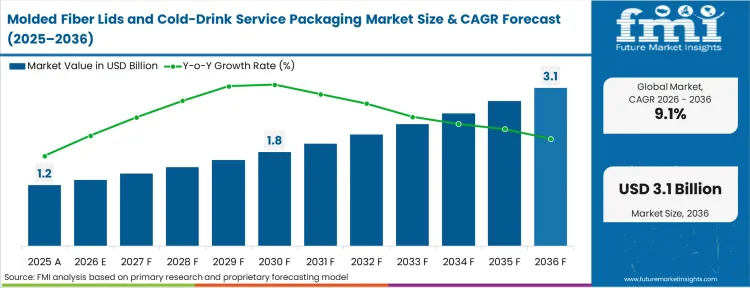
The molded fiber lids and cold-drink service packaging was valued at USD 1.2 billion in 2025. Industry demand is poised to cross USD 1.3 billion in 2026, expanding at a CAGR of 9.08% during the forecast period. The cumulative buildup of organic waste mandates propels the valuation to USD 3.1 billion through 2036, as drive-thru operators aggressively swap legacy polystyrene for highly engineered, snap-fit fiber technologies capable of matching plastic leak-resistance.
High-volume beverage chains are currently being forced to abandon spot-market plastic purchasing in favor of multi-year fiber offtake agreements. Delaying this strategic shift invites severe margin compression, leaving hesitant operators exposed to volatile pricing from a severely constrained premium tooling network. Downstream disposal economics at major stadiums are quietly dictating initial material qualification, tying commercial viability directly to municipal composting infrastructure. Manufacturers weaving sustainable packaging solutions seamlessly into their broader portfolios are winning the most lucrative, long-term regional contracts.
Eliminating intentionally added per- and polyfluoroalkyl substances (PFAS) stands as the definitive threshold for mass commercialization. The moment material scientists perfect a bio-based coating that survives prolonged condensation without collapsing, global procurement networks will instantly transition their entire cold-cup portfolios. Passing this chemical barrier immediately transforms the landscape from localized pilot testing into aggressive, fleet-wide integration.
Summary of Molded Fiber Lids and Cold-Drink Service Packaging Market
- Molded Fiber Lids and Cold-Drink Service Packaging Market Definition
- This landscape focuses on advanced molded pulp products engineered for cold-beverage service. The defining functional boundary is the ability to endure severe condensation while providing leak-proof, snap-fit security, entirely sidestepping legacy plastics and non-repulpable linings.
- Demand Drivers in the Market
- Aggressive legislative phase-outs of expanded polystyrene compel quick-service procurement directors to secure compliant materials that won't compromise drive-thru speed.
- Punitive surcharges on mixed-waste disposal force institutional facility managers to convert entirely to organic-friendly service ware.
- Escalating extended producer responsibility (EPR) taxes push beverage packaging engineers to redesign liquid containment assemblies, mitigating downstream financial liabilities.
- Key Segments Analyzed in the FMI Report
- Lids: Capturing a projected 45.2% share in 2026, lids act as the fastest compliance victory, allowing brands to eliminate plastic without overhauling their primary cup architecture.
- Bagasse: Securing an estimated 38.5% share in 2026, sugarcane residue provides the long-fiber tensile strength essential for milling sharp, snap-fit undercuts.
- Quick Service Restaurants (QSR): Dominating with a 52.1% share in 2026, these high-throughput operators must implement immediate plastic substitutes to avoid crippling regional fines.
- India: Advancing at an 11.2% compound rate, propelled by the collision of strict federal material bans and the rapid geographic expansion of franchise networks.
- Analyst Opinion at FMI
- Ismail Sutaria, Principal Analyst, Packaging, at FMI, opines, "The standard metric for forecasting this transition is counting municipal plastic bans, but that completely misreads the operational bottleneck. The actual speed limit is dictated by machine-shop capacity. A fast-food chain may urgently want to swap 50 million lids to meet an internal ESG pledge, but securing a supplier with the precision-milled molds required to produce a flawless fiber closure at that scale takes upwards of 18 months. The structural clock here runs on tooling lead times, not regulatory deadlines."
- Strategic Implications / Executive Takeaways
- Converters must lock down multi-year supply agreements with reliable bagasse mills to insulate their margins against severe spot-market price swings.
- Procurement heads at major restaurant groups need to initiate joint-development contracts with tier-1 manufacturers immediately to guarantee access to high-precision molding capacity.
- Catering directors face a pressing mandate to align their procurement specifications perfectly with the specific organic processing capabilities of their municipal waste partners.
- Methodology
- Primary Research: Stakeholder interviews targeting QSR supply chain leaders and beverage packaging designers.
- Desk Research: Evaluation of global compostability standards and regional EPR legislative frameworks.
- Market-Sizing and Forecasting: Grounded in the physical deployment of advanced thermoforming equipment.
- Data Validation and Update Cycle: Cross-referenced using municipal organic diversion rates and hospitality waste audits.
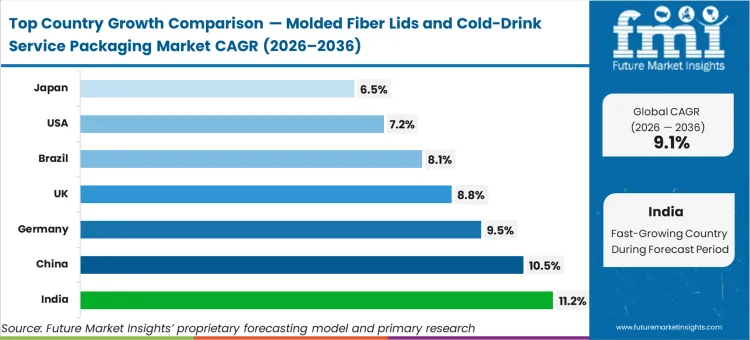
India is projected to expand at a CAGR of 11.2%, catalyzed by federal single-use plastic bans colliding with a massive surge in organized fast-food retail. Leveraging unparalleled domestic bagasse pulp infrastructure, China tracks closely behind at 10.5%. Germany is poised to record a 9.5% advance, while the United Kingdom is expected to grow by 8.8%. Further west, Brazil registers an 8.1% trajectory. The USA is anticipated to advance at 7.2%, with Japan following at 6.5%. This geographic divergence highlights a core structural truth: regions heavily penalized by mixed-waste municipal tariffs transition far faster than those relying solely on corporate sustainability pledges.
Molded Fiber Lids and Cold-Drink Service Packaging Market Key Takeaways
| Metric | Details |
|---|---|
| Industry Size (2026) | USD 1.3 billion |
| Industry Value (2036) | USD 3.1 billion |
| CAGR (2026–2036) | 9.08% |
Source: Future Market Insights (FMI) analysis, based on proprietary forecasting model and primary research
Molded Fiber Lids and Cold-Drink Service Packaging Market Definition
This sector encompasses precision-engineered, pulp-based components designed explicitly to replace rigid polymers in chilled beverage dispensing. Functionally bounded by the strict requirement to maintain geometric stability under low-temperature, high-condensation stress, these products stand apart from standard dry-goods clamshells. Navigating this space requires advanced thermoforming tolerances to guarantee spill-proof closures and specialized bio-barriers to prevent structural decay during consumption.
Molded Fiber Lids and Cold-Drink Service Packaging Market Inclusions
The analytical scope incorporates thermoformed and transfer-molded fiber lids, multi-beverage carriers, cold cups, and stirrers. Products treated with water-resistant chemistries are fully included, provided they achieve recognized industrial or home compostability certifications. The assessment tracks the deployment of these materials directly into commercial foodservice packaging channels, serving as the primary consumer-facing containment vessels.
Molded Fiber Lids and Cold-Drink Service Packaging Market Exclusions
Secondary transit materials and standard corrugated shipping cartons are explicitly excluded from this analysis. Items utilizing non-repulpable polymer linings, such as legacy PE-coated paper cups, fall completely outside the boundaries. The core logic behind these exclusions rests on tracking only those materials capable of entering organic recovery streams without demanding complex, mechanical delamination at the end of their lifecycle.
Molded Fiber Lids and Cold-Drink Service Packaging Market Research Methodology
- Primary Research: Direct consultations with tier-1 quick-service procurement heads, global beverage brand packaging engineers, and sustainability directors at major institutional catering firms.
- Desk Research: Deep-dive analysis of technical barrier chemistry patents, municipal single-use legislative filings, and compostability registries from recognized environmental testing authorities.
- Market-Sizing and Forecasting: Baseline metrics anchor heavily to the verifiable installed capacity of high-precision thermoforming machines and declared pulp conversion expansions.
- Data Validation and Update Cycle: Growth projections are rigorously triangulated against regional organic waste processing statistics and independent hospitality sector procurement audits.
Segmental Analysis
Molded Fiber Lids and Cold-Drink Service Packaging Market Analysis by Product Type
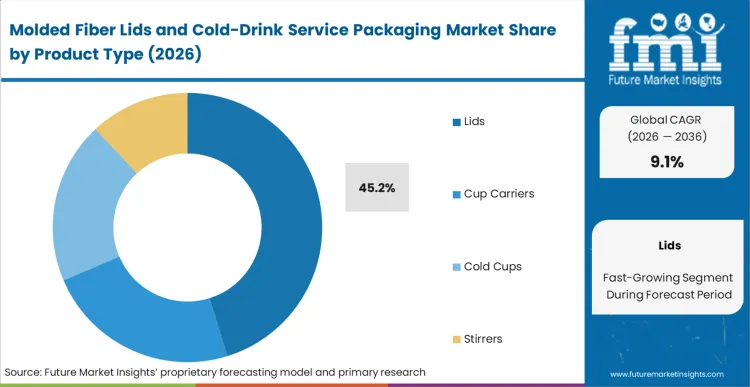
The displacement of legacy polystyrene is swift and unforgiving when new municipal ordinances take effect. According to FMI's estimates, the lids segment captures a dominant 45.2% share in 2026 because it represents the most surgically precise compliance target in the beverage assembly. Packaging engineers recognize that swapping the cup itself requires overcoming massive structural hurdles, but upgrading the lid delivers immediate regulatory alignment with minimal operational friction. Ultimately, the success of this transition hinges on snap-fit integrity. If a molded pulp closure cannot secure tightly enough to prevent spills during rapid drive-thru handoffs, it is instantly disqualified, regardless of its superior environmental credentials. Franchisees forced to deploy poorly engineered geometries immediately suffer operational blowback through spiked refund rates and frustrated staff.
- Initial specification: The ability to match the exact dimensional tolerances of legacy plastic closures triggers the green light for pilot programs at major beverage chains.
- Qualification testing: Surviving a standard 45-minute condensation window without structural decay dictates whether eco-friendly food packaging graduates from localized trials to national deployment.
- Expansion criteria: Lucrative, multi-year contract renewals go exclusively to vendors capable of navigating severe tooling bottlenecks to scale production across thousands of locations.
Molded Fiber Lids and Cold-Drink Service Packaging Market Analysis by Material Source
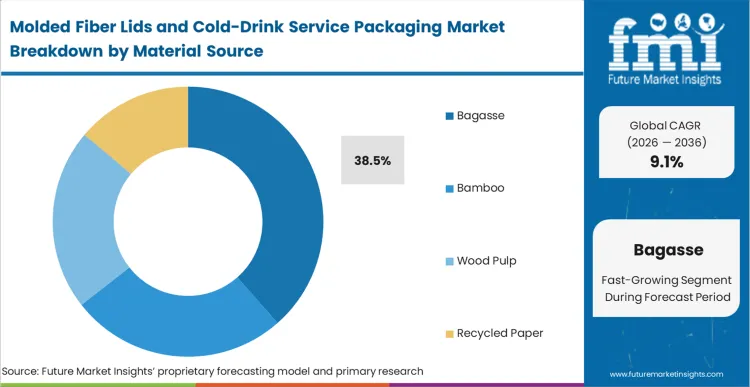
Bagasse commands its leading 38.5% position not due to mere abundance, but because of its fundamentally superior fiber morphology. The robust, elongated fibers of sugarcane residue grant manufacturers the ability to achieve the deep draws and sharp undercuts necessary for a secure lid fitment, complex geometries that short-fiber recycled paper simply cannot maintain during the high-heat curing process. Facility directors heavily prioritize this specific feedstock as it drastically reduces the reject rate coming off the thermoforming line. When engineering interfaces for chilled drinks, the substrate must fiercely resist the degrading effects of low temperatures and constant moisture. Operators who gamble on weaker, recycled pulp blends face a high probability of structural collapse in the consumer's hand, prompting immediate delisting by premium catering clients.
- Defect prevention: The inherent tensile strength of sugarcane fibers eliminates the rim-splitting failures frequently observed when low-grade pulps are stretched over standard cup brims.
- Residual exposure: Even utilizing premium feedstocks, prolonged contact with high-acid chilled beverages demands the flawless application of bio-barriers to prevent premature softening.
- Operational capture: Plant managers are required to meticulously calibrate drying oven temperatures to the exact moisture retention profile of each bagasse batch to guarantee unwavering dimensional stability.
Molded Fiber Lids and Cold-Drink Service Packaging Market Analysis by End Use
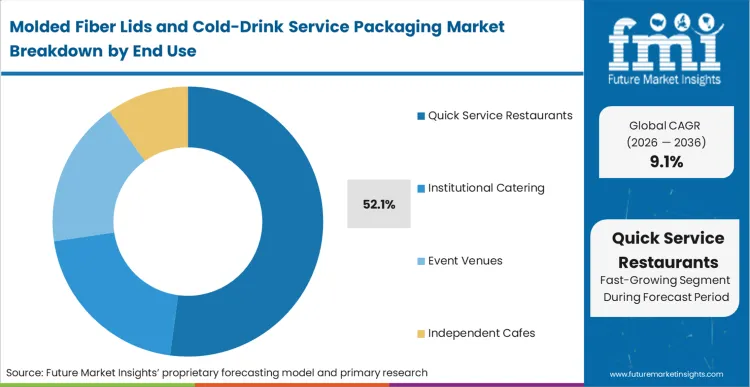
A sharp contradiction defines the Quick Service Restaurant (QSR) environment: these franchises demand the absolute lowest unit costs, yet they are structurally cornered into buying the most highly engineered fiber products on the market. Holding a 52.1% share, the fast-food sector tests packaging ruthlessly. A cold cup must survive rough handling by hurried staff, the crushing lateral pressure of a multi-cup carrier, and turbulent transport in a customer's vehicle. Based on FMI's assessment, this hostile environment forces supply chain teams to absorb higher initial material costs just to prevent catastrophic workflow bottlenecks at the service window. Analyzing the complete lifecycle reveals a different financial reality; while fiber carries a premium, it successfully eliminates escalating municipal fines and punitive mixed-waste tipping fees. Brands that hesitate to qualify these advanced closures routinely find themselves locked out of progressive cities where sudden plastic bans paralyze their standard operations.
- Procurement phase: Financial savings stem directly from consolidating the packaging supply chain and neutralizing the threat of municipal non-compliance penalties across diverse regions.
- Operational deployment: Hidden friction emerges during the rollout phase as employees must be retrained on the slightly modified application force required to properly seat fiber lids.
- Lifecycle assessment: The unit economics heavily favor quick-service restaurant QSR packaging alternatives once avoided landfill surcharges and regional EPR taxes are comprehensively calculated.
Molded Fiber Lids and Cold-Drink Service Packaging Market Drivers, Restraints, and Opportunities
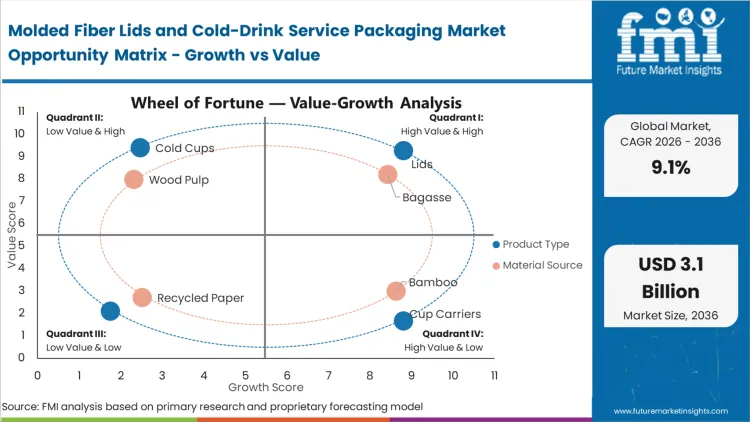
The urgent necessity to secure high-grade fiber pulp fundamentally rewires how global beverage brands approach their sourcing models. Moving away from the volatile spot market for legacy plastics, procurement directors are now compelled to ink multi-year contracts with elite molded pulp converters, aiming to guarantee supply lines long before sweeping legislative bans take effect. The commercial stakes of delaying this strategic pivot are immense; supply chain leaders who fail to secure dedicated tooling capacity risk devastating regional stockouts when new municipal ordinances abruptly criminalize their existing polystyrene inventory.
The most severe operational friction dragging down deployment speed is the extensive machine-shop lead time required to mill high-precision molds. Crafting the heated tooling capable of producing a flawless, leak-proof fiber lid requires specialized mechanical engineering that standard egg-carton thermoformers simply cannot execute. This reality creates a massive supply-side bottleneck. Even when corporate capital is instantly approved, the physical hardware cannot be manufactured fast enough to satisfy the surging demands of national retail chains. While early iterations of modular tooling are appearing, their current inability to hold strict tolerances for complex undercuts severely limits their utility in the cold-drink space.
Opportunities in the Molded Fiber Lids and Cold-Drink Service Packaging Market
- PFAS-free barrier chemistries: The escalating legislative war on fluorinated chemicals opens a massive frontier for material science innovators. Formulators capable of delivering fully compostable, highly water-resistant coatings successfully neutralize the industry's most daunting regulatory hurdle.
- Integrated tooling design: The critical shortage of precision molds paves a highly profitable path for vertically integrated takeaway packaging manufacturers. Firms bringing mold-making entirely in-house drastically accelerate their time-to-market, allowing them to snatch exclusive contracts from impatient franchise networks.
- Closed-loop venue recovery: The massive concentration of organic waste at stadiums and transit hubs enables the creation of highly efficient, dedicated fiber recovery loops. Facilities management companies partnering directly with commercial composters secure lucrative waste diversion contracts by guaranteeing a pristine, contamination-free pulp stream.
Regional Analysis
Based on the regional analysis, the Molded Fiber Lids and Cold-Drink Service Packaging market is segmented into North America, Europe, Asia Pacific, and Latin America across 40 plus countries.
.webp "Top Country Growth Comparison Molded Fiber Lids And Cold Drink Service Packaging Market Cagr (2026 2036)")
| Country | CAGR (2026 to 2036) |
|---|---|
| India | 11.2% |
| China | 10.5% |
| Germany | 9.5% |
| United Kingdom | 8.8% |
| Brazil | 8.1% |
| USA | 7.2% |
| Japan | 6.5% |
Source: Future Market Insights (FMI) analysis, based on proprietary forecasting model and primary research
North America Molded Fiber Lids and Cold-Drink Service Packaging Market Analysis
The highly fragmented nature of North American solid waste legislation creates a chaotic patchwork of localized mandates, rather than a smooth, unified transition. FMI analysts opine that this fractured environment essentially forces massive fast-food networks to make a difficult choice: run complex dual supply chains, or voluntarily elevate their entire national footprint to meet the strictest regional standard. increasingly, major brands are opting for the latter, aggressively upgrading their cold-cup assemblies from coast to coast to streamline logistics and protect their brand equity.
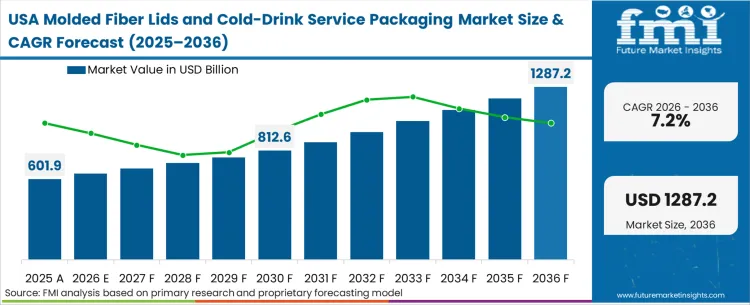
- USA: The rapid proliferation of municipal single-use plastic bans across key coastal cities forces national beverage networks to completely dismantle their standard operating procedures. Operations managers are required to transition their high-volume drive-thrus to advanced paper cups and fiber lids to ensure uninterrupted service across wildly varying jurisdictions. A CAGR of 7.2% is expected for the USA over the forecast period. Chains that successfully standardize a high-performance fiber ecosystem secure highly profitable, exclusive catering rights with progressive university systems and sprawling tech campuses.
Europe Molded Fiber Lids and Cold-Drink Service Packaging Market Analysis
Stringent extended producer responsibility (EPR) frameworks fundamentally rewrite the economic rules for cold-drink service across the continent. By directly taxing the deployment of mixed-material and non-repulpable plastics, regulators have shifted molded fiber from a premium corporate sustainability initiative into a baseline financial necessity. This aggressive margin dynamic acts as a massive catalyst, sparking rapid conversion rates, particularly within the vast institutional catering sector.
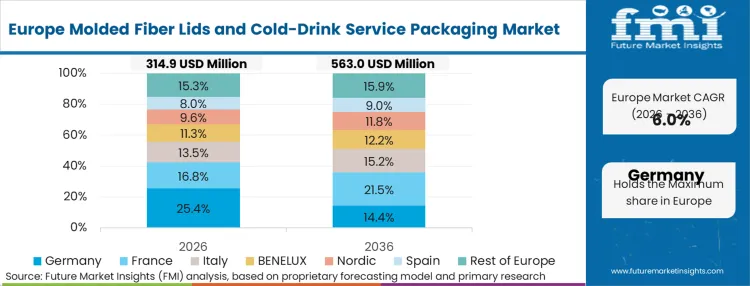
- Germany: Updated packaging waste directives in Germany impose severe financial penalties on the use of single-use plastics in commercial catering environments. Procurement managers operating within these borders are compelled to integrate fully certified compostable or repulpable fiber solutions just to avoid catastrophic EPR tax brackets. Over the forecast period, Germany is set for a CAGR of 9.5%. Achieving this transition allows facility managers to entirely bypass the exorbitant secondary sorting processes previously required at their large-scale venue operations.
- United Kingdom: The uncompromising enforcement of UK Plastics Pact targets removes all ambiguity from corporate material selection. Supply chain directors are legally obligated to strip all legacy polymers from their cold-drink assemblies to pass impending compliance audits. The United Kingdom market for molded fiber lids is likely to post a CAGR of 8.8%. This fiercely compliance-driven trajectory establishes the UK as the world's premier testing ground for validating next-generation PFAS-free barrier chemistries before they are rolled out globally.
Asia Pacific Molded Fiber Lids and Cold-Drink Service Packaging Market Analysis
The explosive expansion of organized quick-service retail into previously untapped tier-2 cities dictates the furious pace of fiber infrastructure deployment across the region. Unburdened by entrenched legacy plastic recycling networks, incoming fast-food giants are able to leapfrog directly to molded pulp solutions. By utilizing localized agricultural waste streams, these operators successfully insulate themselves from the extreme volatility of global shipping and supply shocks.
- India: An uncompromising federal prohibition on single-use plastics collides head-on with the hyper-expansion of organized franchise networks pushing into tier-2 urban centers. Procurement heads operate under immense pressure to localize their fiber sourcing, aiming to dodge heavy import tariffs while maintaining flawless regulatory compliance. The Indian landscape is set to achieve a CAGR of 11.2%. This dynamic grants an unassailable competitive edge to domestic bagasse converters capable of scaling precision thermoforming capacity faster than their international rivals.
- China: The unparalleled density of China's domestic bagasse pulp infrastructure enables manufacturers to achieve aggressive price parity with legacy polymers. Sourcing directors leverage this massive localized feedstock advantage to completely bypass the margin compression plaguing their Western counterparts. FMI estimates the market in China to expand at an annual growth rate of 10.5%. What this robust CAGR figure fails to communicate is that Chinese engineering facilities are currently dictating the global baseline for high-speed fiber thermoforming cycle times.
- Japan: Highly sophisticated and rigidly structured municipal incineration protocols in Japan demand materials that burn cleanly without emitting toxic byproducts. Beverage brands must meticulously qualify fiber packaging that aligns flawlessly with these exacting thermal recovery requirements. Japan's industry is expected to demonstrate a CAGR of 6.5%. Domestic operators who master this highly specific thermal compliance profile capture fierce, long-term loyalty from an intensely quality-focused consumer base.
- Brazil: The sheer scale of Brazil's sugarcane industry provides an abundant, highly localized feedstock that continuously fuels regional pulp molding operations. Packaging engineers benefit from the unique strategic advantage of integrating a fully domestic supply chain that shields them from international logistical chaos. Sales in Brazil are projected to rise at an 8.1% compound rate. This deep agricultural integration empowers Brazilian converters to consistently undercut imported plastic alternatives on total lifecycle costs.
FMI's report includes extensive modeling of rapidly modernizing Southeast Asian hubs like Vietnam and Thailand. These secondary markets exhibit a swift convergence toward unified compostability standards, heavily dictated by the aggressive procurement policies of multinational hotel chains operating across the region.
Competitive Aligners for Market Players
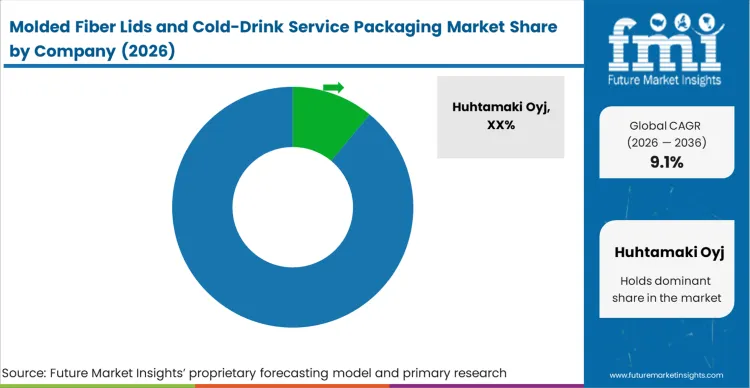
The competitive landscape for high-tolerance cold-drink fiber applications remains intensely concentrated, driven by the massive capital expenditure required to deploy precision thermoforming technology. Elite tier-1 players dominate the space because they closely guard the limited pool of advanced machine-shop capacity capable of milling zero-draft-angle molds. Procurement directors do not evaluate vendors based on basic pulp quality; they qualify partners strictly on their proven ability to manufacture millions of units with zero variance in snap-fit dimensional stability, a rigorous requirement that instantly disqualifies lower-tier egg-carton manufacturers.
Incumbents fiercely defend their structural advantage through deep vertical integration, meticulously controlling every node from the raw bamboo packaging pulp supply down to the final proprietary barrier chemistry application. Top-tier manufacturers have successfully insulated themselves from spot-market shocks by forging ironclad, multi-year alliances with agricultural fiber processors. To legitimately challenge these leaders, a new entrant must build not just raw forming capacity, but a fully integrated, PFAS-free barrier coating application line capable of operating at breakneck speeds without bottlenecking the thermoforming output.
Looking toward 2036, the structural tension between quick-service restaurant demands for absolute cost parity and vendor requirements for rapid capital recovery will heavily define the trajectory. Massive beverage buyers are actively resisting vendor lock-in by strategically funding secondary suppliers to build competing tooling networks. Yet, despite this aggressive push for diversification, the sheer technical difficulty of executing high-speed, precision fiber molding ensures the market will remain heavily consolidated among the few organizations capable of meeting both extreme scale and flawless quality mandates.
Key Players in Molded Fiber Lids and Cold-Drink Service Packaging Market
- Huhtamaki Oyj
- Pactiv Evergreen Inc.
- Sabert Corporation
- Sonoco Products Company
- Genpak, LLC
- Fabri-Kal
- World Centric
- U.S. Corrugated, Inc.
Scope of the Report
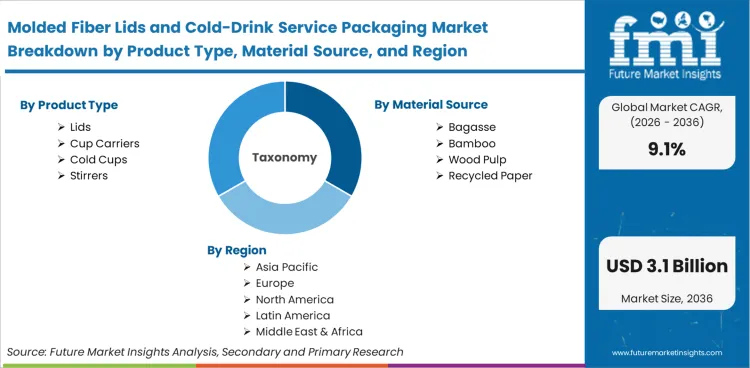
| Metric | Value |
|---|---|
| Quantitative Units | USD 1.3 billion to USD 3.1 billion, at a CAGR of 9.08% |
| Market Definition | Precision-engineered, pulp-based components designed explicitly for chilled beverage service, functionally bounded by the strict requirement to maintain geometric stability and snap-fit leak resistance under low-temperature condensation stress, without relying on legacy plastics. |
| Product Type Segmentation | Lids, Cup Carriers, Cold Cups, Stirrers |
| Material Source Segmentation | Bagasse, Bamboo, Wood Pulp, Recycled Paper |
| End Use Segmentation | Quick Service Restaurants, Institutional Catering, Event Venues, Independent Cafes |
| Regions Covered | North America, Europe, Asia Pacific, Latin America |
| Countries Covered | India, China, Germany, United Kingdom, Brazil, USA, Japan, and 40 plus countries |
| Key Companies Profiled | Huhtamaki Oyj, Pactiv Evergreen Inc., Sabert Corporation, Sonoco Products Company, Genpak, LLC, Fabri-Kal, World Centric, U.S. Corrugated, Inc. |
| Forecast Period | 2026 to 2036 |
| Approach | Primary interviews conducted directly with QSR procurement heads and beverage packaging engineers. Baseline data anchored securely to verifiable installed thermoforming capacity and declared pulp conversion expansions. Forecasts triangulated against regional organic waste processing statistics. |
Source: Future Market Insights (FMI) analysis, based on proprietary forecasting model and primary research
Molded Fiber Lids and Cold-Drink Service Packaging Market Analysis by Segments
Product Type:
- Lids
- Cup Carriers
- Cold Cups
- Stirrers
Material Source:
- Bagasse
- Bamboo
- Wood Pulp
- Recycled Paper
End Use:
- Quick Service Restaurants
- Institutional Catering
- Event Venues
- Independent Cafes
Region:
- North America
- United States
- Canada
- Europe
- Germany
- United Kingdom
- France
- Italy
- Spain
- Asia Pacific
- China
- Japan
- South Korea
- Taiwan
- Singapore
- Latin America
- Brazil
- Mexico
- Argentina
- Middle East & Africa
- GCC Countries
- South Africa
- Israel
Bibliography
- Biodegradable Products Institute. (2024). BPI Certification Scheme for Compostable Products.
- Chen, Y., & Wang, L. (2024). Advances in PFAS-free barrier coatings for cellulosic food packaging. Food Packaging and Shelf Life, 41, 101234.
- Department for Environment, Food & Rural Affairs. (2024). Extended producer responsibility for packaging: Guidance for obligated producers. GOV.UK.
- Foodservice Packaging Institute. (2024). 2024 Trends in Foodservice Packaging: The Shift Toward Molded Fiber and Recyclability.
- Technical Association of the Pulp and Paper Industry. (2024). Advances in high-precision tooling and thermoforming for molded fiber applications. TAPPI Press.
- Washington State Department of Ecology. (2024). Per- and polyfluoroalkyl substances (PFAS) in food packaging. State of Washington.
- Western Michigan University Paper Pilot Plant. (2024). Protocols for assessing the repulpability and recyclability of barrier-coated fiber packaging. Western Michigan University.
This bibliography is provided for reader reference. The full FMI report contains the complete reference list with primary source documentation.
This Report Addresses
- Market intelligence to support strategic decision making across high-precision molded fiber lids, cold-beverage cups, and multi-cup carriers
- Market size estimation and 10-year revenue forecasts from 2026 to 2036, supported by verifiable installed base of thermoformed fiber molding machines
- Growth opportunity mapping across specific material sources with emphasis on the elimination of intentionally added PFAS for water/grease resistance
- Segment and regional revenue forecasts covering quick-service restaurants and institutional catering across stringent extended producer responsibility frameworks
- Competition strategy assessment including vertical integration of pulp supply, precision machine-shop capacity, and proprietary barrier chemistry application
- Capability development tracking including PFAS-free barrier chemistries, snap-fit dimensional stability metrics, and compostability certification frameworks
- Market access analysis covering municipal solid waste mandates, organic waste processing infrastructure limits, and EPR tax brackets
- Market report delivery in PDF, Excel, PPT, and interactive dashboard formats for executive strategy, global beverage brand packaging engineering, and operational benchmarking use
Frequently Asked Questions
How large is the Molded Fiber Lids and Cold-Drink Service Packaging Market in 2026?
The industry is expected to be valued at USD 1.3 billion. This figure reflects the immediate, aggressive capital deployed by tier-1 beverage brands transitioning their highest-volume disposable assemblies away from legacy plastics.
What will it be valued at by 2036?
The valuation is projected to reach USD 3.1 billion by 2036. This cumulative buildup signals the pivotal moment when high-tolerance fiber thermoforming completely displaces polystyrene across the entire commercial foodservice spectrum.
What CAGR is projected?
A CAGR of 9.08% is expected from 2026 to 2036. This trajectory is constrained not by a lack of consumer demand, but strictly by the machine-shop lead times required to mill the highly specialized precision molds needed for leak-proof lids.
Which Product Type segment leads?
Lids hold the dominant position, securing 45.2% of the total share in 2026. Representing the lowest-mass intervention point in a cold-cup assembly, replacing the lid yields an immediate regulatory victory without forcing brands to completely redesign their primary containment vessels.
Which Material Source segment leads?
Bagasse leads the material category, capturing a 38.5% share in 2026. The superior tensile strength and long fiber morphology of sugarcane residue empower converters to consistently achieve the sharp undercuts necessary for secure, snap-fit geometries.
Which End Use segment leads?
Quick Service Restaurants dominate with a 52.1% share in 2026. The unparalleled, centralized procurement power of these massive chains forces rapid, fleet-wide transitions to circumvent crippling municipal fines across their localized franchise networks.
What drives rapid growth?
The unrelenting expansion of extended producer responsibility frameworks fundamentally alters the financial equation. Procurement directors are heavily compelled to secure long-term fiber offtake agreements because the escalating tipping fees and disposal taxes on mixed-material plastics destroy their unit margins.
What is the primary restraint?
The severe global shortage of precision tooling capacity acts as a hard ceiling on rapid deployment. Developing and cutting the heated molds capable of producing a flawless fiber closure requires specialized engineering that basic pulp-forming facilities cannot instantly replicate.
Which country grows fastest?
India is projected to expand the fastest at 11.2%, followed by China at 10.5%. While China leverages its immense domestic pulp infrastructure to stabilize global pricing, India's trajectory is fueled by a hyper-expansion of fast-food networks abruptly colliding with strict federal single-use plastic bans, forcing a technological leapfrog effect.
How do municipal solid waste mandates impact adoption?
Localized bans on single-use items effectively force national operators to upgrade their entire supply chain to meet the strictest common denominator. Attempting to manage separate plastic and fiber inventories across varying state lines creates logistical friction that far exceeds the material premium of switching entirely to molded pulp.
What role do PFAS-free barrier chemistries play?
The eradication of fluorinated chemicals serves as the critical structural gate. Until a fiber lid or cold cup can successfully withstand 45 minutes of heavy condensation using a compostable, PFAS-free coating, it remains entirely disqualified from tier-1 procurement frameworks.
Why is the competitive landscape highly concentrated?
The staggering capital required to deploy zero-draft-angle thermoforming lines effectively locks out smaller competitors. Massive buyers strictly qualify their vendors based on the proven ability to deliver millions of units with zero variance in snap-fit dimensional stability.
How do institutional caterers evaluate these products?
Large venue operators focus entirely on downstream waste integration. If a newly introduced fiber product cannot pass the strict screening requirements of their specific regional organic composting partner, it instantly triggers exorbitant mixed-waste disposal surcharges.
Why are cold cups lagging behind lids in adoption?
A cold cup requires significantly more material mass and advanced structural integrity to securely hold large volumes of liquid under pressure. The specialized tooling and barrier chemistries required for deep-draw fiber cups are considerably more complex than those needed for shallow lids.
What makes bagasse superior to recycled paper pulp?
Recycled paper fibers physically shorten each time they are re-pulped, leading to severely compromised tensile strength. Bagasse maintains its virgin fiber length, successfully preventing the rim-splitting failure modes frequently observed when cheap fiber is stretched over a standard cup brim.
How does Germany's regulatory environment differ from the USA?
Germany heavily relies on punitive financial penalties through EPR tax brackets to force adoption, turning the transition into a stark economic calculation for operators. Conversely, the USA relies more heavily on outright localized bans, creating a highly fragmented and chaotic compliance landscape.
Why do QSR operators tolerate the higher unit cost?
The initial material premium attached to a molded fiber lid is thoroughly offset by avoiding municipal non-compliance penalties and streamlining national inventory. Driving down operational complexity across thousands of franchise locations easily justifies the fractional increase in unit pricing.
What happens if a franchise delays qualification?
Operators who hesitate face severe supply stockouts when new municipal ordinances hit, simply because the limited pool of tier-1 fiber converters will have already allocated their precision molding capacity to early-moving, decisive competitors.
How do vendors insulate themselves from pulp volatility?
Market leaders strategically forge direct, multi-year alliances with agricultural fiber processors in regions like Brazil and China. This deep vertical integration effectively shields their production lines from the extreme spot-market price fluctuations of raw pulp.
What is the primary focus of the research methodology?
The baseline is strictly anchored to the verifiable installed base of advanced thermoforming equipment. Measuring actual, physical machine capacity provides a vastly more accurate picture of the market's true trajectory than simply tracking legislative announcements.
Preview the report firsthand - request a free sample
Get SampleGet the brochure for pricing and purchase details.
Get PDFTable of Content
- Executive Summary
- Global Market Outlook
- Demand-side Trends
- Supply-side Trends
- Technology Roadmap Analysis
- Analysis and Recommendations
- Market Overview
- Market Coverage / Taxonomy
- Market Definition / Scope / Limitations
- Research Methodology
- Chapter Orientation
- Analytical Lens and Working Hypotheses
- Market Structure, Signals, and Trend Drivers
- Benchmarking and Cross-market Comparability
- Market Sizing, Forecasting, and Opportunity Mapping
- Research Design and Evidence Framework
- Desk Research Programme (Secondary Evidence)
- Company Annual and Sustainability Reports
- Peer-reviewed Journals and Academic Literature
- Corporate Websites, Product Literature, and Technical Notes
- Earnings Decks and Investor Briefings
- Statutory Filings and Regulatory Disclosures
- Technical White Papers and Standards Notes
- Trade Journals, Industry Magazines, and Analyst Briefs
- Conference Proceedings, Webinars, and Seminar Materials
- Government Statistics Portals and Public Data Releases
- Press Releases and Reputable Media Coverage
- Specialist Newsletters and Curated Briefings
- Sector Databases and Reference Repositories
- FMI Internal Proprietary Databases and Historical Market Datasets
- Subscription Datasets and Paid Sources
- Social Channels, Communities, and Digital Listening Inputs
- Additional Desk Sources
- Expert Input and Fieldwork (Primary Evidence)
- Primary Modes
- Qualitative Interviews and Expert Elicitation
- Quantitative Surveys and Structured Data Capture
- Blended Approach
- Why Primary Evidence is Used
- Domain Subject-matter Experts
- Scientists
- Physicians and Other Healthcare Professionals
- Primary Modes
- Governance, Ethics, and Data Stewardship
- Research Ethics
- Data Integrity and Handling
- Desk Research Programme (Secondary Evidence)
- Tooling, Models, and Reference Databases
- Data Engineering and Model Build
- Data Acquisition and Ingestion
- Cleaning, Normalisation, and Verification
- Synthesis, Triangulation, and Analysis
- Quality Assurance and Audit Trail
- Market Background
- Market Dynamics
- Drivers
- Restraints
- Opportunity
- Trends
- Scenario Forecast
- Demand in Optimistic Scenario
- Demand in Likely Scenario
- Demand in Conservative Scenario
- Opportunity Map Analysis
- Product Life Cycle Analysis
- Supply Chain Analysis
- Investment Feasibility Matrix
- Value Chain Analysis
- PESTLE and Porter’s Analysis
- Regulatory Landscape
- Regional Parent Market Outlook
- Production and Consumption Statistics
- Import and Export Statistics
- Market Dynamics
- Global Market Analysis 2021 to 2025 and Forecast, 2026 to 2036
- Historical Market Size Value (USD Million) Analysis, 2021 to 2025
- Current and Future Market Size Value (USD Million) Projections, 2026 to 2036
- Y-o-Y Growth Trend Analysis
- Absolute $ Opportunity Analysis
- Global Market Pricing Analysis 2021 to 2025 and Forecast 2026 to 2036
- Global Market Analysis 2021 to 2025 and Forecast 2026 to 2036, By Product Type
- Introduction / Key Findings
- Historical Market Size Value (USD Million) Analysis By Product Type , 2021 to 2025
- Current and Future Market Size Value (USD Million) Analysis and Forecast By Product Type , 2026 to 2036
- Lids
- Cup Carriers
- Cold Cups
- Stirrers
- Lids
- Y-o-Y Growth Trend Analysis By Product Type , 2021 to 2025
- Absolute $ Opportunity Analysis By Product Type , 2026 to 2036
- Global Market Analysis 2021 to 2025 and Forecast 2026 to 2036, By Material Source
- Introduction / Key Findings
- Historical Market Size Value (USD Million) Analysis By Material Source, 2021 to 2025
- Current and Future Market Size Value (USD Million) Analysis and Forecast By Material Source, 2026 to 2036
- Bagasse
- Bamboo
- Wood Pulp
- Recycled Paper
- Bagasse
- Y-o-Y Growth Trend Analysis By Material Source, 2021 to 2025
- Absolute $ Opportunity Analysis By Material Source, 2026 to 2036
- Global Market Analysis 2021 to 2025 and Forecast 2026 to 2036, By End Use
- Introduction / Key Findings
- Historical Market Size Value (USD Million) Analysis By End Use, 2021 to 2025
- Current and Future Market Size Value (USD Million) Analysis and Forecast By End Use, 2026 to 2036
- Quick Service Restaurants
- Institutional Catering
- Event Venues
- Independent Cafes
- Quick Service Restaurants
- Y-o-Y Growth Trend Analysis By End Use, 2021 to 2025
- Absolute $ Opportunity Analysis By End Use, 2026 to 2036
- Global Market Analysis 2021 to 2025 and Forecast 2026 to 2036, By Region
- Introduction
- Historical Market Size Value (USD Million) Analysis By Region, 2021 to 2025
- Current Market Size Value (USD Million) Analysis and Forecast By Region, 2026 to 2036
- North America
- Latin America
- Western Europe
- Eastern Europe
- East Asia
- South Asia and Pacific
- Middle East & Africa
- Market Attractiveness Analysis By Region
- North America Market Analysis 2021 to 2025 and Forecast 2026 to 2036, By Country
- Historical Market Size Value (USD Million) Trend Analysis By Market Taxonomy, 2021 to 2025
- Market Size Value (USD Million) Forecast By Market Taxonomy, 2026 to 2036
- By Country
- USA
- Canada
- Mexico
- By Product Type
- By Material Source
- By End Use
- By Country
- Market Attractiveness Analysis
- By Country
- By Product Type
- By Material Source
- By End Use
- Key Takeaways
- Latin America Market Analysis 2021 to 2025 and Forecast 2026 to 2036, By Country
- Historical Market Size Value (USD Million) Trend Analysis By Market Taxonomy, 2021 to 2025
- Market Size Value (USD Million) Forecast By Market Taxonomy, 2026 to 2036
- By Country
- Brazil
- Chile
- Rest of Latin America
- By Product Type
- By Material Source
- By End Use
- By Country
- Market Attractiveness Analysis
- By Country
- By Product Type
- By Material Source
- By End Use
- Key Takeaways
- Western Europe Market Analysis 2021 to 2025 and Forecast 2026 to 2036, By Country
- Historical Market Size Value (USD Million) Trend Analysis By Market Taxonomy, 2021 to 2025
- Market Size Value (USD Million) Forecast By Market Taxonomy, 2026 to 2036
- By Country
- Germany
- UK
- Italy
- Spain
- France
- Nordic
- BENELUX
- Rest of Western Europe
- By Product Type
- By Material Source
- By End Use
- By Country
- Market Attractiveness Analysis
- By Country
- By Product Type
- By Material Source
- By End Use
- Key Takeaways
- Eastern Europe Market Analysis 2021 to 2025 and Forecast 2026 to 2036, By Country
- Historical Market Size Value (USD Million) Trend Analysis By Market Taxonomy, 2021 to 2025
- Market Size Value (USD Million) Forecast By Market Taxonomy, 2026 to 2036
- By Country
- Russia
- Poland
- Hungary
- Balkan & Baltic
- Rest of Eastern Europe
- By Product Type
- By Material Source
- By End Use
- By Country
- Market Attractiveness Analysis
- By Country
- By Product Type
- By Material Source
- By End Use
- Key Takeaways
- East Asia Market Analysis 2021 to 2025 and Forecast 2026 to 2036, By Country
- Historical Market Size Value (USD Million) Trend Analysis By Market Taxonomy, 2021 to 2025
- Market Size Value (USD Million) Forecast By Market Taxonomy, 2026 to 2036
- By Country
- China
- Japan
- South Korea
- By Product Type
- By Material Source
- By End Use
- By Country
- Market Attractiveness Analysis
- By Country
- By Product Type
- By Material Source
- By End Use
- Key Takeaways
- South Asia and Pacific Market Analysis 2021 to 2025 and Forecast 2026 to 2036, By Country
- Historical Market Size Value (USD Million) Trend Analysis By Market Taxonomy, 2021 to 2025
- Market Size Value (USD Million) Forecast By Market Taxonomy, 2026 to 2036
- By Country
- India
- ASEAN
- Australia & New Zealand
- Rest of South Asia and Pacific
- By Product Type
- By Material Source
- By End Use
- By Country
- Market Attractiveness Analysis
- By Country
- By Product Type
- By Material Source
- By End Use
- Key Takeaways
- Middle East & Africa Market Analysis 2021 to 2025 and Forecast 2026 to 2036, By Country
- Historical Market Size Value (USD Million) Trend Analysis By Market Taxonomy, 2021 to 2025
- Market Size Value (USD Million) Forecast By Market Taxonomy, 2026 to 2036
- By Country
- Kingdom of Saudi Arabia
- Other GCC Countries
- Turkiye
- South Africa
- Other African Union
- Rest of Middle East & Africa
- By Product Type
- By Material Source
- By End Use
- By Country
- Market Attractiveness Analysis
- By Country
- By Product Type
- By Material Source
- By End Use
- Key Takeaways
- Key Countries Market Analysis
- USA
- Pricing Analysis
- Market Share Analysis, 2025
- By Product Type
- By Material Source
- By End Use
- Canada
- Pricing Analysis
- Market Share Analysis, 2025
- By Product Type
- By Material Source
- By End Use
- Mexico
- Pricing Analysis
- Market Share Analysis, 2025
- By Product Type
- By Material Source
- By End Use
- Brazil
- Pricing Analysis
- Market Share Analysis, 2025
- By Product Type
- By Material Source
- By End Use
- Chile
- Pricing Analysis
- Market Share Analysis, 2025
- By Product Type
- By Material Source
- By End Use
- Germany
- Pricing Analysis
- Market Share Analysis, 2025
- By Product Type
- By Material Source
- By End Use
- UK
- Pricing Analysis
- Market Share Analysis, 2025
- By Product Type
- By Material Source
- By End Use
- Italy
- Pricing Analysis
- Market Share Analysis, 2025
- By Product Type
- By Material Source
- By End Use
- Spain
- Pricing Analysis
- Market Share Analysis, 2025
- By Product Type
- By Material Source
- By End Use
- France
- Pricing Analysis
- Market Share Analysis, 2025
- By Product Type
- By Material Source
- By End Use
- India
- Pricing Analysis
- Market Share Analysis, 2025
- By Product Type
- By Material Source
- By End Use
- ASEAN
- Pricing Analysis
- Market Share Analysis, 2025
- By Product Type
- By Material Source
- By End Use
- Australia & New Zealand
- Pricing Analysis
- Market Share Analysis, 2025
- By Product Type
- By Material Source
- By End Use
- China
- Pricing Analysis
- Market Share Analysis, 2025
- By Product Type
- By Material Source
- By End Use
- Japan
- Pricing Analysis
- Market Share Analysis, 2025
- By Product Type
- By Material Source
- By End Use
- South Korea
- Pricing Analysis
- Market Share Analysis, 2025
- By Product Type
- By Material Source
- By End Use
- Russia
- Pricing Analysis
- Market Share Analysis, 2025
- By Product Type
- By Material Source
- By End Use
- Poland
- Pricing Analysis
- Market Share Analysis, 2025
- By Product Type
- By Material Source
- By End Use
- Hungary
- Pricing Analysis
- Market Share Analysis, 2025
- By Product Type
- By Material Source
- By End Use
- Kingdom of Saudi Arabia
- Pricing Analysis
- Market Share Analysis, 2025
- By Product Type
- By Material Source
- By End Use
- Turkiye
- Pricing Analysis
- Market Share Analysis, 2025
- By Product Type
- By Material Source
- By End Use
- South Africa
- Pricing Analysis
- Market Share Analysis, 2025
- By Product Type
- By Material Source
- By End Use
- USA
- Market Structure Analysis
- Competition Dashboard
- Competition Benchmarking
- Market Share Analysis of Top Players
- By Regional
- By Product Type
- By Material Source
- By End Use
- Competition Analysis
- Competition Deep Dive
- Huhtamaki Oyj
- Overview
- Product Portfolio
- Profitability by Market Segments (Product/Age /Sales Channel/Region)
- Sales Footprint
- Strategy Overview
- Marketing Strategy
- Product Strategy
- Channel Strategy
- Pactiv Evergreen Inc.
- Sabert Corporation
- Sonoco Products Company
- Genpak, LLC
- Fabri-Kal
- World Centric
- U.S. Corrugated, Inc.
- Huhtamaki Oyj
- Competition Deep Dive
- Assumptions & Acronyms Used


