


By Ismail Sutaria
Paper pallets appeal to buyers for a simple reason: they can remove both paperwork and weight from international shipments. In a market where delays and chargeable kilos both cost money, that is a strong commercial argument.
The category benefits most where shippers care about predictable border clearance, air cargo economics, and sustainability narratives that can survive procurement review. Those factors are making performance-led specifications more common than generic pallet substitution.
Why the category is getting a closer look
- Stricter enforcement around wood packaging compliance raises the cost of getting phytosanitary details wrong.
- Air cargo pricing continues to reward lower package weight, not just lower unit cost.
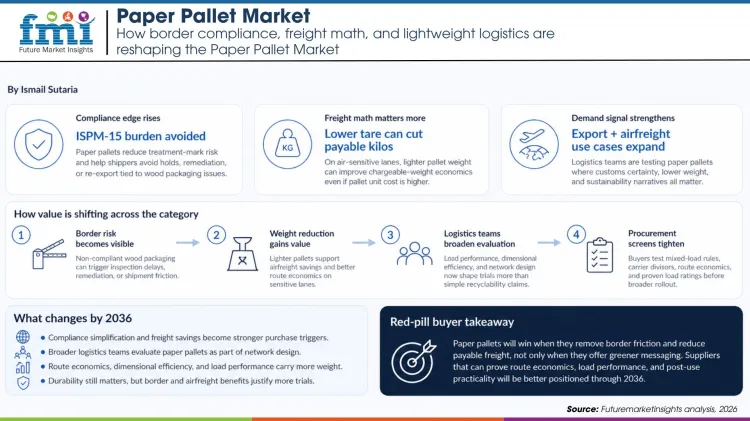
USDA APHIS and CBP guidance on wood packaging makes it clear that non-compliant material can trigger holds, remediation, or re-export. That gives paper pallets an advantage because they avoid ISPM-15 treatment-mark issues that still complicate cross-border wood packaging decisions.
Freight economics add a second, more immediate pull. Under IATA chargeable-weight logic, any reduction in pallet tare can help shippers lower payable kilograms on sensitive lanes. That means the category can win even when the pallet itself costs more than a basic wooden alternative.
Which demand signals matter most now
- Exporters want packaging that lowers the chance of customs friction.
- Weight reduction remains commercially attractive as airlines and shippers chase fuel and carbon savings.
Paper pallets are attractive because they simplify compliance conversations. Shippers that have dealt with wood-packaging inspections or mixed-load complications understand the value of using a material that does not bring the same phytosanitary burden into the transaction.
The weight story is equally persuasive. Airline and cargo operators continue to highlight the savings that come from lighter equipment, and buyers can apply the same logic to pallet selection. For high-value or air-sensitive lanes, every kilogram removed from packaging can improve landed economics.
| Market dimension | 2015-2025 | 2026-2036 |
|---|---|---|
| Core buying motive | Sustainability and niche export use drove much of the interest. | Compliance simplification and freight savings become stronger purchase triggers. |
| Competitive benchmark | Wood pallets remained the undisputed default. | Paper pallets gain ground where border risk and airfreight costs are material. |
| Channel context | Adoption was often project-specific or customer-led. | Broader logistics teams evaluate them as part of network design. |
| Claims emphasis | Recyclability messaging carried a lot of the sales story. | Load performance, dimensional efficiency, and route economics matter more. |
| Buyer caution | Questions centered on durability and handling limits. | Buyers still test performance, but compliance and freight math justify more trials. |
What buyers still need to challenge
- Compliance benefits are strong, but mixed shipments and route-specific rules still need checking.
- Weight savings only convert into margin when carrier divisors and dimensional rules are understood correctly.
Procurement teams should still review the full shipment context rather than assuming any lightweight format removes all risk. Mixed loads, dunnage choices, and importer obligations can still create exposure even when the pallet itself looks compliant.
They should also interrogate freight assumptions carefully. Chargeable-weight formulas, divisors, and dimensional rounding can vary by carrier and lane. A good paper pallet program therefore depends on transport math and packaging design being evaluated together, not in separate departments.
What could define the next buying wave
- Tighter enforcement on wood packaging errors should make lightweight alternatives easier to justify in boardrooms.
- The strongest suppliers will be the ones that can prove route economics instead of relying on broad sustainability claims alone.
As wood-packaging enforcement stays strict, logistics teams will put more value on solutions that reduce avoidable border friction. That is especially relevant for exporters who cannot afford delay on high-value or time-sensitive shipments.
At the same time, the category will need to win on data. Buyers increasingly want documented load ratings, freight savings logic, and post-use handling options rather than generic eco-language. For the 2026-2036 outlook and deeper segmentation, see the Future Market Insights report: Paper Pallet Market (2026 - 2036) - https://www.futuremarketinsights.com/reports/paper-pallet-market
Bibliography
- USDA APHIS, "Import ISPM 15-Compliant Wood Packaging Material into the United States" (2026 guidance). Https://www.aphis.usda.gov/plant-imports/wood-packaging-material/import
- US Customs and Border Protection, "Wood Packaging Materials." https://www.cbp.gov/border-security/protecting-agriculture/wpm
- International Plant Protection Convention, ISPM 15: Regulation of wood packaging material in international trade (official text; processed wood and alternative materials exempt). Https://www.ippc.int/static/media/files/publications/en/2014/06/30/ispm_15_2009_en_2014-06-16.pdf
- IATA Knowledge Hub, "Air Cargo Tariffs and Rules: What You Need to Know" (chargeable weight and 6,000 divisor). Https://www.iata.org/en/publications/newsletters/iata-knowledge-hub/air-cargo-tariffs-and-rules-what-you-need-to-know/
- Virgin Atlantic Cargo, ATL Tariff (2026; chargeable weight rule). Https://www.virginatlanticcargo.com/content/dam/cargo/pdf/ATLtariff.pdf
- Swiss WorldCargo lightweight ULD rollout and annual savings (2025 report). Https://www.aircargonews.net/airlines/swiss-worldcargo-rolls-out-lightweight-ulds/1080292.article
- Packaging Dive coverage of corrugated recovery-rate methodology debate (2023-2024). Https://www.packagingdive.com/news/afpa-recycling-rate-corrugated-box-occ/690482/

