


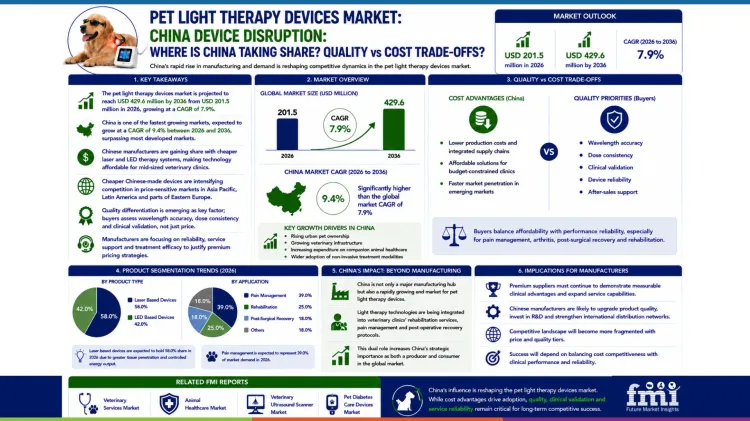
- The pet light therapy devices market is projected to reach USD 429.6 million by 2036 from USD 201.5 million in 2026, growing at a CAGR of 7.9% during the forecast period.
- China is becoming one of the fastest growing manufacturing and consumption hubs. The market in China is expected to grow at a CAGR of 9.4% between 2026 and 2036, surpassing most developed markets.
- Chinese domestic manufacturers are increasing their share by offering cheaper laser and LED therapy systems making photobiomodulation technology affordable for mid-sized veterinary clinics
- The increased availability of cheaper Chinese-made devices is intensifying competition in price-sensitive markets in Asia Pacific, Latin America and parts of Eastern Europe.
- Quality differentiation is emerging as a competitive factor, with veterinary buyers increasingly assessing wavelength accuracy, dose consistency and clinical validation rather than simply purchase price.
- Manufacturers, facing increased competition from Chinese suppliers, are focusing on reliability, service support and treatment efficacy to support premium pricing strategies.
The pet light therapy devices market is moving into a phase where the competitive dynamics are being shaped by China’s increasing footprint in manufacturing veterinary devices. North America and Western Europe continue to be major demand centers, while China is quickly emerging as a production hub and a rapidly growing end market for pet healthcare technologies.
The market will grow by USD 201.5 million in 2026 and is projected to reach USD 429.6 million in 2036, creating an incremental opportunity of more than USD 228 million during the forecast period. The growth is being supported by increasing pet population, increased expenditure on companion animal healthcare and wider use of non-invasive treatment modalities.
China is becoming a big competitor in this industry.
The pet light therapy devices market in the country is estimated to grow at a CAGR of 9.4% during 2026-2036, significantly higher than the CAGR of 7.9% of the global market. The growth is being propelled by the swift rise in urban pet ownership, the growing veterinary infrastructure and the advent of domestic device makers.
Historically, North America and Europe dominated the veterinary photobiomodulation systems market. These suppliers have built their market positions on the basis of strong clinical evidence, premium product engineering and extensive veterinary training programs.
China is reshaping the competitive equation.
Domestic manufacturers have been able to develop more cost-effective laser-based and LED-based therapy devices thanks to lower production costs, integrated supply chains, and growing technical capabilities. Being able to purchase light therapy technology at a much lower acquisition cost is a very attractive proposition for veterinary clinics that are working under budget constraints.
The trend is especially noticeable in developing veterinary markets.
Capital expenditure constraints in emerging economy clinics restrict them from adopting premium therapy systems. Chinese vendors are increasingly filling that gap with offerings in the entry-level and mid-tier device categories at price points that enable faster market penetration.
But cost-competitiveness is only part of the equation.
Veterinary buyers are more sophisticated than ever in evaluating therapeutic light systems. Unlike commodity equipment categories, the results of treatment in photobiomodulation are highly dependent upon the precision of wavelength, reliability of energy delivery, treatment parameters and dependability of the device.
As adoption expands, veterinary clinics are paying greater attention to these performance variables.
This creates a quality-versus-cost trade-off that is reshaping purchasing decisions across the market.
Premium manufacturers still have the edge on clinical validation, practitioner education and after sales support. Veterinary professionals have a tendency to favor devices with documented treatment protocols and proven efficacy data.
Consistency in treatment continues to be critical in applications such as pain management, which is expected to represent 39.0% of market demand in 2026. Clinics using photobiomodulation for arthritis management, post-surgical recovery and rehabilitation need the confidence that devices deliver predictable outcomes from session to session.
Trends in product segmentation also support this dynamic.
The demand for laser based devices is expected to be 58.0% in 2026 due to the continued preference for systems that offer controlled energy output and greater tissue penetration. Performance reliability remains an important buying criterion, even though the less expensive options are gaining more market share.
China's impact is much bigger than manufacturing.
Domestic demand is also increasing rapidly as companion animal care is becoming more sophisticated. Light therapy technologies are being integrated into veterinary clinics’ rehabilitation services, pain management programs and post-operative recovery protocols.
This increases the strategic importance of China in the global market as a producer and consumer.
Manufacturers working in this environment face important strategic choices.
Premium suppliers must continue to demonstrate measurable clinical advantages, while expanding service capabilities and practitioner training. Chinese manufacturers are also likely to gradually upgrade their value chains through better product quality, investment in research and the strengthening of international distribution networks.
The likely result is a more fragmented competitive landscape.
Entry level markets may become more price driven but the more advanced veterinary facilities are still focused on performance, validation and support infrastructure.
One misconception to avoid is that the market leader is necessarily the one with the cheapest devices.
At the end of the day, veterinary professionals will evaluate technologies based on treatment results, client satisfaction and operational reliability. The price remains a factor, but clinical trust often trumps this in long-term purchasing decisions.
Bottom line
China is emerging as a key disruptive force in the pet light therapy devices market, fueled by a combination of manufacturing scale, cost competitiveness and rapidly growing domestic demand. The availability of less expensive devices is increasing market access, but the long-term competitive landscape will rely on the industry’s capacity to balance affordability with demonstrated clinical performance and treatment consistency.

