


- Processing capacity is becoming a stronger margin factor in starch derivatives because suppliers must secure reliable crop inputs, energy access, wet-milling efficiency, drying capacity, modification capability, and logistics continuity before they can defend contracts.
- Corn remains the most important feedstock in starch derivatives, but wheat, potato, cassava, and tapioca are becoming more strategically important where buyers need specific texture, clarity, clean-label positioning, or regional sourcing flexibility.
- Feedstock risk is not only a crop-price issue. Weather disruption, low starch content, poor grain quality, cellulose load, energy volatility, trade policy, import competition, and underutilized plants can all affect production cost and delivery reliability.
- The strongest advantage belongs to integrated processors with crop access, wet-milling scale, modification technology, application labs, multiple sourcing regions, and the ability to shift between native starch, modified starch, glucose syrup, maltodextrin, resistant starch, and industrial starch applications.
- The biggest risk is assuming starch derivatives are simple commodity ingredients. In reality, buyers are increasingly paying for supply security, consistent functionality, documentation, and reliable production capacity as much as they are paying for starch itself.
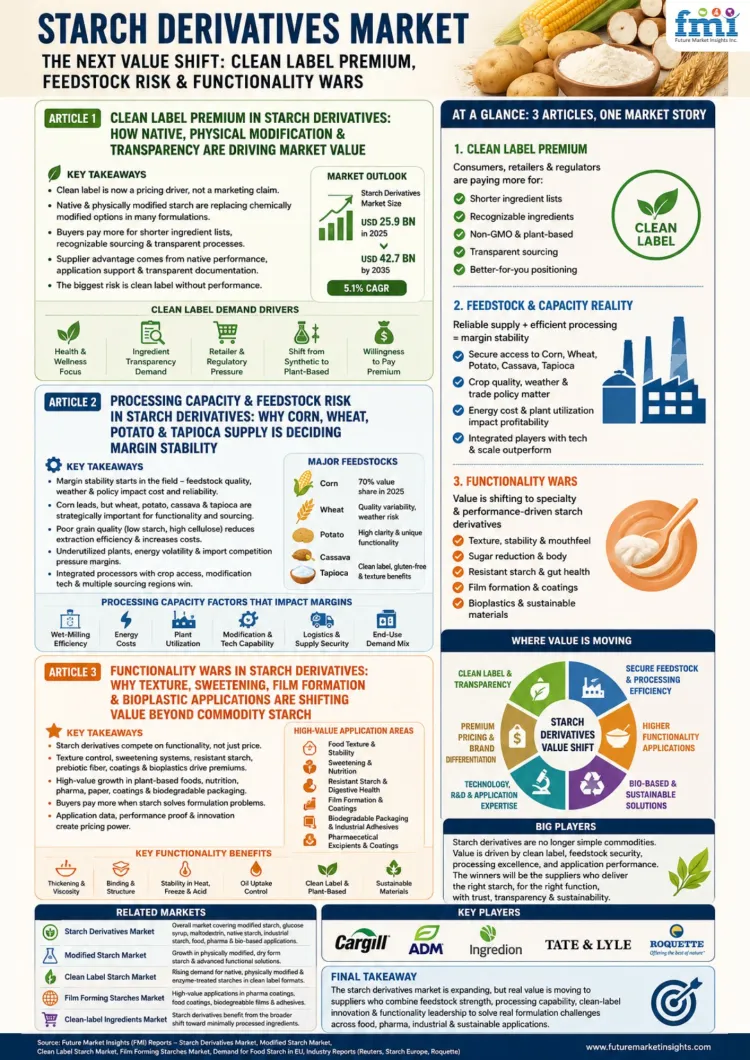
Processing capacity is becoming one of the most important hidden pressure points in the starch derivatives market. The market is growing steadily, but the economics behind that growth are becoming more difficult. FMI projects the starch derivatives market to increase from USD 25.9 billion in 2025 to USD 42.7 billion by 2035 at a 5.1% CAGR, supported by demand from food and drinks, biotechnology, bioplastics, industrial markets, clean-label formulations, plant-based alternatives, and resistant starch applications. That growth creates volume opportunity, but it also increases pressure on processors to secure dependable raw materials and maintain efficient conversion capacity.
The core issue is that starch derivatives are only as stable as the agricultural and processing systems behind them. Corn, wheat, potato, cassava, and tapioca do not behave like identical raw materials. Each crop has different starch yield, harvest seasonality, moisture profile, regional concentration, processing cost, and functional output. Corn may dominate because of its high starch yield, cost efficiency, and wet-milling scale, but wheat, potato, cassava, and tapioca remain essential because they support different functionality and sourcing needs. FMI identifies corn as the leading source of starch derivatives, with a 70% value share in 2025, and notes that major processors use wet milling to produce native and modified starches, glucose syrups, maltodextrin, and polyols.
This creates a simple but important market reality: starch derivative margin stability begins before the starch plant. It begins in the field. Agricultural yield, weather conditions, raw material availability, and trade policies directly affect production costs and supply stability. FMI specifically identifies corn, wheat, cassava, and potatoes as core feedstocks whose prices are influenced by crop yield, weather, and government trade policy. This means processors cannot treat procurement as a back-office activity. Feedstock procurement is now central to pricing power, supply reliability, and customer retention.
Corn gives starch derivative producers scale, but it also creates concentration risk. Corn-based starch derivatives are widely used in confectionery, sauces, dairy applications, beverage sweeteners, processed foods, and fermentation-based applications. Corn’s advantage comes from the ability to convert large volumes into multiple outputs, including native starch, modified starch, glucose syrup, high-fructose corn syrup, maltodextrin, resistant starch, and fermentation substrates. However, when corn costs rise or competing uses such as feed, ethanol, and biochemicals absorb supply, starch processors face direct pressure on input costs and operating margins.
Wheat creates a different type of risk. It is not only the price of wheat that matters; quality matters just as much. In 2024, Reuters reported that France’s soft wheat harvest was expected to be the lowest in 40 years because of excess rain, and starch makers warned that smaller grains contained less starch and more cellulose, creating higher processing challenges, possible filter clogging, machine damage, slowdowns, and additional co-product handling. This shows why feedstock risk cannot be measured only by tonnage. A processor may receive enough grain by volume, but still face lower extraction efficiency, higher maintenance cost, and weaker throughput if the starch content and grain quality are poor.
Potato starch carries another form of strategic importance. Potato starch is valued in applications where clarity, viscosity, neutral taste, and specific texture are difficult to replace. In food starch applications, FMI notes that potato starch has unique properties, including high amylopectin content, large granule size, and superior clarity, making it important in baby food, clear sauces, confectionery, and gluten-free baking where maize and wheat alternatives may not deliver equivalent performance. This makes potato starch less interchangeable than many buyers assume. When potato supply tightens, processors and buyers may face reformulation risk, not only price pressure.
Tapioca and cassava are important because they give processors and food manufacturers a different clean-label, gluten-free, and texture route. Tapioca starch is often valued for smooth texture, neutral taste, clear gels, and allergen-friendly positioning. However, tapioca supply can also become a margin pressure point because it is more geographically concentrated than corn. Reuters reported that Vietnamese tapioca imports into Europe nearly trebled for the second consecutive year, supported by the EU-Vietnam trade agreement, while Thailand remains the largest starch exporter and produces most cassava starch, also called tapioca. This creates both opportunity and risk: buyers gain access to tapioca-based alternatives, but domestic processors may face import competition and sourcing volatility.
Processing capacity is the second major margin lever after feedstock. Starch processing is capital-intensive because producers need wet-milling systems, separation capacity, drying systems, modification lines, quality testing, storage, energy access, wastewater handling, and logistics. In Europe, Starch Europe states that the industry produces 9.8 million tonnes of starch and starch derivatives and more than 5 million tonnes of proteins and fibres from 70 production facilities in 18 EU member states, primarily using 22 million tonnes of EU-grown wheat, maize, and starch potatoes. This shows how starch derivatives depend on large-scale crop conversion infrastructure, not just ingredient blending.
Capacity utilization is becoming more important because demand is uneven across end markets. Starch derivatives serve food, beverage, paper, cardboard, pharmaceutical, textile, chemical, and packaging applications. In Europe, the starch industry’s output is exposed not only to food demand but also to non-food sectors such as paper and corrugating. Starch Europe reports that EU consumption includes native starches, modified starches, and starch sweeteners, with significant use in food and non-food applications, especially corrugating and paper making. When paper or cardboard demand weakens, starch plants may lose volume even if food demand remains stable.
Recent European market conditions show how quickly utilization can become a problem. Reuters reported that Europe’s starch makers reduced production as demand fell from pandemic-era highs, with paper and cardboard weakness weighing on starch use. The same report noted that cheaper imports from Asia, including Chinese dextrose and sorbitol and Vietnamese tapioca, added pressure on European producers. This matters because lower utilization weakens fixed-cost absorption. Even efficient plants can face margin pressure when they run below optimal capacity.
Energy cost is another major pressure point. Starch processing requires heat, drying, water treatment, and continuous industrial operations. Roquette’s June 2025 EU market update described the European starch processing industry as operating under strain from raw material availability, energy costs, and market demand, with grain price volatility and high energy costs continuing to affect the sector. Energy exposure is especially important in modified starch, glucose syrup, maltodextrin, and drying-heavy powder formats because production economics depend on both crop cost and conversion cost.
Modified starch demonstrates why capacity quality matters, not only capacity volume. FMI projects the modified starch market to grow from USD 9.4 billion in 2025 to USD 14.2 billion by 2036 at a 3.8% CAGR. Dry form is projected to hold 66.8% share in 2026, and physically modified starch is projected to secure 52.1% share in 2026 as food makers seek texture control with cleaner label wording. This means buyers are not just asking for more starch. They are asking for more technically controlled starch that can survive heat, acid, shear, freezing, thawing, storage, and clean-label reformulation pressure.
The capacity constraint is especially visible in clean-label and physically modified starch. Clean-label reformulation is pushing food manufacturers away from chemically modified starches toward native, physically modified, and enzyme-treated starches. FMI estimates the clean-label starch market at USD 1.3 billion in 2026 and USD 2.4 billion by 2036, with native starch holding 50.0% of the product segment and powder starch holding 70.0% of form demand. This shift requires processors to invest in functionality without relying only on traditional chemical modification.
This is where processing know-how becomes a competitive moat. Native starch can be label-friendly, but it may not always deliver the same heat stability, freeze-thaw resistance, or acid tolerance as chemically modified starch. Physically modified and enzyme-treated starches can narrow that performance gap, but they require process control, formulation support, and application testing. A supplier with only basic extraction capacity may struggle to serve premium food manufacturers, while a supplier with modification technology and application labs can defend higher-margin contracts. FMI notes that clean-label starch adoption is constrained by native starch performance limitations, cost premiums for specialty grades, and the need for application-specific formulation expertise.
The strongest processing advantage belongs to integrated players. In the EU food starch market, FMI identifies major processors such as Cargill, Roquette, Ingredion, AVEBE, and Tate & Lyle as operators of integrated wet-milling and starch modification facilities. FMI also notes that these processors control the conversion of maize, wheat, and potato into native and modified starch products, with specialization based on crop access and processing capability. This type of integration allows companies to manage crop procurement, production scheduling, product development, quality control, and customer technical support within a more coordinated system.
Global competitive advantage is also tied to portfolio flexibility. FMI identifies Cargill, ADM, Ingredion, Roquette, and Tate & Lyle as major starch derivative manufacturers with strong supply chain networks, R&D capabilities, and diversified portfolios. The same source notes that companies are emphasizing clean-label starches, resistant starches for digestive health, and bio-based applications for green packaging. Suppliers that can shift output between food, beverage, pharma, paper, packaging, and industrial uses are better positioned to protect margins when one end market slows.
For buyers, the practical lesson is that lowest-price sourcing can create hidden risk. A starch derivative may look interchangeable on a procurement sheet, but the risk profile changes depending on feedstock origin, crop year quality, supplier integration, processing route, and technical service. A sauce manufacturer buying modified starch, a dairy alternative brand buying clean-label starch, a paper converter buying cationic starch, and a nutraceutical company buying resistant starch all need different performance guarantees. Price matters, but inconsistent viscosity, delayed supply, reformulation failure, or poor batch repeatability can cost more than a modest ingredient premium.
For suppliers, the lesson is that feedstock diversification and capacity discipline are becoming commercial selling points. Companies that can demonstrate stable access to corn, wheat, potato, cassava, and tapioca will be better placed to win buyers that worry about climate volatility, trade disruption, and origin concentration. Companies that can also show energy resilience, modern wet-milling systems, clean-label modification capability, and documented quality controls will be able to defend stronger pricing. In starch derivatives, reliability itself is becoming part of the product.
The margin winners will therefore be processors that treat feedstock and capacity as strategy, not operations. They will build supply agreements with growers, invest in crop-specific processing knowledge, maintain flexible product portfolios, and support buyers with application data. They will use corn for scale, potato for specialized functionality, wheat where regional economics work, and tapioca or cassava where clean-label and gluten-free positioning matter. They will also avoid overdependence on one crop, one plant, one region, or one end market.
The weakest players will be those caught between commodity pricing and specialty expectations. If a supplier lacks raw material security, modification capability, technical documentation, and logistics resilience, it may be forced to compete mainly on price. That is dangerous in a market where energy cost, weather damage, import competition, and underutilized capacity can quickly erode margins. The starch derivatives market is growing, but growth alone will not protect processors that cannot control their conversion economics.
For the starch derivatives market, the next phase of competition will be decided less by who can produce starch and more by who can produce the right starch, from the right feedstock, at the right specification, with reliable cost control. Corn, wheat, potato, and tapioca are not just raw materials. They are strategic margin levers. Processing capacity is not just factory infrastructure. It is the foundation of buyer trust, supply security, and long-term pricing power.
Related Markets
- Starch Derivatives Market: Parent market covering modified starch, glucose syrup, maltodextrin, corn-based starch derivatives, industrial starch, food applications, pharmaceutical uses, and bio-based applications.
- Modified Starch Market: Important because processing capacity is shifting toward dry, physically modified, and cleaner-label starch grades that require more technical conversion capability.
- Clean Label Starch Market: Relevant because clean-label demand increases the need for native, physically modified, and enzyme-treated starches with stronger application support.
- Demand for Food Starch in EU: Useful for understanding integrated wet-milling capacity, maize/wheat/potato conversion, and the role of major processors in regional supply security.
- Film Forming Starches Market: Relevant because higher-value starch applications in coatings, biodegradable packaging, adhesives, and pharmaceutical films increase the importance of specialized processing capacity.

