

- Market Size (2026)
- USD 1.3 Bn
- Forecast (2036)
- USD 2.4 Bn
- CAGR (2026 to 2036)
- 6.5%
Clean Label Starch Market Size, Market Forecast and Outlook By FMI
The clean label starch market was valued at USD 1.2 billion in 2025. The market is set to reach USD 1.3 billion by 2026-end and grow at a CAGR of 6.5% between 2026-2036 to reach USD 2.4 billion by 2036. Native Starch will dominate with a 50.0% share, while Powder Starch will lead with a 70.0% share.
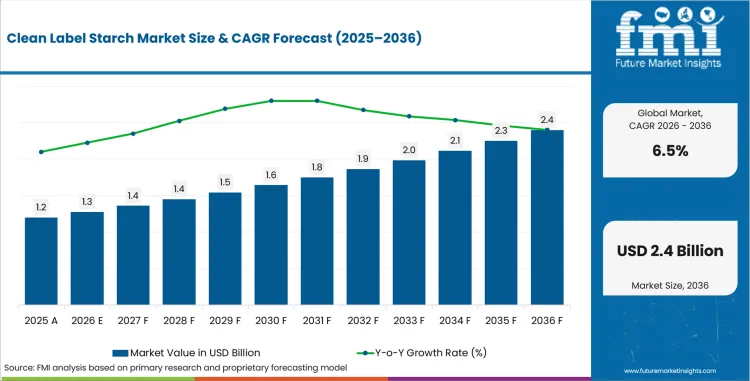
Key Takeaways, Market Size, and Forecast
- 2026 Market Size: USD 1.3 billion
- 2036 Market Size: USD 2.4 billion
- Compound Annual Growth Rate (CAGR): 6.5% from 2026 to 2036
- Absolute $ Opportunity: USD 1.1 billion between 2026 and 2036
- Leading Product Segment: Native Starch
- Native Starch Share in 2026: 50.0%
- Fastest-growing Country: China
- China CAGR: 8.8% through 2036
| Parameter | Details |
|---|---|
| Market Size in 2026 (Value) | USD 1.3 billion |
| Market Forecast in 2036 (Value) | USD 2.4 billion |
| Compound Annual Growth Rate (CAGR) | 6.5% from 2026 to 2036 |
| Years Considered | 2021 to 2036 |
| Base Year | 2025 |
| Forecast Period | 2026 to 2036 |
| Units Considered | Value (USD Bn) |
| Leading Sub-Region | China |
Summary of the Clean Label Starch Market
- Demand and Growth Drivers
- Clean-label reformulation across bakery, dairy, sauces, and convenience food categories is expected to sustain demand for native and minimally modified starch as a replacement for chemically modified starch through 2036.
- Consumer preference for recognizable ingredient names and regulatory scrutiny of modified starch labeling are likely to drive procurement shifts toward clean-label starch variants during the forecast period.
- Expansion of clean-label starch into snack seasoning, plant-based food, and infant nutrition applications is anticipated to broaden the addressable market beyond traditional food processing.
- Product and Segment View
- Native starch is likely to account for 50.0% of the product segment in 2026, supported by its label-friendly positioning as an unmodified, recognizable ingredient in processed food formulations.
- Food and beverages account for 75.0% of application demand, with sauces, soups, bakery, dairy, and convenience food as the primary procurement categories.
- Corn-based starch holds 45.0% of the source segment, reflecting the scale of corn wet milling and the availability of clean-label corn starch grades for food manufacturing.
- Geography and Competitive Outlook
- China is projected to lead with an 8.8% CAGR through 2036, driven by rapid growth in processed food manufacturing, increasing clean-label awareness, and domestic starch production capacity.
- India at 8.1% reflects expanding packaged food manufacturing and growing consumer demand for ingredient transparency in urban retail markets.
- Companies with diversified starch sourcing, clean-label certification, and application-specific formulation capabilities are likely to capture increasing share during the forecast period.
- Analyst Opinion
- Nandini Roy Choudhury, Principal Consultant at FMI says, 'Starch suppliers that can deliver consistent functionality across sauces, dairy, and bakery applications while meeting clean-label ingredient declaration requirements are likely to strengthen supply positions with food manufacturers scaling reformulation programs through 2036.'
- The clean-label starch market is transitioning from a niche premium ingredient to a mainstream food manufacturing requirement as clean-label becomes the baseline procurement specification.
- Adoption is increasing due to regulatory pressure on modified starch labeling, consumer demand for simple ingredient lists, and the improving functional performance of native starch solutions.
- Physically modified and enzyme-treated starch grades are closing the performance gap with chemically modified starch, enabling broader adoption in demanding food processing applications.
- Corn, tapioca, and potato remain the primary starch sources, with tapioca gaining share in applications requiring specific texture and mouthfeel characteristics.
Clean Label Starch Market Definition
The clean-label starch market encompasses commercially traded starch products that meet clean-label criteria, including native starch, physically modified starch, and enzyme-treated starch derived from corn, tapioca, potato, and other botanical sources. These products serve as thickeners, stabilizers, and texturizers in food and beverage, pharmaceutical, and industrial applications.
Clean Label Starch Market Inclusions
Market scope covers all commercially traded clean-label starch products categorized by product (native starch, physically modified starch, enzyme-treated starch), form (powder starch, liquid starch, granular starch), application (food and beverages, pharmaceuticals, industrial), end use (food and beverage manufacturers, pharmaceutical companies, industrial users), and source (corn-based starch, tapioca-based starch, potato-based starch, other sources). Revenue coverage spans 2026 to 2036.
Clean Label Starch Market Exclusions
The scope does not include chemically modified starch, starch derivatives produced through chemical cross-linking or substitution, or industrial starch used exclusively in paper and textile manufacturing.
Clean Label Starch Market Research Methodology
- Primary Research: FMI analysts conducted interviews with starch producers, food manufacturers, ingredient formulators, and procurement specialists in key markets.
- Desk Research: Combined data from starch industry trade databases, food ingredient sourcing reports, and clean-label certification body publications.
- Market Sizing and Forecasting: Bottom-up aggregation from food, pharmaceutical, and industrial application volumes across regional clean-label adoption curves.
- Data Validation: Cross-checked quarterly against starch production data, food manufacturing procurement trends, and ingredient trade flow statistics.
Why is the Clean Label Starch Market Growing?
- Clean-label reformulation in sauces, dairy, bakery, and convenience food is generating sustained demand, with the market projected to reach USD 2.4 billion by 2036.
- China leads at 8.8% CAGR, driven by processed food manufacturing growth, domestic starch production capacity, and increasing clean-label awareness among urban consumers.
- Native starch at 50.0% of the product segment reflects the dominance of unmodified starch in clean-label positioning, supported by improving functional performance in food processing applications.
The clean-label starch market is estimated at USD 1.3 billion in 2026 and is projected to reach USD 2.4 billion by 2036, expanding at a CAGR of 6.5%. Demand is shaped by the structural shift from chemically modified starch to native and minimally processed alternatives in food manufacturing. Clean-label starch meets consumer expectations for simple, recognizable ingredient lists.
Native starch accounts for 50.0% of the product segment, while powder starch represents 70.0% of form demand. Food and beverages account for 75.0% of application demand, with food and beverage manufacturers representing 70.0% of end-use procurement. Corn-based starch holds 45.0% of the source segment.
Growth reflects the improving functional performance of native and physically modified starch solutions that are narrowing the performance gap with chemically modified starch in sauce viscosity, bakery texture, and dairy stabilization applications.
Market Segmentation Analysis
- Native starch holds 50.0% of the product segment in 2026, positioned as an unmodified, label-friendly thickener and texturizer for clean-label food formulations.
- Food and beverages account for 75.0% of application demand, with sauces, soups, bakery, dairy, and convenience food as the primary procurement categories.
- Corn-based starch dominates at 45.0% of the source segment, supported by corn wet milling scale and the availability of food-grade native corn starch.
The clean-label starch market is segmented by product (native starch, physically modified starch, enzyme-treated starch), form (powder starch, liquid starch, granular starch), application (food and beverages, pharmaceuticals, industrial), end use (food and beverage manufacturers, pharmaceutical companies, industrial users), and source (corn-based starch, tapioca-based starch, potato-based starch, other sources).
Insights into the Native Starch Product Segment
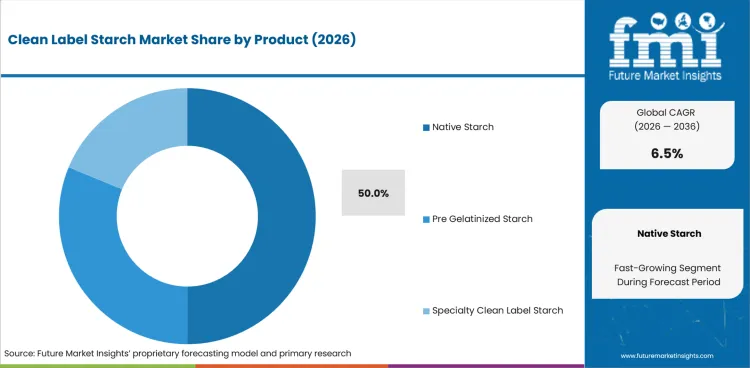
In 2026, native starch accounts for 50.0% of the product segment. Corn, tapioca, and potato native starch grades serve food manufacturers seeking clean-label ingredient declaration without the regulatory complexity of modified starch labeling. Native starch delivers basic thickening and texturizing functionality.
Physically modified starch and enzyme-treated starch represent higher-performance clean-label alternatives that approach the functional properties of chemically modified starch. These grades serve applications in sauces, dairy, and convenience food where viscosity stability, freeze-thaw tolerance, and process durability are required.
Insights into the Food and Beverages Application Segment
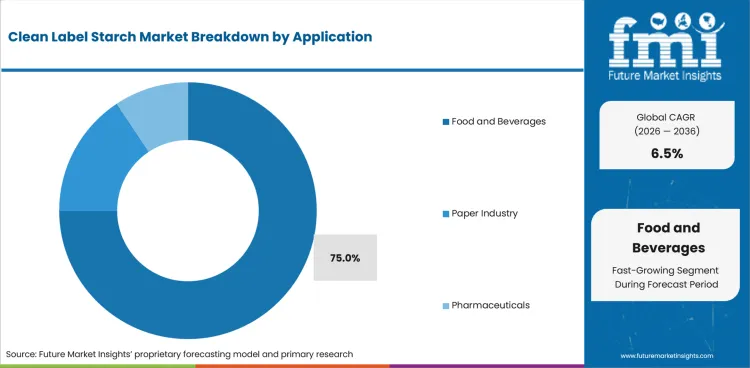
Food and beverages account for 75.0% of application demand in 2026. Sauces and soups are the largest sub-application, followed by bakery products, dairy, and convenience food. Starch provides thickening, stabilization, and texture in these applications while meeting clean-label ingredient requirements.
Snack seasoning, plant-based food, and infant nutrition represent growing application sub-segments where clean-label starch provides binding, coating, and texturizing functionality with simple ingredient declaration.
Clean Label Starch Market Drivers, Restraints, and Opportunities
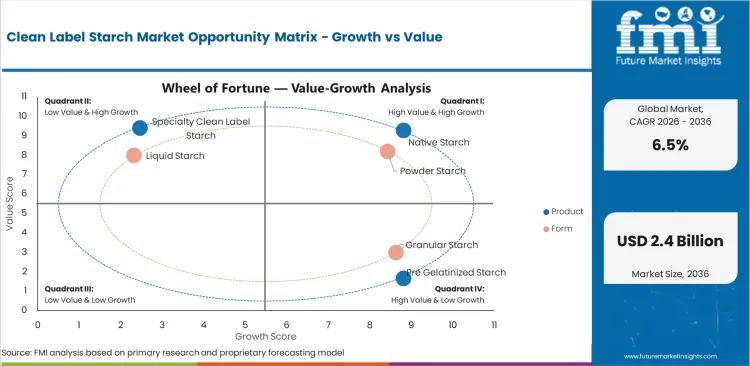
- Consumer demand for simple ingredient lists and regulatory scrutiny of modified starch labeling are creating structural procurement shifts toward clean-label starch in food manufacturing.
- Functional performance limitations of native starch compared to chemically modified grades constrain adoption in process-intensive food manufacturing applications.
- Physically modified and enzyme-treated starch grades are closing the performance gap, enabling broader clean-label starch adoption across sauces, dairy, and convenience food.
The clean-label starch market expands on the basis of ingredient transparency demand, regulatory trends, and improving native starch functionality. Constraints include performance limitations relative to modified starch, cost premiums for specialty grades, and the need for application-specific formulation expertise.
Ingredient Transparency and Modified Starch Labeling
Demand is shaped by consumer preference for recognizable ingredients and regulatory requirements that distinguish modified starch labeling from native starch. Food manufacturers are reformulating product lines to use clean-label starch that appears as a simple, familiar ingredient on product packaging.
Functional Performance Gap
Adoption is constrained by the inferior process tolerance and viscosity stability of native starch compared to chemically modified alternatives. This performance gap limits clean-label starch adoption in retorted sauces, frozen convenience food, and other applications requiring durability under extreme processing conditions.
Technology Advancement in Clean-Label Starch
Growth is supported by advances in physical modification and enzymatic treatment that improve clean-label starch functionality. Heat-moisture treatment, annealing, and controlled enzyme processes produce starch grades with improved freeze-thaw stability, shear resistance, and acid tolerance.
Analysis of Clean Label Starch Market By Key Countries
.webp "Top Country Growth Comparison Clean Label Starch Market Cagr (2026 2036)")
| Country | CAGR |
|---|---|
| China | 8.8% |
| India | 8.1% |
| Germany | 7.1% |
| Brazil | 6.8% |
| USA | 6.2% |
| UK | 5.5% |
| Japan | 4.9% |
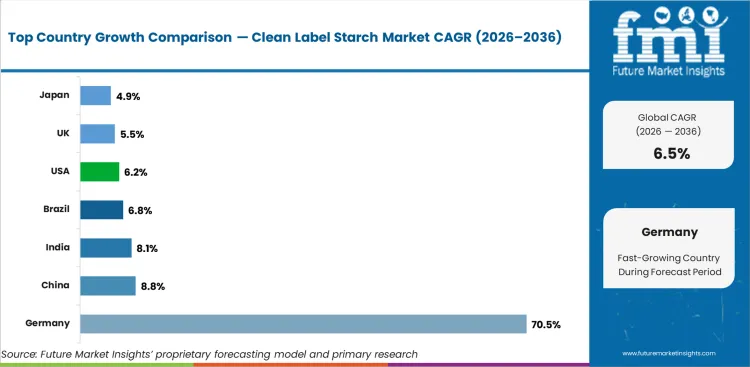
- China at 8.8% leads growth, driven by processed food manufacturing expansion, domestic starch production capacity, and growing consumer demand for ingredient transparency.
- India at 8.1% reflects expanding packaged food manufacturing and increasing clean-label awareness among urban consumers purchasing through organized retail.
- Germany (7.1%) and Brazil (6.8%) sustain growth through established food manufacturing sectors and regulatory alignment with clean-label ingredient definitions.
- The USA at 6.2% maintains demand through ongoing food manufacturer reformulation programs replacing modified starch with clean-label alternatives.
The global clean-label starch market is projected to expand at a CAGR of 6.5% from 2026 to 2036. The study covers more than 30 countries, and the primary markets are analyzed below.
Demand Outlook for Clean Label Starch Market in China
China is projected to lead with an 8.8% CAGR through 2036. Rapid processed food manufacturing growth, large domestic corn and tapioca starch production capacity, and increasing urban consumer demand for ingredient quality drive clean-label starch adoption.
- Domestic starch producers in China scale clean-label native starch production to serve growing demand from processed food and convenience food manufacturers.
- Urban consumer demand for ingredient transparency in packaged food is pushing domestic manufacturers to adopt clean-label starch formulations.
- Government food safety initiatives and SAMR labeling standards support the transition from chemically modified to native and physically modified starch ingredients.
Future Outlook for Clean Label Starch Market in India
India is expected to grow at 8.1% through 2036. Expanding packaged food manufacturing, organized retail growth in tier-1 and tier-2 cities, and international food company operations in India support clean-label starch procurement.
- FSSAI food labeling regulations support ingredient transparency that aligns with clean-label starch procurement by domestic food manufacturers.
- International food companies manufacturing in India adopt global clean-label ingredient specifications including native and enzyme-treated starch grades.
- Domestic corn and tapioca starch production provides a local supply base for clean-label starch ingredients in Indian food manufacturing.
Opportunity Analysis of Clean Label Starch Market in Germany
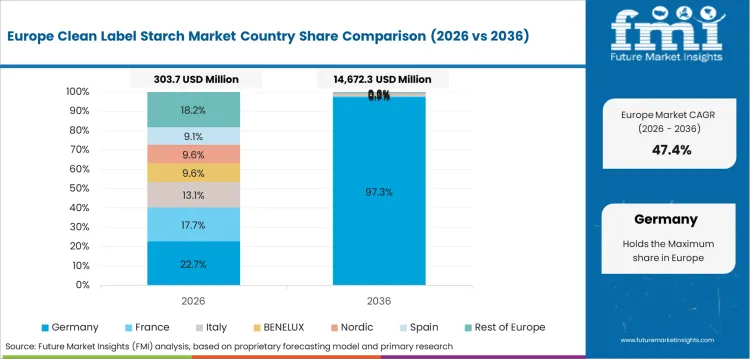
Germany is projected to expand at 7.1% through 2036. EU food additive regulation, established sauce and convenience food manufacturing, and consumer preference for clean ingredient lists support clean-label starch demand.
- EU food additive regulations require specific labeling for chemically modified starch, creating a regulatory incentive for food manufacturers to use clean-label native starch alternatives.
- German sauce and convenience food manufacturers procure physically modified starch grades that deliver process tolerance while meeting clean-label ingredient declaration requirements.
- Established starch producers in Germany invest in physical modification and enzyme treatment technologies to serve growing clean-label demand.
In-depth Analysis of Clean Label Starch Market in the United States
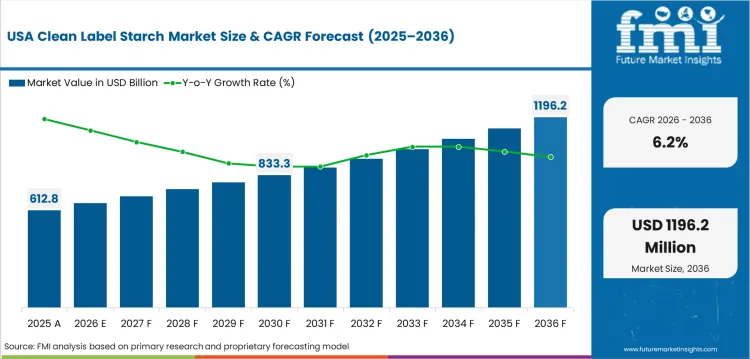
The USA is projected to grow at 6.2% through 2036. Ongoing food manufacturer reformulation programs and retailer clean-label sourcing requirements sustain demand for clean-label starch across sauce, dairy, and snack applications.
- Major US food companies continue multi-year reformulation programs replacing chemically modified starch with clean-label native and physically modified alternatives.
- Retailer private-label specifications in US grocery chains require clean-label ingredient declarations that favor native starch over modified starch in sauces and dressings.
- Tapioca-based clean-label starch gains share in US food manufacturing for applications requiring specific texture and mouthfeel characteristics.
Sales Analysis of Clean Label Starch Market in Japan
Japan is projected to grow at 4.9% through 2036. Quality-driven food manufacturing, established ingredient safety standards, and consumer preference for natural food products support steady clean-label starch demand.
- Japanese food manufacturers maintain strict ingredient qualification protocols that favor documented native starch sources with consistent functionality and safety data.
- Potato and tapioca-based starch grades serve Japanese food applications where specific texture characteristics are required in sauces, noodles, and confectionery.
- Long supplier qualification cycles support stable procurement relationships with established clean-label starch producers.
Competitive Landscape and Strategic Positioning
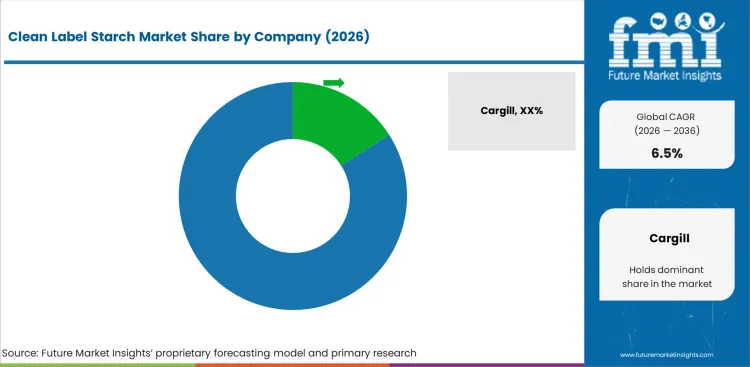
- Cargill and Ingredion lead the market with vertically integrated corn and tapioca starch operations and comprehensive clean-label grade portfolios for food manufacturing.
- Tate & Lyle and Archer Daniels Midland Company compete through diversified food ingredient platforms that integrate clean-label starch with other texturizing and stabilizing solutions.
- Roquette Freres S.A. and Beneo maintain positions through specialty starch expertise and application-specific formulation support.
Cargill and Ingredion hold leading positions through vertically integrated starch production from corn, tapioca, and potato sources, combined with global distribution networks serving food manufacturers. Both companies invest in physical modification and enzyme treatment technologies.
Tate & Lyle competes through its speciality food ingredients platform. Archer Daniels Midland Company provides clean-label starch as part of its diversified agricultural processing portfolio. Roquette Freres and Beneo serve European and Asian markets with specialty starch grades.
Barriers include grain sourcing and wet milling infrastructure, food safety certification, and application-specific formulation expertise. Strategic priorities center on functional performance improvement, tapioca starch capacity expansion, and clean-label certification.
Key Companies in the Clean Label Starch Market
Key global companies leading the clean label starch market include:
- Cargill (USA), Ingredion (USA), and Tate & Lyle (UK) maintain vertically integrated starch production with comprehensive clean-label portfolios and established food manufacturer relationships globally.
- Archer Daniels Midland Company (USA), Roquette Freres S.A. (France), and Beneo (Belgium) hold positions through diversified ingredient platforms, specialty starch expertise, and application support for European and Asian food manufacturers.
- Emerging players focus on tapioca and specialty botanical starch sources for niche clean-label applications in plant-based food and infant nutrition.
Competitive Benchmarking: Clean Label Starch Market
| Company | Starch Portfolio | Source Diversification | Food Manufacturer Access | Geographic Footprint |
|---|---|---|---|---|
| Cargill | High | High | Strong | Global |
| Ingredion | High | High | Strong | Global |
| Tate & Lyle | High | Medium | Strong | Global |
| ADM | High | High | Strong | Global |
| Roquette Freres S.A. | Medium | Medium | Moderate | Europe, Global |
| Beneo | Medium | Medium | Moderate | Europe |
Source: Future Market Insights competitive analysis, 2026.
Key Developments in Clean Label Starch Market
- In 2025, Ingredion expanded its clean-label tapioca starch production capacity to serve growing demand from sauce and dairy manufacturers in North America and Asia.
- In 2025, Tate & Lyle launched a new physically modified clean-label starch range for frozen convenience food applications in European markets.
Key Players in the Clean Label Starch Market
Major Global Players
- Cargill
- Ingredion
- Tate & Lyle
- Archer Daniels Midland Company
- Roquette Freres S.A.
- Beneo
Emerging Players/Startups
- Specialty tapioca starch producers
- Regional native starch suppliers
- Enzyme-treated starch technology companies
Report Scope and Coverage
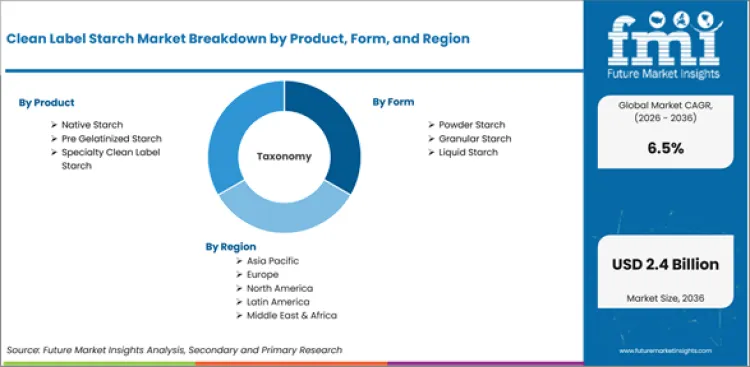
| Parameter | Details |
|---|---|
| Market size by 2036 | USD 2.40 billion |
| Growth rate | 6.5% CAGR (2026 to 2036) |
| Forecast period | 2026 to 2036 |
| Base year value (2025) | USD 1.2 billion |
| Key Segment Covered | Product, Form, Application, End Use, Source |
| Regions covered | North America, Latin America, Europe, East Asia, South Asia and Pacific, Middle East and Africa |
| Countries covered | China, India, Germany, Brazil, USA, UK, Japan, 30 plus countries |
| Key companies profiled | Cargill, Ingredion, Tate & Lyle, Archer Daniels Midland Company, Roquette Freres S.A., Beneo |
| Approach | Hybrid bottom-up and top-down methodology starting with verified starch production and food manufacturing data, projecting adoption velocity across starch types, applications, and regions. |
Market Segmentation Analysis
Clean Label Starch Market Segmented by Product:
- Native Starch
- Unmodified Starch
- Corn Starch
- Potato Starch
- Functional Native Starch
- Improved Stability
- Enhanced Texture
- Unmodified Starch
- Pre Gelatinized Starch
- Cold Water Soluble Starch
- Instant Thickening
- Convenience Foods
- Pregelatinized Blends
- Multi Functional Blends
- Food Processing Use
- Cold Water Soluble Starch
- Specialty Clean Label Starch
- Organic Starch
- Certified Organic
- Clean Label Formulation
- Functional Starch
- Fat Replacement
- Texture Enhancement
- Organic Starch
Clean Label Starch Market Segmented by Form:
- Powder Starch
- Fine Powder
- Industrial Grade
- Granular Starch
- Coarse Granules
- Food Grade
- Liquid Starch
- Slurry Form
- Industrial Use
Clean Label Starch Market Segmented by Application:
- Food and Beverages
- Bakery Products
- Cakes and Pastries
- Bread
- Dairy Products
- Yogurt
- Desserts
- Processed Foods
- Ready Meals
- Sauces and Soups
- Beverages
- Thickened Drinks
- Functional Beverages
- Bakery Products
- Paper Industry
- Paper Coating
- Surface Sizing
- Strength Enhancement
- Paper Coating
- Pharmaceuticals
- Excipient Use
- Tablet Binding
- Controlled Release
- Excipient Use
Clean Label Starch Market Segmented by End Use:
- Food and Beverage Manufacturers
- Processed Food Companies
- Large Scale Production
- Private Label Brands
- Processed Food Companies
- Paper Manufacturers
- Industrial Paper Production
- Packaging Paper
- Specialty Paper
- Industrial Paper Production
- Pharmaceutical Companies
- Drug Manufacturers
- Formulation Development
- Drug Manufacturers
Clean Label Starch Market Segmented by Source:
- Corn Based Starch
- Yellow Corn
- White Corn
- Potato Based Starch
- Native Potato
- Processed Potato
- Tapioca Based Starch
- Cassava Root
- Refined Tapioca
- Wheat Based Starch
- Standard Wheat
- Refined Wheat
Clean Label Starch Market by Region:
- North America
- USA
- Canada
- Mexico
- Latin America
- Brazil
- Chile
- Rest of Latin America
- Western Europe
- Germany
- UK
- Italy
- Spain
- France
- Nordic
- BENELUX
- Rest of Western Europe
- Eastern Europe
- Russia
- Poland
- Hungary
- Balkan & Baltic
- Rest of Eastern Europe
- East Asia
- China
- Japan
- South Korea
- South Asia and Pacific
- India
- ASEAN
- Australia & New Zealand
- Rest of South Asia and Pacific
- Middle East & Africa
- Kingdom of Saudi Arabia
- Other GCC Countries
- Türkiye
- South Africa
- Other African Union
- Rest of Middle East & Africa
Research Sources and Bibliography
- 1. European Commission. (2025). EU Regulation on Food Additives: Modified Starch Classification and Labeling Requirements. EC.
- 2. USA Food and Drug Administration. (2025). FDA Food Starch Standards: Labeling and Safety Requirements for Native and Modified Starch. FDA.
- 3. International Starch Institute. (2025). ISI Annual Report: Global Starch Production and Trade Statistics. ISI.
- 4. Codex Alimentarius Commission. (2025). Codex Standard for Food Grade Starch: Quality Specifications. WHO/FAO.
- 5. Food and Agriculture Organization. (2025). FAO Global Crop Production Statistics: Corn, Cassava, and Potato Output Data. FAO.
This bibliography is provided for reader reference.
This Report Answers
- Estimating the size of the clean-label starch market and projected revenue from 2026 to 2036.
- Segmenting by product, form, application, end use, and source.
- Regional and country-level insights across more than 30 markets.
- Analysis of native, physically modified, and enzyme-treated starch technologies.
- Assessment of the competitive landscape and company benchmarking.
- Identifying investment opportunities in food reformulation, tapioca starch, and specialty applications.
- Tracking supply chain dynamics from grain sourcing to starch distribution.
- Delivery of data in PDF and Excel formats.
Frequently Asked Questions
How big is the clean label starch market in 2026?
The global clean label starch market is estimated to be valued at USD 1.3 billion in 2026.
What will be the size of clean label starch market in 2036?
The market size for the clean label starch market is projected to reach USD 2.4 billion by 2036.
How much will be the clean label starch market growth between 2026 and 2036?
The clean label starch market is expected to grow at a 6.5% CAGR between 2026 and 2036.
What are the key products in the clean label starch market?
The key products in the clean label starch market are Native Starch, Pre Gelatinized Starch and Specialty Clean Label Starch.
Which form segment is expected to contribute significant share in the clean label starch market in 2026?
In terms of form, powder starch segment is expected to command 70.0% share in the clean label starch market in 2026.
Preview the report firsthand - request a free sample
Get SampleGet the brochure for pricing and purchase details.
Get PDFTable of Content
- Key Takeaways
- Market Size and CAGR
- Top Growth Driver
- Fastest Growing Segment
- Leading Region
- Key Companies
- Emerging Opportunities
- Executive Summary
- Global Market Outlook
- Demand-side Trends
- Supply-side Trends
- Technology Roadmap Analysis
- Analysis and Recommendations
- Analyst Perspective (What is happening? Why now? What should investors know?)
- Key Questions Answered
- How large is the market?
- What is the CAGR?
- What are key trends?
- Which region dominates?
- Who are the leaders?
- Market Overview
- Market Coverage / Taxonomy
- Market Definition / Scope / Limitations
- Research Methodology
- Chapter Orientation
- Analytical Lens and Working Hypotheses
- Market Structure, Signals, and Trend Drivers
- Benchmarking and Cross-market Comparability
- Market Sizing, Forecasting, and Opportunity Mapping
- Research Design and Evidence Framework
- Desk Research Programme (Secondary Evidence)
- Expert Input and Fieldwork (Primary Evidence)
- Tooling, Models, and Reference Databases
- Data Engineering and Model Build
- Quality Assurance and Audit Trail
- Market Background
- Market Dynamics (Drivers, Restraints, Opportunity, Trends)
- Scenario Forecast (Optimistic, Likely, Conservative)
- Impact Analysis
- AI Impact
- Sustainability Impact
- Regulatory Impact
- Technology Impact
- Consumer / Buyer Analysis
- Purchase Drivers
- Adoption Barriers
- Buyer Journey
- Opportunity Map Analysis
- Product Life Cycle Analysis
- Supply Chain Analysis
- Investment Feasibility Matrix
- Value Chain Analysis
- PESTLE and Porter's Analysis
- Regulatory Landscape
- Regional Parent Market Outlook
- Production and Consumption Statistics
- Import and Export Statistics
- Global Market Analysis and Forecast, 2021 to 2036
- Historical Market Size Value (USD Million) Analysis, 2021 to 2025
- Current and Future Market Size Value (USD Million) Projections, 2026 to 2036
- Y-o-Y Growth Trend Analysis
- Absolute $ Opportunity Analysis
- Global Market Pricing Analysis, 2021 to 2036
- Global Market Analysis and Forecast, By Product, 2021 to 2036
- Introduction / Key Findings
- Historical Market Size Value (USD Million) Analysis By Product, 2021 to 2025
- Current and Future Market Size Value (USD Million) Analysis and Forecast By Product, 2026 to 2036
- Native Starch
- Unmodified Starch
- Functional Native Starch
- Pre Gelatinized Starch
- Cold Water Soluble Starch
- Pregelatinized Blends
- Specialty Clean Label Starch
- Organic Starch
- Functional Starch
- Native Starch
- Y-o-Y Growth Trend Analysis By Product, 2021 to 2025
- Absolute $ Opportunity Analysis By Product, 2026 to 2036
- Global Market Analysis and Forecast, By Form, 2021 to 2036
- Introduction / Key Findings
- Historical Market Size Value (USD Million) Analysis By Form, 2021 to 2025
- Current and Future Market Size Value (USD Million) Analysis and Forecast By Form, 2026 to 2036
- Powder Starch
- Fine Powder
- Industrial Grade
- Granular Starch
- Coarse Granules
- Food Grade
- Liquid Starch
- Slurry Form
- Industrial Use
- Powder Starch
- Y-o-Y Growth Trend Analysis By Form, 2021 to 2025
- Absolute $ Opportunity Analysis By Form, 2026 to 2036
- Global Market Analysis and Forecast, By Application, 2021 to 2036
- Introduction / Key Findings
- Historical Market Size Value (USD Million) Analysis By Application, 2021 to 2025
- Current and Future Market Size Value (USD Million) Analysis and Forecast By Application, 2026 to 2036
- Food and Beverages
- Bakery Products
- Dairy Products
- Processed Foods
- Beverages
- Paper Industry
- Paper Coating
- Pharmaceuticals
- Excipient Use
- Food and Beverages
- Y-o-Y Growth Trend Analysis By Application, 2021 to 2025
- Absolute $ Opportunity Analysis By Application, 2026 to 2036
- Global Market Analysis and Forecast, By End Use, 2021 to 2036
- Introduction / Key Findings
- Historical Market Size Value (USD Million) Analysis By End Use, 2021 to 2025
- Current and Future Market Size Value (USD Million) Analysis and Forecast By End Use, 2026 to 2036
- Food and Beverage Manufacturers
- Processed Food Companies
- Paper Manufacturers
- Industrial Paper Production
- Pharmaceutical Companies
- Drug Manufacturers
- Food and Beverage Manufacturers
- Y-o-Y Growth Trend Analysis By End Use, 2021 to 2025
- Absolute $ Opportunity Analysis By End Use, 2026 to 2036
- Global Market Analysis and Forecast, By Source, 2021 to 2036
- Introduction / Key Findings
- Historical Market Size Value (USD Million) Analysis By Source, 2021 to 2025
- Current and Future Market Size Value (USD Million) Analysis and Forecast By Source, 2026 to 2036
- Corn Based Starch
- Yellow Corn
- White Corn
- Potato Based Starch
- Native Potato
- Processed Potato
- Tapioca Based Starch
- Cassava Root
- Refined Tapioca
- Wheat Based Starch
- Standard Wheat
- Refined Wheat
- Corn Based Starch
- Y-o-Y Growth Trend Analysis By Source, 2021 to 2025
- Absolute $ Opportunity Analysis By Source, 2026 to 2036
- Global Market Analysis and Forecast, By Region, 2021 to 2036
- Introduction
- Historical Market Size Value (USD Million) Analysis By Region, 2021 to 2025
- Current Market Size Value (USD Million) Analysis and Forecast By Region, 2026 to 2036
- North America
- Latin America
- Western Europe
- Eastern Europe
- East Asia
- South Asia and Pacific
- Middle East & Africa
- Market Attractiveness Analysis By Region
- North America Market Analysis and Forecast, By Country, 2021 to 2036
- Historical Market Size Value (USD Million) Trend Analysis By Market Taxonomy, 2021 to 2025
- Market Size Value (USD Million) Forecast By Market Taxonomy, 2026 to 2036
- By Country
- USA
- Canada
- Mexico
- By Product
- By Form
- By Application
- By End Use
- By Source
- By Country
- Market Attractiveness Analysis
- By Country
- By Product
- By Form
- By Application
- By End Use
- By Source
- Key Takeaways
- Latin America Market Analysis and Forecast, By Country
- Historical Market Size Value (USD Million) Trend Analysis By Market Taxonomy, 2021 to 2025
- Market Size Value (USD Million) Forecast By Market Taxonomy, 2026 to 2036
- By Country
- Brazil
- Chile
- Rest of Latin America
- By Product
- By Form
- By Application
- By End Use
- By Source
- By Country
- Market Attractiveness Analysis
- By Country
- By Product
- By Form
- By Application
- By End Use
- By Source
- Key Takeaways
- Western Europe Market Analysis and Forecast, By Country
- Historical Market Size Value (USD Million) Trend Analysis By Market Taxonomy, 2021 to 2025
- Market Size Value (USD Million) Forecast By Market Taxonomy, 2026 to 2036
- By Country
- Germany
- UK
- Italy
- Spain
- France
- Nordic
- BENELUX
- Rest of Western Europe
- By Product
- By Form
- By Application
- By End Use
- By Source
- By Country
- Market Attractiveness Analysis
- By Country
- By Product
- By Form
- By Application
- By End Use
- By Source
- Key Takeaways
- Eastern Europe Market Analysis and Forecast, By Country
- Historical Market Size Value (USD Million) Trend Analysis By Market Taxonomy, 2021 to 2025
- Market Size Value (USD Million) Forecast By Market Taxonomy, 2026 to 2036
- By Country
- Russia
- Poland
- Hungary
- Balkan & Baltic
- Rest of Eastern Europe
- By Product
- By Form
- By Application
- By End Use
- By Source
- By Country
- Market Attractiveness Analysis
- By Country
- By Product
- By Form
- By Application
- By End Use
- By Source
- Key Takeaways
- East Asia Market Analysis and Forecast, By Country
- Historical Market Size Value (USD Million) Trend Analysis By Market Taxonomy, 2021 to 2025
- Market Size Value (USD Million) Forecast By Market Taxonomy, 2026 to 2036
- By Country
- China
- Japan
- South Korea
- By Product
- By Form
- By Application
- By End Use
- By Source
- By Country
- Market Attractiveness Analysis
- By Country
- By Product
- By Form
- By Application
- By End Use
- By Source
- Key Takeaways
- South Asia and Pacific Market Analysis and Forecast, By Country
- Historical Market Size Value (USD Million) Trend Analysis By Market Taxonomy, 2021 to 2025
- Market Size Value (USD Million) Forecast By Market Taxonomy, 2026 to 2036
- By Country
- India
- ASEAN
- Australia & New Zealand
- Rest of South Asia and Pacific
- By Product
- By Form
- By Application
- By End Use
- By Source
- By Country
- Market Attractiveness Analysis
- By Country
- By Product
- By Form
- By Application
- By End Use
- By Source
- Key Takeaways
- Middle East & Africa Market Analysis and Forecast, By Country
- Historical Market Size Value (USD Million) Trend Analysis By Market Taxonomy, 2021 to 2025
- Market Size Value (USD Million) Forecast By Market Taxonomy, 2026 to 2036
- By Country
- Kingdom of Saudi Arabia
- Other GCC Countries
- Türkiye
- South Africa
- Other African Union
- Rest of Middle East & Africa
- By Product
- By Form
- By Application
- By End Use
- By Source
- By Country
- Market Attractiveness Analysis
- By Country
- By Product
- By Form
- By Application
- By End Use
- By Source
- Key Takeaways
- Key Countries Market Analysis
- USA
- Pricing Analysis
- Market Share Analysis, 2025
- By Product
- By Form
- By Application
- By End Use
- By Source
- Canada
- Pricing Analysis
- Market Share Analysis, 2025
- By Product
- By Form
- By Application
- By End Use
- By Source
- Mexico
- Pricing Analysis
- Market Share Analysis, 2025
- By Product
- By Form
- By Application
- By End Use
- By Source
- Brazil
- Pricing Analysis
- Market Share Analysis, 2025
- By Product
- By Form
- By Application
- By End Use
- By Source
- Chile
- Pricing Analysis
- Market Share Analysis, 2025
- By Product
- By Form
- By Application
- By End Use
- By Source
- Germany
- Pricing Analysis
- Market Share Analysis, 2025
- By Product
- By Form
- By Application
- By End Use
- By Source
- UK
- Pricing Analysis
- Market Share Analysis, 2025
- By Product
- By Form
- By Application
- By End Use
- By Source
- Italy
- Pricing Analysis
- Market Share Analysis, 2025
- By Product
- By Form
- By Application
- By End Use
- By Source
- Spain
- Pricing Analysis
- Market Share Analysis, 2025
- By Product
- By Form
- By Application
- By End Use
- By Source
- France
- Pricing Analysis
- Market Share Analysis, 2025
- By Product
- By Form
- By Application
- By End Use
- By Source
- India
- Pricing Analysis
- Market Share Analysis, 2025
- By Product
- By Form
- By Application
- By End Use
- By Source
- ASEAN
- Pricing Analysis
- Market Share Analysis, 2025
- By Product
- By Form
- By Application
- By End Use
- By Source
- Australia & New Zealand
- Pricing Analysis
- Market Share Analysis, 2025
- By Product
- By Form
- By Application
- By End Use
- By Source
- China
- Pricing Analysis
- Market Share Analysis, 2025
- By Product
- By Form
- By Application
- By End Use
- By Source
- Japan
- Pricing Analysis
- Market Share Analysis, 2025
- By Product
- By Form
- By Application
- By End Use
- By Source
- South Korea
- Pricing Analysis
- Market Share Analysis, 2025
- By Product
- By Form
- By Application
- By End Use
- By Source
- Russia
- Pricing Analysis
- Market Share Analysis, 2025
- By Product
- By Form
- By Application
- By End Use
- By Source
- Poland
- Pricing Analysis
- Market Share Analysis, 2025
- By Product
- By Form
- By Application
- By End Use
- By Source
- Hungary
- Pricing Analysis
- Market Share Analysis, 2025
- By Product
- By Form
- By Application
- By End Use
- By Source
- Kingdom of Saudi Arabia
- Pricing Analysis
- Market Share Analysis, 2025
- By Product
- By Form
- By Application
- By End Use
- By Source
- Türkiye
- Pricing Analysis
- Market Share Analysis, 2025
- By Product
- By Form
- By Application
- By End Use
- By Source
- South Africa
- Pricing Analysis
- Market Share Analysis, 2025
- By Product
- By Form
- By Application
- By End Use
- By Source
- USA
- Market Structure Analysis
- Competition Dashboard
- Competition Benchmarking
- Market Share Analysis of Top Players
- By Regional
- By Product
- By Form
- By Application
- By End Use
- By Source
- Emerging Startups
- Innovation Benchmarking
- Competition Analysis
- Competition Deep Dive
- Cargill
- Overview
- Product Portfolio
- Profitability by Market Segments (Product/Region/Sales Channel)
- Sales Footprint
- Strategy Overview
- Marketing Strategy
- Product Strategy
- Channel Strategy
- Ingredion
- Tate & Lyle
- Archer Daniels Midland Company
- Roquette Frères S.A.
- Beneo
- MGP Ingredients, Inc.
- Lyckeby
- Euroduna Food Ingredients GmbH
- Cargill
- Case Studies
- Success Stories
- Recent Developments
- Competition Deep Dive
- Assumptions & Acronyms Used


