By Rahul Pandita

In textile wet processing, pH control is no longer a narrow chemistry issue. It now affects shade consistency, rework rates, wastewater performance, and a mill's ability to satisfy both regulators and brand auditors.

That is why this market is becoming more strategic. Buyers are not just choosing acid or alkali donors. They are deciding how much process stability and compliance insurance they want to build into dyeing and finishing operations.

Why the market is under stronger pressure
Textile Based Ph Controllers Market

  • Environmental rules in Europe and beyond are increasing the cost of poor wet-processing control.
  • Brand-led wastewater programs are making pH management visible in supplier audits.

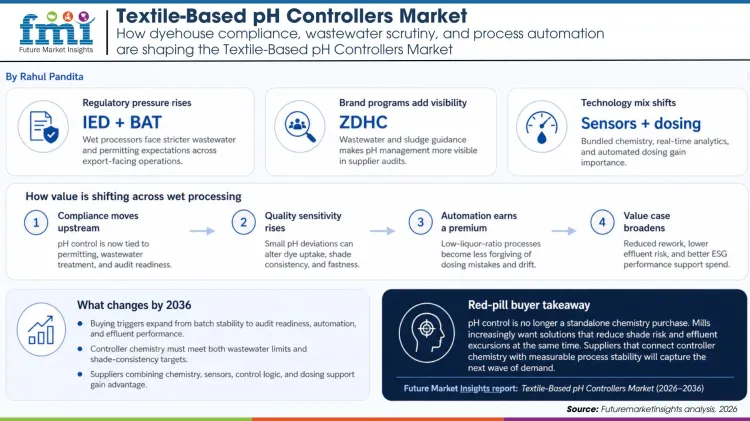
The updated Industrial Emissions Directive and related textile BAT discussions put wet processors under more visible regulatory pressure. Mills selling into demanding export channels can no longer treat process variability as an internal production issue because permitting and compliance expectations are becoming stricter.

Brand programs add a second layer of discipline. ZDHC wastewater and sludge guidance gives buyers and auditors clearer reasons to test what once sat quietly inside plant operations. When pH swings undermine treatment or create color inconsistency, the commercial consequences now show up much faster.

What is pulling in new demand

  • Research continues to show how small pH shifts can materially change dye uptake, shade quality, and fastness.
  • Large wet-processing volumes in major textile countries keep demand tied to real operating scale.

Published work on dye behavior across different pH ranges supports what mills already know operationally: small deviations can produce visible quality loss. That strengthens demand for tighter controller chemistry and dosing logic because the cost of re-dyeing or off-shade production can be substantial.

Scale reinforces the need. China and India remain central to global wet processing, and enforcement actions around wastewater quality keep pH on the operational checklist. Where output is large and audits are frequent, even modest improvements in control can justify spend quickly.

Market dimension 2015-2025 2026-2036
Operational role pH control was often treated as a routine chemistry setting. It becomes more closely tied to quality, compliance, and wastewater outcomes.
Buying trigger Mills bought mainly to stabilize batches and reduce visible defects. Buyers also need audit readiness, automation, and better effluent performance.
Technology mix Manual dosing and basic formulations remained common. Bundled chemistry, sensors, and automated dosing gain importance.
Compliance exposure Local regulation mattered most. Brand standards and export-market scrutiny carry more influence.
Value case Reduced rework was the main commercial argument. Reduced rework, lower risk, and better ESG performance all support demand.

What buyers should evaluate more rigorously

  • Low-liquor-ratio and water-saving processes make pH drift more commercially damaging.
  • Controller chemistry should be tested against both wastewater limits and shade consistency targets.

As mills push toward lower-liquor operations and higher resource efficiency, process baths become less forgiving of dosing mistakes. That means the tolerance for weak control narrows, and the commercial penalty of pH drift grows.

Procurement should therefore be more integrated than before. Buyers need to know whether a controller package helps the mill meet local pH discharge limits, wastewater program expectations, and dyeing consistency targets at the same time. A product that solves only one of those problems is often not enough now.

What the next phase may reward

  • The market is likely to favor suppliers that combine chemistry with real-time analytics and dosing support.
  • Audit pressure should continue to move buyers away from manual neutralization practices.

The commercial center of gravity is shifting toward solutions rather than standalone formulations. Mills increasingly want donors, sensors, control logic, and process recommendations that reduce both shade risk and effluent excursions, especially in export-facing operations.

That makes the market more data-aware than it used to be. Suppliers that can connect controller chemistry with measurable process stability will have an advantage. For the 2026-2036 forecast and deeper segmentation, see the Future Market Insights report: Textile-Based pH Controllers Market (2026 - 2036) - https://www.futuremarketinsights.com/reports/textile-based-ph-controllers-market

Bibliography

  • https://pmc.ncbi.nlm.nih.gov/articles/PMC9636545/
  • https://pmc.ncbi.nlm.nih.gov/articles/PMC10098549/
  • https://pmc.ncbi.nlm.nih.gov/articles/PMC12224096/
  • https://programme.roadmaptozero.com/suppliers/change-log/18
  • https://eeb.org/wp-content/uploads/2024/12/Circular-textiles-policy-review_EEB_December-2024.pdf
  • https://en.wikipedia.org/wiki/Sevilla_process
  • https://www.texleader.com.cn/en/news-34827.html
  • https://link.springer.com/article/10.1007/s44371-026-00506-x
  • https://www.sciencedirect.com/article/pii/S0959652622044262
  • https://www.indiantextilemagazine.in/wp-content/uploads/2025/01/Welspun-Living-ESG-report-2024_-final.pdf


Frequently Asked Questions

What is driving growth in the Textile-Based pH Controllers Market?

Growth in the Textile-Based pH Controllers Market is being supported by stronger end-user demand, operational efficiency needs, regulatory pressure, and wider adoption across relevant commercial and industrial applications.

Which factors could limit Textile-Based pH Controllers Market expansion?

High upfront costs, validation requirements, supply chain constraints, pricing pressure, and slower adoption among cost-sensitive buyers can restrict expansion in the Textile-Based pH Controllers Market.

Which end users are important for the Textile-Based pH Controllers Market?

Demand typically comes from manufacturers, service providers, healthcare or industrial operators, distributors, and specialized buyers that need reliable performance, compliance, and cost efficiency.

How are regulations influencing the Textile-Based pH Controllers Market?

Regulations are pushing suppliers toward safer materials, better documentation, stronger quality controls, and products that help customers meet environmental, safety, or performance standards.

What should companies watch in the Textile-Based pH Controllers Market through the forecast period?

Companies should track raw material costs, technology upgrades, customer purchasing cycles, regional policy changes, and competitive moves that can alter pricing and adoption rates.

Similar Industry Reports

Similar Industry Reports

Gas & Dual-Fuel Injection Systems Market
Anti-Redeposition Polymer Additives for Short-Wash Cycles Market

The Anti-Redeposition Polymer Additives for Short-Wash Cycles Market is segmented by Polymer Chemistry (Polyacrylate Maleic Copolymers, Carboxymethyl Cellulose, Soil Release Polyesters, PVP Polymers, Biopolymer Blends, Polyaspartates), Detergent Format (Powder Detergents, Liquid Detergents, Pods, Tablets, Sheets, Gels), End Use (Household Laundry, Commercial Laundry, Hospitality Laundry, Healthcare Laundry, Textile Care, Industrial Cleaning), Wash Condition (Cold Short Cycles, Warm Quick Cycles, Low Water Cycles, Mixed Fabric Cycles, Stain Prewash, Rinse Saver Cycles), Function (Soil Suspension, Anti Graying, Dye Transfer Control, Clay Control, Soil Release, Whiteness Care), and Sales Channel (Direct Sales, Distributors, Formulation Houses, Contract Blenders, Online B2B). Forecast for 2026 to 2036.

Gas & Dual-Fuel Injection Systems Market
Recycling of Automotive Glass and Laminated Windscreens in EU Industry

The Recycling of Automotive Glass and Laminated Windscreens in EU Industry is segmented by Source Stream (ELV Glass, Replacement Glass, OEM Scrap, Dismantled Windscreens, Side and Rear Glass), Glass Type (Laminated Glass, Tempered Glass, Mixed Glass, Windscreen Glass, Side and Rear Glass), Recycling Process (Mechanical Separation, Thermal Delamination, Chemical Recovery, Crushing and Cleaning, PVB Separation), Recovered Output (Glass Cullet, Recycled PVB, Mixed Fines, Glass Powder, Composite Residue), End Application (Flat Glass, Insulation Wool, Container Glass, Polymer Compounds, Construction Fill), Vehicle Type (Passenger Cars, SUVs, Light Commercial Vehicles, Heavy Commercial Vehicles, Buses), End User (Flat Glass Manufacturers, Insulation Producers, Polymer Processors, Aggregates Processors, Specialty Recyclers), Collection Channel (Dismantlers, Replacement Glass Networks, Authorized Treatment Facilities, Scrap Yards, OEM Plants), and Region. Forecast for 2026 to 2036.

Gas & Dual-Fuel Injection Systems Market
Recycled Technical Textiles for EU Automotive Acoustic Insulation Industry

The Recycled Technical Textiles for EU Automotive Acoustic Insulation Industry is segmented by Material Type (rPET, Blended Fibers, PP Fibers, Cotton Shoddy, Bio Blends), Feedstock Source (Post-consumer, Pre-consumer, ELV Textiles, Mixed Waste, Bottle Flake), Product Form (Felts, Mats, Pads, Molded Parts, Composites), Application (Floor Insulators, Wheel Liners, Headliners, Trunk Liners, Dash Insulators, Door Panels, Hood Liners), Vehicle Type (Passenger Cars, SUVs, LCVs, BEVs, Hybrids), Manufacturing Process (Needlepunch, Thermobonding, Airlaid, Compression Molding, Lamination), and Region. Forecast for 2026 to 2036.

Gas & Dual-Fuel Injection Systems Market
High-Brix Fruit Quality Enhancement Fertilizer Market

The High-Brix Fruit Quality Enhancement Fertilizer Market is segmented by Nutrient Focus (Potassium-Rich, Calcium-Rich, Magnesium-Rich, Micronutrient Blends, Carbon-Based Inputs, Amino and Seaweed Inputs), Form (Water-Soluble Powders, Liquid Concentrates, Suspension Blends, Soluble Granules), Delivery Method (Fertigation, Foliar Spray, Soil Drench), Fruit Type (Grapes, Citrus, Berries, Pome Fruits, Stone Fruits, Tropical Fruits), Farm Type (Open-Field Orchards, Protected Cultivation, Export Orchards), and Region. Forecast for 2026 to 2036.

Gas & Dual-Fuel Injection Systems Market
Urban Rooftop Farm-Safe Pest Management Chemistry Market

The Urban Rooftop Farm-Safe Pest Management Chemistry Market is segmented by Chemistry Type (Microbials, Botanicals, Minerals), Application Method (Foliar Sprays, Root Drenches, Spot Treatment), Crop Type (Leafy Greens, Fruiting Crops, Herbs), and Region. Forecast for 2026 to 2036.