

- Market Size (2026)
- USD 58.4 Mn
- Forecast (2036)
- USD 81.6 Mn
- CAGR (2026 to 2036)
- 3.4%
How big is 1 2 2 Hydroxy Ethoxy Ethyl Piperazine Market size?
USD 58.4 million in 2026 and USD 81.6 million by 2036 at a 3.4% CAGR.
Sales of 1 2 2 hydroxy ethoxy ethyl piperazine are estimated to rise at 3.4% CAGR through 2036, increasing valuation from USD 58.4 million in 2026 to USD 81.6 million by 2036. Pharmaceutical companies depend on 1-(2-(2-hydroxyethoxy)ethyl)piperazine (HEEP) as a critical chemical building block to manufacture prescription medications reliably. Drug makers demand strict quality control during chemical synthesis since every batch must meet exact purity levels and keep impurities to an absolute minimum. This steady flow of new generic medications drives continuous qualification testing for essential drug intermediates. Resulting with chemical suppliers earning their revenue through repeat orders of fully approved ingredient batches.
Purchasing teams across global markets apply distinct regional criteria on selecting their chemical partners. Buyers in Japan and the United States prioritize strict documentation of manufacturing methods along with an uninterrupted pharmaceutical supply chain. Sourcing managers in Brazil and South Korea emphasize smooth compliance with local regulations and demand highly responsive technical support from their vendors. Analytical testing capabilities also expanded significantly when LGC Standards introduced 21 new active pharmaceutical ingredient reference materials during 2025. Such newly available laboratory standards help quality-control chemists identify unknown impurities faster and make confident batch-release decisions. Broader reference data allows manufacturers to compare incoming HEEP shipments against approved recipe specifications with more precision.
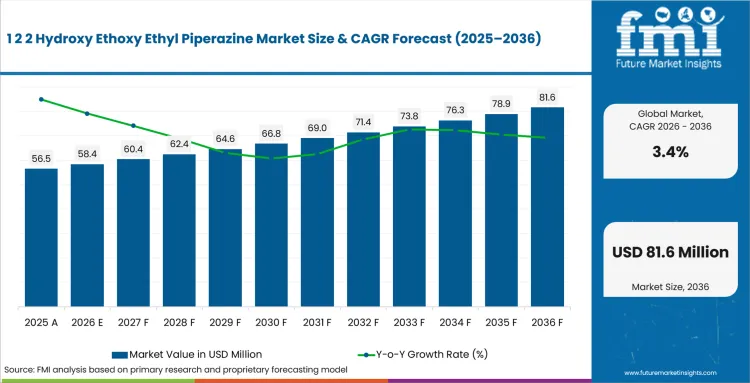
Key Takeaways for the 1 2 2 Hydroxy Ethoxy Ethyl Piperazine Market
- Demand for 1 2 2 hydroxy ethoxy ethyl piperazine is driven by qualified pharmaceutical synthesis routes and reliable lot release across regulated manufacturing programmes.
- Purity greater than or equal to 99% is forecast to garner 64.0% share of product in 2026, influenced by tighter assay acceptance and process-yield protection.
- Pharmaceutical grade is estimated to lead grade with 57.0% share in 2026, reflecting documentation requirements across API and intermediate production.
- Small addressable volumes and customer concentration represent primary barriers limiting capacity expansion and weakening bargaining power during long qualification cycles.
- Competition focusses on Tokyo Chemical Industry Co., Ltd., Merck KGaA, Thermo Fisher Scientific Inc., LGC Standards, Megafine Pharma (P) Ltd., Surya Life Sciences Ltd., Oceanic Pharmachem Pvt. Ltd., and Jiangsu Jingye Pharmaceutical Co., Ltd., with suppliers differentiating based on synthesis capability and documentation quality.
Analyst Perspective
“Commercial value in 1 2 2 hydroxy ethoxy ethyl piperazine follows repeatable synthesis performance instead of chemical identity. Buyers examine validated assay results and impurity limits during supplier approval. Durable revenue emerges from consistent lot release and disciplined change control across regulated customer programmes.”
- Nikhil Kaitwade, Principal Analyst for Chemicals at Future Market Insights
How is 1 2 2 Hydroxy Ethoxy Ethyl Piperazine Market segmented?
The 1 2 2 hydroxy ethoxy ethyl piperazine industry is segmented by product, application, end user, distribution channel, grade, and region.
The 1 2 2 hydroxy ethoxy ethyl piperazine market is segmented by product, application, end user, distribution channel, grade, and region. Product coverage includes purity greater than or equal to 99%, purity greater than or equal to 98%, customized purity, research grade, and technical grade. Application coverage addresses pharmaceuticals, cosmetics, agrochemicals, chemical intermediates, and research and development. End-user coverage spans pharmaceutical manufacturers, cosmetic manufacturers, agrochemical manufacturers, research institutes, and chemical companies. Distribution channel coverage includes direct sales, chemical distributors, online B2B platforms, third-party traders, and contract supply. Grade coverage includes pharmaceutical grade, industrial grade, cosmetic grade, research grade, and specialty grade. Regional coverage includes North America and Europe together with East Asia. South Asia and Pacific, Latin America, and Middle East and Africa complete geographic assessment.
What makes purity greater than or equal to 99% central to product selection?
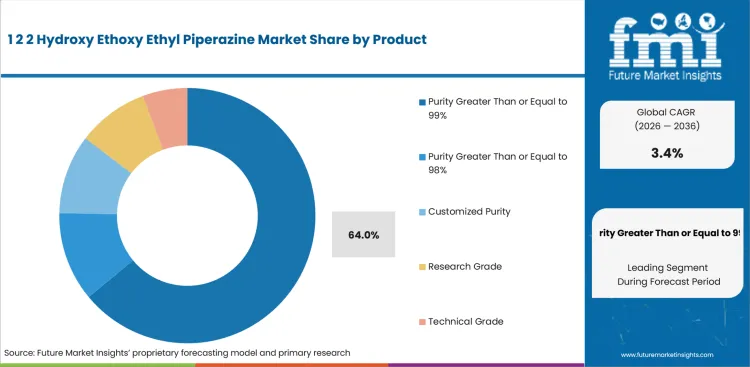
Purity greater than or equal to 99% promotes synthesis routes sensitive to residual reagents and unspecified impurities. Customer approval examines assay method consistency together with minor-impurity effects on downstream yield. Tokyo Chemical Industry lists HEEP above 98.0% by gas chromatography and titration, reflected by specifications and certificate documentation. Such evidence illustrates how Product selection moves from nominal identity toward measured batch performance.
- Based on product, purity greater than or equal to 99% is predicted to represent 64.0% share in 2026 since regulated customers need narrower impurity variation across repeated commercial batches. Supplier approval considers analytical-method comparability and documented change control across every accepted manufacturing route.
- Purity greater than or equal to 98% and customized purity address distinct cost or testing requirements across process development. Research grade and technical grade convert commercially only if selected material preserves target yield under the customer’s release specification.
Why does pharmaceuticals lead application demand?
LGC Standards identifies HEEP as Quetiapine HEEP Impurity and places it within the Quetiapine API family. FDA Label listed 11 quetiapine labeling records in April 2026, reinforcing assay and impurity-control work across pharmaceutical applications. Such classification connects the molecule with assay development and release investigations across regulated drug programmes. Cosmetics and agrochemicals face less consistent demand unless a specific formulation route requires HEEP. Pharmaceuticals leads application depending on HEEP use in quetiapine-related intermediate and impurity-control work.
- Pharmaceuticals are anticipated to account for 43.0% share of application in 2026, driven by quetiapine intermediate and API manufacturing requirements involving documented synthesis and impurity limits. Repeat purchasing follows successful batch transfer and accepted analytical evidence across customer manufacturing sites.
- Cosmetics and agrochemicals create supplementary demand through specialized synthesis or formulation work. Chemical intermediates and research and development generate orders only under project-specific purity thresholds and release records.
What supports pharmaceutical manufacturers across end user demand?
Pharmaceutical manufacturers purchase HEEP led by quality-led qualification involving process chemistry and supplier controls. FDA reported 97.0% on-time performance for standard original abbreviated new drug application reviews during fiscal 2025. Predictable review timelines encourage manufacturers to maintain complete chemistry and manufacturing records for every intermediate entering an approved route. HEEP suppliers compete based on documentation quality and lot reproducibility across small molecule CDMO programmes.
- By end user, pharmaceutical manufacturers are likely to hold 48.0% share in 2026 as it is reflected by direct responsibility for intermediate qualification and finished-drug quality records. Approved suppliers gain recurring orders through controlled impurity profiles and dependable batch-release timing.
- Cosmetic Manufacturers and Agrochemical Manufacturers evaluate HEEP against application-specific performance needs. Research Institutes and Chemical Companies purchase intermittently unless a validated route links material quality with a measurable outcome.
How does direct sales shape demand in the distribution channel segment?
Direct sales influences technical communication between HEEP producers and regulated manufacturing customers. Lot-specific documents and change notifications reach quality teams without unnecessary transfer through several commercial parties. LGC Standards lists a United States dispatch period of 48 hours for its HEEP reference product, illustrating how direct availability supports investigation and method-verification work. Faster access reduces delays during deviation review or supplier comparison.
- Direct sales are expected to secure 52.0% share in 2026 owing to long-term supply agreements and bulk supply contracts requiring clear quality ownership. Direct communication improves document exchange during qualification and later process changes.
- Chemical distributors and online B2B platforms extend access across smaller accounts or distant locations. Third-party traders and contract supply lose value if commercial convenience separates buyers from lot history and technical accountability.
Why does pharmaceutical grade lead grade demand?
Pharmaceutical Grade connects HEEP supply with validated test methods and documented manufacturing controls. Buyers compare assay limits against route sensitivity instead of accepting a generic purity statement. Merck’s Sigma-Aldrich catalogue lists HEEP at 95.0% assay, demonstrating meaningful specification differences across commercially available material. Pharmaceutical grade receives preference whenever lower-assay material introduces extra purification or investigation work.
- Pharmaceutical grade is projected to capture 57.0% share in 2026, backed by GMP grade and USP grade demand across regulated synthesis programmes. Release confidence improves through traceable methods and controlled impurity limits for every supplied lot.
- Industrial grade and cosmetic grade serve process or formulation work under distinct evidence thresholds. Research grade and specialty grade remain commercially sound only if testing effort matches final application risk.
What are drivers, restraints, and opportunities in 1 2 2 Hydroxy Ethoxy Ethyl Piperazine Market?
Qualified pharmaceutical synthesis supports demand across approved intermediate and API manufacturing routes. Customer concentration limits production economics across specialized production campaigns.
- Driver: Continued demand for piperazine-based pharmaceutical intermediates sustains repeat qualification across approved synthesis programmes. Stable impurity profiles encourage replenishment orders from pharmaceutical manufacturers managing validated production routes.
- Restraint: A concentrated buyer base exposes suppliers to delayed approvals and irregular campaign schedules. Long qualification cycles also weaken capacity utilization across specialized HEEP production batches.
- Opportunity: Controlled custom synthesis and analytical support improve conversion from development work into recurring supply. Suppliers offering traceable assay records may secure repeat orders across regulated pharmaceutical programmes.
Generic drug activity sustains demand for documented intermediates across active pharmaceutical ingredient programmes. FDA recorded 19 first generic approvals through March 2026, creating fresh chemistry and manufacturing review activity across several drug routes. HEEP demand benefits only if a related programme uses the molecule within an approved synthesis or impurity-control pathway. Supplier access requires route-level evidence instead of general generic-drug expansion.
Supply interruptions expose the cost of narrow pharmaceutical sourcing and long requalification periods. EMA listed shortages across 5 prolonged-release quetiapine strengths in its May 2026 update, citing production issues and increased demand. Intermediate suppliers face tighter scrutiny as drug manufacturers examine continuity and alternate-source readiness. Qualification costs rise if impurity profiles differ across production routes.
Quality transparency creates expansion potential for suppliers offering controlled synthesis and analytical support. PMDA reported identified-deficiency lists accompanying 2 recent GMP/GCTP annual reports in September 2025. Public inspection findings sharpen manufacturer attention toward raw-material controls and outsourced activity management. HEEP suppliers offering complete traceability may secure deeper participation in regulated customer programmes.
How are country CAGRs aligned in 1 2 2 Hydroxy Ethoxy Ethyl Piperazine Market?
| Country or Market | CAGR |
|---|---|
| Japan | 4.5% |
| USA | 4.1% |
| Brazil | 3.8% |
| South Korea | 3.4% |
| Canada | 3.1% |
| UK | 2.7% |
| Germany | 2.4% |
Source: Future Market Insights analysis, 2026.
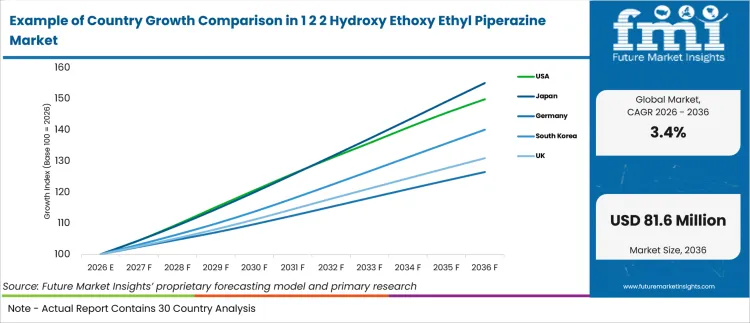
The country comparison shows a gradual step-down across the markets covered. Japan and the United States occupy the upper end of the range, followed by Brazil and South Korea as the second tier. Canada forms the next forecast band. The United Kingdom and Germany complete the lower end of the comparison. The 2.1-percentage-point spread shows that profiled markets share a steady expansion outlook, although national positions reflect different levels of commercial momentum. Individual forecasts may vary according to pharmaceutical manufacturing activity and supplier availability.
- Japan and the United States lead the comparison and establish the principal pharmaceutical demand cluster among the markets shown.
- Brazil and South Korea follow, indicating a measured difference from the leading national forecasts.
- Canada forms the next expansion band and maintains a limited gap from South Korea.
- The United Kingdom and Germany complete the comparison under documentation-intensive supplier approval systems.
- The pattern resembles a gradual downward slope instead of a sharp separation among national markets.
Markets with comparable CAGRs are likely to present different entry conditions due to local manufacturing depth and technical support availability. The full report provides country-level analysis across North America, Europe, East Asia, South Asia and Pacific, Latin America, and Middle East and Africa.
Country-wise Analysis
- Industry in Japan is set to rise at 4.5% CAGR during the forecast period, led by specialist chemical supply and stringent pharmaceutical quality review. Buyers assess route consistency and lot documentation prior to repeat purchasing. Tokyo Chemical Industry’s current Japan catalogue lists 2 HEEP pack sizes, supporting qualification work and small-batch analytical assessment. Local sourcing access reduces delays during method verification and process development.
- Generic-drug programmes sustain recurring demand for qualified intermediates and impurity standards. Sector in the United States is projected to record a 4.1% CAGR between 2026 and 2036, reflecting extensive chemistry and manufacturing review across regulated drug supply. FDA listed 87 first generic approvals during calendar 2025, maintaining demand for route-specific analytical evidence across applicants. Commercial entry favors suppliers offering dependable documentation and responsive technical communication.
- Buyers in Brazil require local regulatory execution together with stable imported or domestic supply arrangements. Anvisa’s April 2026 guidance assigns 120 days for priority marketing-authorization review, reinforcing the value of complete quality packages for drug-related materials. HEEP suppliers gain advantage through clear manufacturer records and local commercial representation. Industry in the Brazil is anticipated to grow at 3.8% CAGR during the study period, aided by pharmaceutical manufacturing activity and structured supplier qualification across regulated synthesis programmes.
- The market in South Korea is expected to progress at 3.4% CAGR during the assessment period, guided by structured pharmaceutical approval and quality-data requirements. MFDS published its 2025 Drug Approval Report in July 2026, and current guidance defines 8 drug-substance data groups covering identity through packaging. Such requirements reward suppliers maintaining complete specifications and reference-standard records. Responsive document support strengthens acceptance across regulated customer projects.
- Marketed quetiapine products sustain quality maintenance and supplier-review activity across manufacturers in Canada. Sales in Canada are likely to register a 3.1% CAGR between 2026 and 2036, helped by measured demand across regulated pharmaceutical programmes. Health Canada recorded a marketed quetiapine product at 200 mg with status in July 2025, confirming active product oversight across the molecule’s downstream family. HEEP demand remains limited to approved routes and verified impurity-control needs.
- Specialist medicine supply and shortage management increase attention toward qualified alternate sources. NHS Business Services Authority listed 9 quetiapine serious-shortage protocols during 2024, demonstrating the operational effect of constrained drug availability. Intermediate buyers examine traceability and continuity across critical synthesis inputs. Demand in the United Kingdom is projected to increase at 2.7% CAGR by 2036, backed by specialist pharmaceutical activity and documentation-intensive supplier qualification across regulated synthesis programmes.
- Adoption in Germany is forecast to expand at 2.4% CAGR across 2026 to 2036, influenced by careful supplier qualification and conservative switching across pharmaceutical routes. EMA’s May 2026 update listed Germany among 21 countries affected by prolonged-release quetiapine shortages, sharpening alternate-source planning across regulated buyers. Regulated customers value documented impurity profiles and early change notification across specialized fine chemicals. Slower conversion follows the time required for analytical comparability and process approval.
Who are notable companies in 1 2 2 Hydroxy Ethoxy Ethyl Piperazine Market?
Tokyo Chemical Industry Co., Ltd. and Merck KGaA join Thermo Fisher Scientific Inc. and LGC Standards. Megafine Pharma (P) Ltd. and Surya Life Sciences Ltd. join Oceanic Pharmachem Pvt. Ltd. and Jiangsu Jingye Pharmaceutical Co., Ltd.
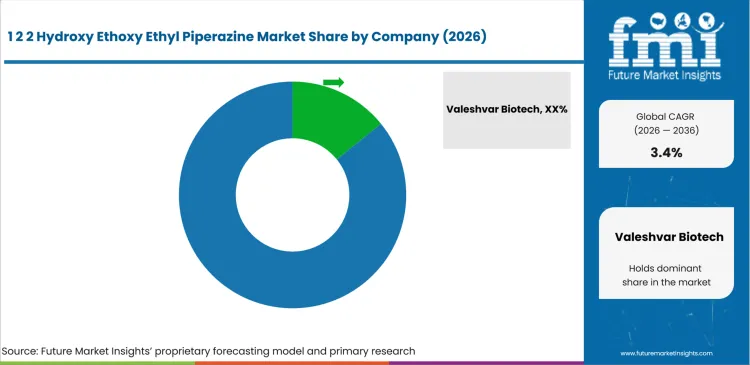
The competitive outlook combines global laboratory suppliers with pharmaceutical intermediate manufacturers serving regulated production routes. Reagent and reference-material companies compete through assay documentation and reliable availability across research and quality-control programmes. Intermediate producers compete depending on synthesis consistency and impurity control across commercial pharmaceutical batches. Regional suppliers compete due to responsive technical support and lot-release accountability across customer manufacturing sites. The fine chemicals market analysis provides a useful comparison for specification discipline and supplier qualification within specialized synthesis programmes. Commercial success requires clear ownership of deviations since one inconsistent batch can erase gains created by faster delivery or lower pricing.
- Tokyo Chemical Industry Co., Ltd. and Merck KGaA compete based on documented HEEP products and lot certificates. Customer teams assess assay consistency and pack availability during laboratory qualification.
- Thermo Fisher Scientific Inc. and LGC Standards support analytical use across synthesis and impurity investigations. Buyers examine certificate detail and dispatch reliability during method verification.
- Megafine Pharma (P) Ltd., Surya Life Sciences Ltd., and Oceanic Pharmachem Pvt. Ltd. serve pharmaceutical intermediate programs. Customer approval examines process control and commercial batch support.
- Jiangsu Jingye Pharmaceutical Co., Ltd. supports pharmaceutical intermediate production and export supply. Manufacturing review covers synthesis capability and quality documentation.
Competitive Benchmarking: 1 2 2 Hydroxy Ethoxy Ethyl Piperazine Market
| Company | Assay Documentation | Synthesis and Impurity Control | Technical and Supply Support | Geographic Reach |
|---|---|---|---|---|
| Tokyo Chemical Industry Co., Ltd. | High | Medium | High | Global |
| Merck KGaA | High | Medium | High | Global |
| Thermo Fisher Scientific Inc. | High | Medium | High | Global |
| LGC Standards | High | Low | High | Global |
| Megafine Pharma (P) Ltd. | Medium | High | High | International |
| Surya Life Sciences Ltd. | Medium | High | Medium | International |
| Oceanic Pharmachem Pvt. Ltd. | Medium | High | Medium | International |
| Jiangsu Jingye Pharmaceutical Co., Ltd. | Medium | High | Medium | Asia and export markets |
Source: Future Market Insights competitive analysis, 2026.
Key Developments in 1 2 2 Hydroxy Ethoxy Ethyl Piperazine Market
- In January 2025, Sivem Pharmaceuticals ULC recalled 15 quetiapine XR lots following potential N-nitroso-desalkyl-quetiapine exposure above established intake limits. Quality action raises upstream scrutiny for impurity control and intermediate traceability across quetiapine synthesis.
- In January 2025, Apotex Inc. recalled five APO-QUETIAPINE XR lots across two strengths following possible nitrosamine-limit exceedance. Quality action increases testing expectations for qualified inputs and route-specific impurity monitoring.
- In March 2025, the USA Food and Drug Administration added N-nitroso-norquetiapine to its acceptable-intake table for quetiapine-related nitrosamine impurities. The agency established a 400 ng/day limit, increasing analytical requirements across quetiapine intermediate qualification and impurity-control programs.
Key Players in 1 2 2 Hydroxy Ethoxy Ethyl Piperazine Market
Global Laboratory and Reference Suppliers
- Tokyo Chemical Industry Co., Ltd.
- Merck KGaA
- Thermo Fisher Scientific Inc.
- LGC Standards
Indian Pharmaceutical Intermediate Manufacturers
- Megafine Pharma (P) Ltd.
- Surya Life Sciences Ltd.
- Oceanic Pharmachem Pvt. Ltd.
East Asian Specialty Producer
- Jiangsu Jingye Pharmaceutical Co., Ltd.
1 2 2 Hydroxy Ethoxy Ethyl Piperazine Market Report Scope
| Coverage Field | Report Scope |
|---|---|
| Market breakdown | 1 2 2 hydroxy ethoxy ethyl piperazine market breakdown is segmented by product, application, end user, distribution channel, grade, and region |
| Quantitative Units | Revenue in USD Million, CAGR in %. |
| Market Definition | Commercial supply of 1-[2-(2-hydroxyethoxy)ethyl]piperazine across pharmaceutical, specialty-chemical, cosmetic, agrochemical, and research grades. Generic piperazine products outside the defined HEEP identity are excluded. |
| Regions Covered | North America, Europe, East Asia, South Asia and Pacific, Latin America, Middle East and Africa |
| Countries Covered | Japan, USA, Brazil, South Korea, Canada, UK, and Germany |
| Key Companies Profiled | Tokyo Chemical Industry Co., Ltd., Merck KGaA, Thermo Fisher Scientific Inc., LGC Standards, Megafine Pharma (P) Ltd., Surya Life Sciences Ltd., Oceanic Pharmachem Pvt. Ltd., Jiangsu Jingye Pharmaceutical Co., Ltd. |
| Forecast Period | 2026 to 2036 |
| Approach | Hybrid bottom-up and top-down methodology uses segment shares and country CAGRs. Supplier activity and buyer qualification evidence support final market reconciliation. |
Source: Future Market Insights analysis, 2026.
1 2 2 Hydroxy Ethoxy Ethyl Piperazine Market - Research Methodology
| Method | Approach |
|---|---|
| Primary Research | FMI analysts gathered input from manufacturers, service providers, technology developers, distributors, end users, procurement teams, and subject-matter experts. Interviews examined purchasing decisions, product or service evaluation, adoption barriers, approval requirements, pricing considerations, and expectations for technical or commercial support. Respondents were also asked what evidence is required before a trial, pilot, or initial order develops into regular purchasing. |
| Desk Research | Desk research covered government statistics, regulatory publications, trade data, industry associations, technical literature, standards, company filings, product information, and official corporate announcements. Sources were reviewed for relevance, publication date, geographic coverage, and consistency with the defined market scope. Claims relating to performance, applications, approvals, capacity, investment, and commercial activity were retained only when supported by credible public evidence. |
| Market Sizing and Forecasting | The market model combined the baseline value with historical performance, segment structure, pricing and volume indicators, adoption levels, company participation, and country-level demand conditions. Forecast assumptions considered economic activity, investment trends, regulatory developments, technology adoption, purchasing cycles, supply availability, and barriers to wider market use. Segment and regional estimates were reconciled before the final market total was calculated. |
| Data Validation | Estimates were checked against multiple independent indicators, including public data, company activity, trade patterns, industry developments, and findings from primary interviews. Validation also tested whether products, services, applications, and company revenues fell within the defined market boundaries. Adjacent categories, unsupported claims, overlapping revenues, and activities without direct market relevance were excluded to reduce double counting and maintain consistency across segments and countries. |
Source: Future Market Insights analysis, 2026.
1 2 2 Hydroxy Ethoxy Ethyl Piperazine Market by Segments
1 2 2 Hydroxy Ethoxy Ethyl Piperazine Market segmented by Product:
- Purity Greater Than or Equal to 99%
- Purity Greater Than or Equal to 98%
- Customized Purity
- Research Grade
- Technical Grade
1 2 2 Hydroxy Ethoxy Ethyl Piperazine Market segmented by Application:
- Pharmaceuticals
- Cosmetics
- Agrochemicals
- Chemical Intermediates
- Research and Development
1 2 2 Hydroxy Ethoxy Ethyl Piperazine Market segmented by End User:
- Pharmaceutical Manufacturers
- Cosmetic Manufacturers
- Agrochemical Manufacturers
- Research Institutes
- Chemical Companies
1 2 2 Hydroxy Ethoxy Ethyl Piperazine Market segmented by Distribution Channel:
- Direct Sales
- Chemical Distributors
- Online B2B Platforms
- Third-Party Traders
- Contract Supply
1 2 2 Hydroxy Ethoxy Ethyl Piperazine Market segmented by Grade:
- Pharmaceutical Grade
- Industrial Grade
- Cosmetic Grade
- Research Grade
- Specialty Grade
1 2 2 Hydroxy Ethoxy Ethyl Piperazine Market segmented by Region:
- North America
- United States
- Canada
- Europe
- UK
- Germany
- East Asia
- Japan
- South Korea
- South Asia and Pacific
- Additional countries covered in the full regional model
- Latin America
- Brazil
- Middle East and Africa
- Additional countries covered in the full regional model
Research Sources and Bibliography
- Agência Nacional de Vigilância Sanitária. (2026, April 6). Medicinal products.
- European Medicines Agency. (2026, May 4). Quetiapine - supply shortage.
- Food and Drug Administration. (2025). 2025 first generic drug approvals.
- Food and Drug Administration. (2025). Generic drugs program activities report - FY 2025 monthly performance.
- Food and Drug Administration. (2026, April 10). FDALabel: Quetiapine labeling results.
- Food and Drug Administration. (2026). First generic drug approvals.
- Food and Drug Administration. (2026). Generic drugs program fiscal year 2025 activities report.
- Health Canada. (2025, January 7). QUETIAPINE XR: Affected lots may exceed the established acceptable intake limit for N-nitroso-desalkyl-quetiapine.
- Health Canada. (2025, January 31). APO-QUETIAPINE XR: May exceed the established acceptable intake limit for N-nitroso-desalkyl-quetiapine.
- Health Canada. (2025, July 17). PRO-QUETIAPINE: Product information.
- LGC Standards. (2025, December 15). Five thought leadership crackers from 2025.
- USA Food and Drug Administration. (2025, March 14). CDER nitrosamine impurity acceptable intake limits.
- Ministry of Food and Drug Safety. (2026, July 3). 2025 drug approval report.
- National Health Service Business Services Authority. (2024, July 16). Serious shortage protocols: Quetiapine tablets.
- Pharmaceuticals and Medical Devices Agency. (2025, September). GMP/GCTP annual report FY 2024.
This bibliography entries cover sources cited in the article. The full-report research files contain the complete reference register and detailed source records.
This Report Answers
- How do product, application, end user, distribution channel, grade, and region influence demand?
- What criteria guide pharmaceutical manufacturers evaluating 1 2 2 hydroxy ethoxy ethyl piperazine suppliers?
- Why do country CAGRs differ across Japan, USA, Brazil, South Korea, Canada, UK, and Germany?
- What companies compete through purity control and lot availability?
- How are forecasts validated through bottom-up and top-down analysis using independent indicators?
- What evidence supports customer approval prior to recurring commercial supply?
- Why do assay methods and impurity limits influence supplier selection?
- How does customer concentration limit return across specialized production campaigns?
- How do change-control records influence approval across quality and process teams?
- What supplier capabilities improve long-term confidence and repeat ordering?
Frequently Asked Questions
How big is the 1 2 2 Hydroxy Ethoxy Ethyl Piperazine Market in 2026?
The 1 2 2 hydroxy ethoxy ethyl piperazine market is valued at USD 58.4 million in 2026 and is forecast to reach USD 81.6 million by 2036, supported by pharmaceutical manufacturers requiring strict purity control and repeatable lot release across quetiapine intermediate and API synthesis programs in regulated drug manufacturing.
What is the CAGR of the 1 2 2 Hydroxy Ethoxy Ethyl Piperazine Market from 2026 to 2036?
The 1 2 2 hydroxy ethoxy ethyl piperazine market is projected to grow at a CAGR of 3.4% between 2026 and 2036, supported by continued generic drug approvals sustaining demand for documented pharmaceutical intermediates and increasing analytical requirements across quetiapine-related impurity control and supplier qualification programs.
Which product grade leads the 1 2 2 Hydroxy Ethoxy Ethyl Piperazine Market?
Purity greater than or equal to 99% accounts for 64.0% of the 1 2 2 hydroxy ethoxy ethyl piperazine market by product in 2026, driven by regulated customers requiring narrower impurity variation and analytical-method comparability across repeated commercial batches in pharmaceutical intermediate and API manufacturing programs.
How much will the 1 2 2 Hydroxy Ethoxy Ethyl Piperazine Market add between 2026 and 2036?
The 1 2 2 hydroxy ethoxy ethyl piperazine market is set to add USD 23.2 million between 2026 and 2036, growing from USD 58.4 million to USD 81.6 million as generic drug program expansion, tightening nitrosamine impurity controls, and increasing pharmaceutical manufacturer scrutiny of intermediate traceability drive qualified supplier demand globally.
Who are the leading companies in the 1 2 2 Hydroxy Ethoxy Ethyl Piperazine Market?
Leading companies in the 1 2 2 hydroxy ethoxy ethyl piperazine market include Tokyo Chemical Industry, Merck KGaA, Thermo Fisher Scientific, LGC Standards, Megafine Pharma, Surya Life Sciences, Oceanic Pharmachem, and Jiangsu Jingye Pharmaceutical, competing across global laboratory and reference supply, Indian pharmaceutical intermediate manufacturing, and East Asian specialty production with documented synthesis and impurity control capabilities.
Preview the report firsthand - request a free sample
Get SampleGet the brochure for pricing and purchase details.
Get PDFTable of Content
- Key Takeaways
- Market Size and CAGR
- Top Growth Driver
- Fastest Growing Segment
- Leading Region
- Key Companies
- Emerging Opportunities
- Executive Summary
- Global Market Outlook
- Demand-side Trends
- Supply-side Trends
- Technology Roadmap Analysis
- Analysis and Recommendations
- Analyst Perspective (What is happening? Why now? What should investors know?)
- Key Questions Answered
- How large is the market?
- What is the CAGR?
- What are key trends?
- Which region dominates?
- Who are the leaders?
- Market Overview
- Market Coverage / Taxonomy
- Market Definition / Scope / Limitations
- Research Methodology
- Chapter Orientation
- Analytical Lens and Working Hypotheses
- Market Structure, Signals, and Trend Drivers
- Benchmarking and Cross-market Comparability
- Market Sizing, Forecasting, and Opportunity Mapping
- Research Design and Evidence Framework
- Desk Research Programme (Secondary Evidence)
- Expert Input and Fieldwork (Primary Evidence)
- Tooling, Models, and Reference Databases
- Data Engineering and Model Build
- Quality Assurance and Audit Trail
- Market Background
- Market Dynamics (Drivers, Restraints, Opportunity, Trends)
- Scenario Forecast (Optimistic, Likely, Conservative)
- Impact Analysis
- AI Impact
- Sustainability Impact
- Regulatory Impact
- Technology Impact
- Consumer / Buyer Analysis
- Purchase Drivers
- Adoption Barriers
- Buyer Journey
- Opportunity Map Analysis
- Product Life Cycle Analysis
- Supply Chain Analysis
- Investment Feasibility Matrix
- Value Chain Analysis
- PESTLE and Porter's Analysis
- Regulatory Landscape
- Regional Parent Market Outlook
- Production and Consumption Statistics
- Import and Export Statistics
- Global Market Analysis and Forecast, 2021 to 2036
- Historical Market Size Value (USD Million) Analysis, 2021 to 2025
- Current and Future Market Size Value (USD Million) Projections, 2026 to 2036
- Y-o-Y Growth Trend Analysis
- Absolute $ Opportunity Analysis
- Global Market Pricing Analysis, 2021 to 2036
- Global Market Analysis and Forecast, By Product, 2021 to 2036
- Introduction / Key Findings
- Historical Market Size Value (USD Million) Analysis By Product, 2021 to 2025
- Current and Future Market Size Value (USD Million) Analysis and Forecast By Product, 2026 to 2036
- Purity Greater Than or Equal to 99%
- Pharmaceutical Grade
- Electronic Grade
- Purity Greater Than or Equal to 98%
- Industrial Grade
- Laboratory Grade
- Customized Purity
- Customer Specific Grade
- High Performance Grade
- Research Grade
- Analytical Grade
- Synthesis Grade
- Technical Grade
- Bulk Grade
- Process Grade
- Purity Greater Than or Equal to 99%
- Y-o-Y Growth Trend Analysis By Product, 2021 to 2025
- Absolute $ Opportunity Analysis By Product, 2026 to 2036
- Global Market Analysis and Forecast, By Application, 2021 to 2036
- Introduction / Key Findings
- Historical Market Size Value (USD Million) Analysis By Application, 2021 to 2025
- Current and Future Market Size Value (USD Million) Analysis and Forecast By Application, 2026 to 2036
- Pharmaceuticals
- Quetiapine Intermediate
- API Manufacturing
- Cosmetics
- Skin Care Products
- Hair Care Products
- Agrochemicals
- Crop Protection Chemicals
- Pesticide Intermediates
- Chemical Intermediates
- Fine Chemicals
- Specialty Chemicals
- Research and Development
- Process Development
- Laboratory Research
- Pharmaceuticals
- Y-o-Y Growth Trend Analysis By Application, 2021 to 2025
- Absolute $ Opportunity Analysis By Application, 2026 to 2036
- Global Market Analysis and Forecast, By End User, 2021 to 2036
- Introduction / Key Findings
- Historical Market Size Value (USD Million) Analysis By End User, 2021 to 2025
- Current and Future Market Size Value (USD Million) Analysis and Forecast By End User, 2026 to 2036
- Pharmaceutical Manufacturers
- API Manufacturers
- Drug Formulation Companies
- Cosmetic Manufacturers
- Personal Care Companies
- Contract Manufacturers
- Agrochemical Manufacturers
- Crop Protection Producers
- Agricultural Chemical Companies
- Research Institutes
- Academic Laboratories
- Government Research Centers
- Chemical Companies
- Specialty Chemical Producers
- Fine Chemical Manufacturers
- Pharmaceutical Manufacturers
- Y-o-Y Growth Trend Analysis By End User, 2021 to 2025
- Absolute $ Opportunity Analysis By End User, 2026 to 2036
- Global Market Analysis and Forecast, By Distribution Channel, 2021 to 2036
- Introduction / Key Findings
- Historical Market Size Value (USD Million) Analysis By Distribution Channel, 2021 to 2025
- Current and Future Market Size Value (USD Million) Analysis and Forecast By Distribution Channel, 2026 to 2036
- Direct Sales
- Long-Term Supply Agreements
- Bulk Supply Contracts
- Chemical Distributors
- Global Chemical Distributors
- Regional Distributors
- Online B2B Platforms
- Digital Procurement Platforms
- E-Commerce Portals
- Third-Party Traders
- Importers
- Exporters
- Contract Supply
- OEM Supply
- Custom Manufacturing Agreements
- Direct Sales
- Y-o-Y Growth Trend Analysis By Distribution Channel, 2021 to 2025
- Absolute $ Opportunity Analysis By Distribution Channel, 2026 to 2036
- Global Market Analysis and Forecast, By Grade, 2021 to 2036
- Introduction / Key Findings
- Historical Market Size Value (USD Million) Analysis By Grade, 2021 to 2025
- Current and Future Market Size Value (USD Million) Analysis and Forecast By Grade, 2026 to 2036
- Pharmaceutical Grade
- GMP Grade
- USP Grade
- Industrial Grade
- Process Grade
- Commercial Grade
- Cosmetic Grade
- Personal Care Grade
- High Purity Cosmetic Grade
- Research Grade
- Analytical Grade
- Laboratory Grade
- Specialty Grade
- Custom Grade
- High Performance Grade
- Pharmaceutical Grade
- Y-o-Y Growth Trend Analysis By Grade, 2021 to 2025
- Absolute $ Opportunity Analysis By Grade, 2026 to 2036
- Global Market Analysis and Forecast, By Region, 2021 to 2036
- Introduction
- Historical Market Size Value (USD Million) Analysis By Region, 2021 to 2025
- Current Market Size Value (USD Million) Analysis and Forecast By Region, 2026 to 2036
- North America
- Latin America
- Western Europe
- Eastern Europe
- East Asia
- South Asia and Pacific
- Middle East & Africa
- Market Attractiveness Analysis By Region
- North America Market Analysis and Forecast, By Country, 2021 to 2036
- Historical Market Size Value (USD Million) Trend Analysis By Market Taxonomy, 2021 to 2025
- Market Size Value (USD Million) Forecast By Market Taxonomy, 2026 to 2036
- By Country
- USA
- Canada
- By Product
- By Application
- By End User
- By Distribution Channel
- By Grade
- By Country
- Market Attractiveness Analysis
- By Country
- By Product
- By Application
- By End User
- By Distribution Channel
- By Grade
- Key Takeaways
- Latin America Market Analysis and Forecast, By Country
- Historical Market Size Value (USD Million) Trend Analysis By Market Taxonomy, 2021 to 2025
- Market Size Value (USD Million) Forecast By Market Taxonomy, 2026 to 2036
- By Country
- Brazil
- Mexico
- Chile
- Rest of Latin America
- By Product
- By Application
- By End User
- By Distribution Channel
- By Grade
- By Country
- Market Attractiveness Analysis
- By Country
- By Product
- By Application
- By End User
- By Distribution Channel
- By Grade
- Key Takeaways
- Western Europe Market Analysis and Forecast, By Country
- Historical Market Size Value (USD Million) Trend Analysis By Market Taxonomy, 2021 to 2025
- Market Size Value (USD Million) Forecast By Market Taxonomy, 2026 to 2036
- By Country
- Germany
- UK
- Italy
- Spain
- France
- Nordic
- BENELUX
- Rest of Western Europe
- By Product
- By Application
- By End User
- By Distribution Channel
- By Grade
- By Country
- Market Attractiveness Analysis
- By Country
- By Product
- By Application
- By End User
- By Distribution Channel
- By Grade
- Key Takeaways
- Eastern Europe Market Analysis and Forecast, By Country
- Historical Market Size Value (USD Million) Trend Analysis By Market Taxonomy, 2021 to 2025
- Market Size Value (USD Million) Forecast By Market Taxonomy, 2026 to 2036
- By Country
- Russia
- Poland
- Hungary
- Balkan & Baltic
- Rest of Eastern Europe
- By Product
- By Application
- By End User
- By Distribution Channel
- By Grade
- By Country
- Market Attractiveness Analysis
- By Country
- By Product
- By Application
- By End User
- By Distribution Channel
- By Grade
- Key Takeaways
- East Asia Market Analysis and Forecast, By Country
- Historical Market Size Value (USD Million) Trend Analysis By Market Taxonomy, 2021 to 2025
- Market Size Value (USD Million) Forecast By Market Taxonomy, 2026 to 2036
- By Country
- China
- Japan
- South Korea
- By Product
- By Application
- By End User
- By Distribution Channel
- By Grade
- By Country
- Market Attractiveness Analysis
- By Country
- By Product
- By Application
- By End User
- By Distribution Channel
- By Grade
- Key Takeaways
- South Asia and Pacific Market Analysis and Forecast, By Country
- Historical Market Size Value (USD Million) Trend Analysis By Market Taxonomy, 2021 to 2025
- Market Size Value (USD Million) Forecast By Market Taxonomy, 2026 to 2036
- By Country
- India
- ASEAN
- Australia & New Zealand
- Rest of South Asia and Pacific
- By Product
- By Application
- By End User
- By Distribution Channel
- By Grade
- By Country
- Market Attractiveness Analysis
- By Country
- By Product
- By Application
- By End User
- By Distribution Channel
- By Grade
- Key Takeaways
- Middle East & Africa Market Analysis and Forecast, By Country
- Historical Market Size Value (USD Million) Trend Analysis By Market Taxonomy, 2021 to 2025
- Market Size Value (USD Million) Forecast By Market Taxonomy, 2026 to 2036
- By Country
- Kingdom of Saudi Arabia
- Other GCC Countries
- Türkiye
- South Africa
- Other African Union
- Rest of Middle East & Africa
- By Product
- By Application
- By End User
- By Distribution Channel
- By Grade
- By Country
- Market Attractiveness Analysis
- By Country
- By Product
- By Application
- By End User
- By Distribution Channel
- By Grade
- Key Takeaways
- Key Countries Market Analysis
- USA
- Pricing Analysis
- Market Share Analysis, 2025
- By Product
- By Application
- By End User
- By Distribution Channel
- By Grade
- Canada
- Pricing Analysis
- Market Share Analysis, 2025
- By Product
- By Application
- By End User
- By Distribution Channel
- By Grade
- Mexico
- Pricing Analysis
- Market Share Analysis, 2025
- By Product
- By Application
- By End User
- By Distribution Channel
- By Grade
- Brazil
- Pricing Analysis
- Market Share Analysis, 2025
- By Product
- By Application
- By End User
- By Distribution Channel
- By Grade
- Chile
- Pricing Analysis
- Market Share Analysis, 2025
- By Product
- By Application
- By End User
- By Distribution Channel
- By Grade
- Germany
- Pricing Analysis
- Market Share Analysis, 2025
- By Product
- By Application
- By End User
- By Distribution Channel
- By Grade
- UK
- Pricing Analysis
- Market Share Analysis, 2025
- By Product
- By Application
- By End User
- By Distribution Channel
- By Grade
- Italy
- Pricing Analysis
- Market Share Analysis, 2025
- By Product
- By Application
- By End User
- By Distribution Channel
- By Grade
- Spain
- Pricing Analysis
- Market Share Analysis, 2025
- By Product
- By Application
- By End User
- By Distribution Channel
- By Grade
- France
- Pricing Analysis
- Market Share Analysis, 2025
- By Product
- By Application
- By End User
- By Distribution Channel
- By Grade
- India
- Pricing Analysis
- Market Share Analysis, 2025
- By Product
- By Application
- By End User
- By Distribution Channel
- By Grade
- ASEAN
- Pricing Analysis
- Market Share Analysis, 2025
- By Product
- By Application
- By End User
- By Distribution Channel
- By Grade
- Australia & New Zealand
- Pricing Analysis
- Market Share Analysis, 2025
- By Product
- By Application
- By End User
- By Distribution Channel
- By Grade
- China
- Pricing Analysis
- Market Share Analysis, 2025
- By Product
- By Application
- By End User
- By Distribution Channel
- By Grade
- Japan
- Pricing Analysis
- Market Share Analysis, 2025
- By Product
- By Application
- By End User
- By Distribution Channel
- By Grade
- South Korea
- Pricing Analysis
- Market Share Analysis, 2025
- By Product
- By Application
- By End User
- By Distribution Channel
- By Grade
- Russia
- Pricing Analysis
- Market Share Analysis, 2025
- By Product
- By Application
- By End User
- By Distribution Channel
- By Grade
- Poland
- Pricing Analysis
- Market Share Analysis, 2025
- By Product
- By Application
- By End User
- By Distribution Channel
- By Grade
- Hungary
- Pricing Analysis
- Market Share Analysis, 2025
- By Product
- By Application
- By End User
- By Distribution Channel
- By Grade
- Kingdom of Saudi Arabia
- Pricing Analysis
- Market Share Analysis, 2025
- By Product
- By Application
- By End User
- By Distribution Channel
- By Grade
- Türkiye
- Pricing Analysis
- Market Share Analysis, 2025
- By Product
- By Application
- By End User
- By Distribution Channel
- By Grade
- South Africa
- Pricing Analysis
- Market Share Analysis, 2025
- By Product
- By Application
- By End User
- By Distribution Channel
- By Grade
- USA
- Market Structure Analysis
- Competition Dashboard
- Competition Benchmarking
- Market Share Analysis of Top Players
- By Regional
- By Product
- By Application
- By End User
- By Distribution Channel
- By Grade
- Emerging Startups
- Innovation Benchmarking
- Competition Analysis
- Competition Deep Dive
- Valeshvar Biotech
- Overview
- Product Portfolio
- Profitability by Market Segments
- Sales Footprint
- Strategy Overview
- Marketing Strategy
- Product Strategy
- Channel Strategy
- Tokyo Chemical Industry India
- Shanghai Ruifu Chemical
- Surya Life Sciences
- Suzhou Jingye Medicine & Chemical
- Merck KGaA
- Thermo Fisher Scientific
- Alfa Aesar
- Biosynth
- Toronto Research Chemicals
- Valeshvar Biotech
- Case Studies
- Success Stories
- Recent Developments
- Competition Deep Dive
- Assumptions & Acronyms Used


