

- Market Size (2026)
- USD 47.6 Bn
- Forecast (2036)
- USD 68.5 Bn
- CAGR (2026 to 2036)
- 3.7%
How big is Automotive Exterior Trim Parts Market in 2026?
Exterior trim part sales carry a 3.7% CAGR outlook from 2026 to 2036. The 2025 market size stood at USD 45.9 billion. The 2026 estimate is USD 47.6 billion, and 2036 carries a projection of USD 68.45 billion.
The automotive exterior trim parts market grows from USD 45.9 billion in 2025 to an estimated USD 47.6 billion in 2026. A 3.7% CAGR between 2026 and 2036 then takes sales to USD 68.45 billion by 2036.
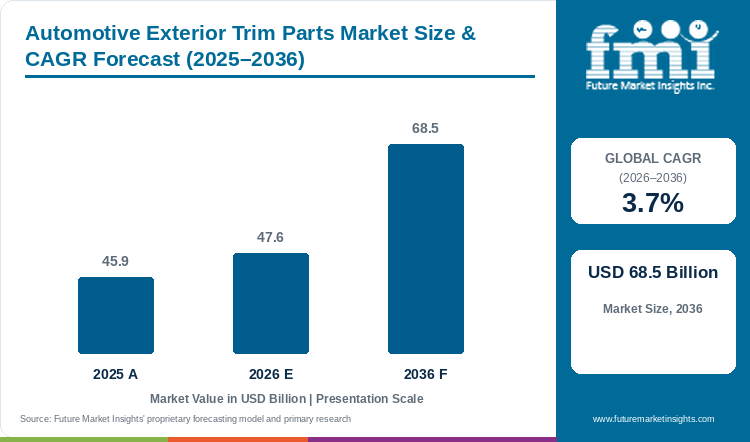
Exterior trim sales rise each time a new vehicle model enters production, because bumpers, grilles and tailgates are made for one named model and ship only after that model launches. OPmobility reported on 22 July 2026 that exterior parts production in H1 2026 was hit as program launches were postponed.[1] Launch delays thus shape the changing economics of demand, as suppliers carry plant cost before the first bumper ships.
Every factory chrome grille is a later job for the dechroming and blackout exterior trim services market, which FMI tracks at a 7.2% CAGR from 2026 to 2036. Restyling grows near double the first-fit rate, so makers offering black-finish trim from the factory keep part of the restyling value. European bumper covers use resin from the Europe recycled plastics for exterior body parts and bumpers market, on a 10.9% CAGR between 2026 and 2036. Moulders will therefore bid recycled grades on European programmes.
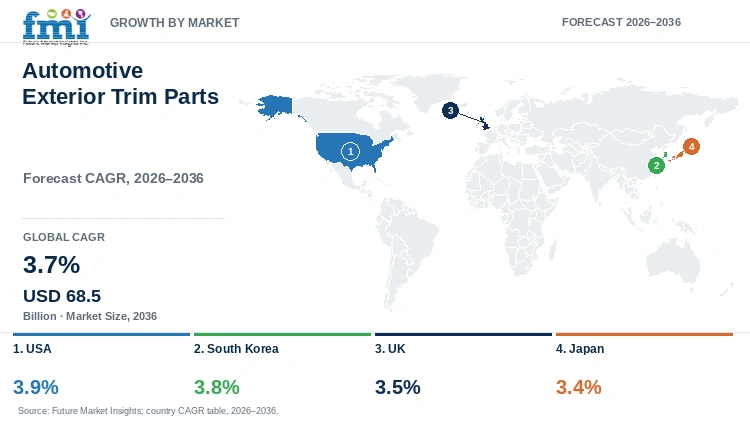
First fit still takes 57% of 2026 channel sales, and steel components hold 54% of material sales, so programme awards and material choice fill supplier order books. The USA leads profiled countries on 3.9%, South Korea follows on 3.8%, and Japan comes last on 3.4%.
Key Market Trends & Insights
- By product, passenger cars held 68% of sales in 2026, a group spanning compact, mid size, luxury, sedan and SUV models.
- By sales channel, first fit accounted for 57% in 2026, backed by OEM supply contracts that fix trim specifications for 5 to 7 year production cycles.
- By application, OEM supply is estimated to have carried 58.6% of 2026 sales. Toyoda Gosei said in June 2026 that exterior parts from the company made with recycled plastic and in-mold coating had been chosen for use on the new Lexus ES.[2]
- By material, steel components held 54% in 2026, with aluminum components gaining on lightweight targets for fuel efficiency and EV range.
- By end user, individual vehicle owners formed about 72.3% of buying (estimated) in 2026, with fleet operators second.
Regional Highlights
- Fastest-growing profiled country: the USA, posting 3.9% CAGR in the 2026 to 2036 window.
- By country: South Korea posts 3.8% and the UK 3.5%, with Japan lowest at 3.4%.
- SMMT reported on 30 September 2026 that UK car production rose by 6.1% to 39,328 units in August.[3]
Market Size & Forecast
Table 1: Market Size and Forecast for the Automotive Exterior Trim Parts Market (USD billion and percentage), 2025 to 2036
| Metric | Value |
|---|---|
| 2025 Market Size | USD 45.9 billion |
| Estimated Market Size in 2026 | USD 47.6 billion |
| Projected Market Size by 2036 | USD 68.45 billion |
| CAGR, 2026 to 2036 | 3.7% |
| Added Revenue, 2026 to 2036 | USD 20.85 billion |
| Market Expansion Multiple | 1.4x |
Incremental sales of USD 20.85 billion arrive between 2026 and 2036, FMI data show. Two adjacent markets, the automotive decorative exterior trim market and the automotive bumper market, supply decorative strips and bumper covers to the same vehicle programmes as exterior trim parts. Suppliers that quote grilles, bumper covers and decorative strips as one front-end module will collect all three orders on each vehicle in one award.
Vehicle Programme Calendars and Trim Material Substitution
Vehicle programme calendars decide the quarter in which bumper and grille shipments start. Magna reported second-quarter 2026 Body Exteriors & Structures sales of $4,421 million, against $4,253 million a year earlier, and listed the launch of new programs among the factors behind consolidated sales.[4] OPmobility postponed exterior launches in H1 2026 and gained first contracts with Leapmotor International outside China for exterior parts on vehicles sold in Europe.[1] Material substitution from chrome and steel toward recycled plastic is a second supply-side force shaping market growth. Toyoda Gosei uses a 25% recycled plastic mix in the lower grille and bumper parts of the Lexus ES, and the company says the mix can reach 50%.[2] Ibec reported that ECHA opened a 60-day consultation on the SEAC draft opinion for restricting certain chromium(VI) substances, with submissions due by 17 August 2026.[5] Plating shops for decorative chrome will carry higher compliance cost, and moulded-in-colour or painted plastic trim will take a growing number of new nameplates.
Table 2: Programme Timing and Material Substitution Indicators for the Automotive Exterior Trim Parts Market (USD million, percentage and dates), 2026
| Indicator | Data Point | Relevance | Source |
|---|---|---|---|
| OPmobility exterior launches, H1 2026 | Program launches postponed to the coming months | A late start of production shifts first-fit trim volume. | [1] |
| OPmobility Toledo, Ohio plant | Bumpers, grilles and tailgates from H2 2027 | New exterior capacity close to US vehicle assembly. | [1] |
| OPmobility and Leapmotor International, 2026 | First exterior contracts outside China, for vehicles sold in Europe | Chinese brands are sourcing exterior parts for European sales. | [1] |
| Magna Body Exteriors & Structures, Q2 2026 | $4,421 million, up from $4,253 million | New program launches supported group sales. | [4] |
| Toyoda Gosei parts on the Lexus ES, release of June 2026 | 25% recycled plastic mix; up to 50% possible | Recycled resin now reaches visible bumper and grille parts. | [2] |
| ELV Directive note, June 2026 | Recycled plastic use expected to become compulsory on new vehicles sold after 2032 | Material qualification work starts years before the deadline. | [2] |
| ECHA chromium(VI) consultation, 2026 | Submissions due by 17 August 2026 | Decorative plating faces a restriction review in Europe. | [5] |
Analyst Perspective
“Recycled-content plastic trim for the electric platforms launching after 2027 is the opening I would back, because vehicle makers now score bidders on weight and resin source alongside finish. Suppliers that pair in-mold coating with regional bumper and grille plants will take the electric programme awards.”
- Nikhil Kaitwade, Principal Consultant, Future Market Insights.
How is the automotive exterior trim parts market segmented?
Five axes split the automotive exterior trim parts market (product, sales channel, application, material and end user), plus region. Passenger cars lead product sales at 68% in 2026, first fit leads the sales channel split at 57%, and steel leads material sales at 54%.
By product: passenger cars (compact, mid size, luxury, sedan and SUV) and commercial vehicles (heavy trucks and buses).
By sales channel: first-fit supply and replacement sales.
By application: OEM supply and aftermarket services.
By material: steel components and aluminum components.
By end user: individual vehicle owners and fleet operators.
By region: coverage spans Western Europe and Latin America, then South Asia and Pacific, Middle East & Africa and East Asia, with North America and Eastern Europe.
Why do passenger cars lead product sales?
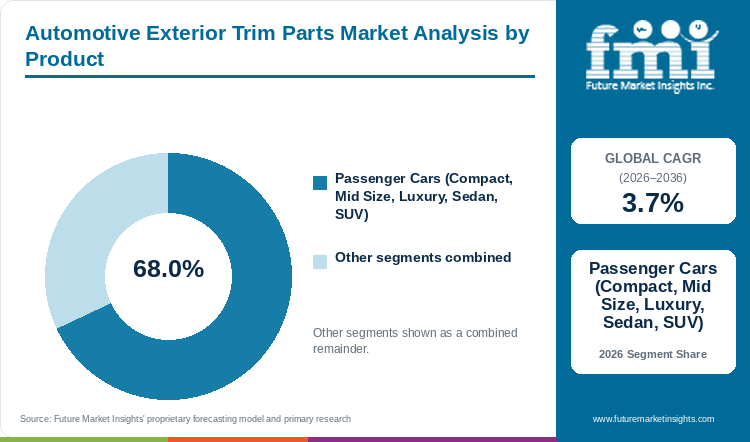
Commercial vehicles take a 32% slice of 2026 product sales, leaving passenger cars with 68%.
Table 3: Product Share for the Automotive Exterior Trim Parts Market (percentage share), 2026
| Product | Estimated Share (2026) |
|---|---|
| Passenger Cars | 68% |
| Commercial Vehicles | 32% |
| Total | 100.0% |
Table 4: Product Leadership and Market Growth for the Automotive Exterior Trim Parts Market (segment and CAGR percentage), 2026 to 2036
| Metric | Value |
|---|---|
| Global CAGR (2026 to 2036) | 3.7% |
| Leading Segment | Passenger Cars |
Production scale separates cars from heavy trucks and buses in the FMI split, and cars take 68% of product sales. Each car nameplate carries a grille, bumper covers, side mouldings and badges. Toyoda Gosei said in June 2026 that lower grille and bumper parts from the company had been chosen for use on the new Lexus ES.[2] Commercial vehicles hold 32%. Truck and bus cabs will keep longer model cycles and fewer decorative pieces per unit, so SUV and sedan refreshes will hold the car lead through 2036.
- Commercial vehicles cover heavy trucks and buses.
- Toyoda Gosei recycled plastic went first into the Toyota Camry sold mainly in Europe and then into the Lexus ES.[2]
Why does first fit lead sales channel sales?
Replacement takes 43% of the 2026 sales channel split, and first fit takes 57%.
Table 5: Sales Channel Share for the Automotive Exterior Trim Parts Market (percentage share), 2026
| Sales Channel | Estimated Share (2026) |
|---|---|
| First Fit | 57% |
| Replacement | 43% |
| Total | 100.0% |
Magna named the launch of new programs among the reasons for a 3% gain in second-quarter 2026 sales.[4] Programme awards fix trim specifications for 5 to 7 year production cycles, and FMI puts first fit at 57% of channel sales on that basis. Replacement follows at 43%, fed by collision repair and owner customisation. A body shop orders one bumper cover at a time. A first-fit award covers every unit of a model run, so first fit stays ahead of replacement.
- Replacement sales come from collision repair and aesthetic customisation.
- Second-quarter 2026 Body Exteriors & Structures sales at Magna came to $4,421 million.[4]
Why does OEM supply lead application sales?
Application sales in 2026 split an estimated 58.6% to OEM supply and 41.4% to aftermarket services.
Table 6: Application Share for the Automotive Exterior Trim Parts Market (percentage share), 2026
| Application | Estimated Share (2026) |
|---|---|
| OEM Supply | 58.6% |
| Aftermarket Services | 41.4% |
| Total | 100.0% |
Vehicle makers pick one trim source per programme and keep that source for the model run. OEM supply therefore leads application sales, estimated at 58.6%, and aftermarket services take 41.4%. OPmobility gained first exterior parts contracts with Leapmotor International for vehicles sold in Europe, which adds a new OEM buyer to the supply base.[1] OEM trim orders follow vehicle builds in the wider automotive OEM market, so each Leapmotor model launch in Europe adds trim volume for OPmobility. Owner restyling feeds a related pool, the dechroming and blackout exterior trim services market, which advances at 7.2% CAGR during 2026 to 2036. Aftermarket services will grow on owner demand for blackout trim and on repair work across an older vehicle parc.
- Aftermarket services include repair and restyling of grilles, mouldings and badges.
- OPmobility also holds contracts with Chery in Spain and Brazil.[1]
Why do steel components lead material sales?
Steel components make up 54% of material sales in 2026; aluminum components hold the other 46%.
Table 7: Material Share for the Automotive Exterior Trim Parts Market (percentage share), 2026
| Material | Estimated Share (2026) |
|---|---|
| Steel Components | 54% |
| Aluminum Components | 46% |
| Total | 100.0% |
Installed stamping capacity keeps steel brackets, reinforcements and formed trim ahead of aluminum. Steel holds 54% of material sales, FMI finds, and aluminum gains on lightweight requirements for fuel efficiency and EV range. Toyoda Gosei moulds lower grille and bumper parts for the Lexus ES with a 25% recycled plastic mix, so plastics now compete with both metals on visible trim.[2] Aluminum, at 46%, will narrow the gap with steel on electric platforms. Steel will keep the lead on commercial vehicle parts, which carry heavier loads.
- Aluminum components gain on electric platforms with range targets.
- Toyoda Gosei says recycled plastic in exterior parts can reach a 50% mix.[2]
Why do individual vehicle owners lead end-user sales?
Individual vehicle owners represent an estimated 72.3% of end-user sales in 2026, against 27.7% for fleet operators.
Table 8: End User Share for the Automotive Exterior Trim Parts Market (percentage share), 2026
| End User | Estimated Share (2026) |
|---|---|
| Individual Vehicle Owners | 72.3% |
| Fleet Operators | 27.7% |
| Total | 100.0% |
Domestic-market car output in the UK rose 26% in August 2026, SMMT reported.[3] UK-built cars for the home market will reach private owners first, and those owners buy replacement grilles, mirror caps and mouldings after collisions or for restyling. Private owners account for an estimated 72.3% of end-user sales. Fleet operators hold 27.7% and will order trim in batches under repair contracts and refresh schedules, which favours suppliers with catalogue depth.
- Fleet operators buy trim through repair contracts.
- Electrified cars made up 43.6% of UK cars produced in August 2026.[3]
What are the drivers, restraints, and opportunities in the automotive exterior trim parts market?
Growth of the automotive exterior trim parts market comes from passenger vehicle production recovery and new EV platform launches. Key challenges faced by manufacturers include postponed programme launches, cost pressure and tighter rules on chrome plating chemicals.
- Driver: New model platforms and EV launches reset grille, bumper and moulding specifications.
- Restraint: Launch delays and plating restrictions add cost and idle tooling time.
- Opportunity: Recycled-content plastics and owner restyling open new order books.
Fresh Platforms Reset Trim Specifications
Aerodynamic and weight targets on EV platforms are reshaping trim specifications. Toyoda Gosei announced on 24 September 2026 a plant in Bidkin Industrial Area, Maharashtra, for bumpers and instrument panels, with an investment of about INR 5.758 billion and production planned for the first half of 2029.[6] The plant will serve Japanese automakers in India. Bumper demand in India will follow the Maharashtra plant as Japanese automakers add Indian nameplates.
Launch Delays and Plating Rules Weigh on Margins
Postponed launches cut OPmobility exterior output in H1 2026, and Exterior & Lighting consolidated sales fell 4.5% to €2,281 million.[1] Ibec reported a 60-day ECHA consultation on restricting certain chromium(VI) oxides, oxyacids and salts used in plating and surface treatment.[5] Chrome-finish suppliers will face retooling or new coating lines in Europe. Retooling cost for chrome-free coating falls hardest on single-plant chrome platers.
Recycled Resin and Restyling Open Fresh Orders
Aftermarket replacement driven by collision repair and aesthetic customisation forms a secondary channel outside new vehicle cycles, as FMI notes. Toyoda Gosei states that recycled plastic use is expected to become compulsory on new vehicles sold after 2032 under the ELV Directive.[2] The Europe recycled plastics for exterior body parts and bumpers in automotive industry market expands at a 10.9% CAGR over 2026 to 2036. Moulders with approved recycled grades will quote first on European programmes.
Which country CAGRs are profiled in the automotive exterior trim parts market?
Table 9: Country CAGR Comparison for the Automotive Exterior Trim Parts Market (CAGR percentage), 2026 to 2036
| Country | CAGR |
|---|---|
| USA | 3.9% |
| South Korea | 3.8% |
| UK | 3.5% |
| Japan | 3.4% |
How do country-level CAGRs compare in the automotive exterior trim parts market?
Four countries carry published CAGRs for 2026 to 2036. The USA leads at 3.9%, as per FMI, and South Korea follows at 3.8%. The UK is set at 3.5%, and Japan closes the group at 3.4%. Regional growth is following different paths, with light truck output and a deep collision-repair trade favouring the USA and home-brand assembly concentrating purchasing in South Korea and Japan.
- USA pairs light truck production and a large repair aftermarket with new EV launches.
- South Korea channels trim buying through Hyundai and Kia assembly plants.
- UK combines premium vehicle output with a mature parc for replacement parts.
- Japan rewards precision fit and finish at Toyota, Honda and Nissan.
Full report country CAGRs cover: seven regions, namely Latin America, Eastern Europe, East Asia, Middle East & Africa, Western Europe, South Asia and Pacific, and North America.
Country-wise Analysis
USA Automotive Exterior Trim Parts Market Outlook (2026 to 2036)
OPmobility plans a Toledo, Ohio plant dedicated to exterior solutions, with bumpers, grilles and tailgates due from the second half of 2027.[1] Magna cited lower light vehicle production in North America among the factors on second-quarter 2026 sales.[4] Domestic car and light truck output, a large collision-repair aftermarket and EV platform launches from home and foreign OEMs carry a 3.9% CAGR for the USA from 2026 to 2036.
Key takeaway: Local bumper and grille capacity in Ohio from 2027 will shorten supply lines for US programmes.
South Korea Automotive Exterior Trim Parts Market Outlook (2026 to 2036)
South Korea is set at a 3.8% CAGR from 2026 to 2036. Vehicle output rose 12% year on year to 394,210 units in June 2026, just-auto reported, and first-half output reached 2,110,783 units.[7] The same report named Hyundai Motor among firms hit by temporary parts shortages.[7] Hyundai and Kia volumes concentrate trim procurement, and Korean suppliers bring exterior systems integration and lightweight material work.
Key takeaway: A single sourcing decision at Hyundai or Kia will move national trim volume.
UK Automotive Exterior Trim Parts Market Outlook (2026 to 2036)
Premium output from Jaguar Land Rover and other UK makers calls for high-specification trim. SMMT reported a 6.1% rise in car production to 39,328 units in August 2026, with electrified models at 43.6% of cars built.[3] Nissan, McLaren and Bentley announced investments of £170m, £500m and £350m in September 2026.[3] The mature UK vehicle parc adds collision-repair replacement sales, and the UK posts a 3.5% CAGR across the 2026 to 2036 span.
Key takeaway: Fresh money at premium and EV plants points UK buying toward low-volume, high-finish parts.
Japan Automotive Exterior Trim Parts Market Outlook (2026 to 2036)
Japan carries the lowest of the four CAGRs, 3.4% over 2026 to 2036. Toyota, Honda and Nissan platforms generate concentrated trim procurement and favour suppliers with tight quality control. Toyoda Gosei reached mass production of a large in-mold coated luggage panel, a first in Japan as of 31 May 2026.[2] Lightweight requirements support aluminum use on new Toyota, Honda and Nissan models.
Key takeaway: Moulding and painting inside one tool will cut cost on large panels for Japanese suppliers.
Who are the notable companies in the automotive exterior trim parts market?
Key suppliers include Plastic Omnium, Toyoda Gosei Co., Ltd., SMP Deutschland GmbH, Magna International Inc., Flex-N-Gate, Rehau Automotive, Polytec Group, Minth Group, and Motherson Sumi Systems.
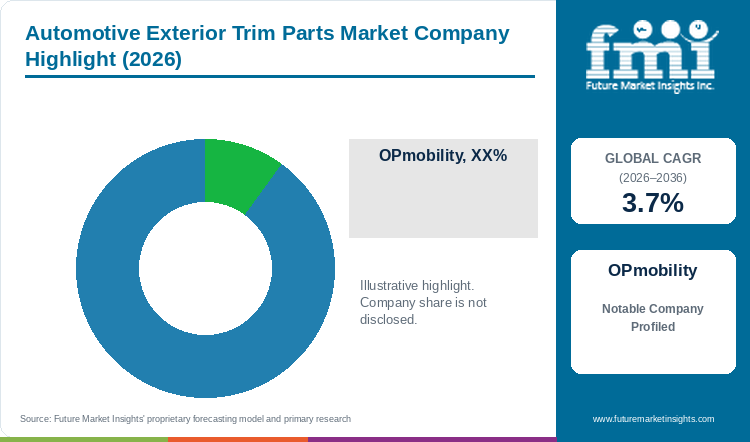
Plastic Omnium holds an estimated 16% share in the FMI company review, supported by global trim manufacturing and OEM partnerships. Toyoda Gosei, SMP Deutschland and Magna compete on engineering, material work and multi-platform plants. Moves in 2025 that are rewriting the rules of market competition include a Plastic Omnium launch of a lightweight composite exterior trim system for EV platforms and a Magna expansion into sensor-integrated grille and bumper modules. Recent filings add OPmobility plant plans, Magna segment results and Toyoda Gosei recycled-plastic parts.[1][4][2] Emerging supplier Minth Group posted first-half 2026 revenue of 13.408 billion yuan, up 9.1% year on year, Gasgoo reported in August 2026.[8] The group runs four product lines and 80 factories and offices across 15 countries on four continents.[8] The 15-country Minth plant base gives the group a local quote for programmes on several continents.
- Major suppliers: Plastic Omnium, Toyoda Gosei Co., Ltd., SMP Deutschland GmbH, and Magna International Inc.
- Specialized suppliers: Flex-N-Gate, Rehau Automotive, and Polytec Group.
- Emerging suppliers: Minth Group and Motherson Sumi Systems.
Competitive Benchmarking: Automotive Exterior Trim Parts Market
Table 10: Competitive Benchmarking for the Automotive Exterior Trim Parts Market (qualitative documentation ratings), 2026
| Company | Programme Reach | Material Work | Plant Activity | Disclosure |
|---|---|---|---|---|
| OPmobility | High | Medium | High | High |
| Magna International | High | Low | Medium | High |
| Toyoda Gosei | Medium | High | High | High |
Each rating shows the depth of dated company documentation and carries no ranking.
Key Developments in the Automotive Exterior Trim Parts Market
- In September 2026, Toyoda Gosei announced a bumper and instrument panel plant in Maharashtra, India, with production planned for the first half of 2029.[6]
- In September 2026, SMMT reported UK investments of £170m by Nissan, £500m by McLaren and £350m by Bentley.[3]
- In August 2026, Gasgoo reported first-half revenue of 13.408 billion yuan at Minth Group, up 9.1% year on year.[8]
- In July 2026, Magna reported second-quarter Body Exteriors & Structures sales of $4,421 million.[4]
- In July 2026, OPmobility set out plans for a Toledo, Ohio exterior plant and reported first exterior contracts with Leapmotor International outside China.[1]
- In June 2026, Toyoda Gosei said exterior parts from the company with recycled plastic and in-mold coating had been chosen for use on the new Lexus ES.[2]
- In June 2026, Ibec reported an ECHA consultation on restricting certain chromium(VI) substances, open until 17 August 2026.[5]
Key Players in the Automotive Exterior Trim Parts Market
Major Suppliers
- Plastic Omnium
- Toyoda Gosei Co., Ltd.
- SMP Deutschland GmbH
- Magna International Inc.
Specialized Suppliers
- Flex-N-Gate
- Rehau Automotive
- Polytec Group
Emerging Suppliers
- Minth Group
- Motherson Sumi Systems
Automotive Exterior Trim Parts Market - Report Scope
Table 11: Report Scope for the Automotive Exterior Trim Parts Market (coverage fields and definitions), 2026 to 2036
| Coverage field | Report scope |
|---|---|
| Market breakdown | Product; sales channel; application; material; end user; region |
| Quantitative units | USD billion |
| Market definition | Exterior trim parts for passenger cars and commercial vehicles, including grilles, bumper trim, mouldings and badges, supplied through first fit and replacement channels. |
| Regions covered | North America; Latin America; Western Europe; Eastern Europe; East Asia; South Asia and Pacific; Middle East & Africa |
| Countries covered | USA; South Korea; UK; Japan |
| Key companies profiled | Plastic Omnium, Toyoda Gosei Co., Ltd., SMP Deutschland GmbH, Magna International Inc., Flex-N-Gate, Rehau Automotive, Polytec Group, Minth Group, Motherson Sumi Systems |
| Forecast period | 2026 to 2036 |
Automotive Exterior Trim Parts Market - Research Methodology
Table 12: Research Methodology for the Automotive Exterior Trim Parts Market (research methods and approach), 2026 edition
| Method | Approach |
|---|---|
| Data Sources | Programme, plant and material facts come from company filings, press releases, trade bodies and trade press dated May 2025 or later. |
| Desk Research | Desk work covers supplier results, plant announcements, vehicle production releases and chemical restriction notices. |
| Market Sizing and Forecasting | Sizing starts from the 2025 base of USD 45.9 billion and the 3.7% CAGR. |
| Data Validation | Plant dates and material shares were matched to the announcing company and to trade body releases of the same quarter. |
Automotive Exterior Trim Parts Market by Segments
Automotive Exterior Trim Parts Market segmented by Product:
- Passenger Cars (Compact, Mid Size, Luxury, Sedan, SUV)
- Commercial Vehicles (Heavy Trucks, Buses)
Automotive Exterior Trim Parts Market segmented by Sales Channel:
- First Fit
- Replacement
Automotive Exterior Trim Parts Market segmented by Application:
- OEM Supply
- Aftermarket Services
Automotive Exterior Trim Parts Market segmented by Material:
- Steel Components
- Aluminum Components
Automotive Exterior Trim Parts Market segmented by End User:
- Individual Vehicle Owners
- Fleet Operators
Automotive Exterior Trim Parts Market by Region
- North America
- USA
- Latin America
- Western Europe
- UK
- Eastern Europe
- East Asia
- Japan
- South Korea
- South Asia and Pacific
- Middle East & Africa
Research Sources and Bibliography
- [1] OPmobility. (2026, July 22). H1 2026 results press release. https://www.opmobility.com/wp-content/uploads/2026/07/opmobility-press-release-h1-2026-results-en.pdf
- [2] Toyoda Gosei Co., Ltd. (2026, June 11). Interior and exterior products used on the new Lexus ES. https://www.toyoda-gosei.com/news/details.php?id=462
- [3] SMMT. (2026, September 30). Vehicle manufacturing grows alongside £1bn investment boost but EU trade threats loom. https://www.smmt.co.uk/vehicle-manufacturing-grows-alongside-1bn-investment-boost-but-eu-trade-threats-loom/
- [4] Magna International Inc. (Form 6-K, SEC). (2026, July 31). Magna announces strong second quarter results, raises outlook for 2026. https://www.sec.gov/Archives/edgar/data/0000749098/000110465926088923/tm2618646d1_ex99-1.htm
- [5] Ibec. (2026, June 30). European Chemical Agency consultation. https://www.ibec.ie/sfa/news-insights-and-events/insights/2026/06/30/european-chemical-agency-consultation
- [6] Toyoda Gosei Co., Ltd. (2026, September 24). New plant for automotive interior and exterior parts in West-Central India. https://www.toyoda-gosei.com/news/details.php?id=472
- [7] Just Auto. (2026, July 16). South Korea auto exports rise 6% in June. https://www.just-auto.com/news/south-korea-auto-exports-rise-6-in-june/
- [8] Gasgoo. (2026, August 26). Minth Group H1 Revenue 13.408 Billion Yuan, Net Profit Up 12.3% YoY. https://autonews.gasgoo.com/articles/news/minth-group-h1-revenue-13408-billion-yuan-net-profit-up-123-yoy-2092586216670449665
This bibliography is provided for reader reference. The full report contains the complete reference list and detailed citations.
This Report Answers
- What will automotive exterior trim parts market size be in 2026 and 2036?
- At what CAGR will sales grow from 2026 to 2036?
- Which product and sales channel will hold the largest shares?
- How will material substitution change demand for steel and aluminum?
- Which country will post the fastest growth?
- Which suppliers will shape OEM programme awards?
Frequently Asked Questions
How large will the automotive exterior trim parts market be in 2026?
Sales in 2026 will total USD 47.6 billion in the Future Market Insights estimate. By 2036, the projection will stand at USD 68.45 billion.
What CAGR will the automotive exterior trim parts market post through 2036?
A 3.7% CAGR from 2026 to 2036 will carry sales forward, per FMI. EV platform launches and lighter plastic and aluminum trim will drive sales gains.
Which product will hold the largest share in 2026?
Passenger cars will account for 68% of 2026 product sales. Commercial vehicles will hold the remaining 32%.
Which sales channel will lead in 2026?
First fit will lead with 57% of sales channel sales. OEM contracts of 5 to 7 years will anchor the first-fit lead.
Which country will grow fastest through 2036?
In the FMI country view, the USA will grow fastest at a 3.9% CAGR from 2026 to 2036. South Korea will follow at 3.8%.
Who will be the key companies in the automotive exterior trim parts market?
Plastic Omnium, Toyoda Gosei, SMP Deutschland, Magna International, Flex-N-Gate, Rehau Automotive, Polytec Group, Minth Group and Motherson Sumi Systems will be the key names.
Preview the report firsthand - request a free sample
Get SampleGet the brochure for pricing and purchase details.
Get PDFTable of Content
- Key Takeaways
- Market Size and CAGR
- Top Growth Driver
- Fastest Growing Segment
- Leading Region
- Key Companies
- Emerging Opportunities
- Executive Summary
- Global Market Outlook
- Demand-side Trends
- Supply-side Trends
- Technology Roadmap Analysis
- Analysis and Recommendations
- Analyst Perspective (What is happening? Why now? What should investors know?)
- Key Questions Answered
- How large is the market?
- What is the CAGR?
- What are key trends?
- Which region dominates?
- Who are the leaders?
- Market Overview
- Market Coverage / Taxonomy
- Market Definition / Scope / Limitations
- Research Methodology
- Chapter Orientation
- Analytical Lens and Working Hypotheses
- Market Structure, Signals, and Trend Drivers
- Benchmarking and Cross-market Comparability
- Market Sizing, Forecasting, and Opportunity Mapping
- Research Design and Evidence Framework
- Desk Research Programme (Secondary Evidence)
- Expert Input and Fieldwork (Primary Evidence)
- Tooling, Models, and Reference Databases
- Data Engineering and Model Build
- Quality Assurance and Audit Trail
- Market Background
- Market Dynamics (Drivers, Restraints, Opportunity, Trends)
- Scenario Forecast (Optimistic, Likely, Conservative)
- Impact Analysis
- AI Impact
- Sustainability Impact
- Regulatory Impact
- Technology Impact
- Consumer / Buyer Analysis
- Purchase Drivers
- Adoption Barriers
- Buyer Journey
- Opportunity Map Analysis
- Product Life Cycle Analysis
- Supply Chain Analysis
- Investment Feasibility Matrix
- Value Chain Analysis
- PESTLE and Porter's Analysis
- Regulatory Landscape
- Regional Parent Market Outlook
- Production and Consumption Statistics
- Import and Export Statistics
- Global Market Analysis and Forecast, 2021 to 2036
- Historical Market Size Value (USD Billion) Analysis, 2021 to 2025
- Current and Future Market Size Value (USD Billion) Projections, 2026 to 2036
- Y-o-Y Growth Trend Analysis
- Absolute $ Opportunity Analysis
- Global Market Pricing Analysis, 2021 to 2036
- Global Market Analysis and Forecast, By Product, 2021 to 2036
- Introduction / Key Findings
- Historical Market Size Value (USD Billion) Analysis By Product, 2021 to 2025
- Current and Future Market Size Value (USD Billion) Analysis and Forecast By Product, 2026 to 2036
- Passenger Cars (Compact, Mid Size, Luxury, Sedan, SUV)
- Commercial Vehicles (Heavy Trucks, Buses)
- Y-o-Y Growth Trend Analysis By Product, 2021 to 2025
- Absolute $ Opportunity Analysis By Product, 2026 to 2036
- Global Market Analysis and Forecast, By Sales Channel, 2021 to 2036
- Introduction / Key Findings
- Historical Market Size Value (USD Billion) Analysis By Sales Channel, 2021 to 2025
- Current and Future Market Size Value (USD Billion) Analysis and Forecast By Sales Channel, 2026 to 2036
- First Fit
- Replacement
- Y-o-Y Growth Trend Analysis By Sales Channel, 2021 to 2025
- Absolute $ Opportunity Analysis By Sales Channel, 2026 to 2036
- Global Market Analysis and Forecast, By Application, 2021 to 2036
- Introduction / Key Findings
- Historical Market Size Value (USD Billion) Analysis By Application, 2021 to 2025
- Current and Future Market Size Value (USD Billion) Analysis and Forecast By Application, 2026 to 2036
- OEM Supply
- Aftermarket Services
- Y-o-Y Growth Trend Analysis By Application, 2021 to 2025
- Absolute $ Opportunity Analysis By Application, 2026 to 2036
- Global Market Analysis and Forecast, By Material, 2021 to 2036
- Introduction / Key Findings
- Historical Market Size Value (USD Billion) Analysis By Material, 2021 to 2025
- Current and Future Market Size Value (USD Billion) Analysis and Forecast By Material, 2026 to 2036
- Steel Components
- Aluminum Components
- Y-o-Y Growth Trend Analysis By Material, 2021 to 2025
- Absolute $ Opportunity Analysis By Material, 2026 to 2036
- Global Market Analysis and Forecast, By End User, 2021 to 2036
- Introduction / Key Findings
- Historical Market Size Value (USD Billion) Analysis By End User, 2021 to 2025
- Current and Future Market Size Value (USD Billion) Analysis and Forecast By End User, 2026 to 2036
- Individual Vehicle Owners
- Fleet Operators
- Y-o-Y Growth Trend Analysis By End User, 2021 to 2025
- Absolute $ Opportunity Analysis By End User, 2026 to 2036
- Global Market Analysis and Forecast, By Region, 2021 to 2036
- Introduction
- Historical Market Size Value (USD Billion) Analysis By Region, 2021 to 2025
- Current Market Size Value (USD Billion) Analysis and Forecast By Region, 2026 to 2036
- North America
- Latin America
- Western Europe
- Eastern Europe
- East Asia
- South Asia and Pacific
- Middle East & Africa
- Market Attractiveness Analysis By Region
- North America Market Analysis and Forecast, By Country, 2021 to 2036
- Historical Market Size Value (USD Billion) Trend Analysis By Market Taxonomy, 2021 to 2025
- Market Size Value (USD Billion) Forecast By Market Taxonomy, 2026 to 2036
- By Country
- USA
- By Product
- By Sales Channel
- By Application
- By Material
- By End User
- By Country
- Market Attractiveness Analysis
- By Country
- By Product
- By Sales Channel
- By Application
- By Material
- By End User
- Key Takeaways
- Latin America Market Analysis and Forecast, By Country
- Historical Market Size Value (USD Billion) Trend Analysis By Market Taxonomy, 2021 to 2025
- Market Size Value (USD Billion) Forecast By Market Taxonomy, 2026 to 2036
- By Country
- By Product
- By Sales Channel
- By Application
- By Material
- By End User
- Market Attractiveness Analysis
- By Country
- By Product
- By Sales Channel
- By Application
- By Material
- By End User
- Key Takeaways
- Western Europe Market Analysis and Forecast, By Country
- Historical Market Size Value (USD Billion) Trend Analysis By Market Taxonomy, 2021 to 2025
- Market Size Value (USD Billion) Forecast By Market Taxonomy, 2026 to 2036
- By Country
- UK
- By Product
- By Sales Channel
- By Application
- By Material
- By End User
- By Country
- Market Attractiveness Analysis
- By Country
- By Product
- By Sales Channel
- By Application
- By Material
- By End User
- Key Takeaways
- Eastern Europe Market Analysis and Forecast, By Country
- Historical Market Size Value (USD Billion) Trend Analysis By Market Taxonomy, 2021 to 2025
- Market Size Value (USD Billion) Forecast By Market Taxonomy, 2026 to 2036
- By Country
- By Product
- By Sales Channel
- By Application
- By Material
- By End User
- Market Attractiveness Analysis
- By Country
- By Product
- By Sales Channel
- By Application
- By Material
- By End User
- Key Takeaways
- East Asia Market Analysis and Forecast, By Country
- Historical Market Size Value (USD Billion) Trend Analysis By Market Taxonomy, 2021 to 2025
- Market Size Value (USD Billion) Forecast By Market Taxonomy, 2026 to 2036
- By Country
- Japan
- South Korea
- By Product
- By Sales Channel
- By Application
- By Material
- By End User
- By Country
- Market Attractiveness Analysis
- By Country
- By Product
- By Sales Channel
- By Application
- By Material
- By End User
- Key Takeaways
- South Asia and Pacific Market Analysis and Forecast, By Country
- Historical Market Size Value (USD Billion) Trend Analysis By Market Taxonomy, 2021 to 2025
- Market Size Value (USD Billion) Forecast By Market Taxonomy, 2026 to 2036
- By Country
- By Product
- By Sales Channel
- By Application
- By Material
- By End User
- Market Attractiveness Analysis
- By Country
- By Product
- By Sales Channel
- By Application
- By Material
- By End User
- Key Takeaways
- Middle East & Africa Market Analysis and Forecast, By Country
- Historical Market Size Value (USD Billion) Trend Analysis By Market Taxonomy, 2021 to 2025
- Market Size Value (USD Billion) Forecast By Market Taxonomy, 2026 to 2036
- By Country
- By Product
- By Sales Channel
- By Application
- By Material
- By End User
- Market Attractiveness Analysis
- By Country
- By Product
- By Sales Channel
- By Application
- By Material
- By End User
- Key Takeaways
- Key Countries Market Analysis
- USA
- Pricing Analysis
- Market Share Analysis, 2025
- By Product
- By Sales Channel
- By Application
- By Material
- By End User
- UK
- Pricing Analysis
- Market Share Analysis, 2025
- By Product
- By Sales Channel
- By Application
- By Material
- By End User
- Japan
- Pricing Analysis
- Market Share Analysis, 2025
- By Product
- By Sales Channel
- By Application
- By Material
- By End User
- South Korea
- Pricing Analysis
- Market Share Analysis, 2025
- By Product
- By Sales Channel
- By Application
- By Material
- By End User
- USA
- Market Structure Analysis
- Competition Dashboard
- Competition Benchmarking
- Market Share Analysis of Top Players
- By Regional
- By Product
- By Sales Channel
- By Application
- By Material
- By End User
- Emerging Startups
- Innovation Benchmarking
- Competition Analysis
- Competition Deep Dive
- OPmobility
- Overview
- Product Portfolio
- Profitability by Market Segments
- Sales Footprint
- Strategy Overview
- Marketing Strategy
- Product Strategy
- Channel Strategy
- Magna International
- Toyoda Gosei
- Plastic Omnium
- Toyoda Gosei Co., Ltd.
- SMP Deutschland GmbH
- Flex-N-Gate
- Rehau Automotive
- Polytec Group
- Minth Group
- Motherson Sumi Systems
- OPmobility
- Case Studies
- Success Stories
- Recent Developments
- Competition Deep Dive
- Assumptions & Acronyms Used


