

- Industry Size (2026)
- USD 2.43 Bn
- Forecast (2036)
- USD 4.28 Bn
- CAGR (2026 to 2036)
- 5.8%
Cotton Bags Market size, market forecast and outlook by FMI
The cotton bags market was valued at USD 2.30 billion in 2025, projected to reach USD 2.43 billion in 2026, and is forecast to expand to USD 4.28 billion by 2036 at a 5.8% CAGR. Accelerating single-use plastic bans across municipal and national jurisdictions are compelling retailers, grocery chains, and industrial buyers to transition toward reusable cotton bag alternatives. Procurement officers managing corporate sustainability compliance targets now treat cotton bag sourcing as a mandatory packaging line item rather than a discretionary promotional expense.
Summary of Cotton Bags Market
- The market is forecast to touch USD 4.28 billion by 2036.
- Annual growth of 5.8% is projected across the 2026-2036 forecast horizon.
- In 2025, market value was pegged at USD 2.30 billion.
- The forecast period unlocks an incremental opportunity worth USD 1.85 billion.
- Calico bags lead by type with 40.0% share in 2026 due to their versatility across grocery retail and branded promotional use cases.
- Up to 5 Kg capacity segment holds 35.0% share in 2026, reflecting high-volume demand from grocery and convenience retail channels.
- Automotive end use commands 25.0% share in 2026 as parts packaging and distribution logistics adopt reusable cotton containment bags.
- Demand is accelerating as single-use plastic bag bans at municipal and national levels convert cotton bags into mandatory procurement items for retail and grocery chains.
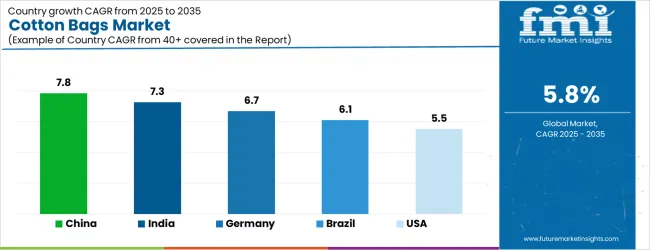
- Among key countries, China leads at 7.8% CAGR, followed by India at 7.3%, Germany at 6.7%, Brazil at 6.1%, the USA at 5.5%, the UK at 4.9%, and Japan at 4.4%.
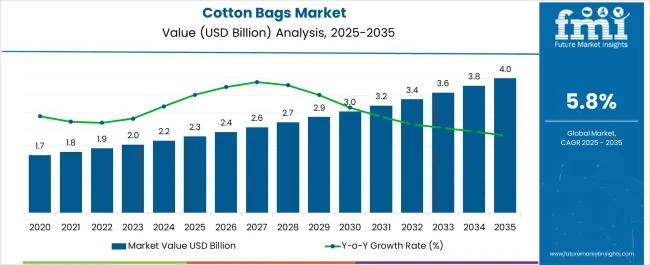
FMI analysts observe that the cotton bags category is shifting from a niche promotional product into a regulated packaging compliance tool. Legislative action banning single-use plastic bags at the municipal and national level has converted cotton bags from optional branded merchandise into a procurement requirement for grocery, retail, and industrial distribution channels. The cost per unit remains higher than polypropylene alternatives, but lifecycle cost analysis increasingly favours cotton bags when factoring in reuse cycles and brand equity. As per FMI, vertically integrated manufacturers controlling ginning, weaving, and printing under one facility are capturing margin that fragmented contract assemblers cannot match.
All major markets reflect accelerated deployment parameters. China sets a 7.8% CAGR, India sets a 7.3% CAGR, Germany sets a 6.7% CAGR, Brazil sets a 6.1% CAGR, USA sets a 5.5% CAGR, UK sets a 4.9% CAGR, and Japan sets a 4.4% CAGR. China leads at 7.8% CAGR as domestic textile manufacturers scale export-oriented cotton bag production lines to serve European and North American compliance demand. India follows at 7.3%, leveraging its raw cotton supply advantage and low-cost weaving infrastructure. Germany at 6.7% reflects strict federal packaging legislation mandating reusable alternatives. Brazil benefits from growing retail chain adoption of branded cotton totes. The USA expands at 5.5% as state-level plastic bag bans accumulate. UK and Japan maintain steady growth as retailers integrate reusable bags into loyalty programme incentives.
Cotton Bags Market key takeaways
| Metric | Details |
|---|---|
| Industry Size (2026) | USD 2.43 billion |
| Industry Value (2036) | USD 4.28 billion |
| CAGR (2026-2036) | 5.8% |
Source: Future Market Insights, 2026
Cotton Bags Market definition
Cotton bags are reusable textile bags manufactured from woven or knitted cotton fabric, designed for repeated use in retail, grocery, industrial, and promotional applications. Product categories include calico bags, tote bags, beach cotton bags, and capacity-graded variants ranging from under 5 kg to above 20 kg carrying capacity. These bags serve as alternatives to single-use plastic and paper bags in compliance with packaging waste reduction legislation.
Cotton Bags Market inclusions
Market scope includes all reusable cotton bags across retail, industrial, and promotional channels, covering calico, tote, and beach cotton bag formats. Regional and country-level market sizes, forecast period 2026 to 2036, and segment breakdowns by capacity, end use, and type are fully incorporated.
Cotton Bags Market exclusions
The scope excludes jute bags, polypropylene non-woven bags, single-use paper bags, and polyester-cotton blend bags where cotton content is below 80%. It also omits cotton sack packaging for bulk agricultural commodities.
Cotton Bags Market research methodology
Primary Research:
Analysts conducted interviews with retail procurement managers, textile manufacturers, raw cotton traders, and sustainability compliance officers to map purchasing decision drivers and legislative adoption timelines.
Desk Research:
Data collection aggregated national plastic bag ban legislation databases, organic cotton certification registries, textile trade statistics, and company annual reports from leading bag manufacturers.
Market-Sizing and Forecasting:
Baseline values derive from a bottom-up aggregation of retail and industrial bag procurement volumes by region, applying capacity-specific pricing tiers and legislative compliance adoption curves.
Data Validation and Update Cycle:
Projections are tested against publicly reported revenue guidance from leading textile bag manufacturers and cross-referenced with cotton trade flow data from major producing countries.
Why is the Cotton Bags Market Growing?
The Cotton Bags market is experiencing significant growth due to increasing global awareness of sustainable and eco-friendly alternatives to plastic. Growing environmental regulations and government initiatives to reduce plastic waste are driving adoption across various regions. Consumers and businesses are increasingly shifting toward reusable and biodegradable packaging solutions, which has created strong demand for cotton-based bags.
The market is further supported by rising awareness of health and safety concerns associated with synthetic materials. Technological advancements in cotton processing and bag manufacturing have improved durability and design versatility, enhancing the attractiveness of cotton bags for commercial and personal use. Additionally, expansion in retail, food, and industrial sectors has bolstered market demand, creating opportunities for innovative designs and functional features.
The market is expected to continue growing as consumer preference for eco-conscious products rises, and supply chains adapt to meet the increasing volume requirements efficiently Integration of branding and customization options in cotton bags has also contributed to higher adoption rates, providing both marketing and sustainability benefits.
Segmental Analysis
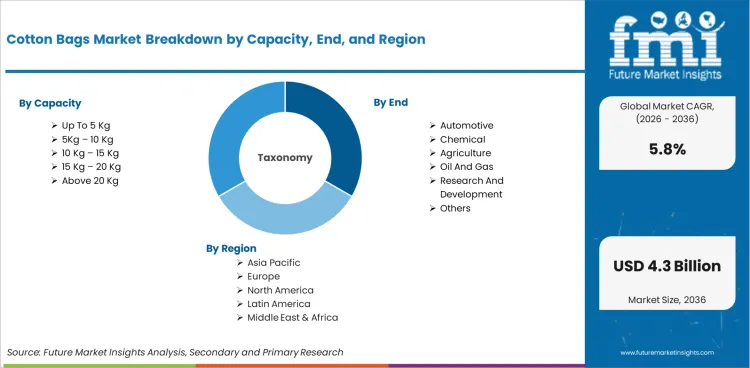
The cotton bags market is segmented by capacity, end use, type, and geographic regions. By capacity, cotton bags market is divided into Up To 5 Kg, 5Kg – 10 Kg, 10 Kg – 15 Kg, 15 Kg – 20 Kg, and Above 20 Kg. In terms of end use, cotton bags market is classified into Automotive, Chemical, Agriculture, Oil And Gas, Research And Development, and Others. Based on type, cotton bags market is segmented into Calico (Unbleached Or Unprocessed Cotton) Bags, Beach Cotton Bags, and Tote Cotton Bags. Regionally, the cotton bags industry is classified into North America, Latin America, Western Europe, Eastern Europe, Balkan & Baltic Countries, Russia & Belarus, Central Asia, East Asia, South Asia & Pacific, and the Middle East & Africa.
Insights into the Up To 5 Kg Capacity Segment
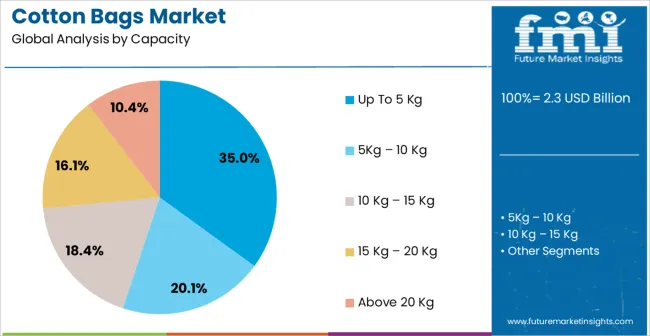
The Up To 5 Kg capacity segment is projected to hold 35.0% of the Cotton Bags market revenue share in 2025, making it the leading capacity category. This segment has been favored due to its suitability for everyday use, ease of handling, and compatibility with retail and grocery applications. The lightweight nature allows convenient transport for consumers while maintaining sufficient strength for repeated use.
The growth of this segment has been reinforced by increasing consumer preference for practical and environmentally responsible alternatives to plastic shopping bags. Retailers have actively promoted these bags through loyalty programs and brand initiatives, driving broader acceptance.
Additionally, the production efficiency and lower material costs associated with smaller capacity bags have enhanced profitability for manufacturers, supporting widespread distribution As consumer awareness of sustainable products continues to expand, the Up To 5 Kg capacity segment is expected to maintain its leading position, supported by ongoing innovation in design and manufacturing processes.
Insights into the Automotive End Use Segment
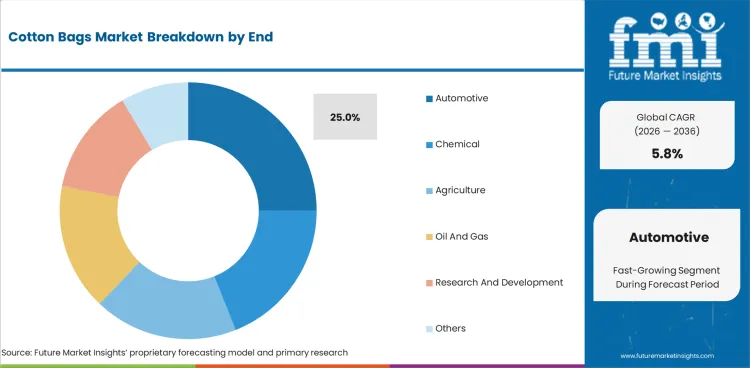
The Automotive end-use segment is estimated to account for 25.0% of the Cotton Bags market revenue share in 2025, emerging as the dominant sector. This segment’s growth has been driven by demand for durable and reusable bags for corporate giveaways, trade shows, and employee kits. Cotton bags are preferred in this sector due to their robustness, customizable design potential, and alignment with sustainability initiatives undertaken by automotive companies.
The ability to incorporate branding and promotional messaging further enhances their utility in marketing campaigns. The rise of eco-conscious corporate policies and increased focus on environmental responsibility has further strengthened the adoption of cotton bags in the automotive sector.
Manufacturers benefit from scalable production and standardized sizing that meets commercial requirements, reducing logistics complexity Continued growth in the automotive industry and emphasis on environmentally responsible practices are expected to reinforce the leading position of this end-use segment in the market.
Insights into the Calico Cotton Bags Segment
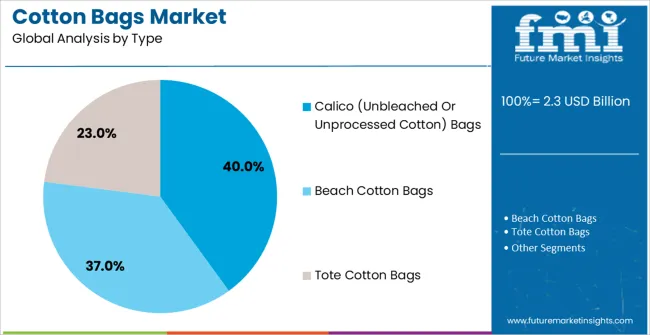
Calico (Unbleached Or Unprocessed Cotton) Bags are projected to hold 40.0% of the Cotton Bags market revenue share in 2025, making them the leading type segment. The popularity of calico bags is being driven by their natural appearance, biodegradability, and versatility for printing and customization. Consumers and businesses alike favor these bags for retail, promotional, and everyday use due to their eco-friendly profile and cost-effectiveness.
Production of calico bags requires minimal chemical processing, which aligns with the rising preference for sustainable and chemical-free products. Their durability and reusability further enhance market appeal, providing a practical alternative to single-use bags.
Additionally, manufacturers have leveraged calico’s adaptability in design, allowing for a range of sizes and printing options that support marketing campaigns and brand visibility As environmental regulations tighten and consumer preference for sustainable products grows, calico cotton bags are expected to continue dominating the market, reinforcing their position as the preferred type segment.
Market Overview
The ecofriendly cotton bags are anticipated to overtake plastic bags in the retail sector during the forecast period. Increasing availability of decorated cotton bags is inciting people to increasingly adopt cotton bags. Cotton bags have high printability & shelf appeal as compared to plastic bags.
Analysis of Cotton Bags Market By Key Countries
.webp "Top Country Growth Comparison Cotton Bags Market Cagr (2026 2036)")
| Country | CAGR |
|---|---|
| China | 7.8% |
| India | 7.3% |
| Germany | 6.7% |
| Brazil | 6.1% |
| USA | 5.5% |
| UK | 4.9% |
| Japan | 4.4% |
Country-wise Analysis
The Cotton Bags Market is expected to register a CAGR of 5.8% during the forecast period, exhibiting varied country level momentum. China leads with the highest CAGR of 7.8%, followed by India at 7.3%. Developed markets such as Germany, France, and the UK continue to expand steadily, while the USA is likely to grow at consistent rates. Japan posts the lowest CAGR at 4.4%, yet still underscores a broadly positive trajectory for the global Cotton Bags Market. In 2024, Germany held a dominant revenue in the Western Europe market and is expected to grow with a CAGR of 6.7%. The USA Cotton Bags Market is estimated to be valued at USD 838.4 million in 2026 and is anticipated to reach a valuation of USD 838.4 million by 2036. Sales are projected to rise at a CAGR of 0.0% over the forecast period between 2026 and 2036. While Japan and South Korea markets are estimated to be valued at USD 122.6 million and USD 57.1 million respectively in 2026.
Key Players in the Cotton Bags Market
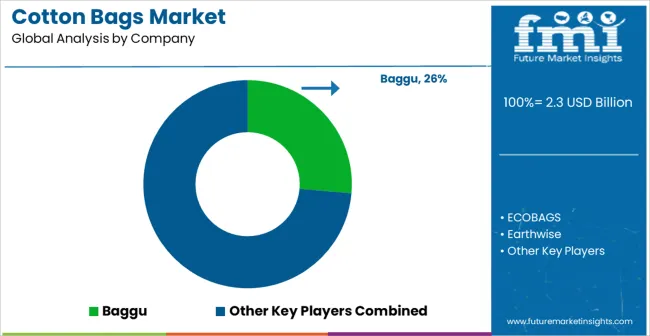
- Baggu
- ECOBAGS
- Earthwise
- ChicoBag
- The Cotton Bag Company
- Unionwear
- Enviro-Tote
- ToteBagFactory
Scope of the Report
| Metric | Value |
|---|---|
| Quantitative Units | USD 2.43 billion to USD 4.28 billion, at a CAGR of 5.8% |
| Market Definition | Cotton bags encompass reusable textile bags manufactured from woven or knitted cotton fabric for retail, grocery, industrial, and promotional use, serving as regulated alternatives to single-use plastic packaging. |
| Capacity Segmentation | Up To 5 Kg, 5 Kg to 10 Kg, 10 Kg to 15 Kg, 15 Kg to 20 Kg, Above 20 Kg |
| End Use Segmentation | Automotive, Chemical, Agriculture, Oil And Gas, Research And Development, Others |
| Type Segmentation | Calico, Beach Cotton Bags, Tote Cotton Bags |
| Regions Covered | North America, Latin America, Europe, East Asia, South Asia, Oceania, Middle East & Africa |
| Countries Covered | China, India, Germany, Brazil, USA, UK, Japan, and 40 plus countries |
| Key Companies Profiled | Baggu, ECOBAGS, Earthwise, ChicoBag, The Cotton Bag Company, Unionwear, Enviro-Tote, ToteBagFactory |
| Forecast Period | 2026 to 2036 |
| Approach | Forecasting models apply a bottom-up methodology starting with regional retail and industrial bag procurement volumes, cross-validated against cotton textile trade data and manufacturer revenue disclosures. |
Cotton Bags Market by Segments
Capacity:
- Up To 5 Kg
- 5Kg - 10 Kg
- 10 Kg - 15 Kg
- 15 Kg - 20 Kg
- Above 20 Kg
End Use:
- Automotive
- Chemical
- Agriculture
- Oil And Gas
- Research And Development
- Others
Type:
- Calico (Unbleached Or Unprocessed Cotton) Bags
- Beach Cotton Bags
- Tote Cotton Bags
Region:
- North America
- USA
- Canada
- Mexico
- Latin America
- Brazil
- Chile
- Rest of Latin America
- Western Europe
- Germany
- UK
- Italy
- Spain
- France
- Nordic
- BENELUX
- Rest of Western Europe
- Eastern Europe
- Russia
- Poland
- Hungary
- Balkan & Baltic
- Rest of Eastern Europe
- East Asia
- China
- Japan
- South Korea
- South Asia and Pacific
- India
- ASEAN
- Australia & New Zealand
- Rest of South Asia and Pacific
- Middle East & Africa
- Kingdom of Saudi Arabia
- Other GCC Countries
- Turkiye
- South Africa
- Other African Union
- Rest of Middle East & Africa
Bibliography
- 1. European Commission. (2024). Directive (EU) 2015/720 on reducing the consumption of lightweight plastic carrier bags: Implementation report. EUR-Lex.
- 2. United Nations Environment Programme. (2024). Single-use plastics: A roadmap for sustainability. UNEP.
- 3. International Trade Centre. (2024). Trade map: Global export and import data for cotton bags and sacks (HS Code 6305). ITC Trade Map.
- 4. Textile Exchange. (2024). Organic cotton market report 2024. Textile Exchange.
- 5. Bureau of Indian Standards. (2024). IS 3005: Cotton canvas for bags. BIS.
- 6. Organisation for Economic Co-operation and Development. (2024). Extended producer responsibility for packaging: Updated guidance for policy implementation. OECD.
This bibliography is provided for reader reference. The full Future Market Insights report contains the complete reference list with primary research documentation.
Frequently Asked Questions
How large is the demand for cotton bags in the global market in 2026?
Demand for cotton bags in the global market is estimated to be valued at USD 2.43 billion in 2026.
What will be the market size of cotton bags in the global market by 2036?
Market size for cotton bags is projected to reach USD 4.28 billion by 2036.
What is the expected demand growth for cotton bags between 2026 and 2036?
Demand for cotton bags is expected to grow at a CAGR of 5.8% between 2026 and 2036.
Which type is poised to lead global sales by 2026?
Calico bags account for 40.0% share in 2026 due to their versatility in grocery retail and branded promotional applications across regulated packaging channels.
How significant is the role of up to 5 kg capacity in driving cotton bag adoption in 2026?
Up to 5 Kg capacity holds 35.0% share in 2026 as high-volume grocery and convenience retail channels drive demand for lightweight reusable bags.
What is driving demand in China?
Chinese textile manufacturers are scaling export-oriented cotton bag production lines to serve European and North American compliance mandates, pushing China to a 7.8% CAGR through 2036.
What is India's growth outlook in this report?
India is projected to grow at a CAGR of 7.3% during 2026 to 2036, leveraging its raw cotton supply advantage and low-cost weaving infrastructure to serve both domestic and export markets.
What is included in the scope of this cotton bags report?
The market covers all reusable cotton bags across calico, tote, and beach cotton bag formats for retail, industrial, and promotional use, with segment breakdowns by capacity, end use, and type.
Preview the report firsthand - request a free sample
Get SampleGet the brochure for pricing and purchase details.
Get PDFTable of Content
- Executive Summary
- Global Market Outlook
- Demand-side Trends
- Supply-side Trends
- Technology Roadmap Analysis
- Analysis and Recommendations
- Market Overview
- Market Coverage / Taxonomy
- Market Definition / Scope / Limitations
- Research Methodology
- Chapter Orientation
- Analytical Lens and Working Hypotheses
- Market Structure, Signals, and Trend Drivers
- Benchmarking and Cross-market Comparability
- Market Sizing, Forecasting, and Opportunity Mapping
- Research Design and Evidence Framework
- Desk Research Programme (Secondary Evidence)
- Company Annual and Sustainability Reports
- Peer-reviewed Journals and Academic Literature
- Corporate Websites, Product Literature, and Technical Notes
- Earnings Decks and Investor Briefings
- Statutory Filings and Regulatory Disclosures
- Technical White Papers and Standards Notes
- Trade Journals, Industry Magazines, and Analyst Briefs
- Conference Proceedings, Webinars, and Seminar Materials
- Government Statistics Portals and Public Data Releases
- Press Releases and Reputable Media Coverage
- Specialist Newsletters and Curated Briefings
- Sector Databases and Reference Repositories
- FMI Internal Proprietary Databases and Historical Market Datasets
- Subscription Datasets and Paid Sources
- Social Channels, Communities, and Digital Listening Inputs
- Additional Desk Sources
- Expert Input and Fieldwork (Primary Evidence)
- Primary Modes
- Qualitative Interviews and Expert Elicitation
- Quantitative Surveys and Structured Data Capture
- Blended Approach
- Why Primary Evidence is Used
- Field Techniques
- Interviews
- Surveys
- Focus Groups
- Observational and In-context Research
- Social and Community Interactions
- Stakeholder Universe Engaged
- C-suite Leaders
- Board Members
- Presidents and Vice Presidents
- R&D and Innovation Heads
- Technical Specialists
- Domain Subject-matter Experts
- Scientists
- Physicians and Other Healthcare Professionals
- Governance, Ethics, and Data Stewardship
- Research Ethics
- Data Integrity and Handling
- Primary Modes
- Tooling, Models, and Reference Databases
- Desk Research Programme (Secondary Evidence)
- Data Engineering and Model Build
- Data Acquisition and Ingestion
- Cleaning, Normalisation, and Verification
- Synthesis, Triangulation, and Analysis
- Quality Assurance and Audit Trail
- Market Background
- Market Dynamics
- Drivers
- Restraints
- Opportunity
- Trends
- Scenario Forecast
- Demand in Optimistic Scenario
- Demand in Likely Scenario
- Demand in Conservative Scenario
- Opportunity Map Analysis
- Product Life Cycle Analysis
- Supply Chain Analysis
- Investment Feasibility Matrix
- Value Chain Analysis
- PESTLE and Porter’s Analysis
- Regulatory Landscape
- Regional Parent Market Outlook
- Production and Consumption Statistics
- Import and Export Statistics
- Market Dynamics
- Global Market Analysis 2021 to 2025 and Forecast, 2026 to 2036
- Historical Market Size Value (USD Million) Analysis, 2021 to 2025
- Current and Future Market Size Value (USD Million) Projections, 2026 to 2036
- Y-o-Y Growth Trend Analysis
- Absolute $ Opportunity Analysis
- Global Market Pricing Analysis 2021 to 2025 and Forecast 2026 to 2036
- Global Market Analysis 2021 to 2025 and Forecast 2026 to 2036, By Capacity
- Introduction / Key Findings
- Historical Market Size Value (USD Million) Analysis By Capacity , 2021 to 2025
- Current and Future Market Size Value (USD Million) Analysis and Forecast By Capacity , 2026 to 2036
- Up To 5 Kg
- 5Kg – 10 Kg
- 10 Kg – 15 Kg
- 15 Kg – 20 Kg
- Above 20 Kg
- Up To 5 Kg
- Y-o-Y Growth Trend Analysis By Capacity , 2021 to 2025
- Absolute $ Opportunity Analysis By Capacity , 2026 to 2036
- Global Market Analysis 2021 to 2025 and Forecast 2026 to 2036, By End
- Introduction / Key Findings
- Historical Market Size Value (USD Million) Analysis By End, 2021 to 2025
- Current and Future Market Size Value (USD Million) Analysis and Forecast By End, 2026 to 2036
- Automotive
- Chemical
- Agriculture
- Oil And Gas
- Research And Development
- Others
- Automotive
- Y-o-Y Growth Trend Analysis By End, 2021 to 2025
- Absolute $ Opportunity Analysis By End, 2026 to 2036
- Global Market Analysis 2021 to 2025 and Forecast 2026 to 2036, By Type
- Introduction / Key Findings
- Historical Market Size Value (USD Million) Analysis By Type, 2021 to 2025
- Current and Future Market Size Value (USD Million) Analysis and Forecast By Type, 2026 to 2036
- Calico
- Beach Cotton Bags
- Tote Cotton Bags
- Calico
- Y-o-Y Growth Trend Analysis By Type, 2021 to 2025
- Absolute $ Opportunity Analysis By Type, 2026 to 2036
- Global Market Analysis 2021 to 2025 and Forecast 2026 to 2036, By Region
- Introduction
- Historical Market Size Value (USD Million) Analysis By Region, 2021 to 2025
- Current Market Size Value (USD Million) Analysis and Forecast By Region, 2026 to 2036
- North America
- Latin America
- Western Europe
- Eastern Europe
- East Asia
- South Asia and Pacific
- Middle East & Africa
- Market Attractiveness Analysis By Region
- North America Market Analysis 2021 to 2025 and Forecast 2026 to 2036, By Country
- Historical Market Size Value (USD Million) Trend Analysis By Market Taxonomy, 2021 to 2025
- Market Size Value (USD Million) Forecast By Market Taxonomy, 2026 to 2036
- By Country
- USA
- Canada
- Mexico
- By Capacity
- By End
- By Type
- By Country
- Market Attractiveness Analysis
- By Country
- By Capacity
- By End
- By Type
- Key Takeaways
- Latin America Market Analysis 2021 to 2025 and Forecast 2026 to 2036, By Country
- Historical Market Size Value (USD Million) Trend Analysis By Market Taxonomy, 2021 to 2025
- Market Size Value (USD Million) Forecast By Market Taxonomy, 2026 to 2036
- By Country
- Brazil
- Chile
- Rest of Latin America
- By Capacity
- By End
- By Type
- By Country
- Market Attractiveness Analysis
- By Country
- By Capacity
- By End
- By Type
- Key Takeaways
- Western Europe Market Analysis 2021 to 2025 and Forecast 2026 to 2036, By Country
- Historical Market Size Value (USD Million) Trend Analysis By Market Taxonomy, 2021 to 2025
- Market Size Value (USD Million) Forecast By Market Taxonomy, 2026 to 2036
- By Country
- Germany
- UK
- Italy
- Spain
- France
- Nordic
- BENELUX
- Rest of Western Europe
- By Capacity
- By End
- By Type
- By Country
- Market Attractiveness Analysis
- By Country
- By Capacity
- By End
- By Type
- Key Takeaways
- Eastern Europe Market Analysis 2021 to 2025 and Forecast 2026 to 2036, By Country
- Historical Market Size Value (USD Million) Trend Analysis By Market Taxonomy, 2021 to 2025
- Market Size Value (USD Million) Forecast By Market Taxonomy, 2026 to 2036
- By Country
- Russia
- Poland
- Hungary
- Balkan & Baltic
- Rest of Eastern Europe
- By Capacity
- By End
- By Type
- By Country
- Market Attractiveness Analysis
- By Country
- By Capacity
- By End
- By Type
- Key Takeaways
- East Asia Market Analysis 2021 to 2025 and Forecast 2026 to 2036, By Country
- Historical Market Size Value (USD Million) Trend Analysis By Market Taxonomy, 2021 to 2025
- Market Size Value (USD Million) Forecast By Market Taxonomy, 2026 to 2036
- By Country
- China
- Japan
- South Korea
- By Capacity
- By End
- By Type
- By Country
- Market Attractiveness Analysis
- By Country
- By Capacity
- By End
- By Type
- Key Takeaways
- South Asia and Pacific Market Analysis 2021 to 2025 and Forecast 2026 to 2036, By Country
- Historical Market Size Value (USD Million) Trend Analysis By Market Taxonomy, 2021 to 2025
- Market Size Value (USD Million) Forecast By Market Taxonomy, 2026 to 2036
- By Country
- India
- ASEAN
- Australia & New Zealand
- Rest of South Asia and Pacific
- By Capacity
- By End
- By Type
- By Country
- Market Attractiveness Analysis
- By Country
- By Capacity
- By End
- By Type
- Key Takeaways
- Middle East & Africa Market Analysis 2021 to 2025 and Forecast 2026 to 2036, By Country
- Historical Market Size Value (USD Million) Trend Analysis By Market Taxonomy, 2021 to 2025
- Market Size Value (USD Million) Forecast By Market Taxonomy, 2026 to 2036
- By Country
- Kingdom of Saudi Arabia
- Other GCC Countries
- Turkiye
- South Africa
- Other African Union
- Rest of Middle East & Africa
- By Capacity
- By End
- By Type
- By Country
- Market Attractiveness Analysis
- By Country
- By Capacity
- By End
- By Type
- Key Takeaways
- Key Countries Market Analysis
- USA
- Pricing Analysis
- Market Share Analysis, 2025
- By Capacity
- By End
- By Type
- Canada
- Pricing Analysis
- Market Share Analysis, 2025
- By Capacity
- By End
- By Type
- Mexico
- Pricing Analysis
- Market Share Analysis, 2025
- By Capacity
- By End
- By Type
- Brazil
- Pricing Analysis
- Market Share Analysis, 2025
- By Capacity
- By End
- By Type
- Chile
- Pricing Analysis
- Market Share Analysis, 2025
- By Capacity
- By End
- By Type
- Germany
- Pricing Analysis
- Market Share Analysis, 2025
- By Capacity
- By End
- By Type
- UK
- Pricing Analysis
- Market Share Analysis, 2025
- By Capacity
- By End
- By Type
- Italy
- Pricing Analysis
- Market Share Analysis, 2025
- By Capacity
- By End
- By Type
- Spain
- Pricing Analysis
- Market Share Analysis, 2025
- By Capacity
- By End
- By Type
- France
- Pricing Analysis
- Market Share Analysis, 2025
- By Capacity
- By End
- By Type
- India
- Pricing Analysis
- Market Share Analysis, 2025
- By Capacity
- By End
- By Type
- ASEAN
- Pricing Analysis
- Market Share Analysis, 2025
- By Capacity
- By End
- By Type
- Australia & New Zealand
- Pricing Analysis
- Market Share Analysis, 2025
- By Capacity
- By End
- By Type
- China
- Pricing Analysis
- Market Share Analysis, 2025
- By Capacity
- By End
- By Type
- Japan
- Pricing Analysis
- Market Share Analysis, 2025
- By Capacity
- By End
- By Type
- South Korea
- Pricing Analysis
- Market Share Analysis, 2025
- By Capacity
- By End
- By Type
- Russia
- Pricing Analysis
- Market Share Analysis, 2025
- By Capacity
- By End
- By Type
- Poland
- Pricing Analysis
- Market Share Analysis, 2025
- By Capacity
- By End
- By Type
- Hungary
- Pricing Analysis
- Market Share Analysis, 2025
- By Capacity
- By End
- By Type
- Kingdom of Saudi Arabia
- Pricing Analysis
- Market Share Analysis, 2025
- By Capacity
- By End
- By Type
- Turkiye
- Pricing Analysis
- Market Share Analysis, 2025
- By Capacity
- By End
- By Type
- South Africa
- Pricing Analysis
- Market Share Analysis, 2025
- By Capacity
- By End
- By Type
- USA
- Market Structure Analysis
- Competition Dashboard
- Competition Benchmarking
- Market Share Analysis of Top Players
- By Regional
- By Capacity
- By End
- By Type
- Competition Analysis
- Competition Deep Dive
- Baggu
- Overview
- Product Portfolio
- Profitability by Market Segments (Product/Age /Sales Channel/Region)
- Sales Footprint
- Strategy Overview
- Marketing Strategy
- Product Strategy
- Channel Strategy
- ECOBAGS
- Earthwise
- ChicoBag
- The Cotton Bag Company
- Unionwear
- Enviro-Tote
- ToteBagFactory
- Baggu
- Competition Deep Dive
- Assumptions & Acronyms Used


