
- Market Size (2026)
- USD 59.4 Bn
- Forecast (2036)
- USD 134.2 Bn
- CAGR (2026 to 2036)
- 8.5%
How big is Electric Bike Market in 2026?
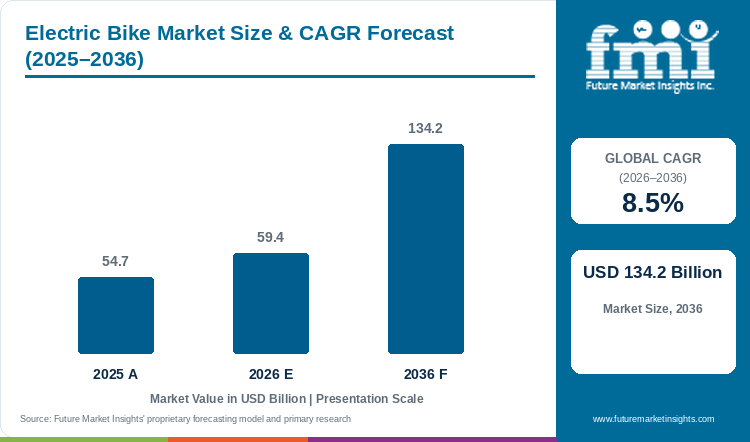
The electric bike market is estimated at USD 54.7 billion in 2025 and is expected to reach USD 59.4 billion in 2026. Demand for electric bikes is projected to grow at an 8.5% CAGR and reach USD 134.2 billion by 2036.
Adoption of electric bikes is moving from leisure riding into daily commuting, and electric bike sales are estimated at USD 54.7 billion for 2025. For 2026, electric bike sales are expected to reach USD 59.4 billion, and an 8.5% CAGR is projected to carry the electric bike market to USD 134.2 billion by 2036. Over the coming decade, the leading trend will be e-bikes replacing conventional bicycles as the default purchase in mature cycling countries. ZIV reported in March 2026 that about 2 million e-bikes were sold in Germany in 2025, a 52.7% share of all bicycles and e-bikes sold.[1] Once the motorised model is the majority choice, growth shifts toward replacement batteries, upgrades and second bikes for cargo or trekking. FMI's analysts advise brands and dealers to build battery testing, trade-in and repair services into every sale, since owners return to the dealer who keeps the battery healthy.
Key Market Trends & Insights
- Pedal assist is expected to account for 80% of propulsion type sales in 2026, as EU rules and most US classes favour motors that cut out when the rider stops pedalling. Throttle bikes hold an estimated 15.4%.
- Lithium-ion is likely to supply 75% of battery type sales in 2026, with lead acid at about 25% in low-cost markets. Bosch announced the PowerTube 360 in June 2026 as the slimmest Bosch battery to date, with a range of over 80 km.[2]
- By usage, urban riding is projected to hold an estimated 54.3% in 2026, ahead of trekking near 18.6% and cargo utility at about 16.2%.
Regional Highlights
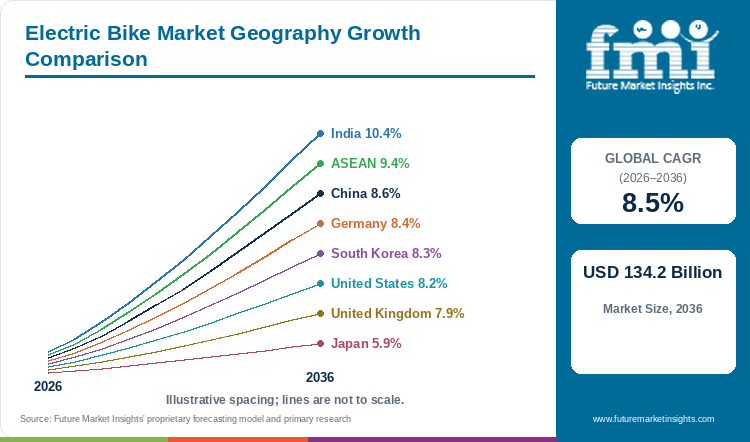
- Delivery fleets switching to electric cycles put India first, with a 10.4% CAGR in FMI's country model and a clear lead over the 8.5% global figure.
- ASEAN is next on 9.4%. China, the largest producer, is projected at 8.6%, a shade above the global rate. Germany, South Korea and the United States cluster between 8.2% and 8.4%, the United Kingdom is on 7.9%, and Japan, at 5.9%, is last in the country ranking.
- More than 12.5 million e-bikes were sold in China through a trade-in programme in 2025, nine times the 2024 figure, Xinhua reported in May 2026.[3]
Market Size & Forecast
Table 1: Market Size and Forecast for the Electric Bike Market (USD billion and percentage), 2025 to 2036
| Metric | Value |
|---|---|
| 2025 Market Size | USD 54.7 billion |
| Estimated Market Size in 2026 | USD 59.4 billion |
| Projected Market Size by 2036 | USD 134.2 billion |
| CAGR, 2026 to 2036 | 8.5% |
| Added Revenue, 2026 to 2036 | USD 74.8 billion |
| Market Expansion Multiple | 2.3x |
Electric bike sales arrive through dealer pre-orders placed months before the riding season, so brands carry the risk of unsold stock when demand stalls. ZIV said German retailers and makers were reducing high stock levels in 2025 and expected normal levels by the end of 2026.[1] Giant reported September 2026 operating revenue of NT$5.4 billion, up 3% year on year, after a weak start to the year left nine-month revenue 5% lower.[4] Short urban trips are also served by scooters, and the electric kick scooter market carries a projected 11.8% CAGR, which keeps e-bike brands competing on comfort and range for the same commuters. In FMI's view, electric bike sales are expected to add USD 74.8 billion between 2026 and 2036, a 2.3x expansion multiple. Heavy discounting by brands clearing stock is the main near-term risk to pricing.
Dealer Stocks, Safety Rules and Delivery Fleets
Balance sheets in the industry are still under strain. Accell Group, which describes itself as the European e-bike market leader, was granted suspension of payments for the group's Dutch entities on 5 August 2026.[5] Merida reported September 2026 sales 26% lower year on year.[4] Dealers will favour brands able to guarantee parts and warranty support for the life of a bike.
Safety rules are tightening in large cities. New York City Council introduced 23 bills on e-bikes and e-scooters, Bicycle Retailer reported on 1 October 2026, including measures to stop the sale and rental of Class 3 e-bikes and a trade-in programme targeting at least 10,000 bikes.[6] China introduced new mandatory national e-bike safety standards in 2025 alongside the trade-in policy.[3] German associations proposed in April 2026 that heavy carrier cycles under EN 17860-4 keep bicycle privileges, with no driving licence or type approval.[7] Brands selling into cities will move volume toward lower-speed, certified models.
Table 2: Stock, Safety and Fleet Indicators for the Electric Bike Market (sales, rules and deployments), 2025 to 2026
| Indicator | Data Point | Relevance | Source |
|---|---|---|---|
| Germany e-bike sales, 2025 | About 2 million; 52.7% of bicycle and e-bike sales | E-bikes as the default purchase | [1] |
| China trade-in e-bike sales, 2025 | Over 12.5 million; nine times 2024 | Replacement demand in China | [3] |
| Giant operating revenue, September 2026 | NT$5.4 billion; up 3% | Brand recovery after destocking | [4] |
| Accell Group, August 2026 | Suspension of payments for Dutch entities | Financial stress at a large European maker | [5] |
| New York City e-bike bills, 2026 | 23 bills; Class 3 sale and rental ban proposed | Speed class rules in large cities | [6] |
| ElektrikExpress fleet, November 2025 | 500 delivery vehicles in six cities | Delivery fleet electrification in India | [8] |
Analyst Perspective
“Battery service and fleet contracts will earn the most dependable e-bike profits of the next decade, as mature markets move to replacement buying and delivery operators run bikes all day. Certified cargo and pedal-assist models for city fleets are unlocking a contract-based layer of demand alongside retail, and I expect the strongest brands to sign multi-year fleet and battery service deals before 2030.”
- Nikhil Kaitwade, Principal Consultant, Future Market Insights.
How is the electric bike market segmented?
The market is segmented into propulsion type, battery type, usage, and region. Pedal assist is expected to hold the largest propulsion share at 80% in 2026, and lithium-ion the largest battery share at 75%.
By propulsion type: pedal assist, throttle, and others.
By battery type: lithium-ion and lead acid.
By usage: urban, trekking, cargo utility, and off road.
By region: North America, Latin America, Western Europe, Eastern Europe, East Asia, South Asia and Pacific, and Middle East and Africa.
Why does pedal assist lead electric bike sales by propulsion type?
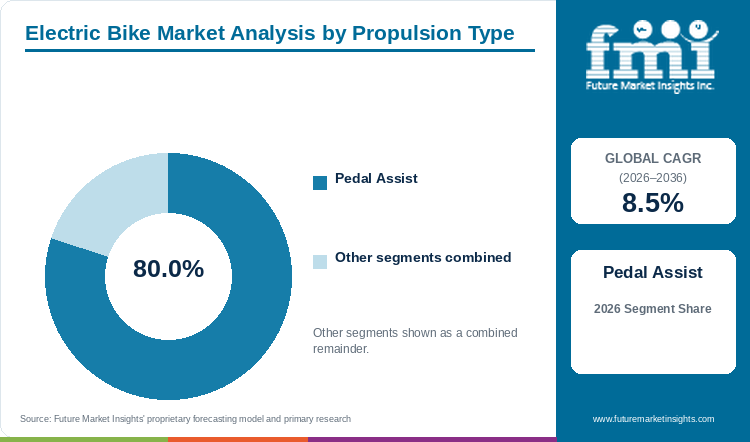
Pedal assist is expected to lead propulsion type sales with 80% share in 2026, ahead of throttle at an estimated 15.4% and other systems at about 4.6%.
Table 3: Propulsion Type Share for the Electric Bike Market (percentage share), 2026
| Propulsion Type | Estimated Share (2026) |
|---|---|
| Pedal Assist | 80% |
| Throttle | 15.4% |
| Others | 4.6% |
| Total | 100.0% |
Table 4: Propulsion Type Leadership and Market Growth for the Electric Bike Market (segment and CAGR percentage), 2026 to 2036
| Metric | Value |
|---|---|
| Global CAGR (2026 to 2036) | 8.5% |
| Leading Segment | Pedal Assist |
European rules treat a bike that assists only as the rider pedals as a bicycle, with no licence or insurance, so pedal assist is expected to lead in 2026 with an 80% share. Throttle bikes, an estimated 15.4%, sell mostly in the United States as Class 2 models and to delivery riders, and city rules on speed and throttles are tightening. Other systems, about 4.6%, include hybrid and dual-mode drives on niche models. Torque sensors also make pedal assist feel like a stronger rider, which shoppers test on a dealer ride and buy for. Riders choosing a throttle bike often compare the bike with a scooter, and the electric kick scooter market pulls some of that demand away from throttle bikes. Brands will keep pedal assist as the core of every range in Europe and Japan.
- Mid-drive and hub-drive pedelecs with torque or cadence sensors make up most pedal assist volume.
- Class 3 e-bikes in the United States are pedal-assist models with a maximum assist speed of 28 mph, Bicycle Retailer reported in October 2026.[6]
Why does lithium-ion lead electric bike sales by battery type?
Lithium-ion is likely to lead battery type sales with 75% share in 2026, against an estimated 25% for lead acid.
Table 5: Battery Type Share for the Electric Bike Market (percentage share), 2026
| Battery Type | Estimated Share (2026) |
|---|---|
| Lithium-ion | 75% |
| Lead Acid | 25% |
| Total | 100.0% |
Riders want a light frame and a range of more than 50 km on one charge, so lithium-ion is likely to stay in front in 2026, holding a 75% share. Lead acid, an estimated 25%, survives in low-cost scooter-style e-bikes sold in parts of Asia, as buyers there accept heavy packs and short range for a lower price. A lithium-ion pack weighs a fraction of a lead acid pack for the same energy and lasts more charge cycles, which suits commuters and fleets riding every day. Cell supply comes from the same plants that serve cars and storage, and growth of the lithium-ion battery market keeps pack prices falling for e-bike brands. Fleet operators will also need charging points for lithium packs, a need tracked by the micro-mobility charging infrastructure market. Safety standards will push the remaining lead acid buyers toward certified lithium packs.
- Frame-integrated tubes, rack-mounted packs and removable down-tube batteries make up the lithium-ion range.
- Bosch said the PowerTube 720 announced in June 2026 offers 720 watt hours for long rides.[2]
Why does urban riding lead electric bike sales by usage?
Urban riding is projected to lead usage sales with an estimated 54.3% share in 2026, ahead of trekking at about 18.6%, cargo utility at 16.2% and off road at 10.9%.
Table 6: Usage Share for the Electric Bike Market (percentage share), 2026
| Usage | Estimated Share (2026) |
|---|---|
| Urban | 54.3% |
| Trekking | 18.6% |
| Cargo Utility | 16.2% |
| Off Road | 10.9% |
| Total | 100.0% |
Most e-bike trips are commutes and errands under 15 km, so urban riding is projected to remain the largest use in 2026, at an estimated 54.3%. Trekking bikes, about 18.6%, sell to older riders and tourers in Germany and the Netherlands who want range for weekend tours. Cargo utility, near 16.2%, serves parents and delivery firms, and orders from fleets are growing faster than retail. Off road e-mountain bikes, an estimated 10.9%, carry the highest prices but sell in smaller numbers. Courier firms replacing vans in city centres give the electric cargo bikes market a projected 14.2% CAGR, faster than e-bikes overall. City riders will keep urban models at the centre of every brand line-up.
- Step-through city bikes, folding e-bikes and compact commuters form the urban range.
- ElektrikExpress deployed 500 electric delivery vehicles, including electric cargo cycles, across six Indian cities by November 2025.[8]
What are the drivers, restraints, and opportunities in the electric bike market?
Commuters and delivery firms are replacing car and van trips with e-bikes, which keeps demand rising in cities. Dealer stock overhangs and tighter safety rules weigh on prices, and fleet and cargo contracts open new demand.
- Driver: City commuters who face traffic and parking costs are choosing e-bikes for daily trips, which turns a leisure purchase into a transport purchase that repeats with each new bike and battery.
- Restraint: Brands that overbuilt stock are discounting to clear inventory, and stricter speed and battery rules raise product costs.
- Opportunity: Delivery operators and city fleets want durable cargo and pedal-assist bikes with service contracts, which rewards brands able to support fleets.
Commuters Turn E-Bikes into Everyday Transport
Consumer preference for e-bikes is strongest among riders who commute short distances in congested cities. German buyers chose e-bikes for 52.7% of bicycle and e-bike purchases in 2025.[1] Chinese buyers traded in older models for more than 12.5 million new e-bikes in 2025.[3] Each commuter who switches becomes a repeat buyer of batteries and bikes over the following years.
Stock Overhangs and Tighter Rules Press on Prices
Producers of electric bikes face lower prices as long as dealer stocks remain high. Accell Group said every realistic option for the business had been explored before the suspension of payments in August 2026.[5] German e-bike production fell 3% to 1,285,000 units in 2025.[1] Brands with lean stock and strong dealer support will hold prices better through the destocking period.
Fleets and Cargo Bikes Open Contract Demand
New sales of electric bikes are expected from delivery and city fleets, as operators buy in bulk and replace bikes on a schedule. ElektrikExpress targets more than 5,000 electric delivery vehicles across Indian cities.[8] ZIV, Zukunft Fahrrad and the German Cycle Logistics Association want heavy carrier cycles kept within bicycle rules.[7] Brands offering fleet leasing, telematics and spare parts will gain repeat orders.
Which country CAGRs are profiled in the electric bike market?
Table 7: Country CAGR Comparison for the Electric Bike Market (CAGR percentage), 2026 to 2036
| Country | CAGR (2026 to 2036) |
|---|---|
| India | 10.4% |
| ASEAN | 9.4% |
| China | 8.6% |
| Germany | 8.4% |
| South Korea | 8.3% |
| United States | 8.2% |
| United Kingdom | 7.9% |
| Japan | 5.9% |
How do country-level CAGRs compare in the electric bike market?
Quick-commerce firms in Indian cities are putting riders on electric cycles, and ElektrikExpress alone deployed 500 delivery vehicles across six cities by November 2025.[8] FMI's country table places India first at 10.4%, with ASEAN next on 9.4% as delivery and commuting fleets grow. China, at 8.6%, has the largest installed base and grows on trade-in demand. Mature but still adding commuters, Germany grows at 8.4% and South Korea at 8.3%. The United States, at 8.2%, faces new city rules on fast e-bikes, and the United Kingdom grows at 7.9%. Japan, at 5.9%, already has a large base of power-assisted bicycles bought for shopping and school runs.
- Delivery fleets in Indian cities are switching to electric cycles.
- ASEAN commuters are moving from petrol scooters to e-bikes.
- Trade-in subsidies replace older e-bikes in China.
- German buyers now choose e-bikes for most bicycle purchases.
- Korean commuters in Seoul and Busan add pedal-assist bikes.
- American city rules are shifting sales toward lower-speed classes.
- British commuters buy e-bikes through cycle-to-work schemes.
- Japanese families replace existing power-assisted bicycles.
Full report country CAGRs cover: India and ASEAN at the front and China a shade above the 8.5% global rate. Germany, South Korea and the United States just under the global rate. The United Kingdom and Japan lower, with all other standard countries by region.
Country-wise Analysis
India Electric Bike Market Outlook (2026 to 2036)
ElektrikExpress operates electric cargo cycles, two-wheelers and trikes for quick-commerce and grocery delivery in Delhi, Gurgaon, Noida, Pune, Mumbai and Thane.[8] Delivery firms in large Indian cities are buying electric cycles to cut fuel costs, and the Indian forecast of a 10.4% CAGR is the fastest in the table.
Key takeaway: Delivery fleets put India first.
ASEAN Electric Bike Market Outlook (2026 to 2036)
Commuters in Viet Nam, Indonesia and Thailand already ride petrol scooters in large numbers, and low-cost e-bikes are replacing some of them in dense cities. ASEAN is expected to grow at a 9.4% CAGR as local assembly and delivery fleets expand.
Key takeaway: Scooter replacement drives ASEAN.
China Electric Bike Market Outlook (2026 to 2036)
China introduced an e-bike trade-in policy and new mandatory national safety standards in 2025, and trade-in sales passed 12.5 million units.[3] Chinese factories make roughly 70 to 80 million bicycles and e-bikes a year, ZIV said in October 2026.[9] China is projected to grow at an 8.6% CAGR, close to the global rate, as replacement buying under the new standards continues.
Key takeaway: Trade-ins and new safety standards shape China.
Germany Electric Bike Market Outlook (2026 to 2036)
About 2 million e-bikes were sold in Germany in 2025, and turnover from bicycle and e-bike sales fell 7.7% to EUR 5.85 billion, ZIV reported.[1] FMI analysts expect Germany to grow at an 8.4% CAGR once stocks return to normal levels by the end of 2026.
Key takeaway: Normal stock levels set up German growth after 2026.
South Korea Electric Bike Market Outlook (2026 to 2036)
Korean commuters use e-bikes for short trips to subway stations, and public bike schemes in Seoul expose new riders to assisted cycling. Growth of 8.3% is forecast for South Korea.
Key takeaway: Short commutes support South Korea.
United States Electric Bike Market Outlook (2026 to 2036)
New York City Council members introduced bills to stop the sale and rental of Class 3 e-bikes and phase out Class 3 use after two years.[6] Growth of 8.2% for the United States, per FMI's country model, will lean on Class 1 and Class 2 models as city rules tighten.
Key takeaway: City rules steer American buyers to lower-speed classes.
United Kingdom Electric Bike Market Outlook (2026 to 2036)
British commuters buy many e-bikes through employer cycle-to-work schemes, and city councils are adding protected lanes. These schemes support a 7.9% forecast for the United Kingdom.
Key takeaway: Employer schemes carry British demand.
Japan Electric Bike Market Outlook (2026 to 2036)
Japanese families have bought power-assisted bicycles for shopping and school runs for decades, so most sales replace existing bikes. A 5.9% rate, last in the country ranking, is what FMI analysts expect from this replacement-led Japanese market.
Key takeaway: Replacement buying sets Japanese growth.
Who are the notable companies in the electric bike market?
Giant, Merida, Trek, Specialized, Accell Group, Riese & Müller, Gazelle, VanMoof, Gocycle, Bulls, Rad Power Bikes, Aventon, Pedego, Addmotor, Yamaha Motor and Bosch eBike Systems are the profiled companies.
Dealers and riders judge e-bike brands on motor feel, battery range, service network and resale value, and the profiled companies range from global bicycle groups to direct-to-consumer brands and drive system suppliers. Giant's first-half 2026 net profit after tax fell to NT$435 million from NT$560 million, on revenue 10.5% lower.[4] Accell Group entered suspension of payments for the Dutch entities of the group in August 2026.[5] Bosch eBike Systems launched the Hub Line motor and Active Line Plus drive in June 2026.[2] FMI's profiled set also covers Merida, Trek, Specialized, Riese & Müller, Gazelle, VanMoof, Gocycle, Bulls, Rad Power Bikes, Aventon, Pedego, Addmotor and Yamaha Motor.
- Global bicycle groups: Giant, Merida, Trek, Specialized and Accell Group.
- Premium and urban e-bike brands: Riese & Müller, Gazelle, VanMoof, Gocycle and Bulls.
- Direct-to-consumer brands: Rad Power Bikes, Aventon, Pedego and Addmotor.
- Drive system suppliers: Yamaha Motor and Bosch eBike Systems.
Competitive Benchmarking: Electric Bike Market
Table 8: Competitive Benchmarking for the Electric Bike Market (qualitative documentation ratings), 2026
| Company | Product Range | Financial Disclosure | Drive and Battery Technology | Recency |
|---|---|---|---|---|
| Giant | High | High | Medium | High |
| Merida | Medium | High | Low | High |
| Accell Group | High | Medium | Low | High |
| Bosch eBike Systems | Medium | Low | High | High |
Marks reflect what 2025 and 2026 company material reveals in each column and imply nothing about market share.
Key Developments in the Electric Bike Market
- On 12 October 2026, Bicycle Retailer reported that Merida unit shipments fell 4% year on year to 87,687 in September 2026.[4]
- On 7 October 2026, ZIV called for anti-dumping measures to cover bicycle components, including motors and batteries.[9]
- On 1 October 2026, Bicycle Retailer reported that New York City Council members had introduced 23 bills on e-bikes and e-scooters.[6]
- On 5 August 2026, a court granted Accell Group and the Dutch subsidiaries suspension of payments.[5]
- In June 2026, Bosch eBike Systems presented the PowerTube 360 battery and the ConnectModule tracking unit.[2]
- On 8 May 2026, Xinhua reported Chinese bicycle output of 110.8 million units for 2025, up 11.3%.[3]
- On 24 April 2026, ZIV and partner associations proposed keeping heavy carrier cycles within bicycle rules.[7]
- On 11 March 2026, ZIV put 2025 German e-bike production at 1,285,000 units, 3% lower.[1]
- On 13 November 2025, ElektrikExpress said the first 500 electric delivery vehicles were running in six Indian cities.[8]
Key Players in the Electric Bike Market
Global Bicycle Groups
- Giant
- Merida
- Trek
- Specialized
- Accell Group
Premium and Urban E-Bike Brands
- Riese & Müller
- Gazelle
- VanMoof
- Gocycle
- Bulls
Direct-to-Consumer Brands
- Rad Power Bikes
- Aventon
- Pedego
- Addmotor
Drive System Suppliers
- Yamaha Motor
- Bosch eBike Systems
Electric Bike Market - Report Scope
Table 9: Report Scope for the Electric Bike Market (coverage fields and definitions), 2026 to 2036
| Coverage field | Report scope |
|---|---|
| Market breakdown | Propulsion type; battery type; usage; region |
| Quantitative units | USD billion |
| Market definition | Bicycles fitted with an electric motor and battery that assist the rider through pedal sensors or a throttle, sold for urban, trekking, cargo and off road use to private and commercial buyers. |
| Regions covered | North America; Latin America; Western Europe; Eastern Europe; East Asia; South Asia and Pacific; Middle East and Africa |
| Countries covered | United States; Canada; Brazil; Mexico; Argentina; Chile; Germany; France; United Kingdom; Italy; Spain; Benelux; Nordics; Poland; Czech Republic; Romania; Hungary; China; Japan; South Korea; India; ASEAN; Australia and New Zealand; GCC Countries; South Africa; Türkiye; Israel |
| Key companies profiled | Giant, Merida, Trek, Specialized, Accell Group, Riese & Müller, Gazelle, VanMoof, Gocycle, Bulls, Rad Power Bikes, Aventon, Pedego, Addmotor, Yamaha Motor, Bosch eBike Systems |
| Forecast period | 2026 to 2036 |
Electric Bike Market - Research Methodology
Table 10: Research Methodology for the Electric Bike Market (research methods and approach), 2026 edition
| Method | Approach |
|---|---|
| Data Sources | Industry association data, bicycle maker announcements, drive supplier releases, city legislation coverage and trade press from May 2025 onward. |
| Desk Research | Desk research covers commuter adoption, dealer stocks, safety rules, battery technology and delivery fleets. |
| Market Sizing and Forecasting | Sizing starts from the 2026 base of USD 59.4 billion and the 8.5% CAGR for 2026 to 2036. |
| Data Validation | Sales, output and regulatory facts were matched to the release or article that first carried them. |
Electric Bike Market by Segments
Electric Bike Market segmented by Propulsion Type:
- Pedal Assist
- Throttle
- Others
Electric Bike Market segmented by Battery Type:
- Lithium-ion
- Lead Acid
Electric Bike Market segmented by Usage:
- Urban
- Trekking
- Cargo Utility
- Off Road
Electric Bike Market by Region
- North America
- United States
- Canada
- Latin America
- Brazil
- Mexico
- Argentina
- Chile
- Western Europe
- Germany
- France
- United Kingdom
- Italy
- Spain
- Benelux
- Nordics
- Eastern Europe
- Poland
- Czech Republic
- Romania
- Hungary
- East Asia
- China
- Japan
- South Korea
- South Asia and Pacific
- India
- ASEAN
- Australia and New Zealand
- Middle East and Africa
- GCC Countries
- South Africa
- Türkiye
- Israel
Research Sources and Bibliography
- [1] Zweirad-Industrie-Verband (ZIV). (2026, March 11). Market Data Bicycle Industry 2025. https://www.ziv-zweirad.de/en/2026/03/11/market-data-2025/
- [2] Bosch eBike Systems. (2026, June). New innovations for June 2026. https://www.bosch-ebike.com/en/news/newfeatures-2026-06
- [3] Gansu Provincial People's Government, Belt and Road portal (Xinhua). (2026, May 8). China's bicycle output posts steady expansion in 2025. https://ydyl.gansu.gov.cn/enggsydyl/news/topnews/202605/t20260509_36165.html
- [4] Bicycle Retailer and Industry News. (2026, October 12). Giant, Ideal and KMC show operating revenue growth in September. https://www.bicycleretailer.com/international/2026/10/12/giant-ideal-and-kmc-show-operating-revenue-growth-september
- [5] Accell Group. (2026, August 5). Accell granted suspension of payments. https://www.accell-group.com/files/3/9/1/4/20260805_Accell%20granted%20suspension%20of%20payments.pdf
- [6] Bicycle Retailer and Industry News. (2026, October 1). Banning Class 3 e-bikes among series of bills introduced by NYC to curb crashes. https://www.bicycleretailer.com/industry-news/2026/10/01/banning-class-3-e-bikes-among-series-bills-introduced-nyc-curb-crashes
- [7] Zweirad-Industrie-Verband (ZIV). (2026, April 24). Improved legal framework for heavy e-cargo bikes. https://www.ziv-zweirad.de/en/2026/04/24/improved-legal-framework-for-heavy-e-cargo-bikes/
- [8] Energetica India. (2025, November 13). ElektrikExpress deploys 500 electric cycles across tier 1 cities, targets over 5,000 vehicles by 2026. https://www.energetica-india.net/news/elektrikexpress-deploys-500-electric-cycles-across-tier-1-cities-targets-over-5000-vehicles-by-2026
- [9] Zweirad-Industrie-Verband (ZIV). (2026, October 7). Fair competition in the global bicycle industry. https://www.ziv-zweirad.de/en/2026/10/07/fair-competition-in-the-global-bicycle-industry/
This bibliography is provided for reader reference. The full report contains the complete reference list and detailed citations.
This Report Answers
- How big is the electric bike market during 2026?
- What market size is projected by 2036?
- Which propulsion type holds notable share?
- Which battery type holds notable share?
- Which countries have notable growth?
- Which companies are notable in the market?
Table of Content
Table of Content
- Key Takeaways
- Market Size and CAGR
- Top Growth Driver
- Fastest Growing Segment
- Leading Region
- Key Companies
- Emerging Opportunities
- Executive Summary
- Global Market Outlook
- Demand-side Trends
- Supply-side Trends
- Technology Roadmap Analysis
- Analysis and Recommendations
- Analyst Perspective (What is happening? Why now? What should investors know?)
- Key Questions Answered
- How large is the market?
- What is the CAGR?
- What are key trends?
- Which region dominates?
- Who are the leaders?
Read More...
- Market Overview
- Market Coverage / Taxonomy
- Market Definition / Scope / Limitations
- Research Methodology
- Chapter Orientation
- Analytical Lens and Working Hypotheses
- Market Structure, Signals, and Trend Drivers
- Benchmarking and Cross-market Comparability
- Market Sizing, Forecasting, and Opportunity Mapping
- Research Design and Evidence Framework
- Desk Research Programme (Secondary Evidence)
- Expert Input and Fieldwork (Primary Evidence)
- Tooling, Models, and Reference Databases
- Data Engineering and Model Build
- Quality Assurance and Audit Trail
- Market Background
- Market Dynamics (Drivers, Restraints, Opportunity, Trends)
- Scenario Forecast (Optimistic, Likely, Conservative)
- Impact Analysis
- AI Impact
- Sustainability Impact
- Regulatory Impact
- Technology Impact
- Consumer / Buyer Analysis
- Purchase Drivers
- Adoption Barriers
- Buyer Journey
- Opportunity Map Analysis
- Product Life Cycle Analysis
- Supply Chain Analysis
- Investment Feasibility Matrix
- Value Chain Analysis
- PESTLE and Porter's Analysis
- Regulatory Landscape
- Regional Parent Market Outlook
- Production and Consumption Statistics
- Import and Export Statistics
- Global Market Analysis and Forecast, 2021 to 2036
- Historical Market Size Value (USD Billion) Analysis, 2021 to 2025
- Current and Future Market Size Value (USD Billion) Projections, 2026 to 2036
- Y-o-Y Growth Trend Analysis
- Absolute $ Opportunity Analysis
- Global Market Pricing Analysis, 2021 to 2036
- Global Market Analysis and Forecast, By Propulsion Type, 2021 to 2036
- Introduction / Key Findings
- Historical Market Size Value (USD Billion) Analysis By Propulsion Type, 2021 to 2025
- Current and Future Market Size Value (USD Billion) Analysis and Forecast By Propulsion Type, 2026 to 2036
- Pedal Assist
- Throttle
- Others
- Y-o-Y Growth Trend Analysis By Propulsion Type, 2021 to 2025
- Absolute $ Opportunity Analysis By Propulsion Type, 2026 to 2036
- Global Market Analysis and Forecast, By Battery Type, 2021 to 2036
- Introduction / Key Findings
- Historical Market Size Value (USD Billion) Analysis By Battery Type, 2021 to 2025
- Current and Future Market Size Value (USD Billion) Analysis and Forecast By Battery Type, 2026 to 2036
- Lithium-ion
- Lead Acid
- Y-o-Y Growth Trend Analysis By Battery Type, 2021 to 2025
- Absolute $ Opportunity Analysis By Battery Type, 2026 to 2036
- Global Market Analysis and Forecast, By Usage, 2021 to 2036
- Introduction / Key Findings
- Historical Market Size Value (USD Billion) Analysis By Usage, 2021 to 2025
- Current and Future Market Size Value (USD Billion) Analysis and Forecast By Usage, 2026 to 2036
- Urban
- Trekking
- Cargo Utility
- Off Road
- Y-o-Y Growth Trend Analysis By Usage, 2021 to 2025
- Absolute $ Opportunity Analysis By Usage, 2026 to 2036
- Global Market Analysis and Forecast, By Region, 2021 to 2036
- Introduction
- Historical Market Size Value (USD Billion) Analysis By Region, 2021 to 2025
- Current Market Size Value (USD Billion) Analysis and Forecast By Region, 2026 to 2036
- North America
- Latin America
- Western Europe
- Eastern Europe
- East Asia
- South Asia and Pacific
- Middle East and Africa
- Market Attractiveness Analysis By Region
- North America Market Analysis and Forecast, By Country, 2021 to 2036
- Historical Market Size Value (USD Billion) Trend Analysis By Market Taxonomy, 2021 to 2025
- Market Size Value (USD Billion) Forecast By Market Taxonomy, 2026 to 2036
- By Country
- United States
- Canada
- By Propulsion Type
- By Battery Type
- By Usage
- By Country
- Market Attractiveness Analysis
- By Country
- By Propulsion Type
- By Battery Type
- By Usage
- Key Takeaways
- Latin America Market Analysis and Forecast, By Country
- Historical Market Size Value (USD Billion) Trend Analysis By Market Taxonomy, 2021 to 2025
- Market Size Value (USD Billion) Forecast By Market Taxonomy, 2026 to 2036
- By Country
- Brazil
- Mexico
- Argentina
- Chile
- By Propulsion Type
- By Battery Type
- By Usage
- By Country
- Market Attractiveness Analysis
- By Country
- By Propulsion Type
- By Battery Type
- By Usage
- Key Takeaways
- Western Europe Market Analysis and Forecast, By Country
- Historical Market Size Value (USD Billion) Trend Analysis By Market Taxonomy, 2021 to 2025
- Market Size Value (USD Billion) Forecast By Market Taxonomy, 2026 to 2036
- By Country
- Germany
- France
- United Kingdom
- Italy
- Spain
- Benelux
- Nordics
- By Propulsion Type
- By Battery Type
- By Usage
- By Country
- Market Attractiveness Analysis
- By Country
- By Propulsion Type
- By Battery Type
- By Usage
- Key Takeaways
- Eastern Europe Market Analysis and Forecast, By Country
- Historical Market Size Value (USD Billion) Trend Analysis By Market Taxonomy, 2021 to 2025
- Market Size Value (USD Billion) Forecast By Market Taxonomy, 2026 to 2036
- By Country
- Poland
- Czech Republic
- Romania
- Hungary
- By Propulsion Type
- By Battery Type
- By Usage
- By Country
- Market Attractiveness Analysis
- By Country
- By Propulsion Type
- By Battery Type
- By Usage
- Key Takeaways
- East Asia Market Analysis and Forecast, By Country
- Historical Market Size Value (USD Billion) Trend Analysis By Market Taxonomy, 2021 to 2025
- Market Size Value (USD Billion) Forecast By Market Taxonomy, 2026 to 2036
- By Country
- China
- Japan
- South Korea
- By Propulsion Type
- By Battery Type
- By Usage
- By Country
- Market Attractiveness Analysis
- By Country
- By Propulsion Type
- By Battery Type
- By Usage
- Key Takeaways
- South Asia and Pacific Market Analysis and Forecast, By Country
- Historical Market Size Value (USD Billion) Trend Analysis By Market Taxonomy, 2021 to 2025
- Market Size Value (USD Billion) Forecast By Market Taxonomy, 2026 to 2036
- By Country
- India
- ASEAN
- Australia and New Zealand
- By Propulsion Type
- By Battery Type
- By Usage
- By Country
- Market Attractiveness Analysis
- By Country
- By Propulsion Type
- By Battery Type
- By Usage
- Key Takeaways
- Middle East and Africa Market Analysis and Forecast, By Country
- Historical Market Size Value (USD Billion) Trend Analysis By Market Taxonomy, 2021 to 2025
- Market Size Value (USD Billion) Forecast By Market Taxonomy, 2026 to 2036
- By Country
- GCC Countries
- South Africa
- Türkiye
- Israel
- By Propulsion Type
- By Battery Type
- By Usage
- By Country
- Market Attractiveness Analysis
- By Country
- By Propulsion Type
- By Battery Type
- By Usage
- Key Takeaways
- Key Countries Market Analysis
- United States
- Pricing Analysis
- Market Share Analysis, 2025
- By Propulsion Type
- By Battery Type
- By Usage
- Canada
- Pricing Analysis
- Market Share Analysis, 2025
- By Propulsion Type
- By Battery Type
- By Usage
- Mexico
- Pricing Analysis
- Market Share Analysis, 2025
- By Propulsion Type
- By Battery Type
- By Usage
- Brazil
- Pricing Analysis
- Market Share Analysis, 2025
- By Propulsion Type
- By Battery Type
- By Usage
- Chile
- Pricing Analysis
- Market Share Analysis, 2025
- By Propulsion Type
- By Battery Type
- By Usage
- Germany
- Pricing Analysis
- Market Share Analysis, 2025
- By Propulsion Type
- By Battery Type
- By Usage
- United Kingdom
- Pricing Analysis
- Market Share Analysis, 2025
- By Propulsion Type
- By Battery Type
- By Usage
- Italy
- Pricing Analysis
- Market Share Analysis, 2025
- By Propulsion Type
- By Battery Type
- By Usage
- Spain
- Pricing Analysis
- Market Share Analysis, 2025
- By Propulsion Type
- By Battery Type
- By Usage
- France
- Pricing Analysis
- Market Share Analysis, 2025
- By Propulsion Type
- By Battery Type
- By Usage
- India
- Pricing Analysis
- Market Share Analysis, 2025
- By Propulsion Type
- By Battery Type
- By Usage
- ASEAN
- Pricing Analysis
- Market Share Analysis, 2025
- By Propulsion Type
- By Battery Type
- By Usage
- Australia and New Zealand
- Pricing Analysis
- Market Share Analysis, 2025
- By Propulsion Type
- By Battery Type
- By Usage
- China
- Pricing Analysis
- Market Share Analysis, 2025
- By Propulsion Type
- By Battery Type
- By Usage
- Japan
- Pricing Analysis
- Market Share Analysis, 2025
- By Propulsion Type
- By Battery Type
- By Usage
- South Korea
- Pricing Analysis
- Market Share Analysis, 2025
- By Propulsion Type
- By Battery Type
- By Usage
- Poland
- Pricing Analysis
- Market Share Analysis, 2025
- By Propulsion Type
- By Battery Type
- By Usage
- Hungary
- Pricing Analysis
- Market Share Analysis, 2025
- By Propulsion Type
- By Battery Type
- By Usage
- Türkiye
- Pricing Analysis
- Market Share Analysis, 2025
- By Propulsion Type
- By Battery Type
- By Usage
- South Africa
- Pricing Analysis
- Market Share Analysis, 2025
- By Propulsion Type
- By Battery Type
- By Usage
- United States
- Market Structure Analysis
- Competition Dashboard
- Competition Benchmarking
- Market Share Analysis of Top Players
- By Regional
- By Propulsion Type
- By Battery Type
- By Usage
- Emerging Startups
- Innovation Benchmarking
- Competition Analysis
- Competition Deep Dive
- Giant
- Overview
- Product Portfolio
- Profitability by Market Segments
- Sales Footprint
- Strategy Overview
- Marketing Strategy
- Product Strategy
- Channel Strategy
- Merida
- Accell Group
- Bosch eBike Systems
- Trek
- Specialized
- Riese & Müller
- Gazelle
- VanMoof
- Gocycle
- Bulls
- Rad Power Bikes
- Aventon
- Pedego
- Addmotor
- Yamaha Motor
- Giant
- Case Studies
- Success Stories
- Recent Developments
- Competition Deep Dive
- Assumptions & Acronyms Used
List of Tables
- Table 1: Global Market Value (USD Billion) Forecast by Region, 2021 to 2036
- Table 2: Global Market Value (USD Billion) Forecast by Propulsion Type, 2021 to 2036
- Table 3: Global Market Value (USD Billion) Forecast by Battery Type, 2021 to 2036
- Table 4: Global Market Value (USD Billion) Forecast by Usage, 2021 to 2036
- Table 5: North America Market Value (USD Billion) Forecast by Country, 2021 to 2036
- Table 6: North America Market Value (USD Billion) Forecast by Propulsion Type, 2021 to 2036
- Table 7: North America Market Value (USD Billion) Forecast by Battery Type, 2021 to 2036
- Table 8: North America Market Value (USD Billion) Forecast by Usage, 2021 to 2036
- Table 9: Latin America Market Value (USD Billion) Forecast by Country, 2021 to 2036
- Table 10: Latin America Market Value (USD Billion) Forecast by Propulsion Type, 2021 to 2036
- Table 11: Latin America Market Value (USD Billion) Forecast by Battery Type, 2021 to 2036
- Table 12: Latin America Market Value (USD Billion) Forecast by Usage, 2021 to 2036
- Table 13: Western Europe Market Value (USD Billion) Forecast by Country, 2021 to 2036
- Table 14: Western Europe Market Value (USD Billion) Forecast by Propulsion Type, 2021 to 2036
- Table 15: Western Europe Market Value (USD Billion) Forecast by Battery Type, 2021 to 2036
- Table 16: Western Europe Market Value (USD Billion) Forecast by Usage, 2021 to 2036
- Table 17: Eastern Europe Market Value (USD Billion) Forecast by Country, 2021 to 2036
- Table 18: Eastern Europe Market Value (USD Billion) Forecast by Propulsion Type, 2021 to 2036
- Table 19: Eastern Europe Market Value (USD Billion) Forecast by Battery Type, 2021 to 2036
- Table 20: Eastern Europe Market Value (USD Billion) Forecast by Usage, 2021 to 2036
- Table 21: East Asia Market Value (USD Billion) Forecast by Country, 2021 to 2036
- Table 22: East Asia Market Value (USD Billion) Forecast by Propulsion Type, 2021 to 2036
- Table 23: East Asia Market Value (USD Billion) Forecast by Battery Type, 2021 to 2036
- Table 24: East Asia Market Value (USD Billion) Forecast by Usage, 2021 to 2036
- Table 25: South Asia and Pacific Market Value (USD Billion) Forecast by Country, 2021 to 2036
- Table 26: South Asia and Pacific Market Value (USD Billion) Forecast by Propulsion Type, 2021 to 2036
- Table 27: South Asia and Pacific Market Value (USD Billion) Forecast by Battery Type, 2021 to 2036
- Table 28: South Asia and Pacific Market Value (USD Billion) Forecast by Usage, 2021 to 2036
- Table 29: Middle East and Africa Market Value (USD Billion) Forecast by Country, 2021 to 2036
- Table 30: Middle East and Africa Market Value (USD Billion) Forecast by Propulsion Type, 2021 to 2036
- Table 31: Middle East and Africa Market Value (USD Billion) Forecast by Battery Type, 2021 to 2036
- Table 32: Middle East and Africa Market Value (USD Billion) Forecast by Usage, 2021 to 2036
List of Figures
- Figure 1: Global Market Pricing Analysis
- Figure 2: Global Market Value (USD Billion) Forecast 2021-2036
- Figure 3: Global Market Value Share and BPS Analysis by Propulsion Type, 2026 and 2036
- Figure 4: Global Market Y-o-Y Growth Comparison by Propulsion Type, 2026-2036
- Figure 5: Global Market Attractiveness Analysis by Propulsion Type
- Figure 6: Global Market Value Share and BPS Analysis by Battery Type, 2026 and 2036
- Figure 7: Global Market Y-o-Y Growth Comparison by Battery Type, 2026-2036
- Figure 8: Global Market Attractiveness Analysis by Battery Type
- Figure 9: Global Market Value Share and BPS Analysis by Usage, 2026 and 2036
- Figure 10: Global Market Y-o-Y Growth Comparison by Usage, 2026-2036
- Figure 11: Global Market Attractiveness Analysis by Usage
- Figure 12: Global Market Value (USD Billion) Share and BPS Analysis by Region, 2026 and 2036
- Figure 13: Global Market Y-o-Y Growth Comparison by Region, 2026-2036
- Figure 14: Global Market Attractiveness Analysis by Region
- Figure 15: North America Market Incremental Dollar Opportunity, 2026-2036
- Figure 16: Latin America Market Incremental Dollar Opportunity, 2026-2036
- Figure 17: Western Europe Market Incremental Dollar Opportunity, 2026-2036
- Figure 18: Eastern Europe Market Incremental Dollar Opportunity, 2026-2036
- Figure 19: East Asia Market Incremental Dollar Opportunity, 2026-2036
- Figure 20: South Asia and Pacific Market Incremental Dollar Opportunity, 2026-2036
- Figure 21: Middle East and Africa Market Incremental Dollar Opportunity, 2026-2036
- Figure 22: North America Market Value Share and BPS Analysis by Country, 2026 and 2036
- Figure 23: North America Market Value Share and BPS Analysis by Propulsion Type, 2026 and 2036
- Figure 24: North America Market Y-o-Y Growth Comparison by Propulsion Type, 2026-2036
- Figure 25: North America Market Attractiveness Analysis by Propulsion Type
- Figure 26: North America Market Value Share and BPS Analysis by Battery Type, 2026 and 2036
- Figure 27: North America Market Y-o-Y Growth Comparison by Battery Type, 2026-2036
- Figure 28: North America Market Attractiveness Analysis by Battery Type
- Figure 29: North America Market Value Share and BPS Analysis by Usage, 2026 and 2036
- Figure 30: North America Market Y-o-Y Growth Comparison by Usage, 2026-2036
- Figure 31: North America Market Attractiveness Analysis by Usage
- Figure 32: Latin America Market Value Share and BPS Analysis by Country, 2026 and 2036
- Figure 33: Latin America Market Value Share and BPS Analysis by Propulsion Type, 2026 and 2036
- Figure 34: Latin America Market Y-o-Y Growth Comparison by Propulsion Type, 2026-2036
- Figure 35: Latin America Market Attractiveness Analysis by Propulsion Type
- Figure 36: Latin America Market Value Share and BPS Analysis by Battery Type, 2026 and 2036
- Figure 37: Latin America Market Y-o-Y Growth Comparison by Battery Type, 2026-2036
- Figure 38: Latin America Market Attractiveness Analysis by Battery Type
- Figure 39: Latin America Market Value Share and BPS Analysis by Usage, 2026 and 2036
- Figure 40: Latin America Market Y-o-Y Growth Comparison by Usage, 2026-2036
- Figure 41: Latin America Market Attractiveness Analysis by Usage
- Figure 42: Western Europe Market Value Share and BPS Analysis by Country, 2026 and 2036
- Figure 43: Western Europe Market Value Share and BPS Analysis by Propulsion Type, 2026 and 2036
- Figure 44: Western Europe Market Y-o-Y Growth Comparison by Propulsion Type, 2026-2036
- Figure 45: Western Europe Market Attractiveness Analysis by Propulsion Type
- Figure 46: Western Europe Market Value Share and BPS Analysis by Battery Type, 2026 and 2036
- Figure 47: Western Europe Market Y-o-Y Growth Comparison by Battery Type, 2026-2036
- Figure 48: Western Europe Market Attractiveness Analysis by Battery Type
- Figure 49: Western Europe Market Value Share and BPS Analysis by Usage, 2026 and 2036
- Figure 50: Western Europe Market Y-o-Y Growth Comparison by Usage, 2026-2036
- Figure 51: Western Europe Market Attractiveness Analysis by Usage
- Figure 52: Eastern Europe Market Value Share and BPS Analysis by Country, 2026 and 2036
- Figure 53: Eastern Europe Market Value Share and BPS Analysis by Propulsion Type, 2026 and 2036
- Figure 54: Eastern Europe Market Y-o-Y Growth Comparison by Propulsion Type, 2026-2036
- Figure 55: Eastern Europe Market Attractiveness Analysis by Propulsion Type
- Figure 56: Eastern Europe Market Value Share and BPS Analysis by Battery Type, 2026 and 2036
- Figure 57: Eastern Europe Market Y-o-Y Growth Comparison by Battery Type, 2026-2036
- Figure 58: Eastern Europe Market Attractiveness Analysis by Battery Type
- Figure 59: Eastern Europe Market Value Share and BPS Analysis by Usage, 2026 and 2036
- Figure 60: Eastern Europe Market Y-o-Y Growth Comparison by Usage, 2026-2036
- Figure 61: Eastern Europe Market Attractiveness Analysis by Usage
- Figure 62: East Asia Market Value Share and BPS Analysis by Country, 2026 and 2036
- Figure 63: East Asia Market Value Share and BPS Analysis by Propulsion Type, 2026 and 2036
- Figure 64: East Asia Market Y-o-Y Growth Comparison by Propulsion Type, 2026-2036
- Figure 65: East Asia Market Attractiveness Analysis by Propulsion Type
- Figure 66: East Asia Market Value Share and BPS Analysis by Battery Type, 2026 and 2036
- Figure 67: East Asia Market Y-o-Y Growth Comparison by Battery Type, 2026-2036
- Figure 68: East Asia Market Attractiveness Analysis by Battery Type
- Figure 69: East Asia Market Value Share and BPS Analysis by Usage, 2026 and 2036
- Figure 70: East Asia Market Y-o-Y Growth Comparison by Usage, 2026-2036
- Figure 71: East Asia Market Attractiveness Analysis by Usage
- Figure 72: South Asia and Pacific Market Value Share and BPS Analysis by Country, 2026 and 2036
- Figure 73: South Asia and Pacific Market Value Share and BPS Analysis by Propulsion Type, 2026 and 2036
- Figure 74: South Asia and Pacific Market Y-o-Y Growth Comparison by Propulsion Type, 2026-2036
- Figure 75: South Asia and Pacific Market Attractiveness Analysis by Propulsion Type
- Figure 76: South Asia and Pacific Market Value Share and BPS Analysis by Battery Type, 2026 and 2036
- Figure 77: South Asia and Pacific Market Y-o-Y Growth Comparison by Battery Type, 2026-2036
- Figure 78: South Asia and Pacific Market Attractiveness Analysis by Battery Type
- Figure 79: South Asia and Pacific Market Value Share and BPS Analysis by Usage, 2026 and 2036
- Figure 80: South Asia and Pacific Market Y-o-Y Growth Comparison by Usage, 2026-2036
- Figure 81: South Asia and Pacific Market Attractiveness Analysis by Usage
- Figure 82: Middle East and Africa Market Value Share and BPS Analysis by Country, 2026 and 2036
- Figure 83: Middle East and Africa Market Value Share and BPS Analysis by Propulsion Type, 2026 and 2036
- Figure 84: Middle East and Africa Market Y-o-Y Growth Comparison by Propulsion Type, 2026-2036
- Figure 85: Middle East and Africa Market Attractiveness Analysis by Propulsion Type
- Figure 86: Middle East and Africa Market Value Share and BPS Analysis by Battery Type, 2026 and 2036
- Figure 87: Middle East and Africa Market Y-o-Y Growth Comparison by Battery Type, 2026-2036
- Figure 88: Middle East and Africa Market Attractiveness Analysis by Battery Type
- Figure 89: Middle East and Africa Market Value Share and BPS Analysis by Usage, 2026 and 2036
- Figure 90: Middle East and Africa Market Y-o-Y Growth Comparison by Usage, 2026-2036
- Figure 91: Middle East and Africa Market Attractiveness Analysis by Usage
- Figure 92: Global Market - Tier Structure Analysis
- Figure 93: Global Market - Company Share Analysis
Frequently Asked Questions
How large is the electric bike market expected in 2026?
Sales of electric bikes are expected to reach USD 59.4 billion in 2026, up from USD 54.7 billion in 2025, FMI's base figures show. The electric bike market is projected to reach USD 134.2 billion by 2036.
What CAGR is projected for the electric bike market through 2036?
An 8.5% CAGR from 2026 to 2036 is projected for the electric bike market. Commuting, replacement buying and delivery fleets carry that growth.
Which propulsion type holds a notable market share in 2026?
Pedal assist is expected to hold the largest propulsion share, 80% in 2026. Throttle bikes follow at an estimated 15.4%.
Which battery type holds a notable market share in 2026?
Lithium-ion is likely to account for 75% of 2026 battery type sales, the leading share. Lead acid makes up an estimated 25%.
Which country has a notable expansion outlook through 2036?
India has the top rate in FMI's country table, a 10.4% CAGR. ASEAN follows at 9.4%.
Who are the key companies in the electric bike market?
Giant, Merida, Trek, Specialized and Accell Group lead the global bicycle group, with Bosch eBike Systems and Yamaha Motor supplying drives. Riese & Müller, Gazelle, VanMoof, Gocycle, Bulls, Rad Power Bikes, Aventon, Pedego and Addmotor complete the profiled companies.
Preview the report firsthand - request a free sample
Get SampleGet the brochure for pricing and purchase details.
Get PDF
