

- Industry Size (2025)
- USD 448.9 Mn
- Forecast (2035)
- USD 996.4 Mn
- CAGR (2025 to 2035)
- 8.3%
Electric Bike Range Extender Market Size and Share Forecast Outlook 2025 to 2035
The electric bike range extender market is set to grow from USD 448.9 million in 2025 to USD 996.4 million by 2035, with a CAGR of 8.3%. Analyzing the elasticity of growth versus macroeconomic indicators reveals a market that is moderately sensitive to economic conditions. Between 2025 and 2030, the market increases from USD 448.9 million to USD 724.3 million, contributing USD 275.4 million in growth, with a CAGR of 12.3%. This early-stage acceleration is influenced by favorable macroeconomic factors such as increasing disposable incomes, a strong shift towards electric vehicles due to environmental concerns, and government incentives for eco-friendly transportation solutions. The elasticity of growth during this phase is positively correlated with economic stability, regulatory support for clean energy, and rising consumer interest in cost-effective electric mobility solutions. From 2030 to 2035, the market continues to grow, reaching USD 996.4 million, contributing USD 272.1 million in growth, with a more moderate CAGR of 6.8%. This deceleration reflects the market’s sensitivity to changes in macroeconomic conditions such as interest rates, inflation, and consumer spending patterns. As the market matures, the demand for range extenders becomes more stable, and growth is influenced more by technological advancements and industry adoption than by direct economic factors. Overall, the market’s growth is elastic, with fluctuations driven by macroeconomic conditions, especially during its early stage.
Quick Stats for Electric Bike Range Extender Market
- Electric Bike Range Extender Market Value (2025): USD 448.9 million
- Electric Bike Range Extender Market Forecast Value (2035): USD 996.4 million
- Electric Bike Range Extender Market Forecast CAGR: 8.3%
- Leading Segment in Electric Bike Range Extender Market in 2025: Battery-based range extenders (46.7%)
- Key Growth Regions in Electric Bike Range Extender Market: North America, Asia-Pacific, Europe
- Top Key Players in Electric Bike Range Extender Market: Bosch, Bafang Electric, Brose (Brose eBike Systems), Fazua, MAHLE, Panasonic Corporation, Shimano, TQ Group, Valeo, Yamaha Motor
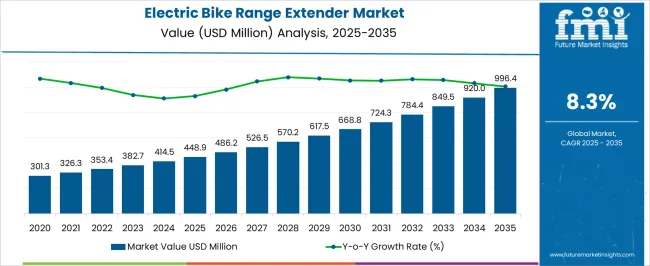
Electric Bike Range Extender Market Key Takeaways
| Metric | Value |
|---|---|
| Electric Bike Range Extender Market Estimated Value in (2025 E) | USD 448.9 million |
| Electric Bike Range Extender Market Forecast Value in (2035 F) | USD 996.4 million |
| Forecast CAGR (2025 to 2035) | 8.3% |
Why is the Electric Bike Range Extender Market Growing?
Market Overview:
The electric bike range extender market is witnessing consistent growth due to expanding e-bike adoption, urban mobility reforms, and rising consumer expectations for longer riding ranges. As cities invest in green transportation and infrastructure, range anxiety continues to be a concern for users, particularly in hilly terrains and longer commutes.
Governments offering subsidies for electric mobility, paired with advancements in battery technology and miniaturized power systems, are creating a favorable outlook for the market. Innovations in energy density, thermal management, and modular power units are further encouraging product development and differentiation.
The increasing integration of range extenders in premium and mid-segment e-bikes is paving the way for scalable demand across commuting, delivery, and leisure segments. Looking forward, strategic collaborations between OEMs and battery tech firms, along with supportive emissions and battery recycling regulations, are expected to drive sustainable market expansion.
Segmental Analysis
The electric bike range extender market is segmented by product, technology, material, application, distribution channelend-user, and geographic regions. By product, the market is divided into Battery-based range extenders, Fuel Cell-based range extenders, and Generator-based range extenders. In terms of technology of the electric bike range extender market is classified into Plug-in range extenders, Wireless range extenders, and Hybrid range extenders. Based on material of the electric bike range extender market is segmented into Lithium-ion batteries, Nickel-metal hydride (NiMH) batteries, and Other. By application of the electric bike range extender market is segmented into Commuter electric bikes, Mountain electric bikes, Cargo electric bikes, Folding electric bikes, and Others. By distribution channel of the electric bike range extender market is segmented into Offline and Online. By end-user of the electric bike range extender market is segmented into Individuals and Commercial use. Regionally, the electric bike range extender industry is classified into North America, Latin America, Western Europe, Eastern Europe, Balkan & Baltic Countries, Russia & Belarus, Central Asia, East Asia, South Asia & Pacific, and the Middle East & Africa.
Insights into the Battery-based Product Segment
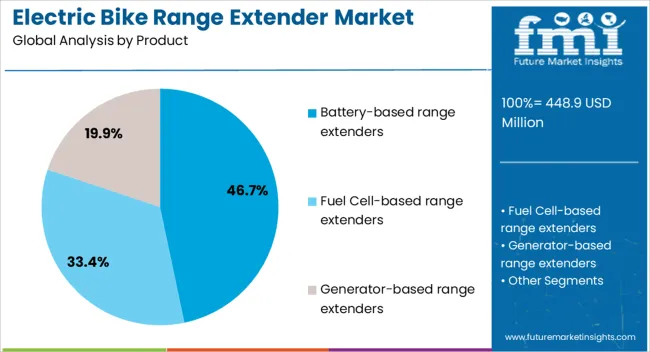
Battery-based range extenders are projected to account for 46.7% of the total market revenue in 2025, making them the dominant product segment. Their popularity is being driven by ease of integration, portability, and ability to directly supplement the main battery during extended rides.
Compact and swappable battery-based systems have gained traction for their modularity, allowing users to tailor performance according to terrain or trip length. Additionally, their compatibility with a wide variety of bike designs has positioned them as a preferred retrofit solution.
Enhanced charging capabilities, supported by fast-charging infrastructure expansion in urban areas, further reinforce their practical use. With advancements in lightweight battery materials and standardized connectors, battery-based extenders are being adopted at scale by both manufacturers and aftermarket service providers.
Insights into the Plug-in Technology Segment
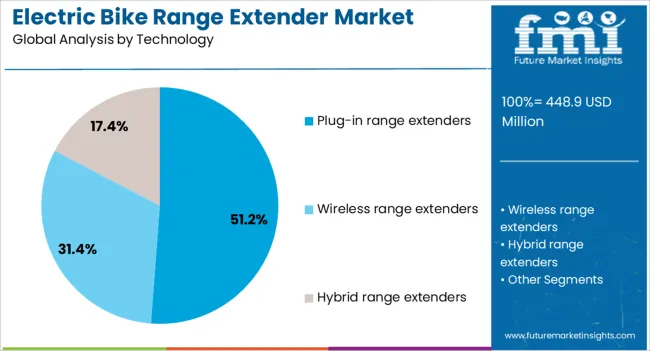
Plug-in range extenders are expected to hold 51.20% of the total market share in 2025, making them the leading technology segment. Their prominence is supported by convenience, user control, and the flexibility to recharge via standard electrical outlets.
These systems offer riders the advantage of energy independence without requiring dedicated charging infrastructure. The rising deployment of plug-in units in commuter and performance e-bikes has been facilitated by improvements in system efficiency, safety protocols, and intuitive user interfaces.
Moreover, plug-in range extenders provide greater energy management flexibility, allowing for on-demand charging or usage reserve modes, which enhances overall battery lifespan. As urban riders and delivery services seek reliable and cost-effective range solutions, plug-in technologies continue to dominate due to accessibility and low operational complexity.
Insights into the Lithium-ion Material Segment
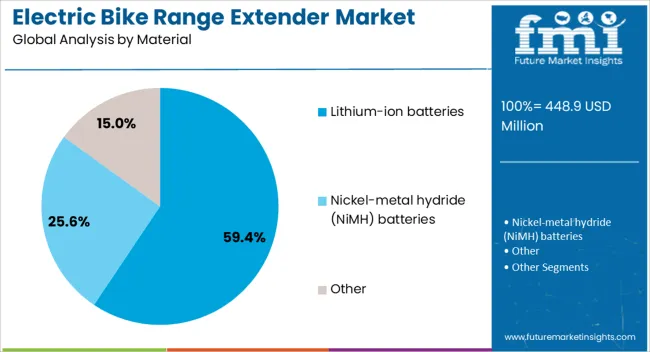
Lithium-ion batteries are anticipated to represent 59.40% of the electric bike range extender market revenue in 2025, positioning them as the top material choice. This leadership is attributed to high energy density, low weight, long lifecycle, and favorable charge-discharge efficiency.
The material’s ability to support compact, powerful, and thermally stable configurations has made it integral to the range extender ecosystem. Advances in lithium-ion chemistry, such as LFP and NMC variants, have improved safety and reduced reliance on rare materials, supporting cost and scalability.
Moreover, the proliferation of lithium-ion recycling programs and second-life applications has strengthened its sustainability profile. Manufacturers favor lithium-ion batteries for their proven reliability and compatibility with smart battery management systems, ensuring consistent performance across varying load conditions and terrain types.
What are the Drivers, Restraints, and Key Trends of the Electric Bike Range Extender Market?
The electric bike range extender market is growing due to increasing demand for longer battery life and improved performance in electric bicycles. As the popularity of e-bikes rises, consumers are seeking solutions to overcome range anxiety, and range extenders provide a viable option. These devices help extend the riding range by supplementing the main battery, making e-bikes more suitable for longer trips and diverse terrains. With advancements in battery technology and energy-efficient systems, the market is seeing growth, especially in urban areas and regions with high cycling demand. Challenges related to cost, compatibility, and technology limitations exist but present opportunities for innovation.
Rising Demand for Longer Riding Range and E-Bike Popularity
The primary driver for the electric bike range extender market is the increasing demand for longer riding ranges in electric bicycles. As e-bikes become more popular, consumers seek solutions that enhance the bike's range to cover greater distances, especially in areas where traditional bicycles are commonly used. E-bike range extenders help mitigate range anxiety by offering a supplementary power source, making longer trips more feasible and appealing. The demand for eco-friendly transportation options, coupled with the rise in urban cycling and commuting, is further accelerating the adoption of electric bikes and the need for reliable range extenders, contributing to market growth.
High Cost and Compatibility Issues
One of the challenges in the electric bike range extender market is the high cost of these devices. Range extenders are typically an added investment for consumers already purchasing expensive electric bikes. While they provide extended range, the additional cost can be a barrier for price-sensitive consumers. Moreover, compatibility issues with different e-bike models and battery systems can limit the widespread adoption of range extenders. Manufacturers must design universal solutions that can work seamlessly with a variety of e-bike configurations, which adds complexity to the development process. Overcoming these cost and compatibility issues is essential for expanding the consumer base and increasing market penetration.
Technological Advancements and Increasing Adoption of E-Bikes
The growing adoption of e-bikes, especially in urban areas, presents significant opportunities for the electric bike range extender market. As cities become more bicycle-friendly and the demand for eco-conscious transportation increases, the potential for range extenders continues to rise. Technological advancements in battery efficiency and power management systems are improving the performance of range extenders, making them more affordable and practical for everyday use. Additionally, the rise of long-distance cycling and bike touring is driving the need for range extenders, presenting an opportunity for manufacturers to innovate and offer tailored solutions for specific markets. The growing popularity of cycling as a recreational activity also creates further growth potential.
Integration of Smart Technology and Lightweight Design
A significant trend in the electric bike range extender market is the integration of smart technology and lightweight designs. Modern range extenders are incorporating smart features such as real-time battery monitoring, energy optimization, and mobile connectivity to allow riders to track performance and make adjustments as needed. These technological advancements improve user experience and enhance the efficiency of range extenders.The trend toward lightweight and compact designs is growing as consumers seek more convenient, portable solutions. Manufacturers are focusing on producing range extenders that are easier to install, remove, and carry without compromising performance. This trend toward enhanced functionality and ease of use is shaping the future of the market.
Analysis of Electric Bike Range Extender Market By Key Countries
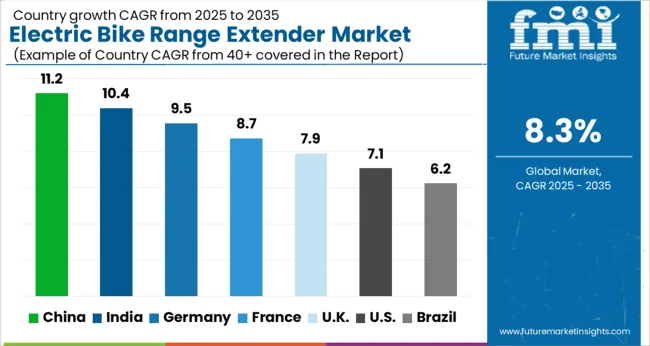
The electric bike range extender market is projected to grow at a global CAGR of 8.3% from 2025 to 2035. China leads with a CAGR of 11.2%, followed by India at 10.4%, and France at 8.7%. The United Kingdom records 7.9%, while the United States stands at 7.1%. China and India, as part of the BRICS group, are experiencing robust growth driven by expanding electric vehicle (EV) adoption, supportive government policies, and increasing environmental awareness. In contrast, OECD countries such as France, the UK, and the USA are seeing steady growth due to rising demand for energy-efficient transportation solutions, including electric bikes and their range extenders. The analysis spans over 40+ countries, with the top markets shown below.
Sales Analysis of Electric Bike Range Extender Market in China
China is projected to grow at a CAGR of 11.2% through 2035, driven by the country’s strong push for electric mobility and government support for clean energy transportation. As China leads in the production of electric vehicles and two-wheelers, the demand for electric bike range extenders is rapidly increasing. The government’s policies, including subsidies for electric vehicle buyers and regulations to reduce carbon emissions, are further driving market growth. The increasing popularity of electric bikes for daily commuting in urban areas also supports market growth. Additionally, advancements in battery technology are improving the range and performance of electric bikes, further fueling demand for range extenders.
- Government incentives and urbanization drive the adoption of electric bikes and range extenders in China.
- Technological advancements in batteries enhance the performance and range of electric bikes.
- Increasing demand for electric bikes for last-mile transportation boosts market growth in China.
In-depth Analysis of Electric Bike Range Extender Market in India
India is projected to grow at a CAGR of 10.4% through 2035, driven by the country’s increasing focus on green transportation and the growing adoption of electric bikes. The rising demand for eco-friendly transportation solutions, combined with government incentives for electric vehicle adoption, is driving the growth of electric bike range extenders in India. The expanding urban population and the need for last-mile connectivity further boost demand for electric bikes. Additionally, the growing awareness of reducing air pollution and lowering carbon footprints is expected to drive the adoption of electric bikes and their range extenders.
- Government incentives and growing eco-consciousness drive demand for electric bikes and range extenders in India.
- Urbanization and last-mile connectivity needs increase demand for electric bikes in Indian cities.
- Environmental concerns fuel the shift toward electric mobility solutions across India.
Growth of Electric Bike Range Extender Market in France
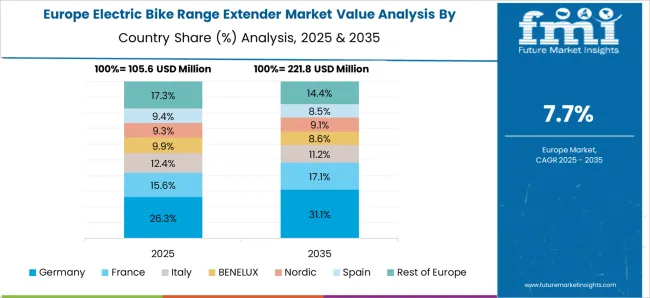
France is projected to grow at a CAGR of 8.7% through 2035, driven by rising consumer demand for electric mobility solutions and government support for sustainable transportation. France’s commitment to reducing carbon emissions and promoting electric vehicles is encouraging the growth of electric bikes and their range extenders. The growing adoption of electric bikes for commuting in urban areas is contributing to market expansion. Additionally, advancements in battery technology and improvements in the performance of electric bikes are driving demand for range extenders. France’s commitment to eco-friendly mobility solutions is expected to continue supporting market growth.
- Government initiatives and a growing preference for sustainable transport solutions drive market growth in France.
- Electric bike adoption for urban commuting accelerates the demand for range extenders in France.
- Advancements in battery technology contribute to the market’s growth as they improve electric bike performance.
Electric Bike Range Extender Market in the United Kingdom
The United Kingdom is projected to grow at a CAGR of 7.9% through 2035, driven by the country’s increasing focus on reducing carbon emissions and promoting electric mobility solutions. The growing demand for electric bikes for short-distance commutes and last-mile connectivity is supporting the market’s growth. The UK government’s incentives for electric vehicle adoption and the rising number of cycling infrastructure developments are boosting the demand for electric bikes and range extenders. As more consumers switch to electric bikes, the need for extended battery range and improved performance will continue to drive the adoption of range extenders.
- Government incentives and growing demand for electric bikes drive market expansion in the UK
- The rise of electric bikes for short-distance commuting increases demand for range extenders in the UK
- Infrastructure developments and support for electric mobility solutions contribute to market growth.
Demand Outlook for Electric Bike Range Extender Market in the United States
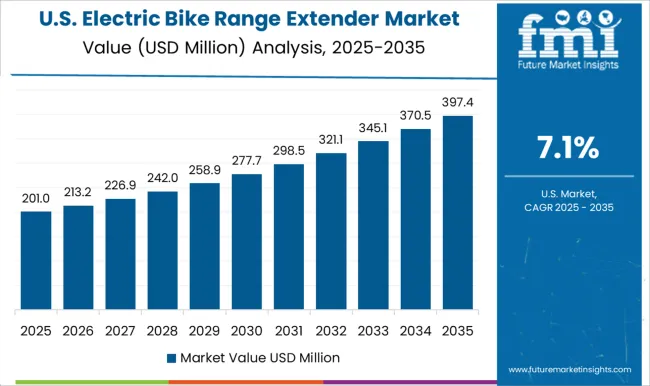
The United States is projected to grow at a CAGR of 7.1% through 2035, with increasing demand for sustainable transportation options driving the adoption of electric bikes and their range extenders. As the USA focuses on reducing carbon emissions and improving energy efficiency, electric bikes are becoming an increasingly popular choice for urban commuters. The rising demand for electric mobility solutions, along with technological innovations in electric bike batteries, is expected to drive market growth. Additionally, government incentives and the growing preference for eco-friendly transportation are further supporting the growth of the electric bike market.
- Increasing demand for eco-friendly transportation fuels the adoption of electric bikes and range extenders in the USA
- Technological innovations in electric bike batteries contribute to market growth in the USA
- Government incentives and a shift toward green transportation solutions accelerate the demand for range extenders.
Competitive Landscape of Electric Bike Range Extender Market
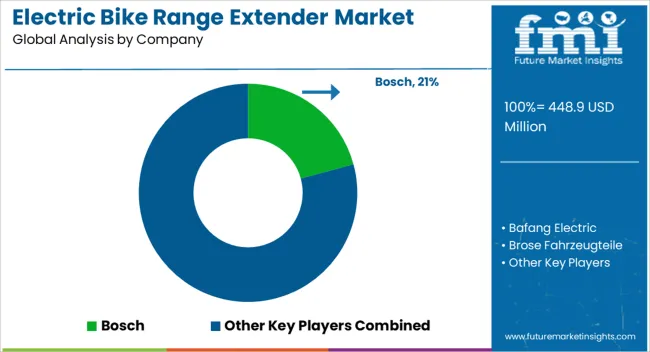
The electric bike range extender market is driven by leading manufacturers offering solutions to enhance the performance and range of electric bicycles. Bosch is a dominant player, providing cutting-edge range extender systems that improve the overall efficiency of e-bikes, allowing riders to travel longer distances with less battery consumption.
Panasonic Corporation and Shimano provide high-quality battery systems and range extender solutions, emphasizing power management and longer-lasting energy storage for e-bike users. TQ-Group and Valeo offer solutions for both high-performance and everyday e-bikes, improving power output and optimizing energy consumption for enhanced range. Yamaha Motor focuses on developing integrated electric drive systems, including range extenders, to offer a complete solution for e-bike manufacturers and consumers looking for increased range and reliability.
Scope of the Report
| Item | Value |
|---|---|
| Quantitative Units | USD Million |
| Product | Battery-based range extenders, Fuel Cell-based range extenders, and Generator-based range extenders |
| Technology | Plug-in range extenders, Wireless range extenders, and Hybrid range extenders |
| Material | Lithium-ion batteries, Nickel-metal hydride (NiMH) batteries, and Other |
| Application | Commuter electric bikes, Mountain electric bikes, Cargo electric bikes, Folding electric bikes, and Others |
| Distribution Channel | Offline and Online |
| End-User | Individuals and Commercial use |
| Regions Covered | North America, Europe, Asia-Pacific, Latin America, Middle East & Africa |
| Country Covered | United States, Canada, Germany, France, United Kingdom, China, Japan, India, Brazil, South Africa |
| Key Companies Profiled | Bosch, Bafang Electric, Brose Fahrzeugteile, FAZUA, Mahle, Panasonic Corporation, Shimano, TQ-Group, Valeo, and Yamaha Motor |
| Additional Attributes | Dollar sales by product type (battery pack extenders, motor-based extenders) and end-use segments (urban e-bikes, mountain e-bikes, recreational e-bikes). Demand dynamics are influenced by the increasing popularity of e-bikes, growing consumer demand for longer ranges, and advancements in electric mobility. Regional trends show strong growth in Europe and North America due to environmental policies and the rising popularity of sustainable transportation, while Asia-Pacific is expanding rapidly with increased e-bike production and adoption. |
Electric Bike Range Extender Market by Segments
Product:
- Battery-based range extenders
- Fuel Cell-based range extenders
- Generator-based range extenders
Technology:
- Plug-in range extenders
- Wireless range extenders
- Hybrid range extenders
Material:
- Lithium-ion batteries
- Nickel-metal hydride (NiMH) batteries
- Other
Application:
- Commuter electric bikes
- Mountain electric bikes
- Cargo electric bikes
- Folding electric bikes
- Others
Distribution Channel:
- Offline
- Online
Region:
- North America
- USA
- Canada
- Mexico
- Latin America
- Brazil
- Chile
- Rest of Latin America
- Western Europe
- Germany
- UK
- Italy
- Spain
- France
- Nordic
- BENELUX
- Rest of Western Europe
- Eastern Europe
- Russia
- Poland
- Hungary
- Balkan & Baltic
- Rest of Eastern Europe
- East Asia
- China
- Japan
- South Korea
- South Asia and Pacific
- India
- ASEAN
- Australia & New Zealand
- Rest of South Asia and Pacific
- Middle East & Africa
- Kingdom of Saudi Arabia
- Other GCC Countries
- Turkiye
- South Africa
- Other African Union
- Rest of Middle East & Africa
Frequently Asked Questions
How big is the electric bike range extender market in 2025?
The global electric bike range extender market is estimated to be valued at USD 448.9 million in 2025.
What will be the size of electric bike range extender market in 2035?
The market size for the electric bike range extender market is projected to reach USD 996.4 million by 2035.
How much will be the electric bike range extender market growth between 2025 and 2035?
The electric bike range extender market is expected to grow at a 8.3% CAGR between 2025 and 2035.
What are the key product types in the electric bike range extender market?
The key product types in electric bike range extender market are battery-based range extenders, fuel cell-based range extenders and generator-based range extenders.
Which technology segment to contribute significant share in the electric bike range extender market in 2025?
In terms of technology, plug-in range extenders segment to command 51.2% share in the electric bike range extender market in 2025.
Preview the report firsthand - request a free sample
Get SampleGet the brochure for pricing and purchase details.
Get PDFTable of Content
- Executive Summary
- Global Market Outlook
- Demand-side Trends
- Supply-side Trends
- Technology Roadmap Analysis
- Analysis and Recommendations
- Market Overview
- Market Coverage / Taxonomy
- Market Definition / Scope / Limitations
- Market Background
- Market Dynamics
- Drivers
- Restraints
- Opportunity
- Trends
- Scenario Forecast
- Demand in Optimistic Scenario
- Demand in Likely Scenario
- Demand in Conservative Scenario
- Opportunity Map Analysis
- Product Life Cycle Analysis
- Supply Chain Analysis
- Investment Feasibility Matrix
- Value Chain Analysis
- PESTLE and Porter’s Analysis
- Regulatory Landscape
- Regional Parent Market Outlook
- Production and Consumption Statistics
- Import and Export Statistics
- Market Dynamics
- Global Electric Bike Range Extender Market Analysis 2020-2024 and Forecast, 2025-2035
- Historical Market Size Value (USD Mn) Analysis, 2020-2024
- Current and Future Market Size Value (USD Mn) Projections, 2025-2035
- Y-o-Y Growth Trend Analysis
- Absolute $ Opportunity Analysis
- Global Electric Bike Range Extender Market Pricing Analysis 2020-2024 and Forecast 2025-2035
- Global Electric Bike Range Extender Market Analysis 2020-2024 and Forecast 2025-2035, By Product
- Introduction / Key Findings
- Historical Market Size Value (USD Mn) Analysis By Product , 2020-2024
- Current and Future Market Size Value (USD Mn) Analysis and Forecast By Product , 2025-2035
- Battery-based range extenders
- Fuel Cell-based range extenders
- Generator-based range extenders
- Y-o-Y Growth Trend Analysis By Product , 2020-2024
- Absolute $ Opportunity Analysis By Product , 2025-2035
- Global Electric Bike Range Extender Market Analysis 2020-2024 and Forecast 2025-2035, By Technology
- Introduction / Key Findings
- Historical Market Size Value (USD Mn) Analysis By Technology, 2020-2024
- Current and Future Market Size Value (USD Mn) Analysis and Forecast By Technology, 2025-2035
- Plug-in range extenders
- Wireless range extenders
- Hybrid range extenders
- Y-o-Y Growth Trend Analysis By Technology, 2020-2024
- Absolute $ Opportunity Analysis By Technology, 2025-2035
- Global Electric Bike Range Extender Market Analysis 2020-2024 and Forecast 2025-2035, By Material
- Introduction / Key Findings
- Historical Market Size Value (USD Mn) Analysis By Material, 2020-2024
- Current and Future Market Size Value (USD Mn) Analysis and Forecast By Material, 2025-2035
- Lithium-ion batteries
- Nickel-metal hydride (NiMH) batteries
- Other
- Y-o-Y Growth Trend Analysis By Material, 2020-2024
- Absolute $ Opportunity Analysis By Material, 2025-2035
- Global Electric Bike Range Extender Market Analysis 2020-2024 and Forecast 2025-2035, By Application
- Introduction / Key Findings
- Historical Market Size Value (USD Mn) Analysis By Application, 2020-2024
- Current and Future Market Size Value (USD Mn) Analysis and Forecast By Application, 2025-2035
- Commuter electric bikes
- Mountain electric bikes
- Cargo electric bikes
- Folding electric bikes
- Others
- Y-o-Y Growth Trend Analysis By Application, 2020-2024
- Absolute $ Opportunity Analysis By Application, 2025-2035
- Global Electric Bike Range Extender Market Analysis 2020-2024 and Forecast 2025-2035, By Distribution Channel
- Introduction / Key Findings
- Historical Market Size Value (USD Mn) Analysis By Distribution Channel, 2020-2024
- Current and Future Market Size Value (USD Mn) Analysis and Forecast By Distribution Channel, 2025-2035
- Offline
- Online
- Y-o-Y Growth Trend Analysis By Distribution Channel, 2020-2024
- Absolute $ Opportunity Analysis By Distribution Channel, 2025-2035
- Global Electric Bike Range Extender Market Analysis 2020-2024 and Forecast 2025-2035, By End-User
- Introduction / Key Findings
- Historical Market Size Value (USD Mn) Analysis By End-User, 2020-2024
- Current and Future Market Size Value (USD Mn) Analysis and Forecast By End-User, 2025-2035
- Individuals
- Commercial use
- Y-o-Y Growth Trend Analysis By End-User, 2020-2024
- Absolute $ Opportunity Analysis By End-User, 2025-2035
- Global Electric Bike Range Extender Market Analysis 2020-2024 and Forecast 2025-2035, By Region
- Introduction
- Historical Market Size Value (USD Mn) Analysis By Region, 2020-2024
- Current Market Size Value (USD Mn) Analysis and Forecast By Region, 2025-2035
- North America
- Latin America
- Western Europe
- Eastern Europe
- East Asia
- South Asia and Pacific
- Middle East & Africa
- Market Attractiveness Analysis By Region
- North America Electric Bike Range Extender Market Analysis 2020-2024 and Forecast 2025-2035, By Country
- Historical Market Size Value (USD Mn) Trend Analysis By Market Taxonomy, 2020-2024
- Market Size Value (USD Mn) Forecast By Market Taxonomy, 2025-2035
- By Country
- USA
- Canada
- Mexico
- By Product
- By Technology
- By Material
- By Application
- By Distribution Channel
- By End-User
- By Country
- Market Attractiveness Analysis
- By Country
- By Product
- By Technology
- By Material
- By Application
- By Distribution Channel
- By End-User
- Key Takeaways
- Latin America Electric Bike Range Extender Market Analysis 2020-2024 and Forecast 2025-2035, By Country
- Historical Market Size Value (USD Mn) Trend Analysis By Market Taxonomy, 2020-2024
- Market Size Value (USD Mn) Forecast By Market Taxonomy, 2025-2035
- By Country
- Brazil
- Chile
- Rest of Latin America
- By Product
- By Technology
- By Material
- By Application
- By Distribution Channel
- By End-User
- By Country
- Market Attractiveness Analysis
- By Country
- By Product
- By Technology
- By Material
- By Application
- By Distribution Channel
- By End-User
- Key Takeaways
- Western Europe Electric Bike Range Extender Market Analysis 2020-2024 and Forecast 2025-2035, By Country
- Historical Market Size Value (USD Mn) Trend Analysis By Market Taxonomy, 2020-2024
- Market Size Value (USD Mn) Forecast By Market Taxonomy, 2025-2035
- By Country
- Germany
- UK
- Italy
- Spain
- France
- Nordic
- BENELUX
- Rest of Western Europe
- By Product
- By Technology
- By Material
- By Application
- By Distribution Channel
- By End-User
- By Country
- Market Attractiveness Analysis
- By Country
- By Product
- By Technology
- By Material
- By Application
- By Distribution Channel
- By End-User
- Key Takeaways
- Eastern Europe Electric Bike Range Extender Market Analysis 2020-2024 and Forecast 2025-2035, By Country
- Historical Market Size Value (USD Mn) Trend Analysis By Market Taxonomy, 2020-2024
- Market Size Value (USD Mn) Forecast By Market Taxonomy, 2025-2035
- By Country
- Russia
- Poland
- Hungary
- Balkan & Baltic
- Rest of Eastern Europe
- By Product
- By Technology
- By Material
- By Application
- By Distribution Channel
- By End-User
- By Country
- Market Attractiveness Analysis
- By Country
- By Product
- By Technology
- By Material
- By Application
- By Distribution Channel
- By End-User
- Key Takeaways
- East Asia Electric Bike Range Extender Market Analysis 2020-2024 and Forecast 2025-2035, By Country
- Historical Market Size Value (USD Mn) Trend Analysis By Market Taxonomy, 2020-2024
- Market Size Value (USD Mn) Forecast By Market Taxonomy, 2025-2035
- By Country
- China
- Japan
- South Korea
- By Product
- By Technology
- By Material
- By Application
- By Distribution Channel
- By End-User
- By Country
- Market Attractiveness Analysis
- By Country
- By Product
- By Technology
- By Material
- By Application
- By Distribution Channel
- By End-User
- Key Takeaways
- South Asia and Pacific Electric Bike Range Extender Market Analysis 2020-2024 and Forecast 2025-2035, By Country
- Historical Market Size Value (USD Mn) Trend Analysis By Market Taxonomy, 2020-2024
- Market Size Value (USD Mn) Forecast By Market Taxonomy, 2025-2035
- By Country
- India
- ASEAN
- Australia & New Zealand
- Rest of South Asia and Pacific
- By Product
- By Technology
- By Material
- By Application
- By Distribution Channel
- By End-User
- By Country
- Market Attractiveness Analysis
- By Country
- By Product
- By Technology
- By Material
- By Application
- By Distribution Channel
- By End-User
- Key Takeaways
- Middle East & Africa Electric Bike Range Extender Market Analysis 2020-2024 and Forecast 2025-2035, By Country
- Historical Market Size Value (USD Mn) Trend Analysis By Market Taxonomy, 2020-2024
- Market Size Value (USD Mn) Forecast By Market Taxonomy, 2025-2035
- By Country
- Kingdom of Saudi Arabia
- Other GCC Countries
- Turkiye
- South Africa
- Other African Union
- Rest of Middle East & Africa
- By Product
- By Technology
- By Material
- By Application
- By Distribution Channel
- By End-User
- By Country
- Market Attractiveness Analysis
- By Country
- By Product
- By Technology
- By Material
- By Application
- By Distribution Channel
- By End-User
- Key Takeaways
- Key Countries Electric Bike Range Extender Market Analysis
- USA
- Pricing Analysis
- Market Share Analysis, 2024
- By Product
- By Technology
- By Material
- By Application
- By Distribution Channel
- By End-User
- Canada
- Pricing Analysis
- Market Share Analysis, 2024
- By Product
- By Technology
- By Material
- By Application
- By Distribution Channel
- By End-User
- Mexico
- Pricing Analysis
- Market Share Analysis, 2024
- By Product
- By Technology
- By Material
- By Application
- By Distribution Channel
- By End-User
- Brazil
- Pricing Analysis
- Market Share Analysis, 2024
- By Product
- By Technology
- By Material
- By Application
- By Distribution Channel
- By End-User
- Chile
- Pricing Analysis
- Market Share Analysis, 2024
- By Product
- By Technology
- By Material
- By Application
- By Distribution Channel
- By End-User
- Germany
- Pricing Analysis
- Market Share Analysis, 2024
- By Product
- By Technology
- By Material
- By Application
- By Distribution Channel
- By End-User
- UK
- Pricing Analysis
- Market Share Analysis, 2024
- By Product
- By Technology
- By Material
- By Application
- By Distribution Channel
- By End-User
- Italy
- Pricing Analysis
- Market Share Analysis, 2024
- By Product
- By Technology
- By Material
- By Application
- By Distribution Channel
- By End-User
- Spain
- Pricing Analysis
- Market Share Analysis, 2024
- By Product
- By Technology
- By Material
- By Application
- By Distribution Channel
- By End-User
- France
- Pricing Analysis
- Market Share Analysis, 2024
- By Product
- By Technology
- By Material
- By Application
- By Distribution Channel
- By End-User
- India
- Pricing Analysis
- Market Share Analysis, 2024
- By Product
- By Technology
- By Material
- By Application
- By Distribution Channel
- By End-User
- ASEAN
- Pricing Analysis
- Market Share Analysis, 2024
- By Product
- By Technology
- By Material
- By Application
- By Distribution Channel
- By End-User
- Australia & New Zealand
- Pricing Analysis
- Market Share Analysis, 2024
- By Product
- By Technology
- By Material
- By Application
- By Distribution Channel
- By End-User
- China
- Pricing Analysis
- Market Share Analysis, 2024
- By Product
- By Technology
- By Material
- By Application
- By Distribution Channel
- By End-User
- Japan
- Pricing Analysis
- Market Share Analysis, 2024
- By Product
- By Technology
- By Material
- By Application
- By Distribution Channel
- By End-User
- South Korea
- Pricing Analysis
- Market Share Analysis, 2024
- By Product
- By Technology
- By Material
- By Application
- By Distribution Channel
- By End-User
- Russia
- Pricing Analysis
- Market Share Analysis, 2024
- By Product
- By Technology
- By Material
- By Application
- By Distribution Channel
- By End-User
- Poland
- Pricing Analysis
- Market Share Analysis, 2024
- By Product
- By Technology
- By Material
- By Application
- By Distribution Channel
- By End-User
- Hungary
- Pricing Analysis
- Market Share Analysis, 2024
- By Product
- By Technology
- By Material
- By Application
- By Distribution Channel
- By End-User
- Kingdom of Saudi Arabia
- Pricing Analysis
- Market Share Analysis, 2024
- By Product
- By Technology
- By Material
- By Application
- By Distribution Channel
- By End-User
- Turkiye
- Pricing Analysis
- Market Share Analysis, 2024
- By Product
- By Technology
- By Material
- By Application
- By Distribution Channel
- By End-User
- South Africa
- Pricing Analysis
- Market Share Analysis, 2024
- By Product
- By Technology
- By Material
- By Application
- By Distribution Channel
- By End-User
- USA
- Market Structure Analysis
- Competition Dashboard
- Competition Benchmarking
- Market Share Analysis of Top Players
- By Regional
- By Product
- By Technology
- By Material
- By Application
- By Distribution Channel
- By End-User
- Competition Analysis
- Competition Deep Dive
- Bosch
- Overview
- Product Portfolio
- Profitability by Market Segments (Product/Age /Sales Channel/Region)
- Sales Footprint
- Strategy Overview
- Marketing Strategy
- Product Strategy
- Channel Strategy
- Bafang Electric
- Brose Fahrzeugteile
- FAZUA
- Mahle
- Panasonic Corporation
- Shimano
- TQ-Group
- Valeo
- Yamaha Motor
- Bosch
- Competition Deep Dive
- Assumptions & Acronyms Used
- Research Methodology


