

- Market Size (2026)
- USD 1120.7 Mn
- Forecast (2036)
- USD 3976.0 Mn
- CAGR (2026 to 2036)
- 13.5%
How big is the Active Electrical Cable Market in 2026?
USD 1,120.7 million in 2026 and USD 3,976.0 million by 2036 at a 13.5% CAGR.
The active electrical cable industry value is anticipated to scale from USD 987.4009 million in 2025 to USD 3,976.0 million by 2036 at 13.5% CAGR, driven by AI racks needing short-reach copper links carrying high-speed traffic through signal-conditioning electronics. AI / HPC clusters are expected to hold 52.0% share in 2026, led by GPU server layouts using dense switch-to-server links. Direct OEM is projected to secure 57.0% share in 2026, reflected by platform qualification and approved supplier programs.
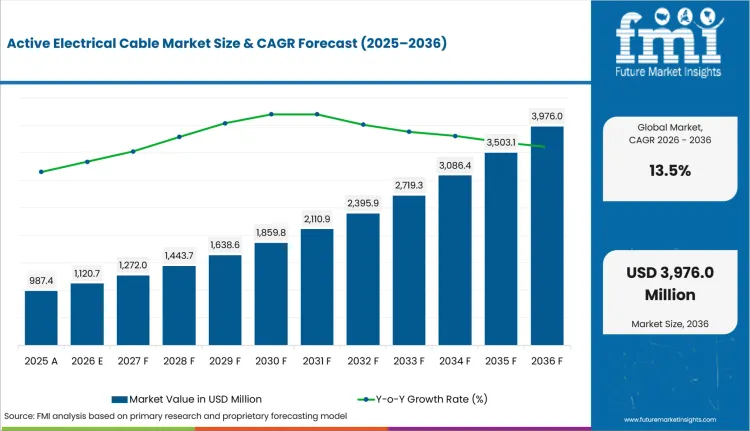
| Metric | Value |
|---|---|
| 2026 Market Size | USD 1,120.7 million |
| 2036 Market Size | USD 3,976.0 million |
| Forecast CAGR | 13.5% from 2026 to 2036 |
| Leading Sales Channel | Direct OEM |
| Direct OEM Share in 2026 | 57.0% |
| Leading End Use | AI / HPC Clusters |
| AI / HPC Clusters Share in 2026 | 52.0% |
| Leading CAGR Country | China |
| China CAGR | 15.8% by 2036 |
Summary of the Active Electrical Cable Market
| Market Signal | Commercial Impact |
|---|---|
| Demand and Growth Drivers | Active electrical cable demand is increasing as AI infrastructure and high-performance computing deployments require high-speed short-reach connectivity.
|
| Product and Segment View | Direct OEM sales, AI/HPC clusters, and OSFP connectivity dominate the market.
|
| Geography and Growth Outlook | China and India are expected to remain the fastest-growing markets for active electrical cables.
|
| Competitive Landscape | Competition is centered on high-speed interconnect technology, connector compatibility, and platform validation.
|
| Analyst Perspective | Active electrical cables are becoming a strategic component of AI rack architecture rather than a standard connectivity product.
- Nikhil Kaitwade Principal Consultant, Technology, Future Market Insights |
AI infrastructure planning is strengthening around rack bandwidth and cable validation. International Energy Agency reported global data center electricity use at about 415 TWh in 2024 and projected it to reach about 945 TWh by 2030. USA Department of Energy reported data centers consumed about 176 TWh in 2023 and could reach 325 TWh to 580 TWh by 2028.
Astera Labs introduced Aries Smart Cable Modules for PCIe 6.0 in February 2026, enabling active copper connectivity up to 7 meters for PCIe 6.x and CXL 3.x applications.Active electrical cable demand is forecast to expand through 2036, supported by AI cluster density and service-led platform qualification.
Which factors support expansion in the Active Electrical Cable Market?
Signal-integrity requirements and AI rack density support market value across data center and cloud infrastructure.
- Market value rises as GPU racks require copper links preserving signal quality across short but demanding server routes.
- Retimed cables support adoption by extending copper use beyond passive DAC limits in dense rack designs.
- AI / HPC cluster operators influence steady demand through high-speed switch and server platform qualification needs.
- Telecom edge and enterprise data centers promote demand for compact cable designs suited to shorter facility layouts.
Why is the Active Electrical Cable Market growing?
AI rack builders need short-reach copper assemblies reducing optical conversion cost while maintaining high-speed signal quality.
Active electrical cable buyers are spending more on retimed assemblies as AI clusters multiply short links between accelerators and servers. International Energy Agency reported data centers accounted for about 1.5% of global electricity consumption in 2024, equal to about 415 TWh, and the sector has grown around 12% per year since 2017. Dense compute rooms need cables that preserve link quality without adding optical modules to every short path. Suppliers combining thinner gauges and platform validation gain better acceptance in hyperscale and cloud buying decisions.
How is the Active Electrical Cable Market segmented?
- Active Electrical Cable Market is segmented by cable type, speed, end use, connector, and sales channel.
- Active Copper Cables are projected to account for 44.0% share in 2026, influenced by short-reach AI data center links needing lower cost than optics.
- 800G is expected to hold 46.0% share in 2026, shaped by AI switch platforms moving beyond 400G fabrics.
- AI / HPC Clusters are anticipated to account for 52.0% share in 2026, led by accelerator networks requiring dense bandwidth near compute hardware.
- OSFP is projected to hold 48.0% share in 2026, guided by front-panel density and thermal handling across AI switches.
- Direct OEM is expected to represent 57.0% share in 2026, supported by platform-level validation and approved vendor lists.
Why do active copper cables lead the Active Electrical Cable Market by cable type?
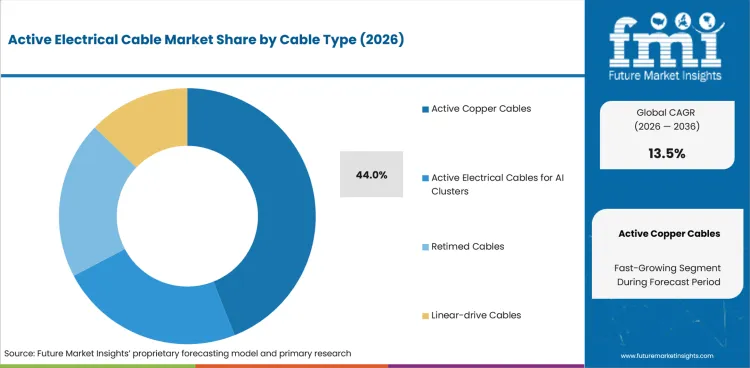
- Active Copper Cables are projected to account for 44.0% share in 2026, driven by short-reach server links needing signal conditioning without optical module cost.
- Retimed cables gain demand as platform teams need copper links capable of meeting stricter error-rate and reach targets.
Which speed leads the Active Electrical Cable Market?
- 800G is expected to hold 46.0% share in 2026, shaped by AI switching platforms that need more bandwidth per rack.
- 1.6T and Above gain use as buyers prepare higher lane-rate designs around 224G PAM4 signaling.
Which end use leads the Active Electrical Cable Market?
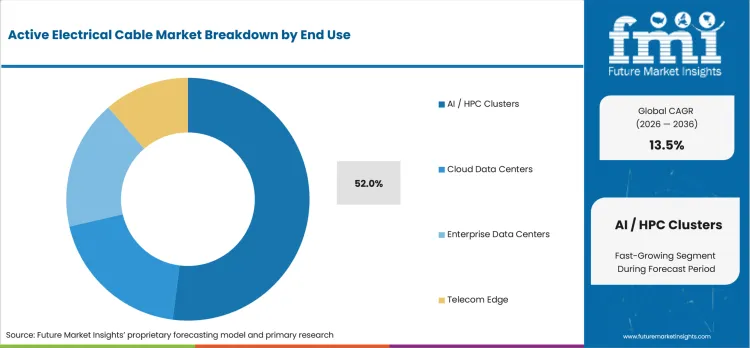
- AI / HPC Clusters are anticipated to account for 52.0% share in 2026, led by GPU rack designs needing low-latency short links.
- Cloud data centers create added demand as hyperscale networks refresh switch-to-server cabling during platform upgrades.
Which connector leads the Active Electrical Cable Market?
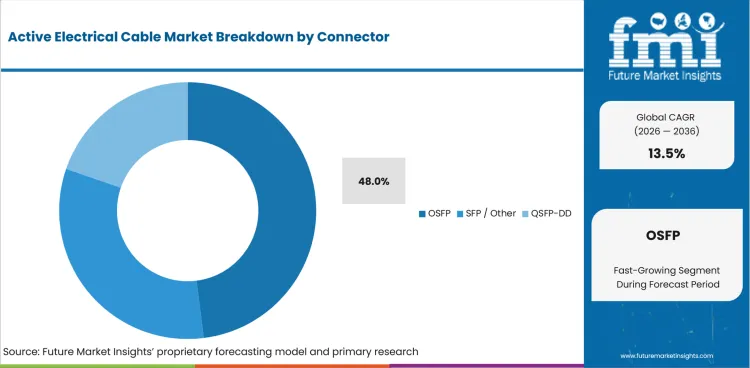
- OSFP is projected to hold 48.0% share in 2026, reflected by its use across high-density 800G AI switch layouts.
- QSFP-DD remains active as cloud and enterprise networks keep mixed-speed platforms in service.
Which sales channel leads the Active Electrical Cable Market?
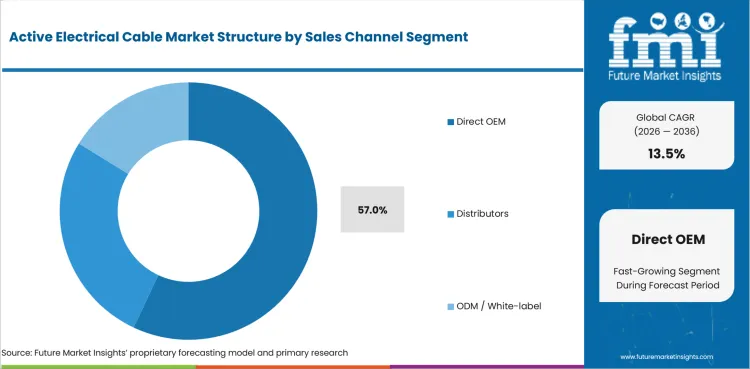
- Direct OEM is expected to represent 57.0% share in 2026, guided by buyer preference for cables qualified with servers, switches, and NICs.
- Distributors remain active across replacement demand and enterprise refresh programs needing faster local availability.
What are the drivers, restraints, and opportunities in the Active Electrical Cable Market?
AI cluster density and retimer-backed copper links are shaping active electrical cable buying decisions.
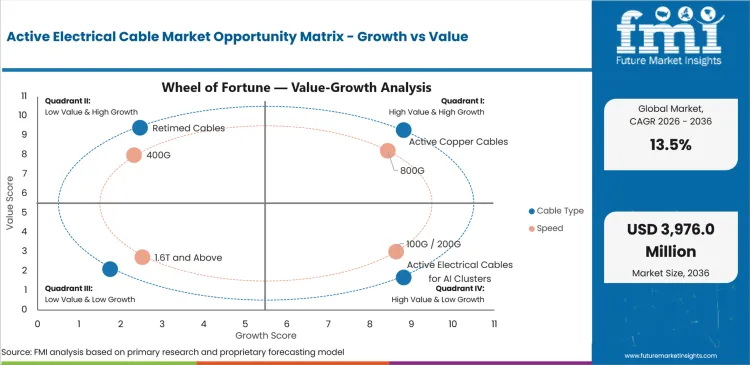
- Driver: Short-reach AI rack links require retimed copper assemblies before higher-speed signal quality can be maintained.
- Restraint: Long qualification cycles can slow new supplier entry across hyperscale and OEM platforms.
- Opportunity: 1.6T and higher-speed links create scope for suppliers with 224G PAM4 readiness and verified connector portfolios.
AI Rack Density Strengthens AEC Demand
AI server architecture creates a clear reason for active electrical cable adoption. International Energy Agency expects data center electricity consumption to grow by around 15% per year from 2024 to 2030, more than 4 times the pace of other electricity demand sectors. Higher rack density increases the number of short high-speed links around accelerators and switches. Active electrical cable suppliers gain demand as signal quality becomes a platform-uptime issue rather than a simple cable-price decision.
Qualification Burden Limits Supplier Entry
New active electrical cable suppliers can face slower acceptance if validation is not complete across retimers and thermal designs. Federal Energy Regulatory Commission directed 6 USA regional grid operators and transmission owners in June 2026 to justify or revise large-load tariff rules within 60 days, showing how AI infrastructure schedules now depend on power access as well as equipment readiness. Buyers may delay unapproved cable families until suppliers prove compatibility and service records. Trial-led selling can reduce hesitation by showing link stability on actual rack platforms.
Higher-Speed Copper Creates Expansion Scope
Higher-speed copper creates a stronger opening for active electrical cable adoption as passive cable reach narrows at advanced data rates. European Commission proposed the Cloud and AI Development Act in June 2026 with an aim to at least triple EU data center capacity within 5 to 7 years, adding pressure for scalable short-reach interconnects in future facilities. Active electrical cable suppliers can convert AI infrastructure plans into repeat purchases through 800G, 1.6T, and PCIe 6 support.
Which countries are growing in the Active Electrical Cable Market?
China 15.8% CAGR, India 15.2% CAGR, United States 14.2% CAGR, South Korea 13.9% CAGR, France 13.1% CAGR, United Kingdom 12.8% CAGR, Japan 12.4% CAGR, and Germany 12.1% CAGR through 2036.
.webp "Top Country Growth Comparison Active Electrical Cable Market Cagr (2026 2036)")
| Country | CAGR |
|---|---|
| China | 15.8% |
| India | 15.2% |
| United States | 14.2% |
| South Korea | 13.9% |
| France | 13.1% |
| United Kingdom | 12.8% |
| Japan | 12.4% |
| Germany | 12.1% |
Source: Future Market Insights, 2026.
How do country-level CAGRs compare in the Active Electrical Cable Market?
China leads country expansion while Germany records the most cautious pace among profiled markets.
China is forecast to record 15.8% CAGR by 2036 due to AI cluster buildout and data hub policy support.
- India is expected to expand at 15.2% CAGR from 2026 to 2036, led by data center capacity additions and AI compute access.
- United States is projected to grow at 14.2% CAGR through 2036 as hyperscale AI networks require validated short-reach copper links.
- South Korea is estimated to rise at 13.9% CAGR by 2036, reflected by cloud and electronics-led AI infrastructure demand.
- France is expected to advance at 13.1% CAGR over the forecast period as AI infrastructure investments support sovereign compute.
- United Kingdom is forecast to grow at 12.8% CAGR by 2036, backed by AI Growth Zones and power-access reform.
- Japan is projected to post 12.4% CAGR by 2036, guided by compact data center layouts and reliability-focused buying.
- Germany is expected to record 12.1% CAGR by 2036, driven by enterprise cloud upgrades and engineering-led validation.
How fast is the Active Electrical Cable Market growing in China?
A 15.8% CAGR through 2036 reflects AI cluster buildout and national computing infrastructure support.
Country Market Snapshot Table
| Parameter | Value |
|---|---|
| Market Size in 2025 (Value) | USD 206.2 million |
| Market Size in 2026 (Value) | USD 238.8 million |
| Market Forecast in 2036 (Value) | USD 1,034.3 million |
| CAGR (2026 to 2036) | 15.8% |
| Years Considered | 2021 to 2036 |
| Base Year | 2025 |
| Forecast Period | 2026 to 2036 |
| Units Considered | Value (USD million) |
| Leading Sub-Region | Yangtze River Delta, Greater Bay Area, Beijing-Tianjin-Hebei, and western data hub corridors |
China Active Electrical Cable Market Outlook
- China active electrical cable industry is defined by AI cluster buildout and country-specific high-speed network requirements. Domestic buyers need active copper links that support short-reach 400G and 800G server routes with stable signal quality.
- Local platform needs will stay influential as cloud and AI operators compare cable compatibility across switch vendors. Suppliers combining engineering support and local interface adaptation are expected to gain more buyer confidence.
Key Growth Drivers
- National computing targets create scale for high-speed cable demand, supported by China’s plan to reach 300 EFLOPS of total computing power by 2025.
- Green data center policy supports efficient interconnect selection, reinforced by 246 national green data centers using green electricity for more than half of power use.
- AI clusters need active copper links as short rack paths multiply across accelerator and switch architectures.
- Domestic cable and electronics suppliers gain scope as buyers need local service access and interface support.
Key Restraints
- Local supplier preference can narrow access for foreign cable vendors lacking domestic qualification records.
- Interface differences can increase engineering effort for global active electrical cable suppliers.
- Energy efficiency rules can raise compliance pressure, indicated by China’s 2025 data center target to lower average PUE below 1.5 and lift renewable energy utilization by 10% annually.
What makes China unique
China stands apart through dense AI infrastructure buildout and local cloud platform qualification needs across domestic electronics supply chains.
Key Companies
- Luxshare Precision
- Eoptolink Technology
- Innolight Technology
- Accelink Technologies
- FiberHome Telecommunication Technologies
- Hengtong Optic-Electric
- Linktel Technologies
Sales & Marketing Channels
- Hyperscale direct sourcing
- ODM platform design-in
- Local distributor channels
- Switch vendor qualification
- Cloud data center integrators
- Factory demonstration programs
Country Segment Breakdown Table
| Segment | Sub-Segments |
|---|---|
| By Cable Type | Active Copper Cables · Active Electrical Cables for AI Clusters · Retimed Cables · Linear-drive Cables |
| By Speed | 100G / 200G · 400G · 800G · 1.6T and Above |
| By End Use | AI / HPC Clusters · Cloud Data Centers · Enterprise Data Centers · Telecom Edge |
| By Connector | QSFP-DD · OSFP · SFP / Other |
| By Sales Channel | Direct OEM · Distributors · ODM / White-label |
| Key Sub-Regions Covered, Technology Corridors | Shanghai · Shenzhen · Guangzhou · Beijing · Hangzhou · Chengdu · Guizhou |
Frequently Asked Questions
How fast is China Active Electrical Cable Market growing?
China records the leading country pace at an estimated 15.8% CAGR, helped by national computing capacity targets and cloud cluster expansion.
Who leads China Active Electrical Cable Market?
Luxshare Precision leads China active electrical cable market among local interconnect suppliers, while Eoptolink Technology and Innolight Technology support data center connectivity programs.
What is driving adoption in China Active Electrical Cable Market?
Local platform qualification and green data center policy are encouraging buyers to approve active copper assemblies for short links.
What is the Active Electrical Cable Market outlook in India?
A 15.2% CAGR through 2036 reflects data center capacity expansion and subsidized AI compute access.
Country Market Snapshot Table
| Parameter | Value |
|---|---|
| Market Size in 2025 (Value) | USD 80.2 million |
| Market Size in 2026 (Value) | USD 92.4 million |
| Market Forecast in 2036 (Value) | USD 379.5 million |
| CAGR (2026 to 2036) | 15.2% |
| Years Considered | 2021 to 2036 |
| Base Year | 2025 |
| Forecast Period | 2026 to 2036 |
| Units Considered | Value (USD million) |
| Leading Sub-Region | Mumbai, Navi Mumbai, Hyderabad, Bengaluru, Noida, and Jamnagar data center corridors |
India Active Electrical Cable Market Outlook
- India active electrical cable demand follows new data center capacity and cost-sensitive rack design. Buyers need short-reach copper assemblies supporting high-density racks while controlling infrastructure cost.
- Data center contractors and system integrators are expected to follow global OEM specifications before localizing stocking and service. Thermal planning and cable routing will remain central to supplier selection across hot-climate facilities.
Key Growth Drivers
- Data center capacity expansion supports short-reach cabling demand, shown by capacity rising from about 375 MW in 2020 to around 1,500 MW by 2025.
- Public AI compute programs increase demand for high-speed infrastructure, reinforced by 38,231 GPUs onboarded through 14 empaneled service providers.
- Mumbai and Hyderabad clusters support repeat demand from cloud and colocation buyers.
- Price-sensitive buyers favor active copper links for short paths before choosing optical alternatives.
Key Restraints
- Cooling and power reliability can shape rack density choices across hot and humid regions.
- Local stock availability may trail global active electrical cable launches and slow replacement cycles.
- Water and energy planning add design pressure, as Indian data centers deploy adiabatic cooling and immersion cooling after capacity crossed 1,500 MW by 2025.
What makes India unique
India combines hot-climate facility engineering and value-focused sourcing across cloud and colocation corridors.
Key Companies
- Sterlite Technologies
- HFCL
- Polycab India
- Finolex Cables
- D-Link India
- R&M India local operations
- NetRack Enclosures
Sales & Marketing Channels
- Data center contractor sourcing
- OEM platform channels
- Cloud provider buying programs
- Distributor import channels
- System integrator sales
- Local rack and cabling partners
Country Segment Breakdown Table
| Segment | Sub-Segments |
|---|---|
| By Cable Type | Active Copper Cables · Active Electrical Cables for AI Clusters · Retimed Cables · Linear-drive Cables |
| By Speed | 100G / 200G · 400G · 800G · 1.6T and Above |
| By End Use | AI / HPC Clusters · Cloud Data Centers · Enterprise Data Centers · Telecom Edge |
| By Connector | QSFP-DD · OSFP · SFP / Other |
| By Sales Channel | Direct OEM · Distributors · ODM / White-label |
| Key Sub-Regions Covered, Technology Corridors | Mumbai · Navi Mumbai · Hyderabad · Bengaluru · Noida · Jamnagar · Pune |
Frequently Asked Questions
How fast is India Active Electrical Cable Market growing?
India shows notable country expansion at an anticipated 15.2% CAGR, aided by colocation capacity additions and AI compute access.
Who leads India Active Electrical Cable Market?
Sterlite Technologies leads India active electrical cable market among local connectivity suppliers, followed by HFCL and Polycab India across domestic cabling channels.
What is driving adoption in India Active Electrical Cable Market?
AI compute onboarding and short-link cost control are moving Indian buyers toward active electrical cables.
What is the Active Electrical Cable Market outlook in the United States?
A 14.2% CAGR through 2036 reflects hyperscale AI clusters and platform-level cable validation.
Country Market Snapshot Table
| Parameter | Value |
|---|---|
| Market Size in 2025 (Value) | USD 296.0 million |
| Market Size in 2026 (Value) | USD 338.0 million |
| Market Forecast in 2036 (Value) | USD 1,275.8 million |
| CAGR (2026 to 2036) | 14.2% |
| Years Considered | 2021 to 2036 |
| Base Year | 2025 |
| Forecast Period | 2026 to 2036 |
| Units Considered | Value (USD million) |
| Leading Sub-Region | Northern Virginia, Texas, Arizona, California, Oregon, and Midwest hyperscale corridors |
United States Active Electrical Cable Market Outlook
- United States active electrical cable demand comes from hyperscale AI clusters and large cloud campuses. Buyers need validated active copper links across Ethernet and PCIe platforms.
- Cable demand follows GPU server deployment and switch refresh cycles. Suppliers with connector access and proven field records will remain favored in design-in decisions.
Key Growth Drivers
- Hyperscale AI projects create large repeat orders after a cable family is qualified for a rack design.
- GPU server expansion strengthens AEC demand, as Lawrence Berkeley National Laboratory reported GPU-accelerated AI servers grew from less than 2 TWh of energy use in 2017 to more than 40 TWh in 2023.
- AI infrastructure adds national power demand pressure, reflected by IEA reporting that the United States accounted for 45% of global data center electricity consumption in 2024, and data centers are expected to represent nearly half of USA electricity demand growth through 2030.
- Chip and networking ecosystems speed validation across Ethernet and PCIe high-speed platforms.
Key Restraints
- Supplier concentration can expose buyers to qualification and lead-time risk.
- Community and utility approval timelines can delay data center commissioning and cable order release.
- Grid procedures remain a constraint, shown by FERC’s 2026 orders requiring six regional grid operators to respond within 60 days on large-load tariff reform.
What makes United States unique
United States demand reflects domestic semiconductor design depth and advanced platform qualification programs.
Key Companies
- Credo Technology
- Amphenol
- Molex
- Astera Labs
- Samtec
- TE Connectivity USA operations
- Marvell Technology
Sales & Marketing Channels
- Direct hyperscale account sales
- Server OEM qualification
- Switch vendor reference lists
- Distributor replacement channels
- ODM design-in programs
- Cloud platform validation labs
Country Segment Breakdown Table
| Segment | Sub-Segments |
|---|---|
| By Cable Type | Active Copper Cables · Active Electrical Cables for AI Clusters · Retimed Cables · Linear-drive Cables |
| By Speed | 100G / 200G · 400G · 800G · 1.6T and Above |
| By End Use | AI / HPC Clusters · Cloud Data Centers · Enterprise Data Centers · Telecom Edge |
| By Connector | QSFP-DD · OSFP · SFP / Other |
| By Sales Channel | Direct OEM · Distributors · ODM / White-label |
| Key Sub-Regions Covered, Technology Corridors | Northern Virginia · Texas · Arizona · California · Oregon · Ohio · Georgia |
Frequently Asked Questions
How fast is United States Active Electrical Cable Market growing?
United States records an estimated 14.2% CAGR, supported by hyperscale AI racks and repeated platform validation cycles.
Who leads United States Active Electrical Cable Market?
Credo Technology leads United States active electrical cable market among local AEC technology suppliers, supported by Amphenol and Molex across assembly and connector channels.
What is driving adoption in United States Active Electrical Cable Market?
GPU server energy expansion and qualified switch platforms are pulling active copper into AI network designs.
What is the Active Electrical Cable Market outlook in South Korea?
A 13.9% CAGR through 2036 reflects cloud and electronics-led AI infrastructure demand.
Country Market Snapshot Table
| Parameter | Value |
|---|---|
| Market Size in 2025 (Value) | USD 50.4 million |
| Market Size in 2026 (Value) | USD 57.4 million |
| Market Forecast in 2036 (Value) | USD 211.5 million |
| CAGR (2026 to 2036) | 13.9% |
| Years Considered | 2021 to 2036 |
| Base Year | 2025 |
| Forecast Period | 2026 to 2036 |
| Units Considered | Value (USD million) |
| Leading Sub-Region | Greater Seoul, Pangyo, Ulsan, Busan, and Daejeon digital infrastructure corridors |
South Korea Active Electrical Cable Market Outlook
- South Korea active electrical cable demand is linked to telecom operators and electronics groups. Buyers need compact high-speed links suited to dense network rooms and validated AI platforms.
- Local demand begins from a smaller base than the United States and China. Adoption will favor cable suppliers with proven compatibility across high-speed servers and retimer chipsets.
Key Growth Drivers
- Government-backed AI compute buying supports GPU cluster infrastructure, as MSIT planned to secure 13,000 advanced GPUs under a KRW 1.46 trillion project.
- Domestic cloud infrastructure R&D supports AI semiconductor data centers, reflected by MSIT’s KRW 400 billion K-Cloud project and 17 selected consortia.
- Telecom and gaming traffic support compact high-speed cable demand across metro facilities.
- Semiconductor ecosystem knowledge improves buyer understanding of signal integrity and thermal control.
Key Restraints
- Data center concentration near Greater Seoul can create land and power pressure.
- Smaller local AEC supplier visibility limits domestic alternatives for hyperscale platform buyers.
- Development budgets remain selective, shown by AI-semiconductor-based data center technology funding moving from KRW 7.5 billion in 2024 to KRW 10 billion in 2025.
What makes South Korea unique
South Korea’s advantage comes from electronics manufacturing knowledge and compact digital infrastructure corridors.
Key Companies
- LS Cable & System
- Taihan Cable & Solution
- Opticis
- Samwon Act
- KNET
- Seojin System
- Gaon Cable
Sales & Marketing Channels
- Telecom operator buying
- Cloud platform sourcing
- Local system integrators
- Network equipment channels
- Specialist cable distributors
- Electronics group supplier programs
Country Segment Breakdown Table
| Segment | Sub-Segments |
|---|---|
| By Cable Type | Active Copper Cables · Active Electrical Cables for AI Clusters · Retimed Cables · Linear-drive Cables |
| By Speed | 100G / 200G · 400G · 800G · 1.6T and Above |
| By End Use | AI / HPC Clusters · Cloud Data Centers · Enterprise Data Centers · Telecom Edge |
| By Connector | QSFP-DD · OSFP · SFP / Other |
| By Sales Channel | Direct OEM · Distributors · ODM / White-label |
| Key Sub-Regions Covered, Technology Corridors | Seoul · Pangyo · Ulsan · Busan · Daejeon · Incheon |
Frequently Asked Questions
How fast is South Korea Active Electrical Cable Market growing?
South Korea records an estimated 13.9% CAGR, supported by public GPU buying and AI semiconductor infrastructure programs.
Who leads South Korea Active Electrical Cable Market?
LS Cable & System leads South Korea active electrical cable market among local cable suppliers, supported by Taihan Cable & Solution and Opticis.
What is driving adoption in South Korea Active Electrical Cable Market?
Cloud platform upgrades and compact metro data centers are supporting active cable selection.
What is the Active Electrical Cable Market outlook in France?
A 13.1% CAGR through 2036 reflects sovereign AI investment and European compute programs.
Country Market Snapshot Table
| Parameter | Value |
|---|---|
| Market Size in 2025 (Value) | USD 43.2 million |
| Market Size in 2026 (Value) | USD 48.9 million |
| Market Forecast in 2036 (Value) | USD 168.2 million |
| CAGR (2026 to 2036) | 13.1% |
| Years Considered | 2021 to 2036 |
| Base Year | 2025 |
| Forecast Period | 2026 to 2036 |
| Units Considered | Value (USD million) |
| Leading Sub-Region | Paris region, Hauts-de-France, Marseille, Lyon, and sovereign cloud corridors |
France Active Electrical Cable Market Outlook
- France active electrical cable demand is driven by AI infrastructure investment and sovereign compute priorities. Buyers need platform-qualified active copper links for AI training and public-sector digital systems.
- Sales are expected to follow global cable qualification lists while local integrators manage site delivery. European data protection and sustainability expectations will guide supplier documentation.
Key Growth Drivers
- AI infrastructure investment supports data center and accelerator demand, after France announced more than €109 billion in infrastructure projects during the 2025 AI Action Summit.
- European AI compute programs support local demand, with the European Commission committing €20 billion via InvestAI to establish up to 5 AI gigafactories.
- Sovereign cloud goals raise interest in European compute capacity and qualified short-reach cable supply.
- Public-sector digital systems support demand for tested cabling used inside secure data center builds.
Key Restraints
- Energy permitting and cooling approvals can slow large-campus construction.
- Public-sector tender review can extend supplier qualification timelines.
- EU capacity expansion will intensify site screening, as the Cloud and AI Development Act aims to at least triple EU data center capacity within 5 to 7 years.
What makes France unique
France gains distinction through sovereign AI funding and public-sector compute demand.
Key Companies
- Radiall
- ACOME
- Nexans
- Axon’ Cable
- Cailabs
- Ekinops
- 2CRSi
Sales & Marketing Channels
- Cloud provider direct sourcing
- European system integrators
- OEM qualification routes
- Specialist cabling distributors
- Public-sector tender channels
- Sovereign cloud project partners
Country Segment Breakdown Table
| Segment | Sub-Segments |
|---|---|
| By Cable Type | Active Copper Cables · Active Electrical Cables for AI Clusters · Retimed Cables · Linear-drive Cables |
| By Speed | 100G / 200G · 400G · 800G · 1.6T and Above |
| By End Use | AI / HPC Clusters · Cloud Data Centers · Enterprise Data Centers · Telecom Edge |
| By Connector | QSFP-DD · OSFP · SFP / Other |
| By Sales Channel | Direct OEM · Distributors · ODM / White-label |
| Key Sub-Regions Covered, Technology Corridors | Paris · Hauts-de-France · Marseille · Lyon · Grenoble · Toulouse |
Frequently Asked Questions
How fast is France Active Electrical Cable Market growing?
France records an estimated 13.1% CAGR, helped by AI infrastructure investment and European gigafactory financing.
Who leads France Active Electrical Cable Market?
Radiall leads France active electrical cable market among local interconnect suppliers, supported by ACOME and Axon’ Cable.
What is driving adoption in France Active Electrical Cable Market?
Sovereign compute plans and AI infrastructure financing are supporting qualified active copper demand.
What is the Active Electrical Cable Market outlook in the United Kingdom?
A 12.8% CAGR through 2036 reflects AI Growth Zones and data center power-access reform.
Country Market Snapshot Table
| Parameter | Value |
|---|---|
| Market Size in 2025 (Value) | USD 53.2 million |
| Market Size in 2026 (Value) | USD 60.0 million |
| Market Forecast in 2036 (Value) | USD 200.2 million |
| CAGR (2026 to 2036) | 12.8% |
| Years Considered | 2021 to 2036 |
| Base Year | 2025 |
| Forecast Period | 2026 to 2036 |
| Units Considered | Value (USD million) |
| Leading Sub-Region | London, Thames Valley, North Wales, Scotland, Cumbria, and North-East AI Growth Zone corridors |
United Kingdom Active Electrical Cable Market Outlook
- United Kingdom active electrical cable demand links to cloud regions, AI Growth Zones, and financial services data processing. Buyers prefer cable assemblies validated through global OEM and integrator channels.
- Demand is more planning-sensitive than in larger hyperscale markets because grid access and site approval pressure can delay equipment ordering. Supplier success will depend on approved vendor lists and local data center partner relationships.
Key Growth Drivers
- AI Growth Zone planning supports concentrated data center construction, with UK policy expected to reduce time to power by up to 5 years.
- Power cost support can improve AI campus economics, with a 500 MW data center eligible to save up to £80 million annually under policy estimates.
- London and regional cloud hubs need high-density interconnects for AI and enterprise workloads.
- Financial services data processing supports validated cable demand across low-latency facilities.
Key Restraints
- Local planning concerns can slow site readiness for large AI campuses.
- Limited domestic AEC manufacturing depth restricts local supplier options.
- Grid policy must screen speculative demand, as AI Growth Zone plans aim to unlock up to £100 billion of added investment and more than 10,000 jobs.
What makes United Kingdom unique
United Kingdom demand is distinguished by AI Growth Zone policy and data center grid-access reform.
Key Companies
- Volex
- HellermannTyton
- Eland Cables
- Cablecraft
- Cablescan
- Brand-Rex
- Datalec Precision Installations
Sales & Marketing Channels
- Global OEM supply agreements
- Data center integrator channels
- Cloud provider direct qualification
- Specialist cable distributors
- Network equipment reseller routes
- AI Growth Zone project partners
Country Segment Breakdown Table
| Segment | Sub-Segments |
|---|---|
| By Cable Type | Active Copper Cables · Active Electrical Cables for AI Clusters · Retimed Cables · Linear-drive Cables |
| By Speed | 100G / 200G · 400G · 800G · 1.6T and Above |
| By End Use | AI / HPC Clusters · Cloud Data Centers · Enterprise Data Centers · Telecom Edge |
| By Connector | QSFP-DD · OSFP · SFP / Other |
| By Sales Channel | Direct OEM · Distributors · ODM / White-label |
| Key Sub-Regions Covered, Technology Corridors | London · Thames Valley · North Wales · Scotland · Cumbria · North-East England |
Frequently Asked Questions
How fast is United Kingdom Active Electrical Cable Market growing?
United Kingdom records an estimated 12.8% CAGR, supported by AI Growth Zones and reduced time-to-power planning.
Who leads United Kingdom Active Electrical Cable Market?
Volex leads United Kingdom active electrical cable market among local cable suppliers, supported by HellermannTyton and Eland Cables.
What is driving adoption in United Kingdom Active Electrical Cable Market?
Regional AI campus planning and power-cost policy support are strengthening active cable approval.
What is the Active Electrical Cable Market outlook in Japan?
A 12.4% CAGR through 2036 reflects compact data center layouts and reliability-focused buying.
Country Market Snapshot Table
| Parameter | Value |
|---|---|
| Market Size in 2025 (Value) | USD 68.1 million |
| Market Size in 2026 (Value) | USD 76.5 million |
| Market Forecast in 2036 (Value) | USD 246.9 million |
| CAGR (2026 to 2036) | 12.4% |
| Years Considered | 2021 to 2036 |
| Base Year | 2025 |
| Forecast Period | 2026 to 2036 |
| Units Considered | Value (USD million) |
| Leading Sub-Region | Tokyo, Osaka, Chiba, Saitama, Kyoto-Osaka corridor, and regional cloud zones |
Japan Active Electrical Cable Market Outlook
- Japan active electrical cable demand is guided by compact data center layouts and strict reliability expectations. Buyers need cable assemblies with stable thermal behavior and proven connector fit.
- Cloud and enterprise services support steady cable demand. Long supplier evaluation cycles will favor cable makers offering detailed failure-rate data and local technical support.
Key Growth Drivers
- AI and cloud workloads support high-density rack links, while IEA expects data center electricity consumption to reach about 945 TWh globally by 2030, slightly above Japan’s current total electricity consumption.
- Domestic AI infrastructure specifications support high-speed rack connectivity, as AIST states ABCI 3.0 includes 6,128 NVIDIA H200 GPU accelerators and 75 PB of storage capacity.
- Telecom edge sites create selective demand for compact active cable designs.
- Reliability-focused buying supports suppliers with proven qualification records.
Key Restraints
- Dense metro locations restrict cable routing and cooling flexibility.
- Long evaluation cycles can slow new AEC supplier entry.
- Tokyo and Osaka concentration increases site pressure, with Japan’s 2025 energy white paper indicating roughly 90% of data centers clustered around the two leading city regions.
What makes Japan unique
Japan’s profile is set by compact facility design and reliability-first supplier evaluation.
Key Companies
- Fujikura
- Sumitomo Electric Industries
- Furukawa Electric
- Yamaichi Electronics
- Hirose Electric
- Hosiden
- JAE
Sales & Marketing Channels
- OEM-qualified cable supply
- Japanese system integrators
- Telecom network equipment channels
- Distributor replacement networks
- Cloud platform buying
- Electronics component channels
Country Segment Breakdown Table
| Segment | Sub-Segments |
|---|---|
| By Cable Type | Active Copper Cables · Active Electrical Cables for AI Clusters · Retimed Cables · Linear-drive Cables |
| By Speed | 100G / 200G · 400G · 800G · 1.6T and Above |
| By End Use | AI / HPC Clusters · Cloud Data Centers · Enterprise Data Centers · Telecom Edge |
| By Connector | QSFP-DD · OSFP · SFP / Other |
| By Sales Channel | Direct OEM · Distributors · ODM / White-label |
| Key Sub-Regions Covered, Technology Corridors | Tokyo · Osaka · Chiba · Saitama · Kyoto · Yokohama |
Frequently Asked Questions
How fast is Japan Active Electrical Cable Market growing?
Japan records an estimated 12.4% CAGR, supported by compact cloud facilities and high-speed public AI computing resources.
Who leads Japan Active Electrical Cable Market?
Fujikura leads Japan active electrical cable market among local cable suppliers, supported by Sumitomo Electric Industries and Furukawa Electric.
What is driving adoption in Japan Active Electrical Cable Market?
ABCI-linked compute capacity and telecom edge upgrades are supporting active copper use.
What is the Active Electrical Cable Market outlook in Germany?
A 12.1% CAGR through 2036 reflects enterprise cloud upgrades and engineering-led supplier validation.
Country Market Snapshot Table
| Parameter | Value |
|---|---|
| Market Size in 2025 (Value) | USD 62.8 million |
| Market Size in 2026 (Value) | USD 70.4 million |
| Market Forecast in 2036 (Value) | USD 220.4 million |
| CAGR (2026 to 2036) | 12.1% |
| Years Considered | 2021 to 2036 |
| Base Year | 2025 |
| Forecast Period | 2026 to 2036 |
| Units Considered | Value (USD million) |
| Leading Sub-Region | Frankfurt, Berlin, Munich, Hamburg, Rhine-Ruhr, and industrial cloud corridors |
Germany Active Electrical Cable Market Outlook
- Germany active electrical cable demand is tied to enterprise and industrial data workloads. Buyers emphasize documentation and supplier accountability before approving cable families.
- Structured data center upgrades and industrial cloud workloads will guide active copper buying across European distribution routes. Germany will remain less hyperscale-heavy than the United States or China, although engineering-led validation keeps product standards high.
Key Growth Drivers
- Data center capacity supports interconnect demand, with Germany reaching 2,730 MW of capacity in 2024 and expected to reach 4,800 MW by 2030.
- Electricity use signals facility scale, as data centers and smaller IT installations required 20 TWh of electricity in 2024.
- Frankfurt-area connectivity supports cloud and colocation network density.
- Engineering-led buyers favor documented interoperability and stable European distribution support.
Key Restraints
- Conservative qualification processes can slow new supplier entry.
- Power availability and grid cost can limit rapid data center expansion.
- Electricity planning pressure can restrain facility schedules, as German data center electricity use is expected to rise from 20 TWh in 2024 to more than 30 TWh by 2030.
What makes Germany unique
Germany is marked by engineering-led validation and enterprise-heavy cloud modernization.
Key Companies
- Rosenberger
- Telegärtner
- HARTING
- LEONI
- METZ CONNECT
- R&M Germany
- EFB-Elektronik
Sales & Marketing Channels
- OEM design-in routes
- European distributor networks
- Colocation integrator channels
- Enterprise data center resellers
- Network equipment partners
- Industrial cloud system integrators
Country Segment Breakdown Table
| Segment | Sub-Segments |
|---|---|
| By Cable Type | Active Copper Cables · Active Electrical Cables for AI Clusters · Retimed Cables · Linear-drive Cables |
| By Speed | 100G / 200G · 400G · 800G · 1.6T and Above |
| By End Use | AI / HPC Clusters · Cloud Data Centers · Enterprise Data Centers · Telecom Edge |
| By Connector | QSFP-DD · OSFP · SFP / Other |
| By Sales Channel | Direct OEM · Distributors · ODM / White-label |
| Key Sub-Regions Covered, Technology Corridors | Frankfurt · Berlin · Munich · Hamburg · Rhine-Ruhr · Stuttgart |
Frequently Asked Questions
How fast is Germany Active Electrical Cable Market growing?
Germany records an estimated 12.1% CAGR, helped by colocation capacity, enterprise cloud refreshes, and engineering-led qualification.
Who leads Germany Active Electrical Cable Market?
Rosenberger leads Germany Active Electrical Cable Market among local interconnect suppliers, supported by Telegärtner and HARTING.
What is driving adoption in Germany Active Electrical Cable Market?
Frankfurt colocation density and strict interoperability checks are supporting active cable demand.
Who are the leading companies in the Active Electrical Cable Market?
Credo Technology, Amphenol, Molex, Marvell, and Astera Labs.
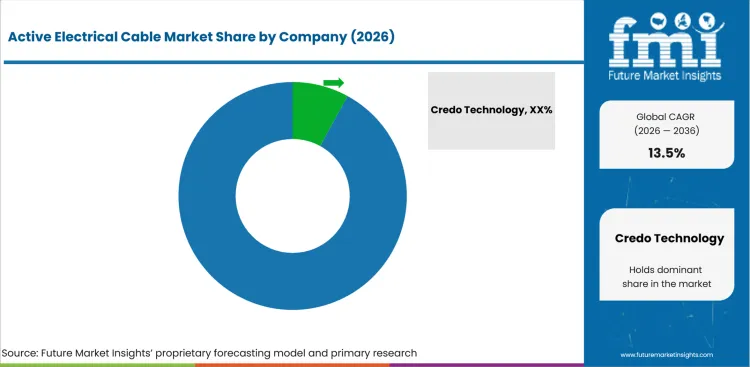
- Established interconnect companies hold an advantage led by manufacturing scale and cable assembly depth.
- Retimer and SerDes suppliers gain acceptance by improving reach and signal stability inside active cable assemblies.
- Regional suppliers win country opportunities through local stocking and data center integrator relationships.
- Platform-ready suppliers improve renewal chances through validated QSFP-DD and PCIe support.
Active electrical cable companies compete by combining connector engineering and cable manufacturing quality. Credo Technology has a strong position depending on HiWire AEC technology and retimer expertise. Amphenol competes through high-speed cable assembly breadth and global connector scale. Molex holds value through connector experience and data center design support.
Manufacturing quality and platform validation have become stronger competitive separators as AI clusters move beyond passive copper reach. Marvell competes through data infrastructure silicon and active electrical cable technology for 800G and 1.6T environments. Astera Labs strengthens competition through PCIe 6.0 smart cable modules and CXL-oriented connectivity. Buyers compare supplier performance through bit error rate and approved platform coverage.
Smaller and regional suppliers can win through fast field support and country-level data center relationships. China, India, and South Korea create opportunities for suppliers operating through system integrators and cloud build partners. United States and Europe create stronger demand for validated cable families suited to AI rack refreshes. Companies proving signal integrity across changing platform generations should gain more durable buyer relationships.
How do top Active Electrical Cable companies compare?
Credo Technology and Marvell score on retimer depth while Amphenol and Molex lead through cable assembly and connector scale.
| Company | Relevance to Market Title | Cable Portfolio Depth | Signal Integrity Strength | Platform Validation Support | Channel Reach | Geographic Footprint |
|---|---|---|---|---|---|---|
| Credo Technology | Very High | Strong | Very Strong | Very Strong | Strong | Global |
| Amphenol | Very High | Very Strong | Strong | Strong | Very Strong | Global |
| Molex | Very High | Very Strong | Strong | Strong | Very Strong | Global |
| Marvell | Very High | Moderate | Very Strong | Strong | Strong | Global |
| Astera Labs | High | Moderate | Very Strong | Strong | Strong | Global |
| TE Connectivity | High | Strong | Moderate | Moderate | Very Strong | Global |
| Samtec | High | Strong | Moderate | Moderate | Strong | Global |
| Broadcom | High | Moderate | Very Strong | Strong | Very Strong | Global |
| NVIDIA | Moderate to High | Moderate | Strong | Very Strong | Very Strong | Global |
| Luxshare Precision | High | Strong | Moderate | Moderate | Strong | Asia and global |
Source: Future Market Insights competitive analysis, 2026.
Who are the key players in the Active Electrical Cable Market?
Credo Technology, Amphenol, and Molex are listed with Marvell and Astera Labs among other suppliers.
Key global companies leading the Active Electrical Cable Market include:
- Credo Technology
- Amphenol
- Molex
- Marvell
- Astera Labs
- TE Connectivity
- Samtec
- Broadcom
- NVIDIA
- Luxshare Precision
Key Developments in Active Electrical Cable Market
- In September 2024, Credo introduced HiWire Shift AECs for 400G Q112 network ports in China, supporting AI/ML backend network requirements.
- In October 2025, Marvell highlighted 800G / 1.6T AEC technology for AI scale-up and scale-out at OCP Global Summit.
- In February 2026, Astera Labs introduced Aries Smart Cable Modules for PCIe 6.0, extending active copper reach for multi-rack AI clusters.
Key Players in the Active Electrical Cable Market
Cable and Connector Leaders
- Amphenol
- Molex
- TE Connectivity
- Samtec
AEC and Retimer Specialists
- Credo Technology
- Marvell
- Astera Labs
- Broadcom
Platform and Manufacturing Ecosystem Players
- NVIDIA
- Luxshare Precision
- Local data center cable assembly partners
PCIe and AI Cluster Specialists
- Astera Labs
- Credo Technology
- Marvell
- Broadcom
Active Electrical Cable Market - Scope & Definition
| Attribute | Detail |
|---|---|
| Market Definition | High-speed copper cable assemblies using active signal-conditioning electronics such as retimers, linear drivers, or embedded monitoring components for data transmission inside AI, cloud, enterprise, and telecom data center systems |
| Functions Covered | Signal conditioning, retiming, link extension, high-speed data transmission, connector conversion, rack-level cable routing, telemetry support, and platform-level validation |
| Applications Covered | Switch-to-server links, GPU rack connectivity, NIC-to-switch routes, storage network links, cloud data center cabling, AI cluster cabling, and telecom edge interconnects |
| End-Use Industries | AI infrastructure, high-performance computing, cloud data centers, enterprise IT, telecom edge networks, hyperscale platforms, and colocation facilities |
| Grades Covered | Standard active copper assemblies, retimed cables, linear-drive cables, 800G AECs, 1.6T AECs, OSFP-based assemblies, QSFP-DD-based assemblies, and PCIe smart cable modules |
| Inclusions | All commercially traded active electrical cables across cable type, speed, end use, connector, sales channel, and country-level data center use |
| Exclusions | Passive DACs, active optical cables, optical transceivers, fiber patch cords, power distribution cables, copper power busbars, general Ethernet patch cables, and internal board-level connector assemblies |
Active Electrical Cable Market - Research Methodology
| Method | Description |
|---|---|
| Primary Research | FMI analyst interviews with data center architects, high-speed cable suppliers, hyperscale infrastructure teams, server OEMs, connector specialists, retimer developers, and system integrators across selected markets |
| Desk Research | Review of official data center energy studies, public AI infrastructure policy material, company product pages, standards-body references, connector ecosystem documents, and country-level facility capacity evidence |
| Market Sizing & Forecasting | Bottom-up equipment revenue approach using active cable shipment estimates, average selling prices, speed mix, connector preference, end-use adoption, and channel control across data center buyers |
| Data Validation | Cross-verification using company portfolios, official energy statistics, AI compute capacity evidence, hyperscale platform signals, connector roadmaps, and country-level data center expansion indicators |
Active Electrical Cable Market - Report Scope
| Parameter | Details |
|---|---|
| Forecast period | 2026 to 2036 |
| Historical period | 2021 to 2025 |
| Quantitative unit | Revenue in USD million |
| By cable type | Active Copper Cables, Active Electrical Cables for AI Clusters, Retimed Cables, Linear-drive Cables |
| By speed | 100G / 200G, 400G, 800G, 1.6T and Above |
| By end use | AI / HPC Clusters, Cloud Data Centers, Enterprise Data Centers, Telecom Edge |
| By connector | QSFP-DD, OSFP, SFP / Other |
| By sales channel | Direct OEM, Distributors, ODM / White-label |
| Regions covered | North America, Latin America, Europe, East Asia, South Asia and Pacific, Middle East and Africa |
| Countries covered | China, India, United States, South Korea, France, United Kingdom, Japan, Germany |
| Key companies profiled | Credo Technology, Amphenol, Molex, Marvell, Astera Labs, TE Connectivity, Samtec, Broadcom, NVIDIA, Luxshare Precision |
| Approach | Bottom-up equipment revenue approach using cable shipments, average system pricing, speed transition, connector mix, channel structure, and country-level AI data center exposure |
Source: Future Market Insights competitive analysis, 2026.
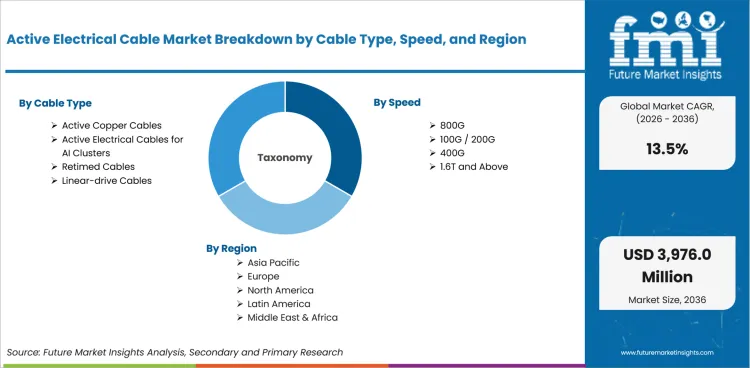
Active Electrical Cable Market Breakdown by Cable Type, Speed, End Use, Connector, Sales Channel, and Region
Active Electrical Cable Market Segmented by Cable Type
- Active Copper Cables
- Active Electrical Cables for AI Clusters
- Retimed Cables
- Linear-drive Cables
Active Electrical Cable Market Segmented by Speed
- 100G / 200G
- 400G
- 800G
- 1.6T and Above
Active Electrical Cable Market Segmented by End Use
- AI / HPC Clusters
- Cloud Data Centers
- Enterprise Data Centers
- Telecom Edge
Active Electrical Cable Market Segmented by Connector
- QSFP-DD
- OSFP
- SFP / Other
Active Electrical Cable Market Segmented by Sales Channel
- Direct OEM
- Distributors
- ODM / White-label
Active Electrical Cable Market by Region
- North America
- Latin America
- Europe
- East Asia
- South Asia and Pacific
- Middle East and Africa
Research Sources and Bibliography
- Astera Labs. (2026, February). Introducing Aries Smart Cable Modules for PCIe 6.
- Bitkom. (2025, November 10). Data centers in Germany: AI drives expansion.
- Credo Technology Group Holding Ltd. (2024, September 10). Credo introduces new HiWire Shift AECs to support 400G Q112 network ports for growing AI/ML backend networks in China.
- European Commission. (2026, June). Cloud computing: Cloud and AI Development Act.
- European Investment Bank. (2025, December 4). EIB Group and European Commission join forces to finance AI gigafactories.
- Federal Energy Regulatory Commission. (2026, June 18). Fact sheet: FERC takes action to support grid efficiency, reliability, and security.
- Federal Ministry for Economic Affairs and Climate Action. (2025). Status and development of the German data center landscape: Executive summary.
- Government of China. (2024, July 7). China beefs up computing power as new economic catalyst.
- Government of China. (2024, July 24). China sets green targets for data centers.
- Government of China. (2025, November 8). Carbon peaking and carbon neutrality: China’s plans and solutions.
- Government of the United Kingdom. (2025, November 13). Delivering AI Growth Zones.
- International Energy Agency. (2026, April 16). Data center electricity use surged in 2025, even with tightening bottlenecks driving a scramble for solutions.
- Lawrence Berkeley National Laboratory. (2024, December). 2024 United States Data Center Energy Usage Report.
- Marvell Technology, Inc. (2025, October 7). Marvell to highlight next-generation accelerated infrastructure at 2025 OCP Global Summit.
- Ministry of Electronics and Information Technology. (2026, March 13). Data center capacity in the country has increased from about 375 MW in 2020 to around 1,500 MW by 2025. Press Information Bureau.
- Ministry of Electronics and Information Technology. (2026, March 25). Government supporting organisations and consortia to develop indigenous AI solutions. Press Information Bureau.
- Ministry of Jal Shakti. (2026, March 30). Water consumption by data centers in the country. Press Information Bureau.
- Ministry of Science and ICT. (2025). MSIT launches KRW 400 billion K-Cloud R&D project based on domestic AI semiconductors.
- Ministry of Science and ICT. (2025). GPU procurement project selects participants.
- Ministry of Science and ICT. (2025). Development of pioneering AI-semiconductor-based data center technologies.
- National Institute of Advanced Industrial Science and Technology. (2025). Computing resource: ABCI 3.0.
- OECD. (2025). Measuring domestic public cloud compute availability for artificial intelligence.
- Presidency of the French Republic. (2025, February 11). Make France an AI powerhouse.
- USA Department of Energy. (2024, December 20). DOE releases new report evaluating increase in electricity demand from data centers.
- International Energy Agency. (2025, April 10). Energy and AI. International Energy Agency.
This bibliography is provided for reader reference and is not exhaustive. The full report contains the complete reference list and detailed citations.
This Report Answers
- Market size estimates for 2026 and forecasts through 2036 for the Active Electrical Cable Market.
- Insights across regional and country-level active electrical cable demand.
- Analysis of demand drivers and purchasing behavior.
- Evaluation of cable types, speeds, end uses, connectors, and sales channels.
- Assessment of AI rack density and high-speed copper qualification needs.
- Identification of opportunities across 800G along with 1.6T, and PCIe 6 active cable programs.
- Evaluation of Direct OEM models and distributor-led replacement channels.
- Country-level analysis covering China, India, United States, South Korea, France, United Kingdom, Japan, and Germany.
- Assessment of competition, including leading interconnect suppliers and retimer specialists.
- Analysis of rack-level decision drivers and service criteria.
- Regional outlooks across North America, Europe, East Asia, South Asia and Pacific, Latin America, and Middle East and Africa.
- Delivery of market data, forecasts, and supporting analysis in report-ready format.
Frequently Asked Questions
What is the growth prospect for active electrical cables?
Demand for active electrical cables is expected to rise at a considerable pace as AI racks need short-reach high-speed links beyond passive copper limits.
Which companies are expected to shape the active electrical cable market?
Credo Technology, Amphenol, Molex, Marvell, Astera Labs, TE Connectivity, Samtec, and Broadcom are expected to shape market competition depending on retimer expertise and platform validation.
Why are data center suppliers investing in active electrical cables?
Data center suppliers are investing in active electrical cables to support AI clusters managing 800G, 1.6T, PCIe 6, and dense switch-to-server connectivity.
Why are Direct OEM sales channels important in the active electrical cable market?
Direct OEM sales channels support platform qualification and repeat supply across approved rack designs.
Which cable formats are gaining attention in active electrical cables?
Active copper cables and PCIe smart cable modules are gaining attention as buyers target short-reach links with stable signal quality.
How does AI infrastructure influence active electrical cable demand?
AI infrastructure influences demand through high port density and stricter signal-integrity requirements near GPU servers.
Why is connector type important for active electrical cables?
Connector type is important since OSFP and QSFP-DD formats define thermal behavior and platform compatibility.
What role does Direct OEM play in active electrical cable adoption?
Direct OEM supports adoption by combining engineering documentation and after-sales troubleshooting.
Preview the report firsthand - request a free sample
Get SampleGet the brochure for pricing and purchase details.
Get PDFTable of Content
- Key Takeaways
- Market Size and CAGR
- Top Growth Driver
- Fastest Growing Segment
- Leading Region
- Key Companies
- Emerging Opportunities
- Executive Summary
- Global Market Outlook
- Demand-side Trends
- Supply-side Trends
- Technology Roadmap Analysis
- Analysis and Recommendations
- Analyst Perspective (What is happening? Why now? What should investors know?)
- Key Questions Answered
- How large is the market?
- What is the CAGR?
- What are key trends?
- Which region dominates?
- Who are the leaders?
- Market Overview
- Market Coverage / Taxonomy
- Market Definition / Scope / Limitations
- Research Methodology
- Chapter Orientation
- Analytical Lens and Working Hypotheses
- Market Structure, Signals, and Trend Drivers
- Benchmarking and Cross-market Comparability
- Market Sizing, Forecasting, and Opportunity Mapping
- Research Design and Evidence Framework
- Desk Research Programme (Secondary Evidence)
- Expert Input and Fieldwork (Primary Evidence)
- Tooling, Models, and Reference Databases
- Data Engineering and Model Build
- Quality Assurance and Audit Trail
- Market Background
- Market Dynamics (Drivers, Restraints, Opportunity, Trends)
- Scenario Forecast (Optimistic, Likely, Conservative)
- Impact Analysis
- AI Impact
- Sustainability Impact
- Regulatory Impact
- Technology Impact
- Consumer / Buyer Analysis
- Purchase Drivers
- Adoption Barriers
- Buyer Journey
- Opportunity Map Analysis
- Product Life Cycle Analysis
- Supply Chain Analysis
- Investment Feasibility Matrix
- Value Chain Analysis
- PESTLE and Porter's Analysis
- Regulatory Landscape
- Regional Parent Market Outlook
- Production and Consumption Statistics
- Import and Export Statistics
- Global Market Analysis and Forecast, 2021 to 2036
- Historical Market Size Value (USD Million) & Volume (Unit) Analysis, 2021 to 2025
- Current and Future Market Size Value (USD Million) & Volume (Unit) Projections, 2026 to 2036
- Y-o-Y Growth Trend Analysis
- Absolute $ Opportunity Analysis
- Global Market Pricing Analysis, 2021 to 2036
- Global Market Analysis and Forecast, By Cable Type, 2021 to 2036
- Introduction / Key Findings
- Historical Market Size Value (USD Million) & Volume (Unit) Analysis By Cable Type, 2021 to 2025
- Current and Future Market Size Value (USD Million) & Volume (Unit) Analysis and Forecast By Cable Type, 2026 to 2036
- Active Copper Cables
- Active Electrical Cables for AI Clusters
- Retimed Cables
- Linear-drive Cables
- Active Copper Cables
- Y-o-Y Growth Trend Analysis By Cable Type, 2021 to 2025
- Absolute $ Opportunity Analysis By Cable Type, 2026 to 2036
- Global Market Analysis and Forecast, By Speed, 2021 to 2036
- Introduction / Key Findings
- Historical Market Size Value (USD Million) & Volume (Unit) Analysis By Speed, 2021 to 2025
- Current and Future Market Size Value (USD Million) & Volume (Unit) Analysis and Forecast By Speed, 2026 to 2036
- 800G
- 100G / 200G
- 400G
- 1.6T and Above
- 800G
- Y-o-Y Growth Trend Analysis By Speed, 2021 to 2025
- Absolute $ Opportunity Analysis By Speed, 2026 to 2036
- Global Market Analysis and Forecast, By End Use, 2021 to 2036
- Introduction / Key Findings
- Historical Market Size Value (USD Million) & Volume (Unit) Analysis By End Use, 2021 to 2025
- Current and Future Market Size Value (USD Million) & Volume (Unit) Analysis and Forecast By End Use, 2026 to 2036
- AI / HPC Clusters
- Cloud Data Centers
- Enterprise Data Centers
- Telecom Edge
- AI / HPC Clusters
- Y-o-Y Growth Trend Analysis By End Use, 2021 to 2025
- Absolute $ Opportunity Analysis By End Use, 2026 to 2036
- Global Market Analysis and Forecast, By Connector, 2021 to 2036
- Introduction / Key Findings
- Historical Market Size Value (USD Million) & Volume (Unit) Analysis By Connector, 2021 to 2025
- Current and Future Market Size Value (USD Million) & Volume (Unit) Analysis and Forecast By Connector, 2026 to 2036
- OSFP
- SFP / Other
- QSFP-DD
- OSFP
- Y-o-Y Growth Trend Analysis By Connector, 2021 to 2025
- Absolute $ Opportunity Analysis By Connector, 2026 to 2036
- Global Market Analysis and Forecast, By Sales Channel, 2021 to 2036
- Introduction / Key Findings
- Historical Market Size Value (USD Million) & Volume (Unit) Analysis By Sales Channel, 2021 to 2025
- Current and Future Market Size Value (USD Million) & Volume (Unit) Analysis and Forecast By Sales Channel, 2026 to 2036
- Direct OEM
- Distributors
- ODM / White-label
- Direct OEM
- Y-o-Y Growth Trend Analysis By Sales Channel, 2021 to 2025
- Absolute $ Opportunity Analysis By Sales Channel, 2026 to 2036
- Global Market Analysis and Forecast, By Region, 2021 to 2036
- Introduction
- Historical Market Size Value (USD Million) & Volume (Unit) Analysis By Region, 2021 to 2025
- Current Market Size Value (USD Million) & Volume (Unit) Analysis and Forecast By Region, 2026 to 2036
- North America
- Latin America
- Western Europe
- Eastern Europe
- East Asia
- South Asia and Pacific
- Middle East & Africa
- Market Attractiveness Analysis By Region
- North America Market Analysis and Forecast, By Country, 2021 to 2036
- Historical Market Size Value (USD Million) & Volume (Unit) Trend Analysis By Market Taxonomy, 2021 to 2025
- Market Size Value (USD Million) & Volume (Unit) Forecast By Market Taxonomy, 2026 to 2036
- By Country
- USA
- Canada
- Mexico
- By Cable Type
- By Speed
- By End Use
- By Connector
- By Sales Channel
- By Country
- Market Attractiveness Analysis
- By Country
- By Cable Type
- By Speed
- By End Use
- By Connector
- By Sales Channel
- Key Takeaways
- Latin America Market Analysis and Forecast, By Country
- Historical Market Size Value (USD Million) & Volume (Unit) Trend Analysis By Market Taxonomy, 2021 to 2025
- Market Size Value (USD Million) & Volume (Unit) Forecast By Market Taxonomy, 2026 to 2036
- By Country
- Brazil
- Chile
- Rest of Latin America
- By Cable Type
- By Speed
- By End Use
- By Connector
- By Sales Channel
- By Country
- Market Attractiveness Analysis
- By Country
- By Cable Type
- By Speed
- By End Use
- By Connector
- By Sales Channel
- Key Takeaways
- Western Europe Market Analysis and Forecast, By Country
- Historical Market Size Value (USD Million) & Volume (Unit) Trend Analysis By Market Taxonomy, 2021 to 2025
- Market Size Value (USD Million) & Volume (Unit) Forecast By Market Taxonomy, 2026 to 2036
- By Country
- Germany
- UK
- Italy
- Spain
- France
- Nordic
- BENELUX
- Rest of Western Europe
- By Cable Type
- By Speed
- By End Use
- By Connector
- By Sales Channel
- By Country
- Market Attractiveness Analysis
- By Country
- By Cable Type
- By Speed
- By End Use
- By Connector
- By Sales Channel
- Key Takeaways
- Eastern Europe Market Analysis and Forecast, By Country
- Historical Market Size Value (USD Million) & Volume (Unit) Trend Analysis By Market Taxonomy, 2021 to 2025
- Market Size Value (USD Million) & Volume (Unit) Forecast By Market Taxonomy, 2026 to 2036
- By Country
- Russia
- Poland
- Hungary
- Balkan & Baltic
- Rest of Eastern Europe
- By Cable Type
- By Speed
- By End Use
- By Connector
- By Sales Channel
- By Country
- Market Attractiveness Analysis
- By Country
- By Cable Type
- By Speed
- By End Use
- By Connector
- By Sales Channel
- Key Takeaways
- East Asia Market Analysis and Forecast, By Country
- Historical Market Size Value (USD Million) & Volume (Unit) Trend Analysis By Market Taxonomy, 2021 to 2025
- Market Size Value (USD Million) & Volume (Unit) Forecast By Market Taxonomy, 2026 to 2036
- By Country
- China
- Japan
- South Korea
- By Cable Type
- By Speed
- By End Use
- By Connector
- By Sales Channel
- By Country
- Market Attractiveness Analysis
- By Country
- By Cable Type
- By Speed
- By End Use
- By Connector
- By Sales Channel
- Key Takeaways
- South Asia and Pacific Market Analysis and Forecast, By Country
- Historical Market Size Value (USD Million) & Volume (Unit) Trend Analysis By Market Taxonomy, 2021 to 2025
- Market Size Value (USD Million) & Volume (Unit) Forecast By Market Taxonomy, 2026 to 2036
- By Country
- India
- ASEAN
- Australia & New Zealand
- Rest of South Asia and Pacific
- By Cable Type
- By Speed
- By End Use
- By Connector
- By Sales Channel
- By Country
- Market Attractiveness Analysis
- By Country
- By Cable Type
- By Speed
- By End Use
- By Connector
- By Sales Channel
- Key Takeaways
- Middle East & Africa Market Analysis and Forecast, By Country
- Historical Market Size Value (USD Million) & Volume (Unit) Trend Analysis By Market Taxonomy, 2021 to 2025
- Market Size Value (USD Million) & Volume (Unit) Forecast By Market Taxonomy, 2026 to 2036
- By Country
- Kingdom of Saudi Arabia
- Other GCC Countries
- Türkiye
- South Africa
- Other African Union
- Rest of Middle East & Africa
- By Cable Type
- By Speed
- By End Use
- By Connector
- By Sales Channel
- By Country
- Market Attractiveness Analysis
- By Country
- By Cable Type
- By Speed
- By End Use
- By Connector
- By Sales Channel
- Key Takeaways
- Key Countries Market Analysis
- USA
- Pricing Analysis
- Market Share Analysis, 2025
- By Cable Type
- By Speed
- By End Use
- By Connector
- By Sales Channel
- Canada
- Pricing Analysis
- Market Share Analysis, 2025
- By Cable Type
- By Speed
- By End Use
- By Connector
- By Sales Channel
- Mexico
- Pricing Analysis
- Market Share Analysis, 2025
- By Cable Type
- By Speed
- By End Use
- By Connector
- By Sales Channel
- Brazil
- Pricing Analysis
- Market Share Analysis, 2025
- By Cable Type
- By Speed
- By End Use
- By Connector
- By Sales Channel
- Chile
- Pricing Analysis
- Market Share Analysis, 2025
- By Cable Type
- By Speed
- By End Use
- By Connector
- By Sales Channel
- Germany
- Pricing Analysis
- Market Share Analysis, 2025
- By Cable Type
- By Speed
- By End Use
- By Connector
- By Sales Channel
- UK
- Pricing Analysis
- Market Share Analysis, 2025
- By Cable Type
- By Speed
- By End Use
- By Connector
- By Sales Channel
- Italy
- Pricing Analysis
- Market Share Analysis, 2025
- By Cable Type
- By Speed
- By End Use
- By Connector
- By Sales Channel
- Spain
- Pricing Analysis
- Market Share Analysis, 2025
- By Cable Type
- By Speed
- By End Use
- By Connector
- By Sales Channel
- France
- Pricing Analysis
- Market Share Analysis, 2025
- By Cable Type
- By Speed
- By End Use
- By Connector
- By Sales Channel
- India
- Pricing Analysis
- Market Share Analysis, 2025
- By Cable Type
- By Speed
- By End Use
- By Connector
- By Sales Channel
- ASEAN
- Pricing Analysis
- Market Share Analysis, 2025
- By Cable Type
- By Speed
- By End Use
- By Connector
- By Sales Channel
- Australia & New Zealand
- Pricing Analysis
- Market Share Analysis, 2025
- By Cable Type
- By Speed
- By End Use
- By Connector
- By Sales Channel
- China
- Pricing Analysis
- Market Share Analysis, 2025
- By Cable Type
- By Speed
- By End Use
- By Connector
- By Sales Channel
- Japan
- Pricing Analysis
- Market Share Analysis, 2025
- By Cable Type
- By Speed
- By End Use
- By Connector
- By Sales Channel
- South Korea
- Pricing Analysis
- Market Share Analysis, 2025
- By Cable Type
- By Speed
- By End Use
- By Connector
- By Sales Channel
- Russia
- Pricing Analysis
- Market Share Analysis, 2025
- By Cable Type
- By Speed
- By End Use
- By Connector
- By Sales Channel
- Poland
- Pricing Analysis
- Market Share Analysis, 2025
- By Cable Type
- By Speed
- By End Use
- By Connector
- By Sales Channel
- Hungary
- Pricing Analysis
- Market Share Analysis, 2025
- By Cable Type
- By Speed
- By End Use
- By Connector
- By Sales Channel
- Kingdom of Saudi Arabia
- Pricing Analysis
- Market Share Analysis, 2025
- By Cable Type
- By Speed
- By End Use
- By Connector
- By Sales Channel
- Türkiye
- Pricing Analysis
- Market Share Analysis, 2025
- By Cable Type
- By Speed
- By End Use
- By Connector
- By Sales Channel
- South Africa
- Pricing Analysis
- Market Share Analysis, 2025
- By Cable Type
- By Speed
- By End Use
- By Connector
- By Sales Channel
- USA
- Market Structure Analysis
- Competition Dashboard
- Competition Benchmarking
- Market Share Analysis of Top Players
- By Regional
- By Cable Type
- By Speed
- By End Use
- By Connector
- By Sales Channel
- Emerging Startups
- Innovation Benchmarking
- Competition Analysis
- Competition Deep Dive
- Credo Technology
- Overview
- Product Portfolio
- Profitability by Market Segments (Product/Region/Sales Channel)
- Sales Footprint
- Strategy Overview
- Marketing Strategy
- Product Strategy
- Channel Strategy
- Amphenol
- Molex
- Marvell
- Astera Labs
- TE Connectivity
- Samtec
- Broadcom
- Credo Technology
- Case Studies
- Success Stories
- Recent Developments
- Competition Deep Dive
- Assumptions & Acronyms Used


