

- Industry Size (2026)
- USD 292.14 Mn
- Forecast (2036)
- USD 523.17 Mn
- CAGR (2026 to 2036)
- 6%
Adulteration Tester Market Size, Market Forecast and Outlook By FMI
The adulteration tester market was valued at USD 275.60 million in 2025, projected to reach USD 292.14 million in 2026, and is forecast to expand to USD 523.17 million by 2036 at a 6.0% CAGR.
Summary of Adulteration Tester Market
- By 2036, the market is projected to be worth USD 523.17 million.
- A 6.0% compound annual growth rate is anticipated between 2026 and 2036.
- Market size in 2025 was estimated at USD 275.60 million.
- An absolute dollar opportunity of USD 231.04 million is anticipated between 2026 and 2036.
- Milk leads by Product Type with 25.0% share in 2026, driven by persistent dairy supply chain adulteration risk.
- Food & Beverage Manufacturer leads by End-User with 60.0% share in 2026.
- Demand is driven by the global tightening of food safety enforcement and increasing food fraud incidents requiring adulteration detection at multiple supply chain points.
- Among key countries, China leads at 8.1% CAGR, followed by India at 7.5%, Germany at 6.9%, Brazil at 6.3%, the USA at 5.7%, the UK at 5.1%, and Japan at 4.5%.

Adulteration Tester Market Key Takeaways
| Metric | Details |
|---|---|
| Industry Size (2026) | USD 292.14 million |
| Industry Value (2036) | USD 523.17 million |
| CAGR (2026 to 2036) | 6% |
Source: Future Market Insights, 2026
FMI opines that the global tightening of food safety enforcement and the increasing frequency of food fraud incidents are driving sustained investment in adulteration detection instruments across both manufacturing quality assurance and regulatory inspection networks. Milk testing remains the largest single product category as dairy supply chain complexity and the economic incentive for dilution or substitution sustain persistent adulteration risk.
As per FMI, the instrument landscape is shifting from laboratory-only workflows toward portable, field-deployable testing devices that enable rapid screening at procurement points, processing facilities, and distribution checkpoints. Food and beverage manufacturers are embedding adulteration testing into their incoming raw material inspection protocols as retailer and regulatory audit requirements tighten. Regulatory bodies are expanding their testing infrastructure to cover a broader range of food categories, with meat authenticity, spice adulteration, and beverage quality testing receiving increased budgetary allocation.
China leads with an 8.1% CAGR, driven by food safety regulation enforcement expansion and domestic testing instrument manufacturing growth. India follows at 7.5%, supported by dairy sector adulteration control mandates and food safety authority capacity building. Germany advances at 6.9%, anchored by strict EU food fraud detection enforcement and laboratory accreditation requirements. Brazil records a 6.3% pace. The United States maintains a 5.7% trajectory, reflecting FSMA compliance-driven testing investment. The United Kingdom grows at 5.1%, while Japan records a 4.5% rate, supported by its rigorous food quality certification infrastructure.
Adulteration Tester Market Definition
Adulteration testers are analytical instruments designed to detect the presence of foreign substances, contaminants, and quality deviations in food and beverage products. These devices range from portable field-testing units for rapid screening to laboratory-grade instruments performing spectroscopic, chromatographic, and chemical analysis to identify adulteration in milk, meat, eggs, vegetables, fruits, tea, coffee, and carbonated beverages in compliance with food safety regulations.
Adulteration Tester Market Inclusions
Market scope covers adulteration testing instruments for milk, meat and eggs, vegetables, fruits, tea and coffee powder, carbonated drinks, and other food categories. The scope encompasses portable rapid-screening devices, benchtop analyzers, and laboratory-grade analytical instruments used by food and beverage manufacturers and regulatory bodies for quality assurance and compliance testing.
Adulteration Tester Market Exclusions
General-purpose laboratory spectroscopy and chromatography instruments not configured or marketed for food adulteration testing are excluded. The scope omits microbiological testing equipment, allergen testing kits, and packaging integrity testing devices that do not directly measure adulteration or compositional deviation.
Adulteration Tester Market Research Methodology
- Primary Research: Analysts engaged with procurement directors, operations managers, and technical specialists to identify decision-making triggers and specification requirements shaping purchasing cycles.
- Desk Research: Data collection aggregated regulatory documentation, industry standards publications, institutional procurement records, and publicly filed corporate disclosures.
- Market-Sizing and Forecasting: Baseline values derive from a bottom-up aggregation of product-level revenues, applying region-specific adoption curves and regulatory timeline adjustments to project future demand trajectories.
- Data Validation and Update Cycle: Projections are tested against publicly reported expenditure guidance from leading institutions and verified through cross-referencing primary interview outputs with secondary data sources.
Why is the Adulteration Tester Market Growing?
The Adulteration Tester Market is expanding steadily as food safety and quality assurance become critical priorities across global supply chains. Growing concerns regarding contamination, counterfeit ingredients, and deliberate adulteration of consumables have increased the adoption of advanced testing solutions. Regulatory frameworks focusing on consumer protection and stringent enforcement of food standards are further driving the demand.
In particular, the food and beverage sector has witnessed heightened scrutiny, prompting manufacturers to implement regular quality checks using technologically advanced adulteration testers. The shift toward automation and digitalization of testing systems is enhancing efficiency, enabling real-time analysis, and reducing dependency on manual procedures. Additionally, the rising consumption of packaged and processed food in both emerging and developed economies is amplifying the need for standardized safety checks at scale.
As consumer awareness regarding food integrity continues to grow, and governments enforce stricter compliance mandates, the adulteration tester market is expected to record sustained growth The future outlook is defined by innovation in portable and automated testing devices that promise accuracy, reliability, and user-friendly operation.
Segmental Analysis
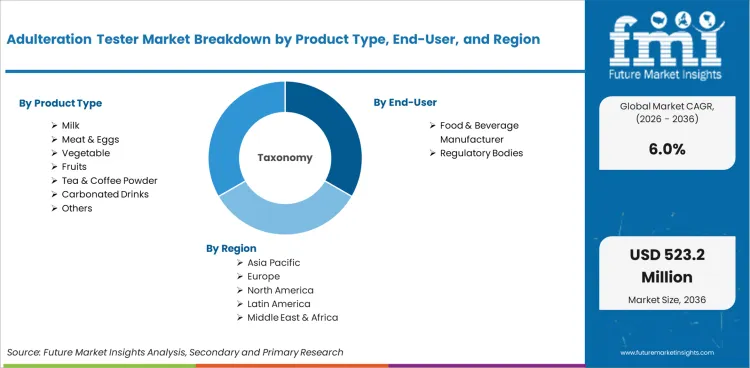
The adulteration tester market is segmented by product type, end-user, and geographic regions. By product type, adulteration tester market is divided into Milk, Meat & Eggs, Vegetable, Fruits, Tea & Coffee Powder, Carbonated Drinks, and Others.
In terms of end-user, adulteration tester market is classified into Food & Beverage Manufacturer and Regulatory Bodies. Regionally, the adulteration tester industry is classified into North America, Latin America, Western Europe, Eastern Europe, Balkan & Baltic Countries, Russia & Belarus, Central Asia, East Asia, South Asia & Pacific, and the Middle East & Africa.
Insights into the Milk Segment
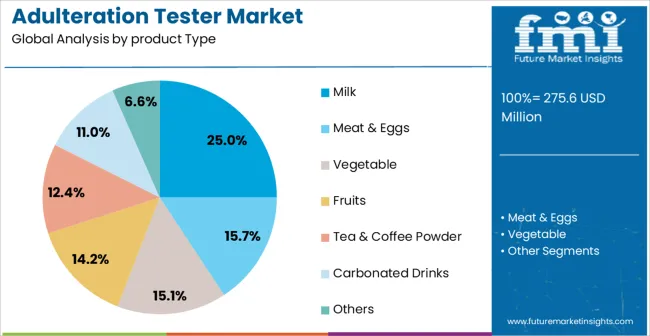
The Milk segment is projected to hold 25.00% of the overall revenue share of the Adulteration Tester Market in 2026, making it one of the leading product categories. The dominance of this segment is being driven by the widespread consumption of milk as a staple food and the recurring challenges associated with its adulteration. Instances of contamination with water, starch, detergents, and synthetic agents have necessitated stringent quality monitoring across the dairy value chain.
Governments and industry stakeholders have introduced mandatory testing protocols to ensure milk safety, leading to an increased deployment of specialized adulteration testers. The segment has benefited from the development of portable and easy-to-use testing devices that allow rapid identification of contaminants both at the production site and during distribution.
Rising consumer health concerns and increasing demand for pure dairy products are also reinforcing the importance of milk testing With dairy consumption expected to continue growing globally, the Milk segment is likely to maintain its significant share, supported by ongoing investments in testing technologies that enhance detection accuracy and reduce operational costs.
Insights into the Food and Beverage Manufacturer Segment
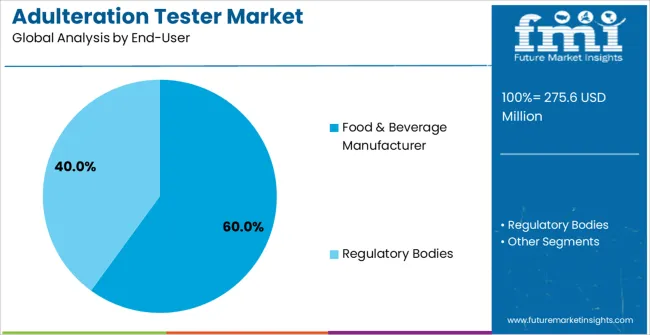
The Food and Beverage Manufacturer segment is estimated to account for 60.00% of the total revenue share of the Adulteration Tester Market in 2026, positioning it as the largest end-user category. This segment’s prominence is being supported by the pressing need for large-scale quality control systems in food processing plants, beverage production units, and packaging facilities. Manufacturers are under increasing pressure to comply with stringent national and international food safety regulations, which mandate regular and accurate adulteration testing to ensure product integrity.
The reliance on adulteration testers has been heightened by the risks of reputational damage and financial losses associated with recalls, legal actions, and consumer distrust. Integration of advanced testing technologies has allowed manufacturers to achieve higher throughput, real-time data analysis, and streamlined reporting for compliance audits.
Growing consumer demand for transparency and safety in food and beverage products has further strengthened the adoption of adulteration testers As the industry continues to globalize and supply chains expand, the Food and Beverage Manufacturer segment is expected to remain dominant, with adoption reinforced by the dual imperatives of regulatory compliance and brand protection.
Market Overview
Adulteration Tester Market: Overview
Adulteration is defined as the purposeful tempering of food & beverage with the intent of altering the test result to give positive output. In recent years, adulteration has become a serious issue in the food & beverages industry, globally.
Determination of adulteration in food & beverages is an important task, as it might cause serious health issues. Vendors are highly focused on the development of advanced adulteration tester to analyze the known and unknown food & beverage contamination.
The food integrity compendium performs testing of adulteration, authentication, and halal foods. Adulteration tester performs the test for various applications such as dyes, fruits, fish, honey, halal foods, spices, edible oil, beverages, and others.
Among all the applications of adulteration tester, milk adulteration tester is witnessing a significant demand from the end-consumers. Vendors are offering Do-it-Yourself (DIT) Kit for the test of milk adulteration. In adulteration tester market, three types of kits are available for milk adulteration tests, such as large kit, medium kit, and small kit.
Each kit has different testing capabilities such as in large kit is suitable for detection of Ammonia Fertilizers, Urea, Starch & Cereal Flours etc. Medium kits are suitable for the detection of salt, urea, sugar and starch; and small kits are suitable for the detection of Urea, Starch &Cereal Flours and neutralizers.
Analysis of Adulteration Tester Market By Key Countries
.webp "Top Country Growth Comparison Adulteration Tester Market Cagr (2026 2036)")
| Country | CAGR |
|---|---|
| China | 8.1% |
| India | 7.5% |
| Germany | 6.9% |
| Brazil | 6.3% |
| USA | 5.7% |
| UK | 5.1% |
| Japan | 4.5% |

Country-wise Analysis
The Adulteration Tester Market is expected to register a CAGR of 6.0% during the forecast period, exhibiting varied country level momentum. China leads with the highest CAGR of 8.1%, followed by India at 7.5%. Developed markets such as Germany, France, and the UK continue to expand steadily, while the USA is likely to grow at consistent rates.
Japan posts the lowest CAGR at 4.5%, yet still underscores a broadly positive trajectory for the global Adulteration Tester Market. In 2024, Germany held a dominant revenue in the Western Europe market and is expected to grow with a CAGR of 6.9%.
Key Players in the Adulteration Tester Market

- Thermo Fisher Scientific Inc.
- Everest Instruments Pvt. Ltd.
- Benny Impex
- Boekel Scientific
- Amaze Instruments
- Presto Group
- Thwing Albert
- Progen Scientificvvv
Scope of the Report
| Metric | Value |
|---|---|
| Quantitative Units | USD 292.14 million to USD 523.17 million, at a CAGR of 6% |
| Market Definition | Adulteration testers are analytical instruments designed to detect the presence of foreign substances, contaminants, and quality deviations in food and beverage products. These devices range from portable field-testing units for rapid screening to laboratory-grade instruments performing spectroscopic, chromatographic, and chemical analysis to identify adulteration in milk, meat, eggs, vegetables, fruits, tea, coffee, and carbonated beverages in compliance with food safety regulations. |
| Segmentation | Product Type: Milk, Meat & Eggs, Vegetable, Fruits, Tea & Coffee Powder, Carbonated Drinks, Others; End-User: Food & Beverage Manufacturer, Regulatory Bodies |
| Regions Covered | North America, Latin America, Europe, East Asia, South Asia, Oceania, Middle East & Africa |
| Countries Covered | China, India, Germany, Brazil, USA, UK, Japan, and 40 plus countries |
| Key Companies Profiled | Thermo Fisher Scientific Inc., Everest Instruments Pvt. Ltd., Benny Impex, Boekel Scientific, Amaze Instruments, Presto Group, Thwing Albert, Progen Scientific |
| Forecast Period | 2026 to 2036 |
| Approach | Forecasting models apply a bottom-up methodology starting with installed base metrics and project conversion rates, cross-validated against institutional expenditure guidance. |
Adulteration Tester Market by Segments
Product Type:
- Milk
- Meat & Eggs
- Vegetable
- Fruits
- Tea & Coffee Powder
- Carbonated Drinks
- Others
End-User:
- Food & Beverage Manufacturer
- Regulatory Bodies
Region:
- North America
- USA
- Canada
- Mexico
- Latin America
- Brazil
- Chile
- Rest of Latin America
- Western Europe
- Germany
- UK
- Italy
- Spain
- France
- Nordic
- BENELUX
- Rest of Western Europe
- Eastern Europe
- Russia
- Poland
- Hungary
- Balkan & Baltic
- Rest of Eastern Europe
- East Asia
- China
- Japan
- South Korea
- South Asia and Pacific
- India
- ASEAN
- Australia & New Zealand
- Rest of South Asia and Pacific
- Middle East & Africa
- Kingdom of Saudi Arabia
- Other GCC Countries
- Turkiye
- South Africa
- Other African Union
- Rest of Middle East & Africa
Bibliography
- World Health Organization. (2024). Food safety: key facts and global standards update. WHO.
- USA Food and Drug Administration. (2024). Food safety modernization act: preventive controls and testing requirements. FDA.
- European Commission. (2024). Official controls regulation (EU) 2017/625: food fraud detection and enforcement update. European Commission.
- Food and Agriculture Organization. (2024). Codex Alimentarius: methods of analysis for food adulteration. FAO.
- Organisation for Economic Co-operation and Development. (2024). Food chain analysis: traceability and authenticity testing. OECD.
- International Organization for Standardization. (2023). ISO 17025: General requirements for the competence of testing and calibration laboratories. ISO.
This bibliography is provided for reader reference. The full Future Market Insights report contains the complete reference list with primary research documentation.
Frequently Asked Questions
How large is the demand for Adulteration Testers in the global market in 2026?
Demand for Adulteration Testers in the global market is estimated to be valued at USD 292.14 million in 2026.
What will be the market size of Adulteration Testers by 2036?
Market size for Adulteration Testers is projected to reach USD 523.17 million by 2036.
What is the expected demand growth between 2026 and 2036?
Demand for Adulteration Testers is expected to grow at a CAGR of 6.0% between 2026 and 2036.
Which Product Type is poised to lead global sales by 2026?
Milk accounts for 25.0% share in 2026, driven by persistent dairy supply chain adulteration risk and regulatory testing mandates.
Which End-User leads the market in 2026?
Food & Beverage Manufacturer represents 60.0% of end-user share as quality assurance testing is embedded into incoming raw material inspection protocols.
What is driving demand in China?
Food safety regulation enforcement expansion and domestic testing instrument manufacturing growth are fueling demand in China at an 8.1% CAGR.
What is India's growth outlook?
India is projected to grow at a CAGR of 7.5% during 2026 to 2036.
What is included in the scope?
The market covers portable screening devices, benchtop analyzers, and laboratory-grade adulteration testing instruments for milk, meat, eggs, vegetables, fruits, tea, coffee, and carbonated drinks.
Preview the report firsthand - request a free sample
Get SampleGet the brochure for pricing and purchase details.
Get PDFTable of Content
- Executive Summary
- Global Market Outlook
- Demand-side Trends
- Supply-side Trends
- Technology Roadmap Analysis
- Analysis and Recommendations
- Research Methodology
- Chapter Orientation
- Analytical Lens and Working Hypotheses
- Market Structure, Signals, and Trend Drivers
- Benchmarking and Cross-market Comparability
- Market Sizing, Forecasting, and Opportunity Mapping
- Research Design and Evidence Framework
- Desk Research Programme (Secondary Evidence)
- Company Annual and Sustainability Reports
- Peer-reviewed Journals and Academic Literature
- Corporate Websites, Product Literature, and Technical Notes
- Earnings Decks and Investor Briefings
- Statutory Filings and Regulatory Disclosures
- Technical White Papers and Standards Notes
- Trade Journals, Industry Magazines, and Analyst Briefs
- Conference Proceedings, Webinars, and Seminar Materials
- Government Statistics Portals and Public Data Releases
- Press Releases and Reputable Media Coverage
- Specialist Newsletters and Curated Briefings
- Sector Databases and Reference Repositories
- FMI Internal Proprietary Databases and Historical Market Datasets
- Subscription Datasets and Paid Sources
- Social Channels, Communities, and Digital Listening Inputs
- Additional Desk Sources
- Social and Community Interactions
- Desk Research Programme (Secondary Evidence)
- Stakeholder Universe Engaged
- C-suite Leaders
- Board Members
- Presidents and Vice Presidents
- R&D and Innovation Heads
- Technical Specialists
- Domain Subject-matter Experts
- Scientists
- Physicians and Other Healthcare Professionals
- Governance, Ethics, and Data Stewardship
- Research Ethics
- Data Integrity and Handling
- Tooling, Models, and Reference Databases
- Data Engineering and Model Build
- Data Acquisition and Ingestion
- Cleaning, Normalisation, and Verification
- Synthesis, Triangulation, and Analysis
- Quality Assurance and Audit Trail
- Market Background
- Market Dynamics
- Drivers
- Restraints
- Opportunity
- Trends
- Scenario Forecast
- Demand in Optimistic Scenario
- Demand in Likely Scenario
- Demand in Conservative Scenario
- Opportunity Map Analysis
- Product Life Cycle Analysis
- Supply Chain Analysis
- Investment Feasibility Matrix
- Value Chain Analysis
- PESTLE and Porter’s Analysis
- Regulatory Landscape
- Regional Parent Market Outlook
- Production and Consumption Statistics
- Import and Export Statistics
- Market Dynamics
- Global Market Analysis 2021 to 2025 and Forecast, 2026 to 2036
- Historical Market Size Value (USD Million) Analysis, 2021 to 2025
- Current and Future Market Size Value (USD Million) Projections, 2026 to 2036
- Y-o-Y Growth Trend Analysis
- Absolute $ Opportunity Analysis
- Global Market Pricing Analysis 2021 to 2025 and Forecast 2026 to 2036
- Global Market Analysis 2021 to 2025 and Forecast 2026 to 2036, By Product Type
- Introduction / Key Findings
- Historical Market Size Value (USD Million) Analysis By Product Type , 2021 to 2025
- Current and Future Market Size Value (USD Million) Analysis and Forecast By Product Type , 2026 to 2036
- Milk
- Meat & Eggs
- Vegetable
- Fruits
- Tea & Coffee Powder
- Carbonated Drinks
- Others
- Milk
- Y-o-Y Growth Trend Analysis By Product Type , 2021 to 2025
- Absolute $ Opportunity Analysis By Product Type , 2026 to 2036
- Global Market Analysis 2021 to 2025 and Forecast 2026 to 2036, By End-User
- Introduction / Key Findings
- Historical Market Size Value (USD Million) Analysis By End-User, 2021 to 2025
- Current and Future Market Size Value (USD Million) Analysis and Forecast By End-User, 2026 to 2036
- Food & Beverage Manufacturer
- Regulatory Bodies
- Food & Beverage Manufacturer
- Y-o-Y Growth Trend Analysis By End-User, 2021 to 2025
- Absolute $ Opportunity Analysis By End-User, 2026 to 2036
- Global Market Analysis 2021 to 2025 and Forecast 2026 to 2036, By Region
- Introduction
- Historical Market Size Value (USD Million) Analysis By Region, 2021 to 2025
- Current Market Size Value (USD Million) Analysis and Forecast By Region, 2026 to 2036
- North America
- Latin America
- Western Europe
- Eastern Europe
- East Asia
- South Asia and Pacific
- Middle East & Africa
- Market Attractiveness Analysis By Region
- North America Market Analysis 2021 to 2025 and Forecast 2026 to 2036, By Country
- Historical Market Size Value (USD Million) Trend Analysis By Market Taxonomy, 2021 to 2025
- Market Size Value (USD Million) Forecast By Market Taxonomy, 2026 to 2036
- By Country
- USA
- Canada
- Mexico
- By Product Type
- By End-User
- By Country
- Market Attractiveness Analysis
- By Country
- By Product Type
- By End-User
- Key Takeaways
- Latin America Market Analysis 2021 to 2025 and Forecast 2026 to 2036, By Country
- Historical Market Size Value (USD Million) Trend Analysis By Market Taxonomy, 2021 to 2025
- Market Size Value (USD Million) Forecast By Market Taxonomy, 2026 to 2036
- By Country
- Brazil
- Chile
- Rest of Latin America
- By Product Type
- By End-User
- By Country
- Market Attractiveness Analysis
- By Country
- By Product Type
- By End-User
- Key Takeaways
- Western Europe Market Analysis 2021 to 2025 and Forecast 2026 to 2036, By Country
- Historical Market Size Value (USD Million) Trend Analysis By Market Taxonomy, 2021 to 2025
- Market Size Value (USD Million) Forecast By Market Taxonomy, 2026 to 2036
- By Country
- Germany
- UK
- Italy
- Spain
- France
- Nordic
- BENELUX
- Rest of Western Europe
- By Product Type
- By End-User
- By Country
- Market Attractiveness Analysis
- By Country
- By Product Type
- By End-User
- Key Takeaways
- Eastern Europe Market Analysis 2021 to 2025 and Forecast 2026 to 2036, By Country
- Historical Market Size Value (USD Million) Trend Analysis By Market Taxonomy, 2021 to 2025
- Market Size Value (USD Million) Forecast By Market Taxonomy, 2026 to 2036
- By Country
- Russia
- Poland
- Hungary
- Balkan & Baltic
- Rest of Eastern Europe
- By Product Type
- By End-User
- By Country
- Market Attractiveness Analysis
- By Country
- By Product Type
- By End-User
- Key Takeaways
- East Asia Market Analysis 2021 to 2025 and Forecast 2026 to 2036, By Country
- Historical Market Size Value (USD Million) Trend Analysis By Market Taxonomy, 2021 to 2025
- Market Size Value (USD Million) Forecast By Market Taxonomy, 2026 to 2036
- By Country
- China
- Japan
- South Korea
- By Product Type
- By End-User
- By Country
- Market Attractiveness Analysis
- By Country
- By Product Type
- By End-User
- Key Takeaways
- South Asia and Pacific Market Analysis 2021 to 2025 and Forecast 2026 to 2036, By Country
- Historical Market Size Value (USD Million) Trend Analysis By Market Taxonomy, 2021 to 2025
- Market Size Value (USD Million) Forecast By Market Taxonomy, 2026 to 2036
- By Country
- India
- ASEAN
- Australia & New Zealand
- Rest of South Asia and Pacific
- By Product Type
- By End-User
- By Country
- Market Attractiveness Analysis
- By Country
- By Product Type
- By End-User
- Key Takeaways
- Middle East & Africa Market Analysis 2021 to 2025 and Forecast 2026 to 2036, By Country
- Historical Market Size Value (USD Million) Trend Analysis By Market Taxonomy, 2021 to 2025
- Market Size Value (USD Million) Forecast By Market Taxonomy, 2026 to 2036
- By Country
- Kingdom of Saudi Arabia
- Other GCC Countries
- Turkiye
- South Africa
- Other African Union
- Rest of Middle East & Africa
- By Product Type
- By End-User
- By Country
- Market Attractiveness Analysis
- By Country
- By Product Type
- By End-User
- Key Takeaways
- Key Countries Market Analysis
- USA
- Pricing Analysis
- Market Share Analysis, 2025
- By Product Type
- By End-User
- Canada
- Pricing Analysis
- Market Share Analysis, 2025
- By Product Type
- By End-User
- Mexico
- Pricing Analysis
- Market Share Analysis, 2025
- By Product Type
- By End-User
- Brazil
- Pricing Analysis
- Market Share Analysis, 2025
- By Product Type
- By End-User
- Chile
- Pricing Analysis
- Market Share Analysis, 2025
- By Product Type
- By End-User
- Germany
- Pricing Analysis
- Market Share Analysis, 2025
- By Product Type
- By End-User
- UK
- Pricing Analysis
- Market Share Analysis, 2025
- By Product Type
- By End-User
- Italy
- Pricing Analysis
- Market Share Analysis, 2025
- By Product Type
- By End-User
- Spain
- Pricing Analysis
- Market Share Analysis, 2025
- By Product Type
- By End-User
- France
- Pricing Analysis
- Market Share Analysis, 2025
- By Product Type
- By End-User
- India
- Pricing Analysis
- Market Share Analysis, 2025
- By Product Type
- By End-User
- ASEAN
- Pricing Analysis
- Market Share Analysis, 2025
- By Product Type
- By End-User
- Australia & New Zealand
- Pricing Analysis
- Market Share Analysis, 2025
- By Product Type
- By End-User
- China
- Pricing Analysis
- Market Share Analysis, 2025
- By Product Type
- By End-User
- Japan
- Pricing Analysis
- Market Share Analysis, 2025
- By Product Type
- By End-User
- South Korea
- Pricing Analysis
- Market Share Analysis, 2025
- By Product Type
- By End-User
- Russia
- Pricing Analysis
- Market Share Analysis, 2025
- By Product Type
- By End-User
- Poland
- Pricing Analysis
- Market Share Analysis, 2025
- By Product Type
- By End-User
- Hungary
- Pricing Analysis
- Market Share Analysis, 2025
- By Product Type
- By End-User
- Kingdom of Saudi Arabia
- Pricing Analysis
- Market Share Analysis, 2025
- By Product Type
- By End-User
- Turkiye
- Pricing Analysis
- Market Share Analysis, 2025
- By Product Type
- By End-User
- South Africa
- Pricing Analysis
- Market Share Analysis, 2025
- By Product Type
- By End-User
- USA
- Market Structure Analysis
- Competition Dashboard
- Competition Benchmarking
- Market Share Analysis of Top Players
- By Regional
- By Product Type
- By End-User
- Competition Analysis
- Competition Deep Dive
- Thermo Fisher Scientific Inc.
- Overview
- Product Portfolio
- Profitability by Market Segments (Product/Age /Sales Channel/Region)
- Sales Footprint
- Strategy Overview
- Marketing Strategy
- Product Strategy
- Channel Strategy
- Everest Instruments Pvt. Ltd.
- Benny Impex
- Boekel Scientific
- Amaze Instruments
- Presto Group
- Thwing Albert
- Progen Scientificvvv
- Thermo Fisher Scientific Inc.
- Competition Deep Dive
- Assumptions & Acronyms Used


