

- Market Size (2026)
- USD 1.0 Bn
- Forecast (2036)
- USD 2.2 Bn
- CAGR (2026 to 2036)
- 8.3%
How big is Aerosol Contract Filling Services Market in 2026?
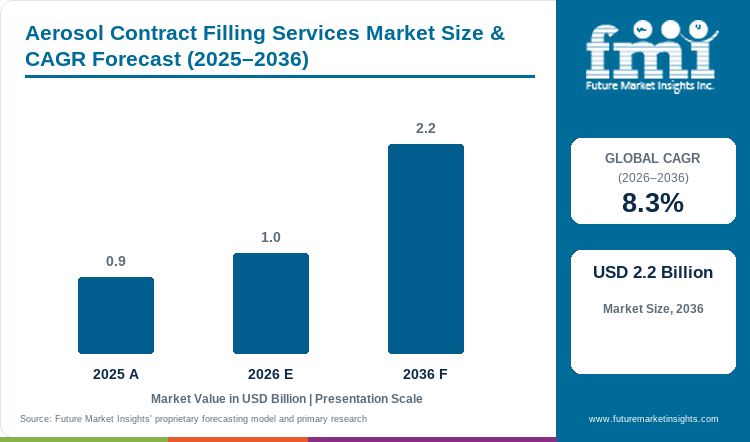
The aerosol contract filling services market is projected to expand at a CAGR of 8.3% through 2036, rising from USD 0.9 billion in 2025 to USD 1.0 billion in 2026 and reaching USD 2.2 billion by the end of the forecast period.
Aerosol contract filling services are becoming important among brands that do not have their own pressure filling facilities. The filling process begins with product mixing and moves to valve placement before gas is charged into the can. The cans are then tested for pack performance before final packing. This requirement is leading brands with smaller or irregular runs to use outside filling companies. The aerosol contract filling services market is expected to expand at 8.3% CAGR through 2036. In September 2025, FEA reported that more than 3.4 billion aerosols were produced in the EU during 2024. The high production of aerosols in the EU is expected to support outsourced work across personal care and household products. Brands are likely to select a filler based on open line time and batch control. The decision also depends on aerosol packaging needs.
Aerosol filling work is often placed near the supply of cans and technical services. These factors help brands move production without affecting the availability of pack components. In April 2026, BAMA reported that aluminium represented 67% of UK aerosol can material during 2025. This share is giving UK fillers a stable material base for several product categories. France has a similar advantage through its wider aerosol network. In March 2026, CFA reported 63 member companies across France's aerosol chain. The network connects fillers with brands and component suppliers. It also gives plants access to technical support when a pack issue arises. Such local support is expected to make contract packaging work easier during production transfers.
Key Takeaways
- Brands are likely to use specialist fillers to avoid underused pressure equipment. This also gives them flexible batch scheduling through 2036.
- By aerosol type, liquefied-gas aerosols are projected to account for 53.4% of demand in 2026.
- Conventional pressure filling is estimated to hold 48.0% of filling technology demand in 2026.
- Personal care and cosmetics are expected to lead end use with 31.0% share in 2026.
- Propellant restrictions can extend qualification work before a formula reaches commercial filling. Component changes can add to the same process.
- Aeropac and AERKO International / Shamrock Filling document direct aerosol-filling capability. Aerosol and Liquid Packaging and Chem-Pak also document direct capability.
Analyst Perspective
“Brand owners will gain flexibility as fillers combine formulation support with several propellant and valve options. Qualification will remain difficult where new propellants or components require separate line validation.”
- Nandini Roy Choudhury, Principal Consultant, Future Market Insights.
How is the aerosol contract filling services market segmented?
Aerosol Contract Filling Services Market is segmented by aerosol type, filling technology, capacity range, end use, and region. Liquefied-gas aerosols are expected to hold 53.4% of aerosol type demand in 2026. Conventional pressure filling is estimated to represent 48.0% of filling technology demand. The 151-300 ml range is projected at 42.6% of capacity range demand, while personal care and cosmetics are expected to hold 31.0% of end use demand.
Aerosol contract filling services market is segmented by aerosol type and filling technology. Capacity range and end use are also evaluated. The analysis also covers region.
Regional analysis is carried out separately to understand the market demand across different countries.
Aerosol type covers liquefied-gas aerosols and compressed-gas aerosols. Bag-on-valve and other formats are also included.
Filling technology covers conventional pressure filling and bag-on-valve filling. Crimping and valve assembly are also included. Aseptic and pharma aerosol filling forms another category.
Capacity range covers packs up to 150 ml and packs from 151-300 ml. The 301-500 ml range is also included. Capacity above 500 ml forms the remaining range.
End use covers pharmaceuticals and automotive. Household and institutional use is also included. Personal care and cosmetics form another end-use category. Other end uses are part of the market as well.
Region covers North America and Latin America. It also covers Western and Eastern Europe. East Asia and South Asia and Pacific are included. Middle East and Africa form another regional category.
Why do liquefied-gas aerosols hold the aerosol type position?
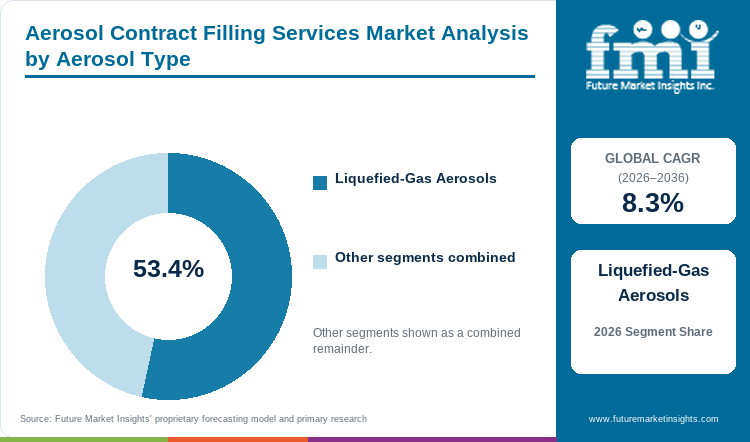
Liquefied-gas aerosols are expected to hold 53.4% of aerosol type demand in 2026, supported by stable dispensing pressure across formulations.
Liquefied-gas aerosols maintain pressure while the product is being dispensed. The propellant remains partly in liquid form inside the can. It replaces the gas released as the product is sprayed. This helps in maintaining spray performance until the can is empty. Such pressure control is making liquefied-gas aerosols suitable for personal care and household products. Fillers check the formula with the can and propellant before commercial production. The aerosol valves are checked with the same pack system. A change in one component can affect pressure or spray output. This can increase qualification work before a long production run begins. Established component combinations are expected to remain preferred through 2036 because they reduce the difficulty of line changeovers.
- Liquefied-gas aerosols are projected to account for 53.4% in 2026. Stable pressure and broad formulation use are supporting the segment.
- In September 2025, FEA stated that cosmetics and household products represented two-thirds of EU aerosol production during 2024.
What keeps conventional pressure filling central to filling technology?
Conventional pressure filling is estimated to represent 48.0% of filling technology demand in 2026, reflecting efficient high-speed recurring production.
Conventional pressure filling is used when the formula and pack components have already been qualified. The product is filled into the can before the valve is placed and crimped. Propellant is then added on the filling line. This process allows fillers to run recurring programs on established equipment. Chem-Pak states that its high-speed aerosol line can run up to 100 cans per minute. Aeropac reports capacity above 30,000 aerosols per day across its sites. Such capacity is expected to support high-volume programs where the approved formula can be repeated. The bag-on-valve systems follow a different process because the pack needs separate parts. Fillers are likely to use other equipment when pouch setup or leak testing is required.
- Conventional pressure filling is estimated to hold 48.0% in 2026. Its fit with repeatable high-speed production is supporting this share.
- Current filler capability pages show dedicated high-speed lines alongside flexible lines for specialty formulas and nonstandard component combinations.
Why does the 151-300 ml range lead capacity demand?
With 42.6% expected in 2026, the 151-300 ml range will lead capacity range demand through broad cross-category pack compatibility.
The 151-300 ml range sits between travel packs and larger industrial cans. This size is used across personal care and household products. Maintenance products also use the same capacity range. The pack fits conveyors and cartons that are already used for many aerosol programs. It can also work with standard valves and packing systems. This reduces the equipment changes needed between jobs. Aeropac lists can sizes from 50 ml to 750 ml. Mid-size orders can share equipment with nearby formats. Standard aluminum aerosol cans give brands a familiar pressure pack for retail use. This compatibility is expected to keep the 151-300 ml range important through 2036.
- The 151-300 ml segment is expected to lead capacity range with 42.6% share in 2026. Broad pack use across categories is supporting this position.
- Mid-size cans support line speed because they fit existing conveyors and cartons. They can also work with standard valves and packing systems.
How does personal care and cosmetics shape end-use demand?
Personal care and cosmetics are projected to command 31.0% of end use demand in 2026, underpinned by recurring high-volume programs.
Personal care and cosmetics are creating repeat filling work for deodorants and hair sprays. Shaving products add further demand from the same sector. These products need consistent spray performance before they reach the market. Their pack appearance also needs to remain the same across each production run. Brands are using specialist fillers when in-house aerosol capacity is limited. In September 2025, FEA reported that personal care represented 47.8% of EU aerosol production in 2024. This large base is expected to support outsourced filling demand through 2036. The repeat business is supported by personal care packaging. New product launches can create transfers when additional qualified capacity is needed.
- Personal care and cosmetics are expected to lead end use with 31.0% share in 2026. Frequent repeat filling is supporting this position.
- BAMA reported in April 2026 that personal care remained the dominant UK aerosol filling sector during 2025.
What are the drivers, restraints and opportunities in the Aerosol Contract Filling Services Market?
In the aerosol contract filling services market, Driver: outsourcing will keep giving brands specialized pressure-filling access; Restraint: propellant and component compliance will continue extending qualification work; Opportunity: bag-on-valve and compressed-gas formats will open specialized filling programs.
- Driver: Outsourcing gives brands access to dedicated aerosol equipment and formulation support. It also gives them flexible production without owning every filling asset.
- Restraint: Propellant restrictions and valve compatibility can delay commercial filling. Line validation can extend the process after formula approval.
- Opportunity: Bag-on-valve and compressed-gas formats can create specialized work for fillers. Controlled charging and component qualification are needed for these programs.
Brands use contract fillers when they need aerosol lines but cannot keep the equipment fully utilized. The filler carries out gas charging and crimping within the same production process. Batch records are kept while final packing is completed. This gives brands access to specialist capacity without losing control over each batch. In May 2026, HCPA released its tenth Aerosol Guide with updated voluntary standards and test methods. The guide supports documented practices across customer programs. Pharmaceutical packaging also shows why clear records are important in outsourced filling work. Brands are likely to choose fillers that can add line time while keeping batch control in place. This requirement is expected to support contract filling demand through 2036.
Propellant regulations are increasing qualification work even when a filling line has open capacity. The European Commission updated its F-gas guidance for products and equipment in May 2025. Personal care products using fluorinated greenhouse gases have faced limits since January 2025 under Regulation (EU) 2024/573. A new gas can change pressure inside the pack. Brands then need stability tests before the product is released. The spray caps can also affect spray feel when pack components are changed. Late changes can push validation into a production period that is already booked. These requirements are likely to slow transfers involving new propellants or pack parts.
Bag-on-valve and compressed-gas formats are gaining prominence as brands seek less contact between product and gas. Controlled gas charging is needed before these packs can be released. Reliable leak checks are required during filling as well. Aeropac and AERKO International / Shamrock Filling document bag-on-valve work. Aerosol and Liquid Packaging also lists this service. In July 2026, Cortec documented an air-powered bag-on-valve product for Tool & Die Rust Preventative. Demand for bag-on-valve laminates is supporting the component supply chain for these packs. Fillers with controlled processes are expected to gain work from specialty programs through 2036. Flexible changeovers will remain important as more programs move to outside plants.
Which country CAGRs are profiled in the Aerosol Contract Filling Services Market?
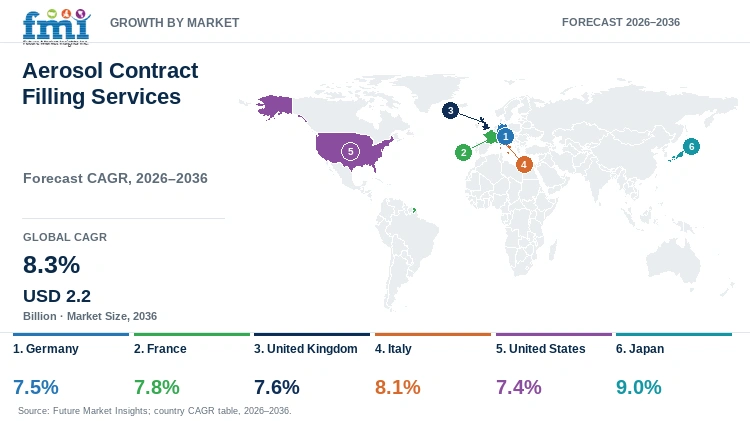
| Country | CAGR |
|---|---|
| Germany | 7.5% |
| France | 7.8% |
| United Kingdom | 7.6% |
| Italy | 8.1% |
| United States | 7.4% |
| Japan | 9.0% |
How do country-level CAGRs compare in the Aerosol Contract Filling Services Market?
Country growth is expected to range from 7.4% to 9.0% through 2036. The service opportunity differs because each country has a different production mix. Outsourcing depth also differs from one market to another. Regulation and filling networks further influence the forecast. Germany and France are forecast within a 7.5% to 8.1% range. The United Kingdom and Italy are also forecast within this range. Japan is projected at 9.0%, while the United States is projected at 7.4%. These rates show expected market growth. They do not show current service revenue.
- Germany fillers are supported by high aerosol output and established personal care programs. A mature component supply network also supports production.
- France's aerosol chain connects fillers with brands and component suppliers. Material firms and technology providers are also part of the chain. Specialized service companies support the market as well.
- United Kingdom fillers are managing a mature personal care base. Household demand and production scheduling are changing at the same time.
- Italy's suppliers link contract filling with domestic propellant and component capabilities. They also provide machinery and packaging. Finished-product capabilities are part of the aerosol chain as well.
- United States fillers are managing product-specific propellant rules during production transfers. Technical qualification is becoming more important for these programs.
- Japan's aerosol industry relies heavily on specialist contract filling. Safety controls are shaping the production and handling of pressurized packs.
Similar country growth rates can still create different requirements for contract fillers. Plant scale and product mix differ from one country to another. Qualification routes also vary across the market. The full report covers North America and Latin America. It also covers Western and Eastern Europe. East Asia is included in the report. South Asia and Pacific are also covered. Middle East and Africa form part of the report as well.
Country-wise Analysis
- Germany is forecast to grow at 7.5% CAGR through 2036 because it has a large aerosol production base. IGA reported that 934 million aerosols were produced in Germany during 2025. Personal care accounted for 609 million units. This volume is supporting demand for cans and valves. It is also supporting packing work and filling capacity. Product groups are moving at different rates across the country. Plants therefore need flexible schedules for different campaigns. Fillers that reduce cleaning time are expected to take on program changes more easily.
- France is projected to grow at 7.8% CAGR through 2036 because its aerosol chain links several local suppliers. In March 2026, more than 50 members attended the Comité Français des Aérosols annual general meeting. The association connects fillers with brands and technical service teams. Can makers and valve firms are also part of the group. This network helps fillers resolve pack issues before a transfer is scheduled. Requirements can change with the formula or gas used in the product. They can also change with the pack design. Providers with close supplier ties are expected to handle short lead times more effectively.
- The United Kingdom is estimated to grow at 7.6% CAGR through 2036. In April 2026, BAMA reported that total UK aerosol filling fell 2% during 2025 compared with 2024. Personal care remained the main sector. Household filling increased during the same period. This difference in category demand is making flexible schedules important for fillers. The mature market keeps cost and line utilization important during transfer discussions. Fillers that manage short setup gaps are expected to gain more outside work through 2036.
- Italy is forecast to grow at 8.1% CAGR through 2036 because aerosol suppliers are connected across the domestic supply chain. Italian companies work in filling and gas supply. They also provide cans and components. Machinery and packaging are available through the same supply base. Federchimica's AIA reported 67 member companies and 2,064 employees in December 2025. The group said its members represented about 70% of the national sector. This network helps fillers resolve pack and line issues with nearby partners. Providers that link filling with packing and checks are expected to support shorter supply paths.
- The United States is projected to grow at 7.4% CAGR through 2036 as fillers manage different regulatory dates for consumer and technical aerosols. EPA has set a GWP limit of 150 for consumer aerosol products from January 2025. Some technical aerosol uses have later dates under the same transition rules. Brands are testing new gases before they transfer production. Valves and pack parts are also tested as part of the process. Each transfer can require pressure checks and leak checks before the line is cleared. This work can slow a transfer even when capacity is open. Fillers with strong test records are expected to handle new programs more effectively.
- Japan is projected to grow at 9.0% CAGR through 2036 because brands rely heavily on specialist filling capacity. In March 2025, the Aerosol Industry Association of Japan asked local governments to share its video on safe aerosol disposal. This shows the importance of end-of-life handling for pressurized packs. Fillers need to manage can and valve checks before a product is released. Gas checks and leak checks are also carried out. Production transfer can take longer when a product needs new parts or further line tests. Local technical support helps plants complete this work. Fillers that combine safe handling with stable pack checks are expected to support additional brand programs.
Who are the notable companies in the Aerosol Contract Filling Services Market?
Notable companies in the Aerosol Contract Filling Services Market include Aeropac, AERKO International / Shamrock Filling, Aerosol and Liquid Packaging, and Chem-Pak.
The market includes direct aerosol fillers and companies that support the aerosol supply chain. Aeropac and AERKO International / Shamrock Filling document direct aerosol-filling capability. Aerosol and Liquid Packaging and Chem-Pak also document this capability. Aeropac supports formulation work across two Australian manufacturing sites. It also offers several propellant options. Chem-Pak operates high-speed aerosol lines with mixing and batching support. Linden Chemie provides broader contract manufacturing. Its site does not document a dedicated aerosol line. Adelphi Karmelle supplies filling machinery. Cortec documents product-side bag-on-valve formats. Michigan Coating Products provides custom coatings and packaging support. Pharmaceutical contract packaging can overlap with aerosol work when controlled filling and traceability are required.
- Direct aerosol contract filling is offered by Aeropac and AERKO International / Shamrock Filling. Aerosol and Liquid Packaging and Chem-Pak are also direct fillers.
- Broader contract manufacturing is offered by Linden Chemie GmbH & Co. KG. Michigan Coating Products also provides custom packaging support.
- Adelphi Karmelle provides filling equipment for the market. Cortec Corporation provides aerosol product references.
Competitive Benchmarking: Aerosol Contract Filling Services Market
| Company | Direct Aerosol Filling | Formulation / Product Support | Specialized Filling / Engineering | Geographic Reach |
|---|---|---|---|---|
| Aeropac | High | High | High | Australia; two manufacturing sites plus warehouse |
| Linden Chemie GmbH & Co. KG | Low | High | Medium | Germany and European customer base |
| Adelphi Karmelle | Low | Low | High | United Kingdom with international machinery supply |
| Cortec Corporation | Low | High | Medium | North America with international product reach |
| AERKO International / Shamrock Filling | High | Medium | High | United States |
| Michigan Coating Products | Low | High | Medium | North America and Europe |
| Aerosol and Liquid Packaging | High | Medium | High | United States |
| Chem-Pak | High | High | High | United States |
High indicates that current public evidence documents direct commercial work in a criterion. Medium indicates a narrower documented role. Low indicates adjacent activity or no direct aerosol-filling proof for that criterion. Geographic reach shows where each company states that it works. It is not scored. The table compares documented capability. It does not measure market share or revenue size.
Key Developments in the Aerosol Contract Filling Services Market
- In July 2026, Aeropac acquired Aerosolve in Melbourne and added a second manufacturing site to expand aerosol capacity and supply resilience.
- In May 2026, Chem-Pak implemented Microsoft Dynamics 365 Finance and Operations. The system connects production with material and capacity data. It also connects quality data.
- In January 2026, Adelphi Group announced its acquisition of Karmelle and expanded its UK filling and packaging machinery portfolio.
Key Players in the Aerosol Contract Filling Services Market
Direct Aerosol Filling Services
- Aeropac
- AERKO International / Shamrock Filling
- Aerosol and Liquid Packaging
- Chem-Pak
Broader Contract Manufacturing and Custom Packaging
- Linden Chemie GmbH & Co. KG
- Michigan Coating Products
Filling Equipment and Aerosol Product References
- Adelphi Karmelle
- Cortec Corporation
Aerosol Contract Filling Services Market - Report Scope
| Coverage field | Report scope |
|---|---|
| Market breakdown | By aerosol type, filling technology, capacity range, end use, and region. |
| Quantitative Units | USD billion. |
| Market Definition | Commercial outsourced aerosol filling services include product batching when bundled with filling, propellant charging, valve or crimp assembly, bag-on-valve filling, testing, labeling, and related packing. Empty-can or valve manufacturing, non-aerosol filling without an aerosol service component, and finished branded-product revenue are excluded. |
| Regions Covered | North America, Latin America, Western Europe, Eastern Europe, East Asia, South Asia and Pacific, and Middle East and Africa. |
| Countries Covered | Germany, France, United Kingdom, Italy, United States, Japan, and 20+ countries included in the full report. |
| Key Companies | Aeropac, Linden Chemie GmbH & Co. KG, Adelphi Karmelle, Cortec Corporation, AERKO International / Shamrock Filling, Michigan Coating Products, Aerosol and Liquid Packaging, Chem-Pak. |
| Forecast Period | 2026 to 2036. |
| Approach | Primary and secondary research with market triangulation. |
Aerosol Contract Filling Services Market - Research Methodology
| Method | Approach |
|---|---|
| Primary Research | FMI analysts gathered input from manufacturers, service providers, technology developers, distributors, end users, procurement teams, and subject-matter experts. Interviews examined purchasing decisions, product or service evaluation, adoption barriers, approval requirements, pricing considerations, and expectations for technical or commercial support. Respondents were also asked what evidence is required before a trial, pilot, or initial order develops into regular purchasing. |
| Desk Research | Desk research covered government statistics, regulatory publications, trade data, industry associations, technical literature, standards, company filings, product information, and official corporate announcements. Sources were reviewed for relevance, publication date, geographic coverage, and consistency with the defined market scope. Claims relating to performance, applications, approvals, capacity, investment, and commercial activity were retained only when supported by credible public evidence. |
| Market Sizing and Forecasting | The market model combined the baseline value with historical performance, segment structure, pricing and volume indicators, adoption levels, company participation, and country-level demand conditions. Forecast assumptions considered economic activity, investment trends, regulatory developments, technology adoption, purchasing cycles, supply availability, and barriers to wider market use. Segment and regional estimates were reconciled before the final market total was calculated. |
| Data Validation | Estimates were checked against multiple independent indicators, including public data, company activity, trade patterns, industry developments, and findings from primary interviews. Validation also tested whether products, services, applications, and company revenues fell within the defined market boundaries. Adjacent categories, unsupported claims, overlapping revenues, and activities without direct market relevance were excluded to reduce double counting and maintain consistency across segments and countries. |
Aerosol Contract Filling Services Market by Segments
Aerosol Contract Filling Services Market segmented by Aerosol Type:
- Liquefied-Gas Aerosols
- Compressed-Gas Aerosols
- Bag-on-Valve
- Other
Aerosol Contract Filling Services Market segmented by Filling Technology:
- Conventional Pressure Filling
- Bag-on-Valve Filling
- Crimping & Valve Assembly
- Aseptic / Pharma Aerosol
Aerosol Contract Filling Services Market segmented by Capacity Range:
- Up to 150 ml
- 151-300 ml
- 301-500 ml
- Above 500 ml
Aerosol Contract Filling Services Market segmented by End Use:
- Pharmaceuticals
- Automotive
- Household & Institutional
- Personal Care & Cosmetics
- Other
Aerosol Contract Filling Services Market by Region:
- North America
- United States
- Canada
- Latin America
- Brazil
- Mexico
- Chile
- Rest of Latin America
- Western Europe
- Germany
- United Kingdom
- Italy
- Spain
- France
- Nordics
- Benelux
- Rest of Western Europe
- Eastern Europe
- Russia
- Poland
- Hungary
- Balkan and Baltic States
- Rest of Eastern Europe
- East Asia
- China
- Japan
- South Korea
- South Asia and Pacific
- India
- ASEAN
- Australia and New Zealand
- Rest of South Asia and Pacific
- Middle East and Africa
- Kingdom of Saudi Arabia
- Other GCC Countries
- Turkiye
- South Africa
- Other African Union Countries
- Rest of Middle East and Africa
Research Sources and Bibliography
- U.S. Environmental Protection Agency. (2026, August 28). Technology Transitions HFC restrictions by sector. https://www.epa.gov/hfcs/technology-transitions-hfc-restrictions-sector
- British Aerosol Manufacturers' Association. (2026, April 14). The British Aerosol Manufacturers' Association releases 2025 UK aerosol filling figures. https://bama.co.uk/news/press-release-bama-aerosol-filling-figures-2026
- Aerosol Industry Association of Japan. (2025, March 7). YouTube [Request to post a YouTube video on aerosol product disposal on municipal websites].
- European Commission. (2025, May 22). F-gas legislation. https://climate.ec.europa.eu/areas-action/fluorinated-greenhouse-gases/f-gas-legislation_en
- Household & Commercial Products Association. (2026, May 13). HCPA's 10th Edition Aerosol Guide is available.
- Chem-Pak. (2026, June 26). Reliability and uptime: Inside the Chem-Pak and Haumiller partnership.
- Cortec Corporation. (2025, May 21). Save time and money on injection mold protection with one can of EcoAir®.
- European Aerosol Federation. (2025, September). Annual report 2025: Facts and figures.
- Industrie-Gemeinschaft Aerosole e.V. (2026). Produktion 2025 in Deutschland.
- Comité Français des Aérosols. (2026, March 31). 2026 - Assemblée Générale du CFA en présentiel.
- Federchimica - Associazione Italiana Aerosol. (n.d.). AIA. Retrieved September 25, 2026.
- Aeropac. (2026, July 2). Aeropac expands manufacturing capability with acquisition of Aerosolve.
- Aeropac. (n.d.). What we do: End-to-end aerosol services. Retrieved September 25, 2026.
- Chem-Pak. (2026, May 13). Built for the brands we pack for: Our move to Microsoft Dynamics 365 F&O.
- Chem-Pak. (n.d.). Aerosol contract manufacturing, filling and toll filling services. Retrieved September 25, 2026.
- AERKO International. (n.d.). Shamrock Filling. Retrieved September 25, 2026.
- Aerosol and Liquid Packaging. (n.d.). Aerosol and liquid filling capabilities. Retrieved September 25, 2026.
- Linden Chemie GmbH & Co. KG. (n.d.). Services: Contract manufacturing, filling and packaging. Retrieved September 25, 2026.
- Adelphi Group of Companies. (2026, January 6). Adelphi Group acquires Karmelle Ltd | Expanding liquid packaging expertise.
- Adelphi Karmelle. (n.d.). Filling, capping & labelling machinery. Retrieved September 25, 2026.
- Michigan Coating Products. (n.d.). Industrial coatings and customer packaging services. Retrieved September 25, 2026.
- Cortec Corporation. (2026, March 31). EcoAir Biobased CLP.
- Cortec Corporation. (2026, July 6). EcoAir Tool & Die Rust Preventative.
This bibliography is provided for reader reference and is not exhaustive. The full report contains the complete reference list and detailed citations.
This Report Answers
- How large is the aerosol contract filling services market in 2025, 2026 and 2036?
- Why do brands outsource aerosol filling instead of owning dedicated pressure equipment?
- Why do liquefied-gas aerosols hold 53.4% of aerosol type demand in 2026?
- Why does conventional pressure filling account for 48.0% of filling technology demand?
- Why does the 151-300 ml range hold 42.6% of capacity demand in 2026?
- How do personal care and cosmetics shape contract-filling demand?
- How do forecast conditions differ across Germany, France, United Kingdom, Italy, United States, and Japan?
- Which companies directly fill aerosols and which serve adjacent roles?
Frequently Asked Questions
How big is the aerosol contract filling services market in 2026?
The aerosol contract filling services market is valued at USD 1.0 billion in 2026, up from USD 0.9 billion in 2025. It is projected to reach USD 2.2 billion by 2036.
What is the CAGR of the aerosol contract filling services market from 2026 to 2036?
The aerosol contract filling services market is projected to grow at 8.3% CAGR through 2036. Outsourcing, flexible capacity, and specialized filling formats are expected to support the forecast through 2036.
Which aerosol type leads the market in 2026?
Liquefied-gas aerosols are projected to hold 53.4% of aerosol type demand in 2026. The format is expected to keep supporting stable pressure across established aerosol applications.
Which filling technology leads the market in 2026?
Conventional pressure filling is estimated to hold 48.0% of filling technology demand in 2026. Standardized production sequences are expected to keep supporting efficient recurring filling for qualified formulas.
Which capacity range leads the market in 2026?
The 151-300 ml range is expected to hold 42.6% of capacity range demand in 2026. Its compatibility with established programs is expected to keep supporting demand through 2036.
Which companies have direct current aerosol contract-filling evidence?
Aeropac, AERKO International / Shamrock Filling, Aerosol and Liquid Packaging, and Chem-Pak document direct filling. Linden Chemie, Adelphi Karmelle, Cortec, and Michigan Coating Products serve adjacent roles.
Preview the report firsthand - request a free sample
Get SampleGet the brochure for pricing and purchase details.
Get PDFTable of Content
- Key Takeaways
- Market Size and CAGR
- Top Growth Driver
- Fastest Growing Segment
- Leading Region
- Key Companies
- Emerging Opportunities
- Executive Summary
- Global Market Outlook
- Demand-side Trends
- Supply-side Trends
- Technology Roadmap Analysis
- Analysis and Recommendations
- Analyst Perspective (What is happening? Why now? What should investors know?)
- Key Questions Answered
- How large is the market?
- What is the CAGR?
- What are key trends?
- Which region dominates?
- Who are the leaders?
- Market Overview
- Market Coverage / Taxonomy
- Market Definition / Scope / Limitations
- Research Methodology
- Chapter Orientation
- Analytical Lens and Working Hypotheses
- Market Structure, Signals, and Trend Drivers
- Benchmarking and Cross-market Comparability
- Market Sizing, Forecasting, and Opportunity Mapping
- Research Design and Evidence Framework
- Desk Research Programme (Secondary Evidence)
- Expert Input and Fieldwork (Primary Evidence)
- Tooling, Models, and Reference Databases
- Data Engineering and Model Build
- Quality Assurance and Audit Trail
- Market Background
- Market Dynamics (Drivers, Restraints, Opportunity, Trends)
- Scenario Forecast (Optimistic, Likely, Conservative)
- Impact Analysis
- AI Impact
- Sustainability Impact
- Regulatory Impact
- Technology Impact
- Consumer / Buyer Analysis
- Purchase Drivers
- Adoption Barriers
- Buyer Journey
- Opportunity Map Analysis
- Product Life Cycle Analysis
- Supply Chain Analysis
- Investment Feasibility Matrix
- Value Chain Analysis
- PESTLE and Porter's Analysis
- Regulatory Landscape
- Regional Parent Market Outlook
- Production and Consumption Statistics
- Import and Export Statistics
- Global Market Analysis and Forecast, 2021 to 2036
- Historical Market Size Value (USD Billion) Analysis, 2021 to 2025
- Current and Future Market Size Value (USD Billion) Projections, 2026 to 2036
- Y-o-Y Growth Trend Analysis
- Absolute $ Opportunity Analysis
- Global Market Pricing Analysis, 2021 to 2036
- Global Market Analysis and Forecast, By Aerosol Type, 2021 to 2036
- Introduction / Key Findings
- Historical Market Size Value (USD Billion) Analysis By Aerosol Type, 2021 to 2025
- Current and Future Market Size Value (USD Billion) Analysis and Forecast By Aerosol Type, 2026 to 2036
- Liquefied-Gas Aerosols
- Compressed-Gas Aerosols
- Bag-on-Valve
- Other
- Y-o-Y Growth Trend Analysis By Aerosol Type, 2021 to 2025
- Absolute $ Opportunity Analysis By Aerosol Type, 2026 to 2036
- Global Market Analysis and Forecast, By Filling Technology, 2021 to 2036
- Introduction / Key Findings
- Historical Market Size Value (USD Billion) Analysis By Filling Technology, 2021 to 2025
- Current and Future Market Size Value (USD Billion) Analysis and Forecast By Filling Technology, 2026 to 2036
- Conventional Pressure Filling
- Bag-on-Valve Filling
- Crimping & Valve Assembly
- Aseptic / Pharma Aerosol
- Y-o-Y Growth Trend Analysis By Filling Technology, 2021 to 2025
- Absolute $ Opportunity Analysis By Filling Technology, 2026 to 2036
- Global Market Analysis and Forecast, By Capacity Range, 2021 to 2036
- Introduction / Key Findings
- Historical Market Size Value (USD Billion) Analysis By Capacity Range, 2021 to 2025
- Current and Future Market Size Value (USD Billion) Analysis and Forecast By Capacity Range, 2026 to 2036
- Up to 150 ml
- 151-300 ml
- 301-500 ml
- Above 500 ml
- Y-o-Y Growth Trend Analysis By Capacity Range, 2021 to 2025
- Absolute $ Opportunity Analysis By Capacity Range, 2026 to 2036
- Global Market Analysis and Forecast, By End Use, 2021 to 2036
- Introduction / Key Findings
- Historical Market Size Value (USD Billion) Analysis By End Use, 2021 to 2025
- Current and Future Market Size Value (USD Billion) Analysis and Forecast By End Use, 2026 to 2036
- Pharmaceuticals
- Automotive
- Household & Institutional
- Personal Care & Cosmetics
- Other
- Y-o-Y Growth Trend Analysis By End Use, 2021 to 2025
- Absolute $ Opportunity Analysis By End Use, 2026 to 2036
- Global Market Analysis and Forecast, By Region, 2021 to 2036
- Introduction
- Historical Market Size Value (USD Billion) Analysis By Region, 2021 to 2025
- Current Market Size Value (USD Billion) Analysis and Forecast By Region, 2026 to 2036
- North America
- Latin America
- Western Europe
- Eastern Europe
- East Asia
- South Asia and Pacific
- Middle East and Africa
- Market Attractiveness Analysis By Region
- North America Market Analysis and Forecast, By Country, 2021 to 2036
- Historical Market Size Value (USD Billion) Trend Analysis By Market Taxonomy, 2021 to 2025
- Market Size Value (USD Billion) Forecast By Market Taxonomy, 2026 to 2036
- By Country
- United States
- Canada
- By Aerosol Type
- By Filling Technology
- By Capacity Range
- By End Use
- By Country
- Market Attractiveness Analysis
- By Country
- By Aerosol Type
- By Filling Technology
- By Capacity Range
- By End Use
- Key Takeaways
- Latin America Market Analysis and Forecast, By Country
- Historical Market Size Value (USD Billion) Trend Analysis By Market Taxonomy, 2021 to 2025
- Market Size Value (USD Billion) Forecast By Market Taxonomy, 2026 to 2036
- By Country
- Brazil
- Mexico
- Chile
- Rest of Latin America
- By Aerosol Type
- By Filling Technology
- By Capacity Range
- By End Use
- By Country
- Market Attractiveness Analysis
- By Country
- By Aerosol Type
- By Filling Technology
- By Capacity Range
- By End Use
- Key Takeaways
- Western Europe Market Analysis and Forecast, By Country
- Historical Market Size Value (USD Billion) Trend Analysis By Market Taxonomy, 2021 to 2025
- Market Size Value (USD Billion) Forecast By Market Taxonomy, 2026 to 2036
- By Country
- Germany
- United Kingdom
- Italy
- Spain
- France
- Nordics
- Benelux
- Rest of Western Europe
- By Aerosol Type
- By Filling Technology
- By Capacity Range
- By End Use
- By Country
- Market Attractiveness Analysis
- By Country
- By Aerosol Type
- By Filling Technology
- By Capacity Range
- By End Use
- Key Takeaways
- Eastern Europe Market Analysis and Forecast, By Country
- Historical Market Size Value (USD Billion) Trend Analysis By Market Taxonomy, 2021 to 2025
- Market Size Value (USD Billion) Forecast By Market Taxonomy, 2026 to 2036
- By Country
- Russia
- Poland
- Hungary
- Balkan and Baltic States
- Rest of Eastern Europe
- By Aerosol Type
- By Filling Technology
- By Capacity Range
- By End Use
- By Country
- Market Attractiveness Analysis
- By Country
- By Aerosol Type
- By Filling Technology
- By Capacity Range
- By End Use
- Key Takeaways
- East Asia Market Analysis and Forecast, By Country
- Historical Market Size Value (USD Billion) Trend Analysis By Market Taxonomy, 2021 to 2025
- Market Size Value (USD Billion) Forecast By Market Taxonomy, 2026 to 2036
- By Country
- China
- Japan
- South Korea
- By Aerosol Type
- By Filling Technology
- By Capacity Range
- By End Use
- By Country
- Market Attractiveness Analysis
- By Country
- By Aerosol Type
- By Filling Technology
- By Capacity Range
- By End Use
- Key Takeaways
- South Asia and Pacific Market Analysis and Forecast, By Country
- Historical Market Size Value (USD Billion) Trend Analysis By Market Taxonomy, 2021 to 2025
- Market Size Value (USD Billion) Forecast By Market Taxonomy, 2026 to 2036
- By Country
- India
- ASEAN
- Australia and New Zealand
- Rest of South Asia and Pacific
- By Aerosol Type
- By Filling Technology
- By Capacity Range
- By End Use
- By Country
- Market Attractiveness Analysis
- By Country
- By Aerosol Type
- By Filling Technology
- By Capacity Range
- By End Use
- Key Takeaways
- Middle East and Africa Market Analysis and Forecast, By Country
- Historical Market Size Value (USD Billion) Trend Analysis By Market Taxonomy, 2021 to 2025
- Market Size Value (USD Billion) Forecast By Market Taxonomy, 2026 to 2036
- By Country
- Kingdom of Saudi Arabia
- Other GCC Countries
- Turkiye
- South Africa
- Other African Union Countries
- Rest of Middle East and Africa
- By Aerosol Type
- By Filling Technology
- By Capacity Range
- By End Use
- By Country
- Market Attractiveness Analysis
- By Country
- By Aerosol Type
- By Filling Technology
- By Capacity Range
- By End Use
- Key Takeaways
- Key Countries Market Analysis
- United States
- Pricing Analysis
- Market Share Analysis, 2025
- By Aerosol Type
- By Filling Technology
- By Capacity Range
- By End Use
- Canada
- Pricing Analysis
- Market Share Analysis, 2025
- By Aerosol Type
- By Filling Technology
- By Capacity Range
- By End Use
- Mexico
- Pricing Analysis
- Market Share Analysis, 2025
- By Aerosol Type
- By Filling Technology
- By Capacity Range
- By End Use
- Brazil
- Pricing Analysis
- Market Share Analysis, 2025
- By Aerosol Type
- By Filling Technology
- By Capacity Range
- By End Use
- Chile
- Pricing Analysis
- Market Share Analysis, 2025
- By Aerosol Type
- By Filling Technology
- By Capacity Range
- By End Use
- Germany
- Pricing Analysis
- Market Share Analysis, 2025
- By Aerosol Type
- By Filling Technology
- By Capacity Range
- By End Use
- United Kingdom
- Pricing Analysis
- Market Share Analysis, 2025
- By Aerosol Type
- By Filling Technology
- By Capacity Range
- By End Use
- Italy
- Pricing Analysis
- Market Share Analysis, 2025
- By Aerosol Type
- By Filling Technology
- By Capacity Range
- By End Use
- Spain
- Pricing Analysis
- Market Share Analysis, 2025
- By Aerosol Type
- By Filling Technology
- By Capacity Range
- By End Use
- France
- Pricing Analysis
- Market Share Analysis, 2025
- By Aerosol Type
- By Filling Technology
- By Capacity Range
- By End Use
- India
- Pricing Analysis
- Market Share Analysis, 2025
- By Aerosol Type
- By Filling Technology
- By Capacity Range
- By End Use
- ASEAN
- Pricing Analysis
- Market Share Analysis, 2025
- By Aerosol Type
- By Filling Technology
- By Capacity Range
- By End Use
- Australia and New Zealand
- Pricing Analysis
- Market Share Analysis, 2025
- By Aerosol Type
- By Filling Technology
- By Capacity Range
- By End Use
- China
- Pricing Analysis
- Market Share Analysis, 2025
- By Aerosol Type
- By Filling Technology
- By Capacity Range
- By End Use
- Japan
- Pricing Analysis
- Market Share Analysis, 2025
- By Aerosol Type
- By Filling Technology
- By Capacity Range
- By End Use
- South Korea
- Pricing Analysis
- Market Share Analysis, 2025
- By Aerosol Type
- By Filling Technology
- By Capacity Range
- By End Use
- Russia
- Pricing Analysis
- Market Share Analysis, 2025
- By Aerosol Type
- By Filling Technology
- By Capacity Range
- By End Use
- Poland
- Pricing Analysis
- Market Share Analysis, 2025
- By Aerosol Type
- By Filling Technology
- By Capacity Range
- By End Use
- Hungary
- Pricing Analysis
- Market Share Analysis, 2025
- By Aerosol Type
- By Filling Technology
- By Capacity Range
- By End Use
- Kingdom of Saudi Arabia
- Pricing Analysis
- Market Share Analysis, 2025
- By Aerosol Type
- By Filling Technology
- By Capacity Range
- By End Use
- South Africa
- Pricing Analysis
- Market Share Analysis, 2025
- By Aerosol Type
- By Filling Technology
- By Capacity Range
- By End Use
- United States
- Market Structure Analysis
- Competition Dashboard
- Competition Benchmarking
- Market Share Analysis of Top Players
- By Regional
- By Aerosol Type
- By Filling Technology
- By Capacity Range
- By End Use
- Emerging Startups
- Innovation Benchmarking
- Competition Analysis
- Competition Deep Dive
- Aeropac
- Overview
- Product Portfolio
- Profitability by Market Segments
- Sales Footprint
- Strategy Overview
- Marketing Strategy
- Product Strategy
- Channel Strategy
- Linden Chemie GmbH & Co. KG
- Adelphi Karmelle
- Cortec Corporation
- AERKO International / Shamrock Filling
- Michigan Coating Products
- Aerosol and Liquid Packaging
- Chem-Pak
- Aeropac
- Case Studies
- Success Stories
- Recent Developments
- Competition Deep Dive
- Assumptions & Acronyms Used


