

- Market Size (2026)
- USD 3.9 Bn
- Forecast (2036)
- USD 7.3 Bn
- CAGR (2026 to 2036)
- 6.4%
How big is Aerospace Epoxies Market in 2026?
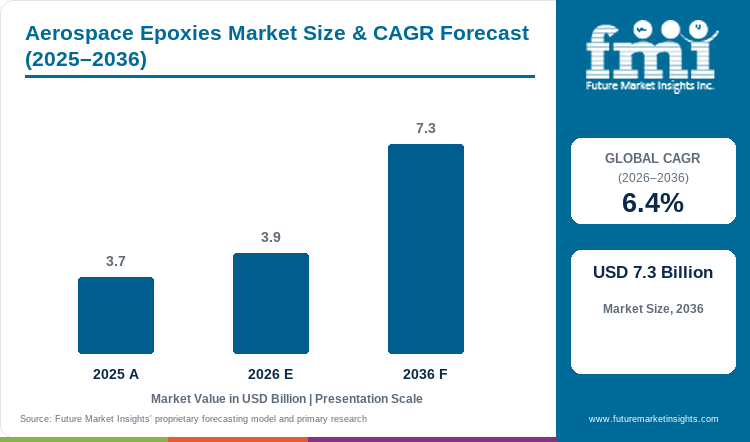
USD 3.9 Billion in 2026 and USD 7.3 Billion by 2036 at a 6.4% CAGR.
The aerospace epoxies market was valued at USD 3.7 Billion in 2025 and is estimated at USD 3.9 Billion in 2026. It is forecast to reach USD 7.3 Billion by 2036 at a 6.4% CAGR. Aircraft production sustains purchases of qualified bonding materials and prepreg resins. Airbus reported in January 2026 that it delivered 793 commercial aircraft in 2025 and ended the year with an 8,754-aircraft backlog. For material suppliers, meeting this workload requires consistent batches and formulations that fit approved assembly processes. Faster curing and easier dosing can help manufacturers increase output without compromising structural performance.
Aerospace customers qualify an epoxy for a particular material, joint and manufacturing process. That approval can support repeat orders throughout an aircraft program, but it also makes substitution slow. Demand in the USA and France is closely tied to established aircraft programs. Japan's next-aircraft research and South Korea's localization efforts create openings for new material qualifications. Germany's industrial modernization agenda adds interest in automated, lower-energy composite processing.
Key Takeaways
- The market is estimated at USD 3.9 Billion in 2026 and is forecast to reach USD 7.3 Billion by 2036 at a 6.4% CAGR.
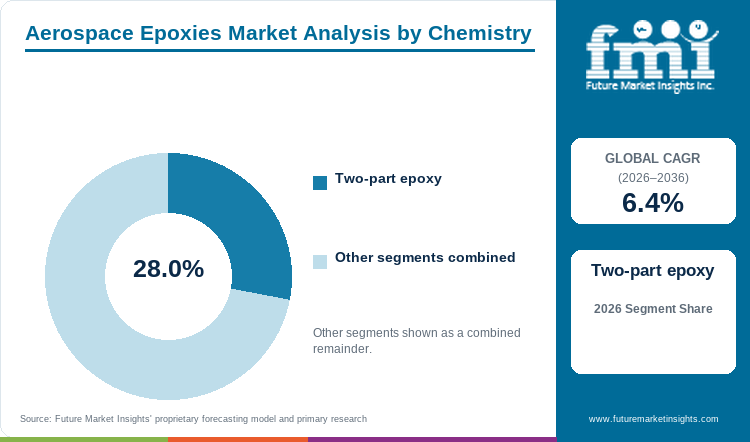
- Two-part epoxy accounts for 28.0% of Chemistry demand in 2026, reflecting its fit with mix-on-demand structural assembly and repair workflows.
- Paste / liquid represents 31.0% of Form demand in 2026, while Structural bonding accounts for 28.0% of Application demand.
- Commercial aircraft represents 42.0% of Platform demand in 2026, and Tier supplier programs account for 38.0% of Sales Channel demand.
- Country CAGRs range from 4.8% in Japan to 6.8% in South Korea from 2026 to 2036. Japan's next-aircraft research and South Korea's materials-localization programs create different qualification opportunities.
- Qualification evidence, process repeatability and supply continuity shape material adoption because epoxy changes can affect bonded joints and composite manufacturing controls.
Analyst Perspective
An epoxy earns a lasting place in an aircraft program when it delivers repeatable bonding or composite performance at production speed. Shorter cure cycles can release tooling capacity, while controlled dispensing can reduce rework. The supplier must demonstrate those gains within the customer's qualified process and maintain consistent material supply as aircraft output increases.
- Nikhil Kaitwade, Principal Consultant, Future Market Insights
How is the aerospace epoxies market segmented?
The market is assessed by Chemistry, Form, Application, Platform, and Sales Channel.
Chemistry covers two-part and one-part epoxies, film adhesives, prepreg resins and toughened systems. Form distinguishes how materials are supplied and applied, from paste and liquid to film, potting systems and primers. Applications range from structural joints and composite layup to interiors, nacelles and electronics. Platform demand follows the requirements of commercial aircraft, defense aircraft, space systems, rotorcraft and UAVs. Tier suppliers purchase against aerostructure programs; OEMs, MRO operators and distributors serve other stages of the aircraft life cycle.
What makes Two-part epoxy central to the Chemistry category?
Two-part epoxy remains central where operators need a workable balance between shelf stability before mixing and predictable cure after dispensing. The format is well suited to structural repair and insert bonding. It also fits liquid shimming and assembly tasks that require controlled ratios with localized application. It also supports room-temperature or mild-heat cure in many formulations, which can reduce dependence on large autoclave cycles for secondary bonding work. Henkel stated in April 2025 that its new aerospace dosing platform was designed around highly filled Loctite 2K Aero epoxy systems used for structural bonding and liquid shimming in aircraft wings and tail units. Controlled dosing helps keep two-part epoxy application consistent during repeat assembly.
- Two-part epoxy accounts for 28.0% of Chemistry demand in 2026 because it combines mix-on-demand processing with structural and repair versatility.
- In April 2025, Henkel described Loctite 2K Aero epoxy systems for safety-relevant structural bonding and liquid shim applications in aircraft production.
Why is Paste / liquid central to the Form category?
Paste and liquid formats fit geometries that cannot be served efficiently by pre-cut film. They can fill gaps and wet prepared surfaces. They can also encapsulate small volumes or be metered directly into assembly features. Flow behavior becomes especially important in electronics and thermal-management applications where void filling must occur without excessive migration. Master Bond announced in January 2025 that EP53TC is a flowable two-component epoxy. The formulation is designed for bonding and sealing as well as coating or small potting applications. It also meets NASA ASTM E595 low-outgassing requirements. Such application breadth supports the 2026 share position of paste and liquid forms across mixed aerospace assembly tasks.
- Paste / liquid accounts for 31.0% of Form demand in 2026 because flowable formats can be dispensed into joints, gaps, and localized potting features.
- In January 2025, Master Bond launched EP53TC as a flowable two-component epoxy. It is designed for bonding and sealing as well as coating or small potting applications.
How does Structural bonding anchor the Application category?
Structural bonding converts epoxy chemistry into a load-transfer function across metal-to-metal, composite-to-composite, and mixed-material joints. Buyers judge these materials on bond durability as well as the repeatability of surface preparation and cure. That creates value for systems that reduce process variability without weakening the interface. H.B. Fuller’s November 2021 Aerospace Product Guide documented structural epoxies for edge fill and core fill. It also covered composite repair and other bonded aircraft applications. Several entries cite OEM or military specifications. The example illustrates why structural bonding remains a high-value application: material performance and process control must work together before an adhesive is accepted into a safety-critical assembly.
- Structural bonding accounts for 28.0% of Application demand in 2026 because epoxy systems provide durable load transfer across aerospace metals and composite structures.
- H.B. Fuller documents epoxy systems for aerospace structural bonding, composite repair, insert potting and other aircraft assembly applications.
What supports Commercial aircraft in the Platform category?
Serial aircraft production consumes qualified epoxy systems across bonded structures, composite parts and interior assemblies. Batch consistency is essential because a formulation must perform repeatedly under the same manufacturing controls. Airbus reported 793 commercial-aircraft deliveries in 2025 and a year-end backlog of 8,754 aircraft in January 2026. Suppliers on these programs must coordinate replenishment with airframe and tier production schedules while supporting repairs and process changes.
- Commercial aircraft accounts for 42.0% of Platform demand in 2026 because serial production creates sustained demand across structural and composite applications. Interior and maintenance needs add recurring consumption.
- In January 2026, Airbus reported 793 commercial-aircraft deliveries for 2025 and a year-end backlog of 8,754 aircraft.
What drives Tier supplier programs in the Sales Channel category?
Tier suppliers convert material specifications into repeat production of aerostructures and subassemblies. Their purchasing decisions therefore sit close to cycle time and scrap. Tooling utilization and automation compatibility are also direct concerns. A material that is technically strong but difficult to process at rate can lose program value. Hexcel stated in June 2025 that its HexPly M51 prepreg was designed for automated and fast processing. The company displayed a wingbox rib developed with GKN Aerospace and a high-rate fuselage frame developed by Duqueine Group. Those demonstrations show how material suppliers work directly with tier manufacturers to validate production methods. That collaboration supports recurring tier-program revenue.
- Tier supplier programs account for 38.0% of Sales Channel demand in 2026 because tiers purchase qualified materials against repeat aerostructure and subassembly programs.
- In June 2025, Hexcel highlighted HexPly M51 demonstrators developed with GKN Aerospace and Duqueine Group for automated high-rate composite production.
What are the drivers, restraints and opportunities in the Aerospace Epoxies Market?
Aircraft production and composite structures support demand, while qualification slows material switching and high-rate epoxy processing creates a productivity opportunity.
- Driver: Higher aircraft build rates and composite-intensive structures increase repeat demand for qualified bonding and prepreg materials. Potting and protective epoxy systems add further recurring demand.
- Restraint: Qualification and bond-process control make material substitution slow and costly in safety-critical structures.
- Opportunity: Fast-cure, lower-temperature, and automation-ready systems can reduce manufacturing time when processing gains arrive with qualification support.
Each aircraft built consumes materials already specified in its structures and assemblies. Airbus reported in January 2026 that 2025 commercial-aircraft deliveries rose to 793 units and its backlog reached 8,754 aircraft. Higher output raises consumption for epoxy suppliers approved on those programs. Meeting the increase depends on lot availability, shelf-life management and stable processing characteristics at the customer's production rate.
Replacing an approved epoxy can require comparative testing and process validation. FAA guidance updated in April 2026 covers material and process control, bonded joints, structural substantiation, manufacturing and database standards. Surface preparation and cure conditions also affect joint durability. A faster-curing or lower-priced formulation therefore needs a supported qualification plan before it can enter a safety-critical assembly.
A practical opportunity is to reduce takt time while preserving the approved structural envelope. Toray Advanced Composites stated in June 2026 that its 3960-FC fast-cure epoxy prepreg can cut cure time by up to 45% while retaining the mechanical performance of its 3960 system. The material also expands vacuum-bag-only processing and supports automated fiber placement or tape laying. That type of improvement can reduce tooling occupancy and energy use without changing the underlying need for aerospace-grade performance. Suppliers can capture this opportunity when they combine faster-cure chemistry with application engineering, process-window data, and qualification support. Faster chemistry alone will not overcome an approval bottleneck.
Which country CAGRs are covered in the Aerospace Epoxies Market?
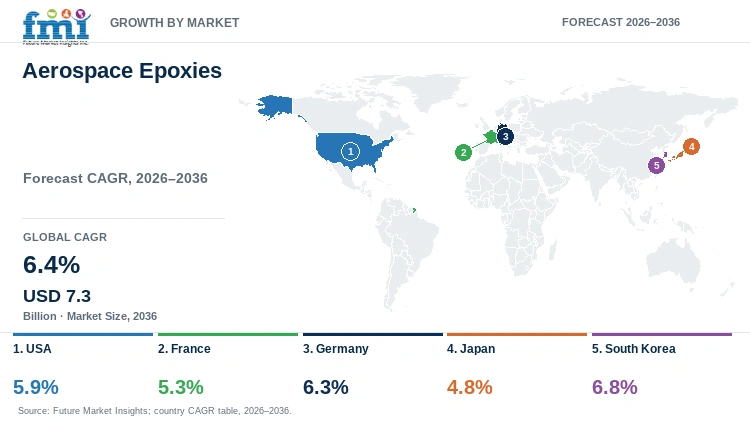
| Country | CAGR |
|---|---|
| USA | 5.9% |
| France | 5.3% |
| Germany | 6.3% |
| Japan | 4.8% |
| South Korea | 6.8% |
How do country-level CAGRs compare in the Aerospace Epoxies Market?
South Korea has the highest profiled CAGR at 6.8% from 2026 to 2036, followed by Germany at 6.3% and USA at 5.9%. France is at 5.3% and Japan at 4.8%, giving a 2.0 percentage-point spread. South Korea's localization work can create new material qualifications, while established aircraft programs in the other markets sustain repeat purchases through approved supply chains.
- South Korea exceeds Germany by 0.5 percentage points. Its aerospace-material localization programs create opportunities to qualify formulations with domestic manufacturers.
- Germany exceeds USA by 0.4 percentage points. German demand includes civil and military programs seeking more efficient composite manufacturing.
- USA exceeds France by 0.6 percentage points. US opportunities span aircraft production and MRO; French demand is closely connected to Airbus and its tier network.
- France exceeds Japan by 0.5 percentage points. France's serial aircraft production and Japan's next-aircraft development support different stages of epoxy qualification.
Aerospace-material orders follow program schedules. A supplier already approved for a long-running aircraft can retain recurring business through production and maintenance, while entry into a new platform requires joint testing and process validation. Country growth therefore translates into orders through specific aircraft and tier programs.
Country-wise Analysis
- USA: Demand for aerospace epoxies is forecast to expand at 5.9% CAGR from 2026 to 2036. The FAA's April 2026 composite-material guidance addresses bonded joints, material and process control, structural substantiation and manufacturing. A formulation change can require testing across these requirements. Suppliers serving production and MRO customers need traceable batches and application data compatible with the approved repair or manufacturing process.
- France: Demand for aerospace epoxies is forecast to expand at 5.3% CAGR from 2026 to 2036. Airbus reported 793 commercial-aircraft deliveries in 2025 and an 8,754-aircraft backlog in January 2026. French aerostructure suppliers must turn that workload into repeat production using approved materials. Reliable replenishment and assistance with cure and dispensing processes help prevent material shortages or rework from delaying assembly.
- Germany: Demand for aerospace epoxies is forecast to expand at 6.3% CAGR from 2026 to 2036. The federal government's June 2026 aviation strategy emphasizes competitiveness, resilience, sustainability and research. For civil and military manufacturers, faster or lower-energy processing must still meet established material specifications. Application engineering is needed to translate epoxy performance into repeatable automated production.
- Japan: Demand for aerospace epoxies is forecast to expand at 4.8% CAGR from 2026 to 2036. METI's December 2025 support program covers next-aircraft primary structures and high-rate production, including composite lightweighting demonstrations. Epoxy suppliers can participate through trials with local tiers, where cure behavior and manufacturing repeatability must be demonstrated before a material enters a new aircraft structure.
- South Korea: Demand for aerospace epoxies is forecast to expand at 6.8% CAGR from 2026 to 2036. KASA's January 2025 work plan supports private-sector participation and localization of aerospace materials and parts. Domestic aircraft, defense and space programs need formulations that can progress from laboratory trials to controlled production. Qualification support and consistent local supply are central to that transition.
Who are the notable companies in the Aerospace Epoxies Market?
Hexcel, Syensqo, Henkel, 3M, Huntsman, PPG, H.B. Fuller, Parker LORD, Master Bond, and Toray Advanced Composites are notable companies active in this market.
Competition is split between composite-material system suppliers, structural adhesive specialists and application-focused formulators. Hexcel, Syensqo and Toray Advanced Composites have documented positions in aerospace prepreg systems and composite processing. Henkel and 3M compete close to the bonded joint through structural adhesive systems. Huntsman and Parker LORD add two-part epoxy or specialty repair capability. H.B. Fuller and Master Bond address assembly, potting and repair requirements, while PPG serves aerospace customers through coatings and sealants infrastructure. Buyers separate suppliers through qualification history, processing fit and dependable program supply.
- Composite resin and prepreg systems: Hexcel, Syensqo and Toray Advanced Composites serve aerospace programs that link epoxy resin behavior with composite manufacturing and cure-cycle requirements.
- Structural bonding systems: Henkel, 3M, Huntsman and Parker LORD serve bonded assemblies through paste, film, repair or specialty structural epoxy formats.
- Application-focused formulations and support: PPG, H.B. Fuller and Master Bond address coatings, repair, potting or other specialized aerospace material requirements.
Competitive Benchmarking: Aerospace Epoxies Market
| Company | Structural Bonding Depth | Epoxy Prepreg / Composite Resin Depth | Aerospace Qualification & Program Support | Geographic Reach |
|---|---|---|---|---|
| Hexcel | Medium | High | High | North America, Europe and Asia-Pacific |
| Syensqo | Medium | High | High | North America, Europe and Asia-Pacific |
| Henkel | High | Unscored | High | North America, Europe and Asia-Pacific |
| 3M | High | Unscored | High | North America, Europe and Asia-Pacific |
| Huntsman | High | Unscored | High | North America, Europe and Asia-Pacific |
| PPG | Unscored | Unscored | High | North America, Europe and Asia-Pacific |
| H.B. Fuller | Medium | Unscored | High | North America, Europe and Asia-Pacific |
| Parker LORD | Medium | Unscored | Medium | North America, Europe and Asia-Pacific |
| Master Bond | Medium | Unscored | Medium | North America with international supply |
| Toray Advanced Composites | Medium | High | High | North America, Europe, Japan and Korea |
Scoring basis: Structural Bonding Depth reflects documented aerospace epoxy adhesive or bonding-system coverage. Epoxy Prepreg / Composite Resin Depth reflects documented thermoset prepreg and resin capability for aerospace composite manufacturing. Aerospace Qualification & Program Support reflects evidence of aerospace specifications, qualification datasets, program collaboration or dedicated application support. High indicates broad documented capability. Medium indicates narrower documented coverage. Low is reserved for a documented limitation.
Key Developments in the Aerospace Epoxies Market
- In June 2026, Toray Advanced Composites highlighted 3960-FC, a fast-cure variant of its 3960 epoxy prepreg system. Toray stated that the material can reduce cure time by up to 45% while maintaining the mechanical performance of the 3960 system. The material also supports vacuum-bag-only processing and automated fiber placement or tape laying.
- In June 2025, Hexcel showcased HexPly M51 for automated and rapid aerospace composite processing. Demonstrators included a press-molded wingbox rib developed with GKN Aerospace and a fuselage frame developed by Duqueine Group. The development connects epoxy prepreg design with shorter production cycles for repeat aerostructure manufacturing.
- In April 2025, Henkel introduced the Sonderhoff DM80 Static Mix dosing machine for highly filled Loctite 2K Aero epoxy systems. The equipment targets structural bonding and liquid shimming in aircraft wings and tail units. Its semi-automatic or fully automatic processing route addresses dosing repeatability as aircraft production becomes more automated.
Key Players in the Aerospace Epoxies Market
Composite Prepreg and Resin Systems
- Hexcel
- Syensqo
- Toray Advanced Composites
Structural Bonding and Assembly Epoxies
- Henkel
- 3M
- Huntsman
- Parker LORD
Aerospace Coatings, Potting and Specialty Formulations
- PPG
- H.B. Fuller
- Master Bond
Aerospace Epoxies Market - Report Scope
| Coverage field | Report scope |
|---|---|
| Market breakdown | Chemistry, Form, Application, Platform, and Sales Channel |
| Quantitative Units | USD Billion |
| Market Definition | Includes revenue from aerospace-grade epoxy resin and prepreg systems, film and paste / liquid structural epoxy adhesives, epoxy potting / encapsulant materials, and epoxy primers / surfacers sold for aircraft, rotorcraft, UAV, and space-system applications. Excludes downstream finished-product revenue, stand-alone reinforcement materials, non-epoxy substitutes, and processing equipment revenue. |
| Regions Covered | North America; Latin America; Western Europe; Eastern Europe; East Asia; South Asia and Pacific; Middle East and Africa |
| Countries Covered | USA, France, Germany, Japan, South Korea, and more than twenty-five additional countries in the full report |
| Key Companies Profiled | Hexcel, Syensqo, Henkel, 3M, Huntsman, PPG, H.B. Fuller, Parker LORD, Master Bond, Toray Advanced Composites |
| Forecast Period | 2026 to 2036 |
| Approach | FMI applies a hybrid bottom-up and top-down sizing approach using product, application, platform, channel and geographic demand checks before reconciling the forecast. |
Aerospace Epoxies Market - Research Methodology
| Method | Approach |
|---|---|
| Primary Research | Structured market inputs cover aerospace material formulators and manufacturers, distributors, OEM or tier engineering teams, MRO participants and subject-matter experts. The discussion framework addresses qualification pathways, application requirements, buying criteria, processing constraints and replacement behavior. |
| Desk Research | Research reviews aviation regulators, government aerospace programs, company filings, official newsrooms, technical product documentation, trade information and standards references. Evidence is retained when it directly supports the market boundary, country conditions, company actions or technical mechanisms used in the analysis. |
| Market Sizing and Forecasting | The sizing process combines bottom-up product and application demand with top-down checks on aerospace production, platform activity, maintenance demand, qualification cycles, pricing and mix. Forecast assumptions consider program build rates, material-substitution friction, manufacturing productivity and channel access. |
| Data Validation | Findings are cross-checked across authoritative public sources and first-party company evidence. Validation excludes double counting, finished-aircraft revenue, stand-alone reinforcement materials, non-epoxy substitute chemistries, processing equipment and unsupported claims outside the defined market boundary. |
Aerospace Epoxies Market by Segments
Aerospace Epoxies Market segmented by Chemistry:
- Two-part epoxy
- One-part epoxy
- Film adhesives
- Epoxy prepreg resins
- Toughened epoxy systems
Aerospace Epoxies Market segmented by Form:
- Paste / liquid
- Film
- Prepreg resin
- Potting / encapsulant
- Primer / surfacer
Aerospace Epoxies Market segmented by Application:
- Structural bonding
- Composite layup
- Interior panels
- Engine / nacelle components
- Electronics potting
Aerospace Epoxies Market segmented by Platform:
- Commercial aircraft
- Defense aircraft
- Space systems
- Rotorcraft
- UAVs
Aerospace Epoxies Market segmented by Sales Channel:
- Tier supplier programs
- OEM approved supply
- MRO / aftermarket
- Distributors
Aerospace Epoxies Market by Region:
- North America
- United States
- Canada
- Latin America
- Brazil
- Mexico
- Argentina
- Chile
- Western Europe
- Germany
- France
- United Kingdom
- Italy
- Spain
- Benelux
- Nordics
- Eastern Europe
- Poland
- Czech Republic
- Romania
- Hungary
- East Asia
- China
- Japan
- South Korea
- South Asia and Pacific
- India
- ASEAN
- Australia and New Zealand
- Middle East and Africa
- GCC Countries
- South Africa
- Türkiye
- Israel
Research Sources and Bibliography
- Federal Aviation Administration. (2026, April 9). Technical Discipline: Advanced Composite Materials.
- Airbus. (2026, January 12). Airbus reports 793 commercial aircraft deliveries in 2025.
- Federal Ministry for Economic Affairs and Energy, Germany. (2026, June 10). Luftfahrtstrategie der Bundesregierung.
- Ministry of Economy, Trade and Industry, Japan. (2025, December 3). Next Aircraft Development Support Project: Primary Structure Development and High-Rate Production Technology Demonstration.
- Korea AeroSpace Administration. (2025, January 22). KASA Announces 2025 Work Plan to Propel Korea as a Top 5 Aerospace Nation.
- Korea AeroSpace Administration. (2026, June 18). Materials and Components Development Program for aerospace localization.
- Toray Advanced Composites. (2026, June 30). Toray Marks 100 Years, Reinforcing Long-Term Commitment to Aerospace, Space, and Defense at Farnborough Air Show.
- Hexcel. (2025, June 18). Hexcel Showcases Ramp up Enablement Innovation with HexPly M51 at Paris Air Show 2025.
- Henkel. (2025, April 15). Precise dosing for safety-relevant components with the new Sonderhoff DM80 Static Mix dosing machine.
- Syensqo. (2025, October 28). CYCOM EP2190 now included in NCAMP database, enabling faster aerospace qualifications.
- 3M. (Accessed 2026, September 22). Structural Adhesives for Aerospace and Aerospace Specification Support Portal.
- Huntsman Corporation. (Accessed 2026, September 22). ARALDITE aerospace epoxy product documentation.
- PPG. (2025, May 8). PPG to invest USD 380 million to build a new U.S. manufacturing facility for aerospace coatings and sealants.
- H.B. Fuller. (Accessed 2026, September 22). Aerospace adhesives and sealants product resources.
- Parker LORD. (2025). LORD 3170 Epoxy Adhesive Technical Data Sheet.
This bibliography is provided for reader reference and is not exhaustive. The full report contains the complete reference list and detailed citations.
This Report Answers
- What is the Aerospace Epoxies Market size in 2026 and what value is forecast for 2036?
- Which aircraft-production and composite-manufacturing pressures support demand for aerospace epoxies?
- Why does Two-part epoxy account for 28.0% of Chemistry demand in 2026?
- How does Paste / liquid form influence aerospace bonding and potting demand?
- Why does Structural bonding account for 28.0% of Application demand in 2026?
- How do Aerospace Epoxies Market growth rates differ across USA, France, Germany, Japan and South Korea?
- Which companies serve composite resin systems, structural adhesives or application-focused aerospace formulations?
- How do qualification and bond-process controls affect material switching in safety-critical aerospace applications?
Frequently Asked Questions
How big is the Aerospace Epoxies Market in 2026?
The market is estimated at USD 3.9 Billion in 2026. It is forecast to reach USD 7.3 Billion by 2036 at a 6.4% CAGR.
What is driving growth in the Aerospace Epoxies Market?
Aircraft production creates repeat demand for qualified bonding and prepreg materials. Composite manufacturing and automation also support demand where suppliers can improve processing without reopening qualification risk.
Which companies are active in the Aerospace Epoxies Market?
Companies covered in this report include Hexcel, Syensqo, Henkel, 3M, Huntsman, PPG, H.B. Fuller, Parker LORD, Master Bond and Toray Advanced Composites. Their positions differ across prepreg, structural bonding and specialized aerospace formulations.
What is a notable restraint in the Aerospace Epoxies Market?
Qualification and process-control requirements slow material switching in bonded joints and composite structures. A formulation change can require comparative testing and manufacturing validation before it enters an approved program.
What should aerospace materials and procurement teams evaluate?
Teams should compare specification status with substrate compatibility and the required mechanical or thermal performance. Cure profile, processing window and supply continuity should also match the production or MRO workflow.
What supports demand through 2036?
Long aircraft production workloads and continued work on composite manufacturing support recurring demand for qualified epoxy systems. Commercial capture depends on stable material performance and repeatable processing across program life cycles.
Preview the report firsthand - request a free sample
Get SampleGet the brochure for pricing and purchase details.
Get PDFTable of Content
- Key Takeaways
- Market Size and CAGR
- Top Growth Driver
- Fastest Growing Segment
- Leading Region
- Key Companies
- Emerging Opportunities
- Executive Summary
- Global Market Outlook
- Demand-side Trends
- Supply-side Trends
- Technology Roadmap Analysis
- Analysis and Recommendations
- Analyst Perspective (What is happening? Why now? What should investors know?)
- Key Questions Answered
- How large is the market?
- What is the CAGR?
- What are key trends?
- Which region dominates?
- Who are the leaders?
- Market Overview
- Market Coverage / Taxonomy
- Market Definition / Scope / Limitations
- Research Methodology
- Chapter Orientation
- Analytical Lens and Working Hypotheses
- Market Structure, Signals, and Trend Drivers
- Benchmarking and Cross-market Comparability
- Market Sizing, Forecasting, and Opportunity Mapping
- Research Design and Evidence Framework
- Desk Research Programme (Secondary Evidence)
- Expert Input and Fieldwork (Primary Evidence)
- Tooling, Models, and Reference Databases
- Data Engineering and Model Build
- Quality Assurance and Audit Trail
- Market Background
- Market Dynamics (Drivers, Restraints, Opportunity, Trends)
- Scenario Forecast (Optimistic, Likely, Conservative)
- Impact Analysis
- AI Impact
- Sustainability Impact
- Regulatory Impact
- Technology Impact
- Consumer / Buyer Analysis
- Purchase Drivers
- Adoption Barriers
- Buyer Journey
- Opportunity Map Analysis
- Product Life Cycle Analysis
- Supply Chain Analysis
- Investment Feasibility Matrix
- Value Chain Analysis
- PESTLE and Porter's Analysis
- Regulatory Landscape
- Regional Parent Market Outlook
- Production and Consumption Statistics
- Import and Export Statistics
- Global Market Analysis and Forecast, 2021 to 2036
- Historical Market Size Value (USD Billion) Analysis, 2021 to 2025
- Current and Future Market Size Value (USD Billion) Projections, 2026 to 2036
- Y-o-Y Growth Trend Analysis
- Absolute $ Opportunity Analysis
- Global Market Pricing Analysis, 2021 to 2036
- Global Market Analysis and Forecast, By Chemistry, 2021 to 2036
- Introduction / Key Findings
- Historical Market Size Value (USD Billion) Analysis By Chemistry, 2021 to 2025
- Current and Future Market Size Value (USD Billion) Analysis and Forecast By Chemistry, 2026 to 2036
- Two-part epoxy
- One-part epoxy
- Film adhesives
- Epoxy prepreg resins
- Toughened epoxy systems
- Y-o-Y Growth Trend Analysis By Chemistry, 2021 to 2025
- Absolute $ Opportunity Analysis By Chemistry, 2026 to 2036
- Global Market Analysis and Forecast, By Form, 2021 to 2036
- Introduction / Key Findings
- Historical Market Size Value (USD Billion) Analysis By Form, 2021 to 2025
- Current and Future Market Size Value (USD Billion) Analysis and Forecast By Form, 2026 to 2036
- Paste / liquid
- Film
- Prepreg resin
- Potting / encapsulant
- Primer / surfacer
- Y-o-Y Growth Trend Analysis By Form, 2021 to 2025
- Absolute $ Opportunity Analysis By Form, 2026 to 2036
- Global Market Analysis and Forecast, By Application, 2021 to 2036
- Introduction / Key Findings
- Historical Market Size Value (USD Billion) Analysis By Application, 2021 to 2025
- Current and Future Market Size Value (USD Billion) Analysis and Forecast By Application, 2026 to 2036
- Structural bonding
- Composite layup
- Interior panels
- Engine / nacelle components
- Electronics potting
- Y-o-Y Growth Trend Analysis By Application, 2021 to 2025
- Absolute $ Opportunity Analysis By Application, 2026 to 2036
- Global Market Analysis and Forecast, By Platform, 2021 to 2036
- Introduction / Key Findings
- Historical Market Size Value (USD Billion) Analysis By Platform, 2021 to 2025
- Current and Future Market Size Value (USD Billion) Analysis and Forecast By Platform, 2026 to 2036
- Commercial aircraft
- Defense aircraft
- Space systems
- Rotorcraft
- UAVs
- Y-o-Y Growth Trend Analysis By Platform, 2021 to 2025
- Absolute $ Opportunity Analysis By Platform, 2026 to 2036
- Global Market Analysis and Forecast, By Sales Channel, 2021 to 2036
- Introduction / Key Findings
- Historical Market Size Value (USD Billion) Analysis By Sales Channel, 2021 to 2025
- Current and Future Market Size Value (USD Billion) Analysis and Forecast By Sales Channel, 2026 to 2036
- Tier supplier programs
- OEM approved supply
- MRO / aftermarket
- Distributors
- Y-o-Y Growth Trend Analysis By Sales Channel, 2021 to 2025
- Absolute $ Opportunity Analysis By Sales Channel, 2026 to 2036
- Global Market Analysis and Forecast, By Region, 2021 to 2036
- Introduction
- Historical Market Size Value (USD Billion) Analysis By Region, 2021 to 2025
- Current Market Size Value (USD Billion) Analysis and Forecast By Region, 2026 to 2036
- North America
- Latin America
- Western Europe
- Eastern Europe
- East Asia
- South Asia and Pacific
- Middle East and Africa
- Market Attractiveness Analysis By Region
- North America Market Analysis and Forecast, By Country, 2021 to 2036
- Historical Market Size Value (USD Billion) Trend Analysis By Market Taxonomy, 2021 to 2025
- Market Size Value (USD Billion) Forecast By Market Taxonomy, 2026 to 2036
- By Country
- United States
- Canada
- By Chemistry
- By Form
- By Application
- By Platform
- By Sales Channel
- By Country
- Market Attractiveness Analysis
- By Country
- By Chemistry
- By Form
- By Application
- By Platform
- By Sales Channel
- Key Takeaways
- Latin America Market Analysis and Forecast, By Country
- Historical Market Size Value (USD Billion) Trend Analysis By Market Taxonomy, 2021 to 2025
- Market Size Value (USD Billion) Forecast By Market Taxonomy, 2026 to 2036
- By Country
- Brazil
- Mexico
- Argentina
- Chile
- By Chemistry
- By Form
- By Application
- By Platform
- By Sales Channel
- By Country
- Market Attractiveness Analysis
- By Country
- By Chemistry
- By Form
- By Application
- By Platform
- By Sales Channel
- Key Takeaways
- Western Europe Market Analysis and Forecast, By Country
- Historical Market Size Value (USD Billion) Trend Analysis By Market Taxonomy, 2021 to 2025
- Market Size Value (USD Billion) Forecast By Market Taxonomy, 2026 to 2036
- By Country
- Germany
- France
- United Kingdom
- Italy
- Spain
- Benelux
- Nordics
- By Chemistry
- By Form
- By Application
- By Platform
- By Sales Channel
- By Country
- Market Attractiveness Analysis
- By Country
- By Chemistry
- By Form
- By Application
- By Platform
- By Sales Channel
- Key Takeaways
- Eastern Europe Market Analysis and Forecast, By Country
- Historical Market Size Value (USD Billion) Trend Analysis By Market Taxonomy, 2021 to 2025
- Market Size Value (USD Billion) Forecast By Market Taxonomy, 2026 to 2036
- By Country
- Poland
- Czech Republic
- Romania
- Hungary
- By Chemistry
- By Form
- By Application
- By Platform
- By Sales Channel
- By Country
- Market Attractiveness Analysis
- By Country
- By Chemistry
- By Form
- By Application
- By Platform
- By Sales Channel
- Key Takeaways
- East Asia Market Analysis and Forecast, By Country
- Historical Market Size Value (USD Billion) Trend Analysis By Market Taxonomy, 2021 to 2025
- Market Size Value (USD Billion) Forecast By Market Taxonomy, 2026 to 2036
- By Country
- China
- Japan
- South Korea
- By Chemistry
- By Form
- By Application
- By Platform
- By Sales Channel
- By Country
- Market Attractiveness Analysis
- By Country
- By Chemistry
- By Form
- By Application
- By Platform
- By Sales Channel
- Key Takeaways
- South Asia and Pacific Market Analysis and Forecast, By Country
- Historical Market Size Value (USD Billion) Trend Analysis By Market Taxonomy, 2021 to 2025
- Market Size Value (USD Billion) Forecast By Market Taxonomy, 2026 to 2036
- By Country
- India
- ASEAN
- Australia and New Zealand
- By Chemistry
- By Form
- By Application
- By Platform
- By Sales Channel
- By Country
- Market Attractiveness Analysis
- By Country
- By Chemistry
- By Form
- By Application
- By Platform
- By Sales Channel
- Key Takeaways
- Middle East and Africa Market Analysis and Forecast, By Country
- Historical Market Size Value (USD Billion) Trend Analysis By Market Taxonomy, 2021 to 2025
- Market Size Value (USD Billion) Forecast By Market Taxonomy, 2026 to 2036
- By Country
- GCC Countries
- South Africa
- Türkiye
- Israel
- By Chemistry
- By Form
- By Application
- By Platform
- By Sales Channel
- By Country
- Market Attractiveness Analysis
- By Country
- By Chemistry
- By Form
- By Application
- By Platform
- By Sales Channel
- Key Takeaways
- Key Countries Market Analysis
- United States
- Pricing Analysis
- Market Share Analysis, 2025
- By Chemistry
- By Form
- By Application
- By Platform
- By Sales Channel
- Canada
- Pricing Analysis
- Market Share Analysis, 2025
- By Chemistry
- By Form
- By Application
- By Platform
- By Sales Channel
- Mexico
- Pricing Analysis
- Market Share Analysis, 2025
- By Chemistry
- By Form
- By Application
- By Platform
- By Sales Channel
- Brazil
- Pricing Analysis
- Market Share Analysis, 2025
- By Chemistry
- By Form
- By Application
- By Platform
- By Sales Channel
- Chile
- Pricing Analysis
- Market Share Analysis, 2025
- By Chemistry
- By Form
- By Application
- By Platform
- By Sales Channel
- Germany
- Pricing Analysis
- Market Share Analysis, 2025
- By Chemistry
- By Form
- By Application
- By Platform
- By Sales Channel
- United Kingdom
- Pricing Analysis
- Market Share Analysis, 2025
- By Chemistry
- By Form
- By Application
- By Platform
- By Sales Channel
- Italy
- Pricing Analysis
- Market Share Analysis, 2025
- By Chemistry
- By Form
- By Application
- By Platform
- By Sales Channel
- Spain
- Pricing Analysis
- Market Share Analysis, 2025
- By Chemistry
- By Form
- By Application
- By Platform
- By Sales Channel
- France
- Pricing Analysis
- Market Share Analysis, 2025
- By Chemistry
- By Form
- By Application
- By Platform
- By Sales Channel
- India
- Pricing Analysis
- Market Share Analysis, 2025
- By Chemistry
- By Form
- By Application
- By Platform
- By Sales Channel
- ASEAN
- Pricing Analysis
- Market Share Analysis, 2025
- By Chemistry
- By Form
- By Application
- By Platform
- By Sales Channel
- Australia and New Zealand
- Pricing Analysis
- Market Share Analysis, 2025
- By Chemistry
- By Form
- By Application
- By Platform
- By Sales Channel
- China
- Pricing Analysis
- Market Share Analysis, 2025
- By Chemistry
- By Form
- By Application
- By Platform
- By Sales Channel
- Japan
- Pricing Analysis
- Market Share Analysis, 2025
- By Chemistry
- By Form
- By Application
- By Platform
- By Sales Channel
- South Korea
- Pricing Analysis
- Market Share Analysis, 2025
- By Chemistry
- By Form
- By Application
- By Platform
- By Sales Channel
- Poland
- Pricing Analysis
- Market Share Analysis, 2025
- By Chemistry
- By Form
- By Application
- By Platform
- By Sales Channel
- Hungary
- Pricing Analysis
- Market Share Analysis, 2025
- By Chemistry
- By Form
- By Application
- By Platform
- By Sales Channel
- Türkiye
- Pricing Analysis
- Market Share Analysis, 2025
- By Chemistry
- By Form
- By Application
- By Platform
- By Sales Channel
- South Africa
- Pricing Analysis
- Market Share Analysis, 2025
- By Chemistry
- By Form
- By Application
- By Platform
- By Sales Channel
- United States
- Market Structure Analysis
- Competition Dashboard
- Competition Benchmarking
- Market Share Analysis of Top Players
- By Regional
- By Chemistry
- By Form
- By Application
- By Platform
- By Sales Channel
- Emerging Startups
- Innovation Benchmarking
- Competition Analysis
- Competition Deep Dive
- Hexcel
- Overview
- Product Portfolio
- Profitability by Market Segments
- Sales Footprint
- Strategy Overview
- Marketing Strategy
- Product Strategy
- Channel Strategy
- Syensqo
- Henkel
- 3M
- Huntsman
- PPG
- H.B. Fuller
- Parker LORD
- Master Bond
- Toray Advanced Composites
- Hexcel
- Case Studies
- Success Stories
- Recent Developments
- Competition Deep Dive
- Assumptions & Acronyms Used


