

- Market Size (2026)
- USD 860.7 Mn
- Forecast (2036)
- USD 1570.7 Mn
- CAGR (2026 to 2036)
- 6.2%
How big is B-Staged Epoxy Resins Market in 2026?
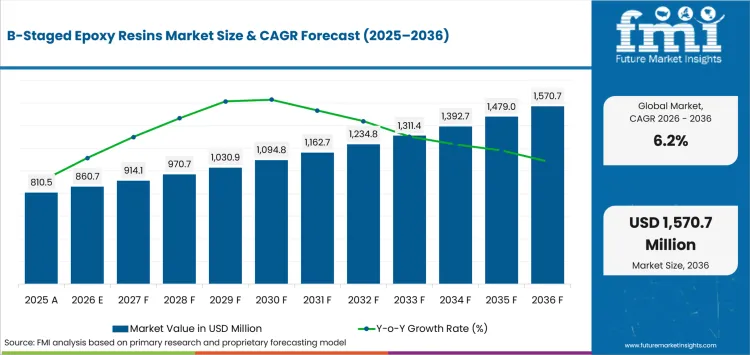
USD 860.7 million in 2026 and USD 1570.7 million by 2036 at a 6.2% CAGR.
Demand for B-staged epoxy resin is projected to increase the valuation from USD 860.7 million in 2026 to USD 1570.7 million by 2036 at 6.2% CAGR. Printed circuit boards provide repeat demand for partially advanced systems that hold resin flow inside a narrow press window. On February 6, 2026 the Semiconductor Industry Association reported that 2025 semiconductor sales reached USD 791.7 billion. The 25.6% annual increase raises downstream qualification activity without translating directly into resin volume.
Country economics depend on how quickly laminate producers can qualify circuit materials without changing approved cure recipes. Electronic-components output increased 25.29% year over year in Taiwan during the first quarter, according to the Ministry of Economic Affairs' May 2026 statistics. The production pace raises the value of local technical coverage for board stacks requiring repeatable dielectric performance and pressing behavior. South Korea offers comparable electronics density, whereas USA and Germany programs place greater weight on traceability and qualification records.
Key Takeaways
- Electronics and aerospace production concentrate qualification activity on resin systems that hold flow, tack and cure response inside approved process windows.
- By resin type, dicyandiamide-cured epoxies are estimated to hold 31.0% in 2026 owing to cure latency that fits stable laminate processing.
- In 2026, prepreg resin is expected to lead form with 34.0% share because partially advanced resin can be stored and laid up ahead of final cure.
- PCB laminates are projected to hold 32.0% share in 2026 owing to repeated use of controlled-flow epoxy prepreg in multilayer board pressing.
- Frozen storage, limited out-life and qualification work raise switching costs even if an alternate formulation offers lower unit pricing.
- Some of the key players in this market include Huntsman Corporation, Hexcel Corporation, Syensqo, Toray Industries, Inc., Teijin Limited, Ventec International Group Co., Ltd., Panasonic Industry Co., Ltd., and Nan Ya Plastics Corporation.
Analyst Perspective
"Margin in b-staged epoxy resins depends on stable tack, flow and out-life inside an approved press or lay-up recipe. Resin producers gain pricing power by cutting cure time or handling losses without forcing customers to repeat dielectric or structural qualification."
- Nikhil Kaitwade, Principal Consultant, Future Market Insights
How is the B-Staged Epoxy Resins Market segmented?
The market is analyzed by resin type, form, application, end use, sales channel and region.
Resin type covers dicyandiamide-cured, phenolic-cured, anhydride-cured, latent-cure epoxy film and modified B-stage systems. Form includes prepreg resin, adhesive film, powder, sheet or tape and liquid-to-B-stage formats. Applications cover PCB laminates, composite prepregs, electrical insulation, structural bonding and aerospace interiors. End uses include electronics, aerospace, automotive, industrial composites and electrical equipment. Sales channels comprise direct resin producers, prepreg manufacturers, electronic materials distributors and custom formulators.
How do PCB laminates shape demand within the application category?
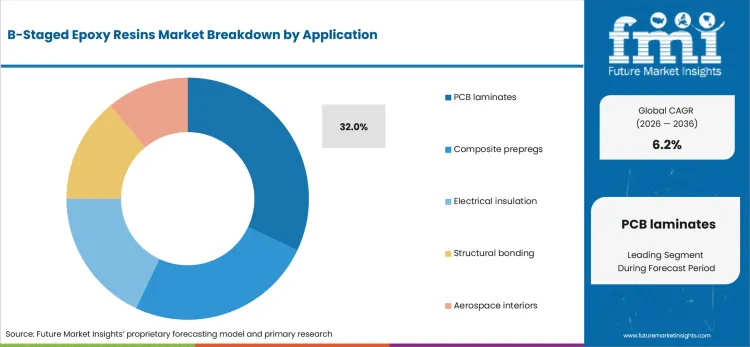
Multilayer PCB pressing turns resin-impregnated glass into a consolidated stack whose dielectric behavior depends on repeatable resin flow and final cure. Material engineers test B-stage chemistry against press behavior as part of each laminate approval.
- In 2026, PCB laminates are expected to lead the application category with 32.0% share due to repeated use of epoxy prepreg during multilayer consolidation.
- PCB laminate qualification becomes more demanding as board producers carry higher order volumes through tightly controlled multilayer processes. IPC reported in March 2025 that February North American PCB shipments rose 11.3% year over year and the book-to-bill ratio reached 1.33.
What makes dicyandiamide-cured epoxies central to the resin type category?
Dicyandiamide latency lets laminate producers impregnate and partially advance resin ahead of the final heat-cure step. Laminate producers choose epoxy curing agents to balance storage stability with complete cure during commercial pressing. Latent cure also reduces the risk that coated glass advances too far during intermediate storage.
- By resin type, dicyandiamide-cured epoxies are estimated to hold 31.0% in 2026 owing to familiar latent-cure behavior in electrical laminate workflows.
- Higher board output increases qualification activity during material approval for each laminate program. IPC reported on February 20, 2025 that North American PCB shipments increased 19.9% year over year in January.
Why does prepreg resin lead the form category?
Prepreg resin commercializes the partially advanced state as a stored prepreg intermediate that preserves reinforcement placement until final cure. Aerospace fabricators compare tack and out-life in carbon fibre prepreg because resin advancement determines handling during lay-up and consolidation.
- Prepreg resin is set to lead the form category with 34.0% share in 2026 due to controlled advancement that supports repeatable lay-up and final consolidation.
- HDI laminates tighten resin-flow and expansion tolerances as microvia structures face repeated thermal stress. Ventec launched VT-47LT IPC4101/126 prepreg in March 2025 for designs requiring lower Z-axis CTE and familiar qualification routes.
What supports electronics as the leading end use?
Electronics converts B-stage resins into high-volume laminate systems, and small changes in flow or dielectric response can trigger another validation cycle. High-volume electronics production therefore rewards formulations with repeatable advancement and storage behavior during board pressing on qualified commercial lines.
- By end use, electronics is forecast to represent 35.0% in 2026 driven by repeat PCB laminate demand and the cost of disrupting qualified process recipes.
- Advanced process and packaging investment keeps material qualification close to high-volume electronics production. Taiwan’s Ministry of Economic Affairs published on June 10, 2026 that electronic-component producers accounted for 77.9% of first-quarter manufacturing fixed-asset additions.
What are the drivers, restraints and opportunities in the B-Staged Epoxy Resins Market?
Electronics throughput raises qualification demand, storage and revalidation raise switching costs, and shorter-cure systems improve the economics of established production lines.
- Driver: Higher PCB booking activity expands demand for latent-cure intermediates that can hold repeatable pressing behavior at volume.
- Restraint: Temperature-controlled storage and material requalification can outweigh a nominal resin-price saving during supplier changes.
- Opportunity: Faster-cure formulations can release tooling capacity if they preserve flow control and the customer’s approved property window.
PCB bookings provide a more direct demand signal for B-stage laminate systems than semiconductor revenue alone. IPC said in May 2025 that April bookings increased 23.5% year over year and the book-to-bill ratio reached 1.21. Higher bookings require more qualification lots, additional press trials and repeat line support for electronics adhesives and laminate resin programs during rapid volume ramps at board factories.
Aerospace programs require material data and process specifications for production approval, so a resin change carries substantial switching cost. In October 2025 Syensqo announced that CYCOM EP2190 epoxy prepreg entered the NCAMP database with standardized qualification reports and process specifications. Shared data reduce repeated testing without eliminating engineering time in prepreg and aerospace adhesives programs tied to approved manufacturing controls.
Faster cure improves economics provided the formulation keeps handling time and final properties stable on existing equipment. Hexcel stated in June 2025 that a Duqueine fuselage frame made with HexPly M51 cut processing time by more than 50%. Shorter approved cycles can release molds for the next production lot, improving composite resin economics and easing comparable fixture pressure in epoxy potting resin production.
Which country CAGRs are profiled in the B-Staged Epoxy Resins Market?
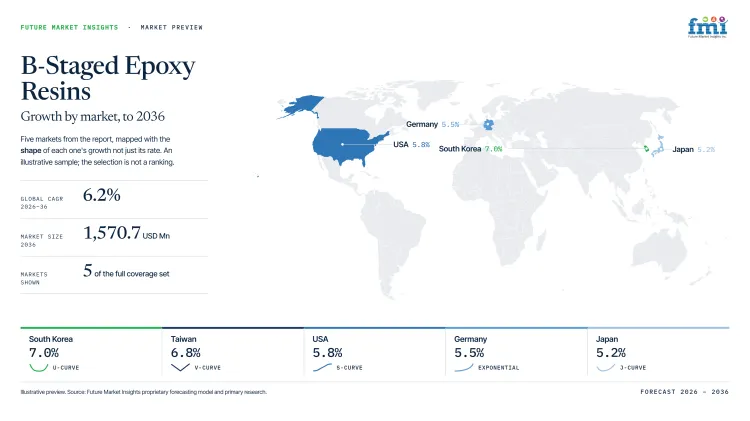
| Country | CAGR |
|---|---|
| South Korea | 7.0% |
| Taiwan | 6.8% |
| USA | 5.8% |
| Germany | 5.5% |
| Japan | 5.2% |
How do country-level CAGRs compare in the B-Staged Epoxy Resins Market?
Five forecasts span 1.5 percentage points between South Korea at 7.0% and Germany at 5.5%. Taiwan at 6.8% stays near South Korea, whereas Taiwan at 6.8% and USA at 5.8% form the middle band. The spread conceals different qualification routes shaped by electronics density and local technical coverage at customer sites.
- South Korea's export-heavy sector keeps qualification schedules tied to memory production ramps.
- Taiwan's electronics investment keeps production capacity close to board and substrate makers.
- USA growth is moderated by long aerospace cycles despite expanding semiconductor investment.
- Germany serves mature automotive and industrial accounts that replace qualified materials infrequently.
- Japan serves mature automotive and electronics accounts that replace qualified materials infrequently.
Growth pace differs from addressable revenue and qualification burden in each country. The full report provides country-level CAGR analysis across North America, Latin America, Europe, East Asia, South Asia, Oceania and the Middle East and Africa.
Country-wise Analysis
- Near South Korea's memory and substrate lines, material engineers run customer-specific reliability checks before laminate chemistry changes. South Korea's b-staged epoxy resins outlook is anticipated to advance at 7.0% CAGR over the assessment period, propelled by dense packaging capacity that keeps application support close to production. In July 2026 the Ministry of Trade, Industry and Resources reported that June semiconductor exports increased 200% year over year. Each board stack requires performance data matched to its production cycle, which keeps approval costly for new formulations. Companies without Korean application engineers face slower fault isolation as resin behavior must be reconciled with each customer's laminate construction.
- Taiwanese laminate and substrate producers work beside advanced packaging lines that require rapid material feedback during high-layer-count board and panel-level packaging trials. Adoption of b-staged epoxy resins in Taiwan is estimated to expand at 6.8% CAGR through 2036, tied to dense electronics manufacturing and local materials engineering. Panel-level packaging investment is turning local equipment and material development into a qualification advantage for nearby material companies. In April 2026 the Ministry of Economic Affairs presented 14 panel-level packaging innovations and reported a 30% production-cost reduction for a new metallization route. High-volume customers reject batch variation that changes resin flow or dielectric performance during qualified press cycles. Local engineering speeds troubleshooting without reducing the approval burden for materials entering existing substrate recipes.
- USA aerospace and advanced-electronics programs divide qualification responsibility among material producers, laminate fabricators and program owners during approval of a new thermoset formulation. In January 2025 the National Institute of Standards and Technology announced an Infinera CHIPS award supporting fab and advanced packaging operations. By 2036, USA is projected to grow at 5.8% CAGR aided by domestic semiconductor investment and a composite manufacturing base that rewards traceable qualification data. Entry favors companies documenting lot consistency and application support as approved resin changes must survive production testing and customer validation. Qualification ownership extends beyond the immediate laminate fabricator, which raises service demands relative to less regulated electronics clusters.
- German electronics and industrial-materials plants emphasize detailed process documentation for formulation changes affecting long-life equipment and qualified component programs. The Federal Government opened Infineon's Smart Power Fab in Dresden in July 2026 and stated that the site doubles local production capacity. Energy costs and lengthy approvals can weaken switching economics despite strong local engineering depth. The German b-staged epoxy resins sector is projected to record 5.5% CAGR during the assessment period, reflecting strong semiconductor capacity alongside conservative qualification practices. Future gains should concentrate on materials that lower validation effort without changing production controls already accepted by German customers at production sites.
- Japanese electronics and industrial-materials plants emphasize rigorous process documentation for formulation changes affecting high-reliability equipment and qualified component programs. Japan’s advanced semiconductor and electronics manufacturing base supports demand for high-performance epoxy materials, while stringent quality requirements and lengthy qualification cycles can limit supplier switching. Energy costs and extended validation requirements can weaken switching economics despite strong domestic engineering capabilities. The Japanese b-staged epoxy resins sector is projected to record 5.2% CAGR during the assessment period, reflecting semiconductor investment alongside conservative qualification practices. Future gains should concentrate on materials that improve processing efficiency and reliability without disrupting production controls already accepted by Japanese customers at manufacturing sites.
Who are the notable companies in the B-Staged Epoxy Resins Market?
Huntsman Corporation, Hexcel Corporation, Syensqo, Toray Industries, Inc., Teijin Limited, Ventec International Group Co., Ltd., Panasonic Industry Co., Ltd., and Nan Ya Plastics Corporation are the notable companies serving this market.
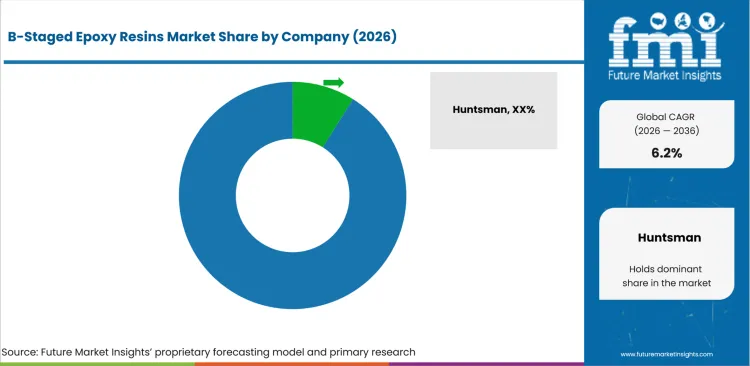
Competition separates epoxy resin formulators from aerospace prepreg producers and electronics-laminate specialists serving qualification-heavy manufacturing programs. Qualification records and controlled resin processing raise entry barriers for formulations entering customer-approved manufacturing recipes. Each resin competes on process fit instead of acting as interchangeable bulk material.
- Huntsman Corporation and Hexcel Corporation serve epoxy resin or prepreg qualification routes for aerospace and industrial composite programs.
- Syensqo, Toray Industries, Inc. and Teijin Limited concentrate on qualified aerospace prepreg and composite-material platforms.
- Ventec International Group Co., Ltd., Panasonic Industry Co., Ltd. and Nan Ya Plastics Corporation serve PCB laminate and prepreg routes tied to electronics manufacturing.
Competitive Benchmarking: B-Staged Epoxy Resins Market
| Company | B-stage Epoxy Route Breadth | Qualification and Process Support | Downstream Application Breadth | Geographic Reach |
|---|---|---|---|---|
| Huntsman Corporation | High | High | High | Global |
| Hexcel Corporation | High | High | High | Global |
| Syensqo | High | High | High | Global |
| Toray Industries, Inc. | High | High | High | Global |
| Teijin Limited | Medium | High | Medium | Asia, Europe and North America |
| Ventec International Group Co., Ltd. | Medium | Medium | Medium | Asia, Europe and North America |
| Panasonic Industry Co., Ltd. | Medium | High | High | Asia, Europe and North America |
| Nan Ya Plastics Corporation | High | Medium | High | Asia and North America |
Scoring basis: High route breadth requires at least three verified B-stage resin, prepreg or laminate routes. Medium covers two documented routes and Low covers one verified B-stage route. High qualification support requires formal customer or third-party approval plus documented process support. Medium requires one formal approval route and Low reflects verified market activity without equivalent public qualification depth. Application breadth assigns High to at least three end-use groups, Medium to two and Low to one.
Key Developments in the B-Staged Epoxy Resins Market
- In July 2026, Hexcel Corporation completed NCAMP qualification of its HexPly M91 carbon-fiber-reinforced epoxy prepreg system in unidirectional tape and plain-weave fabric forms.
- In November 2025, Syensqo and Bell industrialized composite part manufacture using the CYCOM EP2750 fast-cure aerospace prepreg with Syensqo’s DDF process.
- In September 2025, Panasonic Industry Co., Ltd. announced a five-year plan to double production capacity for MEGTRON multilayer circuit board materials.
Key Players in the B-Staged Epoxy Resins Market
Epoxy Resin Platform
- Huntsman Corporation
Aerospace Prepreg and Composite Platforms
- Hexcel Corporation
- Syensqo
- Toray Industries, Inc.
- Teijin Limited
Electronics Laminate and Prepreg Platforms
- Ventec International Group Co., Ltd.
- Panasonic Industry Co., Ltd.
- Nan Ya Plastics Corporation
B-Staged Epoxy Resins Market - Report Scope
| Coverage field | Report scope |
|---|---|
| Market breakdown | By resin type, form, application, end use, sales channel and region. |
| Quantitative Units | USD Million. |
| Market Definition | Partially advanced epoxy resin systems and epoxy-based prepreg or laminate intermediates that complete crosslinking during a later controlled cure step. |
| Regions Covered | North America, Latin America, Europe, East Asia, South Asia and Pacific, and Middle East and Africa. |
| Countries Covered | South Korea, Taiwan, Mexico, USA, Germany and 30+ countries included in the full report. |
| Key Companies Profiled | Huntsman Corporation, Hexcel Corporation, Syensqo, Toray Industries, Inc., Teijin Limited, Ventec International Group Co., Ltd., Panasonic Industry Co., Ltd., and Nan Ya Plastics Corporation. |
| Forecast Period | 2026 to 2036. |
| Approach | Primary and secondary research with market triangulation. |
B-Staged Epoxy Resins Market - Research Methodology
| Method | Approach |
|---|---|
| Primary Research | FMI analysts gathered input from manufacturers, service providers, technology developers, distributors, end users, procurement teams, and subject-matter experts. Interviews examined purchasing decisions, product or service evaluation, adoption barriers, approval requirements, pricing considerations, and expectations for technical or commercial support. Respondents were also asked what evidence is required before a trial, pilot, or initial order develops into regular purchasing. |
| Desk Research | Desk research covered government statistics, regulatory publications, trade data, industry associations, technical literature, standards, company filings, product information, and official corporate announcements. Sources were reviewed for relevance, publication date, geographic coverage, and consistency with the defined market scope. Claims relating to performance, applications, approvals, capacity, investment, and commercial activity were retained only when supported by credible public evidence. |
| Market Sizing and Forecasting | The market model combined the baseline value with historical performance, segment structure, pricing and volume indicators, adoption levels, company participation, and country-level demand conditions. Forecast assumptions considered economic activity, investment trends, regulatory developments, technology adoption, purchasing cycles, supply availability, and barriers to wider market use. Segment and regional estimates were reconciled before the final market total was calculated. |
| Data Validation | Estimates were checked against multiple independent indicators, including public data, company activity, trade patterns, industry developments, and findings from primary interviews. Validation also tested whether products, services, applications, and company revenues fell within the defined market boundaries. Adjacent categories, unsupported claims, overlapping revenues, and activities without direct market relevance were excluded to reduce double counting and maintain consistency across segments and countries. |
B-Staged Epoxy Resins Market by Segments
Resin Type
- Dicyandiamide-cured epoxies
- Phenolic-cured epoxies
- Anhydride-cured epoxies
- Latent-cure epoxy films
- Modified B-stage systems
Form
- Prepreg resin
- Adhesive film
- Powder
- Sheet / tape
- Liquid-to-B-stage
Application
- PCB laminates
- Composite prepregs
- Electrical insulation
- Structural bonding
- Aerospace interiors
End Use
- Electronics
- Aerospace
- Automotive
- Industrial composites
- Electrical equipment
Sales Channel
- Direct resin producers
- Prepreg manufacturers
- Electronic materials distributors
- Custom formulators
B-Staged Epoxy Resins Market by Region:
- North America
- United States
- Canada
- Latin America
- Brazil
- Mexico
- Chile
- Rest of Latin America
- Western Europe
- Germany
- United Kingdom
- Italy
- Spain
- France
- Nordics
- Benelux
- Rest of Western Europe
- Eastern Europe
- Russia
- Poland
- Hungary
- Balkan and Baltic States
- Rest of Eastern Europe
- East Asia
- China
- Japan
- South Korea
- South Asia and Pacific
- India
- ASEAN
- Australia and New Zealand
- Rest of South Asia and Pacific
- Middle East and Africa
- Kingdom of Saudi Arabia
- Other GCC Countries
- Türkiye
- South Africa
- Other African Union Countries
- Rest of Middle East and Africa
Research Sources and Bibliography
- Semiconductor Industry Association. (2026, February 6). Global Annual Semiconductor Sales Increase 25.6% to $791.7 Billion in 2025.
- Ministry of Economic Affairs, R.O.C. (2026, May 19).
- IPC. (2025, February 20). North American PCB Industry Sales Up 19.9 Percent in January.
- Ventec International Group Co., Ltd. (2025, March 12). Ventec International Group announce launch of VT-47LT IPC4101 / 126 Prepreg.
- IPC. (2025, March 31). North American PCB Industry Sales Up 11.3 Percent in February.
- Ministry of Economic Affairs, R.O.C. (2026, June 10).
- IPC. (2025, May 27). North American PCB Industry Shipments Down 6.8 Percent in April.
- Syensqo. (2025, October 21). CYCOM® EP2190 now included in NCAMP database, enabling faster aerospace qualifications.
- Hexcel Corporation. (2025, June 18). Hexcel Showcases Ramp-up Enablement Innovation with HexPly M51 at Paris Air Show 2025.
- Ministry of Trade, Industry and Resources, Republic of Korea. (2026, July 1). Korea’s June Exports Top $100 Billion for First Time, First-Half Exports Reach Record High.
- Ministry of Economic Affairs, R.O.C. (2026, April 10). MOEA Establishes Panel-Level Packaging Ecosystem to Position Industry for US$2 Billion Market Growth.
- Secretaría de Economía, Gobierno de México. (2025, September 23). Comunicado conjunto Educación - Economía - Ciencia y Tecnología.
- National Institute of Standards and Technology. (2025, January 17). USA Department of Commerce Announces CHIPS Incentives Awards with Corning, Edwards Vacuum, and Infinera.
- Federal Government of Germany. (2026, July 2). Weltgrößte Fabrik für Leistungshalbleiter in Dresden eröffnet.
- Huntsman Corporation. (2026, February 18). 2025 Annual Report on Form 10-K.
- Teijin Limited. (2025, June 25). Notice of Convocation of the 159th Ordinary General Meeting of Shareholders.
- Ventec International Group Co., Ltd. (2025, November 10). Consolidated Financial Statements for the Nine Months Ended September 30, 2025 and 2024.
- Ventec International Group Co., Ltd. (2026, April 28). Ventec Evaluates US Manufacturing Facility to Support North American Growth.
- Nan Ya Plastics Corporation. (2026, April 10). March 2026 Operating Results.
- Hexcel Corporation. (2026, July 21). Hexcel Announces NCAMP Qualification of HexPly M91 Composite Material System.
- Syensqo. (2025, November 4). Syensqo and Bell join forces to industrialize composite part manufacture.
- Panasonic Industry Co., Ltd. (2025, September 12). Panasonic Industry will Double the Production Capacity of MEGTRON Multi-layer Circuit Board Materials Over the Next Five Years.
- Syensqo. (2026, July 9). Syensqo breaks ground on manufacturing expansion at its site in Havre de Grace, MD, USA.
- Panasonic Industry Co., Ltd. (2026, March 4). Panasonic Industry Announces an Investment of 7.5 Billion yen for a New MEGTRON Circuit Board Materials Production Line to Address Growing AI Server Demand.
- Huntsman Corporation. (2025, September 17). Huntsman Launches New Range of Safer, More Sustainable ARALDITE Epoxy Adhesives.
- Hexcel Corporation. (2026, March 11). Hexcel and Dassault Aviation Celebrate Falcon 10X Roll-Out, Strengthening a Long-Term Partnership.
- Ventec International Group Co., Ltd. (2026, March 12). Ventec Thailand Facility Supporting “China + Taiwan Plus One” Supply Chains.
- Syensqo. (2025, September 4). Syensqo and Teijin Carbon achieve aerospace qualification for Advanced Resin System.
- Hexcel Corporation. (2026, March 5). JEC World 2026: Hexcel to Unveil Breakthrough Composite Solutions for Aerospace & Defense and Automotive Markets.
- Syensqo. (2026, April 14). Syensqo and Toray Group strengthen aerospace supply security through strategic partnership.
- Toray Industries, Inc. (2026, June 9). Carbon Fiber Composite Materials Business.
- Mitsubishi Chemical Group Corporation. (2026, July 23). Mitsubishi Chemical Corporation develops new series of Xlink Tech carbon fiber prepreg-Contributing to enhanced CFRP performance in applications ranging from sports and leisure to mobility and industry.
- Panasonic Industry Co., Ltd. (2025, April 21). MEGTRON7 Qualified for PCB at European Space Agency ESA.
- Nan Ya Plastics Corporation. (2026, July 30). About Nan Ya_Overview.
- Toray Composite Materials America, Inc. (2026, February 4). Toray Achieves NCAMP Qualification for Next-Gen 3960 Prepreg System, Enabling Aerospace and Defense Certification.
This Report Answers
- How large is the b-staged epoxy resins market in 2026 and what value is projected for 2036?
- Which operating conditions support repeat purchases of b-staged epoxy resin systems?
- Why do dicyandiamide-cured epoxies hold the largest resin-type share in 2026?
- Why does prepreg resin hold the largest form share in 2026?
- How do PCB laminate requirements shape B-stage resin qualification and purchasing?
- Which restraints slow material switching in aerospace and electronics applications?
- How do the five profiled country CAGRs differ through 2036?
- Which companies are active in b-staged epoxy resin, prepreg and laminate supply?
- What recent company actions are changing qualification capacity and downstream material availability?
Frequently Asked Questions
How big is the b-staged epoxy resins market in 2026?
The b-staged epoxy resins market is valued at USD 860.7 million in 2026 and is projected to reach USD 1,570.7 million by 2036. PCB laminates and composite prepregs generate repeat qualification demand as laminate and prepreg processors protect approved cure windows.
What is the CAGR of the b-staged epoxy resins market from 2026 to 2036?
The b-staged epoxy resins market is projected to grow at a CAGR of 6.2% between 2026 and 2036. Expansion depends on electronics throughput and composite programs that require controlled cure latency ahead of final consolidation.
Which resin type leads the b-staged epoxy resins market?
The dicyandiamide-cured epoxies segment is expected to hold 31.0% of the b-staged epoxy resins market in 2026, attributable to latent cure behavior in qualified laminate workflows. The chemistry fits established pressing recipes without forcing extensive process changes during laminate qualification.
Which form leads the b-staged epoxy resins market?
The prepreg resin segment is expected to hold 34.0% of the b-staged epoxy resins market in 2026, supported by its storable partially cured state. Aerospace and industrial users can lay up reinforcement ahead of a controlled final cure at the production site.
Which countries are projected to record the highest growth in the b-staged epoxy resins market?
South Korea is projected to grow at 7.0% CAGR, followed by Taiwan at 6.8% and Mexico at 6.0% through 2036. Growth is tied to semiconductor capacity, packaging investment and regional electronics manufacturing.
Which companies are active in the b-staged epoxy resins market?
Key companies in the b-staged epoxy resins market include Huntsman Corporation, Hexcel Corporation, Syensqo, Toray Industries, Inc., Teijin Limited, Ventec International Group Co., Ltd., Panasonic Industry Co., Ltd., and Nan Ya Plastics Corporation. The companies differ in formulation depth and qualification support by conversion route.
Preview the report firsthand - request a free sample
Get SampleGet the brochure for pricing and purchase details.
Get PDFTable of Content
- Key Takeaways
- Market Size and CAGR
- Top Growth Driver
- Fastest Growing Segment
- Leading Region
- Key Companies
- Emerging Opportunities
- Executive Summary
- Global Market Outlook
- Demand-side Trends
- Supply-side Trends
- Technology Roadmap Analysis
- Analysis and Recommendations
- Analyst Perspective (What is happening? Why now? What should investors know?)
- Key Questions Answered
- How large is the market?
- What is the CAGR?
- What are key trends?
- Which region dominates?
- Who are the leaders?
- Market Overview
- Market Coverage / Taxonomy
- Market Definition / Scope / Limitations
- Research Methodology
- Chapter Orientation
- Analytical Lens and Working Hypotheses
- Market Structure, Signals, and Trend Drivers
- Benchmarking and Cross-market Comparability
- Market Sizing, Forecasting, and Opportunity Mapping
- Research Design and Evidence Framework
- Desk Research Programme (Secondary Evidence)
- Expert Input and Fieldwork (Primary Evidence)
- Tooling, Models, and Reference Databases
- Data Engineering and Model Build
- Quality Assurance and Audit Trail
- Market Background
- Market Dynamics (Drivers, Restraints, Opportunity, Trends)
- Scenario Forecast (Optimistic, Likely, Conservative)
- Impact Analysis
- AI Impact
- Sustainability Impact
- Regulatory Impact
- Technology Impact
- Consumer / Buyer Analysis
- Purchase Drivers
- Adoption Barriers
- Buyer Journey
- Opportunity Map Analysis
- Product Life Cycle Analysis
- Supply Chain Analysis
- Investment Feasibility Matrix
- Value Chain Analysis
- PESTLE and Porter's Analysis
- Regulatory Landscape
- Regional Parent Market Outlook
- Production and Consumption Statistics
- Import and Export Statistics
- Global Market Analysis and Forecast, 2021 to 2036
- Historical Market Size Value (USD Million) Analysis, 2021 to 2025
- Current and Future Market Size Value (USD Million) Projections, 2026 to 2036
- Y-o-Y Growth Trend Analysis
- Absolute $ Opportunity Analysis
- Global Market Pricing Analysis, 2021 to 2036
- Global Market Analysis and Forecast, By Resin Type, 2021 to 2036
- Introduction / Key Findings
- Historical Market Size Value (USD Million) Analysis By Resin Type, 2021 to 2025
- Current and Future Market Size Value (USD Million) Analysis and Forecast By Resin Type, 2026 to 2036
- Dicyandiamide-cured epoxies
- Phenolic-cured epoxies
- Anhydride-cured epoxies
- Latent-cure epoxy films
- Modified B-stage systems
- Dicyandiamide-cured epoxies
- Y-o-Y Growth Trend Analysis By Resin Type, 2021 to 2025
- Absolute $ Opportunity Analysis By Resin Type, 2026 to 2036
- Global Market Analysis and Forecast, By Form, 2021 to 2036
- Introduction / Key Findings
- Historical Market Size Value (USD Million) Analysis By Form, 2021 to 2025
- Current and Future Market Size Value (USD Million) Analysis and Forecast By Form, 2026 to 2036
- Prepreg resin
- Adhesive film
- Powder
- Sheet / tape
- Liquid-to-B-stage
- Prepreg resin
- Y-o-Y Growth Trend Analysis By Form, 2021 to 2025
- Absolute $ Opportunity Analysis By Form, 2026 to 2036
- Global Market Analysis and Forecast, By Application, 2021 to 2036
- Introduction / Key Findings
- Historical Market Size Value (USD Million) Analysis By Application, 2021 to 2025
- Current and Future Market Size Value (USD Million) Analysis and Forecast By Application, 2026 to 2036
- PCB laminates
- Composite prepregs
- Electrical insulation
- Structural bonding
- Aerospace interiors
- PCB laminates
- Y-o-Y Growth Trend Analysis By Application, 2021 to 2025
- Absolute $ Opportunity Analysis By Application, 2026 to 2036
- Global Market Analysis and Forecast, By End Use, 2021 to 2036
- Introduction / Key Findings
- Historical Market Size Value (USD Million) Analysis By End Use, 2021 to 2025
- Current and Future Market Size Value (USD Million) Analysis and Forecast By End Use, 2026 to 2036
- Electronics
- Aerospace
- Automotive
- Industrial composites
- Electrical equipment
- Electronics
- Y-o-Y Growth Trend Analysis By End Use, 2021 to 2025
- Absolute $ Opportunity Analysis By End Use, 2026 to 2036
- Global Market Analysis and Forecast, By Sales Channel, 2021 to 2036
- Introduction / Key Findings
- Historical Market Size Value (USD Million) Analysis By Sales Channel, 2021 to 2025
- Current and Future Market Size Value (USD Million) Analysis and Forecast By Sales Channel, 2026 to 2036
- Direct resin producers
- Prepreg manufacturers
- Electronic materials distributors
- Custom formulators
- Direct resin producers
- Y-o-Y Growth Trend Analysis By Sales Channel, 2021 to 2025
- Absolute $ Opportunity Analysis By Sales Channel, 2026 to 2036
- Global Market Analysis and Forecast, By Region, 2021 to 2036
- Introduction
- Historical Market Size Value (USD Million) Analysis By Region, 2021 to 2025
- Current Market Size Value (USD Million) Analysis and Forecast By Region, 2026 to 2036
- North America
- Latin America
- Western Europe
- Eastern Europe
- East Asia
- South Asia and Pacific
- Middle East & Africa
- Market Attractiveness Analysis By Region
- North America Market Analysis and Forecast, By Country, 2021 to 2036
- Historical Market Size Value (USD Million) Trend Analysis By Market Taxonomy, 2021 to 2025
- Market Size Value (USD Million) Forecast By Market Taxonomy, 2026 to 2036
- By Country
- USA
- Canada
- By Resin Type
- By Form
- By Application
- By End Use
- By Sales Channel
- By Country
- Market Attractiveness Analysis
- By Country
- By Resin Type
- By Form
- By Application
- By End Use
- By Sales Channel
- Key Takeaways
- Latin America Market Analysis and Forecast, By Country
- Historical Market Size Value (USD Million) Trend Analysis By Market Taxonomy, 2021 to 2025
- Market Size Value (USD Million) Forecast By Market Taxonomy, 2026 to 2036
- By Country
- Brazil
- Mexico
- Chile
- Rest of Latin America
- By Resin Type
- By Form
- By Application
- By End Use
- By Sales Channel
- By Country
- Market Attractiveness Analysis
- By Country
- By Resin Type
- By Form
- By Application
- By End Use
- By Sales Channel
- Key Takeaways
- Western Europe Market Analysis and Forecast, By Country
- Historical Market Size Value (USD Million) Trend Analysis By Market Taxonomy, 2021 to 2025
- Market Size Value (USD Million) Forecast By Market Taxonomy, 2026 to 2036
- By Country
- Germany
- UK
- Italy
- Spain
- France
- Nordic
- BENELUX
- Rest of Western Europe
- By Resin Type
- By Form
- By Application
- By End Use
- By Sales Channel
- By Country
- Market Attractiveness Analysis
- By Country
- By Resin Type
- By Form
- By Application
- By End Use
- By Sales Channel
- Key Takeaways
- Eastern Europe Market Analysis and Forecast, By Country
- Historical Market Size Value (USD Million) Trend Analysis By Market Taxonomy, 2021 to 2025
- Market Size Value (USD Million) Forecast By Market Taxonomy, 2026 to 2036
- By Country
- Russia
- Poland
- Hungary
- Balkan & Baltic
- Rest of Eastern Europe
- By Resin Type
- By Form
- By Application
- By End Use
- By Sales Channel
- By Country
- Market Attractiveness Analysis
- By Country
- By Resin Type
- By Form
- By Application
- By End Use
- By Sales Channel
- Key Takeaways
- East Asia Market Analysis and Forecast, By Country
- Historical Market Size Value (USD Million) Trend Analysis By Market Taxonomy, 2021 to 2025
- Market Size Value (USD Million) Forecast By Market Taxonomy, 2026 to 2036
- By Country
- China
- Japan
- South Korea
- By Resin Type
- By Form
- By Application
- By End Use
- By Sales Channel
- By Country
- Market Attractiveness Analysis
- By Country
- By Resin Type
- By Form
- By Application
- By End Use
- By Sales Channel
- Key Takeaways
- South Asia and Pacific Market Analysis and Forecast, By Country
- Historical Market Size Value (USD Million) Trend Analysis By Market Taxonomy, 2021 to 2025
- Market Size Value (USD Million) Forecast By Market Taxonomy, 2026 to 2036
- By Country
- India
- ASEAN
- Australia & New Zealand
- Rest of South Asia and Pacific
- By Resin Type
- By Form
- By Application
- By End Use
- By Sales Channel
- By Country
- Market Attractiveness Analysis
- By Country
- By Resin Type
- By Form
- By Application
- By End Use
- By Sales Channel
- Key Takeaways
- Middle East & Africa Market Analysis and Forecast, By Country
- Historical Market Size Value (USD Million) Trend Analysis By Market Taxonomy, 2021 to 2025
- Market Size Value (USD Million) Forecast By Market Taxonomy, 2026 to 2036
- By Country
- Kingdom of Saudi Arabia
- Other GCC Countries
- Türkiye
- South Africa
- Other African Union
- Rest of Middle East & Africa
- By Resin Type
- By Form
- By Application
- By End Use
- By Sales Channel
- By Country
- Market Attractiveness Analysis
- By Country
- By Resin Type
- By Form
- By Application
- By End Use
- By Sales Channel
- Key Takeaways
- Key Countries Market Analysis
- USA
- Pricing Analysis
- Market Share Analysis, 2025
- By Resin Type
- By Form
- By Application
- By End Use
- By Sales Channel
- Canada
- Pricing Analysis
- Market Share Analysis, 2025
- By Resin Type
- By Form
- By Application
- By End Use
- By Sales Channel
- Mexico
- Pricing Analysis
- Market Share Analysis, 2025
- By Resin Type
- By Form
- By Application
- By End Use
- By Sales Channel
- Brazil
- Pricing Analysis
- Market Share Analysis, 2025
- By Resin Type
- By Form
- By Application
- By End Use
- By Sales Channel
- Chile
- Pricing Analysis
- Market Share Analysis, 2025
- By Resin Type
- By Form
- By Application
- By End Use
- By Sales Channel
- Germany
- Pricing Analysis
- Market Share Analysis, 2025
- By Resin Type
- By Form
- By Application
- By End Use
- By Sales Channel
- UK
- Pricing Analysis
- Market Share Analysis, 2025
- By Resin Type
- By Form
- By Application
- By End Use
- By Sales Channel
- Italy
- Pricing Analysis
- Market Share Analysis, 2025
- By Resin Type
- By Form
- By Application
- By End Use
- By Sales Channel
- Spain
- Pricing Analysis
- Market Share Analysis, 2025
- By Resin Type
- By Form
- By Application
- By End Use
- By Sales Channel
- France
- Pricing Analysis
- Market Share Analysis, 2025
- By Resin Type
- By Form
- By Application
- By End Use
- By Sales Channel
- India
- Pricing Analysis
- Market Share Analysis, 2025
- By Resin Type
- By Form
- By Application
- By End Use
- By Sales Channel
- ASEAN
- Pricing Analysis
- Market Share Analysis, 2025
- By Resin Type
- By Form
- By Application
- By End Use
- By Sales Channel
- Australia & New Zealand
- Pricing Analysis
- Market Share Analysis, 2025
- By Resin Type
- By Form
- By Application
- By End Use
- By Sales Channel
- China
- Pricing Analysis
- Market Share Analysis, 2025
- By Resin Type
- By Form
- By Application
- By End Use
- By Sales Channel
- Japan
- Pricing Analysis
- Market Share Analysis, 2025
- By Resin Type
- By Form
- By Application
- By End Use
- By Sales Channel
- South Korea
- Pricing Analysis
- Market Share Analysis, 2025
- By Resin Type
- By Form
- By Application
- By End Use
- By Sales Channel
- Russia
- Pricing Analysis
- Market Share Analysis, 2025
- By Resin Type
- By Form
- By Application
- By End Use
- By Sales Channel
- Poland
- Pricing Analysis
- Market Share Analysis, 2025
- By Resin Type
- By Form
- By Application
- By End Use
- By Sales Channel
- Hungary
- Pricing Analysis
- Market Share Analysis, 2025
- By Resin Type
- By Form
- By Application
- By End Use
- By Sales Channel
- Kingdom of Saudi Arabia
- Pricing Analysis
- Market Share Analysis, 2025
- By Resin Type
- By Form
- By Application
- By End Use
- By Sales Channel
- Türkiye
- Pricing Analysis
- Market Share Analysis, 2025
- By Resin Type
- By Form
- By Application
- By End Use
- By Sales Channel
- South Africa
- Pricing Analysis
- Market Share Analysis, 2025
- By Resin Type
- By Form
- By Application
- By End Use
- By Sales Channel
- USA
- Market Structure Analysis
- Competition Dashboard
- Competition Benchmarking
- Market Share Analysis of Top Players
- By Regional
- By Resin Type
- By Form
- By Application
- By End Use
- By Sales Channel
- Emerging Startups
- Innovation Benchmarking
- Competition Analysis
- Competition Deep Dive
- Huntsman
- Overview
- Product Portfolio
- Profitability by Market Segments
- Sales Footprint
- Strategy Overview
- Marketing Strategy
- Product Strategy
- Channel Strategy
- Solvay
- Hexcel
- Henkel
- 3M
- Hexion
- Olin
- Nagase ChemteX
- Panacol-Elosol
- Kukdo Chemical
- Huntsman
- Case Studies
- Success Stories
- Recent Developments
- Competition Deep Dive
- Assumptions & Acronyms Used


